anaheim-gazette 1937-10-28
Scanned page
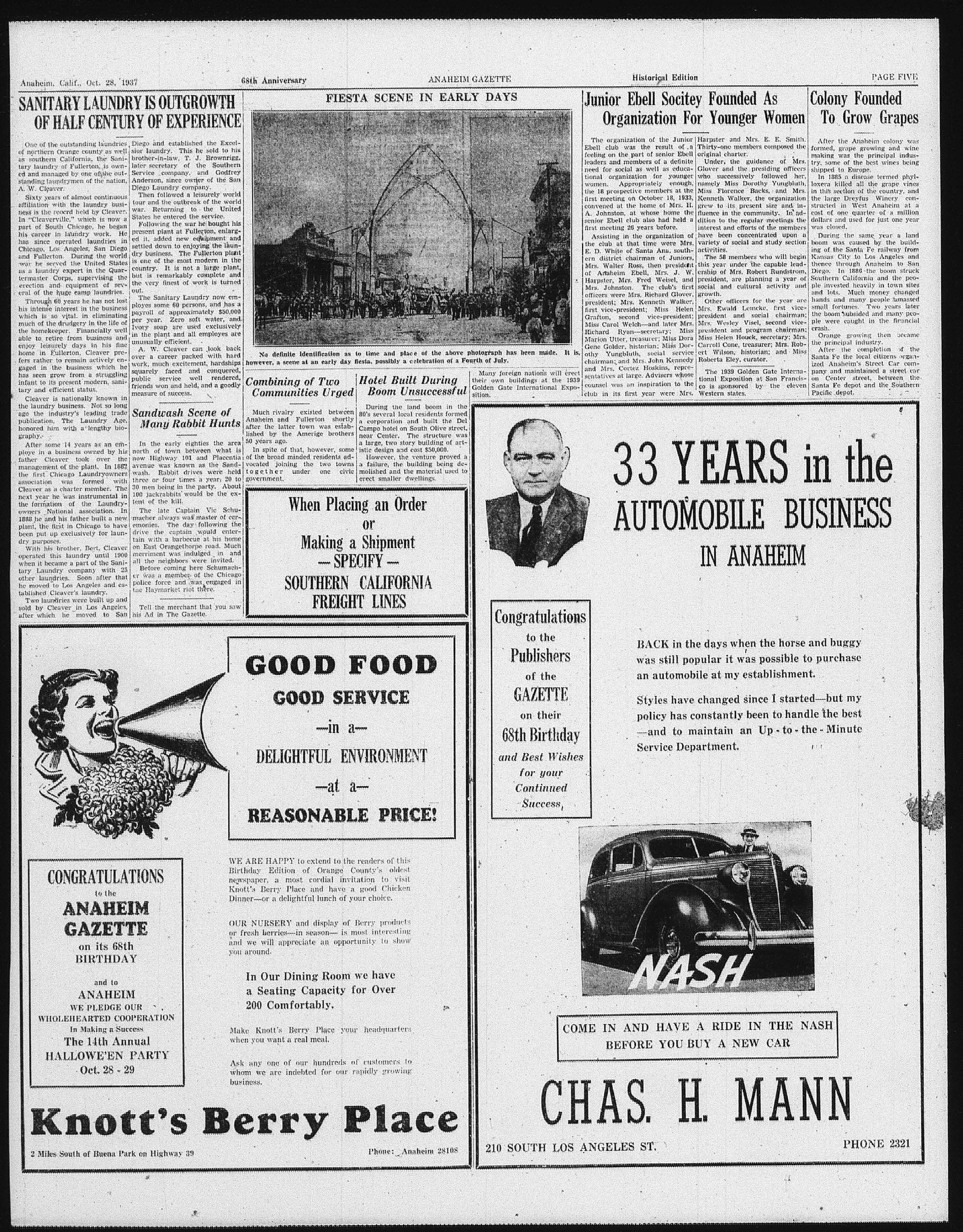
Searchable text
SANITARY LAUNDRY IS OUTGROWTH OF HALF CENTURY OF EXPERIENCE
One of the outstanding laundries of northern Orange county as well as southern California, the Sanitary laundry of Fullerton, is owned and managed by one of the outstanding laundrymen of the nation, A. W. Cleaver.
Sixty years of almost continuous affiliation with the laundry business is the record held by Cleaver. In "Cleaverville," which is now a part of South Chicago, he began his career in laundry work. He has since operated laundries in Chicago, Los Angeles, San Diego and Fullerton. During the world war he served the United States as a laundry expert in the Quartermaster Corps, supervising the erection and equipment of several of the huge camp laundries.
Through 60 years he has not lost his intense interest in the business which is so vital in eliminating much of the drudgery in the life of the homekeeper. Financially well able to retire from business and enjoy leisurely days in his fine home in Fullerton, Cleaver prefers rather to remain actively engaged in the business which he has seen grow from a struggling infant to its present modern, sanitary and efficient status.
Cleaver is nationally known in the laundry business. Not so long ago the industry's leading trade publication, The Laundry Age, honored him with a lengthy biography.
After some 14 years as an employee in a business owned by his father, Cleaver took over the Diego and established the Excellior laundry. This he sold to his brother-in-law, T. J. Brownrigg, later secretary of the Southern Service company, and Godfrey Anderson, since owner of the San Diego Laundry company.
Then followed a leisurely world tour and the outbreak of the world war. Returning to the United States he entered the service.
Following the war he bought his present plant at Fullerton, enlarged it, added new equipment and settled down to enjoying the laundry business. The Fullerton plant is one of the most modern in the country. It is not a large plant, but is remarkably complete and the very finest of work is turned out.
The Sanitary Laundry now employs some 60 persons, and has a payroll of approximately $50,000 per year. Zero soft water, and Ivory soap are used exclusively in the plant and all employees are unusually efficient.
A. W. Cleaver can look back over a career packed with hard work, much excitement, hardships squarely faced and conquered, public service well rendered, friends won and held, and a goodly measure of success.
Sandwash Scene of Many Rabbit Hunts
In the early eighties the area north of town between what is now Highway 101 and Placentia
Combining of Two Communities Urged
Much rivalry existed between Anaheim and Fullerton shortly after the latter town was established by the Amerige brothers 50 years ago.
In spite of that, however, some of the broad minded residents ad-
gaged in the business which he has seen grow from a struggling infant to its present modern, sanitary and efficient status.
Cleaver is nationally known in the laundry business. Not so long ago the industry's leading trade publication, The Laundry Age, honored him with a lengthy biography.
After some 14 years as an employee in a business owned by his father Cleaver took over the management of the plant. In 1882 the first Chicago Laundryowners association was formed with Cleaver as a charter member. The next year he was instrumental in the formation of the Laundryowners National association. In 1888 he and his father built a new plant, the first in Chicago to have been put up exclusively for laundry purposes.
With his brother, Bert, Cleaver operated this laundry until 1900 when it became a part of the Sanitary Laundry company with 25 other laundries. Soon after that he moved to Los Angeles and established Cleaver's laundry.
Two laundries were built up and sold by Cleaver in Los Angeles, after which he moved to San
Sandwash Scene of Many Rabbit Hunts
In the early eighties the area north of town between what is now Highway 101 and Placentia avenue was known as the Sandwash. Rabbit drives were held three or four times a year, 20 to 30 men being in the party. About 100 jackrabbits would be the extent of the kill.
The late Captain Vic Schumacher always was master of ceremonies. The day following the drive the captain would entertain with a barbecue at his home on East Orangethorpe road. Much merriment was indulged in and all the neighbors were invited.
Before coming here Schumacher was a member of the Chicago police force and was engaged in the Haymarket riot there.
Tell the merchant that you saw his Ad in The Gazette.
CONGRATULATIONS
to the
ANAHEIM
GAZETTE
on its 68th
BIRTHDAY
and to
ANAHEIM
WE PLEDGE OUR
WHOLEHEARTED COOPERATION
In Making a Success
The 14th Annual
HALLOWE'EN PARTY
Oct. 28 - 29
WE ARE HAPPY to extend to the new Birthday Edition of Orange County newspaper, a most cordial invitation to Knott's Berry Place and have a Dinner—or a delightful lunch of you around.
OUR NURSERY and display of Berries—in season—is more and we will appreciate an opportunity you around.
In Our Dining Room we have a Seating Capacity for 200 Comfortably.
Make Knott's Berry Place your when you want a real meal.
Ask any one of our hundreds of whom we are indebted for our rabusiness.
Knott's Berry Park
2 Miles South of Buena Park on Highway 39
FIESTA SCENE IN EARLY DAYS
The organization of the Junior Ebell Social Organization was the result of feeling on the part of senior Ebell leaders and members of a definite need for social as well as educational organization for young women. Appropriately enclosed the 18 prospective members at first meeting on October 18, 1930 convened at the home of Mrs. A. Johnston, at whose home senior Ebell club also had held first meeting 26 years before.
Assisting in the organization the club at that time were E. D. White of Santa Ana, southern district chairman of Junior Mrs. Walter Ross, then president of Artaheim Ebell, Mrs. J. Harpster, Mrs. Fred Weisel, Mrs. Johnston. The club's officers were Mrs. Richard Gloss president; Mrs. Kenneth Walt first vice-president; Miss H. Grafton, second vice-president; Miss Carol Welch—and later Richard Ryan—secretary; Mr. Marion Utter, treasurer; Miss B. Gene Golder, historian; Miss Mothy Yungbluth, social secretary; and Mrs. John Kenny and Mrs. Cortez Hoskins, representatives at large. Advisers who counsel was an inspiration to club in its first year were...
ing of Two
unities Urged
alry existed between
and Fullerton shortly
tter town was eslabthe Amerige brothers
of that, however, some
minded residents admining the two towns
under one civic
Hotel Built During
Boom Unsuccessful
During the land boom in the 80's several local residents formed a corporation and built the Del Campo hotel on South Olive street, near Center. The structure was a large, two story building of artistic design and cost $50,000.
However, the venture proved a failure, the building being demolished and the material used to erect smaller dwellings.
When Placing an Order or Making a Shipment — SPECIFY — SOUTHERN CALIFORNIA FREIGHT LINES
GOOD FOOD GOOD SERVICE —in a—
RIGHTFUL ENVIRONMENT —at a—
SONABLE PRICE!
Congratulations to the Publishers of the GAZETTE on their 68th Birthday and Best Wishes for your Continued Success,
BACK in was still an autom
Styles ha policy ha—and to Service D
—at a—
REASONABLE PRICE!
PY to extend to the readers of this
tion of Orange County's oldest
most cordial invitation to visit
Place and have a good Chicken
delightful lunch of your choice.
RY and display of Berry products
in season—is most interesting
appreciate an opportunity to show
Dining Room we have
ing Capacity for Over
comfortably.
Berry Place your headquarters
a real meal.
of our hundreds of customers to
indebted for our rapidly growing
Berry Place
Phone: Anaheim 28108
COME IN AND HAVE
BEFORE YOU
CHAS.
210 SOUTH LOS ANGELES ST.
Senior Ebell Socitey Founded As Organization For Younger Women
The organization of the Junior club was the result of a negotiation on the part of senior Ebell members and members of a definite for social as well as educa-organization for younger men. Appropriately enough, prospective members at the meeting on October 18, 1933, met at the home of Mrs. H. Johnston, at whose home the Ebell club also had held a meeting 26 years before.
Listing in the organization of club at that time were Mrs. White of Santa Ana, south-strict chairman of Juniors, Walter Ross, then president of Anaheim Ebell, Mrs. J. W. Utter, Mrs. Fred Weisel, and Johnston. The club's first members were Mrs. Richard Glover, Agent; Mrs. Kenneth Walker, vice-president; Miss Helen Nelson, second vice-president; Carol Welch—and later Mrs. David Ryan—secretary; Miss In Utter, treasurer; Miss Dora Golder, historian; Miss Dorothy Yungbluth, social service man; and Mrs. John Kennedy Mrs. Cortez Hoskins, repre-ives at large. Advisers whose el was an inspiration to the club in its first year were Mrs.
Harpster and Mrs. E. E. Smith. Thirty-one members composed the original charter.
Under, the guidance of Mrs. Glover and the presiding officers who successively followed her, namely Miss Dorothy Yungbluth, Miss Florence Backs, and Mrs. Kenneth Walker, the organization grew to its present size and influence in the community. In addition to the regular meetings the interest and efforts of the members have been concentrated upon a variety of social and study section activities.
The 58 members who will begin this year under the capable leadership of Mrs. Robert Rundstrom, president, are planning a year of social and cultural activity and growth.
Other officers for the year are Mrs. Ewald Lemcke, first vice-president and social chairman; Mrs. Wesley Visel, second vice-president and program chairman; Miss Helen Houck, secretary; Mrs. Carroll Cone, treasurer; Mrs. Robert Wilson, historian; and Miss Roberta Eley, curator.
The 1939 Golden Gate International Exposition at San Francisco is sponsored by the eleven Western states.
Colony Founded To Grow Grapes
After the Anaheim colony was formed, grape growing and wine making was the principal industry, some of the best wines being shipped to Europe.
In 1885 a disease termed phylloxera killed all the grape vines in this section of the country, and the large Dreyfus Winery constructed in West Anaheim at a cost of one quarter of a million dollars and used for just one year was closed.
During the same year a land boom was caused by the building of the Santa Fe railway from Kansas City to Los Angeles and thence through Anaheim to San Diego. In 1886—the boom struck Southern California and the people invested heavily in town sites and lots. Much money changed hands and many people amassed small fortunes. Two years later the boom subsided and many people were caught in the financial crash.
Orange growing then became the principal industry.
After the completion of the Santa Fe the local citizens organized Anaheim's Street Car company and maintained a street car on Center street, between the Santa Fe depot and the Southern Pacific depot.
33 YEARS in the
AUTOMOBILE BUSINESS
IN ANAHEIM
BACK in the days when the horse and buggy was still popular it was possible to purchase an automobile at my establishment.
Styles have changed since I started—but my policy has constantly been to handle the best—and to maintain an Up-to-the-Minute Service Department.
NASH
IN AND HAVE A RIDE IN THE NASH
BEFORE YOU BUY A NEW CAR
AS. H. MANN
GELES ST.
PHONE 2321