anaheim-gazette 1911-12-21
Scanned page
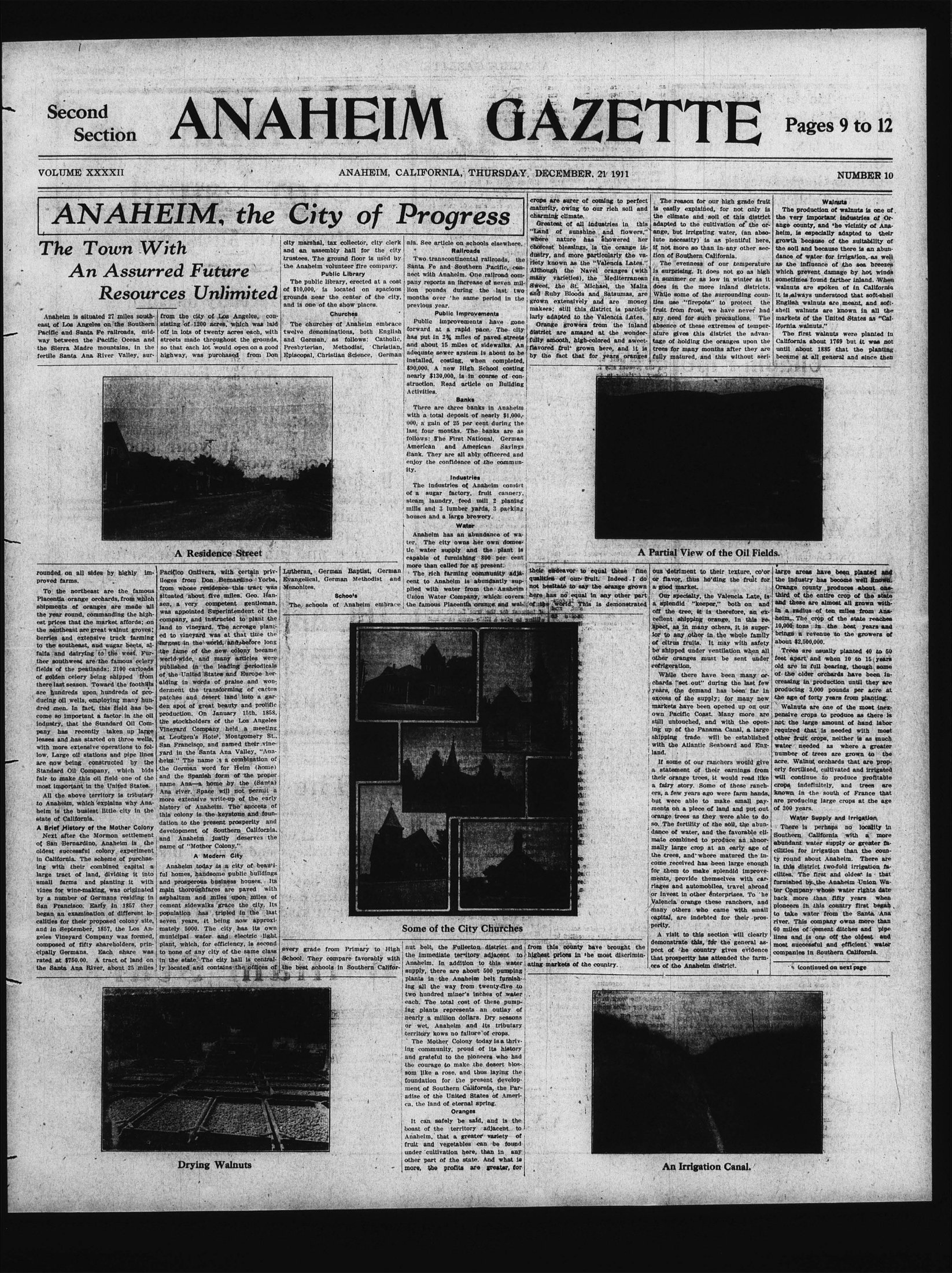
Searchable text
Second Section
VOLUME XXXXII
ANAHEIM, the City
The Town With
An Assurred Future
Resources Unlimited
Anaheim is situated 27 miles southeast of Los Angeles on the Southern Pacific and Santa Fe railroads, midway between the Pacific Ocean and the Sierra Madre mountains, in the fertile Santa Ana River Valley, sur-
from the city of Los Angeles, consisting of 1200 acres, which was laid off in lots of twenty acres each, with streets made throughout the grounds, so that each lot would open on a good highway, was purchased from Don
city marshal, tax collector and an assembly hall trustees. The ground floor the Anaheim volunteer Public Library
The public library, enof $10,000, is located
grounds near the centand is one of the showChurches
The churches of Anatwelve denominations,
and German, as folloPresbyterian, MethodiEpiscopal, Christian Sc
A Residence Street
rounded on all sides by highly improved farms.
To the northeast are the famous Placentia orange orchards, from which shipments of oranges are made all the year round, commanding the highest prices that the market affords; on the southeast are great walnut groves; berries and extensive truck farming to the southeast, and sugar beets, alfalfa and dairying to the west. Further southwest are the famous celery fields of the peatlands; 2100 carloads of golden celery being shipped from there last season. Toward the foothills are hundreds upon hundreds of producing oil wells, employing many hundred men. In fact, this field has become so important a factor in the oil industry, that the Standard Oil Company has recently taken up large leases and has started on three wells, with more extensive operations to follow. Large oil stations and pipe lines are now being constructed by the Standard Oil Company, which bids fair to make this oil field one of the most important in the United States.
All the above territory is tributary to Anaheim, which explains why Anaheim is the busiest little city in the state of California.
A Brief History of the Mother Colony
Next after the Mormon settlement of San Bernardino, Anaheim is the oldest successful colony experiment in California. The scheme of purchasing with their combined capital a large tract of land, dividing it into small farms and planting it with vines for wine-making, was originated by a number of Germans residing in Pacifico Ontivera, with certain privileges from Don Bernardino Yorba, from whose residence this tract was situated about five miles. Geo. Hansen, a very competent gentleman, was appointed Superintendent of the company, and instructed to plant the land to vineyard. The acreage planted to vineyard was at that time the largest in the world, and before long the fame of the new colony became world-wide, and many articles were published in the leading periodicals of the United States and Europe heralding in words of praise and wonderment the transforming of cactus patches and desert land into a garden spot of great beauty and prolific production. On January 15th, 1858, the stockholders of the Los Angeles Vineyard Company held a meeting at Leutgen's Hotel, Montgomery St., San Francisco, and named their vineyard in the Santa Ana Valley, "Anaheim." The name is a combination of the German word for Heim (home) and the Spanish form of the proper name Ana—a home by the (Santa) Ana river. Space will not permit a more extensive write-up of the early history of Anaheim. The success of this colony is the keystone and foundation to the present prosperity and development of Southern California, and Anaheim justly deserves the name of "Mother Colony."
A Modern City
Anaheim today is a city of beautiful homes, handsome public buildings and prosperous business houses. Its main thoroughfares are paved with asphaltum and miles upon miles of
to Anaheim, which explains why Anaheim is the busiest little city in the state of California.
A Brief History of the Mother Colony
Next after the Mormon settlement of San Bernardino, Anaheim is the oldest successful colony experiment in California. The scheme of purchasing with their combined capital a large tract of land, dividing it into small farms and planting it with vines for wine-making, was originated by a number of Germans residing in San Francisco. Early in 1857 they began an examination of different localities for their proposed colony site, and in September, 1857, the Los Angeles Vineyard Company was formed, composed of fifty shareholders, principally Germans. Each share was rated at $750.00. A tract of land on the Santa Ana River, about 25 miles more extensive write-up of the early history of Anaheim. The success of this colony is the keystone and foundation to the present prosperity and development of Southern California, and Anaheim justly deserves the name of "Mother Colony."
A Modern City
Anaheim today is a city of beautiful homes, handsome public buildings and prosperous business houses. Its main thoroughfares are paved with asphaltum and miles upon miles of cement sidewalks grace the city. Its population has tripled in the last seven years, it being now approximately 5000. The city has its own municipal water and electric light plant, which, for efficiency, is second to none of any city of the same class in the state. The city hall is centrally located and contains the offices of every grade from Primary School. They compare the best schools in South
City of Progress
city marshal, tax collector, city clerk and an assembly hall for the city trustees. The ground floor is used by the Anaheim volunteer fire company.
Public Library
The public library, erected at a cost of $10,000, is located on spacious grounds near the center of the city, and is one of the show places.
Churches
The churches of Anaheim embrace twelve denominations, both English and German, as follows: Catholic, Presbyterian, Methodist, Christian, Episcopal, Christian Science, Germannia. See article on schools elsewhere.
Railroads
Two transcontinental railroads, the Santa Fe and Southern Pacific, connect with Anaheim. One railroad company reports an increase of seven million pounds during the last two months over the same period in the previous year.
Public Improvements
Public improvements have gone forward at a rapid pace. The city has put in 2½ miles of paved streets and about 15 miles of sidewalks. An adequate sewer system is about to be installed, costing, when completed, $90,000. A new High School costing nearly $130,000, is in course of construction. Read article on Building Activities.
Banks
There are three banks in Anaheim with a total deposit of nearly $1,000,-000, a gain of 25 per cent during the last four months. The banks are as follows: The First National, German American and American Sayings Bank. They are all ably officered and enjoy the confidence of the community.
crops are surer of coming to perfect maturity, owing to our rich soil and charming climate.
Greatest of all industries in this "Land of sunshine and flowers," where nature has showered her choicest blessings, is the orange industry, and more particularly the variety known as the "Valencia Lates." Although the Navel oranges (with many varieties), the Mediterranean Sweet, the St. Michael, the Malta and Ruby Bloods and Satsumas, are grown extensively and are money makers; still this district is particularly adapted to the Valencia Lates.
Orange growers from the inland district are amazed at the wonderfully smooth, high-colored and sweet-flavored fruit grown here, and it is by the fact that for years oranges
Lutheran, German Baptist, German Evangelical, German Methodist and Menonites.
School's
The schools of Anaheim embrace nearly $130,000 is in course of construction. Read article on Building Activities.
Banks
There are three banks in Anaheim with a total deposit of nearly $1,000,000, a gain of 25 per cent during the last four months. The banks are as follows: The First National, German American and American Savings Bank. They are all ably officered and enjoy the confidence of the community.
Industries
The industries of Anaheim consist of a sugar factory, fruit cannery, steam laundry, feed mill 2 planing mills and 3 lumber yards, 3 packing houses and a large brewery.
Water
Anaheim has an abundance of water. The city owns her own domestic water supply and the plant is capable of furnishing 800 per cent more than called for at present.
The rich farming community adjacent to Anaheim is abundantly supplied with water from the Anaheim Union Water Company, which covers the famous Placentia orange and wal-
their endeavor to equal these fine qualities of our fruit. Indeed I do not hesitate to say the orange grown here has no equal in any other part of the world. This is demonstrated
Some of the City Churches
every grade from Primary to High School. They compare favorably with the best schools in Southern California.
nut belt, the Fullerton district and the immediate territory adjacent to Anaheim. In addition to this water supply, there are about 500 pumping plants in the Anaheim belt furnishing all the way from twenty-five to two hundred miner's inches of water each. The total cost of these pumping plants represents an outlay of nearly a million dollars. Dry seasons or wet, Anaheim and its tributary territory kows no failure of crops.
The Mother Colony today is a thriving community, proud of its history and grateful to the pioneers who had the courage to make the desert blossom like a rose, and thus laying the foundation for the present development of Southern California, the Paradise of the United States of America, the land of eternal spring.
Oranges
It can safely be said, and is the boast of the territory adjacent to Anaheim, that a greater variety of fruit and vegetables can be found under cultivation here, than in any other part of the state. And what is more, the profits are greater, for
coming to perfect our rich soil and industries in this and flowers," she showered her the orange particularly the valencia Lates." All oranges (with Mediterranean hazel, the Malta and Satsumas, are and are money district is partici- Valencia Lates. From the inland at the wonder-ored and sweet here, and it is years oranges
The reason for our high grade fruit is easily explained, for not only is the climate and soil of this district adapted to the cultivation of the orange, but irrigating water, (an absolute necessity) is as plentiful here, if not more so than in any other section of Southern California.
The evenness of our temperature is surprising. It does not go as high in summer or as low in winter as it does in the more inland districts. While some of the surrounding counties use "firepots" to protect the fruit from frost, we have never had any need for such precautions. The absence of these extremes of tempera- ture gives this district the advantage of holding the oranges upon the trees for many months after they are fully matured, and this without seri-
Walnuts
The production of walnuts is one of the very important industries of Or- ange county, and the vicinity of Anaheim, is especially adapted to their growth because of the suitability of the soil and because there is an abun-dance of water for irrigation, as well as the influence of the sea breezes which prevent damage by hot winds sometimes found farther inland. When walnuts are spoken of in California it is always understood that soft-shell English walnuts are meant, and soft-shell walnuts are known in all the markets of the United States as "California walnuts."
The first walnuts were planted in California about 1769 but it was not until about 1885 that the planting became at all general and since then
A Partial View of the Oil Fields.
ous detriment to their texture, co'or or flavor, thus ho'ding the fruit for a good market.
Our specialty, the Valencia Late, is a splendid "keeper," both on and off the tree, it is therefore, an excellent shipping orange. In this respect, as in many others, it is superior to any other in the whole family of citrus fruits. It may with safety be shipped under ventilation when all other oranges must be sent under refrigeration.
While there have been many orchards "set out" during the last few years, the demand has been far in excess of the supply; for many new markets have been opened up on our own Pacific Coast. Many more are still untouched, and with the opening up of the Panama Canal, a large shipping trade will be established with the Atlantic Seaboard and England.
If some of our ranchers would give a statement of their earnings from their orange trees, it would read like a fairy story. Some of these ranchers, a few years ago were farm hands, but were able to make small payments on a piece of land and put out orange trees as they were able to do so. The fertility of the soil, the abundance of water, and the favorable climate combined to produce an abnormally large crop at an early age of the trees, and where matured the income received has been large enough for them to make splendid improvements, provide themselves with carriages and automobiles, travel abroad or invest in other enterprises. To he large areas have been planted and the industry has become well known. Orange county produces about one-third of the entire crop of the state and these are almost all grown within a radius of ten miles from Anaheim. The crop of the state reaches 10,000 tons in the best years and brings a revenue to the growers of about $2,500,000.
Trees are usually planted 40 to 50 feet apart and when 10 to 15 years old are in full bearing, though some of the older orchards have been increasing in production until they are producing 3,000 pounds per acre at the age of forty years from planting.
Walnuts are one of the most inexpensive crops to produce as there is not the large amount of hand labor required that is needed with most other fruit crops, neither is as much water needed as where a greater number of trees are grown to the acre. Walnut orchards that are properly fertilized, cultivated and irrigated will continue to produce profitable crops indefinitely, and trees are known in the south of France that are producing large crops at the age of 300 years.
Water Supply and Irrigation.
There is perhaps no locality in Southern California with a more abundant water supply or greater facilities for irrigation than the county round about Anaheim. There are in this district two-fold irrigation facilities. The first and oldest is that furnished by the Anaheim Union Water Company whose water rights date back more than fifty years when
but were able to make small payments on a piece of land and put out orange trees as they were able to do so. The fertility of the soil, the abundance of water, and the favorable climate combined to produce an abnormally large crop at an early age of the trees, and where matured the income received has been large enough for them to make splendid improvements, provide themselves with carriages and automobiles, travel abroad or invest in other enterprises. To the Valencia orange these ranchers, and many others who came with small capital, are indebted for their prosperity.
A visit to this section will clearly demonstrate this, for the general aspect of the country gives evidence that prosperity has attended the farmers of the Anaheim district.
Water Supply and Irrigation
There is perhaps no locality in Southern California with a more abundant water supply or greater facilities for irrigation than the county round about Anaheim. There are in this district two-fold irrigation facilities. The first and oldest is that furnished by the Anaheim Union Water Company whose water rights date back more than fifty years when pioneers in this country first began to take water from the Santa Ana river. This company owns more than 60 miles of cement ditches and pipe lines and is one off the oldest and most successful and efficient water companies in Southern California.
(continued on next page)
An Irrigation Canal.