anaheim-gazette 1911-08-10
Scanned page
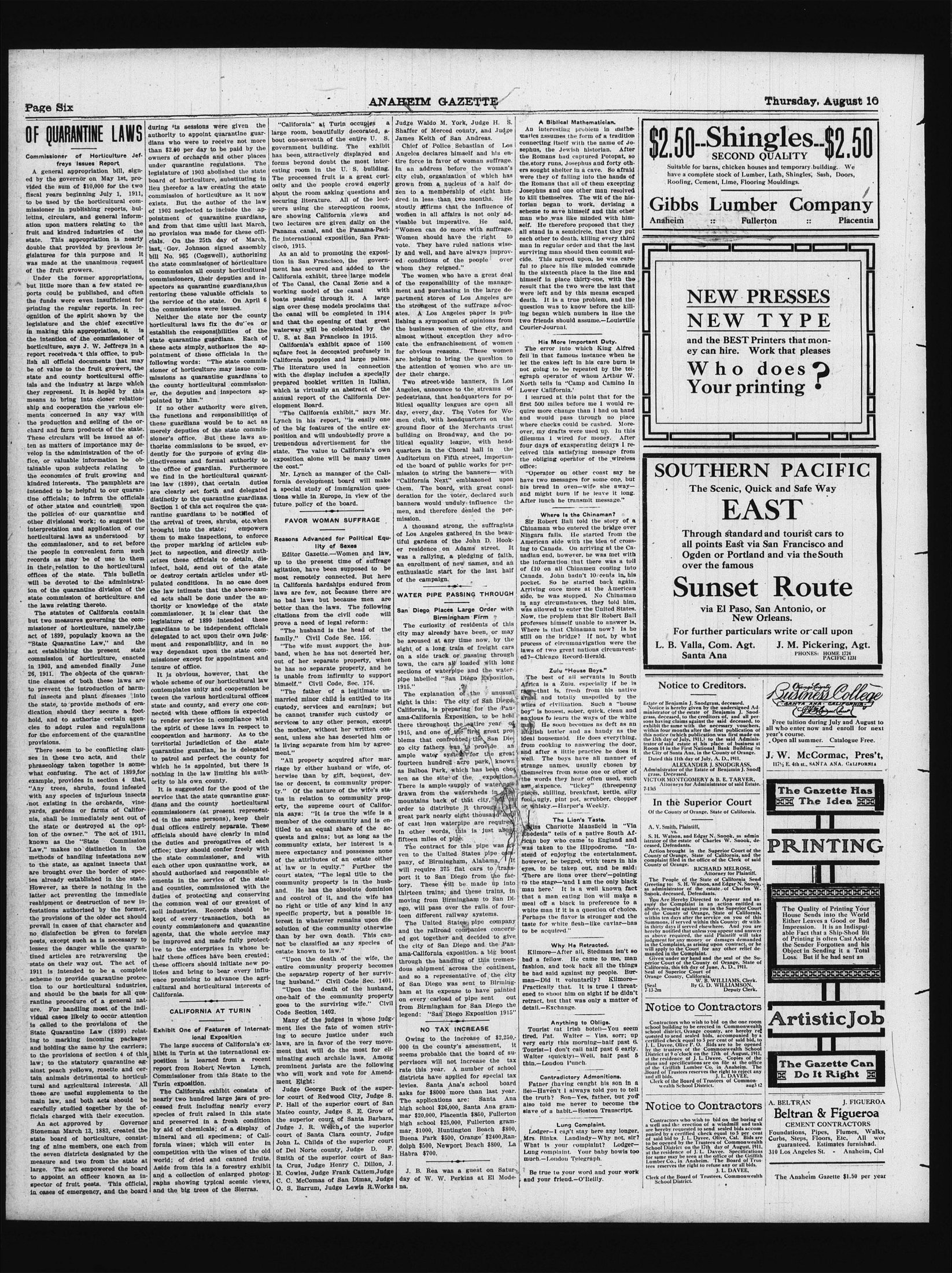
Searchable text
OF QUARANTINE LAWS
Commissioner of Horticulture Jeffreys Issues Report
A general appropriation bill, signed by the governor on May 1st, provided the sum of $10,000 for the two fiscal years beginning July 1, 1911, to be used by the horticultural commissioner in publishing reports, bulletins, circulars, and general information upon matters relating to the fruit and kindred industries of the state. This appropriation is nearly double that provided by previous legislatures for this purpose and it was made at the unanimous request of the fruit growers.
Under the former appropriations, but little more than a few stated reports could be published, and often the funds were even insufficient for printing the regular reports. In recognition of the spirit shown by the legislature and the chief executive in making this appropriation, it is the intention of the commissioner of horticulture, says J. W. Jeffreys in a report received at this office, to publish all official documents that may be of value to the fruit growers, the state and county horticultural officials and the industry at large which they represent. It is hoped by this means to bring into closer relationship and cooperation the various elements concerned in any way with the production and selling of the orchard and farm products of the state. These circulars will be issued as often as matters of importance may develop in the administration of the office, or valuable information be obtainable upon subjects relating to the economies of fruit growing and during its sessions were given the authority to appoint quarantine guardians who were to receive not more than $2.00 per day to be paid by the owners of orchards and other places under quarantine regulations. The legislature of 1903 abolished the state board of horticulture, substituting in lieu therefor a law creating the state commission of horticulture as it now exists. But the author of the law of 1903 neglected to include the appointment of quarantine guardians, and from that time until last March, no provision was made for these officials. On the 25th day of March, last, Gov. Johnson signed assembly bill No. 965 (Cogswell), authorizing the state commissioner of horticulture to commission all county horticultural commissioners, their deputies and inspectors as quarantine guardians, thus restoring these valuable officials to the service of the state. On April 6 the commissions were issued.
Neither the state nor the county horticultural laws fix the du'es or establish the responsibilities of the state quarantine guardians. Each of these acts simply authorizes the appointment of these officials in the following words: "The state commissioner of horticulture may issue commissions as quarantine guardians to the county horticultural commissioner, the deputies and inspectors appointed by him."
If no other authority were given, the functions and responsibilities of these guardians would be to act as merely deputies of the state commissioner's office. But these laws authorize commissions to be issued, evidently for the purpose of giving distinctiveness and formal authority to the office of guardian. Furthermore "California" at Turin oo large room, beautifully designed one-seventh of the en government building. There has been attractively display forms beyond doubt the nesting room in the U. S. The processed fruit is a curiosity and the people crowd about the room asking queuing literature. All oururers using the stereoptics are showing California via two lectures are given daily Panama canal, and the Pacific international exposition cisco, 1915.
As an aid to promoting station in San Francisco, the ment has secured and added California exhibit, three lays of The Canal, the Canal 2 working model of the canoe boats passing through it. Sign over these models provide canal will be complete and that the opening of waterway will be celebrated U. S. at San Francisco i.
California's exhibit space square feet is decorated p California poppies and la The literature used in with the display includes prepared booklet written which is virtually an abstra annual report of the Calif development Board.
"The California exhibit," Lynch in his report, "is of the big features of the position and will undoubtedly tremendous advertisement state. The value to California exposition alone will be much the cost." Mr. Lynch as manager
state and county horticultural officials and the industry at large which they represent. It is hoped by this means to bring into closer relationship and cooperation the various elements concerned in any way with the production and selling of the orchard and farm products of the state. These circulars will be issued as often as matters of importance may develop in the administration of the office, or valuable information be obtainable upon subjects relating to the economics of fruit growing and kindred interests. The pamphlets are intended to be helpful to our quarantine officials; to infrm the officials of other states and countries upon the policies of our quarantine and other divisional work; to suggest the interpretation and application of our horticultural laws as understood by the commissioner, and to set before the people in convenient form such records as may be of use to them in their relation to the horticultural offices of the state. This bulletin will be devoted to the administration of the quarantine division of the state commission of horticulture, and the laws relating thereto.
The statutes of California contain but two measures governing the commission of horticulture, namely, the act of 1899, popularly known as the "State Quarantine Law," and the act establishing the present state commission of horticulture, enacted in 1903, and amended finally June 26, 1911. The objects of the quarantine clauses of both these laws are to prevent the introduction of harmful insects and plant diseases into the state, to provide methods of eradication should they secure a foothold, and to authorize certain agencies to adopt rules and regulations for the enforcement of the quarantine provisions.
There seem to be conflicting clauses in these two acts, and their phraseology taken together is somewhat confusing. The act of 1899, for example, provides in section 4 that, "Any trees, shrubs, found infested with any species of injurious insects not existing in the orchards, vineyards, gardens or farms of California, shall be immediately sent out of the state or destroyed at the option of the owner." The act of 1911, known as the "State Commission Law," makes no distinction in the methods of handling infestations new to the state, as against insects that are brought over the border of species already established in the state. However, as there is nothing in the latter act preventing the immediate missions as quarantine guardians to the county horticultural commissioner, the deputies and inspectors appointed by him."
If no other authority were given, the functions and responsibilities of these guardians would be to act as merely deputies of the state commissioner's office. But these laws authorize commissions to be issued, evidently for the purpose of giving distinctiveness and formal authority to the office of guardian. Furthermore we find in the horticultural quarantine law (1899), that certain duties are clearly set forth and delegated distinctly to the quarantine guardians. Section 1 of this act requires the quarantine guardians to be notified of the arrival of trees, shrubs, etc. when brought into the state; empowers them to make inspections, to enforce the proper marking of articles subject to inspection, and directly authorizes these officials to detain, disinfect, hold, send out of the state or destroy certain articles under stipulated conditions. In no case does the law intimate that the above-named acts shall be done under the authority or knowledge of the state commissioner. It is clear that the legislature of 1899 intended these guardians to be independent officials delegated to act upon their own judgment and responsibility, and in no way dependant upon the state commissioner except for appointment and tenure of office.
It is obvious, however, that the whole scheme of our horticultural law contemplates unity and cooperation between the various horticultural offices state and county, and every one connected with these offices is expected to render service in compliance with the spirit of these laws in respect to cooperation and harmony. As to the territorial jurisdiction of the state quarantine guardian, he is delegated to patrol and perfect the county for which he is appointed, but there is nothing in the law limiting his authority to his own county.
It is suggested for the good of the service that the state quarantine guardians and the county horticultural commissioners (at present represented in the same persons), keep their dual offices entirely separate. These officials should have clearly in mind the duties and prerogatives of each office; they should confer freely with the state commissioner, and with each other upon quarantine work, as should authorized and responsible elements in the service of the state and counties, commissioned with the duties of protecting and conserving
"The California exhibit," Lynch in his report, "is one of the big features of this position and will undoubtedly tremendous advertisement state. The value to California exposition alone will be much cost."
Mr. Lynch as manager of fornia development board a special study of immigration while in Europe, in future policy of the board.
FAVOR WOMAN SUPPLEMENTS
Reasons Advanced for Popularity of Sexes
Editor Gazette—Women up to the present time agitation, have been supported most remotely connected in California hardships en laws are few, not because no bad laws but because better than the laws. The citations from the civil prove a need of legal reform.
"The husband is her family." Civil Code Sec.
"The wife must support band, when he has not done out of her separate property he has no separate property is unable from infirmity himself." Civil Code Sec.
"The father of a legally married minor child is end custody, services and ease he cannot transfer such services to any other person mother, without her sent, unless she has deserved is living separate from his ment."
"All property acquired rilage by either husband or otherwise than by gift, because or descent, is community." Of the nature of this tus in relation to community, the supreme court says: "It is true that member of the community titled to an equal share requests and gains; but as community exists, her im mere expectancy and posi tion of the attributes of an e at law or in equity." For court states, "The legal community property is in and. He has the absolute control of it, and th
not existing in the orchards, vineyards, gardens or farms of California, shall be immediately sent out of the state or destroyed at the option of the owner." The act of 1911, known as the "State Commission Law," makes no distinction in the methods of handling infestations new to the state, as against insects that are brought over the border of species already established in the state. However, as there is nothing in the latter act preventing the immediate reshipment or destruction of new infestations authorized by the former, the provisions of the older act should prevail in cases of that character and no disinfection be given to foreign pests, except such as is necessary to lessen the danger while the quarantined articles are retraversing the state on their way out. The act of 1911 is intended to be a complete scheme to provide quarantine protection to our horticultural industries, and should be the basis for all quarantine procedure of a general nature. For handling most of the individual cases likely to occur attention is called to the provisions of the State Quarantine Law (1899) relating to marking incoming packages and holding the same by the carriers; to the provisions of section 4 of this law; to the statutory quarantine against peach yellows, rosette and certain animals detrimental to horticultural and agricultural interests. All these are useful supplements to the main law, and both acts should be carefully studied together by the officials charged with their execution.
An act approved by Governor Stoneman March 13, 1883, created the state board of horticulture, consisting of nine members, one each from the seven districts designated by the measure and two from the state at large. The act empowered the board to appoint an officer known as inspector of fruit pests. This official, in cases of emergency, and the board dians and the county horticultural commissioners (at present represented in the same persons), keep their dual offices entirely separate. These officials should have clearly in mind the duties and prerogatives of each office; they should confer freely with the state commissioner, and with each other upon quarantine work, as should authorized and responsible elements in the service of the state and counties, commissioned with the duties of protecting and conserving the common weal of our greatest of soil industries. Records should be kept of every transaction, both as county commissioners and quarantine agents, that the whole service may be improved and made fully protective to the enterprises in whose behalf these offices have been created; these officers should initiate new policies and bring to bear every influence promising to advance the agricultural and horticultural interests of California.
CALIFORNIA AT TURIN
Exhibit One of Features of International Exposition
The large success of California's exhibit in Turin at the international exposition is learned from a recent report from Robert Newton Lynch, Commissioner from this State to the Turin exposition.
The California exhibit consists of nearly two hundred large jars of processed fruit including nearly every species of fruit raised in this state and preserved in a fresh condition by aid of chemicals; of a display of mineral and oil specimens; of California wines; which will enter in competition with the wines of the old world; of dried and canned fruits. Aside from this is a forestry exhibit and a collection of enlarged photographs showing typical scenic views, and the big trees of the Sierras.
F court states, "The legal community property is in and. He has the absolute control of it, and that no right or title of any specific property, but a interest in whatever remains solution of the community than by her own death. Not be classified as any estate known to law."
"Upon the death of the entire community proper, the separate ropety of ing husband." Civil Code
"Upon the death of the one-half of the community goes to the surviving w Code Section 1402.
Many of the judges in ment lies the fate of w ing to secure justice u laws, are in favor of th e ment that will do th e minating such archaic la prominent jurists are th e who will work and vote in ment Eight:
Judge George Buck o尔ior court of Redwood Cliff P. Hall of the superior o Mateo county, Judge S. he superior court of San Judge J. R. Welch, o尔 court of Santa Clara co John L. Childs of the su fice of Del Norte county, Jud Smith of the superior co ta Cruz, Judge Henry C E. Cowles, Judge Frank C C. C. McComas of San D O. S. Barrum, Judge Lev
"California" at Turin occupies a large room, beautifully decorated, about one-seventh of the entire U.S. government building. The exhibit has been attractively displayed and forms beyond doubt the most interesting room in the U.S. building. The processed fruit is a great curiosity and the people crowd eagerly about the room asking questions and securing literature. All of the lecturers using the stereopticon rooms, the showing California views and two lectures are given daily on the Panama canal, and the Panama-Pacific international exposition, San Francisco, 1915.
As an aid to promoting the exposition in San Francisco, the government has secured and added to the California exhibit, three large models of The Canal, the Canal Zone and a working model of the canal with seats passing through it. A large sign over these models proclaims that the canal will be completed in 1914 and that the opening of that great waterway will be celebrated by the U.S. at San Francisco in 1915.
California's exhibit space of 1500 square feet is decorated profusely in California popples and large palms. The literature used in connection with the display includes a specially prepared booklet written in Italian, which is virtually an abstract of the annual report of the California Development Board.
"The California exhibit," says Mr. Lynch in his report, "is easily one of the big features of the entire exposition and will undoubtedly prove a tremendous advertisement for the state. The value to California's own exposition alone will be many times the cost."
Mr. Lynch as manager of the Cali-
Judge Waldo M. York, Judge H. S. Shaffer of Merced county, and Judge James Keith of San Andreas.
Chief of Police Sebastian of Los Angeles declares himself and his entire force in favor of woman suffrage. In an address before the woman's city club, organization of which has grown from a nucleus of a half dozen to a membership of eight hundred in less than two months. He stoutly affirms that the influence of women in all affairs is not only advisable but imperative. He said, "Women can do more with suffrage. Women should have the right to vote. They have ruled nations wisely and well, and have always improved conditions of the people over whom they reigned."
The women who have a great deal of the responsibility of the management and purchasing in the large department stores of Los Angeles are the strongest of the suffrage advocates. A Los Angeles paper is publishing a symposium of opinions from the business women of the city, and almost without exception they advocate the enfranchisement of women for obvious reasons. These women are helping to bring the question to the attention of women who are under their charge.
Two street-wide banners, in Los Angeles, announce to the streams of pedestrians, that headquarters for political equality leagues are open all day, every day. The Votes for Women club, with headquarters on the ground floor of the Merchants trust building on Broadway, and the political equality league, with headquarters in the Choral hall in the Auditorium on Fifth street, importuned the board of public works for permission to string the banners—with
A Biblical Mathematician.
An interesting problem in mathematics assumes the form of a tradition connecting itself with the name of Josephus, the Jewish historian. After the Romans had captured Potopat, so story runs, Josephus and forty others sought shelter in a cave. So afraid were they of falling into the hands of the Romans that all of them excepting Josephus and one other man resolved to kill themselves. The wit of the historian began to work, devising a scheme to save himself and this other man who was like minded with himself. He therefore proposed that they all stand in a semicircle, that they put each other to death, killing every third man in regular order and that the last surviving man should then commit suicide. This agreed upon, he was careful to place his like minded comrade in the sixteenth place in the line and himself in place thirty-one, with the result that the two were the last that were left and by this means escaped death. It is a true problem, and the question was to know before the killing began which numbers in line the two friends should assume.—Louisville Courier-Journal.
His More Important Duty.
The error into which King Alfred fell in that famous instance when he let the cakes left in his care burn is not going to be repeated by the telegraph operator of whom Arthur W. North tells in "Camp and Camino In Lower California."
I learned at this point that for the first 500 miles before me I would require more change than I had on hand and would pass through no place where checks could be cashed. Moreover, my drafts were used up. In this dilemma I wired for money. After four days of exasperating delays I received this satisfying message from the obliging operator of the wireless office:
"Operator on other coast say he
FAVOR WOMAN SUFFRAGE
Seasons Advanced for Political Equality of Sexes
Editor Gazette—Women and law, up to the present time of suffrage legislation, have been supposed to be most remotely connected. But here in California hardships endured from laws are few, not because there are no bad laws but because men are better than the laws. The following stations from the civil code will prove a need of legal reform:
"The husband is the head of the family." Civil Code Sec. 156.
"The wife must support the husband, when he has not deserted her, out of her separate property, when he has no separate property, and he is unable from infirmity to support himself." Civil Code Sec. 176.
"The father of a legitimate unmarried minor child is entitled to its custody, services and earnings; but he cannot transfer such custody or services to any other person, except the mother, without her written consent, unless she has deserted him or living separate from him by agreement."
"All property acquired after marriage by either husband or wife, otherwise than by gift, bequest, devise or descent, is community property." Of the nature of the wife's status in relation to community property, the supreme court of California says: "It is true the wife is a member of the community and is entitled to an equal share of the requests and gains; but as long as the community exists, her interest is a mere expectancy and possesses none of the attributes of an estate either at law or in equity." Further the court states, "The legal title to the community property is in the husband. He has the absolute dominion and control of it, and the wife has Two street-wide banners, in Los Angeles, announce to the streams of pedestrians, that headquarters for political equality leagues are open all day, every day. The Votes for Women club, with headquarters on the ground floor of the Merchants trust building on Broadway, and the political equality league, with headquarters in the Choral hall in the Auditorium on Fifth street, importuned the board of public works for permission to string the banners—with "California Next" emblazoned upon them. The board, with great consideration for the voter, declared such banners would unduly influence the men, and therefore denied the permission.
A thousand strong, the suffragists of Los Angeles gathered in the beautiful gardens of the John D. Hooker residence on Adams street. It was a rallying, a pledging of faith, an enrollment of new names, and an enthusiastic start for the last half of the campaign.
WATER PIPE PASSING THROUGH
San Diego Places Large Order with Birmingham Firm
The curiosity of residents of this city may already have been, or may be aroused at any time now, by the sight of a long train of freight cars on a side track or passing through town, the cars ab loaded with long sections of waterpipe and the water pipe labelled "San Diego Exposition, 1915."
The explanation of the unusual sight is this: The city of San Diego California, is preparing for the Panama-California Exposition, to be held there throughout the entire year of 1915, and one of the first great problems that confronted the San Diego city fathers was to provide an ample water system for the great fourteen hundred acre park, known as Balboa Park, which has been chosen as the site of the exposition. There is ample supply of water drawn from the watersheds in mountains back of that city, in order to distribute it through. The great park nearly eight thousand feet of cast iron waterpipe are required. In other words, this is just about fifteen miles of pipe.
The contract for this pipe was given to the United States pipe company, of Birmingham, Alabama. It will require 375 flat cars to transport it to San Diego from the factory. These will be made up into thirteen trains, and these trains, in moving from Birmingham to San Diego under their charge.
Sir Robert Ball told the story of a Chinaman who entered the bridge over Niagara falls. He started from the American side with the idea of crossing to Canada. On arriving at the Canadian end, however, he was met with information that there was a toll of £10 on all Chinamen coming into Canada. John hadn't 10 cents in his pocket. So he started back again. Arriving once more at the American side, he was stopped. No Chinaman in any circumstances, they told him, was allowed to enter the United States. Now, the problem that Sir Robert Ball professes himself unable to answer is: Where is that Chinaman now? Is he still on the bridge? If not, by what process of circumnavigation were the laws of two great nations circumvented?—Chicago Record-Herald.
Zulu "House Boys."
The best of all servants in South Africa is a Zulu. especially if he is now—that is, fresh from his native krugel and totally unspoiled by the wiles of civilization. Such a "house boy" is honest, sober, quick, clean and anxious to learn the ways of the white man. He soon becomes as deft as an English butter and as handy as the ideal housemaid. He does everything from cooking to answering the door, and after a little practice he does it well. The boys have all manner of strange names, usually chosen by themselves from some one or other of the words they hear often used, such as sixpence. "tickey" (threepenny piece), shilling, breakfast, kettle, silly foot-ugly, pint pot, scrubber, chopper or whisky.—Harper's Weekly.
The Lion's Taste.
Miss Charlotte Mansfield in "Via Rhodesia" tells of a native South African boy who came to England and was taken to the Hippodrome. "Instead of enjoying the entertainment, however, he begged, with tears in his eyes, to be taken out, and he said: 'There are lions over there'—pointing to the stage—and I am the only black man here.' It is a well known fact that a man eating lion will make a eograph operator of whom Arthur W. North tells in "Camp and Camino In Lower California.'
I learned at this point that for the first 500 miles before me I would require more change than I had on hand and would pass through no place where checks could be cashed. Moreover, my drafts were used up. In this dilemma I wired for money. After four days of exasperating delays I received this satisfying message from the obliging operator of the wireless office:
"Operator on other coast say he have two messages for some one but his bread in oven—wife she away—and might burn if he leave it long. After lunch he transmit message."
Where Is the Chinaman?
Sir Robert Ball told the story of a Chinaman who entered the bridge over Niagara falls. He started from the American side with the idea of crossing to Canada. On arriving at the Canadian end, however, he was met with information that there was a toll of £10 on all Chinamen coming into Canada. John hadn't 10 cents in his pocket. So he started back again. Arriving once more at the American side, he was stopped. No Chinaman in any circumstances, they told him, was allowed to enter the United States. Now, the problem that Sir Robert Ball professes himself unable to answer is: Where is that Chinaman now? Is he still on the bridge? If not, by what process of circumnavigation were the laws of two great nations circumvented?—Chicago Record-Herald.
Zulu "House Boys."
The best of all servants in South Africa is a Zulu. especially if he is now—that is, fresh from his native krugel and totally unspoiled by the wiles of civilization. Such a "house boy" is honest, sober, quick, clean and anxious to learn the ways of the white man. He soon becomes as deft as an English butter and as handy as the ideal housemaid. He does everything from cooking to answering the door, and after a little practice he does it well. The boys have all manner of strange names, usually chosen by themselves from some one or other of the words they hear often used, such as sixpence. "tickey" (threepenny piece), shilling, breakfast, kettle, silly foot-ugly, pint pot, scrubber, chopper or whisky.—Harper's Weekly.
The Lion's Taste.
Miss Charlotte Mansfield in "Via Rhodesia" tells of a native South African boy who came to England and was taken to the Hippodrome. "Instead of enjoying the entertainment, however, he begged, with tears in his eyes, to be taken out, and he said: 'There are lions over there'—pointing to the stage—and I am the only black man here.' It is a well known fact that a man eating lion will make a eagraph operator of whom Arthur W. North tells in "Camp and Camino In Lower California.'
I learned at this point that for the first 500 miles before me I would require more change than I had on hand and would pass through no place where checks could be cashed. Moreover, my drafts were used up. In this dilemma I wired for money. After four days of exasperating delays I received this satisfying message from the obliging operator of the wireless office:
"Operator on other coast say he have two messages for some one but his bread in oven—wife she away—and might burn if he leave it long. After lunch he transmit message."
In relation to community property, the supreme court of California says: "It is true the wife is a member of the community and is entitled to an equal share of the accruals and gains; but as long as the community exists, her interest is a mere expectancy and possesses none of the attributes of an estate either at law or in equity." Further the Court states, "The legal title to the community property is in the husband. He has the absolute dominion and control of it, and the wife has no right or title of any kind in any specific property, but a possible interest in whatever remains upon dissolution of the community otherwise than by her own death. This cannot be classified as any species of state known to law."
"Upon the death of the wife, the entire community property becomes the separate ropety of her surviving husband." Civil Code Sec. 1401.
"Upon the death of the husband, one-half of the community property goes to the surviving wife." Civil Code Section 1402.
Many of the judges in whose judgment lies the fate of women striving to secure justice under such laws, are in favor of the very movement that will do the most for eliminating such archaic laws. Among prominent jurists are the following who will work and vote for Amendment Eight:
Judge George Buck of the superior court of Redwood City, Judge S. H. Hall of the superior court of San Mateo county, Judge S. E. Grow of the superior court of Santa Barbara, Judge J. R. Welch of the superior court of Santa Clara county, Judge John L. Childs of the superior court of Del Norte county, Judge D. F. Smith of the superior court of Santa Cruz, Judge Henry C. Dillon, J. C. Cowles, Judge Frank Cattem, Judge C. C. McComas of San Dimas, Judge D. S. Barrum, Judge Lewis R. Works
NO TAX INCREASE
Owing to the increase of $2,250,000 in the county's assessment, it seems probable that the board of supervisors will not increase the tax rate this year. A number of school districts have applied for special tax levies. Santa Ana's school board asks for $8000 more than last year. The applications are: Santa Ana high school $26,000, Santa Ana grammar $20,000, Placentia $850, Fullerton high school $25,000, Fullerton grammar $1000, Huntington Beach $800, Buena Park $500, Orange $2400,Randolph $500, Newport Beach $800, La Habra $700.
J. B. Rea was a guest on Saturday of W. W. Perkins at El Modena.
The Lion's Taste.
Miss Charlotte Mansfield in "Via Anodesia" tells of a native South African boy who came to England and was taken to the Hippodrome. "Instead of enjoying the entertainment, however he begged with tears in his eyes, to be taken out, and he said: 'There are lions over there'—pointing to the stage—and I am the only black man here.' It is a well known fact that a man eating lion will make a meal off a black in preference to a white man if it is a question of choice. Perhaps the flavor is stronger and the taste for white flesh—like caviar—has to be acquired."
Why He Retracted.
Kilmore—After all, Stedman isn't so bad a fellow. He came to me, man fashion, and took back all the things he had said against my people. Burman—Did it voluntarily? Kilmore—Practically that. It is true I threatened to shoot him on sight if he didn't retract, but that was only a matter of detail.
Anything to Oblige.
Tourist (at Irish hotel)—You seem tired. Pat. Walter — Yiss, sorr; up very early this morning—half past 6. Tourist—I don't call half past 6 early. Walter (quickly)—Well, half past 5 thin.—London Punch.
Contradictory Admonitions.
Fatner (having caught his son in a lie)—Haven't I always told you to tell the truth? Son—Yes, father, but you also told me never to become the slave of a habit.—Boston Transcript.
Lung Complaint.
Lodger—I can't stay here any longer, Mrs. Binks. Landlady—Why not, sir? What is your complaint? Lodger—Lung complaint. Your baby howls too much.—London Telegraph.
Be true to your word and your friend.—O'Reilly.
Thursday, August 10
$2.50--Shingles--$2.50
SECOND QUALITY
Suitable for barns, chicken houses and temporary building. We have a complete stock of Lumber, Lath, Shingles, Sash, Doors, Roofing, Cement, Lime, Flooring Mouldings.
Gibbs Lumber Company
Anaheim :: Fullerton :: Placentia
NEW PRESSES
NEW TYPE
and the BEST Printers that money can hire. Work that pleases
Who does Your printing?
SOUTHERN PACIFIC
SOUTHERN PACIFIC
The Scenic, Quick and Safe Way
EAST
Through standard and tourist cars to all points East via San Francisco and Ogden or Portland and via the South over the famous
Sunset Route
via El Paso, San Antonio, or New Orleans.
For further particulars write or call upon
L. B. Valla, Com. Agt.
J. M. Pickering, Agt.
Santa Ana
PHONES: HOME 1724
PACIFIC 1231
Notice to Creditors.
Estate of Benjamin J. Snodgrass, deceased.
Notice is hereby given by the undersigned Administrator of the estate of Benjamin J. Snodgrass, deceased, to the creditors of, and all persons having claims against the said deceased, to exhibit the same with the necessary vouchers, within four months after the first publication of this notice (which publication was first made on the 13th day of July, 1911) to the said Administrator of said estate at his place of business at Room 14 in the First National Bank Building in the City of Santa Ana, in the County of Orange.
Dated this 11th day of July, A. D., 1911.
ALEXANDER J. SNODGRASS,
Administrator of the Estate of Benjamin J. Snodgrass, Deceased.
VICTOR MONTGOMERY & B. E. TARVER,
Attorneys for Administrator of said Estate.
7-1345
In the Superior Court
Of the County of Orange, State of California.
A. V. Smith, Plaintiff,
vs.
S. H. Watson, and Edgar N. Snook, as administrator of the estate of Charles W. Snook, deceased, Defendants.
Action brought in the Superior Court of the County of Orange, State of California, and the complaint filed in the office of the Clerk of said County of Orange.
RICHARD MELROSE,
Attorney for Plaintiff.
The People of the State of California Send Greeting to: S. H. Watson, and Edgar N. Snook, as administrator of the estate of Charles W. Snook, deceased, Defendants.
Free tuition during July and August to all who enter now and enroll for next year’s course.
Open all summer. Catalogue Free.
J. W. McCormac, Pres’t,
117½ E. 4th st., SANTA ANA, CALIFORNIA
The Gazette Has The Idea
PRINTING
In the Superior Court
Of the County of Orange, State of California.
A. V. Smith, Plaintiff,
vs.
S. H. Watson, and Edgar N. Snook, as admin
istrator of the estate of Charles W. Snook, deceased, Defendants.
Action brought in the Superior Court of the
County of Orange, State of California, and the
complaint filed in the office of the Clerk of said
County of Orange.
RICHARD MELROSE,
Attorney for Plaintiff.
The People of the State of California Send
Greeting to: S. H. Watson, and Edgar N. Snook,
as administrator of the estate of Charles W.
Snook, deceased, Defendants.
You Are Hereby Directed to Appear and answer
the Complaint in an action entitled as above, brought against you in the Superior Court
of the County of Orange, State of California,
within ten days after the service on you of this
Summons, if served within this County; or within thirty days if served elsewhere. And you are
hereby notified that unless you appear and answer
as above required, the said Plaintiff will take
judgment for any money or damages demanded
in the Complaint, as arising upon contract, or he
will apply to the Court for any other relief demanded in the Complaint.
Given under my hand and the seal of the Superior Court of the County of Orange, State of
California, this 6th day of June, A. D., 1911.
Seal of Superior Court of
Orange County, California.
W. B. WILLIAMS, Clerk.
By G. D. WILLIAMSON,
7-13-2m
Deputy Clerk.
Notice to Contractors
Contractors who wish to bid on the one room
school building to be erected in Commonwealth
school district, Orange county, are hereby requested to send sealed bids accompanied by a
certified check equal to 5 per cent of said bid, to
J. L. Davee, Olive P. O. Bids are to be opened
by the trustees of the Commonwealth School
District at 9 o'clock on the 17th of August, 1911,
at the residence of J. L. Davee. Copies of the
plans and specifications are on file at the office
of the Griffith Lumber Co., in Anaheim. The
Board of Trustees reserves the right to reject any
and all bids.
J. L. DAVEE,
Clerk of the Board of Trustees of Commonwealth School District.
Notice to Contractors
Contractors who wish to bid on the boring of
a well and the erection of a windmill and tank
are hereby requested to send sealed bids accompanied by a certified check equal to 5 per cent
of said bid to J. L. Davee, Olive P. O. Bids are to be opened by the Trustees of Commonwealth
School District on the 17th day of August, 1911,
at the residence of J. L. Davee. Specifications
for same may be seen at the office of the Griffith
Lumber Co., in Anaheim. The Board of Trustees reserves the right to refuse any or all bids.
J. L. DAVEE,
Clerk of the Board of Trustees, Commonwealth
School District.
A. BELTRAN J. FIGUEROA
Beltran & Figueroa
CEMENT CONTRACTORS
Foundations, Pipes, Flumes, Walks,
Curbs, Steps, Floors, Etc. All wor
guaranteed. Estimates furnishad.
310 Los Angeles St. - Anaheim, Cal
The Anaheim Gazette $1.50 per year