anaheim-gazette 1911-08-10
Scanned page
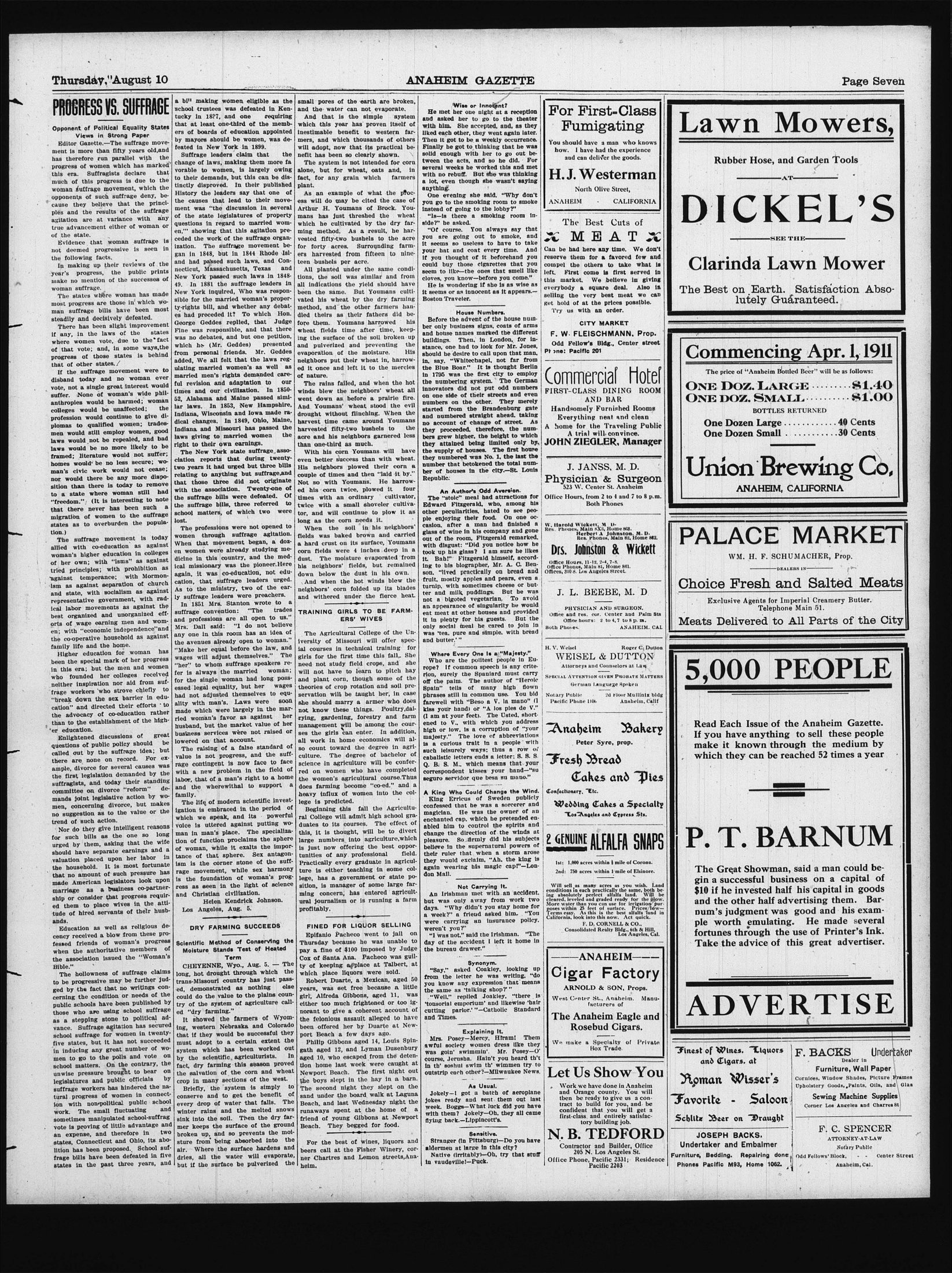
Searchable text
PROGRESS VS. SUFFRAGE
Opponent of Political Equality States Views in Strong Paper
Editor Gazette.—The suffrage movement is more than fifty years old, and has therefore run parallel with the progress of women which has marked this era. Suffragists declare that much of this progress is due to the woman suffrage movement, which the opponents of such suffrage deny, because they believe that the principles and the results of the suffrage agitation are at variance with any true advancement either of woman or of the state.
Evidence that woman suffrage is not deemed progressive is seen in the following facts.
In making up their reviews of the year's progress, the public prints make no mention of the successes of woman suffrage.
The states where woman has made most progress are those in which woman suffrage bills have been most steadily and decisively defeated.
There has been slight improvement if any, in the laws of the states where women vote, due to the fact of that vote; and, in some ways, the progress of those states is behind that of other states.
If the suffrage movement were to disband today and no woman ever vote, not a single great interest would suffer. None of woman's wide philanthropies would be harmed; woman colleges would be unaffected; the profession would continue to give diplomas to qualified women; tradesmen would still employ women, good laws would not be repealed, and bad laws would be no more likely to be framed; literature would not suffer; homes would be no less secure; woman's civic work would not cease;
a bi" making women eligible as the school trustees was defeated in Kentucky in 1827, and one requiring that at least one-third of the members of boards of education appointed by mayors should be women, was defeated in New York in 1899.
Suffrage leaders claim that the change of laws, making them more favorable to women, is largely owing to their demands, but this can be distinctly disproved. In their published History the leaders say that one of the causes that lead to their movement was "the discussion in several of the state legislatures of property questions in regard to married women," showing that this agitation preceded the work of the suffrage organization. The suffrage movement began in 1848, but in 1844 Rhode Island had passed such laws, and Connecticut, Massachusetts, Texas and New York passed such laws in 1848-49. In 1881 the suffrage leaders in New York inquired, Who was responsible for the married woman's property-rights bill, and whether any debates had preceded it? To which Hon. George Geddes replied, that Judge Fine was responsible, and that there was no debates, and but one petition, which he (Mr. Geddes) presented from personal friends. Mr. Geddes added, We all felt that the laws regulating married women's as well as married men's rights demanded careful revision and adaptation to our times and our civilization. In 1850-52, Alabama and Maine passed similar laws. In 1853, New Hampshire, Indiana, Wisconsin and Iowa made radical changes. In 1849, Ohio, Maine, Indiana and Missouri has passed the laws giving to married women the right to their own earnings.
The New York state suffrage association reports that during twenty-two years it had urged but three bills relating to anything but suffrage,and small pores of the water can.
And that is the which this year has instimable benefi mers, and which they will adopt, now the nefit has been so.
The system is no alone, but for what fact, for any grain plant.
As an example less will do may be Arthur H. Youman man's has just tha which he cultivated method. Asvested fifty-two b for forty acres. ers harvested from ten bushels per a All planted unditions, the soil was all indications tha been the same. I vated his wheat b method, and the c dled theirs as tha fore them. Youman wheat fields time ing the surface of and pulverized an evaporation of tha neighbors put their ed it once and lef f nature.
The rains failed, winds blew the new went down as bel And Youmans' wh drought without fl harvest time came harvested fifty-two acre and his neigh than one-third as s
With his corn Y even better success His neighbors plo couple of times an
The suffrage movement is today allied with co-education as against woman's higher education in colleges of her own; with "isms" as against tried principles; with prohibition as against temperance; with Mormonism as against separation of church and state, with socialism as against representative government, with radical labor movements as against the best organized and unorganized efforts of wage earning men and women; with "economic independence" and the co-operative household as against family life and the home.
Higher education for woman has been the special mark of her progress in this era; but the men and women who founded her colleges received neither inspiration nor aid from suffrage workers who strove chiefly to "break down the sex barrier in education" and directed their efforts to the advocacy of co-education rather than to the establishment of the higher education.
Enlightened discussions of great questions of public policy should be called out by the suffrage idea; but there are none on record. For example, divorce for several causes was the first legislation demanded by the suffragists, and today their standing committee on divorce "reform" demands joint legislative action by women, concerning divorce, but makes no suggestion as to the value or the trend of such action.
Nor do they give intelligent reasons for such bills as the one so long urged by them, asking that the wife should have separate earnings and a valuation placed upon her labor in the household. It is most fortunate that no amount of such pressure has made American legislators look upon marriage as a business co-partnership or consider that progress requires
married men's rights demanded careful revision and adaptation to our times and our civilization. In 1850-52, Alabama and Maine passed similar laws. In 1853, New Hampshire, Indiana, Wisconsin and Iowa made radical changes. In 1849, Ohio, Maine, Indiana and Missouri has passed the laws giving to married women the right to their own earnings.
The New York state suffrage association reports that during twenty-two years it had urged but three bills relating to anything but suffrage,and that those three did not originate with the association. Twenty-one of the suffrage bills were defeated. Of the suffrage bills, three referred to school matters,of which two were lost.
The professions were not opened to women through suffrage agitation. When that movement began,a dozen women were already studying medicine in this country,and the medical missionary was the pioneer.Here again,it was co-education,not education,that suffrage leaders urged.As to the ministry,two of the early suffrage leaders were preachers.
In 1851 Mrs. Stanton wrote to a suffrage convention: "The trades and professions are all open to us." Mrs. Dall said: "I do not believe any one in this room has an idea of the avenues already open to woman." "Make her equal before the law,and wages will adjust themselves." The "her" to whom suffrage speakers refer is always the married woman;for the single woman had long possessed legal equality,but her wages had not adjusted themselves to equality with man's.Laws were soon made which were largely in the married woman's favor as against her husband,but the market value of her business services were not raised or lowered on that account.
The raising of a false standard of value is not progress,and the suffrage contingent is now face to face with a new problem in the field of labor,that of a man's right to a home and the wherewithal to support a family.
The life of modern scientific investigation is embraced in the period of which we speak,and its powerful voice is uttered against putting woman in man's place.The specialization of function proclaims the sphere of woman,while it exalts the importance of that sphere.Sex antagonism is the corner stone of the suffrage movement,while sex harmony is the foundation of woman's progress as seen in the light of science and Christian civilization.
The rains failed,the winds blew the new went down as below And Youmans' whore drought without flare harvest time came harvested fifty-two acre and his neighbor than one-third as aWith his corn Y even better success His neighbors plot couple of times and Not so with Your ed his corn twice times with an order twice with a small tor,and will continue long as the corn When the soil fields was baked a hard crust on its corn fields were dust.The moisture his neighbors' fields down below the And when the local neighbors' corn fields and withered under
TRAINING GIRLS' ERS'
The Agricultural University of Missouri special courses in tech girls for the first need not study field will not have to plant corn,the theories of crop rotation servation will be she should marry not know these tying,gardening,management will ses the girls can all work in home so count toward culture.The degree science in agriculture red on women wthe women's agric does farming become heavy influx of wlege is predicted.
Beginning this rural College will add duates to its course this,它是 thought large numbers int is just now offering tunities of any p Practically every nature is either teac lege,has a gover sition,is manager ming concern,h
Nor do they give intelligent reasons for such bills as the one so long urged by them, asking that the wife should have separate earnings and a valuation placed upon her labor in the household. It is most fortunate that no amount of such pressure has made American legislators look upon marriage as a business co-partnership or consider that progress required them to place wives in the attitude of hired servants of their husbands.
Education as well as religious decency received a blow from these professed friends of woman's progress when the authoritative members of the association issued the "Woman's Bible."
The hollowness of suffrage claims to be progressive may be further judged by the fact that no writings concerning the condition or needs of the public schools have been published by those who are using school suffrage as a stepping stone to political advance. Suffrage agitation has secured school suffrage for women in twenty-five states, but it has not succeeded in inducing any great number of women to go to the polls and vote on school matters. On the contrary, the unwise pressure brought to bear on legislatures and public officials by suffrage workers has hindered the natural progress of women in connection with non-political public school work. The small fluctuating and sometimes manipulated school-suffrag vote is proving of little advantage and an expense, and therefore in two states, Connecticut and Ohio, its abolition has been proposed. School suffrage bills have been defeated in five states in the past three years, and
The life of modern scientific investigation is embraced in the period of which we speak, and its powerful voice is uttered against putting woman in man's place. The specialization of function proclaims the sphere of woman, while it exalts the importance of that sphere. Sex antagonism is the corner stone of the suffrage movement, while sex harmony is the foundation of woman's progress as seen in the light of science and Christian civilization.
Helen Kendrick Johnson.
Los Angeles, Aug. 5.
DRY FARMING SUCCEEDS
Scientific Method of Conserving the Moisture Stands Test of Heated Term
CHEYENNE, Wyo., Aug. 5. — The long, hot drought through which the trans-Missouri country has just passed, demonstrated as nothing else could do the value to the plains country of the system of agriculture called "dry farming."
It showed the farmers of Wyoming, western Nebraska and Colorado that if they would be successful they must adopt to a certain extent the system which has been worked out by the scientific agriculturists. In fact, dry farming this season proved the salvation of the corn and wheat crop in many sections of the west.
Briefly, the system is simply to conserve and to get the benefit of every drop of water that falls. The winter rains and the melted snows sink into the soil. Then the dry farmer keeps the surface of the ground broken up, and so prevents the moisture from being absorbed into the air. Where the surface hardens and dries, all the water will evaporate, but if the surface be pulverized the
ANAHEIM GAZETTE
small pores of the earth are broken, and the water can not evaporate.
And that is the simple system which this year has proven itself of inestimable benefit to western farmers, and which thousands of others will adopt, now that its practical benefit has been so clearly shown.
The system is not intended for corn alone, but for wheat, oats and, in fact, for any grain which farmers plant.
As an example of what the process will do may be cited the case of Arthur H. Youmans of Brock. Youmans has just threshed the wheat which he cultivated by the dry farming method. As a result, he harvested fifty-two bushels to the acre for forty acres. Surrounding farmers harvested from fifteen to nineteen bushels per acre.
All planted under the same conditions, the soil was similar and from all indications the yield should have been the same. But Youmans cultivated his wheat by the dry farming method, and the other farmers handled theirs as their fathers did before them. Youmans harrowed his wheat fields time after time, keeping the surface of the soil broken up and pulverized and preventing the evaporation of the moisture. His neighbors put their wheat in, harrowed it once and left it to the mercies of nature.
The rains failed, and when the hot winds blew the neighbors' wheat all went down as before a prairie fire. And Youmans' wheat stood the evil drought without flinching. When the harvest time came around Youmans harvested fifty-two bushels to the acre and his neighbors garnered less than one-third as much.
With his corn Youmans will have even better success than with wheat. His neighbors plowed their corn a couple of times and then "laid it by."
Wise or Innocent?
He met her one night at a reception and asked her to go to the theater with him. She accepted, and, as they liked each other, they went again later. Then it got to be a weekly occurrence. Finally he got to thinking that he was solid enough with her to go out between the acts, and so he did. For several weeks he worked this and met with no rebuff. But she was thinking a lot, even though she wasn't saying anything.
One evening she said, "Why don't you go to the smoking room to smoke instead of going to the lobby?"
"Is—is there a smoking room inside?" he asked.
"Of course. You always say that you are going out to smoke, and it seems so useless to have to take your hat and coat every time. And if you thought of it beforehand you could buy those cigarettes that you seem to like—the ones that smell like cloves, you know—before you come."
He is wondering if she is as wise as it seems or as innocent as it appears.—Boston Traveler.
House Numbers.
Before the advent of the house number only business signs, coats of arms and house names marked the different buildings. Then, in London, for instance, one had to look for Mr. Jones, should he desire to call upon that man, in say, "Whitechapel, not far from the Blue Boar." It is thought Berlin in 1795 was the first city to employ the numbering system. The German innovators did not put odd numbers on one side of their streets and even numbers on the other. They merely started from the Brandenburg gate and numbered straight ahead, taking no account of change of street. As they proceeded, therefore, the numbers grew higher, the height to which they attained being limited only by the supply of houses. The first house they numbered was No. 1, the last the number that betokened the total number of houses in the city.—St. Louis
For First-Class Fumigating
You should have a man who knows how. I have had the experience and can deliver the goods.
H.J. Westerman
North Olive Street,
ANAHEIM CALIFORNIA
The Best Cuts of MEAT
Can be had here any time. We don't reserve them for a favored few and compel the others to take what is left. First come is first served in this market. We believe in giving everybody a square deal. Also in selling the very best meat we can get hold of at the prices possible.
Try us with an order.
CITY MARKET
F.W.FLEISCHMANN, Prop.
Odd Fellow's Bldg., Center street
Phone: Pacific 201
Commercial Hotel
FIRST-CLASS DINING ROOM AND BAR
Handsomely Furnished Rooms
Everything neat and clean
A home for the Traveling Public
A trial will convince.
JOHN ZIEGLER, Manager
J. JANSS, M.D.
The rains failed, and when the hot winds blew the neighbors' wheat all went down as before a prairie fire. And Youmans' wheat stood the evil drought without flinching. When the harvest time came around Youmans harvested fifty-two bushels to the acre and his neighbors garnered less than one-third as much.
With his corn Youmans will have even better success than with wheat. His neighbors plowed their corn a couple of times and then "laid it by." Not so with Youmans. He harrowed his corn twice, plowed it four times with an ordinary cultivator, twice with a small shoveler cultivator, and will continue to plow it as long as the corn needs it.
When the soil in his neighbors' fields was baked brown and carried a hard crust on its surface, Youmans corn fields were 4 inches deep in a dust. The moisture evaporated from his neighbors' fields, but remained down below the dust in his own.
And when the hot winds blew the neighbors' corn folded up its blades and withered under the fierce heat.
TRAINING GIRLS TO BE FARMERS' WIVES
The Agricultural College of the University of Missouri will offer special courses in technical training for girls for the first time this fall. She need not study field crops, and she will not have to learn to pitch hay and plant corn, though some of the theories of crop rotation and soil preservation will be taught her, in case she should marry a armer who does not know these things. Poultry, drying, gardening, forestry and farm management will be among the courses the girls can enter. In addition, all work in home economics will also count toward the degree in agriculture. The degree of bachelor of science in agriculture will be conferred on women who have completed the women's agricultural course. Thus does farming become "co-ed," and a heavy influx of women into the college is predicted.
Beginning this fall the Agricultural College will admit high school graduates to its courses. The effect of this, it is thought, will be to divert large numbers into agriculture, which is just now offering the best opportunities of any professional field. Practically every graduate in agriculture is either teaching in some college, has a government or state position, is manager of some large farming concern, has entered agricultural system. The German innovators did not put odd numbers on one side of their streets and even numbers on the other. They merely started from the Brandenburg gate and numbered straight ahead, taking no account of change of street. As they proceeded, therefore, the numbers grew higher, the height to which they attained being limited only by the supply of houses. The first house they numbered was No. 1, the last the number that betokened the total number of houses in the city.—St. Louis Republic:
An Author's Odd Aversion.
The "stolic" meal had attractions for Edward Fitzgerald, who, among his other peculiarities, hated to see people enjoying their food. On one occasion, after a man had finished a glass of wine in his company and gone out of the room, Fitzgerald remarked, with disgust: "Did you notice how he took up his glass? I am sure he likes it. Bah!" Fitzgerald himself, according to his biographer, Mr. A. C. Benson, "lived practically on bread and fruit, mostly apples and pears, even a turnip, with sometimes cheese or butter and milk puddings. But he was not a bigoted vegetarian. To avoid an appearance of singularity he would eat meat at other houses and provided it in plenty for his guests. But the only social meal he cared to join in was 'tea,' pure and simple, with bread and butter."
Where Every One Is a "Majesty."
Who are the politest people in Europe? If common speech is any criterion, surely the Spaniard must carry off the palm. The author of "Herole Spain" tells of many high flown phrases still in common use. You bid farewell with "Beso a V. la mano" (I kiss your hand) or "A los pies de V." (I am at your feet). The Usted, shortened to V., with which you address high or low, is a corruption of "your majesty." The love of abbreviations is a curious trait in a people with such leisurely ways; thus a row of cabalistic letters ends a letter; S. S. S. Q. B. S. M., which means that your correspondent kisses your hand—"su seguro servidor que besa su mano."
A King Who Could Change the Wind.
King Erricus of Sweden publicly confessed that he was a sorcerer and magician. He was the owner of an enchanted cap, which he pretended enabled him to control the spirits and change the direction of the winds at pleasure. So firmly did his subjects believe in the supernatural powers of their ruler that when a storm arose they would exclaim, "Ah, the king is again wearing his magic cap!"—London Mall.
Not Carrying It.
An Irishman met with an accident.
Commercial Hotel
FIRST-CLASS DINING ROOM AND BAR
Handsomely Furnished Rooms
Everything neat and clean
A home for the Traveling Public
A trial will convince.
JOHN ZIEGLER, Manager
J. JANSS, M.D.
Physician & Surgeon
523 W. Center St. Anaheim
Office Hours, from 2 to 4 and 7 to 8 p.m.
Both Phones
W. Harold Wickett, M.D.
Res. Phones, Main XS3, Home 883.
Herbert A Johnston, M.D.
Res. Phones, Main 82, Home 862.
Drs. Johnston & Wickett
Office Hours, 11-12, 2-4, 7-8.
Office Phones, Main 81, Home 861.
Offices, 310 S. Los Angeles Street.
J. L. BEEBE, M.D.
PHYSICIAN AND SURGEON.
Office and res. cor. Center and Palm Sts
Office hours: 2 to 4,7 to 8 p.m.
Both Phones.
ANAHEIM CAL
Anaheim Bakery
Peter Syre, prop.
Fresh Bread
Cakes and Pies
Confectionary, Etc.
Wedding Cakes a Specialty
Los Angeles and Eppress Sts.
2 GENUINE ALFALFA SNAPS
1st: 1,000 acres within 1 mile of Corona.
2nd: 750 acres within 1 mile of Elsinore.
Will sell as many acres as you wish. Land conditions in each practically the same both being absolutely perfect alfalfa land. Will be cleared levelled and graded ready for the plow
Beginning this fall the Agricultural College will admit high school graduates to its courses. The effect of this, it is thought, will be to divert large numbers into agriculture, which is just now offering the best opportunities of any professional field. Practically every graduate in agriculture is either teaching in some college, has a government or state position, is manager of some large farming concern, has entered agricultural journalism or is running a farm profitably.
FINED FOR LIQUOR SELLING
Epifanio Pacheco went to jail on Thursday because he was unable to pay a fine of $100 imposed by Judge Cox of Santa Ana. Pacheco was guilty of keeping a place at Talbert, at which place liquors were sold.
Robert Duarte, a Mexican, aged 50 years, was set free because a little girl, Alfreda Gibbons, aged 11, was either too much frightened or too ignorant to give a coherent account of the felonious assault alleged to have been offered her by Duarte at Newport Beach a few days ago.
Philip Gibbons aged 14, Louis Spingath aged 12, and Lyman Dusenbury aged 10, who escaped from the detention home last week were caught at Newport Beach. The first night out the boys slept in the hay in a barn. The second night they slept on the sand under the board walk at Laguna Beach, and last Wednesday night the runaways spent at the home of a friend of young Gibbons at Newport Beach. They begged for food.
For the best of wines, liquors and beers call at the Fisher Winery, corner Chartres and Lemon streets, Anaheim.
King Erricus of Sweden publicly confessed that he was a sorcerer and magician. He was the owner of an enchanted cap, which he pretended enabled him to control the spirits and change the direction of the winds at pleasure. So firmly did his subjects believe in the supernatural powers of their ruler that when a storm arose they would exclaim, "Ah, the king is again wearing his magic cap!"—London Mall.
Not Carrying It.
An Irishman met with an accident, but was only away from work two days. "Why didn't you stay home for a week?" a friend asked him. "You were carrying an insurance policy, weren't you?"
"I was not," said the Irishman. "The day of the accident I left it home in the bureau drawer."
Synonym.
"Say," asked Coakley, looking up from the letter he was writing. "do you know any expression that means the same as 'talking shop'?"
"Well," replied Joakley. "there is 'tonsorial emporium' and likewise 'hair cutting parlor.'"—Catholic Standard and Times.
Explaining It.
Mrs. Posey—Mercy, Hiram! Them awful society women dress like they was goin' swimmin'. Mr. Posey—O'course, Jerusha. Hain't you heard th't in th' soshul swim th' wimmen try to outstrip each other?—Milwaukee News.
As Usual.
Jokely—I got a batch of aeroplane jokes ready and sent them out last week. Boggs—What luck did you have with them? Jokely—Oh, they all came flying back.—Lippincott's.
Sensitive.
Stranger (in Pittsburg)—Do you have aldermen at large in this city?
Native (irritably)—Oh, try that stuff in vaudeville!—Puck.
Let Us Show You
Work we have done in Anaheim and Orange county. You will then be ready to give us a contract to build for you, and be confident that you will get a first-class and entirely satisfactory building job.
N. B. TEDFORD
Contractor and Builder, Office 205 N. Los Angeles St.
Office Phone, Pacific 2331; Residence Pacific 2203
Lawn Mowers,
Rubber Hose, and Garden Tools
AT
DICKEL'S
SEE THE
Clarinda Lawn Mower
The Best on Earth. Satisfaction Absolutely Guaranteed.
Commencing Apr. 1, 1911
The price of "Anaheim Bottled Beer" will be as follows:
ONE DOZ. LARGE $1.40
ONE DOZ. SMALL $1.00
BOTTLES RETURNED
One Dozen Large 40 Cents
One Dozen Small 30 Cents
Union Brewing Co.
DINING ROOM
BAR
Furnished Rooms
neat and clean
Traveling Public
will convince.
LER, Manager
SS, M. D.
& Surgeon
St. Anaheim
2 to 4 and 7 to 8 p.m.
Phones
M. D.
XS, Home 863.
A Johnston, M. D.
Oones, Main 82, Home 862.
Oon & Wickett
2-4, 7-8.
81, Home 861.
Angeles Street.
EBE, M. D
AND SURGEON.
Center and Palm Sts
2 to 4, 7 to 8 p.m.
ANAHEIM, CAL
Roger C. Dutton
&DUTTON
Counselors at Law
GIVEN PROBATE MATTERS
language Spoken
2d Floor Mullinix bldg
Anaheim, Calif
Bakery
Syre, prop.
Bread
es and Pies
Cakes a Specialty
s and Cypress Sts.
LFALFA SNAPS
within 1 mile of Corona.
within 1 mile of Elsinore.
ONE DOZ. LARGE $1.40
ONE DOZ. SMALL $1.00
BOTTLES RETURNED
One Dozen Large .40 Cents
One Dozen Small .30 Cents
Union Brewing Co,
ANAHEIM, CALIFORNIA
PALACE MARKET
WM. H. F. SCHUMACHER, Prop.
DEALERS IN
Choice Fresh and Salted Meats
Exclusive Agents for Imperial Creamery Butter.
Telephone Main 51.
Meats Delivered to All Parts of the City
5,000 PEOPLE
Read Each Issue of the Anaheim Gazette.
If you have anything to sell these people make it known through the medium by which they can be reached 52 times a year
P. T. BARNUM
The Great Showman, said a man could begin a successful business on a capital of $10 if he invested half his capital in goods and the other half advertising them. Bar
P. T. BARNUM
The Great Showman, said a man could begin a successful business on a capital of $10 if he invested half his capital in goods and the other half advertising them. Barnum’s judgment was good and his example worth emulating. He made several fortunes through the use of Printer’s Ink. Take the advice of this great advertiser.
ADVERTISE
Finest of Wines, Liquors and Cigars, at Roman Wisser’s Favorite - Saloon Schlitz Beer on Draught
JOSEPH BACKS,
Undertaker and Embalmer
Furniture, Bedding. Repairing done
Phones Pacific M93, Home 1062.
F. BACKS Undertaker
Dealer in
Furniture, Wall Paper
Cornices, Window Shades, Picture Frames
Upholstery Goods, Paints, Oils, and Glas
Sewing Machine Supplies
Corner Los Angeles and Charres St
F. C. SPENCER
ATTORNEY-AT-LAW
Notary Public
Odd Fellows’ Block, Center Street Anaheim, Cal.