anaheim-gazette 1911-07-06
Scanned page
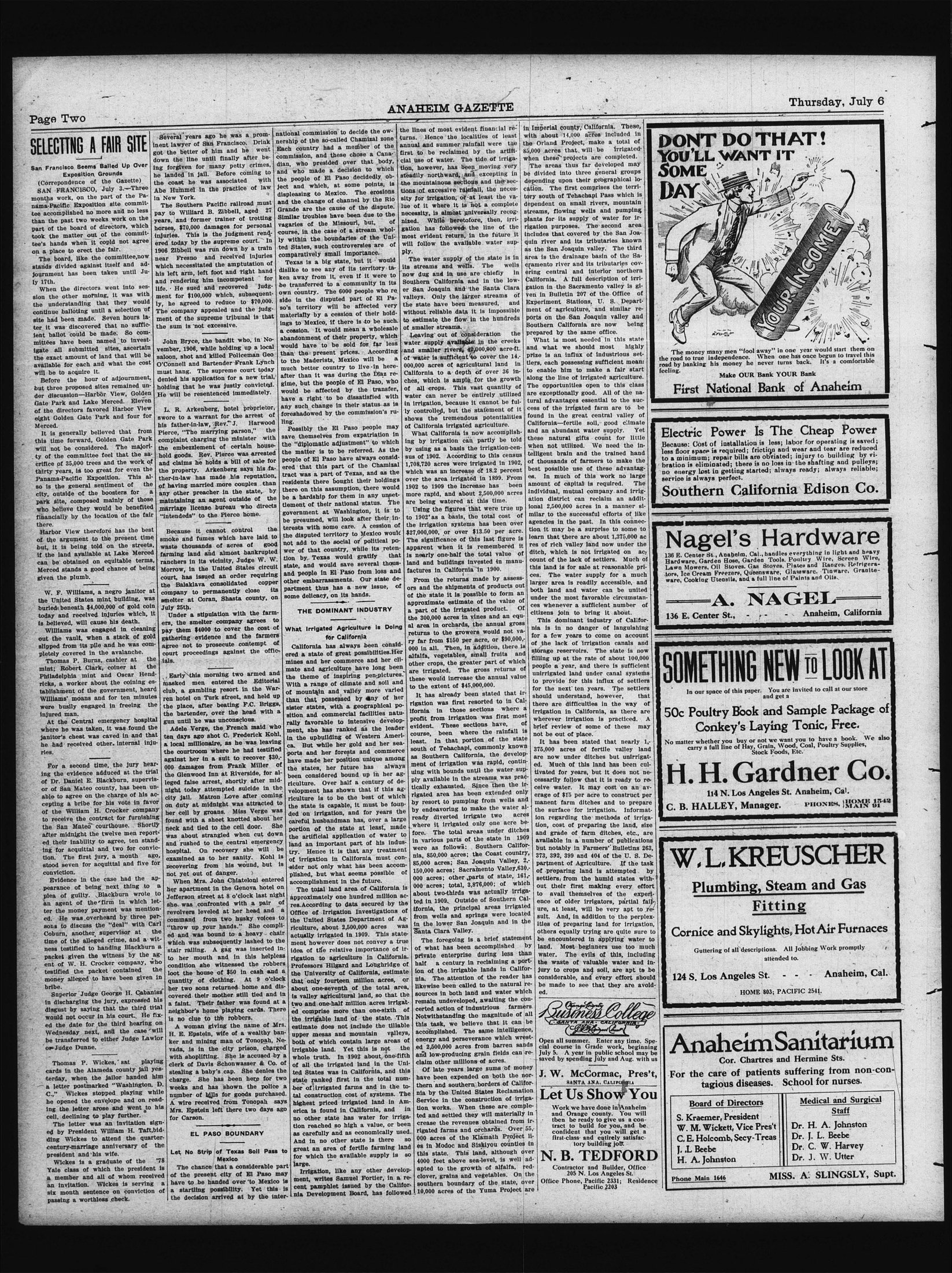
Searchable text
SELECTTNG A FAIR SITE
San Francisco Seems Balled Up Over Exposition Grounds
(Correpondence of the Gazette)
SAN FRANCISCO, July 3.—Three months work, on the part of the Panama-Pacific Exposition site committee accomplished no more and no less than the past two weeks work on the part of the board of directors, which took the matter out of the committee's hands when it copld not agree on a place to erect the fair.
The board, like the committee, now stands divided against itself and adjournment has been taken until July 17th.
When the directors went into session the other morning, it was with the understanding that they would continue balloting until a selection of site had been made. Seven hours later it was discovered that no sufficient ballot could be made. So committees have been named to investigate all submitted sites, ascertain the exact amount of land that will be available for each and what the cost will be to acquire it.
Before the hour of adjournment, but three proposed sites remained under discussion—Harbor View, Golden Gate Park and Lake Merced. Eleven of the directors favored Harbor View eight Golden Gate Park and four for Merced.
It is generally believed that from this time forward, Golden Gate Park will not be considered. The majority of the committee feel that the sacrifice of 35,000 trees and the work of thirty years, is too great for even the several years ago he was a prominent lawyer of San Francisco. Drink got the better of him and he went down the line until finally after being forgiven for many petty crimes, he landed in jail. Before coming to the coast he was associated with Abe Hummel in the practice of law in New York.
The Southern Pacific railroad must pay to Williard B. Zibbell, aged 27 years, and former trainer of trotting horses, $70,000 damages for personal injuries. This is the judgment rendered today by the supreme court. In 1906 Zibbell was run down by a train near Fresno and received injuries which necessitated the amputation of his left arm, left foot and right hand and rendering him incompetent for life. He sued and recovered Judgment for $100,000 which, subsequently, he agreed to reduce to $70,000. The company appealed and the judgment of the supreme tribunal is that the sum is not excessive.
John Bryce, the bandit who, in November, 1906, while holding up a local saloon, shot and killed Policeman Geo O'Connell and Bartender Frank Lynch must hang. The supreme court today denied his application for a new trial, holding that he was justly convicted. He will be resentenced immediately.
L. R. Arkenberg, hotel proprietor, swore to a warrant for the arrest of his father-in-law, Rev. J. Harwood Pierce, "The marrying parson," the complaint charging the minister with the embezzlement of certain household goods. Rev. Pierce was arrested and claims he holds a bill of sale for the property. Arkenberg says his national commission to deference of the so-called Crimes Each country had a mere commission, and these chieftain, who presided over it and who made a decision on the people of El Paso object and which, at some displeasing to Mexico. It and the change of channel Grande are the cause of Similar troubles have been vagaries of the Missouri course, in the case of a city within the boundaries United States, such controversy comparatively small impact.
Texas is a big state, but dislike to see any of its keen away from it, even if transferred to a common country. The 6000 pts side in the disputed pass so's territory will be materially by a cessionings to Mexico, if there is a cession. It would mean abandonment of their property would have to be sold than the present price to the Maderists, Mexico much better country to after than it was during gime, but the people of would be affected by have a right to be disband any such change in their foreshadowed by the corling.
Possibly the El Paso save themselves from eased "diplomatic adjustment" the matter is to be reeled people of El Paso have ered that this part of tract was a part of Tex-
Before the hour of adjournment, but three proposed sites remained under discussion—Harbor View, Golden Gate Park and Lake Merced. Eleven of the directors favored Harbor View eight Golden Gate Park and four for Merced.
It is generally believed that from this time forward, Golden Gate Park will not be considered. The majority of the committee feel that the sacrifice of 35,000 trees and the work of thirty years, is too great for even the Panama-Pacific Exposition. This also is the general sentiment of the city, outside of the boosters for a park site, composed mainly of those who believe they would be benefited financially by the location of the fair there.
Harbor View therefore has the best of the argument to the present time but, it is being told on the streets, if the land available at Lake Merced can be obtained on equitable terms, Merced stands a good chance of being given the plumb.
W. F. Williams, a negro janitor at the United States mint building, was buried beneath $4,000,000 of gold coin today and received injuries which, it is believed, will cause his death.
Williams was engaged in cleaning out the vault, when a stack of gold slipped from its pile and he was completely covered in the avalanche.
Thomas P. Burns, cashier at the mint; Robert Clark, coiner at the Philadelphia mint and Oscar Hendricks, a worker about the coining establishment of the government, heard Williams' moans and for ten minutes were busily engaged in freeing the injured man.
At the Central emergency hospital where he was taken, it was found the janitor's chest was caved in and that he had received other internal injuries.
For a second time, the jury hearing the evidence adduced at the trial of Dr. Daniel E. Blackburn, supervisor of San Mateo county, has been unable to agree on the charge of his accepting a bribe for his vote in favor of the William H. Crocker company to receive the contract for furnishing the San Mateo courthouse. Shortly after midnight the twelve men reported their inability to agree, ten standing for acquittal and two for conviction. The first jury, a month ago, stood seven for acquittal and five for conviction.
Evidence in the case had the appearance of being next thing to a plea of guilty. Blackburn wrote to L. R. Arkenberg, hotel proprietor, swore to a warrant for the arrest of his father-in-law, Rev. J. Harwood Pierce, "The marrying parson," the complaint charging the minister with the embezzlement of certain household goods. Rev. Pierce was arrested and claims he holds a bill of sale for the property. Arkenberg says his father-in-law has made his reputation, of having married more couples than any other preacher in the state, by maintaining an agent outside of the marriage license bureau who directs "intendeds" to the Pierce home.
Because it cannot control the smoke and fumes which have laid to waste thousands of acres of good farming land and almost bankrupted ranchers in its vicinity, Judge W. W. Morrow, in the United States circuit court, has issued an order requiring the Balaklava consolidated copper company to permanently close its smelter at Coran, Shasta county, on July 25th.
Under a stipulation with the farmers, the smelter company agrees to pay them $4000 to cover the cost of gathering evidence and the farmers agree not to prosecute contempt of court proceedings against the officials.
Early this morning two armed and masked men entered the Editorial club, a gambling resort in the Warren hotel on Turk street, and held up the place, after beating F.C. Briggs, the bartender, over the head with a gun until he was unconscious.
Adele Verge, the French maid who ten days ago shot C. Frederick Kohl, a local millionaire, as he was leaving the courtroom where he had testified against her in a suit to recover $30,000 damages from Frank Miller of the Glenwood Inn at Riverside, for alleged false arrest, shortly after midnight today attempted suicide in the city jail. Matron Love after coming on duty at midnight was attracted to her cell by groans. Miss Verge was found with a sheet knotted about her neck and tied to the cell door. She was about strangled when cut down and rushed to the central emergency hospital. On recovery she will be examined as to her sanity. Kohl is recovering from his wound, but is not yet out of danger.
When Mrs. John Chilateloni entered her apartment in the Genova hotel on Jefferson street at 8 o'clock last night after than it was during gime, but the people of El Paso would be affected by any such change in their foreshadowed by the coupling.
Possibly the El Paso save themselves from eased "diplomatic adjustment" the matter is to be reeled people of El Paso have ered that this part of tract was a part of Texas residents there bought there on this assumption be a hardship for them element of their national government at Washington be presumed, will look terests with some care. The disputed territory to not add to the social power of that country, wition by Texas would be state, and would save people in El Paso other embarrassments. partment thus has a some delicacy, on its h
THE DOMINANT
What Irrigated Agriculture for California
California has always ered a state of great mines and her commer mate and agriculture in the theme of inspiring With a range of climates of mountain and valley than that possessed sister states, with a gosition and commercial rally favorable to int ment, she has ranked in the upbuilding of ca. But while her go ports and her forests have made her position the states, her future been considered bound riculture. Over half development has shown riculture is to be tha state is capable, d ed on irrigation, and careful husbandman h portion of the state tha artificial application land an important par try. Hence it is tha of irrigation in Calif orider not only what plished, but what se accomplishment in tha
The total land area approximately one hu
cepting a bribe for his vote in favor of the William H. Crocker company to receive the contract for furnishing the San Mateo courthouse. Shortly after midnight the twelve men reported their inability to agree, ten standing for acquittal and two for conviction. The first jury, a month ago, stood seven for acquittal and five for conviction.
Evidence in the case had the appearance of being next thing to a plea of guilty. Blackburn wrote to an agent of the firm in which letter the money payment was mentioned. He was overheard by three persons to discuss the "deal" with Carl Coburn, another supervisor at the time of the alleged crime, and a witness testified to handing Blackburn a packet given the witness by the agent of W. H. Crocker company, who testified the packet contained the money alleged to have been given in bribe.
Superior Judge George H. Cabaniss in discharging the jury, expressed his disgust by saying that the third trial would not occur in his court. He fixed the date for the third hearing on Wednesday next, and the case will be transferred to either Judge Lawlor or Judge Dunne.
Thomas P. Wickes, sat playing cards in the Alameda county jail yesterday, when the jailor handed him a letter postmarked "Washington, D. C." Wickes stopped playing while he opened the envelope and on reading the letter arose and went to his cell, declining to play further.
The letter was an invitation signed by President William H. Taft,bidding Wickes to attend the quarter-century-marriage anniversary of the president and his wife.
Wickes is a graduate of the '78 Yale class of which the president is a member and all of whom received an invitation. Wickes is serving a six month sentence on conviction of passing a worthless check.
When Mrs. John Chiateloni entered her apartment in the Genova hotel on Jefferson street at 8 o'clock last night she was confronted with a pair of revolvers leveled at her head and a command from two husky voices to "throw up your hands." She complied and was bound to a heavy chair which was subsequently lashed to the stair railing. A gag was inserted into her mouth and in this helpless condition she witnessed the robbers loot the house of $50 in cash and a quantity of clothing. At 9 o'clock her two sons returned home and discovered their mother still tied and in a faint. Their father was found at a neighbor's home playing cards. There is no clue to the robbers.
A woman giving the name of Mrs. H. E. Epstein, wife of a wealthy banker and mining man of Tonopah, Nevada, is in the city prison, charged with shoplifting. She is accused by a clerk of Davis Schonwasser & Co. of stealing a baby’s cap. She denies the charge. She has been here for two weeks and has shown the police a number of bills for goods purchased. A wire received from Tonopah says Mrs. Epstein left there two days ago for Carson.
EL PASO BOUNDARY
Let No Strip of Texas Soil Pass to Mexico
The chance that a considerable part of the present city of El Paso may have to be handed over to Mexico is a startling possibility. Yet this is the decision arrived at by the inter-
ANAHEIM GAZETTE
national commission to decide the ownership of the so-called Chamizal zone Each country had a member of the commission, and these chose a Canadian, who presided over that body, and who made a decision to which the people of El Paso decidedly object and which, at some points, is displeasing to Mexico. The erosions and the change of channel by the Rio Grande are the cause of the dispute. Similar troubles have been due to the vagaries of the Missouri, but, of course, in the case of a stream wholly within the boundaries of the United States, such controversies are of comparatively small importance.
Texas is a big state, but it would dislike to see any of its territory taken away from it, even if it were to be transferred to a community in its own country. The 6000 people who reside in the disputed part of El Paso's territory will be affected very materially by a cession of their holdings to Mexico, if there is to be such a cession. It would mean a wholesale abandonment of their property, which would have to be sold for far less than the present prices. According to the Maderists, Mexico will be a much better country to live in hereafter than it was during the Diaz regime, but the people of El Paso, who would be affected by the transfer, have a right to be dissatisfied with any such change in their status as is foreshadowed by the commission's ruling.
Possibly the El Paso people may save themselves from expatriation in the "diplomatic adjustment" to which the matter is to be referred. As the people of El Paso have always considered that this part of the Chamizal tract was a part of Texas, and as the lines of most evident financial returns. Hence the localities of least annual and summer rainfall were the first to be reclaimed by the artificial use of water. The tide of irrigation, however, has been moving very steadily northward, and excepting in the mountainous sections and the sections of excessive rainfall, the necessity for irrigation, or at least the value of it where it is not a complete necessity, is almost universally recognized. While heretofore, then, irrigation has followed the line of the most evident return, in the future it will follow the available water supply.
The water supply of the state is in its streams and wells. The wells now dug and in use are chiefly in Southern California and in the lower San Joaquin and the Santa Clara valleys. Only the larger streams of the state have been measured, and without reliable data it is impossible to estimate the flow in the hundreds of smaller streams.
Leaving out of consideration the water supply available in the creeks and smaller rivers, 42,000,000 acre-feet. of water is sufficient to cover the 14,000,000 acres of agricultural land in California to a depth of over 36 inches, which is ample for the growth of all crops. This vast quantity of water can never be entirely utilized in irrigation, because it cannot be fully controlled, but the statement of it shows the tremendous potentialities of California irrigated agriculture.
What California is now accomplishing by irrigation can partly be told by using as a basis the irrigation-census of 1902. According to this census 1,708,720 acres were irrigated in 1902, which was an increase of 18.2 percent in Imperial county, California. These, with about 14,000 acres included in the Orland Project, make a total of 85,000 acres that will be irrigated when these projects are completed.
The areas thus far developed may be divided into three general groups depending upon their geographical location. The first comprises the territory south of Tehachapi Pass which is dependent on small rivers, mountain streams, flowing wells and pumping plants for its supply of water for irrigation purposes. The second area includes that covered by the San Joaquin river and its tributaries known as the San Joaquin valley. The third area is the drainage basin of the Sacramento river and its tributaries covering central and interior northern California. A full description of irrigation in the Sacramento valley is given in Bulletin 207 of the Office of Experiment Stations, U. S. Department of agriculture, and similar reports on the San Joaquin valley and Southern California are now being prepared by the same office.
What is most needed in this state and what we should most highly prize is an influx of industrious settlers, each possessing sufficient means to enable him to make a fair start along the line of irrigated agriculture. The opportunities open to this class are exceptionally good. All of the natural advantages essential to the success of the irrigated farm are to be found in the great central valley of California—fertile soil, good climate and an abundant water supply. Yet these natural gifts count for little when not utilized. We need the intelligent brain and the trained hand of thousands of farmers to make the best possible use of these advantageous resources.
after than it was during the Diaz regime, but the people of El Paso, who would be affected by the transfer, have a right to be dissatisfied with any such change in their status as is foreshadowed by the commission's ruling.
Possibly the El Paso people may save themselves from expatriation in the "diplomatic adjustment" to which the matter is to be referred. As the people of El Paso have always considered that this part of the Chamizal tract was a part of Texas, and as the residents there bought their holdings there on this assumption, there would be a hardship for them in any unsettlement of their national status. The government at Washington, it is to be presumed, will look after their interests with some care. A cession of the disputed territory to Mexico would not add to the social or political power of that country, while its retention by Texas would gratify that state, and would save several thousand people in El Paso from loss and other embarrassments. Our state department thus has a new issue, of some delicacy, on its hands.
THE DOMINANT INDUSTRY
What Irrigated Agriculture is Doing for California
California has always been considered a state of great possibilities. Her mines and her commerce and her climate and agriculture have long been the theme of inspiring pen-pictures. With a range of climate and soil and of mountain and valley more varied than that possessed by any of her sister states, with a geographical position and commercial facilities naturally favorable to intensive development, she has ranked as the leader in the upbuilding of Western America. But while her gold and her seaports and her forests and commerce have made her position unique among the states, her future has always been considered bound up in her agriculture. Over half a century of development has shown that if this agriculture is to be the best of which the state is capable, it must be founded on irrigation, and for years the careful husbandman has, over a large portion of the state at least, made the artificial application of water to land an important part of his industry. Hence it is that any treatment of irrigation in California must consider not only what has been accomplished, but what seems possible of accomplishment in the future.
The total land area of California is approximately one hundred million acres, which is ample for the growth of all crops. This vast quantity of water can never be entirely utilized in irrigation, because it cannot be fully controlled, but the statement of it shows the tremendous potentialities of California irrigated agriculture.
What California is now accomplishing by irrigation can partly be told by using as a basis the irrigation-census of 1902. According to this census 1,708,720 acres were irrigated in 1902, which was an increase of 18.2 percent over the area irrigated in 1899. From 1902 to 1909 the increase has been more rapid, and about 2,500,000 acres are being watered at this time.
Using the figures that were true up to 1902 as a basis, the total cost of the irrigation systems has been over $27,000,000, or over $13.50 per acre. The significance of this last figure is apparent when it is remembered it is nearly one-half the total value of land and buildings invested in manufactures in California in 1900.
From the returns made by assessors and the shipments of products out of the state it is possible to form an approximate estimate of the value of a part of the irrigated product. Of the 300,000 acres in vines and an equal area in orchards, the annual gross returns to the growers would not vary far from $150 per acre, or $90,000,000 in all. Then, in addition, there is alfalfa, vegetables, small fruits and other crops, the greater part of which are irrigated. The gross returns of these would increase the annual value to the extent of $45,000,000.
It has already been stated that irrigation was first resorted to in California in those sections where a profit from irrigation was first most evident. These sections have, of course, been where the rainfall is least. In that portion of the state south of Tehachapi, commonly known as Southern California, the development of irrigation was rapid, continuing with bounds until the water supply available in the streams was practically exhausted. Since then the irrigated area has been extended only by resort to pumping from wells and by endeavoring to make the water already diverted irrigate two acres where it irrigated only one acre before. The total areas under ditches in various parts of the state in 1909 were as follows: Southern California, 850,000 acres; the Coast county, 85,000 acres; San Joaquin Valley, 2-150,000 acres; Sacramento Valley,630,000 acres; other parts of state, 161,000 acres; total, 3,876,000; of which about two-thirds was actually irrigated.
Along the line of irrigated agriculture. The opportunities open to this class are exceptionally good. All of the natural advantages essential to the success of the irrigated farm are to be found in the great central valley of California—fertile soil, good climate and an abundant water supply. Yet these natural gifts count for little when not utilized. We need the intelligent brain and the trained hand of thousands of farmers to make the best possible use of these advantages. In much of this work no large amount of capital is required. The individual, mutual company and irrigation district can reclaim an additional 2,500,000 acres in a manner similar to the successful efforts of like agencies in the past. In this connection it may be a surprise to some to learn that there are about 1,375,000 acres of rich valley land now under the ditch, which is not irrigated on ac count of the lack of settlers. Much of this land is for sale at reasonable prices. The water supply for a much larger area is readily accessible, and both land and water can be united under the most favorable circumstances whenever a sufficient number of citizens join to bring it about.
This dominant industry of California is in no danger of languishing for a few years to come on account of the lack of irrigation canals and storage reservoirs. The state is now filling up at the rate of about 100,000 people a year, and there is sufficient unirrigated land under canal systems to provide for this influx of settlers for the next ten years. The settlers should understand, however, that there are difficulties in the way of irrigation in California, as there are wherever irrigation is practiced. A brief review of some of these may not be out of place.
It has been stated that nearly 1,-375,000 acres of fertile valley land are now under ditches but unirrigated. Much of this land has been cultivated for years, but it does not necessarily follow that it is ready to receive water. It may cost on an average of $15 per acre to construct per manent farm ditches and to prepare the surface for irrigation. Information regarding the methods of irrigation, cost of preparing the land, size and grade of farm ditches, etc., are available in a number of publications but notably in Farmers' Bulletins 263, 373, 392, 399 and 404 of the U.S. Department of Agriculture. If the task of preparing land is attempted by settlers from the humid states without their first making every effort to avail themselves of the experi-
the state is capable, it must be founded on irrigation, and for years the careful husbandman has, over a large portion of the state at least, made the artificial application of water to land an important part of his industry. Hence it is that any treatment of irrigation in California must consider not only what has been accomplished, but what seems possible of accomplishment in the future.
The total land area of California is approximately one hundred million acres. According to data secured by the Office of Irrigation Investigations of the United States Department of Agriculture, about 2,500,000 acres was actually irrigated in 1909. This statement however does not convey a true idea of the relative importance of irrigation to agriculture in California. Professors Hilgard and Loughridge of the University of California, estimate that only fourteen million acres, or about one-seventh of the total area, is valley agricultural land, so that the two and one-half million acres irrigated comprise more than one-sixth of the irrigable land of the state. This estimate does not include the tillable upper mesas and mountain valleys, both of which contain large areas of irrigable land. Yet this is not the whole truth. In 1902 about one-fifth of all the irrigated land in the United States was in California, and this state ranked first in the total number of irrigated farms and in the total construction cost of systems. The highest priced irrigated land in America is found in California, and in no other state has water for irrigation reached so high a value, or been as carefully and as economically used. And in no other state is there so great an area of fertile farming land for which the available supply is so large.
Irrigation, like any other development, writes Samuel Fortier, in a recent pamphlet issued by the California Development Board, has followed by resort to pumping from wells and by endeavoring to make the water already diverted irrigate two acres where it irrigated only one acre before. The total areas under ditches in various parts of the state in 1909 were as follows: Southern California, 850,000 acres; the Coast country, 85,000 acres; San Joaquin Valley, 2,150,000 acres; Sacramento Valley,630,000 acres; other parts of state, 161,000 acres; total, 3,876,000; of which about two-thirds was actually irrigated in 1909. Outside of Southern California, the principal areas irrigated from wells and springs were located in the lower San Joaquin and in the Santa Clara Valley.
The foregoing is a brief statement of what has been accomplished by private enterprise during less than half a century in reclaiming a portion of the irrigable lands in California. The attention of the reader has likewise been called to the natural resources in both land and water which remain undeveloped, awaiting the concerted action of industrious farmers. Notwithstanding the magnitude of all this task, we believe that it can be accomplished. The same intelligence, energy and perseverance which wrestled 2,500,000 acres from barren sands and low-producing grain fields can reclaim other millions of acres.
Of late years large sums of money have been expended on both the northern and southern borders of California by the United States Reclamation Service in the construction of irrigation works. When these are completed and settled they will materially increase the revenues obtained from irrigated farms and orchards. Over 55,000 acres of the Klamath Project lies in Modoc and Siskiyou counties in this state. This land, although over 4000 feet above sea-level, is well adapted to the growth of alfalfa, red clover, grains and vegetables. On the southern boundary of the state, over 10,000 acres of the Yuma Project are manent farm ditches and to prepare the surface for irrigation. Information regarding the methods of irrigation, cost of preparing the land, size and grade of farm ditches, etc., are available in a number of publications but notably in Farmers' Bulletins 263, 373, 392, 399 and 404 of the U.S. Department of Agriculture. If the task of preparing land is attempted by settlers from the humid states without their first making every effort to avail themselves of the experience of older irrigators, partial failure, at least, will be very apt to result. And, in addition to the perplexities of preparing land for irrigation, others equally trying are quite sure to be encountered in applying water to land. Most beginners use too much water. The evils of this, including the waste of valuable water and injury to crops and soil, are apt to be considerable, and every effort should be made to see that they are avoided.
Open all summer. Enter any time. Special course in Grade work, beginning July 5. A year in public school may be saved by spending July and Aug. with us
J. W. McCormac, Pres't,
SANTA ANA, CALIFORNIA
Let Us Show You
Work we have done in Anaheim and Orange county. You will then be ready to give us a contract to build for you, and be confident that you will get a first-class and entirely satisfactory building job.
N. B. TEDFORD
Contractor and Builder, Office
205 N. Los Angeles St.
Office Phone, Pacific 2331; Residence Pacific 2203
DON'T DO THAT!
YOU'LL WANT IT
SOME
DAY
The money many men "fool away" in one year would start them on the road to true independence. When one has once begun to travel this road by banking his money he never turns back. It's a comfortable feeling.
Make OUR Bank YOUR Bank
First National Bank of Anaheim
Electric Power Is The Cheap Power
Because: Cost of installation is less; labor for operating is saved; less floor space is required; friction and wear and tear are reduced to a minimum; repair bills are obviated; injury to building by vibration is eliminated; there is no loss in the shafting and pulleys; no energy lost in getting started; always ready; always reliable;
Electric Power Is The Cheap Power
Because: Cost of installation is less; labor for operating is saved;
less floor space is required; friction and wear and tear are reduced
to a minimum; repair bills are obviated; injury to building by vibration is eliminated; there is no loss in the shafting and pulleys;
no energy lost in getting started; always ready; always reliable;
service is always perfect.
Southern California Edison Co.
Nagel’s Hardware
136 E. Center St., Anaheim, Cal., handles everything in light and heavy
Hardware, Garden Hose, Garden Tools, Poultry Wire, Screen Wire,
Lawn Mowers, Oil Stoves, Gas Stoves, Plates and Ranges. Refrigerators,
Ice Cream Freezers, Queensware, Glassware. Tinware, Graniteware, Cooking Utensils, and a full line of Paints and Oils.
A. NAGEL
136 E. Center St., Anaheim, California
SOMETHING NEW TO LOOK AT
In our space of this paper. You are invited to call at our store
and get a
50c Poultry Book and Sample Package of Conkey's Laying Tonic, Free.
No matter whether you buy or not we want you to have a book. We also
carry a full line of Hay, Grain, Wood, Coal, Poultry Supplies,
Stock Foods, Etc.
H. H. Gardner Co.
114 N. Los Angeles St. Anaheim, Cal.
C. B. HALLEY, Manager. PHONES. HOME 1542
MAIN 91
W.L.KREUSCHER
Plumbing, Steam and Gas
C. B. HALLEY, Manager. PHONES. HOME 1542 MAIN 91
W.L.KREUSCHER
Plumbing, Steam and Gas
Fitting
Cornice and Skylights, Hot Air Furnaces
Guttering of all descriptions. All Jobbing Work promptly attended to.
124 S. Los Angeles St. - Anaheim, Cal.
HOME 803; PACIFIC 2541.
AnaheimSanitarium
Cor. Chartres and Hermine Sts.
For the care of patients suffering from non-contagious diseases. School for nurses.
Board of Directors
S. Kraemer, President
W. M. Wickett, Vice Pres't
C.E. Holcomb, Secy-Treas
J. .L Beebe
H. A. Johnston
Medical and Surgical Staff
Dr. H. A. Johnston
Dr. J. L. Beebe
Dr. C. W. Harvey
Dr. J. W. Utter
Phone Main 1646 MISS. A. SLINGSLY, Supt.