anaheim-gazette 1911-07-06
Scanned page
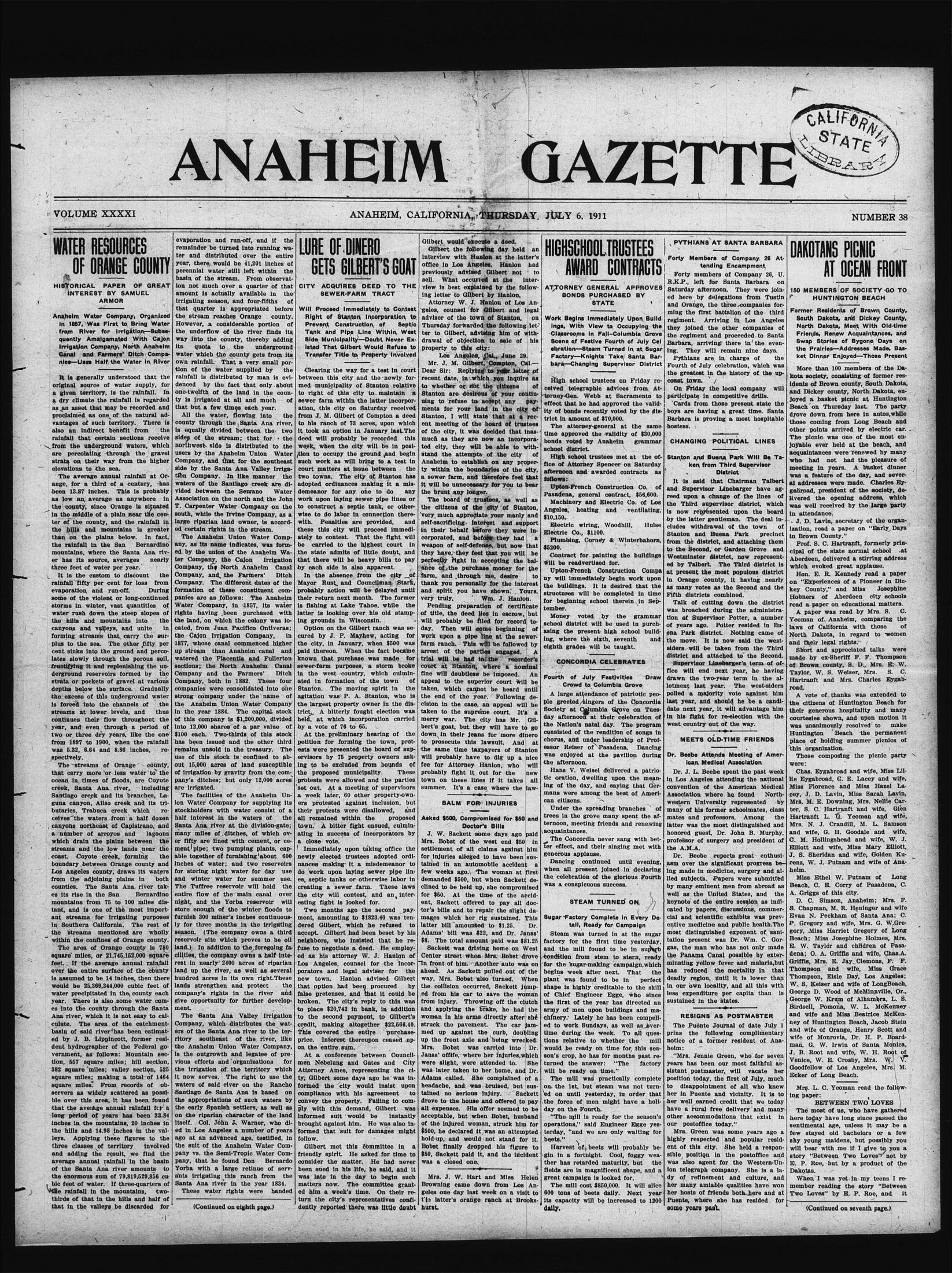
Searchable text
WATER RESOURCES OF ORANGE COUNTY
HISTORICAL PAPER OF GREAT INTEREST BY SAMUEL ARMOR
Anaheim Water Company, Organized in 1857, Was First to Bring Water from River for Irrigation—Subsequently Amalgamated With Cajon Irrigation Company, North Anaheim Canal and Farmers' Ditch Companies—Uses Half the Water in River.
It is generally understood that the original source of water supply, for a given territory, is the rainfall. In a dry climate the rainfall is regarded as an asset that may be recorded and proclaimed as one of the natural advantages of such territory. There is also an indirect benefit from the rainfall that certain sections receive from the underground waters, which are percolating through the gravel strata on their way from the higher elevations to the sea.
Evaporation and run-off, and if the remainder be turned into running water and distributed over the entire year, there would be 41,201 inches of perennial water still left within the basin of the stream. From observation not much over a quarter of that amount is actually available in the irrigating season, and four-fifths of that quarter is appropriated before the stream reaches Orange county. However, a considerable portion of the underflow of the river finds its way into the county, thereby adding its quota to the underground water which the county gets from its own rainfall. That a very small portion of the water supplied by the rainfall is distributed by man is evidenced by the fact that only about one-twelfth of the land in the county is irrigated at all and much of that but a few times each year.
All the water flowing into the county through the Santa Ana river, is equally divided between the two sides of the stream; that for the northwest side is distributed to the users by the Anaheim Union Water Company, and that for the southeast side by the Santa Ana Valley Irrigation Company.
It is generally understood that the original source of water supply, for a given territory, is the rainfall. In a dry climate the rainfall is regarded as an asset that may be recorded and proclaimed as one of the natural advantages of such territory. There is also an indirect benefit from the rainfall that certain sections receive from the underground waters, which are percolating through the gravel strata on their way from the higher elevations to the sea.
The average annual rainfall at Orange, for a third of a century, has been 13.87 inches. This is probably as low an average as anywhere in the county, since Orange is situated in the middle of a plain near the center of the county, and the rainfall in the hills and mountains is greater than on the plains below. In fact, the rainfall in the San Bernardino mountains, where the Santa Ana river has its source, averages nearly three feet of water per year.
It is the custom to discount the rainfall fifty per cent for loss from evaporation and run-off. During some of the violent or long-continued storms in winter, vast quantities of water rush down the steep slopes of the hills and mountains into the canyons and valleys, and unite in forming streams that carry the surplus to the sea. The other fifty per cent sinks into the ground and percolates slowly through the porous soil, fructifying it and replenishing the underground reservoirs formed by the strata or pockets of gravel at various depths below the surface. Gradually the excess of this underground water is forced into the channels of the streams at lower levels, and thus continues their flow throughout the year, and even through a period of two or three dry years, like the one from 1897 to 1900, when the rainfall was 5.32, 6.64 and 8.86 inches, respectively.
The streams of Orange county, that carry more or less water to the ocean in times of floods, are Coyote creek, Santa Ana river, including Santiago creek and its branches, Laguna canyon, Aliso creek and its tributaries, Trabuca creek which receives the waters from a half dozen canyons northeast of Capistrano, and a number of arroyos and lagoons which drain the plains between the streams and the low lands near the coast. Coyote creek, forming the boundary between Orange county and Los Angeles county, draws its waters from the adjoining plains in both counties. The Santa Ana river takes its rise in the San Bernardino rainfall is distributed by man is evidenced by the fact that only about one-twelfth of the land in the county is irrigated at all and much of that but a few times each year.
All the water, flowing into the county through the Santa Ana river, is equally divided between the two sides of the stream; that for the northwest side is distributed to the users by the Anaheim Union Water Company, and that for the southeast side by the Santa Ana Valley Irrigation Company. In like manner the waters of the Santiago creek are divided between the Serrano Water Association on the north and the John T. Carpenter Water Company on the south, while the Irvine Company, as a large riparian land owner, is accorded certain rights in the stream.
The Anaheim Union Water Company, as its name indicates, was formed by the union of the Anaheim Water Company, the Cajon Irrigation Company, the North Anaheim Canal Company, and the Farmers' Ditch Company. The different dates of the formation of these constituent companies are as follows: The Anaheim Water Company, in 1857, its water rights having been purchased with the land, on which the colony was located, from Juan Pacifico Ontiveras; the Cajon Irrigation Company, in 1877, whose canal commenced higher up stream than Anaheim canal and watered the Placentia and Fullerton sections; the North Anaheim Canal Company and the Farmers' Ditch Company, both in 1882. These four companies were consolidated into one strong company under the name of the Anaheim Union Water Company in the year 1884. The capital stock of this company is $1,200,000, divided into 12,000 shares of a par value of $100 each. Two-thirds of this stock has been issued and the other third remains unsold in the treasury. The use of this stock is confined to about 15,000 acres of land susceptible of irrigation by gravity from the company's ditches; but only 12,000 acres are irrigated.
The facilities of the Anaheim Union Water Company for supplying its stockholders with water consist of a half interest in the waters of the Santa Ana river at the division-gate; many miles of ditches, of which over fifty are lined with cement, or cement pipe; two pumping plants, capable together of furnishing about 600 inches of water; and two reservoirs for storing night water for day use and winter water for summer use. The Tuffree reservoir will hold the entire flow of the main canal over rainfall.
between this city and its municipality it is right of this city from J. M. Gilbert to his ranch of 730 it took an option in deed will probably week, when the cation to occupy them such work as will court matters at its two towns. The adopted ordinances demeanor for any work upon laying to construct a sewer wise to do labor in with. Penalties are these this city willately to contest. Be carried tothe state admits that there will be by each side is all.
In the absence Mayor Rust and probably action when their return next month is fishing at Lake latter is looking on ing grounds in W.
Option on the Gicured by J. P. M. in city, in January paid thereon. Whose known that purchase sewer-farm purposes in the west counted in formation Stanton. The most agitation was P.A. at largest property trict. A bitterly held, at which insisted by a vote of 76 to
At the preliminary petition for formifications were presented servisors by 75 pre-ing to be excludedthe proposed munts protests were allowed set out. At a meeta week later, 60 oers protested against their protests were all remained within town. A bitter filing in success oa close vote.
Immediately upon newly elected trust nances making it do work upon lay es, septic tanks or creating a sewer inthe city will cont
guna canyon, Aliso creek and its tributaries, Trabuca creek which receives the waters from a half dozen canyons northeast of Capistrano, and a number of arroyos and lagoons which drain the plains between the streams and the low lands near the coast. Coyote creek, forming the boundary between Orange county and Los Angeles county, draws its waters from the adjoining plains in both counties. The Santa Ana river takes its rise in the San Bernardino mountains from 75 to 100 miles distant, and is one of the most important streams for irrigating purposes in Southern California. The rest of the streams mentioned are wholly within the confines of Orange county.
The area of Orange county is 780 square miles, or 21,745,152,000 square feet. If the average annual rainfall over the entire surface of the county is assumed to be 14 inches, then there would be 25,369,344,000 cubic feet of water precipitated in the county each year. There is also some water comes into the county through the Santa Ana river, which it is not easy to calculate. The area of the catchment basin of said river has been estimated by J. B. Lippincott, former resident hydrographer of the Federal government, as follows: Mountain section, 557 square miles; hill section, 382 square miles; valley section, 525 square miles; making a total of 1464 square miles. From records of observers as widely scattered as possible over this area, it has been found that the average annual rainfall for a long period of years has been 33.84 inches in the mountains, 20 inches in the hills and 14.98 inches in the valleys. Applying these figures to the three classes of territory involved and adding the result, we find the average annual rainfall in the basin of the Santa Ana river amounts to the enormous sum of 79,819,529,856 cubic feet of water. If three-quarters of the rainfall in the mountains, two-thirds of that in the hills and half of that in the valleys be discarded for ion Water Company for supplying its stockholders with water consist of a half interest in the waters of the Santa Ana river at the division-gate; many miles of ditches, of which over fifty are lined with cement, or cement pipe; two pumping plants, capable together of furnishing about 600 inches of water; and two reservoirs for storing night water for day use and winter water for summer use. The Tuffree reservoir will hold the entire flow of the main canal over night, and the Yorba reservoir will store enough of the winter floods to furnish 300 miner's inches continuously for three months in the irrigating season. (The company owns a third reservoir site which proves to be oil land.) In addition to the foregoing facilities, the company owns a half interest in nearly 2400 acres of riparian land up the river, as well as several hundred acres in its own right. These lands strengthen and protect the company's rights in the river and give opportunity for further development.
The Santa Ana Valley Irrigation Company, which distributes the waters of the Santa Ana river to the territory southeast of the river, like the Anaheim Union Water Company, is the outgrowth and legatee of previous efforts and organizations for the irrigation of the territory which it now serves. The right to use the waters of said river on the Rancho Santiago de Santa Ana is based on the appropriations of such waters by the early Spanish settlers, as well as on the riparian character of the land itself. Col. John J. Warner, who died in Los Angeles a number of years ago at an advanced age, testified, in the suit of the Anaheim Water Company vs. the Semi-Tropic Water Company, that he found Don Bernardo Yorba with a large retinue of servants irrigating this ranch from the Santa Ana river in the year 1834.
These water rights were handed
(Continued on eighth page.)
ANAHEIM, CALIFORNIA, THURSDAY, JULY 6, 1911
LURE OF DINERO GETS GILBERT’S GOAT
CITY ACQUIRES DEED TO THE SEWER-FARM TRACT
Will Proceed Immediately to Contest Right of Stanton Incorporation to Prevent Construction of Septic Tank and Pipe Line Within West Side Municipality—Doubt Never Existed That Gilbert Would Refuse to Transfer Title to Property Involved
Clearing the way for a test in court between this city and the newly formed municipality of Stanton relative to right of this city to maintain a sewer farm within the latter incorporation, this city on Saturday received from J. M. Gilbert of Compton a deed to his ranch of 73 acres, upon which it took an option in January last. The deed will probably be recorded this week, when the city will be in position to occupy the ground and begin such work as will bring to a test in court matters at issue between the
Gilbert would execute a deed.
Gilbert the following day held an interview with Hanlon at the latter’s office in Los Angeles. Hanlon had previously advised Gilbert not to sell. What occurred at the interview is best explained by the following letter to Gilbert by Hanlon,
Attorney W. J. Hanlon of Los Angeles, counsel for Gilbert and legal adviser of the town of Stanton, on Thursday forwarded the following letter to Gilbert, advising him of withdrawal of objection to sale of his property to this city:
Los Angeles, Cal., June 29.
Mr. J. M. Gilbert, Compton, Cal.—Dear Sir: Replying to your letter of recent date, in which you inquire as to whether or not the citizens of Stanton are desirous of your continuing to refuse to accept any payments for your land in the city of Stanton, I will state that at a recent meeting of the board of trustees of the city, it was decided that inasmuch as they are now an incorporated city, they will be able to withstand the attempts of the city of Anaheim to establish on any property within the boundaries of the city,
HIGHSCHOOL TRUSTEES AWARD CONTRACTS
ATTORNEY GENERAL APPROVES BONDS PURCHASED BY STATE
Work Begins Immediately Upon Buildings, With View to Occupying the Classrooms in Fall—Columbia Grove Scene of Festive Fourth of July Celebration—Steam Turned in at Sugar Factory—Knights Take Santa Barbara—Changing Supervisor District
High school trustees on Friday received telegraphic advices from Attorney-Gen. Webb at Sacramento to effect that he had approved the validity of bonds recently voted by the district in amount of $70,000.
The attorney-general at the same time approved the validity of $30,000 bonds voted by Anaheim grammar school district.
High school trustees met at the office of Attorney Spencer on Saturday afternoon and awarded contracts as
between this city and the newly formed municipality of Stanton relative to right of this city to maintain a sewer farm within the latter incorporation, this city on Saturday received from J. M. Gilbert of Compton a deed to his ranch of 73 acres, upon which it took an option in January last. The deed will probably be recorded this week, when the city will be in position to occupy the ground and begin such work as will bring to a test in court matters at issue between the two towns. The city of Stanton has adopted ordinances making it a misdemeanor for any one to do any work upon laying sewer pipe lines or to construct a septic tank, or otherwise to do labor in connection therewith. Penalties are provided, and these this city will proceed immediately to contest. That the fight will be carried to the highest court in the state admits of little doubt, and that there will be heavy bills to pay by each side is also apparent.
In the absence from the city of Mayor Rust and Councilman Stark, probably action will be delayed until their return next month. The former is fishing at Lake Tahoe, while the latter is looking over his old stamping grounds in Wisconsin.
Option on the Gilbert ranch was secured by J. P. Mayhew, acting for the city, in January, when $500 was paid thereon. When the fact became known that purchase was made for sewer-farm purposes, a storm broke in the west country, which culminated in formation of the town of Stanton. The moving spirit in the agitation was P. A. Stanton, who is the largest property owner in the district. A bitter fight election was held, at which incorporation carried by a vote of 76 to 65.
At the preliminary hearing of the petition for forming the town, protests were presented the board of supervisors by 75 property owners asking to be excluded from bounds of the proposed municipality. These protests were allowed and the parties set out. At a meeting of supervisors a week later, 60 other property-owners protested against inclusion, but their protests were disallowed, and all remained within the proposed town. A bitter fight ensued, culminating in success of incorporators by a close vote.
Immediately upon taking office the newly elected trustees adopted ordinances making it a misdemeanor to do work upon laying sewer pipe lines, septic tanks or otherwise labor in creating a sewer farm. These laws the city will contest, and an inter-recent date, in which you inquire as to whether or not the citizens of Stanton are desirous of your continuing to refuse to accept any payments for your land in the city of Stanton, I will state that at a recent meeting of the board of trustees of the city, it was decided that inasmuch as they are now an incorporated city, they will be able to withstand the attempts of the city of Anaheim to establish on any property within the boundaries of the city, a sewer farm, and therefore feel that it will be unnecessary for you to bear the brunt any longer.
The board of trustees, as well as the citizens of the city of Stanton, very much appreciate your manly and self-sacrificing interest and support in their behalf before they were incorporated, and before they had a weapon of self-defense, but now that they have, they feel that you will be perfectly Right in accepting the balance of the purchase money for the farm, and through me, desire to thank you personally for the interest and spirit you have shown. Yours, very truly,
Wm. J. Hanlon.
Pending preparation of certificate of title, the deed lies in escrow, but will probably be filed for record today. Then will come beginning of work upon a pipe line at the sewer-farm ranch. This will be followed by arrest of the parties engaged. A trial will be had in the recorder's court at Stanton, where a nominal fine will doubtless be imposed. An appeal to the superior court will be taken, which cannot be heard until the end of the year. Following decision in the case, an appeal will be taken to the supreme court. It's a merry war. The city has Mr. Gilbert's goat, but they will have to go down in their jeans for more dinero to prosecute this lawsuit. And at the same time taxpayers of Stanton will probably have to dig up a nice fee for Attorney Hanlon, who will probably fight it out for the new town on these lines if it takes all summer. It's a case where the law
BALM FOR INJURIES
Asked $500, Compromised for $50 and Doctor's Bills
J. W. Sackett some days ago paid Mrs. Bobst of the west end $50 in settlement of all claims against him for injuries alleged to have been sustained in an automobile accident a few weeks ago. The woman at first demanded $500, but when Sackett declined to be held up, she compromised for $50. At the time of the accid-
High school trustees on Friday received telegraphic advices from Attorney-Gen. Webb at Sacramento to effect that he had approved the validity of bonds recently voted by the district in amount of $70,000.
The attorney-general at the same time approved the validity of $30,000 bonds voted by Anaheim grammar school district.
High school trustees met at the office of Attorney Spencer on Saturday afternoon and awarded contracts as follows:
Upton-French Construction Co. of Pasadena, general contract, $56,600.
Machinery and Electric Co. of Los Angeles, heating and ventilating, $10,150.
Electric wiring, Woodhill, Hulse Electric Co., $1100.
Plumbing, Corney & Winterbahorn, $5200.
Contract for painting the buildings will be readvertised for.
Upton-French Construction Company will immediately begin work upon the buildings. It is desired that the structures will be completed in time for beginning school therein in September.
Money voted by the grammar school district will be used in purchasing the present high school building, where the sixth, seventh and eighth grades will be taught.
CONCORDIA CELEBRATES
Fourth of July Festivities Draw Crowd to Columbia Grove
A large attendance of patriotic people greeted singers of the Concordia Society at Columbia Grove on Tuesday afternoon at their celebration of the Nation's natal day. The program consisted of the rendition of songs in chorus, and under leadership of Professor Reiser of Pasadena. Dancing was enjoyed at the pavilion during the afternoon.
Hans V. Weisel delivered a patriotic oration, dwelling upon the meaning of the day, and saying that Germans were among the best of American citizens.
Under the spreading branches of trees in the grove many spent the afternoon, meeting friends and renewing acquaintances.
The Concordia never sang with better effect, and their singing met with generous applause.
Dancing continued until evening, when all present joined in declaring the celebration of the glorious Fourth was a conspicuous success.
ers protested against inclusion, but their protests were disallowed, and all remained within the proposed town. A bitter fight ensued, culminating in success of incorporators by a close vote.
Immediately upon taking office the newly elected trustees adopted ordinances making it a misdemeanor to do work upon laying sewer pipe lines, septic tanks or otherwise labor in creating a sewer farm. These laws the city will contest, and an interesting fight is looked for.
Two months ago the second payment, amounting to $1823.40 was tendered Gilbert, which he refused to accept. Gilbert had been beset by his neighbors, who insisted that he refuse to negotiate a deed. He employed as his attorney W. J. Hanlon of Los Angeles, counsel for the incorporators and legal adviser for the new town. Hanlon advised Gilbert that option had been procured by false pretenses, and that it could be broken. The city's reply to this was to place $20,743 in bank, in addition to the second payment, to Gilbert's credit, making altogether $22,566.40. This covered the entire purchase price. Interest thereupon ceased upon the entire sum.
At a conference between Councilmen Nebelung and Gates and City Attorney Ames, representing the city, Gilbert some days ago he was informed the city would insist upon compliance with his agreement to convey the property. Failing to comply with this demand, Gilbert was informed suit would be instantly brought against him. He was also informed that suit for damages might follow.
Gilbert met this committee in a friendly spirit. He asked for time to consider the matter. He had never been sued in his life, he said, and it was late in the day to begin such matters now. The committee granted him a week's time. On their return the city's representatives confidently reported there was little doubt
BALM FOR INJURIES
Asked $500, Compromised for $50 and Doctor's Bills
J. W. Sackett some days ago paid Mrs. Bobst of the west end $50 in settlement of all claims against him for injuries alleged to have been sustained in an automobile accident a few weeks ago. The woman at first demanded $500, but when Sackett declined to be held up, she compromised for $50. At the time of the accident, Sackett offered to pay all doctor's bills and to repair the slight damages which her rig sustained. This latter bill amounted to $1.25. Dr. Adams' bill was $22, and Dr. Janss' $8. The total amount paid was $81.25
Sackett was driving home on West Center street when Mrs. Bobst drove in front of him. Another auto was on ahead. As Sackett pulled out of the way, Mrs. Bobst also turned. When the collision occurred, Sackett jumped from his car to save the woman from injury. Throwing off the clutch and applying the brake, he had the woman in his arms directly after she struck the pavement. The car jammed up against the curb, doubling up the front axle and being wrecked. Mrs. Bobst was carried into Dr. Janss' offife, where her injuries, which were slight, were attended to. She was later taken to her home, and Dr. Adams called. She complained of a headache, and was bruised, but sustained no serious injury. Sackett drove to the house and offered to pay all expenses. His offer seemed to be acceptable, but when Bobst, husband of the injured woman, struck him for $500, he declared it was an attempted hold-up, and would not stand for it. Bobst finally dropped his figure to $50, Sackett paid it, and the incident was a closed one.
Mrs. J. W. Hart and Miss Helen Browning came down from Los Angeles one day last week on a visit to its latter's orange ranch at Brookshurst.
Under the spreading branches of trees in the grove many spent the afternoon, meeting friends and renewing acquaintances.
The Concordia never sang with better effect, and their singing met with generous applause.
Dancing continued until evening, when all present joined in declaring the celebration of the glorious Fourth was a conspicuous success.
STEAM TURNED ON
Sugar Factory Complete in Every Detail, Ready for Campaign
Steam was turned in at the sugar factory for the first time yesterday, and the mill found to be in superb condition from stem to stern, ready for the sugar-making campaign, which begins week after next. That the plant was found to be in perfect shape is highly creditable to the skill of Chief Engineer Egge, who since the first of the year has directed an army of men upon buildings and machinery: Lately he has been compelled to work Sundays, as well as overtime during the week. To all questions relative to whether the mill would be ready on time for this season's crop, he has for months past returned the answer: "The factory will be ready on time."
The mill was practically complete on the 1st, but steam was not turned on until yesterday, in order that the force of men might have a holiday on the Fourth.
"The mill is ready for the season's operations," said Engineer Egge yesterday, "and we are only waiting for beets."
Harvest of beets will probably begin in a fortnight. Cool, foggy weather has retarded maturity, but the fields are in magnificent shape, and a great campaign is looked for.
The mill cost $850,000. It will slice 600 tons of beets daily. Next year its capacity will be increased to 1200 daily.
CALIFORNIA STATE LIBRARY
AZETTE
1011 NUMBER 38
OL TRUSTEES AND CONTRACTS
GENERAL APPROVES PURCHASED BY STATE
Immediately Upon Build to Occupying the Fall—Columbia Grove Fourth of July Celc Turned in at Sugar Stants Take Santa Barry Supervisor District
ustees on Friday relic advices from Attb at Sacramento to and approved the validly voted by the disf of $70,000.
general at the same the validity of $30,000 Anaheim grammar ustees met at the off Spencer on Saturday awarded contracts as
PYTHIANS AT SANTA BARBARA
Forty Members of Company 26 Attending Encampment
Forty members of Company 26, U.R.K.P., left for Santa Barbara on Saturday afternoon. They were joined here by delegations from Tustin and Orange, the three companies forming the first battalion of the third regiment. Arriving in Los Angeles they joined the other companies of the regiment and proceeded to Santa Barbara, arriving there in the evening. They will remain nine days.
Pythians are in charge of the Fourth of July celebration, which was the greatest in the history of the upcoast town.
On Friday the local company will participate in competitive drills.
Cards from those present state the boys are having a great time. Santa Barbara is proving a most hospitable hostess.
CHANGING POLITICAL LINES
Stanton and Buena Park Will Be Taken from Third Supervisor District
DAKOTANS PICNIC AT OCEAN FRONT
150 MEMBERS OF SOCIETY GO TO HUNTINGTON BEACH
Former Residents of Brown County, South Dakota, and Dickey County, North Dakota, Meet With Old-time Friends, Renew Acquaintances, and Swap Stories of Bygone Days on the Prairies—Addresses Made, Basket Dinner Enjoyed—Those Present
More than 100 members of the Dakota society, consisting of former residents of Brown county, South Dakota, and Dickey county, North Dakota, enjoyed a basket picnic at Huntington Beach on Thursday last. The party drove down from here in autos, while those coming from Long Beach and other points arrived by electric car. The picnic was one of the most enjoyable ever held at the beach, and acquaintances were renewed by many who had not had the pleasure of meeting in years. A basket dinner was a feature of the day and sever-
CHANGING POLITICAL LINES
Stanton and Buena Park Will Be Taken from Third Supervisor District
It is said that Chairman Talbert and Supervisor Linebarger have agreed upon a change of the lines of the Third supervisor district, which is now represented upon the board by the latter gentleman. The deal includes withdrawal of the town of Stanton and Buena Park precinct from the district, and attaching them to the Second, or Garden Grove and Westminster district, now represented by Talbert. The Third district is at present the most populous district in Orange county, it having nearly as many votes as the Second and the Fifth districts combined.
Talk of cutting down the district was broached during the administration of Supervisor Potter, a number of years ago. Potter resided in Buena Park district. Nothing came of the move. It is now said the west-siders will be taken from the Third district and attached to the Second.
Supervisor Linebarger's term of office will end next year, he having drawn the two-year term in the allotment last year. The west-siders polled a majority vote against him last year, and should he be a candidate next year, it will advantage him in his fight for re-election with the west country out of the way.
MEETS OLD-TIME FRIENDS
Dr. Beebe Attends Meeting of American Medical Association
Dr. J. L. Beebe spent the past week in Los Angeles attending the national convention of the American Medical Association where he found Northwestern University represented by many of his former schoolmates, classmates and professors. Among the latter was the most distinguished and honored guest, Dr. John B. Murphy, professor of surgery and president of the A.M.A.
Dr. Beebe reports great enthusiasm over the significant progress being made in medicine, surgery and allied subjects. Papers were submitted by many eminent men from abroad as well as the United States, and the kota society, consisting of former residents of Brown county, South Dakota, and Dickey county, North Dakota, enjoyed a basket picnic at Huntington Beach on Thursday last. The party drove down from here in autos while those coming from Long Beach and other points arrived by electric car. The picnic was one of the most enjoyable ever held at the beach, and acquaintances were renewed by many who had not had the pleasure of meeting in years. A basket dinner was a feature of the day, and several addresses were made. Charles Eygabroad, president of the society, delivered the opening address, which was well received by the large party in attendance.
J. D. Lavin, secretary of the organization, read a paper on "Early Days in Brown County."
Prof. S. C. Hartranft, formerly principal of the state normal school at Aberdeen, delivered a stirring address which evoked great applause.
Hon. E. R. Kennedy read a paper on "Experiences of a Pioneer in Dickey County," and Miss Josephine Hobners of Aberdeen city schools read a paper on educational matters.
A paper was read by Mrs. S. C. Yeoman of Anaheim, comparing the laws of California with those of North Dakota, in regard to women and their legal rights.
Short and appreciated talks were made by ex-Sheriff F. F. Thompson of Brown county, S. D., Mrs. E. W. Taylor, W. S. Weiser, Mrs. S. C. Hartranft and Mrs. Charles Eygabroad.
A vote of thanks was extended to the citizens of Huntington Beach for their generous hospitality and many courtesies shown, and upon motion it was unanimously resolved to make Huntington Beach the permanent place of holding summer picnics of this organization.
Those composing the picnic party were:
Chas. Eygabroad and wife, Miss Lillie Eygabroad, C. E. Lacey and wife, Miss Florence and Miss Hazel Lacey, J. D. Lavin, Miss Sarah Lavin, Mrs. M. E. Downing, Mrs. Nellie Carter, S. C. Hartranft and wife, Glen Hartranft L. G. Yeoman and wife, Mrs. N. J. Crandill, M. L. Samson and wife, G. H. Goodale and wife, C. M. Hollingshead and wife, W. J. Elliott and wife, Miss Mary Elliott, J. S. Sheridan and wife, Golden Kurenz, W. J. Putnam and wife of Anaheim.
Miss Ethel W. Putnam of Long Beach, C. E. Corry of Pasadena, C. A. Griggs of this city.
READING BRANCHES OF THE MANY SPENT THE AFFECTIVE FRIENDS AND RENEWING NEVER SANG WITH BETWEEN THEIR SINGING MEET WITH HER.
UNIVERSITY REPRESENTED BY MANY OF HIS FORMER SCHOOLMATES, CLASS MATES AND PROFESSORS. AMONG THE LITTER WAS THE MOST DISTINGUISHED AND HONORED GUEST, DR. JOHN B. MURPHY, PROFESSOR OF SURGERY AND PRESIDENT OF THE A.M.A.
DR. BEEBE REPORTS GREAT ENTHUSIASTM OVER THE SIGNIFICANT PROGRESS BEING MADE IN MEDICINE, SURGERY AND ALLIED SUBJECTS. PAPERS WERE SUBMITTED BY MANY EMINENT MEN FROM ABROAD AS well as THE UNITED STATES, AND THE KEYNOTE OF THE ENTIRE SESSION AS Indicated By Papers, Discussions, Commercial and Scientific Exhibits Was Preventive Medicine and Public Health. The Most Distinguished Exponent Of Sanitation Present Was Dr. Wm. C. Gorgas, the Man Who Has Not Only Made The Panama Canal Possible By Exterminating Yellow Fever And Malaria, But Has Reduced The Mortality In That Deadly Region, Until It Is Lower Than In Our Own Locality, And All This With Less Expenditure Per Capita Than Is sustained In The States.
RESIGNS AS POSTMASTER
The Puente Journal of date July 1 prins the following complimentary notice of a former resident of Anaheim:
"Mrs. Jennie Green, who for seven years has been our most faithful assistant postmaster, will vacate her position today, the first of July, much to disappointment of all who knew her in Puente and vicinity. It is to her well earned credit that we today have a rural free delivery and many other accommodations that exist in our postoffice today."
Mrs. Green was some years ago a highly respected and popular resident of this city. She held a responsible position in the postoffice and was also agent for the Western-Union telegraph company. She is a lady of refinement and culture, and her many amiable qualities have won her hosts of friends both here and at Puente, where she has resided for some years past.
MRS. M. E. Downing, Mrs. Nellie Carter, S. C. Hartranft and wife, Glen Hartranft L. G. Yeoman and wife, Mrs. N. J. Crandill, M. L. Samson and wife, G. H. Goodale and wife, C. M. Hollingshead and wife, W. J. Elliott and wife, Miss Mary Elliott, J. S. Sheridan and wife, Golden Kurenz, W. J. Putnam and wife of Anaheim.
Miss Ethel W. Putnam of Long Beach, C. E. Corry of Pasadena, C. A. Griggs of this city.
D. C. Simson, Anaheim; Mrs. F. S. Chapman, M. R. Heninger and wife Evan N. Peckham of Santa Ana; C. P. Gregory and wife, Mrs. G. W.Gregory, Miss Harriet Gregory of Long Beach; Miss Josephine Holmes, Mrs. E. W. Taylor and children of Pasadena; O. A. Griffis and wife, Chas.A. Griffis, Mrs. E. Jay Clemons, F. F. Thompson and wife, Miss Grace Thompson, Elsie Day, Los Angeles; W. S. Keiser and wife of LongBeach, George D. Wood of McMinnville, Or., George W. Krum of Alhambra, L. S. Birdsell, Pomona, W. L. McKenney and wife and Miss Beatrice McKenney of Huntington Beach, Jacob Stein and wife of Orange, Henry Scott and wife of Monrovia, Dr. H. P.Boardman, G. W.Irwin of Santa Monica, J.B.Root and wife, W.H.Root of Venice, W.E.Crosby, Mrs.W.V.Goodfellow of Los Angeles, Mrs.M.Ecker of Long Beach.
MRS. L.C.Yeoman read the following paper:
BETWEEN TWO LOVES
The most of us, who have gathered here today have long since passed the sentimental age, unless it may be a few stayed old bachelors or a few shy young maidens, but possibly you will bear with me if I give to you a story "Between Two Loves" not by E.P.Roe, but by a product of the Dakotas.
When I was yet in my teens I remember reading the story "Between Two Loves" by E.P.Roe, and it