anaheim-gazette 1911-07-06
Scanned page
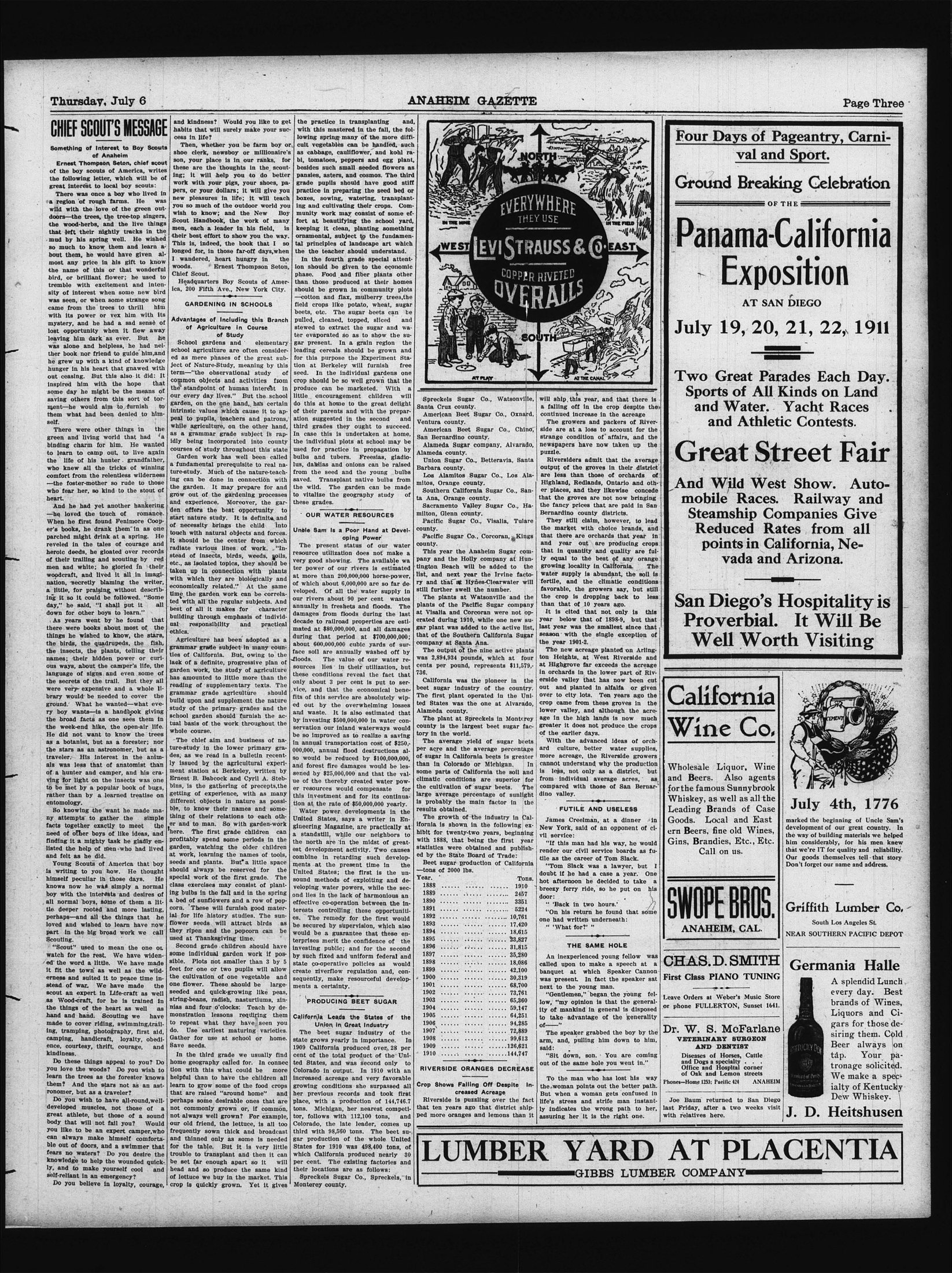
Searchable text
CHIEF SCOUT'S MESSAGE
Something of Interest to Boy Scouts of Anaheim
Ernest Thompson Seton, chief scout of the boy scouts of America, writes the following letter, which will be of great interest to local boy scouts:
There was once a boy who lived in a region of rough farms. He was wild with the love of the green outdoors—the trees, the tree-top singers, the wood-herbs, and the live things that left their nightly tracks in the mud by his spring well. He wished so much to know them and learn about them, he would have given almost any price in his gift to know the name of this or that wonderful bird, or brilliant flower; he used to tremble with excitement and intensity of interest when some new bird was seen, or when some strange song came from the trees to thrill him with its power or vex him with its mystery, and he had a sad sense of lost opportunity when it flew away leaving him dark as ever. But he was alone and helpless, he had neither book nor friend to guide him, and he grew up with a kind of knowledge hunger in his heart that gnawed with out ceasing. But this also it did: It inspired him with the hope that some day he might be the means of saving others from this sort of torment—he would aim to furnish to them what had been denied to himself.
There were other things in the green and living world that had a binding charm for him. He wanted to learn to camp out, to live again the life of his hunter grandfather, who knew all the tricks of winning comfort from the relentless wilderness and kindness? Would you like to get habits that will surely make your success in life?
Then, whether you be farm boy or shoe clerk, newsboy or millionaire's son, your place is in our ranks, for these are the thoughts in the scouting; it will help you to do better work with your pigs, your shoes, papers, or your dollars; it will give you new pleasures in life; it will teach you so much of the outdoor world you wish to know; and the New Boy Scout Handbook, the work of many men, each a leader in his field, is their best effort to show you the way. This is, indeed, the book that I so longed for, in those far-off days, when I wandered, heart hungry in the woods. Ernest Thompson Seton, Chief Scout.
Headquarters Boy Scouts of America, 200 Fifth Ave., New York City.
GARDENING IN SCHOOLS
Advantages of Including this Branch of Agriculture in Course of Study
School gardens and elementary school agriculture are often considered as mere phases of the great subject of Nature-Study, meaning by this term—"the observational study of common objects and activities from the standpoint of human interest in our every day lives." But the school garden, on the one hand, has certain intrinsic values which cause it to appeal to pupils, teachers and patrons, while agriculture, on the other hand, as a grammar grade subject is rapidly being incorporated into county courses of study throughout this state.
Garden work has well been called a fundamental prerequisite to real nature-study. Much of the nature-teach-
out ceasing. But this also it did: It inspired him with the hope that some day he might be the means of saving others from this sort of torment—he would aim to furnish to them what had been denied to himself.
There were other things in the green and living world that had a binding charm for him. He wanted to learn to camp out, to live again the life of his hunter grandfather, who knew all the tricks of winning comfort from the relentless wilderness—the foster-mother so rude to those who fear her, so kind to the stout of heart.
And he had yet another hankering—he loved the touch of romance. When he first found Fenimore Cooper's books, he drank them in as one parched might drink at a spring. He reveled in the tales of courage and heroic deeds, he gloated over records of their trailing and scouting by red men and white; he gloried in their woodcraft, and lived it all in imagination, secretly blaming the writer, a little, for praising without describing it so it could be followed. "Some day," he said, "I shall put it all down for other boys to learn."
As years went by he found that there were books about most of the things he wished to know, the stars, the birds, the quadrupeds, the fish, the insects, the plants, telling their names; their hidden power or curious ways, about the camper's life, the language of signs and even some of the secrets of the trail. But they all were very expensive and a whole library would be needed to cover the ground. What he wanted—what every boy wants—is a handbook giving the broad facts as one sees them in the week-end hike, the open-air life. He did not want to know the trees as a botanist, but as a forester; nor the stars as an astronomer, but as a traveler. His interest in the animals was less that of anatomist than of a hunter and camper, and his craving for light on the insects was one to be met by a popular book of bugs, rather than by a learned treatise on entomology.
So knowing the want he made many attempts to gather the simple facts together exactly to meet the need of other boys of like ideas, and finding it a mighty task he gladly enlisted the help of men who had lived and felt as he did.
Young Scouts of America that boy is writing to you now. He thought himself peculiar in those days. He knows now he was simply a normal boy with the interests and desires of
the observational study of common objects and activities from the standpoint of human interest in our every day lives." But the school garden, on the one hand, has certain intrinsic values which cause it to appeal to pupils, teachers and patrons, while agriculture, on the other hand, as a grammar grade subject is rapidly being incorporated into county courses of study throughout this state.
Garden work has well been called a fundamental prerequisite to real nature-study. Much of the nature-teaching can be done in connection with the garden. It may prepare for and grow out of the gardening processes and experience. Moreover, the garden offers the best opportunity to start nature study. It is definite and of necessity brings the child into touch with natural objects and forces. It should be the center from which radiate various lines of work. "Instead of insects, birds, weeds, goils, etc., as isolated topics, they should be taken up in connection with plants with which they are biologically and economically related." At the same time the garden work can be correlated with all the regular subjects. And best of all it makes for character building through emphasis of individual responsibility and practical ethics.
Agriculture has been adopted as a grammar grade subject in many counties of California. But, owing to the lack of a definite, progressive plan of garden work, the study of agriculture has amounted to little more than the reading of supplementary texts. The grammar grade agriculture should build upon and supplement the nature study of the primary grades and the school garden should furnish the actual basis of the work throughout the whole course.
The chief aim and business of nature-study in the lower primary grades, as we read in a bulletin recently issued by the agricultural experiment station at Berkeley, written by Ernest B. Babcock and Cyril A. Stebbins, is the gathering of precepts,the getting of experience, with as many different objects in nature as possible, to know their names and something of their relations to each other and to man. So with garden-work here. The first grade children can profitably spend some periods in the garden, watching the older children at work, learning the names of tools, seeds and plants. But a little space should always be reserved for the special work of the first grade. The class exercises may consist of planting bulbs in the fall and in the spring.
In this article we discuss how crop should be so widely available that it can produce can be made little encouragement do this at home to their parents and education suggested in third grades they do. In case this is undermined by individual plots used for practice in bulbs and tubers. Thus, daplias and onion from the seed and saved. Transplanting in the wild. The garden to vitalize the geography these grades.
OUR WATER POWER
Uncle Sam is a Poor Opinion
The present state resource utilization is very good showing. Ter power of our rift at more than 200,000 of which about 6,000 developed. Of all these our rivers about 90 annually in freshets damages from floods decade to railroad plowed at $80,000,000 during that period about 600,000,000 cu face soil are annual floods. The value sources lies in these conditions revived only about 3 per cent device, and that they fits of this service ed out by the over and waste. It is also by investing $500,000 servation our inland be so improved as to in annual transport 000,000 annual flood so would be reduced and forest fire damage sensed by $25,000,000 due of thereby created resources would this investment and tion at the rate of $1 million United States says engineering Magazine, a standstill, while the north are in the east development act combine in retardments at the present United States; they sound methods of developing water power and lies in the lack...
So knowing the want he made many attempts to gather the simple facts together exactly to meet the need of other boys of like ideas, and finding it a mighty task he gladly enlisted the help of men who had lived and felt as he did.
Young Scouts of America that boy is writing to you how. He thought himself peculiar in those days. He knows now he was simply a normal boy with the interests and desires of all normal boys, some of them a little deeper rooted and more lasting, perhaps—and all the things that he loved and wished to learn have now part in the big broad work we call Scouting.
"Scout" used to mean the one or watch for the rest. We have widened the word a little. We have made it fit the town as well as the wilderness and suited it to peace time instead of war. We have made the scout an expert in Life-craft as well as Wood-craft, for he is trained in the things of the heart as well as hand and hand. Scouting we have made to cover riding, swimming, trailing, tramping, photography, first aid, camping, handicraft, loyalty, obedience, courtesy, thrift, courage, and kindness.
Do these things appeal to you? Do you love the woods? Do you wish to learn the trees as the forester knows them? And the stars not as an astronomer, but as a traveler?
Do you wish to have all-round, well-developed muscles, not those of a great athlete, but those of a sound body that will not fail you? Would you like to be an expert camper, who can always make himself comfortable out of doors, and a swimmer that fears no waters? Do you desire the knowledge to help the wounded quickly, and to make yourself cool and self-reliant in an emergency?
Do you believe in loyalty, courage,
different objects in nature as possible, to know their names and something of their relations to each other and to man. So with garden-work here. The first grade children can profitably spend some periods in the garden, watching the older children at work, learning the names of tools, seeds and plants. But a little space should always be reserved for the special work of the first grade. The class exercises may consist of planting bulbs in the fall and in the spring a bed of sunflowers and a row of popcorn. These will furnish good material for life history studies. The sunflower seeds will attract birds as they ripen and the popcorn can be used at Thanksgiving time.
Second grade children should have some individual garden work if possible. Plots not smaller than 3 by 5 feet for one or two pupils will allow the cultivation of one vegetable and one flower. These should be large-seeded and quick-growing like peas, string-beans, radish, nasturtiums, zinnias and four o'clocks: Teach by demonstration lessons requiring them to repeat what they have seen you do. Use earliest maturing varieties. Gather for use at school or home. Save seeds.
In the third grade we usually find home geography called for. In connection with this what could be more helpful than to have the children all learn to grow some of the food crops that are raised "around home" and perhaps some desirable ones that are not commonly grown or, if common, not always well grown? For example, our old friend, the lettuce, is all too frequently sown thick and broadcast and thinned only as some is needed for the table. But it is very little trouble to transplant and then it can be set far enough apart so it will head and so produce the same kind of lettuce we buy in the market. This crop is quickly grown. Yet it gives
ANAHEIM GAZETTE
the practice in transplanting and,
with this mastered in the fall, the following spring many of the more difficult vegetables can be handled, such as cabbage, cauliflower, and kohl rabi, tomatoes, peppers and egg plant, besides such small seeded flowers as pansies, asters, and cosmos. The third grade pupils should have good stiff practice in preparing the seed bed or boxes, sowing, watering, transplanting and cultivating their crops. Community work may consist of some effort at beautifying the school yard, keeping it clean, planting something ornamental, subject to the fundamental principles of landscape art which the teacher should understand.
In the fourth grade special attention should be given to the economic phase. Food and fiber plants other than those produced at their homes should be grown in community plots—cotton and flax, mulberry trees, the field crops like potato, wheat, sugar beets, etc. The sugar beets can be pulled, cleaned, topped, sliced and stewed to extract the sugar and water evaporated so as to show the sugar present. In a grain region the leading cereals should be grown and for this purpose the Experiment Station at Berkeley will furnish free seed. In the individual gardens one crop should be so well grown that the produce can be marketed. With a little encouragement children will do this at home to the great delight of their parents and with the preparation suggested in the second and third grades they ought to succeed. In case this is undertaken at home, the individual plots at school may be used for practice in propagation by bulbs and tubers. Freesias, gladiolus, dahlias and onions can be raised from the seed and the young bulbs will ship this year, and that there is a falling off in the crop despite the continued increase in the acreage.
The growers and packers of River-side are at a loss to account for the strange condition of affairs, and the newspapers have now taken up the puzzle.
Riversiders admit that the average output of the groves in their district are less than those of orchards.
OUR WATER RESOURCES
Uncle Sam is a Poor Hand at Developing Power
The present status of our water resource utilization does not make a very good showing. The available water power of our rivers is estimated at more than 200,000,000 horse-power, of which about 6,000,000 are so far developed. Of all the water supply in our rivers about 90 per cent wastes annually in freshhets and floods. The damages from floods during the last decade to railroad properties are estimated at $80,000,000, and all damages during that period at $700,000,000; about 600,000,000 cubic yards of surface soil are annually washed off by floods. The value of our water resources lies in their utilization, but these conditions reveal the fact that only about 3 per cent is put to service, and that the economical benefits of this service are absolutely wiped out by the overwhelming losses and waste. It is also estimated that by investing $500,000,000 in water conservation our inland waterways would be so improved as to realize a saving in annual transportation cost of $250,000,000, annual flood destructions also would be reduced by $100,000,000, and forest fire damages would be lessened by $25,000,000 and that the value of the thereby created water power resources would compensate for this investment and for its continuation at the rate of $50,000,000 yearly.
Water power developments in the United States, says a writer in Engineering Magazine, are practically at a standstill, while our neighbors to the north are in the midst of greatest development activity. Two causes combine in retarding such developments at the present time in the United States; the first is the unsound methods of exploiting and developing water powers, while the second lies in the lack of harmonious an...
Water power developments in the United States, says a writer in Engineering Magazine, are practically at a standstill, while our neighbors to the north are in the midst of greatest development activity. Two causes combine in retarding such developments at the present time in the United States; the first is the unsound methods of exploiting and developing water powers, while the second lies in the lack of harmonious an effective co-operation between the interests controlling these opportunities. The remedy for the first would be secured by supervision, which also would be a guarantee that these enterprises merit the confidence of the investing public; and for the second by such fixed and uniform federal and state co-operative policies as would create riverflow regulation and, consequently, make resourceful developments a certainty.
PRODUCING BEET SUGAR
California Leads the States of the Union in Great Industry
The beet sugar industry of the state grows yearly in importance. In 1909 California produced over 28 percent of the total product of the United States, and was second only to Colorado in output. In 1910 with an increased acreage and very favorable growing conditions she surpassed all her previous records and took first place, with a production of 144,746.7 tons. Michigan, her nearest competitor, follows with 112,100 tons, and Colorado, the late leader, comes up third with 98,560 tons. The beet sugar production of the whole United States for 1910 was 498,400 tons, of which California produced nearly 30 per cent. The existing factories and their locations are as follows:
Spreckels Sugar Co., Spreckels, in Monterey county.
is probably the main factor in the results obtained.
The growth of the industry in California is shown in the following exhibit for twenty-two years, beginning with 1888, that being the first year statistics were obtained and published by the State Board of Trade:
Beet sugar production of California—tons of 2000 lbs.
Year. Tons.
1888 ... 1910
1889 ... 2457
1890 ... 3351
1891 ... 5224
1892 ... 10,761
1893 ... 17,420
1894 ... 18,615
1895 ... 23,827
1896 ... 31,815
1897 ... 35,280
1898 ... 18,086
1899 ... 42,100
1900 ... 30,319
1901 ... 68,700
1902 ... 73,761
1903 ... 65,360
1904 ... 59,147
1905 ... 64,251
1906 ... 94,285
1907 ... 72,889
1908 ... 99,613
1909 ... 126,621
1910 ... 144,747
RIVERSIDE ORANGES DECREASE
Crop Shows Falling Off Despite Increased Acreage
Riverside is puzzling over the fact that ten years ago that district shipped more oranges and lemons than it
FUTILE AND USELESS
James Creelman, at a dinner in New York, said of an opponent of civil service:
“If this man had his way, he would render our civil service boards as futile as the career of Tom Slack.
“Tom Slack was a lawyer, but I doubt if he had a case a year. One hot afternoon he decided to take a breezy ferry ride, so he put on his door:
“‘Back in two hours.’
“On his return he found that some one had written underneath:
“‘What for?’”
THE SAME HOLE
An inexperlenced young fellow was called upon to make a speech at a banquet at which Speaker Cannon was present. In fact the speaker sat next to the young man.
“Gentlemen,” began the young fellow, “my opinion is that the generality of mankind in general is disposed to take advantage of the generality of——”
The speaker grabbed the boy by the arm, and pulling him down to him, said:
“Sit down, son. You are coming out of the same hole you went in.”
To the man who has lost his way the woman points out the better path. But when a woman gets confused in life's stress and strife man instantly indicates the wrong path to her, assuring her it is the right one.
LUMBER YARD A
GIBBS LUMBER
Four Days of Pageantry, Carnival and Sport.
Ground Breaking Celebration
OF THE
Panama-California
Exposition
AT SAN DIEGO
July 19, 20, 21, 22, 1911
Two Great Parades Each Day.
Sports of All Kinds on Land
and Water. Yacht Races
and Athletic Contests.
Great Street Fair
Two Great Parades Each Day.
Sports of All Kinds on Land and Water. Yacht Races and Athletic Contests.
Great Street Fair
And Wild West Show. Automobile Races. Railway and Steamship Companies Give Reduced Rates from all points in California, Nevada and Arizona.
San Diego’s Hospitality is Proverbial. It Will Be Well Worth Visiting
California Wine Co.
Wholesale Liquor, Wine and Beers. Also agents for the famous Sunnybrook Whiskey, as well as all the Leading Brands of Case Goods. Local and Eastern Beers, fine old Wines, Gins, Brandies, Etc., Etc.
Call on us.
July 4th, 1776
marked the beginning of Uncle Sam's development of our great country. In the way of building materials we helped him considerably, for his men knew that we're IT for quality and reliability. Our goods themselves tell that story. Don't forget our name and address.
WHISKEY, as well as all the Leading Brands of Case Goods. Local and Eastern Beers, fine old Wines, Gins, Brandies, Etc., Etc. Call on us.
SWOPE BROS.
ANAHEIM, CAL.
CHAS. D. SMITH
First Class PIANO TUNING
Leave Orders at Weber's Music Store or phone FULLERTON, Sunset 1641.
Dr. W. S. McFarlane
VETERINARY SURGEON AND DENTIST
Diseases of Horses, Cattle and Dogs a specialty... Office and Hospital corner of Oak and Lemon streets
Phones—Home 1253; Pacific 424 ANAHEIM
Joe Baum returned to San Diego last Friday, after a two weeks visit with relatives here.
July 4th, 1776
marked the beginning of Uncle Sam's development of our great country. In the way of building materials we helped him considerably, for his men knew that we're IT for quality and reliability. Our goods themselves tell that story. Don't forget our name and address.
Griffith Lumber Co,
South Los Angeles St.
NEAR SOUTHERN PACIFIC DEPOT
Germania Halle
A splendid Lunch every day. Best brands of Wines, Liquors and Cigars for those desiring them. Cold Beer always on tap. Your patronage solicited. We make a specialty of Kentucky Dew Whiskey.
J. D. Heitshusen