anaheim-gazette 1950-12-11
Scanned page
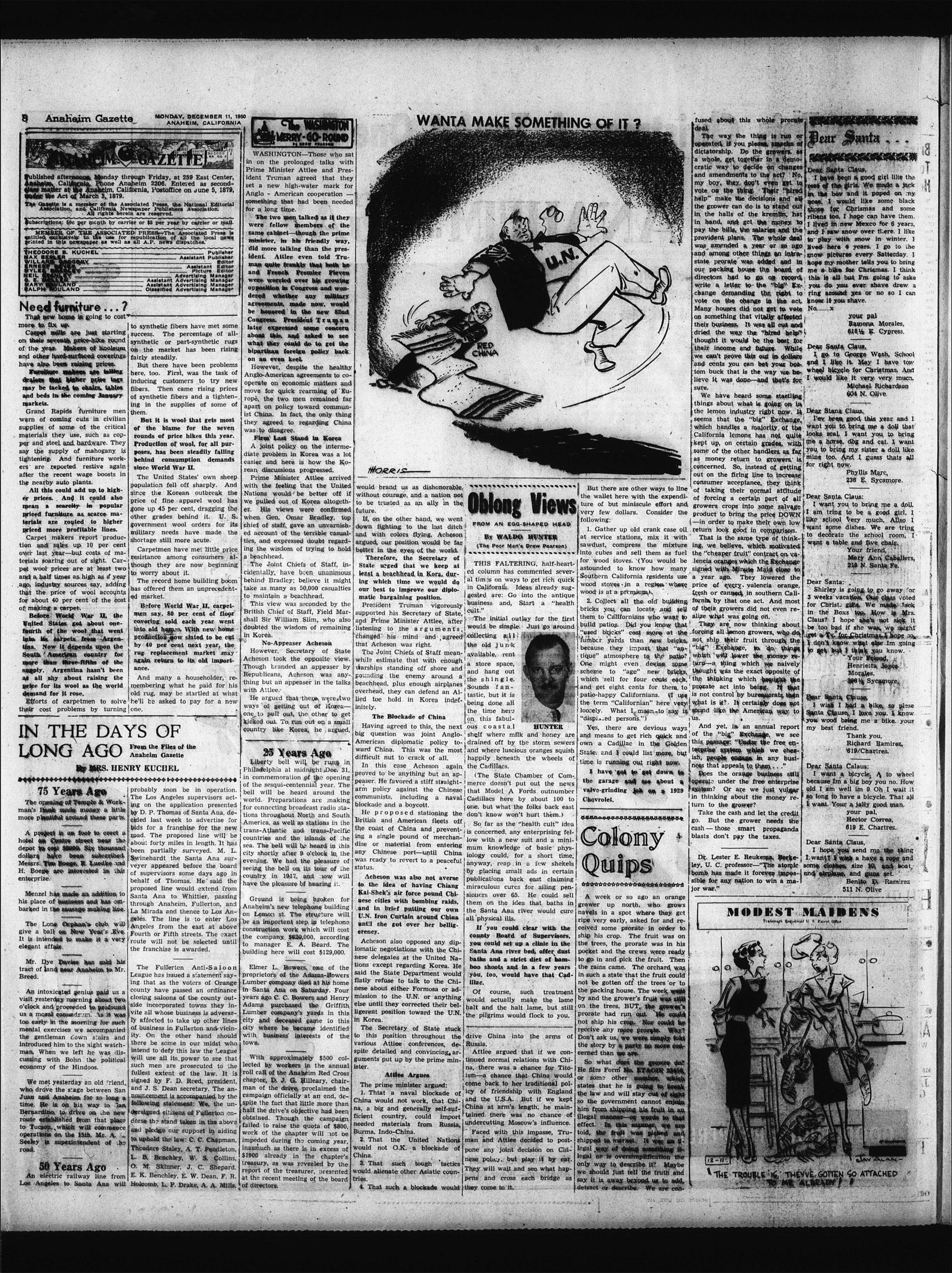
Searchable text
8 Anaheim Gazette MONDAY, DECEMBER 11, 1950 ANAHEIM, CALIFORNIA
Published afternoon, Monday through Friday, at 259 East Center, Anaheim, California. Phone Anaheim 2206. Entered as second-class matter at the Anaheim, California, Postoffice on June 5, 1879, under the Act of March 3, 1879.
The Gazette is a member of the Associated Press, the National Editorial Association, and California Newspaper Publishers Association. All rights herein are reserved.
Subscriptions: 60c per month by carrier or $5 per year by carrier or mail.
MEMBER OF THE ASSOCIATED PRESS—The Associated Press is entitled exclusively to the use for republication of all the local news printed in this newspaper as well as all A.P. news dispatches.
THEODORE B. KUCHEL Publisher
MAX BEILER Assistant Publisher
WILLARD GREGORY Editor
ERNEST BROWN Assistant Editor
MYLEE BROWN Picture Editor
NEIL STANLEY Advertising Manager
G. E. MULLAND Assistant Advertising Manager
MARY BOULAND Assistant Advertising Manager
BALPH ROULAND Classified Advertising Manager
Need furniture...?
That new home is going to cost more to fix up.
Carpet mills are just starting on their seventh price-bike round of the year. Makers of linoleum and other hard-surfaced coverings have also been raising prices.
Furniture makers are talking deals that higher price tags may be tacked to chairs, tables and beds in the coming January markets.
Grand Rapids furniture men warn of coming cuts in civilian supplies of some of the critical materials they use, such as copper and steel and hardware. They say the supply of mahogany is tightening. And furniture workers are reported restive again after the recent wage boosts in synthetic fibers have met some success. The percentage of all synthetic or part-synthetic rugs on the market has been rising fairly steadily.
But there have been problems here, too. First, was the task of inducing customers to try new fibers. Then came rising prices of synthetic fibers and a tightening in the supplies of some of them.
But it is wool that gets most of the blame for the seven rounds of price hikes this year. Production of wool, for all purposes, has been steadily falling behind consumption demands since World War II.
WASHINGTON—Those who sat in on the prolonged talks with Prime Minister Attlee and President Truman agreed that they set a new high-water mark for Anglo-American cooperation — something that had been needed for a long time.
The two men talked as if they were fellow members of the same cabinet—though the prime minister, in his friendly way, did more talking than the president. Attlee even told Truman quite frankly that both he and French Premier Pleven were worried over his growing opposition in Congress and wondered whether any military agreements, made now, would be honored in the new 82nd Congress. President Trump later expressed some concern about this, and asked to see what they could do to get the bipartisan foreign policy back on an even keel.
However, despite the healthy Anglo-American agreements to cooperate on economic matters and move for quick rearming of Europe, the two men remained far apart on policy toward communist China. In fact, the only thing they agreed to regarding China was to disagree.
Firm Last Stand in Korea
A joint policy on the intermediate problem in Korea was a lot easier and here is how the Korean discussions progressed.
Grand Rapids furniture men warn of coming cuts in civilian supplies of some of the critical materials they use, such as copper and steel and hardware. They say the supply of mahogany is tightening. And furniture workers are reported restive again after the recent wage boosts in the nearby auto plants.
All this could add up to higher prices. And it could also mean a scarcity in popular priced furniture as scarce materials are routed to higher priced more profitable lines.
Carpet makers report production and sales up 10 per cent over last year—but costs of materials soaring out of sight. Carpet wool prices are at least two and a half times as high as a year ago, industry sources say, adding that the price of wool accounts for about 40 per cent of the cost of making a carpet.
Before World War II, the United States got about one-fourth of the wool that went into its carpets from Argentina. Now it depends upon the South American country for more than three-fifths of the supply. Argentina hasn't been all shy about raising the price for its wool as the world demand for it rose.
Efforts of carpetmen to solve their cost problems by turning probably soon be in operation. The Los Angeles supervisors acting on the application presented by D. P. Thomas of Santa Ana, decided last week to advertise for bids for a franchise for the new road. The proposed line will be about forty miles in length. It has been partially surveyed. M. L. Swinehardt the Santa Ana surveyor appeared before the board of supervisors some days ago in behalf of Thomas. He said the proposed line would extend from Santa Ana to Whittier, passing Anglo-American agreements to cooperate on economic matters and move for quick rearming of Europe, the two men remained far apart on policy toward communist China. In fact, the only thing they agreed to regarding China was to disagree.
Firm Last Stand in Korea
A joint policy on the intermediate problem in Korea was a lot easier and here is how the Korean discussions progressed.
Prime Minister Attlee arrived with the feeling that the United Nations would be better off if we pulled out of Korea altogether. His views were confirmed when Gen. Omar Bradley, top chief of staff, gave an unvarnished account of the terrible casualties, and expressed doubt regarding the wisdom of trying to hold a beachhead.
The Joint Chiefs of Staff, incidentally, have been unanimous behind Bradley; believe it might take as many as 50,000 casualties to maintain a beachhead.
This view was seconded by the British Chief of Staff, Field Marshall Sir William Slim, who also doubted the wisdom of remaining in Korea.
No-Appeaser Acheson
However, Secretary of State Acheson took the opposite view. Though branded an appeaser by Republicans, Acheson was anything but an appeaser in the talks with Attlee.
He argued that there were two ways of getting out of Korea—one to pull out, the other to get kicked out. To run out on a small country like Korea, he argued,
IN THE DAYS OF LONG AGO From the Files of the Anahcim Gazette
By MRS. HENRY KUCHEL
75 Years Ago
The opening of Temple & Workman's Bank made money a little more plentiful around these parts.
A project is on foot to erect a hotel on Centre street near the depot to cost $8000. Six thousand dollars have been subscribed Messrs. Tim Boege, R. Luedke and H. Boege are interested in this enterprize.
Menzel has made an addition to probably soon be in operation. The Los Angeles supervisors acting on the application presented by D. P. Thomas of Santa Ana, decided last week to advertise for bids for a franchise for the new road. The proposed line will be about forty miles in length. It has been partially surveyed. M. L. Swinehardt the Santa Ana surveyor appeared before the board of supervisors some days ago in behalf of Thomas. He said the proposed line would extend from Santa Ana to Whittier, passing Anglo-American agreements to cooperate on economic matters and move for quick rearming of Europe, the two men remained far apart on policy toward communist China. In fact, the only thing they agreed to regarding China was to disagree.
Firm Last Stand in Korea
A joint policy on the intermediate problem in Korea was a lot easier and here is how the Korean discussions progressed.
Prime Minister Attlee arrived with the feeling that the United Nations would be better off if we pulled out of Korea altogether. His views were confirmed when Gen. Omar Bradley, top chief of staff, gave an unvarnished account of the terrible casualties, and expressed doubt regarding the wisdom of trying to hold a beachhead.
The Joint Chiefs of Staff, incidentally, have been unanimous behind Bradley; believe it might take as many as 50,000 casualties to maintain a beachhead.
This view was seconded by the British Chief of Staff, Field Marshal Sir William Slim, who also doubted the wisdom of remaining in Korea.
No-Appeaser Acheson
However, Secretary of State Acheson took the opposite view. Though branded an appeaser by Republicans, Acheson was anything but an appeaser in the talks with Attlee.
He argued that there were two ways of getting out of Korea—one to pull out, the other to get kicked out. To run out on a small country like Korea, he argued,
25 Years Ago
Liberty bell will be rung in Philadelphia at midnight Dec. 31, in commemoration of the opening of the sesqui-centennial year. The bell will be heard around the world. Preparations are making for connecting broadcast radio stations throughout North and South America, as well as stations in the trans-Atlantic and trans-Pacific countries and the islands of the sea. The bell will be heard in this city shortly after 9 o'clock in the evening. We had the pleasure of seeing the bell on its tour of the country in 1917, and now will have the pleasure of hearing it.
The opening of Temple & Workman's Bank made money a little more plentiful around these parts.
A project is on foot to erect a hotel on Centre street near the depot to cost $8000. Six thousand dollars have been subscribed. Messrs. Tim Boege, R. Luedke and H. Boege are interested in this enterprize.
Menzel has made an addition to his place of business and has embarked in the sausage making line.
The Lone Orphan's club will give a ball on New Year's Eve. It is intended to make it a very elegant affair.
Mr. Dye Davies has sold his tract of land near Anaheim to Mr. Breed.
An intoxicated genius paid us a visit yesterday morning about two o'clock and proceeded to profound us a moral conundrum. As it was too early in the morning for such mental exercises we accompanied the gentleman down stairs and introduced him to the night watchman. When we left he was discussing with Bohn the political economy of the Hindoos.
We met yesterday an old friend, who drove the stage between San Juan and Anaheim for so long a time. He is on his way to San Bernardino, to drive on the new route established from that place to Tucson, which will commence operations on the 15th. Mr. A. J. Seeley is superintendent of the road.
50 Years Ago
An electric railway line from Los Angeles to Santa Ana will The Fullerton Anti-Saloon League has issued a statement saying that as the voters of Orange county have passed an ordinance closing saloons of the county outside incorporated towns they invite all whose business is adversely affected to take up other lines of business in Fullerton and vicinity. On the other hand should there be some in our midst who intend to defy this law the League will use all its power to see that such men are prosecuted to the fullest extent of the law. It is signed by F. D. Reed, president, and J. S. Dean secretary. The announcement is accompanied by the following statement: We, the undersigned citizens of Fullerton endorse the stand taken in the above and pledge our support in aiding to uphold the law: C. C. Chapman, Theodore Staley, A. T. Pendleton, L. B. Benchley, W. S. Collins, O. M. Skinner, J. C. Shepard, E. K. Benchley, E. W. Dean, F. R. Holcomb, L. F. Drake, A. A. Mills,
Ground is being broken for Anaheim's new telephone building on Lemon st. The structure will be an important step in telephone construction work which will cost the company $620,000, according to manager E. A. Beard. The building here will cost $129,000.
Elmer L. Bowers, one of the proprietors of the Adams-Bowers Lumber company died at his home in Santa Ana on Saturday. Four years ago C. C. Bowers and Henry Adams purchased the Griffith Lumber company's yards in this city and deceased came to this city where he became identified with business interests of the town.
With approximately $500 collected by workers in the annual roll call of the Anaheim Red Cross chapter, D. J. G. Hillary, chairman of the drive, proclaimed the campaign officially at an end, despite the fact that little more than half the drive's objective had been obtained. Though the campaign failed to raise the quota of $800, work of the chapter will not be impeded during the coming year, inasmuch as there is in excess of $1900 already in the chapter's treasury, as was revealed by the report of the treasurer, presented at the recent meeting of the board of directors.
WANTA MAKE SOMETHING OF IT?
WASHINGTON—Those who sat prolonged talks with Minister Attlee and President Man agreed that they had high-water mark for American cooperation — that had been needed time.
Men talked as if they knew members of the net—though the prime minister in his friendly way, talking than the presettlee even told Tru- frankly that both he and Premier Pleven carried over his growing interest in Congress and won whether any military was made now, would be in the new 82nd President Trump expressed some concern, and asked to see if could do to get the foreign policy back on keel.
Despite the healthy American agreements to co-economic matters and quick rearming of Eu-wo men remained far policy toward commun- In fact, the only thing to regarding China agree.
Fast Stand in Korea policy on the interme-m in Korea was a lot here is how the Ko-sions progressed.
would brand us as dishonorable, without courage, and a nation not to be trusted as an ally in the future.
If, on the other hand, we went down fighting to the last ditch and with colors flying, Acheson argued, our position would be far better in the eyes of the world.
Therefore, the Secretary of State urged that we keep at least a beachhead in Kora, during which time we would do our best to improve our diplomatic bargaining position.
President Truman vigorously supported his Secretary of State, and Prime Minister Attlee, after listening to the arguments, changed his mind and agreed that Acheson was right.
The Joint Chiefs of Staff meanwhile estimate that with enough warships standing off shore and pounding the enemy around a beachhead, plus enough airplanes overhead, they can defend an Allied toe hold in Korea indefinitely.
The Blockade of China
Having agreed to this, the next big question was joint Anglo-American diplomatic policy toward China. This was the most difficult nut to crack of all.
In this case Acheson again proved to be anything but an appeaser. He favored a stiff straight-arm policy against the Chinese communists, including a naval blockade and a boycott.
He proposed stationing the British and American fleets off the coast of China and preventing a single pound of merchandise or material from entering any Chinese port—until China was ready to revert to a peaceful status.
Acheson was also not averse to the idea of having Chiang Kai-Shek's air force pound China.
Oblong Views
FROM AN EGG-SHAPED HEAD
By WALDO HUNTER
(The Poor Man's Drew Pearson)
THIS FALTERING, half-hearted column has commented several times on ways to get rich quick in California. Ideas already suggested are: Go into the antique business and, Start a "health cult."
The initial outlay for the first would be simple. Just go around collecting all the old junk available, rent a store space, and hang out the shingle. Sounds fantastic, but it is being done all the time here on this fabulous coastal shelf where milk and honey are drained off by the storm sewers and where luscious oranges squish happily beneath the wheels of the Cadillacs.
(The State Chamber of Commerce doesn't put out the news that Model A Fords outnumber Cadillacs here by about 100 to one, but what the folks back east don't know won't hurt them.)
So far as the "health cult" idea is concerned, any enterprising fellow with a new suit and a minimum knowledge of basic physiology could, for a short time, anyway, reap in a few shekels by placing small ads in certain publications back east claiming miraculous curcs for ailing pensioners over 65. He could sell But there are other ways to the wallet here with the experience of but miniscule efforts very few dollars. Consider following:
1. Gather up old crank cases at service stations, mix it with sawdust, compress the mix into cubes and sell them as for wood stoves. (You would astounded to know how many Southern California residents wood stoves in a region where wood is at a premium).
2. Collect all the old bulb bricks you can locate, and them to Californians who want build patios. Did you know "used bricks" cost more at lumber yards than new bricks because they impart that unique atmosphere to the place One might even devise a scheme to "age" new bricks which sell for four cents each and get eight cents for their patio-happy Californians. (If the term "Californian" here loosely. What I mean to say "displaced persons.")
Yes, there are devious ways and means to get rich quickly own a Cadillac in the Gulf State, and I could list more time is running out right now.
I have got to get down the garage and see about valve-grinding job on a Chovrolet.
Colony Quips
A week or so ago an ordeal
is being broken for new telephone building last. The structure will present step in telephone work which will cost $620,000, according to E. A. Beard. The fare will cost $129,000.
Bowers, one of the of the Adams-Bowers company died at his home on Saturday. Four C. Bowers and Henry purchased the Griffith company's yards in this deceased came to this he became identified less interests of the proximately $500 col-worker in the annual Anaheim Red Cross J. G. Hilleary, chair drive, proclaimed the officially at an end, deed that little more than we've objective had been though the campaign rise the quota of $800, the chapter will not be during the coming year, there is in excess of duty in the chapter's was revealed by the treasurer, presented at meeting of the board proposed stationing the British and American fleets off the coast of China and preventing a single pound of merchandise or material from entering any Chinese port—until China was ready to revert to a peaceful status.
Acheson was also not averse to the idea of having Chiang Kai-Shek's air force pound Chinese cities with bombing raids, and in brief putting our own U.N. Iron Curtain around China until she got over her belligerency.
Acheson also opposed any diplomatic negotiations with the Chinese delegates at the United Nations except regarding Korea. He said the State Department would flatly refuse to talk to the Chinese about either Formosa or admission to the U.N. or anything else until they corrected their belligerent position toward the U.N. in Korea.
The Secretary of State stuck to this position throughout the various Attlee conferences, despite detailed and convincing arguments put up by the prime minister.
Attlee Argues
The prime minister argued:
1. That a naval blockade of China would not work, that China, a big and generally self-sufficient country, could import needed materials from Russia, Burma, Indo-China.
2. That the United Nations would not O.K. a blockade of China.
3. That such tough tactics would alienate other Asiatic countries.
4. That such a blockade would drive China into the arms of Russia.
Attlee argued that if we continued normal relations with China, there was a chance for Titoism—a chance that China would come back to her traditional policy of friendship with England and the U.S.A. But if we kept China at arm's length, he maintained there was no chance of undercutting Moscow's influence.
Faced with this impasse, Truman and Attlee decided to postpone any joint decision on Chinese policy, but play it by car. They will wait and see what happens and cross each bridge as they come to it.
So far as the "health cult" idea is concerned, any enterprising fellow with a new suit and a minimum knowledge of basic physiology could, for a short time, anyway, reap in a few shekels by placing small ads in certain publications back east claiming miraculous curces for ailing pensioners over 65. He could sell them on the idea that baths in the Santa Ana river would cure all physical ills.
If you could clear with the county Board of Supervisors, you could set up a clinic in the Santa Ana river bed, offer dust baths and a strict diet of bamboo shoots and in a few years you, too, would have that Cadillac.
Of course, such treatment would actually make the lame halt and the halt lame, but still the pilgrims would flock to you.
So what does the grower He files Form No. ETAOIN 23 or some other number, who states that he is going to buy the law and will stay out of so the government cannot ent him from shipping his fruit in illegal manner—or words to effect. In this manner, we told, the fruit was picked shipped to market. It was an legal way of doing something legal or is oversimplification only way to describe it? Maybe we should just tell the truth say it is away beyond us to a detract or describe. We are
fused about this whole prorate deal.
The way the thing is run or operated, if you please, smacks of dictatorship. Do the growers, as a whole, get together in a democratic way to decide on changes and amendments to the act? No, my boy, they don't even get to vote on the thing. Their "hired help" make the decisions and all the grower can do is to stand out in the halls of the kremlin, hat in hand, and get the money to pay the bills, the salaries and the provident plans. The whole deal was amended a year or so ago and among other things an intra-state prorate was added and in our packing house the board of directors had to go on record, write a letter to the "big" Exchange demanding the right to vote on the change in the act. Many houses did not get to vote on something that vitally affected their business. It was all cut and dried the way the "hired help" thought it would be the best for their income and future. While we can't prove this out in dollars and cents you can bet your bottom buck that is the way we believe it was done—and that's for sure.
We have heard some startling things about what is going on in the lemon industry right now. It seems that the "big" Exchange, which handles a majority of the California lemons has not quite kept up, on certain grades, with some of the other handlers as far as money return to growers is concerned. So, instead of getting out on the firing line to increase
Dear Santa ...
Dear Santa Claus,
I have been a good girl like the rest of the girls. We made a jack in the boy and it poped on my nose. I would like some black shoe for Christmas and some ribs too. I hope can have them. I lived in new Mexico for 6 years, and I saw snow over there. I like to play with snow in winter. I lived here 4 years. I go to the snow pictures every Satterday. I hope my mother tells you to bring me a bike for Christmas. I think this is all but I'm going to ask you do you ever shave drew a ring around yes or no so I can know if you shave.
No.....x
your pal
Ramona Morales,
618½ E. Cypress.
Dear Santa Claus,
I go to George Wash, School and I like it. May I have toowheel bicycle for Christmas. And I would like it very much.
Michael Richardson
604 N. Olive.
Dear Stana Claus,
I've been good this year and I want you to bring me a doll that looks real. I want you to bring me a horse, dog and cat. I want you to bring my sister a doll like mine too. And I guess thats all for right now.
Phyllis Marc.
At there are other ways to line wallet here with the expenditure of but miniscule effort and few dollars. Consider thewing:
Gather up old crank case oil service stations, mix it with rust, compress the mixture cubes and sell them as fuel wood stoves. (You would be interested to know how many northern California residents use stoves in a region where it is at a premium).
Collect all the old buildings you can locate and sell to Californians who want to patios. Did you know that bricks" cost more at the four yards than new bricks, use they impart that "an atmosphere to the patio"? It might even devise some one to "age" new bricks, sell for four cents each, get eight cents for them to happy Californians. (I use term "Californian" here very simply. What I mean to say is related persons.))
There are devious ways means to get rich quick and a Cadillac in the Golden Gate and I could list more, but is running out right now.
Have got to get down to garage and see about a co-grinding job on a 1929 Chevrolet.
We have heard some startling things about what is going on in the lemon industry right now. It seems that the "big" Exchange, which handles a majority of the California lemons has not quite kept up, on certain grades, with some of the other handlers as far as money return to growers is concerned. So, instead of getting out on the firing line to increase consumer acceptance, they think of taking their normal attitude of forcing a certain part of all growers crops into some salvage product to bring the price DOWN—in order to make their own low return look good in comparison.
That is the same type of thinking we believe, which motivated the "cheaper fruit" contract on valencia oranges which the Exchange signed with Minute Maid close to a year ago. They lowered the price of every valencia orange, fresh or canned, in southern California by that one act. And most of their growers did not even realize what was going on.
They are now thinking about forcing all lemon growers, who do not ship their fruit through the "big" Exchange, to do things which will lower the money return—a thing which we naively thought was the exact opposite of the thinking which brought the prorate act into being. If that is not control by bureaucrats then what is it? It certainly does not sound like the American way to us.
And yet, in an annual report of the "big" Exchange, we see this passage: "Under the free enterprise system which we cherish, people engage in any business that appeals to them..."
Does the orange business still operate under the free enterprise system? Or are we just vulgar in thinking about the money return to the grower?
Take the cash and let the credit go. But the grower needs the cash—those smart propaganda blasts don't pay the taxes.
Dr. Lester E. Reukema, Berkeley, U.C. professor—"The atomic bomb has made it forever impossible for any nation to win a major war."
I would like it very very much.
Michael Richardson
604 N. Olive
Dear Stana Claus,
I've been good this year and I want you to bring me a doll that looks real. I want you to bring me a horse, dog and cat. I want you to bring my sister a doll like mine too. And I guess thats all for right now.
Phyllis Marc,
236 E. Sycamore.
Dear Santa Claus:
I want you to bring me a doll. I am tring to be a good girl, I like school Very much. Allso I want some dishes. We are tring to decorate the school room, I want a table and five chair.
Your friend,
Mary Ann Caballers,
219 N. Santa Fe.
Dear Santa:
Shirley is going to go away or 3 weeks vacation. Our class voted for Christ gifts. We made Jack in the Boxs too. How is Mrs. Claus? I hope she's not sick it be too bad if she was, we might get a TV for Christmas I hope so I don't know what else Im going to get but I think you know.
Your Friend,
Henrietta Joyce
Morales,
398½ Sycamore.
Dear Santa Clause,
I wish I had a bike, so please Santa Clause, I love you. I know you wood bring me a bike your my best friend.
Thank you,
Richard Ramirez,
619/Chartres.
Dear Santa Calaus:
I want a bicycle. A to wheel because Im a big boy you no. How old I am well im 9 Oh I wait it so long to have a bicycle. That all I want. Your a jally good man.
your pal,
Hector Correa,
619 E. Chartres.
Dear Santa Claus,
I hope you send me the thing I want? I wish a have a rope and some clothes, size 10, and boat, and airplane, and guns set.
Benito D. Ramirez
511 N. Olive
MODEST MAIDENS
Trademark Registered U.S. Patent Office
THE TROUBLE IS, THEYVE GOTTEN SO ATTACHED TO ME ALREADY!!