anaheim-gazette 1945-12-06
Scanned page
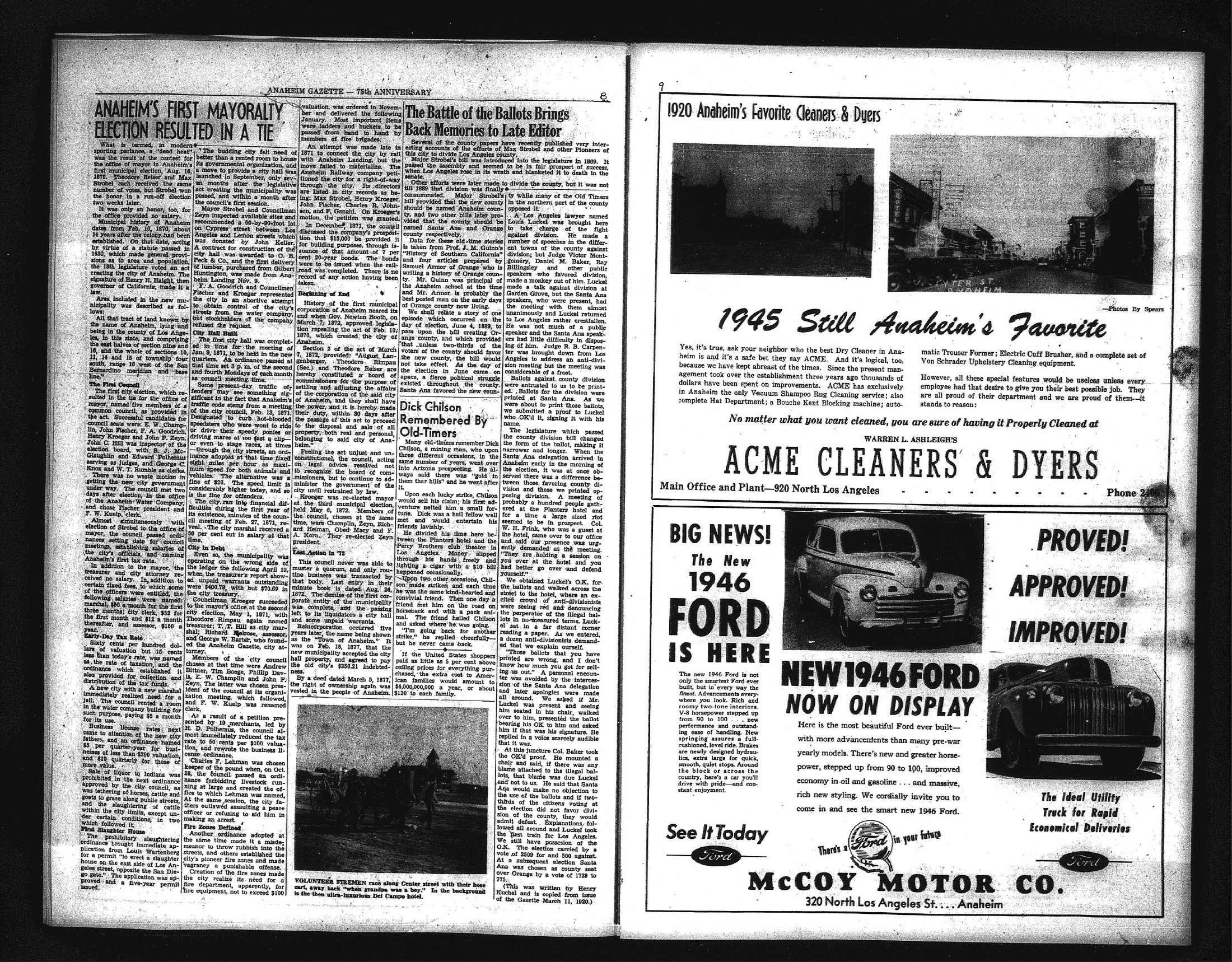
Searchable text
ANAHEIM’S FIRST MAYORALTY ELECTION RESULTED IN A TIE
What is termed, in modern sporting parlance, a “dead heat” was the result of the contest for the office of mayor in Anaheim’s first municipal election, Aug. 16, 1870. Theodore Reiser and Max Strobel each received the same number of votes, but Strobel won the honor in a run-off election two weeks later.
It was only an honor, too, for the office provided no salary.
Municipal history of Anaheim dates from Feb. 10, 1870, about 14 years after the colony had been established. On that date, acting by virtue of a statute passed in 1850, which made general provisions as to area and population, the 18th legislature voted an act creating the city of Anaheim. The signature of Henry H. Halight, then governor of California, made it a law.
Area included in the new municipality was described as follows:
All that tract of land known by the name of Anaheim, lying and being in the county of Los Angeles, in this state, and comprising the east halves of section nine and 10, and the whole of sections 10, 11, 14 and 15 of township four.
The budding city felt need of better than a rented room to house its governmental organization, and a move to provide a city hall was launched in September, only seven months after the legislative act creating the municipality was passed, and within a month after the council's first session.
Mayor Strobel and Councilman Zeyn inspected available sites and recommended a 80-by-90-foot lot on Cypress street between Los Angeles and Lemon streets which was donated by John Keller. A contract for construction of the city hall was awarded to O. B. Peck & Co., and the first delivery of lumber, purchased from Gilbert Huntington, was made from Anaheim Landing Nov. 9.
F. A. Goodrich and Councilmen Fischer and Kroeger represented the city in an abortive attempt to obtain control of the city's streets from the water company, but stockholders of the company refused the request.
City Hall Built
The first city hall was completed in time for the meeting of Jan. 9, 1871, to be held in the new valuation, was ordered in November and delivered the following January. Most important items were ladders and buckets to be passed from hand to hand by members of fire brigades.
An attempt was made late in 1871 to connect the city by rail with Anaheim Landing, but the move failed to materialize. The Anaheim Railway company petitioned the city for a right-of-way through the city. Its directors are listed in city records as being: Max Strobel, Henry Kroeger, John Fischer, Charles R. Johnson, and F. Ganahl. On Kroeger's motion, the petition was granted.
In December, 1871, the council discussed the company's proposition that $15,000 be provided it for building purposes, through issuance of that amount of 7 per cent 20-year bonds. The bonds were to be issued when the railroad was completed. There is no record of any action having been taken.
Beginning of End
History of the first municipal corporation of Anaheim neared its end when Gov. Newton Booth, on March 7, 1872, approved legislation repealing the act of Feb. 10, 1870, which created the city of Anaheim.
Section 2 of the act of March 7, 1872, provided: "August Lan-
The First Council
The first city election, which resulted in the tie for the office of mayor, named five members of a common council, as provided in the act. Successful candidates for council seats were: E. W. Champlin, John Fischer, F. A. Goodrich, Henry Kroeger and John P. Zeyn. John C. Hill was inspector of the election board, with S. J. McGlaughlin and Edward Polhemus serving as judges, and George C. Knox and W. T. Rumble as clerks.
There was no waste motion in getting the new city government under way. The council met two days after election, in the office of the Anaheim Water Company, and chose Fischer president and F. W. Kuelp, clerk.
Almost simultaneously with election of Strobel to the office of mayor, the council passed ordinances setting date for council meetings, establishing salaries of the city's officials, and naming Anaheim's first tax rate.
In addition to the mayor, the treasurer and city attorney received no salary. In addition to certain fixed fees, to which some of the officers were entitled, the following salaries were named: marshal, $50 a month for the first three months; city clerk, $32 for the first month and $12 a month thereafter, and assessor, $150 a year.
Early-Day Tax Rate
Sixty cents per hundred dollars of valuation but 15 cents less than today's rate, was named as the rate of taxation, and the ordinance which established it also provided for collection and F. A. Goodrich and Councilmen Fischer and Kroeger represented the city in an abortive attempt to obtain control of the city's streets from the water company, but stockholders of the company refused the request.
City Hall Built
The first city hall was completed in time for the meeting of Jan. 9, 1871, to be held in the new quarters. An ordinance passed at that time set 3 p.m. of the second and fourth Mondays of each month as council meeting time.
Some present-day traffic offenders may see something significant in the fact that Anaheim's traffic code stems from a meeting of the city council, Feb. 13, 1871. Designated to curb hot-blooded speedsters who were wont to ride or drive their speedy ponies or driving mares at too fast a clip—or even to stage races, at times—through the city streets, an ordinance adopted at that time fixed eight miles per hour as maximum speed for both animals and vehicles. The alternative was a fine of $20. The speed limit is considerably higher today, and so is the fine for offenders.
The city ran into financial difficulties during the first year of its existence, minutes of the council meeting of Feb. 27, 1871, reveal. The city marshal received a 50 per cent cut in salary at that time.
City in Debt
Even so, the municipality was operating on the wrong side of the ledger the following April 10, when the treasurer's report showed unpaid warrants outstanding were $400.79, with but $70.89 in the city treasury.
Councilman Kroeger succeeded to the mayor's office at the second city election, May 1, 1871, with Theodore Rimpau again named treasurer; T. T. Hill as city marshal; Richard Melrose, assessor, and George W. Barter, who founded the Anaheim Gazette, city attorney.
Members of the city council chosen at that time were Andrew Bittner, Tim Boege, Phillip Davis, E. W. Champlin and John P.
Beginning of End
History of the first municipal corporation of Anaheim neared its end when Gov. Newton Booth, on March 7, 1872, approved legislation repealing the act of Feb. 10, 1870, which created the city of Anaheim.
Section 2 of the act of March 7, 1872, provided: "August Langenberger, Theodore Rimpau (Sec.) and Theodore Reiser are hereby constituted a board of commissioners for the purpose of settling and adjusting the affairs of the corporation of the said city of Anaheim, and they shall have the power, and it is hereby made their duty, within 30 days after the passage of this act to proceed to the disposal and sale of all property, both real and personal, belonging to said city of Anaheim."
Feeling the act unjust and unconstitutional, the council, acting on legal advice resolved not to recognize the board of commissioners, but to continue to administer the government of the city until restrained by law.
Kroeger was re-elected mayor at the third municipal election, held May 6, 1872. Members of the council, chosen at the same time, were Champlin, Zeyn, Richard Heiman, Obed Macy and F. A. Korn. They re-elected Zeyn president.
Last Action in '72
This council never was able to muster a quorum, and only routine business was transacted by that body. Last entry in their minute book is dated Aug. 26, 1872. The demise of the first corporate entity of the municipality was complete, and the passing left to its liquidators a city hall and some unpaid warrants.
Reincorporation occurred five years later, the name being shown as the "Town of Anaheim." It was on Feb. 16, 1877, that the new municipality accepted the city hall property, and agreed to pay the old city's $358.21 indebtedness.
By a deed dated March 5, 1877,
the Anaheim school and Mr. Armor is best posted man on or Orange county m.
We shall relate an episode which occured day of election, Just pass upon the billange county,and wethat unless two-thvoters of the county,the new county,thenot take effect.Athe election in Juapace,a fierce poliexisted throughout Santa Ana favored tha
Dick Chilson Remembered Old-Timers
Many old-timers reChilson,a mining manthree different occauses same number of yearsinto Arizona prospectways said therew them thar hills"and it.
Upon each lucky stwould sell his claim;venture netted himintune.Dick was a halmetet and would esfriends lavishly.
He divided his timetween the Planters hhPerry Brothers clubLos Angeles.Monthrough his handslighting a cigarwithhappened occasionally.Upon two otheroccasionmade strikes;andhewasthe same kindconvivial friend.Thefriend met him onthehorseback andwithmal.The friendhalndand asked where hew"I'm going backstrike,"he repliedbut he never came b
If the United States paid as little as 5 per ceiling prices for even chased,the extra cost
Early-Day Tax Rate
Sixty cents per hundred dollars of valuation but 15 cents less than today's rate, was named as the rate of taxation, and the ordinance which established it also provided for collection and distribution of the tax funds.
A new city with a new marshal immediately realized need for a jail. The council rented a room in the water company building for such purpose, paying $5 a month for its use.
Business license rates next came to attention of the new city fathers, and an ordinance named $5 per quarter-year for businesses of less than $200 valuation, and $10 quarterly for those of more value.
Sale of liquor to Indians was prohibited in the next ordinance approved by the city council, as was tethering of horses, cattle and goats to graze along public streets, and the slaughtering of cattle within the city limits, except under certain conditions, in two which followed it.
First Slaughter House
The prohibitory slaughtering ordinance brought immediate application from Louis Wartenberg for a permit "to erect a slaughter house on the east side of Los Angeles street, opposite the San Diego gate." The application was approved and a five-year permit issued.
The Battle of the Ballots Brings Back Memories to Late Editor
Several of the county papers have recently published very interesting accounts of the efforts of Max Strobel and other Pioneers of this city to divide Los Angeles county.
Major Strobel's bill was introduced into the legislature in 1869. It passed the assembly and seemed to be in fair prospect of success, when Los Angeles rose in its wrath and blanketed it to death in the senate.
Other efforts were later made to divide the county, but it was not till 1889 that division was finally consummated. Major Strobel's bill provided that the new county should be named Anaheim county, and two other bills later provided that the county should be named Santa Ana and Orange county respectively.
Data for these old-time stories is taken from Prof. J. M. Guinn's "History of Southern California" and four articles prepared by Samuel Armor of Orange who is writing a history of Orange county. Mr. Guinn was principal of the Anaheim school at the time and Mr. Armor is probably the best posted man on the early days of Orange county now living.
We shall relate a story of one episode which occurred on the day of election, June 4, 1889, to pass upon the bill creating Orange county, and which provided that unless two-thirds of the voters of the county should favor the new county, the bill would
A Los Angeles lawyer named Louis Luckel was brought here to take charge of the fight against division. He made a number of speeches in the different towns of the county against division; but Judge Victor Montgomery, Daniel M. Baker, Ray Billingsley and other public speakers who favored division, made a monkey out of him. Luckel made a talk against division at Garden Grove, but the Santa Ana speakers, who were present, had the meeting with them almost unanimously and Luckel returned to Los Angeles rather crestfallen. He was not much of a public speaker and the Santa Ana speakers had little difficulty in disposing of him. Judge R. B. Carpenter was brought down from Los Angeles to address an official.
1920 Anaheim’s Favorite Cleaners & Dye
Yes, it's true, ask your neighbor who the best Dry Cleaner is and it's a safe bet they say ACME. And it's
Dick Chilson Remembered By Old-Timers
Many old-timers remember Dick Chilson, a mining man, who upon three different occasions, in the same number of years, went over into Arizona prospecting. He always said there was "gold in them thar hills" and he went after it.
Upon each lucky strike, Chilson would sell his claim; his first adventure netted him a small fortune. Dick was a hall fellow well met and would entertain his friends lavishly.
He divided his time here between the Planters hotel and the Perry Brothers club theater in Los Angeles. Money slipped through his hands freely and lighting a cigar with a $10 bill happened occasionally.
Upon two other occasions, Chilson made strikes; and each time he was the same kind-hearted and convivial friend. Then one day a friend met him on the road on horseback and with a pack animal. The friend hailed Chilson and asked where he was going.
"I'm going back for another strike," he replied cheerfully—but he never came back.
If the United States shoppers paid as little as 5 per cent above cefiling prices for everything purchased, the extra cost to American made a talk against division at Garden Grove, but the Santa Ana speakers, who were present, had the meeting with them almost unanimously and Luckel returned to Los Angeles rather crestfallen. He was not much of a public speaker and the Santa Ana speakers had little difficulty in disposing of him. Judge R. B. Carpenter was brought down from Los Angeles to address an anti-division meeting but the meeting was considerable of a frost.
Ballots against county division were entrusted to us to be printed. Ballots for the division were printed at Santa Ana. As we were about to print those ballots, we submitted a proof to Luckel who OK'd it, signing it with his name.
The legislature which passed the county division bill changed the form of the ballot, making it narrower and longer. When the Santa Ana delegation arrived in Anaheim early in the morning of the election, it was at once observed there was a difference between those favoring county division and those we printed opposing division. A meeting of probably a hundred people gathered at the Planters hotel and for a time a large sized riot seemed to be in prospect. Col. W. H. Frink, who was a guest at the hotel, came over to our office and said our presence was urgently demanded at the meeting. "They are holding a session on you over at the hotel and you had better go over and defend yourself."
We obtained Luckel's OK. for the ballots and walked across the street to the hotel, where an excited crowd of anti-divisionists were seeing red and denouncing the perpetrator of the illegal ballots in no-measured terms. Luckel sat in a far distant corner reading a paper. As we entered, a dozen anti-divisionists demanded that we explain ourselves.
"Those ballots that you have printed are wrong, and I don't know how much you got for selling us out." A personal encounter was avoided by the interne
If the United States shoppers paid as little as 5 per cent above ceiling prices for everything purchased, the extra cost to American families would amount to $4,000,000,000 a year, or about $120 to each family.
At this juncture Col. Baker took the OK'd proof. He mounted a chair and said, if there was any blame attached to the illegal ballots, that blame was due Luckel and not to us. He said that Santa Ana would make no objection to the use of the ballots and if two-thirds of the citizens voting at the election did not favor division of the county, they would admit defeat. Explanations followed all around and Luckel took the first train for Los Angeles. We still have possession of the O.K. The election carried by a vote of 2509 for and 500 against. At a subsequent election Santa Ana was chosen as county seat over Orange by a vote of 1729 to 775.
(This was written by Henry Kuchel and is copied from issue of the Gazette March 11, 1920.)
Favorite Cleaners & Dyers
—Photos By Spears
Still Anaheim's Favorite
habor who the best Dry Cleaner in Anathey say, ACME. And it's located at
matic Trouser Former; Electric Cuff Brusher, and a complete set of
Still Anaheim's Favorite
hbor who the best Dry Cleaner in Anathey say ACME. And it's logical, too,
most of the times. Since the present manablishment three years ago thousands of
improvements. ACME has exclusively
from Shampoo Rug Cleaning service; also
a Bouche Kent Blocking machine; auto-
matic Trouser Former; Electric Cuff Brusher, and a complete set of
Von Schrader Upholstery Cleaning equipment.
However, all these special features would be useless unless every
employee had that desire to give you their best possible job. They
are all proud of their department and we are proud of them—it
stands to reason:
For what you want cleaned, you are sure of having it Properly Cleaned at
WARREN L. ASHLEIGH'S
ME CLEANERS & DYERS
1920 North Los Angeles Phone 2405
PROVED!
APPROVED!
IMPROVED!
NEW 1946 FORD
NEW 1946 FORD
NOW ON DISPLAY
Here is the most beautiful Ford ever built—with more advancements than many pre-war yearly models. There’s new and greater horsepower, stepped up from 90 to 100, improved economy in oil and gasoline . . . and massive, rich new styling. We cordially invite you to come in and see the smart new 1946 Ford.
The Ideal Utility Truck for Rapid Economical Deliveries
McCOY MOTOR CO.
320 North Los Angeles St.... Anaheim