anaheim-gazette 1945-12-06
Scanned page
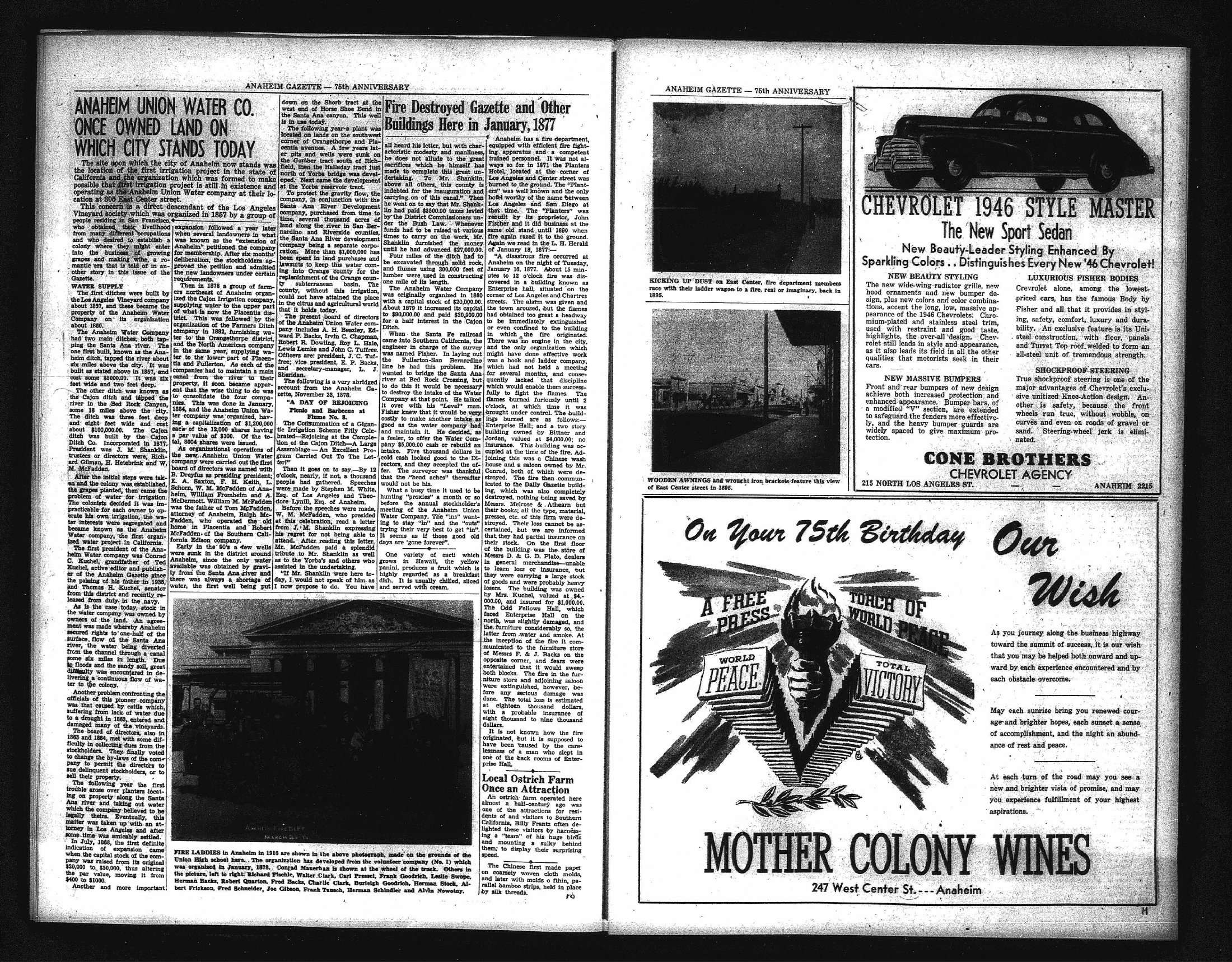
Searchable text
ANAHEIM UNION WATER CO.
ONCE OWNED LAND ON
WHICH CITY STANDS TODAY
The site upon which the city of Anaheim now stands was the location of the first irrigation project in the state of California and the organization which was formed to make possible that first irrigation project is still in existence and operating as the Anaheim Union Water company at their location at 305 East Center street.
This concern is a direct descendant of the Los Angeles Vineyard society which was organized in 1857 by a group of people residing in San Francisco, who obtained their livelihood from many different occupations and who desired to establish a colony where they might enter into the business of growing grapes and making wine, a romantic era that is told of in another story in this issue of the Gazette.
WATER SUPPLY
The first ditches were built by the Los Angeles Vineyard company about 1857, and these became the property of the Anaheim Water Company on its organization about 1860.
The Anaheim Water Company had two main ditches, both tapping the Santa Ana river. The one first built, known as the Anaheim ditch, tanned the rivers about expansion followed a year later when several landowners in what was known as the "extension of Anaheim" petitioned the company for membership. After six months' deliberation, the stockholders approved the petition and admitted the new landowners under certain requirements.
Then in 1878 a group of farmers northeast of Anaheim organized the Cajon Irrigation company, supplying water to the upper part of what is now the Placentia district. This was followed by the organization of the Farmers Ditch company in 1882, furnishing water to the Orangethorpe district, and the North American company in the same year, supplying water to the lower part of Placentia down on the Shorb tract at the west end of Horse Shoe Bend in the Santa Ana canyon. This well is in use today.
The following year a plant was located on lands on the southwest corner of Orangethorpe and Placentia avenues. A few years later pits and wells were sunk on the Gomber tract south of Richfield, then the Halladay tract just north of Yorba bridge was developed. Next came the development at the Yorba reservoir tract.
To protect the gravity flow, the company, in conjunction with the Santa Ana River Development company, purchased from time to time, several thousand acres of land along the river in San Bernardino and Riverside counties, the Santa Ana River development company being a separate corporation. More than $1,000,000 has been spent in land purchases and lawsuits to keep this water coming into Orange county for the replenishment of the Orange county subterranean basin. The county, without this irrigation, could not have attained the place in the citrus and agricultural world that it holds today.
The present board of directors of the Anaheim Union Water company includes A. H. Beazley, Edward P. Backs, Irvin C. Chapman, Robert R. Dowling, Roy L. Hale, Lewis Lemke and John C. Tuffree. Officers are: president, J. C. Tuffree.
Fire Destroyed Buildings Here
all heard his letter, but with aacteristic modesty and made to complete this dertaking. To Mr. S above all others, this co indebted for the inauguration carrying on of this canal, he went on to say that Mr. ill had paid $3500.00 taxes by the District Commission der the Bush Law. We funds had to be raised at times to carry on the work Shanklin furnished until he had advanced $2400. Four miles of the ditch be excavated through soil and flumes using 300,000 lumber were used in cons one mile of its length.
The Anaheim Water Co was originally organized with a capital stock of $200,000 About 1879 it increased its to $90,000.00 and paid $240 for a half interest in the Ditch.
When the Santa Fe came into Southern California engineer in charge of the was named Fisher. In lay
WATER SUPPLY
The first ditches were built by the Los Angeles Vineyard company about 1857, and these became the property of the Anaheim Water Company on its organization about 1860.
The Anaheim Water Company had two main ditches, both tapping the Santa Ana river. The one first built, known as the Anaheim ditch, tapped the river about six miles above the city. It was built as stated above in 1857, and cost some $5000.00. It was six feet wide and two feet deep.
The other ditch was known as the Cajon ditch and tapped the river in the Bed Rock Canyon, some 18 miles above the city. The ditch was three feet deep and eight feet wide and cost about $100,000.00. The Cajon ditch was built by the Cajon Ditch Co. Incorporated in 1877. President was J. M. Shanklin, trustees or directors were, Richard Gilman, H. Hetebrink and W. M. McFadden.
After the initial steps were taken and the colony was established, the grapes planted, then came the problem of water for irrigation. The colonists decided it was impracticable for each owner to operate his own irrigation, the water interests were segregated and became known as the Anaheim Water company, the first organized water project in California.
The first president of the Anaheim Water company was Conrad C. Kuchel, grandfather of Ted Kuchel, active editor and publisher of the Anaheim Gazette since the passing of his father in 1935, and Thomas H. Kuchel, senator from this district and recently released from duty in the navy.
As is the case today, stock in the water company was owned by owners of the land. An agreement was made whereby Anaheim secured rights to one-half of the surface flow of the Santa Ana river, the water being diverted from the channel through a canal some six miles in length. Due to floods and the sandy soil, great difficulty was encountered in delivering a continuous flow of water.
Then in 1878 a group of farmers northeast of Anaheim organized the Cajon Irrigation company, supplying water to the upper part of what is now the Placentia district. This was followed by the organization of the Farmers Ditch company in 1882, furnishing water to the Orangethorpe district, and the North American company in the same year, supplying water to the lower part of Placentia and Fullerton. As each of the companies had to maintain a main canal from the river to their property, it soon became apparent that the wise thing to do was to consolidate the four companies. This was done in January, 1884, and the Anaheim Union Water company was organized, having a capitalization of $1,200,000 each of the 12,000 shares having a par value of $100. Of the total, 8004 shares were issued.
As organizational operations of the new Anaheim Union Water company were carried out the first board of directors was named with B. Dreyfus as presiding president; E. A. Saxton, F. H. Keith, L. Schorn, W. M. McFadden of Anaheim, William Fromheim and A. McDermott. William M. McFadden was the father of Tom McFadden, attorney of Anaheim, Ralph McFadden, who operated the old home in Placentia and Robert McFadden of the Southern California Edison company.
Early in the 90's a few wells were sunk in the district around Anaheim, since the only water available was obtained by gravity from the Santa Ana river and there was always a shortage of water, the first well being put subterranean basin. The county, without this irrigation, could not have attained the place in the citrus and agricultural world that it holds today.
The present board of directors of the Anaheim Union Water company includes A. H. Beazley, Edward P. Backs, Irvin C. Chapman, Robert R. Dowling, Roy L. Hale, Lewis Lemke and John C. Tuffree. Officers are: president, J. C. Tuffree; vice president, E. P. Backs, and secretary-manager, L. J. Sheridan.
The following is a very abridged account from the Anaheim Gazette, November 23, 1878.
"A DAY OF REJOICING
Picnic and Barbecue at Flume No. 8.
The Consummation of a Gigantic Irrigation Scheme Fitly Celebrated—Rejoicing at the Completion of the Cajon Ditch—a Large Assemblage—An Excellent Program Carried Out To The Letter!"
Then it goes on to say,-By 12 o'clock, nearly, if not, a thousand people had gathered. Speeches were made by Stephen M. White, Esq. of Los Angeles and Theodore Lynill, Esq. of Anaheim.
Before speeches were made, W. M. McFadden, who presided at this celebration, read a letter from J. M. Shanklin expressing his regret for not being able to attend. After reading this letter, Mr. McFadden paid a splendid tribute to Mr. Shanklin as well as to the Yorba's and others who assisted in the undertaking.
"If Mr. Shanklin were here today, I would not speak of him as I now propose to do." You have
One variety of cacti grows in Hawaii, the panilim produces a fruit widely regarded as a bread dish. It is usually chilled and served with cream.
As is the case today, stock in the water company was owned by owners of the land. An agreement was made whereby Anaheim secured rights to one-half of the surface, flow of the Santa Ana river, the water being diverted from the channel through a canal some six miles in length. Due to floods and the sandy soil, great difficulty was encountered in delivering a continuous flow of water to the colony.
Another problem confronting the officials of this pioneer company was that caused by cattle which, suffering from lack of water due to a drought in 1863, entered and damaged many of the vineyards.
The board of directors, also in 1863 and 1864, met with some difficulty in collecting dues from the stockholders. They finally voted to change the by-laws of the company to permit the directors to sue delinquent stockholders, or to sell their property.
The following year the first trouble arose over planters locating on property along the Santa Ana river and taking out water which the company believed to be legally theirs. Eventually, this matter was taken up with an attorney in Los Angeles and after some time was amicably settled.
In July, 1868, the first definite indication of expansion came when the capital stock of the company was raised from its original $20,000 to $50,000, thus altering the par value, moving it from $400 to $1000.
Another and more important...
Fire Destroyed Gazette and Other Buildings Here in January, 1877
all heard his letter, but with characteristic modesty and manliness, he does not allude to the great sacrifices which he himself has made to complete this great undertaking. To Mr. Shanklin, above all others, this county is indebted for the inauguration and carrying on of this canal." Then he went on to say that Mr. Shanklin had paid $3500.00 taxes levied by the District Commissioners under the Bush Law. Whenever funds had to be raised at various times to carry on the work, Mr. Shanklin furnished the money until he had advanced $27,000.00.
Four miles of the ditch had to be excavated through solid rock, and flumes using 300,000 feet of lumber were used in constructing one mile of its length.
The Anaheim Water Company was originally organized in 1860 with a capital stock of $20,000.00. About 1879 it increased its capital to $90,000.00 and paid $20,000.00 for a half interest in the Cajon Ditch.
When the Santa Fe railroad came into Southern California, the engineer in charge of the survey was named Fisher. In laying out Anaheim has a fire department, equipped with efficient fire fighting apparatus and a competent trained personnel. It was not always so for in 1871 the Planters Hotel, located at the corner of Los Angeles and Center street was burned to the ground. The "Planters" was well known and the only hotel worthy of the name between Los Angeles and San Diego at that time. The "Planters" was rebuilt by its proprietor, John Fischer and it did business at the same old stand until 1890 when fire again razed it to the ground. Again we read in the L. H. Herald of January 18, 1877:
"A disastrous fire occurred at Anaheim on the night of Tuesday, January 16, 1877. About 15 minutes to 12 o'clock fire was discovered in a building known as Enterprise hall, situated on the corner of Los Angeles and Chartres streets. The alarm was given and the town aroused, but the flames had obtained too great a headway to be immediately extinguished or even confined to the building in which the fire originated. There was no engine in the city, and the only organization which might have done effective work..."
KICKING UP DUST on East Center, fire department members race with their ladder wagon to a fire, real or imaginary, back in 1895.
The Anaheim Water Company was originally organized in 1860 with a capital stock of $20,000.00. About 1879 it increased its capital to $90,000.00 and paid $20,000.00 for a half interest in the Cajon Ditch.
When the Santa Fe railroad came into Southern California, the engineer in charge of the survey was named Fisher. In laying out the Fullerton-San Bernardino line he had this problem. He wanted to bridge the Santa Ana river at Bed Rock Crossing, but to do this it would be necessary to destroy the intake of the Water Company at that point. He talked it over with his "Level" man. Fisher knew that it would be very costly to make another intake as good as the water company had and maintain it. He decided, as a feeler, to offer the Water Company $5,000.00 cash or rebuild an intake. Five thousand dollars in cold cash looked good to the Directors, and they accepted the offer. The surveyor was thankful that the "head aches" thereafter would not be his.
What a busy time it used to be hunting "proxies" a month or so before the annual stockholder's meeting of the Anaheim Union Water Company. The "ins" wanting to stay "in" and the "outs" trying their very best to get "in". It seems as if those good old days are 'gone forever'.
One variety of cacti which grows in Hawaii, the yellow panini, produces a fruit which is highly regarded as a breakfast dish. It is usually chilled, sliced and served with cream.
Enterprise hall, situated on the corner of Los Angeles and Chartres streets. The alarm was given and the town aroused, but the flames had obtained too great a headway to be immediately extinguished or even confined to the building in which the fire originated. There was no engine in the city, and the only organization which might have done effective work was a hook and ladder company, which had not held a meeting for several months, and consequently lacked that discipline which would enable them successfully to fight the flames. The flames burned furiously until 2 o'clock, at which time it was brought under control. The buildings burned are as follows:—Enterprise Hall; and a two story building owned by Bittner and Jordan, valued at $4,000.00; no insurance. This building was occupied at the time of the fire. Adjoining this was a Chinese wash house and a saloon owned by Mr. Conrad, both of which were destroyed. The fire then communicated to the Daily Gazette building, which was also completely destroyed, nothing being saved by Messrs. Melrose & Athearn but their books; all the type, material, presses, etc. of this firm were destroyed. Their loss cannot be ascertained, but we are informed that they had partial insurance on their stock. On the first floor of the building was the store of Messrs D. & G. D. Plato, dealers in general merchandise—unable to learn loss or insurance, but they were carrying a large stock of goods and were probably heavy losers. The building was owned by Mrs. Kuchel, valued at $4,-000.00, and insured for $1,000.00. The Odd Fellows Hall, which faced Enterprise Hall on the north, was slightly damaged, and the furniture considerably so, the latter from water and smoke. At the inception of the fire it communicated to the furniture store of Messrs F. & J. Backs on the opposite corner, and fears were entertained that it would sweep both blocks. The fire in the furniture store and adjoining members race with their ladder wagon to a fire, real or imaginary, back in 1895.
WOODEN AWNINGS and wrought iron brackets feature this view of East Center street in 1895.
On Your 75th E
A FREE PRESS
WORLD DEACE
The Odd Fellows Hall, which faced Enterprise Hall on the north, was slightly damaged, and the furniture considerably so, the latter from water and smoke. At the inception of the fire it communicated to the furniture store of Messrs F. & J. Backs on the opposite corner, and fears were entertained that it would sweep both blocks. The fire in the furniture store and adjoining saloon were extinguished, however, before any serious damage was done. The total loss is estimated at eighteen thousand dollars, with a probable insurance of eight thousand to nine thousand dollars.
It is not known how the fire originated, but it is supposed to have been caused by the carelessness of a man who slept in one of the back rooms of Enterprise Hall.
Local Ostrich Farm
Once an Attraction
An ostrich farm operated here almost a half-century ago was one of the attractions for residents of and visitors to Southern California, Billy Frantz often delighted these visitors by harnessing a "team" of his huge birds and mounting a sulky behind them; to display their surprising speed.
The Chinese first made paper on coarsely woven cloth molds, and later with molds of fthin, parallel bamboo strips, held in place by silk threads.
CHEVROLET 1946 STYLE MASTER
The New Sport Sedan
New Beauty-Leader Styling Enhanced By
Sparkling Colors ... Distinguishes Every New '46 Chevrolet!
NEW BEAUTY STYLING
The new wide-wing radiator grille, new hood ornaments and new bumper design, plus new colors and color combinations, accent the long, low, massive appearance of the 1946 Chevrolets. Chromium-plated and stainless steel trim, used with restraint and good taste, highlights, the over-all design. Chevrolet still leads in style and appearance, as it also leads its field in all the other qualities that motorists seek in their
LUXURIOUS FISHER BODIES
Crevrolet alone, among the lowest-priced cars, has the famous Body by Fisher and all that it provides in styling, safety, comfort, luxury and durability. An exclusive feature is its Uni-steel construction, with floor, panels and Turret Top roof welded to form an all-steel unit of tremendous strength.
The new wide-wing radiator grille, new hood ornaments and new bumper design, plus new colors and color combinations, accent the long, low, massive appearance of the 1946 Chevrolets. Chromium-plated and stainless steel trim, used with restraint and good taste, highlights, the over-all design. Chevrolet still leads in style and appearance, as it also leads its field in all the other qualities that motorists seek in their cars.
NEW MASSIVE BUMPERS
Front and rear bumpers of new design achieve both increased protection and enhanced appearance. Bumper bars, of a modified "V" section, are extended to safeguard the fenders more effectively, and the heavy bumper guards are widely spaced to give maximum protection.
CREVROLET alone, among the lowest-priced cars, has the famous Body by Fisher and all that it provides in styling, safety, comfort, luxury and durability. An exclusive feature is its Uni-steel construction, with floor, panels and Turret Top roof welded to form an all-steel unit of tremendous strength.
SHOCKPROOF STEERING
True shockproof steering is one of the major advantages of Chevrolet's exclusive unitized Knee-Action design. Another is safety, because the front wheels run true, without wobble, on curves and even on roads of gravel or sand. Steering-wheel jerk is eliminated.
CONE BROTHERS
CHEVROLET AGENCY
215 NORTH LOS ANGELES ST. — ANAHEIM 2215
75th Birthday Our Wish
As you journey along the business highway toward the summit of success, it is our wish that you may be helped both onward and upward by each experience encountered and by each obstacle overcome.
As you journey along the business highway toward the summit of success, it is our wish that you may be helped both onward and upward by each experience encountered and by each obstacle overcome.
May each sunrise bring you renewed courage and brighter hopes, each sunset a sense of accomplishment, and the night an abundance of rest and peace.
At each turn of the road may you see a new and brighter vista of promise, and may you experience fulfillment of your highest aspirations.
HER COLONY WINES
247 West Center St.----Anaheim