anaheim-gazette 1945-12-06
Scanned page
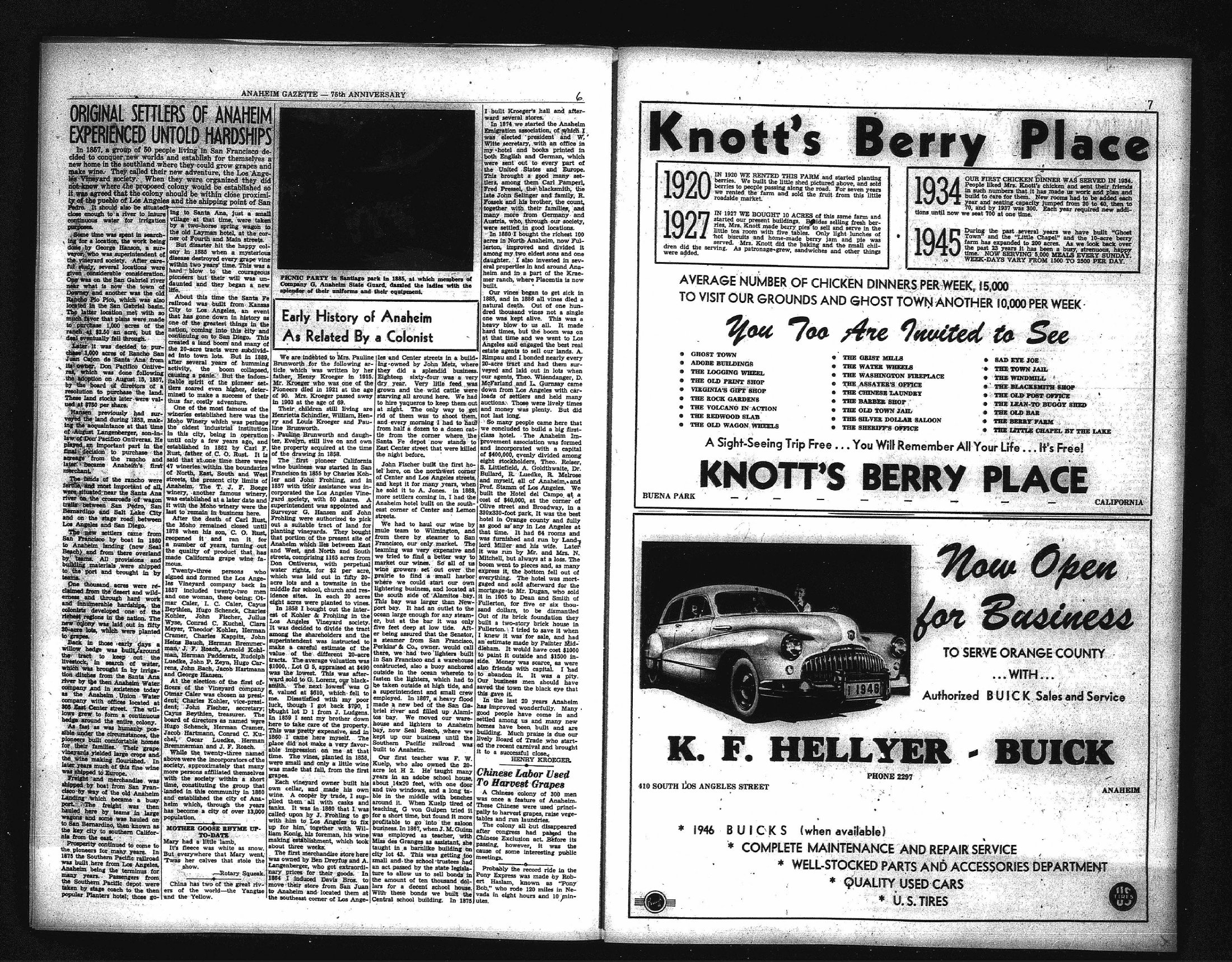
Searchable text
ORIGINAL SETTLERS OF ANAHEIM EXPERIENCED UNTOLD HARDSHIPS
In 1857, a group of 50 people living in San Francisco decided to conquer new worlds and establish for themselves a new home in the southland where they could grow grapes and make wine. They called their new adventure, the Los Angeles Vineyard society. When they were organized they did not know where the proposed colony would be established so it was agreed that the colony should be within close proximity of the pueblo of Los Angeles and the shipping point of San Pedro. It should also be situated close enough to a river to insure continuous water for irrigation purposes.
Some time was spent in searching for a location, the work being done by George Hanson, a surveyor, who was superintendent of the vineyard society. After careful study, several locations were given considerable consideration. One was on the San Gabriel river near what is now the town of Downey and another was the old Rancho Pio Pico, which was also located in the San Gabriel basin. The latter location met with much favor that plans were made to purchase 1,000 acres of the ranch at $2.50 an acre, but the deal eventually fell through.
Later it was decided to purchase 1,000 acres of Rancho San Antonio Colony. Just a small village at that time, were taken by a two-horse spring wagon to the old Layman hotel, at the corner of Fourth and Main streets.
But disaster hit the happy colony in 1885 when a mysterious disease destroyed every grape vine within two years' time. This was a hard blow to the courageous pioneers but their will was undaunted and they began a new life.
About this time the Santa Fe railroad was built from Kansas City to Los Angeles, an event that has gone down in history as one of the greatest things in the nation, coming into this city and continuing on to San Diego. This created a land boom and many of the 20-acre tracts were subdivided into town lots. But in 1889...
near what is now the town of Downey and another was the old Rancho Pio Pico, which was also located in the San Gabriel basin. The latter location met with so much favor that plans were made to purchase 1,000 acres of the ranch at $2.50 an acre, but the deal eventually fell through.
Later it was decided to purchase 1,000 acres of Rancho San Juan Cajon de Santa Ana from its owner, Don Pacifico Ontiveras, which was done following the adoption on August 15, 1857, by the board of directors of a resolution to purchase the land. These land stocks later were valued at $750 per share.
Hansen previously had surveyed the land during 1858, making the acquaintance at that time of August Langenberger, son-in-law of Don Pacifico Ontiveras. He played an important part in the final decision to purchase the acreage from the rancho and later became Anaheim's first merchant.
The lands of the rancho were fertile, and most important of all, were situated near the Santa Ana river on the crossroads of wagon trails between San Pedro, San Bernardino and Salt Lake City and on the stage road between Los Angeles and San Diego.
The new settlers came from San Francisco by boat in 1860 to Anaheim landing (now Seal Beach) and from there overland by teams. All provisions and building materials were shipped to the port and brought in by teams.
One thousand acres were reclaimed from the desert and wilderness and through hard work and innumerable hardships, the colonists developed one of the richest regions in the nation. The new colony was laid out in fifty 20-acre lots, which were planted to grapes.
Back in those early days a willow hedge was built around the tract to keep out the livestock, in search of water, which was brought in by irrigation ditches from the Santa Ana
About this time the Santa Fe railroad was built from Kansas City to Los Angeles, an event that has gone down in history as one of the greatest things in the nation, coming into this city and continuing on to San Diego. This created a land boom and many of the 20-acre tracts were subdivided into town lots. But in 1889, after several years of humming activity, the boom collapsed, causing a panic. But the indomitable spirit of the pioneer settlers soared even higher, determined to make a success of their thus far costly adventure.
One of the most famous of the wineries established here was the Moho Winery which was perhaps the oldest industrial institution in this city, being in operation until only a few years ago, and established in 1862 by Carl F. Rust, father of C. O. Rust. It is said that at one time there were 47 wineries within the boundaries of North, East, South and West streets, the present city limits of Anaheim. The T. J. F. Boege winery, another famous winery, was established at a later date and it with the Moho winery were the last to remain in business here.
After the death of Carl Rust, the Moho remained closed until 1878 when his son, C. O. Rust, reopened it and ran it for a number of years, turning out the quality of product that has made California grape wine famous.
Twenty-three persons who signed and formed the Los Angeles Vineyard company back in 1857 included twenty-two men and one woman, these being: Otmar Caler, I. C. Caler, Cayus Beythien, Hugo Schenck, Charles Kohler, John Fischer, Julius Wyse, Conrad C. Kuchel, Clara Meyer, Theodor Kohler, Herman Cramer, Charles Kappitz, John Heins Bauch, Herman Bremmerman, J. F. Roach, Arnold Kohlman, Herman Padderatz, Rudolph Luedke, John P. Zeyn, Hugo Carrens, John Bach, Jacob Hartmann and George Hansen.
We are indebted to Mrs. Pauline Brunworth for the following article which was written by her father, Henry Kroeger in 1915. Mr. Kroeger who was one of the Pioneers died in 1921 at the age of 90. Mrs. Kroeger passed away in 1903 at the age of 69.
Their children still living are Henrietta Schindler, William Henry and Louis Kroeger and Pauline Brunworth.
Pauline Brunworth and daughter Evelyn still live on and own the property acquired at the time of the drawing in 1858.
The first pioneer California wine business was started in San Francisco in 1855 by Charles Kohler and John Frohling, and in 1857 with their assistance was incorporated the Los Angeles Vineyard society, with 50 shares. A superintendent was appointed and Surveyor G. Hansen and John Frohling were authorized to pick out a suitable tract of land for planting vineyards. They bought that portion of the present site of Anaheim which lies between East and West, and North and South streets, comprising 1165 acres from Don Ontiveras, with perpetual water rights, for $2 per acre, which was laid out in fifty 20-acre lots and a townsite in the middle for school, church and residence sites. In each 20 acres eight acres were planted to vines.
In 1858 I bought out the interest of Kohler & Frohling in the Los Angeles Vineyard society. It was decided to divide the tract among the shareholders and the superintendent was instructed to make a careful estimate of the value of the different 20-acre tracts. The average valuation was $1000. Lot G 5, appraised at $490 was the lowest. This was afterward sold to G. Lowe's bank.
Early History of Anaheim As Related By a Colonist
We are indebted to Mrs. Pauline Brunworth for the following article which was written by her father, Henry Kroeger in 1915. Mr. Kroeger who was one of the Pioneers died in 1921 at the age of 90. Mrs. Kroeger passed away in 1903 at the age of 69.
Their children still living are Henrietta Schindler, William Henry and Louis Kroeger and Pauline Brunworth.
Pauline Brunworth and daughter Evelyn still live on and own the property acquired at the time of the drawing in 1858.
The first pioneer California wine business was started in San Francisco in 1855 by Charles Kohler and John Frohling, and in 1857 with their assistance was incorporated the Los Angeles Vineyard society, with 50 shares. A superintendent was appointed and Surveyor G. Hansen and John Frohling were authorized to pick out a suitable tract of land for planting vineyards. They bought that portion of the present site of Anaheim which lies between East and West, and North and South streets, comprising 1165 acres from Don Ontiveras, with perpetual water rights, for $2 per acre, which was laid out in fifty 20-acre lots and a townsite in the middle for school, church and residence sites. In each 20 acres eight acres were planted to vines.
In 1858 I bought out the interest of Kohler & Frohling in the Los Angeles Vineyard society. It was decided to divide the tract among the shareholders and the superintendent was instructed to make a careful estimate of the value of the different 20-acre tracts. The average valuation was $1000. Lot G 5, appraised at $490 was the lowest. This was afterward sold to G. Lowe's bank.
John Fischer built the first hotel here, on the northwest corner of Center and Los Angeles street; he kept it for many years; he sold it to A. Jones; in more settlers coming in, I had Anaheim hotel built on the south east corner of Center and Los streets.
We had to haul our wine mule team to Wilmington; from there by steamer to Francisco; our only market team was very expensive; we tried to find a better wine market our wines. So all our wine growers set out over prairie to find a small harbor where we could start our lightering business; and locate the south side of Alamitos This bay was larger than Port bay. It had an outlet to ocean large enough for any steller; but at the bar it was five feet deep at low tide.
er being assured that the Semi-a steamer from San Francisco Perkins'& Co., owner would there, we had two lighters in San Francisco and a warehouse constructed; also a buoy anchored outside in the ocean where fasten the lighters which have
and innumerable hardships, the colonists developed one of the richest regions in the nation. The new colony was laid out in fifty 20-acre lots, which were planted to grapes.
Back in those early days a willow hedge was built around the tract to keep out the livestock, in search of water, which was brought in by irrigation ditches from the Santa Ana river by the then Anaheim Water company and in existence today as the Anaheim Union Water company with offices located at 305 East Center street. The willows grew to form a continuous hedge around the entire colony.
As fast as was humanly possible under the circumstances, the pioneers built comfortable homes for their families. Their grape vineyards yielded large crops and the wine making flourished. In later years much of this fine wine was shipped to Europe.
Freight and merchandise was shipped by boat from San Francisco by way of the old Anaheim Landing which became a busy port. The freight was then hauled here by teams in large wagons and some were hauled on to San Bernardino, then known as the key city to southern California from the east.
Prosperity continued to come to the pioneers for many years. In 1875 the Southern Pacific railroad was built here from Los Angeles, Anaheim being the terminus for many years. Passengers from the Southern Pacific depot were taken by stage coach to the then popular Planters hotel; those go-
MOTHER GOOSE RHYME UP TO-DATE
Mary had a little lamb,
It's fleece was white as snow.
But everywhere that Mary went;
'Twas her calves that stole the show.
Rotary Squeak.
China has two of the great rivers of the world—the Yangtse and the Yellow.
In 1858 I bought out the interest of Kohler & Frohling in the Los Angeles Vineyard society. It was decided to divide the tract among the shareholders and the superintendent was instructed to make a careful estimate of the value of the different 20-acre tracts. The average valuation was $1000.. Lot G 5, appraised at $490 was the lowest. This was afterward sold to G. Lorenz, our blacksmith. The next lowest was G. 6, valued at $610, which fell to me. Dissatisfied with my poor luck, though I got back $790, I bought lot D 1 from J. Ludgens. In 1859 I sent my brother down here to take care of the property. This was pretty expensive, and in 1860 I came here myself. The place did not make a very favorable impression on me at that time. The vines, planted in 1858, were small and only a little wine was made that fall, from the first grapes.
Each vineyard owner built his own cellar, and made his own wine. A cooper by trade, I supplied them all with casks and tanks. It was in 1860 that I was called upon by J. Frohling to go with him to Los Angeles to fix up for him, together with William Konig, his foreman, his wine making establishment, which took about three weeks.
The first merchandise store here was owned by Ben Dreyfus and A. Langenberger, who got extraordinary prices for their goods. In 1864 I induced Davis Bros. to move their store from San Juan to Anaheim and located them at the southeast corner of Los Angele-
port bay. It had an outlet to ocean large enough for any store, but at the bar it was five feet deep at low tide. er being assured that the Semi-a steamer from San Francisco Perkins'& Co., owner would there, we had two lighters in San Francisco and a warehouser constructed, also a buoy anchored outside in the ocean where they fasten the lighters, which have be taken outside at high tide, a superintendent and small employer. In 1867, a heavy made a new bed of the San briel river and filled up Allto bay. We moved our house and lighters to Anaheim bay, now Seal Beach, where we kept up our business until Southern Pacific railroad built to Anaheim.
Our first teacher was F. Kuelp, who also owned the acre lot H 2. He taught me years in an adobe school house about 14x20 feet, with one and two windows, and a long blee in the middle with benches around it. When Kuelp tired teaching, G von Gulpen tried for a short time, but found it profitable to go into the same business. In 1867, when J. M. G was employed as teacher, Miss des Granges as assistant taught in a barnlike building city lot 43. This was getting small and the school trustees an act passed by the state legislature to allow us to sell bonds the amount of ten thousand dollars for a decent school ho-With these bonds we built Central school building.
I built Kroeger's hall and afterward several stores.
In 1874 we started the Anaheim Emigration association, of which I was elected president and W. Witte secretary, with an office in my hotel and books printed in both English and German, which were sent out to every part of the United States and Europe. This brought a good many settlers, among them Carl Pamperl, Fred Pressel, the blacksmith, the late John Selinger and family, R. Fossek and his brother, the count, together with their families, and many more from Germany and Austria, who, through our society, were settled in good locations.
In 1880 I bought the richest 100 acres in North Anaheim, now Fullerton, improved and divided it among my two eldest sons and one daughter. I also invested in several properties in and around Anaheim and in a part of the Kraemer ranch, where Placentia is now built.
Our vines began to get sick in 1885, and in 1886 all vines died a natural death. Out of one hundred thousand vines not a single one was kept alive. This was a heavy blow to us all. It made hard times, but the boom was on at that time and we went to Los Angeles and engaged the best real estate agents to sell our lands. A. Rimpau and I bonded nearly every
Knott's B
IN 1920 WE RENTED THIS FARM and started plant berries. We built the little shed pictured above, and s berries to people passing along the road. For seven ye we rented the farm and sold the fruit from this l roadside market.
IN 1927 WE BOUGHT 10 ACRES of this same farm started our present buildings. Besides selling fresh b ries, Mrs. Knott made berry pies to sell and serve in little tea room with five tables. Only light lunches hot biscuits and home-made berry jam and pie served. Mrs. Knott did the baking and the small cl were added.
AVERAGE NUMBER OF CHICKEN D TO VISIT OUR GROUNDS AND GHO You Too An
• GHOST TOWN • THE GR
of Anaheim
by a Colonist
les and Center streets in a building owned by John Metz, where they did a splendid business. Eighteen sixty-four was a very dry year. Very little feed was grown and the wild cattle were starving all around here. We had to hire yaqueros to keep them out at night. The only way to get rid of them was to shoot them, and every morning I had to haul from half a dozen to a dozen cattle from the corner where the Santa Fe depot now stands to East Center street that were killed the night before.
John Fischer built the first hotel here, on the northwest corner of Center and Los Angeles streets, and kept it for many years, when he sold it to A. Jones. In 1868, more settlers coming in, I had the Anaheim hotel built on the southeast corner of Center and Lemon streets.
We had to haul our wine by mule team to Wilmington, and from there by steamer to San Francisco, our only market. The teaming was very expensive and we tried to find a better way to market our wines. So all of us wine growers set out over the prairie to find a small harbor where we could start our own lightering business, and located at the south side of Alamitos bay. This bay was larger than Newport bay. It had an outlet to the ocean large enough for any steamer, but at the bar it was only five feet deep at low tide. After being assured that the Senator, a steamer from San Francisco, Perkins & Co., owner, would call there, we had two lighters built in San Francisco and a warehouse constructed, also a buoy anchored outside in the ocean whereeto, to fasten the lighters which had built.
Our vines began to get sick in 1885, and in 1886 all vines died a natural death. Out of one hundred thousand vines not a single one was kept alive. This was a heavy blow to us all. It made hard times, but the boom was on at that time and we went to Los Angeles and engaged the best real estate agents to sell our lands. A Rimpau and I bonded nearly every 20-acre tract and had them surveyed and laid out in lots when our agents, Theo. Wisendanger, D. McFarland and L. Gurnsay came down from Los Angeles with carloads of settlers and held many auctions. Those were lively times and money was plenty. But did not last long.
So many people came here that we concluded to build a big first-class hotel. The Anaheim Improvement association was formed and incorporated with a capital of $400,000, evenly divided among eight stockholders, Theo. Reiser, S. Littlefield, A. Goldthwaite, Dr. Bullard, R. Luedke, R. Melrose and myself, all of Anaheim, and Prof. Stamm of Los Angeles. We built the Hotel del Campo at a cost of $40,000, at the corner of Olive street and Broadway, in a 330x330-foot park. It was the best hotel in Orange county and fully as good as any in Los Angeles at that time. It had 64 rooms and was furnished and run by Landlord Miller and his wife. Later it was run by Mr. and Mrs. N. Mitchell, but always at a loss. The boom went to pieces and, as many express it, the bottom fell out of everything. The hotel was mortgaged and sold afterward for the mortgage to Mr. Dugan, who sold it in 1905 to Dean and Smith of Fullerton, for five or six thousand dollars, to be dismantled. Out of its brick foundation they built a two-story brick house in Fullerton. I tried to save it when I knew it was for sale, and had an estimate made by Painter Middleham. It would have cost $1000 to paint it outside and $1500 inside. Money was scarce, as were also friends with capital. I had to abandon it. It was a pity.
A Sight-Seeing Trip Free... You
KNOTT'S B
BUENA PARK
port bay. It had an outlet to the ocean large enough for any steamer, but at the bar it was only five feet deep at low tide. After being assured that the Senator, a steamer from San Francisco, Perkins & Co., owner, would call there, we had two lighters built in San Francisco and a warehouse constructed, also a buoy anchored outside in the ocean whereto, to fasten the lighters, which had to be taken outside at high tide, and a superintendent and small crew employed. In 1867, a heavy flood made a new bed of the San Gabriel river and filled up Alamitos bay. We moved our warehouse and lighters to Anaheim bay, now Seal Beach, where we kept up our business until the Southern Pacific railroad was built to Anaheim.
Our first teacher was F. W. Kuelp, who also owned the 20-acre lot H 2. He taught many years in an adobe school house, about 14x20 feet, with one door and two windows, and a long table in the middle with benches around it. When Kuelp tired of teaching, G von Gulpen tried it for a short time, but found it more profitable to go into the saloon business. In 1867, when J. M. Guinn was employed as teacher, with Miss des Granges as assistant, she taught in a barnlike building on city lot 43. This was getting too small and the school trustees had an act passed by the state legislature to allow us to sell bonds in the amount of ten thousand dollars for a decent school house. With these bonds we built the Central school building. In 1875
Chinese Labor Used To Harvest Grapes
A Chinese colony of 300 men was once a feature of Anaheim. These Chinese were used principally to harvest grapes, raise vegetables and run laundries.
The colony all but disappeared after congress had passed the Chinese Exclusion act. Before its passing, however, it was the cause of some interesting public meetings.
Probably the record ride in the Pony Express was made by Robert Haslam, known as "Pony Bob," who rode 120 miles in Nevada in eight hours and 10 minutes.
t's Berry Place
1934
OUR FIRST CHICKEN DINNER WAS SERVED IN 1934. People liked Mrs. Knott's chicken and sent their friends in such numbers that it has made us work and plan and build to care for them. New rooms had to be added each year and seating capacity jumped from 20 to 40; then to 70, and by 1937 was 300. Each year required new additions until now we seat 700 at one time.
1945
During the past several years we have built "Ghost Town" and the "Little Chapel" and the 10-acre berry farm has expanded to 200 acres. As we look back over the past 23 years it has been a busy, strenuous, happy time. NOW SERVING 5,000 MEALS EVERY SUNDAY. WEEK-DAYS VARY FROM 1500 TO 2500 PER DAY.
BER OF CHICKEN DINNERS PER WEEK, 15,000
ROUNDS AND GHOST TOWN ANOTHER 10,000 PER WEEK
Too Are Invited to See
TOO ARE INVITED TO SEE
• THE GRIST MILLS
• THE WATER WHEELS
• THE WASHINGTON FIREPLACE
• THE ASSAYER'S OFFICE
• THE CHINESE LAUNDRY
• THE BARBER SHOP
• THE OLD TOWN JAIL
• THE SILVER DOLLAR SALOON
• THE SHERIFF'S OFFICE
• SAD EYE JOE
• THE TOWN JAIL
• THE WINDMILL
• THE BLACKSMITH SHOP
• THE OLD POST OFFICE
• THE LEAN-TO BUGGY SHED
• THE OLD BAR
THE BERRY FARM
THE LITTLE CHAPEL BY THE LAKE
g Trip Free ... You Will Remember All Your Life ... It's Free!
SCOTT'S BERRY PLACE
CALIFORNIA
Now Open
for Business
TO SERVE ORANGE COUNTY
... WITH...
for Business
TO SERVE ORANGE COUNTY
...WITH...
Authorized BUICK Sales and Service
HELLYER - BUICK
PHONE 2297
ANAHEIM
KS (when available)
PLETE MAINTENANCE AND REPAIR SERVICE
* WELL-STOCKED PARTS AND ACCESSORIES DEPARTMENT
* QUALITY USED CARS
* U.S. TIRES