anaheim-gazette 1939-08-24
Scanned page
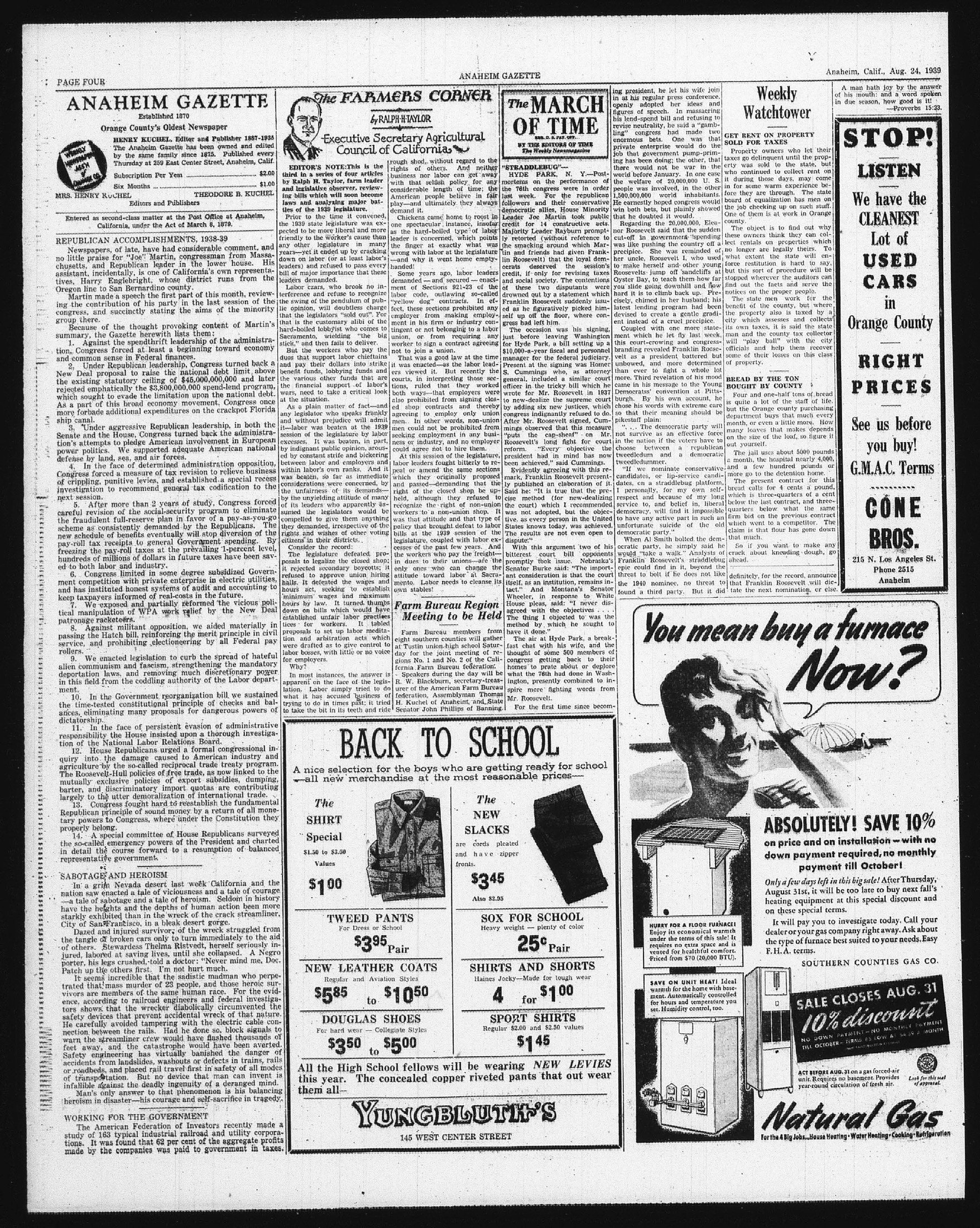
Searchable text
ANAHEIM GAZETTE
Established 1870
Orange County's Oldest Newspaper
HENRY KUCHEL, Editor and Publisher 1887-1935
The Anaheim Gazette has been owned and edited by the same family since 1875. Published every Thursday at 259 East Center Street, Anaheim, Calif.
Subscription Per Year ... $2.00
Six Months ... $1.00
MRS. HENRY KUCHEL
THEODORE B. KUCHEL
Editors and Publishers
Entered as second-class matter at the Post Office at Anaheim,
California, under the Act of March 8, 1879.
REPUBLICAN ACCOMPLISHMENTS, 1938-39
Newspapers, of late, have had considerable comment, and no little praise for "Joe" Martin, congressman from Massachusetts, and Republican leader in the lower house. His assistant, incidentally, is one of California's own representatives, Harry Englebright, whose district runs from the Oregon line to San Bernardino county.
Martin made a speech the first part of this month, reviewing the contribution of his party in the last session of the congress, and succinctly stating the aims of the minority group there.
Because of the thought provoking content of Martin's summary, the Gazette herewith lists them:
1. Against the spendthrift leadership of the administration, Congress forced at least a beginning toward economy and common sense in Federal finances.
2. Under Republican leadership, Congress turned back a New Deal proposal to raise the national debt limit above the existing statutory ceiling of $45,000,000,000 and later rejected emphatically the $3,800,000,000 spend-lend program, which sought to evade the limitation upon the national debt.
3. Under aggressive Republican leadership, in both the Senate and the House, Congress turned back the administration's attempts to pledge American involvement in European power politics. We supported adequate American national defense by land sea and air forces.
EDITOR'S NOTE: This letter third in a series of four articles by Ralph H. Taylor, farm land and legislative observer, receiving bills which will soon be laws and analyzing major titles of the 1939 legislature.
Prior to the time it concludes the 1939 state legislature was expected to be more liberal and friendly to the worker's cause any other legislature in years—yet it ended up by down on labor (or at least leaders) and refused to pass bill of major importance that leaders demanded.
Labor czars, who brook interference and refuse to recite the swing of the pendulum or public opinion, will doubtless that the legislators "sold out" that is the customary alibi hard-boiled lobbyist who co-Sacramento, wielding "the stick," and then fails to deli.
But the workers who provide that support labor chilis and pay their dollars into benefit funds, lobbying fund the various other funds tha the financial support of wars, need to take a critical at the situation.
As a plain matter of fact any legislator who speaks is and without prejudice will it—labor was beaten at the session of the legislature by excesses. It was beaten, in by indignant public opinion, ed by constant strife and bribe.
2. Under Republican leadership, Congress turned back a New Deal proposal to raise the national debt limit, above the existing statutory ceiling of $45,000,000,000 and later rejected emphatically the $3,800,000,000 spend-lend program, which sought to evade the limitation upon the national debt. As a part of this broad economy movement, Congress once more forbade additional expenditures on the crackpot Florida ship canal.
3. Under aggressive Republican leadership, in both the Senate and the House, Congress turned back the administration's attempts to pledge American involvement in European power politics. We supported adequate American national defense by land, sea, and air forces.
4. In the face of determined administration opposition, Congress forced a measure of tax revision to relieve business of crippling, punitive levies, and established a special recess investigation to recommend general tax codification to the next session.
5. After more than 2 years of study, Congress forced careful revision of the social-security program to eliminate the fraudulent full-reserve plan in favor of a pay-as-you-go scheme as consistently demanded by the Republicans. The new schedule of benefits eventually will stop diversion of the pay-roll tax receipts to general Government spending. By freezing the pay-roll taxes at the prevailing 1-percent level, hundreds of millions of dollars in future taxes have been saved to both labor and industry.
6. Congress limited in some degree subsidized Government competition with private enterprise in electric utilities, and has instituted honest systems of audit and accounting to keep taxpayers informed of real-costs in the future.
7. We exposed and partially reformed the vicious political manipulation of WPA work relief by the New Deal patronage racketeers.
8. Against militant opposition, we aided materially in passing the Hatch bill, reinforcing the merit principle in civil service, and prohibiting electioneering by all Federal pay rollers.
9. We enacted legislation to curb the spread of hateful alien communism and fascism, strengthening the mandatory deportation laws, and removing much discretionary power in this field from the coddling authority of the Labor department.
10. In the Government reorganization bill we sustained the time-tested constitutional principle of checks and balances, eliminating many proposals for dangerous powers of dictatorship.
11. In the face of persistent evasion of administrative responsibility the House insisted upon a thorough investigation of the National Labor Relations Board.
12. House Republicans urged a formal congressional inquiry into the damage caused to American industry and agriculture by the so-called reciprocal trade treaty program. The Roosevelt-Hull policies of free trade, as now linked to the mutually exclusive policies of export subsidies, dumping, barter, and discriminatory import quotas are contributing largely to the utter demoralization of international trade.
13. Congress fought hard to reestablish the fundamental Republican principle of sound money by a return of all monetary powers to Congress, where under the Constitution they properly belong.
14. A special committee of House Republicans surveyed the so-called emergency powers of the President and charted in detail the course forward to a resumption of balanced representative government.
The Roosevelt-Hull policies of free trade, as now linked to the mutually exclusive policies of export subsidies, dumping, barter, and discriminatory import quotas are contributing largely to the utter demoralization of international trade.
13. Congress fought hard to reestablish the fundamental Republican principle of sound money by a return of all monetary powers to Congress, where under the Constitution they properly belong.
14. A special committee of House Republicans surveyed the so-called emergency powers of the President and charted in detail the course forward to a resumption of balanced representative government.
SABOTAGE AND HEROISM
In a grim Nevada desert last week California and the nation saw enacted a tale of viciousness and a tale of courage—a tale of sabotage and a tale of heroism. Seldom in history have the heights and the depths of human action been more starkly exhibited than in the wreck of the crack streamliner, City of San Francisco, in a bleak desert gorge.
Dazed and injured survivor of the wreck struggled from the tangle of broken cars only to turn immediately to the aid of others. Stewardess Thelma Ristvedt, herself seriously injured, labored at saving lives, until she collapsed. A Negro porter, his legs crushed, told a doctor: "Never mind me, Doc. Patch up the others first. I'm not hurt much.
It seems incredible that the sadistic madman who perpetrated that mass murder of 23 people, and those heroic survivors are members of the same human race. For the evidence, according to railroad engineers and federal investigators shows that the wrecker diabolically circumvented the safety devices that prevent accidental wreck of that nature. He carefully avoided tampering with the electric cable connection between the rails. Had he done so, block signals to warn the streamliner crew would have flashed thousands of feet away, and the catastrophe would have been averted. Safety engineering has virtually banished the danger of accidents from landslides, washouts or defects in trains, rails or roadbeds, and placed rail travel first in safety of all modes of transportation. But no device that man can invent is infallible against the deadly ingenuity of a deranged mind.
Man's only answer to that phenomenon is his balancing heroism in disaster—his courage and self-sacrifice in tragedy.
WORKING FOR THE GOVERNMENT
The American Federation of Investors recently made a study of 163 typical industrial railroad and utility corporations. It was found that 62 per cent of the aggregate profits made by the companies was paid to government in taxes.
ANAHEIM GAZETTE
The FARMERS CORNER
by RALPH H. TAYLOR
Executive Secretary Agricultural Council of California
EDITOR'S NOTE: This is the third in a series of four articles by Ralph H. Taylor, farm leader and legislative observer, reviewing bills which will soon become laws and analyzing major battles of the 1939 legislature.
Prior to the time it convened, the 1939 state legislature was expected to be more liberal and more friendly to the worker's cause than any other legislature in many years—yet it ended up by cracking down on labor (or at least labor's leaders) and refused to pass every bill of major importance that these leaders demanded.
Labor czars, who brook no interference and refuse to recognize the swing of the pendulum of public opinion, will doubtless charge that the legislators "sold out". For that is the customary alibi of the hard-boiled lobbyist who comes to cramento, wielding "the big buck," and then fails to deliver.
But the workers who pay the taxes that support labor chieftains and pay their dollars into strike benefit funds, lobbying funds and various other funds that are financial support of labor's needs to take a critical look at the situation.
As a plain matter of fact—and by legislator who speaks frankly without prejudice will admit—labor was beaten at the 1939 session of the legislature by labor processes. It was beaten, in part, indignant public opinion, aroused by constant strife and bickering rough shod, without regard to the rights of others. And neither business nor labor can get away with that selfish policy for any considerable length of time; the American people believe in fair play—and ultimately they always demand it.
Chickens came home to roost in one spectacular instance, insofar as the hard-boiled type of labor leader is concerned, which points the finger at exactly what was wrong with labor at the legislature—and why it went home empty-handed!
Some years ago, labor leaders demanded—and secured—enactment of Sections 921-23 of the labor code, outlawing so-called "yellow dog" contracts. In effect, these sections prohibited any employer from making employment in his firm or industry contingent or not belonging to a labor union, or from requiring any worker to sign a contract agreeing not to join a union.
That was a good law at the time it was enacted—as the labor leaders viewed it. But recently the courts, in interpreting those sections, ruled that they worked both ways—that employers were also prohibited from signing closed shop contracts and thereby agreeing to employ only union men. In other words, non-union men could not be prohibited from seeking employment in any business or industry, and no employer could agree not to hire them.
At this session of the legislature,
"The MARCH OF TIME
BY THE EDITORS OF TIME
The Weekly Newsmagazine"
"STRADDLEBUG"—HYDE PARK, N. Y.—Postmortems on the performance of the 76th congress were in order last week. For the republican followers and their conservative democratic allies, House Minority Leader Joe Martin took public credit for 14 constructive acts. Majority Leader Rayburn promptly retorted (without reference to the smacking around which Martin and friends had given Franklin Roosevelt) that the loyal democrats deserved the session's credit, if only for revising taxes and social society. The contentions of these two disputants were drowned out by a statement which Franklin Roosevelt suddenly issued as he figuratively picked himself up off the floor, where congress had left him.
The occasion was his signing, just before leaving Washington for Hyde Park, a bill setting up a $10,000-a-year fiscal and personnel manager for the federal judiciary. Present at the signing was Homer S. Cummings who, as attorney general, included a similar court officer in the tricky bill which he wrote for Mr. Roosevelt in 1937 to new-dealize the supreme court by adding six new justices, which congress indignantly refused to do. After Mr. Roosevelt signed, Cummings observed that this measure "puts the cap-sheaf" on Mr. Roosevelt's long fight for court reform. "Every objective the president had in mind has now ing president, he let his hand in at his regular press conference openly adopted her ideas of speech. In most his lend-spend bill and reviise neutrality, he said he ling" congress had made enormous bets. One way private enterprise would job that government punishment has been doing; the other would not be waived world before January. In the welfare of 20,000,000 people was involved, in 1,500,000,000 world infiltration. He earnestly hoped congress win both bets, but plainly that he doubted it would.
Regarding the 20,000,000 nor Roosevelt said that the cut-off in government was like pushing the counterprince. She was remorseful her uncle, Roosevelt I, to make herself and other Roosevelts jump off 'sand' Oyster Bay, to teach them you slide going downhill hard it is to climb back cisely, chimed in her husky latest lending program devised to create a gentleness instead of a cruel prince.
Coupled with one moment which he let fly later this court-crowning and branding revealed Franklin velt as a president battle unbowed, and more deeply than ever to fight a war more. Third revelation of came in his message to the Democratats' convention bury. By his own accuse chose his words with extra so that their meaning s pikestaff plain:
"... The democratic nation not survive as an effect in the nation if the voters choose between a n tweedledum and a o."
As a plain matter of fact—and by legislator who speaks frankly and without prejudice will admit—labor was beaten at the 1939 session of the legislature by labor accesses. It was beaten, in part, by indignant public opinion, aroused by constant strife and bickering between labor and employers and within labor's own ranks. And it was beaten, so far as immediate considerations were concerned, by the unfairness of its demands—the unyielding attitude of many its leaders who apparently assumed the legislators would be impelled to give them anything they demanded, irrespective of the rights and wishes of other voting citizens in their districts.
Consider the record:
The legislature defeated proposals to legalize the closed shop; rejected secondary boycotts; it refused to approve union hiring calls. It defeated the wages and hours act, seeking to establish minimum wages and maximum hours by law. It turned thumbs down on bills which would have established unfair labor practices for workers. It tabled proposals to set up labor mediation and arbitration acts which were drafted as to give control to labor bosses, with little or no voice for employers.
Why?
In most instances, the answer is apparent on the face of the legislation. Labor simply tried to do what it has accused business of trying to do in times past; it tried to take the bit in its teeth and ride it was enacted—as the labor leaders viewed it. But recently the courts, in interpreting those sections, ruled that they worked both ways—that employers were also prohibited from signing closed shop contracts and thereby agreeing to employ only union men. In other words, non-union men could not be prohibited from seeking employment in any business or industry, and no employer could agree not to hire them.
At this session of the legislature, labor leaders fought bitterly to repeal or amend the same sections which they originally proposed and passed—demanding that the right of the closed shop be upheld, although they refused to recognize the right of non-union workers to a non-union shop. It was that attitude and that type of policy that brought defeat to labor bills at the 1939 session of the legislature, coupled with labor excesses of the past few years. And the workers who pay the freight—in dues to their unions—are the only ones who can change the attitude toward labor at Sacramento. Labor needs to cleanse its own stables!
Farm Bureau Region Meeting to be Held
Farm Bureau members from eight southern counties will gather at Tustin union-high school Saturday for the joint meeting of regions No. 1 and No. 2 of the California Farm Bureau federation.
Speakers during the day will be R. W. Blackburn, secretary-treasurer of the American Farm Bureau federation, Assemblyman Thomas H. Kuchel of Anaheim, and State Senator John Phillips of Banning.
Present at the signing was Homer S. Cummings who, as attorney general, included a similar court officer in the tricky bill which he wrote for Mr. Roosevelt in 1937 to new-dealize the supreme court by adding six new justices, which congress indignantly refused to do. After Mr. Roosevelt signed, Cummings observed that this measure "puts the cap-sheaf" on Mr. Roosevelt's long fight for court reform. "Every objective the president had in mind has now been achieved," said Cummings.
Evidently agreeing with this remark, Franklin Roosevelt presently published an elaboration of it. Said he: "It is true that the precise method (for new-dealizing the court) which I recommended was not adopted, but the objective, as every person in the United States knows today, was achieved. The results are not even open to dispute."
With this argument two of his bitterest court bill opponents promptly took issue. Nebraska's Senator Burke said: "The important consideration is that the court itself, as an institution, remains intact." And Montana's Senator Wheeler, in response to White House pleas, said: "I never disagreed with the objectives . . . The thing I objected to was the method by which he sought to have it done."
The air at Hyde Park, a breakfast chat with his wife, and the thought of some 500 members of congress getting back to their homes to prate about or deplore what the 76th had done in Washington, presently combined to inspire more fighting words from Mr. Roosevelt.
For the first time since becoming a member of society, he nominated candidates, or lip-service dates, on a straddlebug I personally, for my respect and because of service to, and belief in democracy, will find it to have any active part in unfortunate suicide of democratic party."
When Al Smith bolted ocratic party, he simply would "take a walk." A Franklin Roosevelt's epic could find in it, but threat to bolt if he does the 1940 nominee, no found a third party.
BACK TO SCHOOL
A nice selection for the boys who are getting ready for school—all new merchandise at the most reasonable prices—
The SHIRT Special
$1.50 to $3.50
Values
The NEW SLACKS
are cords pleated and have zipper fronts.
The SHIRT Special
$1.50 to $3.50
Values
$100
TWEED PANTS
For Dress or School
$395 Pair
NEW LEATHER COATS
Regular and Aviation Styles
$585 to $1050
DOUGLAS SHOES
For hard wear — Collegiate Styles
$350 to $500
The NEW SLACKS
are cords pleated and have zipper fronts.
$345
Also $2.95
SOX FOR SCHOOL
Heavy weight — plenty of color
25¢ Pair
SHIRTS AND SHORTS
Haines Jocky—Made for tough wear
4 for $100
SPORT SHIRTS
Regular $2.00 and $2.50 values
$145
All the High School fellows will be wearing NEW LEVIES this year. The concealed copper riveted pants that out wear them all—
YUNGBLUTH'S
145 WEST CENTER STREET
ing president, he let his wife join in at his regular press conference, openly adopted her ideas and figures of speech. In massacring his lend-spend bill and refusing to revise neutrality, he said a "gambling" congress had made two enormous bets. One was that private enterprise would do the job that government pump-priming has been doing; the other, that there would not be war in the world before January. In one case the welfare of 20,000,000 U.S. people was involved, in the other 1,500,000,000 world inhabitants. He earnestly hoped congress would win both bets, but plainly showed that he doubted it would.
Regarding the 20,000,000 Eleanor Roosevelt said that the sudden cut-off in government spending was like pushing the country off a precipice. She was reminded of her uncle, Roosevelt I, who used to make herself and other young Roosevelts jump off sandcliffs at Oyster Bay, to teach them how far you slide going downhill and how hard it is to climb back up. Precisely, chimed in her husband; his latest lending program had been devised to create a gentle gradient instead of a cruel precipice.
Coupled with one more statement which he let fly last week, this court-crowning and congress-branding revealed Franklin Roosevelt as a president battered but unbowed, and more determined than ever to fight a whole lot more. Third revelation of his mood came in his message to the Young Democratss' convention at Pittsburgh. By his own account, he chose his words with extreme care so that their meaning should be pikestaff plain:
"The democratic party will not survive as an effective force in the nation if the voters have to choose between a republican tweedledum and a democratic Weekly Watchtower
GET RENT ON PROPERTY SOLD FOR TAXES
Property owners who let their taxes go delinquent until the property was sold to the state, but who continued to collect rent on it during those days, may come in for some warm experience before they are through. The state board of equalization has men on the job checking up on such stuff. One of them is at work in Orange county."
The object is to find out why these owners think they can collect rentals on properties which no longer are legally theirs. To what extent the state will enforce restitution is hard to say, but this sort of procedure will be stopped wherever the auditors can find out the facts and serve the notices on the proper people.
The state men work for the benefit of the county, but where the property also is taxed by a city which assesses and collects its own taxes, it is said the state man and the county tax collector will "play ball" with the city officials and help them recover some of their losses on this class of property.
BREAD BY THE TON BOUGHT BY COUNTY
Four and one-half tons of bread is quite a lot of the staff of life. But the Orange county purchasing department buys that much every month, or even a little more. How many loaves that makes depends on the size of the loaf, so figure it out yourself.
The jail uses about 5000 pounds."
unbowed, and more determined than ever to fight a whole lot more. Third revelation of his mood came in his message to the Young Democratss' convention at Pittsburgh. By his own account, he chose his words with extreme care so that their meaning should be pikestaff plain:
"The democratic party will not survive as an effective force in the nation if the voters have to choose between a republican tweedledum and a democratic tweedledummer.
"If we nominate conservative candidates, or lip-service candidates, on a straddlebug platform, I personally, for my own self-respect and because of my long service to, and belief in, liberal democracy, will find it impossible to have any active part in such an unfortunate suicide of the old democratic party."
When Al Smith bolted the democratic party, he simply said he would "take a walk." Analysts of Franklin Roosevelt's straddlebug epic could find in it, beyond the threat to bolt if he does not like the 1940 nominee, no threat to found a third party. But it did
BREAD BY THE TON BOUGHT BY COUNTY
Four and one-half tons of bread is quite a lot of the staff of life, but the Orange county purchasing department buys that much every month, or even a little more. How many loaves that makes depends on the size of the loaf, so figure it out yourself.
The jail uses about 5000 pounds a month, the hospital nearly 4,000, and a few hundred pounds or more go to the detention home.
The present contract for this bread calls for 4 cents a pound, which is three-quarters of a cent below the last contract, and three-quarters below what the same firm bid on the previous contract which went to a competitor. The claim is that flour has gone down that much.
So if you want to make any crack about kneading dough, go ahead.
definitely, for the record, announce that Franklin Roosevelt will dictate the next nomination, or else.
You mean buy a furnace Now?
ABSOLUTELY! SAVE 10% on price and on installation—with no down payment required, no monthly payment till October!
ABSOLUTELY! SAVE 10%
on price and on installation—with no down payment required, no monthly payment till October!
Only a few days left in this big sale! After Thursday, August 31st, it will be too late to buy next fall's heating equipment at this special discount and on these special terms.
It will pay you to investigate today. Call your dealer or your gas company right away. Ask about the type of furnace best suited to your needs. Easy F.H.A. terms.
SOUTHERN COUNTIES GAS CO.
SALE CLOSES AUG. 31
10% discount
NO DOWN PAYMENT—NO MONTHLY PAYMENT
TILL OCTOBER—TERMS AS LOW AS $4.59 A MONTH
ACT BEFORE AUG. 31 on a gas forced-air unit. Requires no basement. Provides year-round circulation of fresh air.
Natural Gas
For the 4 Big Jobs...House Heating • Water Heating • Cooking • Refrigeration