anaheim-gazette 1939-07-13
Scanned page
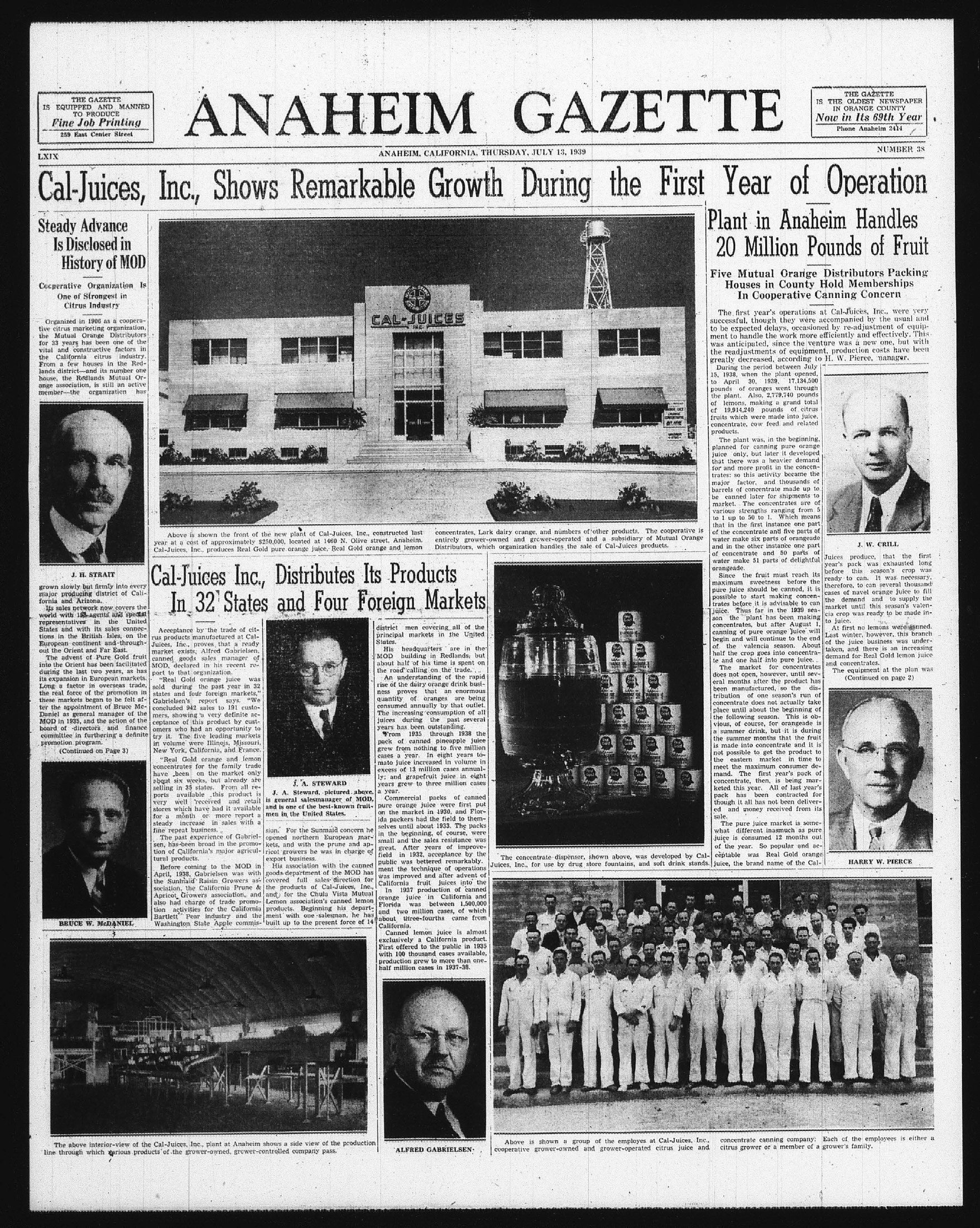
Searchable text
THE GAZETTE
IS EQUIPPED AND MANNED
TO PRODUCE
Fine Job Printing
259 East Center Street
LXIX
Cal-Juices, Inc., Shows Remark
Steady Advance
Is Disclosed in
History of MOD
Cooperative Organization Is
One of Strongest in
Citrus Industry
Organized in 1906 as a cooperative citrus marketing organization,
the Mutual Orange Distributors
for 33 years has been one of the vital and constructive factors in
the California citrus industry.
From a few houses in the Redlands district—and its number one
house, the Redlands Mutual Orange association, is still an active member—the organization has
From a few houses in the Redlands district—and its number one house, the Redlands Mutual Orange association, is still an active member—the organization has
J. H. STRAIT
grown slowly but firmly into every major producing district of California and Arizona.
Its sales network now covers the world with 153 agents and special representatives in the United States and with its sales connections in the British Isles, on the European continent and throughout the Orient and Far East.
The advent of Pure Gold fruit into the Orient has been facilitated during the last two years, as has its expansion in European markets. Long a factor in overseas trade, the real force of the promotion in these markets began to be felt after the appointment of Bruce McDaniel as general manager of the MOD in 1935, and the action of the board of directors and finance committee in furthering a definite promotion program.
(Continued on Page 3)
Acceptance by the trade of citrus products manufactured at Cal-Juices, Inc., proves that a ready market exists; Alfred Gabrielsen, canned goods sales manager of MOD, declared in his recent report to that organization.
"Real Gold orange juice was sold during the past year in 32 states and four foreign markets," Gabrielsen's report says. "We concluded 942 sales to 191 customers, showing a very definite acceptance of this product by customers who had an opportunity to try it. The five leading markets in volume were Illinois, Missouri, New York, California, and France."
"Real Gold orange and lemon concentrates for the family trade have been on the market only about six weeks, but already are selling in 35 states. From all reports available this product is very well received and retail stores which have had it available for a month or more report a steady increase in sales with a fine repeat business.
The past experience of Gabrielsen, has been broad in the promotion of California's major agricultural products.
Before coming to the MOD in
Cal-Juices Inc., Distributes In 32 States and Four F
J. A. STEWARD
J. A. Steward, pictured above is general sales manager of MO and is one of the best-known fruited men in the United States.
sion. For the Sunmaid concern opened northern European markets, and with the prune and ricot growers he was in charge of export business.
His association with the cann
have been on the market only about six weeks, but already are selling in 35 states. From all reports available this product is very well received and retail stores which have had it available for a month or more report a steady increase in sales with a fine repeat business.
The past experience of Gabrielsen, has been broad in the promotion of California's major agricultural products.
Before coming to the MOD in April, 1938, Gabrielsen was with the Sunmaid Raisin Growers association, the California Prune & Apricot Growers association, and also had charge of trade promotion activities for the California Bartlett Pear industry and the Washington State Apple commission.
The above interior-view of the Cal-Juices, Inc., plant at Anaheim shows a side view of the product line through which various products of the grower-owned, grower-controlled company pass.
AHEIM GAZETE
ANAHEIM, CALIFORNIA, THURSDAY, JULY 13, 1939
Remarkable Growth During the First
CAL-JUICES
plant of Cal-Juices, Inc., constructed last located at 1460 N. Olive street, Anaheim. Orange juice, Real Gold orange and lemon concentrates, Lark dairy orange, and numbers of other products. The cooperative entirely grower-owned and grower-operated and a subsidiary of Mutual Orchard Distributors, which organization handles the sale of Cal-Juices products.
Distributes Its Products and Four Foreign Markets
district men covering all of the principal markets in the United States.
His headquarters are in the MOD building in Redlands, but about half of his time is spent on the road calling on the trade.
An understanding of the rapid rise of the dairy orange drink business proves that an enormous quantity of oranges are being consumed annually by that outlet. The increasing consumption of all juices during the past several years has been outstanding.
From 1935 through 1938 the pack of canned pineapple juice grew from nothing to five million cases a year. In eight years tomato juice increased in volume in excess of 13 million cases annually; and grapefruit juice in eight years grew to three million cases a year.
Commercial packs of canned pure orange juice were first put on the market in 1930, and Florida packers had the field to themselves until about 1933. The packs in the beginning, of course, were small and the sales resistance was great. After years of improve-field in 1932, acceptance by the public was bettered remarkably.
The concentrate dispenser, shown above, was developed by Juices, Inc., for use by drug store fountains, and soft drink s
For the Sunmaid concern he northern European marand with the prune and aprowers he was in charge of business.
Association with the canned department of the MOD has full sales-direction for products of Cal-Juices, Inc., or the Chula Vista Mutual association's canned lemon fruits. Beginning his department with one-salesman, he has up to the present force of 14.
Commercial packs of canned pure orange juice were first put on the market in 1930, and Florida packers had the field to themselves until about 1933. The packs in the beginning, of course, were small and the sales resistance was great. After years of improve-field in 1932, acceptance by the public was bettered remarkably.
The technique of operations was improved and after advent of California fruit juices into the In 1937 production of canned orange juice in California and Florida was between 1,500,000 and two million cases, of which about three-fourths came from California.
Canned lemon juice is almost exclusively a California product. First offered to the public in 1935 with 100 thousand cases available, production grew to more than one-half million cases in 1937-38.
ALFRED GABRIELSEN
Above is shown a group of the employes at Cal-Juices, cooperative grower-owned and grower-operated citrus juice
THE GAZETTE
IS THE OLDEST NEWSPAPER
IN ORANGE COUNTY
Now in Its 69th Year
Phone Anaheim 2414
NUMBER 38
the First Year of Operation
Plant in Anaheim Handles
20 Million Pounds of Fruit
Five Mutual Orange Distributors Packing
Houses in County Hold Memberships
In Cooperative Canning Concern
The first year's operations at Cal-Juices, Inc., were very successful, though they were accompanied by the usual and to be expected delays, occasioned by re-adjustment of equipment to handle the work more efficiently and effectively. This was anticipated, since the venture was a new one, but with the readjustments of equipment, production costs have been greatly decreased, according to H. W. Pierce, manager.
During the period between July 15, 1938, when the plant opened, to April 30, 1939, 17,134,500 pounds of oranges went through the plant. Also, 2,779,740 pounds of lemons, making a grand total of 19,914,240 pounds of citrus fruits which were made into juice, concentrate, cow feed and related products.
The plant was, in the beginning, planned for canning pure orange juice only, but later it developed
During the period between July 15, 1938, when the plant opened, to April 30, 1939, 17,134,500 pounds of oranges went through the plant. Also, 2,779,740 pounds of lemons, making a grand total of 19,914,240 pounds of citrus fruits which were made into juice, concentrate, cow feed and related products.
The plant was, in the beginning, planned for canning pure orange juice only, but later it developed that there was a heavier demand for and more profit in the concentrates: so this activity became the major factor, and thousands of barrels of concentrate made up to be canned later for shipments to market. The concentrates are of various strengths ranging from 5 to 1 up to 50 to 1. Which means that in the first instance one part of the concentrate and five parts of water make six parts of orangeade and in the other instance one part of concentrate and 50 parts of water make 51 parts of delightful orangeade.
Since the fruit must reach its maximum sweetness before the pure juice should be canned, it is possible to start making concentrates before it is advisable to can juice. Thus far in the 1939 season the plant has been making concentrates, but after August 1, canning of pure orange juice will begin and will continue to the end of the valencia season. About half the crop goes into concentrate and one half into pure juice.
The market for concentrates does not open, however, until several months after the product has been manufactured, so the distribution of one season's run of concentrate does not actually take place until about the beginning of the following season. This is obvious, of course, for orangeade is a summer drink, but it is during the summer months that the fruit is made into concentrate and it is not possible to get the product to the eastern market in time to meet the maximum consumer demand. The first year's pack of concentrate, then, is being marketed this year. All of last year's pack has been contracted for though it all has not been delivered and money received from its sale.
The pure juice market is somewhat different inasmuch as pure juice is consumed 12 months out of the year. So popular and acceptable was Real Gold orange juice, the brand name of the Cal-
J. W. CRILL
Juices produce, that the first year's pack was exhausted long before this season's crop was ready to can. It was necessary, therefore, to can several thousand cases of navel orange juice to fill the demand and to supply the market until this season's valencia crop was ready to be made into juice.
At first no lemons were grown. Last winter, however, this branch of the juice business was undertaken, and there is an increasing demand for Real Gold lemon juice and concentrates.
The equipment at the plan was (Continued on page 2)
above, was developed by Calntains, and soft drink stands.
The first year's pack of concentrate, then, is being marketed this year. All of last year's pack has been contracted for though it all has not been delivered and money received from its sale.
The pure juice market is somewhat different inasmuch as pure juice is consumed 12 months out of the year. So popular and acceptable was Real Gold orange juice, the brand name of the Cal-
employes at Cal-Juices, Inc., over-operated citrus juice and concentrate canning company. Each of the employees is either a citrus grower or a member of a grower's family.