anaheim-gazette 1937-10-28
Scanned page
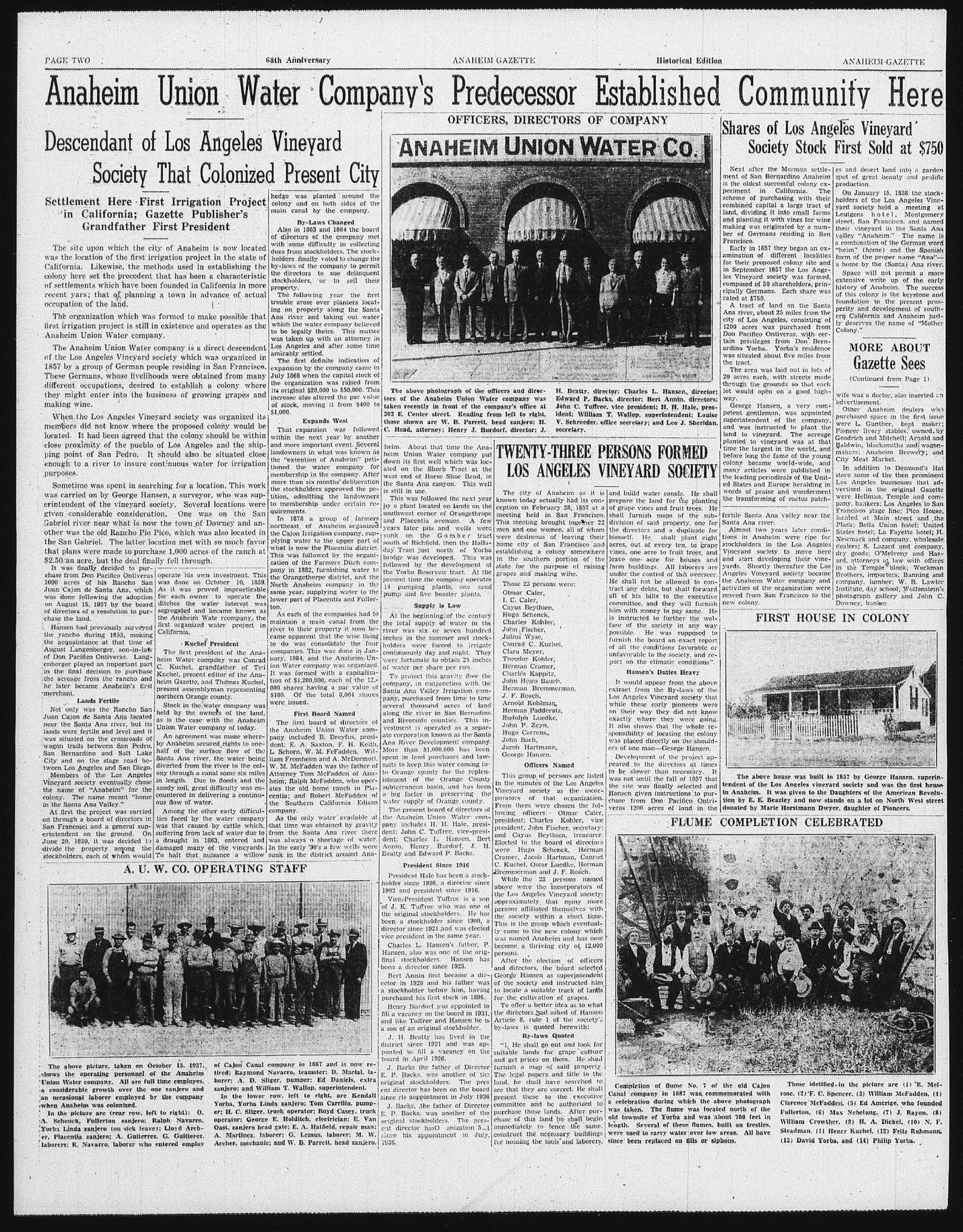
Searchable text
Anaheim Union Water Company
Descendant of Los Angeles Vineyard Society That Colonized Present City
Settlement Here First Irrigation Project in California; Gazette Publisher's Grandfather First President
The site upon which the city of Anaheim is now located was the location of the first irrigation project in the state of California. Likewise, the methods used in establishing the colony here set the precedent that has been a characteristic of settlements which have been founded in California in more recent years; that of planning a town in advance of actual occupation of the land.
The organization which was formed to make possible that first irrigation project is still in existence and operates as the Anaheim Union Water company.
The Anaheim Union Water company is a direct descendent of the Los Angeles Vineyard society which was organized in 1857 by a group of German people residing in San Francisco. These Germans, whose livelihoods were obtained from many different occupations, desired to establish a colony where they might enter into the business of growing grapes and making wine.
When the Los Angeles Vineyard society was organized its members did not know where the proposed colony would be located. It had been agreed that the colony should be within close proximity of the pueblo of Los Angeles and the shipping point of San Pedro. It should also be situated close hedge was planted around colony and on both sides main canal by the company.
By-Laws Changed
Also in 1863 and 1864 the directors of the company with some difficulty in collections from stockholders. The holders finally voted to change by-laws of the company to allow directors to sue delinquency stockholders, or to sell property.
The following year the trouble arose over planters' ing on property along the Ana river and taking out which the water company be to legally theirs. This was taken up with an attorney Los Angeles and after some amicably settled.
The first definite indication expansion by the company came July 1868 when the capital staged the organization was raised its original $20,000 to $50,000 increase also altered the part of stock, moving it from $1,000.
Expands West
That expansion was for within the next year by a more important event. Landowners in what was known as "extention of Anaheim"
1857 by a group of German people residing in San Francisco. These Germans, whose livelihoods were obtained from many different occupations, desired to establish a colony where they might enter into the business of growing grapes and making wine.
When the Los Angeles Vineyard society was organized its members did not know where the proposed colony would be located. It had been agreed that the colony should be within close proximity of the pueblo of Los Angeles and the shipping point of San Pedro. It should also be situated close enough to a river to insure continuous water for irrigation purposes.
Sometime was spent in searching for a location. This work was carried on by George Hansen, a surveyor, who was superintendent of the vineyard society. Several locations were given considerable consideration. One was on the San Gabriel river near what is now the town of Downey and another was the old Rancho Pio Pico, which was also located in the San Gabriel. The latter location met with so much favor that plans were made to purchase 1,000 acres of the ranch at $2.50-an acre, but the deal finally fell through.
It was finally decided to purchase from Don Pacifico Ontiveras 1000 acres of his Rancho San Juan Cajon de Santa Ana, which was done following the adoption on August 15, 1957 by the board of directors of a resolution to purchase the land.
Hansen had previously surveyed the rancho during 1853, making the acquaintance at that time of August Langenberger, son-in-law of Don Pacifico Ontiveras. Langenberger played an important part in the final decision to purchase the acreage from the rancho and he later became Anaheim's first merchant.
Lands Fertile
Not only was the Rancho San Juan Cajon de Santa Ana located near the Santa Ana river, but its lands were fertile and level and it was situated on the crossroads of wagon trails between San Pedro, San Bernardino and Salt Lake City and on the stage road between Los Angeles and San Diego.
Members of the Los Angeles Vineyard society eventually chose the name of "Anaheim" for the colony. The name meant "home in the Santa Ana Valley."
At first the project was carried on through a board of directors in San Francosci and a general superintendent on the ground. On June 20, 1859, it was decided to divide the property among the stockholders, each of whom would operate his own investment. This was done on October 10, 1859. As it was proved impracticable for each owner to operate the ditches the water interest was segregated and became known as the Anaheim Wate company, the first organized water project in California.
Kuchel President
The first president of the Anaheim Water company was Conrad C. Kuchel, grandfather of Tei Kuchel, present editor of the Anaheim Gazette, and Thomas Kuchel, present assemblyman representing northern Orange county.
Stock in the water company was held by the owners of the land, as is the case with the Anaheim Union Water company of today.
An agreement was made whereby Anaheim secured rights to one-half of the surface flow of the Santa Ana river, the water being diverted from the river to the colony through a canal some six miles in length. Due to floods and the sandy soil, great difficulty was encountered in delivering a continuous flow of water.
Among the other early difficulties faced by the water company was that caused by cattle which, suffering from lack of water due to a draught in 1863, entered and damaged many of the vineyards. To halt that nuisance a willow
Expands West
That expansion was forced within the next year by an increase important event. Some landowners in what was known as "extention of Anaheim" tioned the water company membership in the company more than six months' delibere stockholders approved this tition, admitting the land to membership under certain requirements.
In 1878 a group of front northeast of Anaheim orgained the Cajon Irrigation company plying water to the upper part what is now the Placentia district. This was followed by the organization of the Farmers Ditch parry in 1882, furnishing water or Orangethorpe district, and North Anaheim company in same year, supplying water lower part of Placentia and Placentia.
As each of the companies maintain a main canal from river to their property it soon came apparent that the wise do was consolidate these companies. This was done in January, 1884, and the Anaheim Water company was organized. It was formed with a capital of $1,200,000, each of the 000 shares having a par value $100. Of the total $8,004 were issued.
First Board Named
The first board of directors of the Anaheim Union Water company included B. Dreyfus, dent; E. A. Saxton, F. H., L. Schorn, W. M. FeFadden, liam Fromheim and A. McDeW. W. M. McFadden was the fath Attorney Tom McFadden of Anaheim; Ralph McFadden whoates the old home ranch in centia; and Robert McFadden of Southern California B company.
As the only water available that time was obtained by going from the Santa Ana river was always o shortage of water. In the early '90's a few wells sunk in the district around
Members of the Los Angeles Vineyard society eventually chose the name of "Anaheim" for the colony. The name meant "home in the Santa Ana Valley."
At first the project was carried on through a board of directors in San Francosci and a general superintendent on the ground. On June 20, 1859, it was decided to divide the property among the stockholders, each of whom would
Among the other early difficulties faced by the water company was that caused by cattle which, suffering from lack of water due to a draught in 1863, entered and damaged many of the vineyards. To halt that nuisance a willow
The above picture, taken on October 15, 1937, shows the operating personnel of the Anaheim Union Water company. All are full time employes, a considerable growth over the one zanjero and an occasional laborer employed by the company when Anaheim was colonized.
In the picture are (rear row, left to right): O. A. Schenek, Fullerton zanjero; Ralph Navarro, Yorba Linda zanjero (on sick leave); Lloyd Archer, Placentia zanjero; A. Guiterrez, G. Guitterez, laborers; R. Navarro, laborer who entered employ of Cajon Canal company in 1887 and is now tired; Raymond Navarro, teamster; D. Maciaborer; A. D. Sliger, pumper; Ed Daniels, zanjero; and William T. Wallop, superintender.
In the lower row, left to right, are Kel Yorba, Yorba Linda zanjero; Tom Carrillo, placer; H. C. Sliger, truck operator; Boyd Casey, operator; George E. Holditch, electrician; E. Oast, zanjero head gate; E. A. Hatfield, repairer; A. Martlinez, laborer; G. Lemus, laborer; M. Archer, mechanic; and W. B. Parrett, headzanjero.
A nniversary
ANAHEIM GAZETTE
Historic
Water Company's Predecessor Established
Vineyard in Present City
By-Laws Changed
Also in 1863 and 1864 the board directors of the company met on some difficulty in collecting stockholders. The stockholders finally voted to change the laws of the company to permit directors to sue delinquent stockholders, or to sell their property.
The following year the firstable arose over planters location on property along the Santa river and taking out water which the water company believed be legally theirs. This matter taken up with an attorney in Angeles and after some time carefully settled.
The first definite indication of expansion by the company came in 1868 when the capital stock of organization was raised from original $20,000 to $50,000. This please also altered the par value stock, moving it from $400 to $500.
Expands West
That expansion was followed in the next year by another more important event. Several towners in what was known as "extention of Anaheim" peti
OFFICERS, DIRECTORS OF COMPANY
ANAHEIM UNION WATER CO
The above photograph of the officers and directors of the Anaheim Union Water company was taken recently in front of the company's office at 303 E. Center street. Reading from left to right, those shown are W. B. Parrett, head zanjero; H. C. Head, attorney; Henry J. Burdorf, director; J.
H. Beatty, director; Charles L. Hansen, Edward P. Backs, director; Bert Annih John C. Tuffree, vice president; H. H. Ident; William T. Wallop, superintendent V. Schroeder, office secretary; and Leo secretary.
heim. About that time the Anaheim Union Water company put
Expands West
that expansion was followed in the next year by another more important event. Several landowners in what was known as "extention of Anaheim" petitioned the water company for membership in the company. After three or six months' deliberation stockholders approved the petition, admitting the landowners membership under certain remeasures.
In 1878 a group of farmers—the east of Anaheim organized Cajon Irrigation company, supplying water to the upper part of it is now the Placentia district. This was followed by the organization of the Farmers Ditch company in 1882, furnishing water to Orangethorpe district, and the South Anaheim company in the same year, supplying water to the other part of Placentia and Fuller-area companies had to contain a main canal from the river to their property it soon became apparent that the wise thing did was consolidate the four companies. This was done in January, 1884, and the Anaheim Un-Water company was organized. It was formed with a capitalization of $1,200,000, each of the 12-shares having a par value of $10. Of the total 8,004 shares issued.
First Board Named
The first board of directors of Anaheim Union Water company included B. Dreyfus, president; E. A. Saxton, F. H. Keith, chorn, W. M. FeFadden, Wil-Fromheim and A. McDermott. M. McFadden was the father oforney Tom McFadden of Anaheim; Ralph McFadden, who operated the old home ranch in Placentia; and Robert McFadden of Southern California Edison company.
The only water available at time was obtained by gravity from the Santa Ana river there always o shortage of water. The early '90's a few wells were in the district around Ana-
heim. About that time the Anaheim Union Water company put down its first well which was located on the Shorb Tract at the west end of Horse Shoe Bend, in the Santa Ana canyon. This well is still in use.
This was followed the next year by a plant located on lands on the southwest corner of Orangethrope and Placentia avenues. A few years later pits and wells were sunk on the Gomber tract south of Richfield, then the Halladay Tract just north of Yorba bridge was developed. This was followed by the development at the Yorba Reservoir tract. At the present time the company operates 14 pumping plants, one sand pump and five booster plants.
Supply is Low
At the beginning of the century the total supply of water in the river was six or seven hundred inches in the summer and stockholders were forced to irrigate continuously day and night. They were fortunate to obtain 25 inches of water per share per run.
To protect this gravity flow the company, in conjunction with the Santa Ana Valley Irrigation company, purchased from time to time several thousand acres of land along the river in San Bernadino and Riverside counties. This investment is operated as a separate corporation known as the Santa Ana River Development company. More than $1,000,000 has been spent in land purchases and lawsuits to keep this water coming into Orange County for the replenishment of the Orange County subterranean basin, and has been a big factor in preserving the water supply of Orange county.
The present board of directors of Anaheim Union Water company includes H. H. Hale, president; John C. Tuffree, vice-president; Charles L. Hansen, Bert Annin, Henry Burdorf, J. H. Beatty and Edward P. Backs.
President Since 1916
The city of Anaheim as it is known today actually had its conception on February 28, 1857 at a meeting held in San Francisco. This meeting brought together 22 men and one women, all of whom were desirous of leaving their home city of San Francisco and establishing a colony somewhere in the southern portion of the state for the purpose of raising grapes and making wine.
Those 23 persons were:
Otmar Caler,
I. C. Caler,
Cayus Beythien,
Hugo Schenck,
Charles Kohler,
John Fischer,
Julius Wyse,
Conrad C. Kuchel,
Clara Meyer,
Theodor Kohler,
Herman Cramer,
Charles Kappitz,
John Heins Bauch,
Herman Bremmerman,
J. F. Roach,
Arnold Kohlman,
Herman Padderatz,
Rudolph Luedke,
John P. Zeyn,
Hugo Carrens,
John Bach,
Jacob Hartmann,
George Hansen.
Officers Named
This group of persons are listed in the minutes of the Los Angeles Vineyard society as the incorporators of that organization. From them were chosen the following officers: Otmar Caler, president; Charles Kohler, vice president; John Fischer, secretary; and Cayus Beythien, treasurer. Elected to the board of directors were Hugo Schenck, Herman Cramer, Jacob Hartman, Conrad C. Kuchel, Oscar Luedke, Herman Bremmerman.
Twenty-three Persons For Los Angeles Vineyard Society
and build water canals to prepare the land for two of grape vines and fruit shall furnish maps on division of said property to the directors and a dike himself. He shall have acres out of every ten vineins, one acre to fruit leave one-acre for our farm buildings. All he under the control of thе He shall not be allowed tract any debts, but shall all of his bills to thе committee, and they will him with money to pay it instructed to further fare of the society in possible. He was sure furnish the board an order of all the conditions for unfavorable to the society port on the climatic c
Hansen's Duties
It would appear from extract from the By-Los Angeles Vineyard society while these early pickups on their way they did exactly where they went It also shows that their sponsibility of locating was placed directly on one of man—Georgie.
Development of the depared to the directors to be slower than new was not until the fall on the site was finally signed Hansen given instruction chase from Don Pacific veras 1200 acres of l
President Since 1916
President Hale has been a stockholder since 1898, a director since 1902 and president since 1916.
Vice-President Tuffrec is a son of J. K. Tuffree who was one of the original stockholders. He has been a stockholder since 1909, a director since 1921 and was elected vice president in the same year.
Charles L. Hansen's father, P. Hansen, also was one of the original stockholders. Hansen has been a director since 1923.
Bert Annin first became a director in 1920 and his father was a stockholder before him, having purchased his first stock in 1896.
Henry Burdorf was appointed to fill a vacancy on the board in 1931, and like Tuffree and Hansen he is a son of an original stockholder.
J. H. Beatty has lived in the district since 1921 and was appointed to fill a vacancy on the board in April 1926.
J. Backs the father of Director E. P. Backs, was another of the original stockholders. The present director has been on the board since ris appointment in July 1936.
J. Backs, the father of Director E. P. Backs, was another of the original stockholders. The present director hasO anization 5...1 since his appointment in July, 1936.
This group of persons are listed in the minutes of the Los Angeles Vineyard society as the incorporators of that organization. From them were chosen the following officers: Otmar Caler, president; Charles Kohler, vice president; John Fischer, secretary; and Cayus Beythien, treasurer. Elected to the board of directors were Hugo Schenck, Heirman Cramer, Jacob Hartman, Conrad C. Kuchel, Oscar Luedke, Herman Dremmerman and J. F. Roach.
While the 23 persons named above were the incorporators of the Los Angeles Vineyard society; approximately that many more persons affiliated themselves with the society within a short time. This is the group which eventually came to the new colony which was named Anaheim and has now become a thriving city of 12,000 persons.
After the election of officers and directors, the board selected George Hansen as superintendent of the society and instructed him to locate a suitable track of lands for the cultivation of grapes.
To offer a better idea as to what the directors had asked of Hanson Article 8, rule 1 of the society's by-laws is quoted herewith:
By-laws Quoted
"1. He shall go out and look for suitable lands for grape culture and get prices on them. He shall furnish a map of said property. The legal papers and title to the land, he shall have searched to see that they are correct. He shall present these to the executive committee and be authorized to purchase those lands. After purchase of this land he shall begin immediately to fence the same, construct the necessary buildings for housing the tools and laborers,
Completion of flume Canal company in 1887 a celebration during v was taken. The flume old townsite of Yorba length. Several of th were used to carry water since been replaced on
Established Community Here
COMPANY
ATER CO.
Shares of Los Angeles Vineyard Society Stock First Sold at $750
Next after the Mormon settlement of San Bernardino Anaheim is the oldest successful colony experiment in California. The scheme of purchasing with their combined capital a large tract of land, dividing it into small farms and planting it with vines for wine making was originated by a number of Germans residing in San Francisco.
Early in 1857 they began an examination of different localities for their proposed colony site and in September 1857 the Los Angeles Vineyard society was formed, composed of 50 shareholders, principally Germans. Each share was rated at $750.
A tract of land on the Santa Ana river, about 25 miles from the city of Los Angeles, consisting of 1200 acres was purchased from Don Pacifico Ontiveras, with certain privileges from Don Bernardino Yorba. Yorba's residence was situated about five miles from the tract.
The area was laid out in lots of 20 acres each, with streets made through the grounds so that each lot would open on a good highway.
George Hansen, a very competent gentleman, was appointed superintendent of the company, and was instructed to plant the land to vineyard. The acreage planted to vineyard was at that time the largest in the world, and before long the fame of the young ones and desert land into a garden spot of great beauty and prolific production.
On January 15, 1858 the stockholders of the Los Angeles Vineyard society held a meeting at Leutgens hotel, Montgomery street, San Francisco, and named their vineyard in the Santa Ana valley "Anaheim." The name is a combination of the German word "heim" (home) and the Spanish form of the proper name "Ana"—a home by the (Santa) Ana river.
Space will not permit a more extensive write up of the early history of Anaheim. The success of this colony is the keystone and foundation to the present prosperity and development of southern California and Anaheim justly deserves the name of "Mother Colony."
MORE ABOUT Gazette Sees
(Continued from Page 1)
wife was a doctor, also inserted an advertisement.
Other Anaheim dealers who purchased space in the first issue were L. Gunther, boot maker; Pioneer livery stables, owned by Goodrich and Mitchell; Arnold and Baldwin, blacksmiths and wagon-makers; Anaheim Brewery; and City Meat Market.
PERSONS FORMED VINEYARD SOCIETY
and build water canals. He shall prepare the land for the planting of grape vines and fruit trees. He shall furnish maps of the subdivision of said property, one for the directors and a duplicate for himself. He shall plant eight acres, out of every ten, to grape vines, one acre to fruit trees, and leave one-acre for houses and farm buildings. All laborers are under the control of this overseer. He shall not be allowed to contract any debts, but shall forward all of his bills to the executive committee, and they will furnish him with money to pay same. He is instructed to further the welfare of the society in any way possible. He was supposed to furnish the board an exact report of all the conditions favorable or unfavorable to the society, and report on the climatic conditions".
Hansen's Duties Heavy
It would appear from the above extract from the By-laws of the Los Angeles Vineyard society that while these early pioneers were on their way they did not know exactly where they were going. It also shows that the whole responsibility of locating the colony was placed directly on the shoulders of one man—George Hansen.
Development of the project appeared to the directors at times to be slower than necessary. It was not until the fall of 1857 that the site was finally selected and Hansen given instructions to purchase from Don Pacifico Ontriveras 1200 acres of land in the
FIRST HOUSE IN COLONY
The above house was built in 1857 by George Hansen, superintendent of the Los Angeles vineyard society and was the first house in Anaheim. It was given to the Daughters of the American Revolution by E. E. Beazley and now stands on a lot on North West street donated by Marle Horsimann Dwyer, daughter of Pioneers.
FLUME COMPLETION CELEBRATED
The above house was built in 1857 by George Hansen, superintendent of the Los Angeles vineyard society and was the first house in Anaheim. It was given to the Daughters of the American Revolution by E. E. Beazley and now stands on a lot on North West street donated by Marie Horstmann Dwyer, daughter of Pioneers.
FLUME COMPLETION CELEBRATED
Completion of flume No. 7 of the old Cajon Canal company in 1887 was commemorated with a celebration during which the above photograph was taken. The flume was located north of the old townsite of Yorba and was about 700 feet in length. Several of these flumes, built on trestles, were used to carry water over low areas. All have since been replaced on fills or siphons.
Those idetified in the picture are (1) R. Melrose, (2) F. C. Spencer, (3) William McFadden, (4) Clarence McFadden, (5) Ed Amerige, who founded Fullerton, (6) Max Nebelung, (7) J. Rayon, (8) William Crowther, (9) H. A. Dickel, (10) N. F. Steadman, (11) Henry Kuchel, (12) Fritz Ruhmann, (13) David Yorba, and (14) Philip Yorba.