anaheim-gazette 1937-10-28
Scanned page
Searchable text
HEREIN
is contained a review of the founding, the growth and development of Anaheim,
1870 to 1937
68th
ANAH
VOL. LXVIII
City Of Anaheim Incorporated
Governor Henry H. Haight
Gives Document Approval
Major Max Strobel Elected First Mayor of New Municipality which Lasted Only Two Years; Reorganized in 1877
The eighteenth California state legislature passed an act creating the city of Anaheim, official approval of which was given on February 10, 1870, by Governor Henry H. Haight. Thus, about a year after the Pioneers had settled the colony
Major Max Strobel Elected First Mayor of New Municipality which Lasted Only Two Years; Reorganized in 1877
The eighteenth California state legislature passed an act creating the city of Anaheim, official approval of which was given on February 10, 1870, by Governor Henry H. Haight. Thus, about a year after the Pioneers had settled the colony it became an incorporated city.
By the statute Anaheim was declared incorporated according to an act of 1850, providing general provisions as to area and population. The territory embraced within the boundaries of the new municipality was described as being "All that tract of land known by the name of Anaheim, lying and being in the county of Los Angeles, in this state, and comprising the east halves of sections nine and 16, and the whole of sections 10, 11, 14 and 15 of township four south range ten west, of the San Bernardino meridian and base line."
The act of incorporation declared especially that, the common council should consist of five members. It was provided that the new city should have no recorder, but that the duties of such officer should be performed by the mayor. The mayor was elected by the people separate from the common council and had the power of veto of any ordinances passed by the council.
The first election held in Anaheim resulted in Theodore Reiser and Max Strobel tying for mayor with 48 votes, and E. W. Champlin, Henry Kroeger, John P. Zeyn, F. A. Goodrich and John Fischer being elected councilmen. N. H. Mitchel was chosen city assessor, David Davies, city marshal; S. J. Davis, city attorney, and Theodore Rumpau, city treasurer.
Election Aug. 16, 1870
The election was held on August 16, 1870. The election board consisted of John C. Hill, inspector, Edward Polhemus and S. J. McGlauflin, judges, and George C. Knox and W. T. Rumble, clerks.
The councilmen-elect met at the office of the Anaheim Water company on August 18, 1870, to organize. John Fischer was elected president of the body and F. W. Kuelp was appointed clerk.
The second mayoralty election was held on August 31 and resulted in the election of Max Strobel, who therefore became Anaheim's first mayor.
Following the election of Strobel the council passed the first three ordinances of the city. The Strobel the council passed three ordinances touching upon the sale of intoxicating drinks to Indians, slaughtering of cattle within the city, and the tying of horses, cows or goats in public streets for the purpose of feeding. In each case the ordinance prohibited such action, except that one established a permit to slaughter cows under certain restrictions.
Shortly thereafter, Louis Wartenberg petitioned the council "for a permit to erect a slaughter house on certain premises on the east side of Los Angeles street, opposite the San Diego gate". His application was granted and he was given a five year permit.
Obtain Site
During September, 1870, steps were taken to obtain a site for a town hall, with Mayor Strobel and John P. Zeyn instructed to make the arrangement. They reported that Mr. Dreyfus had agreed to sell them Lot 20 for $150. At this point Jacob Keller offered to the mayor and council a lot 60 x 90 feet located on Cypress street between Los Angeles and Lemon streets for this purpose of building a station house. This offer was accepted.
O. B. Peck and company obtained the contract for building the city hall. The necessary lumber was purchased from Gilbert Huntington, the first delivery of which was made from Anaheim Landing on November 9, 1870.
On the same day the council
The second mayoralty election was held on August 31 and resulted in the election of Max Strobel, who therefore became Anaheim's first mayor.
Following the election of Strobel the council passed the first three ordinances of the city. The first provided that meetings of the council should be each Monday evening at 7:30 o'clock and that all proceedings of the meetings should be published in English. The second fixed the salaries and prescribed the general duties of the city officers. The mayor received no salary, the marshal was granted $50 a month for the first three months; city treasurer, none; city attorney, none; city clerk, $12 a month and $20 extra for the first month; and assessor, $150 a year. Some of the officers were entitled to certain fixed fees in addition to their salaries.
Tax Rate 60c
Ordinance No. 3 created a machinery for collecting taxes and provided for the distribution of money collected. The city tax rate was set at 60 cents per $100 valuation.
The next business done by the council was to rent a room of the Anaheim Water company's office for use as a jail. The rate of rental was $5 a month.
Then followed the adoption of an ordinance providing for business licenses. The rate was set at $5 quarterly for businesses valued at less than $2,000 and $10 quarterly for those valued more than $2,000.
According to the recommendations previously made by Mayor
City Streets Sought
At a regular meeting of the council held November 14 a special committee consisting of Henry Kroeger, F. A. Goodrich and John Fischer was appointed "to confer with the Anaheim Water company for the purpose of procuring control of the streets. The matter was eventually placed before a meeting of the stockholders of the company and unanimously rejected.
The council met for the first time in the new city hall on January 9, 1871, and adopted an ordinance changing the time of meeting to the second and fourth Mondays of each month at 3 o'clock.
On February 13, Anaheim's first traffic ordinance was passed. It set a speed limit for vehicles and animals at eight miles per hour and set a maximum fine of $20.
That all was not going well financially with the city was first revealed in the council's minutes for February 27 when the city marshal's salary was cut 50 percent. On April 10 the treasurer's report showed a cash balance of $70.69 and outstanding unpaid warrants amounting to $400.79.
Kroeger Elected Mayor
The second city election was held on May 1, 1871. Henry Kroeger was elected mayor, John P. Zeyn, Philip Davis, Tim Boege, Andrew Bittner and E. W. Champlin, councilmen. Theodore Rimpau, re-elected treasurer, T. T. Hill, city marshal, Richard Melrose, assessor, and George W. Barter, founder of the Gazette, attorney. Zeyn was elected pres-
8th Anniversary
AND HISTORICAL EDITION
ANAHEIM GAZETE
ANAHEIM, CALIFORNIA, THURSDAY, OCTOBER 28, 1937
corporated Through Legislative Act Of
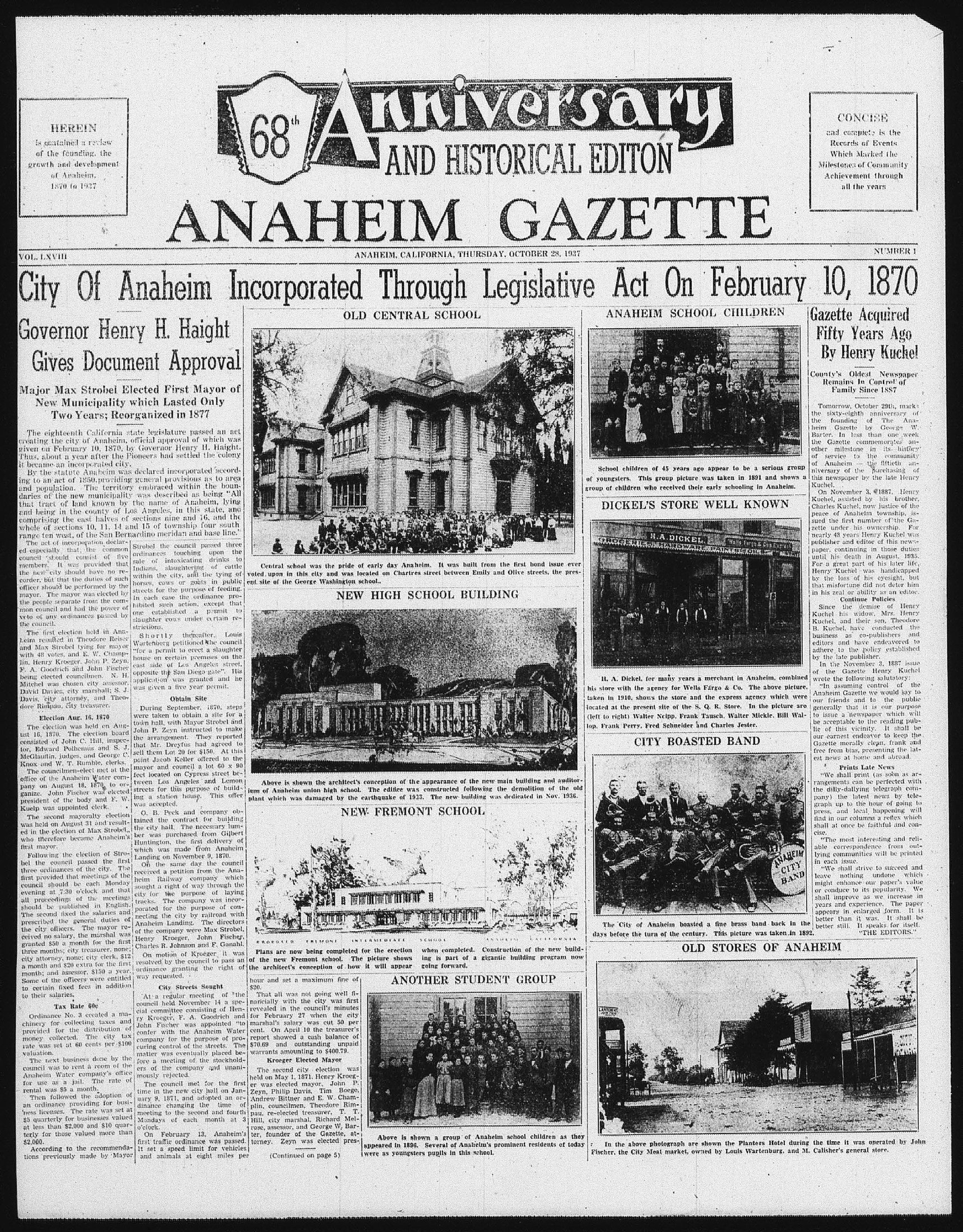
OLD CENTRAL SCHOOL
ANAHEIM SC
school was the pride of early day Anaheim. It was built from the first bond issue ever in this city and was located on Chartres street between Emily and Olive streets, the presthe George Washington school.
NEW HIGH SCHOOL BUILDING
is shown the architect's conception of the appearance of the new main building and auditorium union high school. The edifice was constructed following the demolition of the old which was damaged by the earthquake of 1933. The new-building was dedicated in Nov. 1936.
NEW FREMONT SCHOOL
NEW FREMONT SCHOOL
The now being completed for the erection of New Fremont school. The picture shows its conception of how it will appear when completed. Construction of the new building is part of a gigantic building program now going forward.
ANOTHER STUDENT GROUP
Above is shown a group of Anaheim school children as they appeared in 1896. Several of Anaheim's prominent residents of today were as youngsters pupils in this school.
CONCISE
and complete is the
Records of Events
Which Marked the
Milestones of Community
Achievement through
all the years
NUMBER 1
Act On February 10, 1870
ANAHEIM SCHOOL CHILDREN
Gazette Acquired
Fifty Years Ago
By Henry Kuchel
County's Oldest Newspaper
Remains In Control of
Family Since 1887
Tomorrow, October 29th, marks
the sixty-eighth anniversary of
the founding of The Anaheim Gazette by George W.
Barter. In less than one week
the Gazette commemorates another milestone in its history
of service to the community
School children of 45 years ago appear to be a serious group of students. This group picture was taken in 1891 and shows a number of children who received their early schooling in Anaheim.
DICKEL'S STORE WELL KNOWN
I. A. Dickel, for many years a merchant in Anaheim, combined store with the agency for Wells Fargo & Co. The above picture, taken in 1910, shows the store and the express agency which were located at the present site of the S. Q. R. Store. In the picture are two right) Walter Nipp, Frank Tausch, Walter Mickle, Bill Wal-Frank Perry, Fred Schneider and Charles Jester.
CITY BOASTED BAND
County's Oldest Newspaper Remains In Control of Family Since 1887
Tomorrow, October 29th, marks the sixty-eighth anniversary of the founding of The Anaheim Gazette by George W. Barter. In less than one week the Gazette commemorates another milestone in its history of service to the community of Anaheim — the fiftieth anniversary of the purchasing of this newspaper by the late Henry Kuechel.
On November 3, 1887, Henry Kuechel, assisted by his brother, Charles Kuechel, now justice of the peace of Anaheim township, issued the first number of the Gazette under his ownership. For nearly 48 years Henry Kuechel was publisher and editor of this newspaper, continuing in those duties until his death in August, 1935. For a great part of his later life, Henry Kuechel was handicapped by the loss of his eyesight, but that misfortune did not deter him in his zeal or ability as an editor.
Continue Policies
Since the demise of Henry Kuechel his widow, Mrs. Henry Kuechel, and their son, Theodore B. Kuechel, have conducted the business as co-publishers and editors and have endeavored to adhere to the policy established by the late publisher.
In the November 3, 1887 issue of the Gazette Henry Kuechel wrote the following salutatory:
"In assuming control of the Anaheim Gazette we would say to our friends and to the public generally that it is our purpose to issue a newspaper which will be acceptable to the reading public of this vicinity. It shall be our earnest endeavor to keep the Gazette morally clean, frank and free from bias, presenting the latest news at home and abroad."
Prints Late News
"We shall print (as soon as arrangements can be perfected with the dilly-dallying telegraph company) the latest news by telegraph up to the hour of going to press, and local happening will find in our columns a reflex which shall at once be faithful and concise.
"The most interesting and reliable correspondence from outlying communities will be printed in each issue."
"We shall strive to succeed and
The City of Anaheim boasted a fine brass band back in the
s before the turn of the century. This picture was taken in 1892.
"We shall print (as soon as arranges can be perfected with
the dilly-dallying telegraph company) the latest news by telegraph up to the hour of going to
press, and local happening will find in our columns a reflex which
shall at once be faithful and concise.
"The most interesting and reliable correspondence from outlying communities will be printed in each issue.
"We shall strive to succeed and leave nothing undone which
might enhance our paper's value or conduce to its popularity. We
shall improve as we increase in years and experience. The paper
appears in enlarged form. It is better than it was. It shall be
better still. It speaks for itself.
"THE EDITORS."
OLD STORES OF ANAHEIM
In the above photograph are shown the Planters Hotel during the time it was operated by John
her, the City Meat market, owned by Louis Wartenburg, and M. Calisher's general store.