anaheim-gazette 1937-10-28
Scanned page
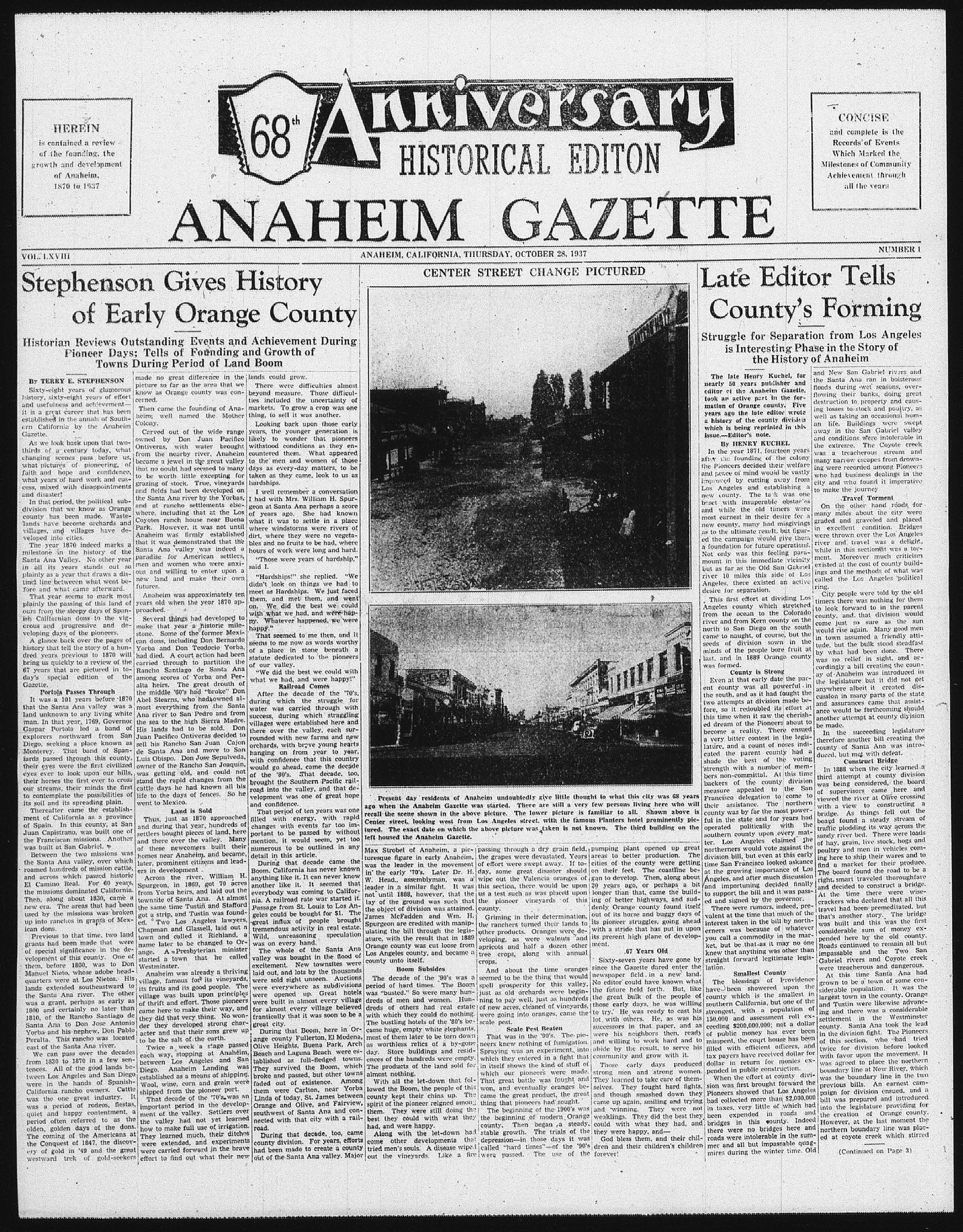
Searchable text
HEREIN is contained a review of the founding, the growth and development of Anaheim.
1870 to 1937
VOL. LXVIII
Stephenson Gives History of Early Orange County
Historian Reviews Outstanding Events and Achievement During Pioneer Days; Tells of Founding and Growth of Towns During Period of Land Boom
By TERRY E. STEPHENSON
Sixty-eight years of glamorous history, sixty-eight years of effort and usefulness and achievement—it is a great career that has been established in the annals of Southern California by the Anaheim Gazette.
As we look back upon that two-thirds of a century today, what changing scenes pass before us,
made no great difference in the picture so far as the area that we know as Orange county was concerned.
Then came the founding of Anaheim, well named the Mother Colony.
Cerved out of the wide range owned by Don Juan Pacifico Ontiveras, with water brought from the nearby river, Anaheim lands could grow.
There were difficulties almost beyond measure. Those difficulties included the uncertainty of markets. To grow a crop was one thing, to sell it was another.
Looking back upon those early years, the younger generation is likely to wonder that pioneers withstood conditions as they encountered them. What appeared
BY TERRY E. STEPHENSON
Sixty-eight years of glamorous history, sixty-eight years of effort and usefulness and achievement—it is a great career that has been established in the annals of Southern California by the Anaheim Gazette.
As we look back upon that two-thirds of a century today, what changing scenes pass before us, what pictures of pioneering, of faith and hope and confidence, what years of hard work and success, mixed with disappointments and disaster!
In that period, the political subdivision that we know as Orange county has been made. Wastelands have become orchards and villages, and villages have developed into cities.
The year 1870 indeed marks a milestone in the history of the Santa Ana Valley. No other year in all its years stands out so plainly as a year that draws a distinct line between what went before and what came afterward.
That year seems to mark most plainly the passing of this land of ours from the sleepy days of Spanish Californian dons to the vigorous and progressive and developing days of the pioneers.
A glance back over the pages of history that tell the story of a hundred years previous to 1870 will bring us quickly to a review of the 67 years that are pictured in today's special edition of the Gazette.
PORTOLA PASSES THROUGH
It was a 101 years before 1870 that the Santa Ana valley was a land unknown to any living white man. In that year, 1769, Governor Gaspar Portola led a band of explorers northward from San Diego, seeking a place known as Monterey. That band of Spaniards passed through this county, their eyes were the first civilized eyes ever to look upon our hills, their horses the first ever to cross our streams, their minds the first to contemplate the possibilities of its soil and its spreading plain.
Thereafter came the establishment of California as a province of Spain. In this county, at San Juan Capistrano, was built one of the Franciscan missions. Another was built at San Gabriel.
Between the two missions was the Santa Ana valley, over which roamed hundreds of mission cattle, made no great difference in the picture so far as the area that we know as Orange county was concerned.
Then came the founding of Anaheim, well named the Mother Colony.
Cerved out of the wide range owned by Don Juan Pacifico Ontiveras, with water brought from the nearby river, Anaheim became a jewel in the great valley that no doubt had seemed to many to be worth little excepting for grazing of stock. True, vineyards and fields had been developed on the Santa Ana river by the Yorbas, and at rancho settlements elsewhere, including that at the Los Coyotes ranch house near Buena Park. However, it was not until Anaheim was firmly established that it was demonstrated that the Santa Ana valley was indeed a paradise for American settlers, men and women who were anxious and willing to enter upon a new land and make their own futures.
Anaheim was approximately ten years old when the year 1870 approached.
Several things had developed to make that year a historic milestone. Some of the former Mexican dons, including Don Bernardo Yorba and Don Teodocio Yorba, had died. A court action had been carried through to partition the Rancho Santiago de Santa Ana among scores of Yorba and Peralta heirs. The great drouth of the middle '60's had "broke" Don Abel Stearns, who had owned almost everything from the Santa Ana river to San Pedro and from the sea to the high Sierra Madre. His lands had to be sold. Don Juan Pacifico Ontiveras decided to sell his Rancho San Juan Cajon de Santa Ana and move to San Luis Obispo. Don Jose Sepulveda, owner of the Rancho San Joaquin, was getting old, and could not stand the rapid changes from the cattle days he had known all his life to the days of fences. So he went to Mexico.
LAND IS SOLD
Thus, just as 1870 approached and during that year, hundreds of settlers bought pieces of land, here and there over the valley. Many of these newcomers built their homes near Anaheim, and became later, prominent citizens and leaders in development.
lands could grow.
There were difficulties almost beyond measure. Those difficulties included the uncertainty of markets. To grow a crop was one thing, to sell it was another.
Looking back upon those early years, the younger generation is likely to wonder that pioneers withstood conditions as they encountered them. What appeared to the men and women of those days as every-day matters, to be taken as they came, look to us as hardships.
I well remember a conversation I had with Mrs. William H. Spurgeon at Santa Ana perhaps a score of years ago. She had known what it was to settle in a place where windstorms were rivers of dirt, where they were no vegetables and no fruits to be had, where hours of work were long and hard.
"Those were years of hardship," said I.
"Hardships!" she replied. "We didn't look on things we had to meet as Hardships. We just faced them, and met them, and went on. We did the best we could with what we had, and were happy. Whatever happened, we were happy."
That seemed to me then, and it seems to me now as words worthy of a place in stone beneath a statute dedicated to the pioneers of our valley.
"We did the best we could with what we had, and were happy!"
Railroad Comes
After the decade of the '70's, during which the struggle for water was carried through with success, during which straggling villages were established here and there over the valley, each surrounded with new farms and new orchards, with brave young hearts hanging on from year to year, with confidence that this country would go ahead, came the decade of the '80's. That decade, too, brought the Southern Pacific railroad into the valley, and that development was one of great hope and confidence.
That period of ten years was one filled with energy, with rapid changes with events far too important to be passed by without mention; it would seem, yet too numerous to be outlined in any detail in this article.
During that decade came the Room California has never known
eyes ever to look upon our miss,
their horses the first ever to cross
our streams, their minds the first
to contemplate the possibilities of
its soil and its spreading plain.
Thereafter came the establishment of California as a province of Spain. In this county, at San Juan Capistrano, was built one of the Franciscan missions. Another was built at San Gabriel.
Between the two missions was the Santa Ana valley, over which roamed hundreds of mission cattle, and across which passed historic El Camino Real. For 60 years, the missions dominated California. Then, along about 1830, came a new era. The areas that had been used by the missions was broken up into ranches in grants of Mexican dons.
Previous to that time, two land grants had been made that were of special significance in the development of this county. One of them, before 1800, was to Don Manuel Nieto, whose adobe headquarters were at Los Nietos. His lands extended southeastward to the Santa Ana river. The other was a grant, perhaps as early as 1800 and certainly no later than 1810, of the Rancho Santiago de Santa Ana to Don Jose Antonio Yorba and his nephew, Don Pablo Peralta. This ranch was located east of the Santa Ana river.
We can pass over the decades from 1830 to 1870 in a few sentences. All of the good lands between Los Angeles and San Diego were in the hands of Spanish-California rancho owners. Cattle was the one great industry. It was a period of rodeos, fiestas, quiet and happy contentment, a period often referred to as the olden, golden days of the dons. The coming of the Americans at the Conquest of 1847, the discovery of gold in '49 and the great westward trek of gold-seekers
Land is Sold
Thus, just as 1870 approached and during that year, hundreds of settlers bought pieces of land, here and there over the valley. Many of these newcomers built their homes near Anaheim, and became later, prominent citizens and leaders in development.
Across the river, William H. Spurgeon, in 1869, got 70 acres from Yorba heirs, and laid out the townsite of Santa Ana. At almost the same time Tustin and Stafford got a strip, and Tustin was founded. Two Los Angeles lawyers, Chapman and Glassell, laid out a town and called it Richland, a name later to be changed to Orange. A Presbyterian minister started a town that he called Westminster.
Anaheim was already a thriving village, famous for its vineyards, its fruits and its good people. The village was built upon principles of thrift and effort. Those pioneers came here to make their way, and they did that very thing. No wonder they developed strong character and that their sons grew up to be the salt of the earth.
Twice a week a stage passed each way, stopping at Anaheim between Los Angeles and San Diego. Anaheim Landing was established as a means of shipping. Wool, wine, corn and grain were shipped from the pioneer port.
That decade of the '70's was an important period in the development of the valley. Settlers over the valley had not yet learned how to make full use of irrigation. They learned much, their ditches were extended, and experiments were carried forward in the brave effort to find out what their new
That period of ten years was one filled with energy, with rapid changes with events far too important to be passed by without mention, it would seem, yet too numerous to be outlined in any detail in this article.
During that decade came the Boom. California has never known anything like it. It can never know another like it. It seemed that everybody was coming to California. A railroad war started it Passage from St. Louis to Los Angeles could be bought for $1. The great influx of people brought tremendous activity in real estate Wild, unreasoning speculation was on every hand.
The whole of the Santa Ana valley was bought in the flood or excitement. New townsites were laid out, and lots by the thousands were sold sight unseen. Auctions were everywhere as subdivisions were opened up. Great hotels were built in almost every village for almost every village believed frantically that it was soon to be a great city.
During that Boom, here in Orange county Fullerton, El Modena Olive Heights, Buena Park, Arch Beach and Laguna Beach were established as full-fledged towns They survived the Boom, which broke and passed, but other towns faded out of existence. Among them were Carlton, near Yorb Linda of today, St. James between Orange and Olive, and Fairview southwest of Santa Ana and connected with that city with a rail road.
During that decade, too, cam county division. For years, effort had been made to create a county out of the Santa Ana valley. Majo
8th Anniversary
HISTORICAL EDITION
ANAHEIM GAZETE
ANAHEIM, CALIFORNIA, THURSDAY, OCTOBER 28, 1937
CENTER STREET CHANGE PICTURED
were difficulties almost measure. Those difficulted the uncertainty of To grow a crop was one sell it was another.
back upon those early younger generation is wonder that pioneers conditions as they en-them. What appeared men and women of those every-day matters, to be money came, look to us as remember a conversation Mrs. William H. Spuranta Ana perhaps a score ago. She had known has to settle in a place windstorms were rivers of they were no vegeta- fruits to be had, where work were long and hard. were years of hardship," ships!" she replied. "We on things we had to hardships. We just faced met them, and went did the best we could we had, and were happ- ever happened, we were armed to me then, and it now as words worthy in stone beneath a dedicated to the pioneers valley.
the best we could with head, and were happy!" Railroad Comes
the decade of the '70's, which the struggle for carried through with curring which straggling were established here and the valley, each sur- with new farms and new with brave young hearts from year to year, evidence that this country head, came the decade 70's. That decade, too, the Southern Pacific rail the valley, and that de- was one of great hope sense.
jod of ten years was one high energy, with rapid events far too im- be passed by without it would seem, yet too to be outlined in any this article.
that decade came the california has never known
Present day residents of Anaheim undoubtedly give little thought to what this city was 68 ago when the Anaheim Gazette was started. There are still a very few persons living here who recall the scene shown in the above picture. The lower picture is familiar to all. Shown abo Center street, looking west from Los Angeles street, with the famous Planters hotel prominently tured. The exact date on which the above picture was taken is not known. The third building o left housed the Anaheim Gazette.
Max Strobel of Anaheim, a picturesque figure in early Anaheim, was the leader in the movement passing through a dry grain field, the grapes were devastated. Years of effort were swept away. If to pumping plant opened up areas to better production cities of the county were
Present day residents of Anaheim undoubtedly give little thought to what this city was 68 years ago when the Anaheim Gazette was started. There are still a very few persons living here who recall the scene shown in the above picture. The lower picture is familiar to all. Shown above Center street, looking west from Los Angeles street, with the famous Planters hotel prominently tured. The exact date on which the above picture was taken is not known. The third building on left housed the Anaheim Gazette.
Max Strobel of Anaheim, a picturesque figure in early Anaheim, was the leader in the movement in the early '70's. Later Dr. H. W. Head., assemblyman, was a leader in a similar fight. It was not until 1888, however, that the lay of the ground was such that the object of division was attained. James McFadden and Wm. H. Spurgeon are credited with manipulating the bill through the legislature, with the result that in 1889 Orange county was cut loose from Los Angeles county, and became a county unto itself.
Boom Subsides
The decade of the '90's was a period of hard times. The Boom was "busted." So were many hundreds of men and women. Hundreds of others had real estate with which they could do nothing. The bustling hotels of the '80's became huge, empty white elephants, most of them later to be torn down as worthless relics of a by-gone day. Store buildings and residences of the hundreds were empty. The products of the land sold for almost nothing.
With all the let-down that followed the Boom, the people of this county kept their chins up. The spirit of the pioneer reigned among them. They were still doing the best they could with what they had, and were happy.
Along with the let-down had come other developments that tried men's souls. A disease wiped out the vineyards. Like a fire passing through a dry grain field, the grapes were devastated. Years of effort were swept away. If today, some great disaster should wipe out the Valencia oranges of this section, there would be upon us a test such as was placed upon the pioneer vineyards of this county.
Griming in their determination, the ranchers turned their lands to other products. Oranges were developing, as were walnuts and apricots and half a dozen other tree crops, along with annual crops.
And about the time oranges seemed to be the thing that would spell prosperity for this valley, just as old orchards were beginning to pay well, just as hundreds of new acres, cleaned of vineyards, were going into oranges, came the scale pest.
Scale Pest Beaten
That was in the '90's. The pioneers knew nothing of fumigation. Spraying was an experiment, into which they entered in a fight that in itself shows the kind of stuff of which our pioneers were made. That great battle was fought and won, and eventually oranges became the great product, the great thing that pioneers had sought.
The beginning of the 1900's was the beginning of modern Orange county. Then began a steady growth. The trials of the depression—in those days it was called "hard times"—of the '90's were passed. The use of the pumping plant opened up areas to better production. cities of the county were grown on their feet. The coastline gan to develop. Then, along 20 years ago, or perhaps longer than that, came the ing of better highways, and denly Orange county found out of its horse and buggy due its pioneer struggles, going with a stride that has put in its present high plane of development.
67 Years Old
Sixty-seven years have gone since the Gazette dared entitle newspaper field. In a new No editor could have known the future held forth. But the great bulk of the people those early days, he was to try. He was ready to co-lot with others. He, as successors in that paper, were his neighbors then, and willing to work hard abide by the result, to serve community and grow with those early days pre-strong men and strong women. They learned to take care of selves. They fought hard and though smashed down came up again, smiling and winning. They were weaklings. They did the best could with what they had they were happy, and—God bless them, and their dren and their children's care forever!
Late Editor Tells County's Forming
Struggle for Separation from Los Angeles is Interesting Phase in the Story of the History of Anaheim
The late Henry Kuchel, for nearly 50 years publisher and editor of the Anaheim Gazette, took an active part in the formation of Orange county. Five years ago the late editor wrote a history of the county division which is being reprinted in this issue.—Editor's note.
By HENRY KUCHEL
In the year 1871, fourteen years after the founding of the colony and New San Gabriel rivers and the Santa Ana ran in boisterous floods during wet seasons, overflowing their banks, doing great destruction to property and causing losses to stock and poultry, as well as taking an occasional human life. Buildings were swept away in the San Gabriel valley and conditions were intolerable in the extreme. The Coyote creek was a treacherous stream and many people escape from drown-
The late Henry Kuchel, for nearly 50 years publisher and editor of the Anaheim Gazette, took an active part in the formation of Orange county. Five years ago the late editor wrote a history of the county division which is being reprinted in this issue.—Editor's note.
By HENRY KUCHEL
In the year 1871, fourteen years after the founding of the colony the Pioneers decided their welfare and peace of mind would be vastly improved by cutting away from Los Angeles and establishing a new county. The task was one beset with insuperable obstacles and while the old timers were most earnest in their desire for a new county, many had misgivings as to the ultimate result, but figured the campaign would give them a foundation for future operations. Not only was this feeling paramount in this immediate vicinity but as far as the Old San Gabriel river 10 miles this side of Los Angeles, there existed an active desire for separation.
This first effort at dividing Los Angeles county which stretched from the ocean to the Colorado river and from Kern county on the north to San Diego on the south came to naught, of course, but the seeds of division sown in the minds of the people bore fruit at last, and in 1889 Orange county was formed.
County is Strong
Even at that early date the parent county was all powerful in the south, and as it had fought the two attempts at division made before, so it redoubled its effort at this time when it saw the cherished dream of the Pioneers about to become a reality. There ensued a very bitter contest in the legislature, and a count of noses indicated the parent county had a shade best of the voting strength with a number of members non-committal. At this time backers of the county division measure appealed to the San Francisco delegation to come to their assistance. The northern county was by far the most powerful in the state and for years had operated politically with the southern county upon every matter. Los Angeles claimed the northerners would vote against the division bill, but even at this early time San Francisco looked askance at the growing importance of Los and New San Gabriel rivers and the Santa Ana ran in boisterous floods during wet seasons, overflowing their banks, doing great destruction to property and causing losses to stock and poultry, as well as taking an occasional human life. Buildings were swept away in the San Gabriel valley and conditions were intolerable in the extreme. The Coyote creek was a treacherous stream and many narrow escapes from drowning were recorded among Pioneers who had business dealings in the city and who found it imperative to make the journey.
Travel Torment
On the other hand roads for many miles about the city were graded and graveled and placed in excellent condition. Bridges were thrown over the Los Angeles river and travel was a delight, while in this section it was a torment. Moreover much criticism existed at the cost of county buildings and the methods of what was called the Los Angeles political ring.
City people were told by the old timers there was nothing for them to look forward to in the parent county, and that division would come just so sure as the sun would rise again. Many good men in town assumed a friendly attitude, but the bulk stood steadfast by what had been done. There was no relief in sight, and accordingly a bill creating the county of Anaheim was introduced in the legislature but it did not get anywhere albeit it created discussion in many parts of the state and assurances came that assistance would be forthcoming should another attempt at county division be made.
In the succeeding legislature therefore another bill creating the county of Santa Ana was introduced, but met with defeat.
Construct Bridge
In 1888 when the city learned a third attempt at county division was being considered, the board of supervisors came here and viewed the river at Olive crossing with a view to constructing a bridge. As things fell out the board found a steady stream of traffic plodding its way across the sandy river bed. There were loads of hay, grain, live stock, hogs and poultry and men in vehicles coming here to ship their wares and to find a market for their produce.
to what this city was 68 years old persons living here who will diar to all. Shown above is planters hotel prominently picn. The third building on the
caping plant opened up great ways to better production. The ages of the county were getting their feet. The coastline be- to develop. Then, along about years ago, or perhaps a bit longer than that, came the build- of better highways, and sud- ly Orange county found itself of its horse and buggy days of pioneer struggles, going ahead in a stride that has put in upon present high plane of development.
67 Years Old
sixty-seven years have gone by since the Gazette dared enter the newspaper field in a new land. Editor could have known what future held forth. But, like the great bulk of the people of early days, he was willing to carry with others. He, as was his successors in that paper, and as were his neighbors then, ready willing to work hard and to trade by the result, to serve his community and grow with it.
Those early days produced long men and strong women, they learned to take care of themselves. They fought hard fights, but though smashed down they came up again, smiling and trying to winning. They were not skillets. They did the best they did with what they had, and they were happy, and—God bless them, and their children and their children's children ever!
The blessings of Providence have been showered upon the county which is the smallest in southern California, but one of the strongest, with a population of 150,000 and assessment roll exceeding $200,000,000; not a dollar of public money has ever been misspent, the court house has been filled with efficient officers, and tax payers have received dollar for dollar in return for monies expended in public construction.
When the effort at county division was first brought forward the Pioneers showed that Los Angeles had collected more than $2,000,000 in taxes, very little of which had been expended in roads and bridges in this county. Indeed there were no bridges here and roads were intolerable in the summer and all but impassable quagmires during the winter time. Old bers non-committal. At this time backers of the county division measure appealed to the San Francisco delegation to come to their assistance. The northern county was by far the most powerful in the state and for years had operated politically with the southern county upon every matter. Los Angeles claimed the northerners would vote against the division bill, but even at this early time San Francisco looked askance at the growing importance of Los Angeles, and after much discussion and importuning decided finally to support the bill and it was passed and signed by the governor.
There were rumors, indeed, prevalent at the time that much of the interest taken in the bill by northerners was because of whatever you call a commodity in the market, but be that as it may no one knew that anything was other than straight forward legitimate legislation.
Smallest County
The blessings of Providence have been showered upon the county which is the smallest in southern California, but one of the strongest, with a population of 150,000 and assessment roll exceeding $200,000,000; not a dollar of public money has ever been misspent, the court house has been filled with efficient officers, and tax payers have received dollar for dollar in return for monies expended in public construction.
When the effort at county division was first brought forward the Pioneers showed that Los Angeles had collected more than $2,000,000 in taxes, very little of which had been expended in roads and bridges in this county. Indeed there were no bridges here and roads were intolerable in the summer and all but impassable quagmires during the winter time. Old third attempt at county division was being considered, the board of supervisors came here and viewed the river at Olive crossing with a view to constructing a bridge. As things fell out the board found a steady stream of traffic plodding its way across the sandy river bed. There were loads of hay, grain, live stock, hogs and poultry and men in vehicles coming here to ship their wares and to find a market for their produce. The board found the road to be a right, smart traveled thoroughfare and decided to construct a bridge. At the time there were wise-crackers who declared that all this travel had been premeditated, but that's another story. The bridge was built and this was the first considerable sum of money expended here by the old county. Roads continued to remain all but impassable and the Two San Gabriel rivers and Coyote creek were treacherous and dangerous.
At this time Santa Ana had grown to be a town of some considerable population. It was the largest town in the county. Orange and Tustin were likewise advancing and there was a considerable settlement in the Westminster county. Santa Ana took the lead in the division fight. The Pioneers of this section, who had tried twice for division before looked with favor upon the movement. It was agreed to place the northern boundary line at New River, which was the boundary line in the two previous bills. An earnest campaign for division ensued, and a bill was prepared and introduced into the legislature providing for the creation of Orange county. However, at the last moment the northern boundary line was placed at coyote creek which stirred