anaheim-gazette 1937-06-17
Scanned page
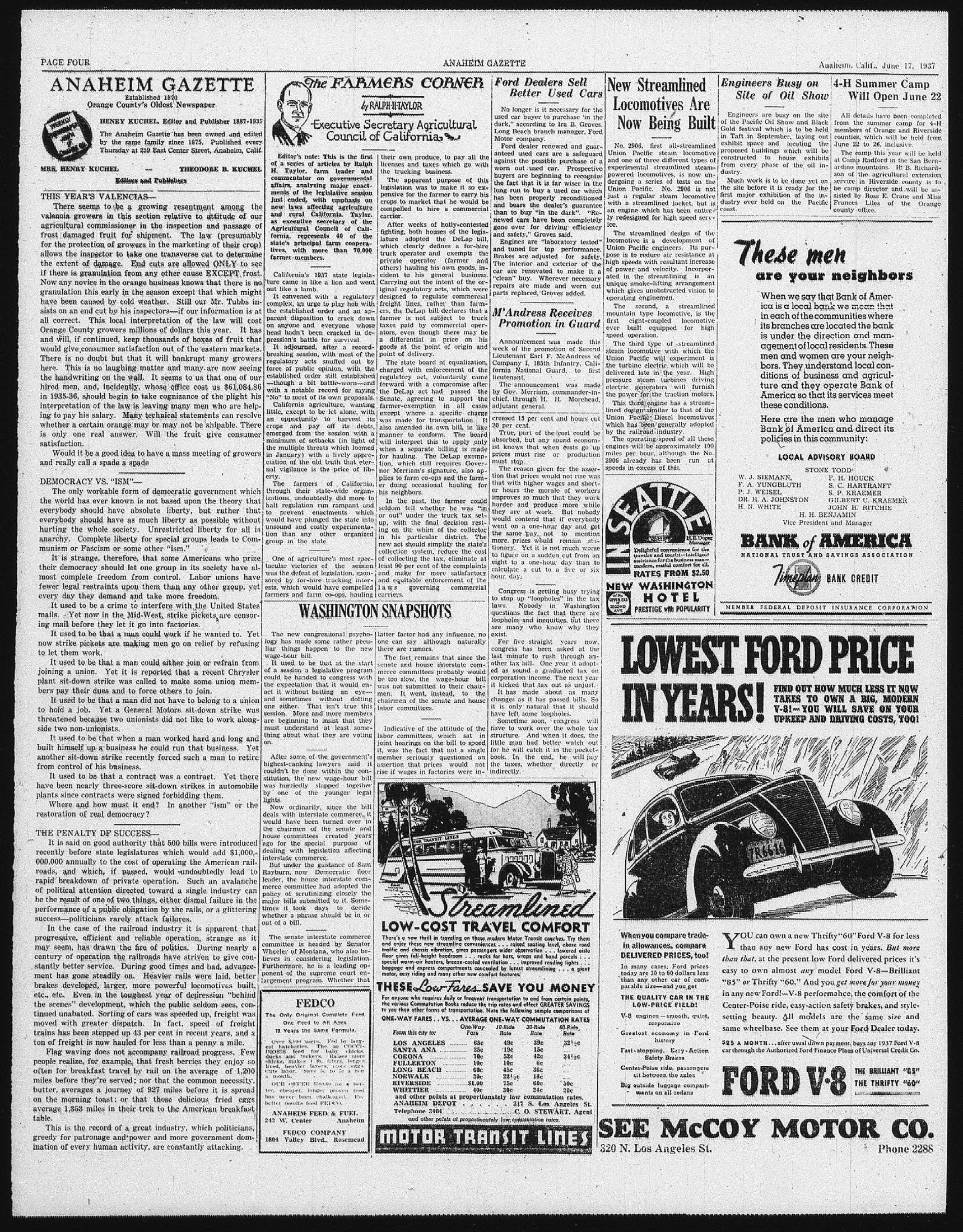
Searchable text
ANAHEIM GAZETTE
Established 1870
Orange County's Oldest Newspaper
HENRY KUCHEL, Editor and Publisher 1887-1935
The Anaheim Gazette has been owned and edited by the same family since 1875. Published every Thursday at 259 East Center Street, Anaheim, Calif.
MRS. HENRY KUCHEL — THEODORE B. KUCHEL
Editors and Publishers
THIS YEAR'S VALENCIAS—
There seems to be a growing resentment among the valencia growers in this section relative to attitude of our agricultural commissioner in the inspection and passage of frost damaged fruit for shipment. The law (presumably for the protection of growers in the marketing of their crop) allows the inspector to take one transverse cut to determine the extent of damage. End cuts are allowed ONLY to see if there is granulation from any other cause EXCEPT frost. Now any novice in the orange business knows that there is no granulation this early in the season except that which might have been caused by cold weather. Still our Mr. Tubbs insists on an end cut by his inspectors—if our information is at all correct. This local interpretation of the law will cost Orange County growers millions of dollars this year. It has and will, if continued, keep thousands of boxes of fruit that would give consumer satisfaction out of the eastern markets. There is no doubt but that it will bankrupt many growers here. This is no laughing matter and many are now seeing the handwriting on the wall. It seems to us that one of our hired men, and, incidently, whose office cost us $61,084.86 in 1935-36, should begin to take cognizance of the plight his interpretation of the law is leaving many men who are helping to pay his salary. Many technical statements can resolve whether a certain orange may or may not be shipable. There is only one real answer. Will the fruit give consumer satisfaction.
Would it be a good idea to have a mass meeting of growers
Editor's note: This is the first of a series of articles by R.H. Taylor, farm leader and commentator on government affairs, analyzing major events of the legislative session. Just ended, with emphasis on new laws affecting agriculture and rural California. Taxes as executive secretary of Agricultural Council of California, represents 40 of state's principal farm cooperatives, with more than 70 farmer-members.
California's 1937 state legislation came in like a lion and out like a lamb.
It convened with a regular complex, an urge to play hobbit the established order and an parent disposition to crack on anyone and everyone we head hadn't been cracked in pression's battle for survival.
It adjourned, after a reckless breaking session, with most of regulatory acts snuffed out force of public opinion, with established order still established—though a bit battle-worn—with a notable record for so "No" to most of its own property.
California agriculture, war little, except to be let alone, an opportunity to harvest crops and pay off its debt emerged from the session with minimum of setbacks (in light of multiple threats which loomed in January) with a lively ap
DEMOCRACY VS. "ISM"—
The only workable form of democratic government which the world has ever known is not based upon the theory that everybody should have absolute liberty, but rather that everybody should have as much liberty as possible without hurting the whole society. Unrestricted liberty for all is anarchy. Complete liberty for special groups leads to Communism or Fascism or some other "ism."
It is strange, therefore, that some Americans who prize their democracy should let one group in its society have almost complete freedom from control. Labor unions have fewer legal restraints upon them than any other group, yet every day they demand and take more freedom.
It used to be a crime to interfere with the United States mails. Yet now in the Mid-West, strike pickets are censoring mail before they let it go into factories.
It used to be that a man could work if he wanted to. Yet now strike pickets are making men go on relief by refusing to let them work.
It used to be that a man could either join or refrain from joining a union. Yet it is reported that a recent Chrysler plant sit-down strike was called to make some union members pay their dues and to force others to join.
It used to be that a man did not have to belong to a union to hold a job. Yet a General Motors sit-down strike was threatened because two unionists did not like to work alongside two non-unionists.
It used to be that when a man worked hard and long and built himself up a business he could run that business. Yet another sit-down strike recently forced such a man to retire from control of his business.
It used to be that a contract was a contract. Yet there have been nearly three-score sit-down strikes in automobile plants since contracts were signed for bidding them.
Where and how must it end? In another "ism" or the restoration of real democracy?
THE PENALTY DF SUCCESS—
It is said on good authority that 500 bills were introduced recently before state legislatures which would add $1,000,-000,000 annually to the cost of operating the American railroads, and which, if neglected, would undoubtedly lead to here. This is no laughing matter and many are now seeing the handwriting on the wall. It seems to us that one of our hired men, and, incidently, whose office cost us $61,084.86 in 1935-36, should begin to take cognizance of the plight his interpretation of the law is leaving many men who are helping to pay his salary. Many technical statements can resolve whether a certain orange may or may not be shipable. There is only one real answer. Will the fruit give consumer satisfaction.
Would it be a good idea to have a mass meeting of growers and really call a spade a spade
WASHINGT
The new congressional psychology has made some rather pitiar things happen to the wage-hour bill.
It used to be that at the time of a session a legislative program could be handed to Congress so the expectation that it would act it without batting an eye and sometimes without dot one either. That isn't true session. More and more memoirs are beginning to insist that we must understand at least something about what they are voicing on.
After some of the government highest-ranking lawyers said couldn't be done within the constitution, the new wage-hour was hurriedly slapped together by one of the younger lights.
Now ordinarily, since the deals with interstate commerce would have been turned over the chairmen of the senate house committees created ago for the special purpose dealing with legislation affect interstate commerce.
But under the guidance of S...
It used to be that a contract was a contract. Yet there have been nearly three-score sit-down strikes in automobile plants since contracts were signed forbidding them.
Where and how must it end? In another "ism" or the restoration of real democracy?
THE PENALTY DF SUCCESS—
It is said on good authority that 500 bills were introduced recently before state legislatures which would add $1,000,-000,000 annually to the cost of operating the American railroads, and which, if passed, would undoubtedly lead to rapid breakdown of private operation. Such an avalanche of political attention directed toward a single industry can be the result of one of two things, either dismal failure in the performance of a public obligation by the rails, or a glittering success—politicians rarely attack failures.
In the case of the railroad industry it is apparent that progressive, efficient and reliable operation, strange as it may seem, has drawn the fire of politics. During nearly a century of operation the railroads have striven to give constantly better service. During good times and bad, advancement has gone steadily on. Heavier rails were laid, better brakes developed, larger, more powerful locomotives built, etc., etc. Even in the toughest year of depression "behind the scenes" development, which the public seldom sees, continued unabated. Sorting of cars was speeded up, freight was moved with greater dispatch. In fact, speed of freight trains has been stepped up 43 per cent in recent years, and a ton of freight is now hauled for less than a penny a mile.
Flag waving does not accompany railroad progress. Few people realize, for example, that fresh berries they enjoy so often for breakfast travel by rail on the average of 1,200 miles before they're served; nor that the common necessity, butter, averages a journey of 927 miles before it is spread on the morning toast; or that those delicious fried eggs average 1,353 miles in their trek to the American breakfast table.
This is the record of a great industry, which politicians, greedy for patronage and power and more government domination of every human activity, are constantly attacking.
The FARMERS CORNER
by RALPH H. TAYLOR
Executive Secretary Agricultural Council of California
Editor's note: This is the first series of articles by Ralph Taylor, farm leader and mentor on governmental affairs, analyzing major enactments of the legislative session ended, with emphasis on laws affecting agriculture in rural California. Taylor, executive secretary of the Cultural Council of California, represents 40 of the state's principal farm cooperatives, with more than 70,000 member-members.
California's 1937 state legislature came in like a lion and went like a lamb, convened with a regulatory lex, an urge to play hob with established order and an apt disposition to crack down anyone and everyone whose hadn't been cracked in deion's battle for survival.
Adjourned, after a recording session, with most of the regulatory acts snuffed out by public opinion, with the finished order still established—a bit battle-worn—and a notable record for saying to most of its own proposals. California agriculture, wanting except to be let alone, with opportunity to harvest its and pay off its debts, led from the session with a num of setbacks (in light of multiple threats which loomed January) with a lively apprehension of all the licenses and taxes which go with the trucking business.
The apparent purpose of this legislation was to make it so expensive for the farmer to carry his crops to market that he would be compelled to hire a commercial carrier.
After weeks of hotly-contested fighting, both houses of the legislature adopted the DeLap bill, which clearly defines a for-hire truck operator and exempts the private operator (farmer and others) hauling his own goods, incident to his general business. Carrying out the intent of the original regulatory acts, which were designed to regulate commercial freight lines, rather than farmers, the DeLap bill declares that a farmer is not subject to truck taxes paid by commercial operators, even though there may be a differential in price on his goods at the point of origin and point of delivery.
The state board of equalization, charged with enforcement of the regulatory act, voluntarily came forward with a compromise after the DeLap act had passed the Senate, agreeing to support the farmer-exemption in all cases except where a specific charge was made for transportation. It also amended its own bill, in like manner to conform. The board will interpret this to apply only when a separate billing is made for hauling. The DeLap exemplified longer used cars are a safeguard against the possible purchase of a worn out used car. Prospective buyers are beginning to recognize the fact that it is far wiser in the long run to buy a used car which has been properly reconditioned and bears the dealer's guarantee than to buy "in the dark". "Renewed cars have been completely gone over for driving efficiency and safety," Groves said.
Engines are "laboratory tested" and tuned for top performance. Brakes are adjusted for safety. The interior and exterior of the car are renovated to make it a "clean" buy. Wherever necessary repairs are made and worn out parts replaced, Groves added.
M'Andress Receives Promotion in Guard
Announcement was made this week of the promotion of Second Lieutenant Earl F. McAndress of Company I, 185th Infantry, California National Guard, to first lieutenant.
The announcement was made by Gov. Merriam, commander-in-chief, through H. H. Morehead, adjutant general.
creased 15 per cent and hours cut 20 per cent.
True, part of the cost could be absorbed, but any sound economist knows that when costs go up prices must rise or production
New Streamline Locomotives Now Being Used
No. 2906, first all-Union Pacific steam locomotive and one of three different experimental streamliners powered locomotives. In dergoing a series of Union Pacific. No. 2906 just a regular steam locomotive with a streamlined jacket an engine which has barely redesigned for high speed ice.
The streamlined design locomotive is a developed Union Pacific engineer posing to reduce air resistance high speeds with results of power and velocity. Detailed in the streamliner unique smoke-lifting art which gives unobstructed operating enginemen.
The second, a mountain type locomotor first eight-coupled ever built equipped for speed operation.
The third type of steam locomotor with Union Pacific will expire the turbine electric which delivered late in the year pressure steam turbine electric generators with the power for the traction.
This third engine has lined design similar to Union Pacific Diesel locomotives which has been generally by the railroad industry.
The operating speed of engines will be approx. miles per hour, although 2006 already has been achieved.
WASHINGTON SNAPSHOTS
new congressional psychos has made some rather peculiar things happen to the new hour bill.
used to be that at the start session a legislative program be handed to congress with expectation that it would end without batting an eye—sometimes without dotting either. That isn't true this time. More and more members beginning to insist that they understand at least some about what they are voting on some of the government's rest-ranking lawyers said it might be done within the concession, the new wage-hour bill curriedly slapped together one of the younger legal ordinarily, since the bill with interstate commerce, it have been turned over to chairmen of the senate and committees created years or the special purpose of using legislation affecting state commerce.
under the guidance of Sam
The state board of equalization, charged with enforcement of the regulatory act, voluntarily came forward with a compromise after the DeLap act had passed the Senate, agreeing to support the farmer-exemption in all cases except where a specific charge was made for transportation. It also amended its own bill, in like manner to conform. The board will interpret this to apply only when a separate billing is made for hauling. The DeLap exemption, which still requires Governor Merriam's signature, also applies to farm co-ops and the farmer doing occasional hauling for his neighbors.
In the past, the farmer could seldom tell whether he was "in or out" under the truck tax set-up, with the final decision resting on the whim of the collector in his particular district. The new act should simplify the state's collection system, reduce the cost of collecting the tax, eliminate at least 90 per cent of the complaints and make for more satisfactory and equitable enforcement of the laws governing commercial carriers.
Indicative of the attitude of the labor committees, which sat in joint hearings on the bill to speed it, was the fact that not a single member seriously questioned an assertion that prices would not rise if wages in factories were increased 15 per cent and hours cut 20 per cent.
True, part of the cost could be absorbed, but any sound economist knows that when costs go up prices must rise or production must stop.
The reason given for the assertion that prices would not rise was that with higher wages and shorter hours the morale of workers improves so much that they work harder and produce more while they are at work. But nobody would contend that if everybody went on a one-hour day and got the same pay, not to mention more, prices would remain stationary. Yet it is not much worse to figure on a sudden cut from an eight to a one-hour day than to calculate a cut to a five or six hour day.
Congress is getting busy trying to stop up "loopholes" in the tax laws. Nobody in Washington questions the fact that there are loopholes and inequities, but there are many who know why they exist.
For five straight years now, congress has been asked at the last minute to rush through another tax bill. One year it adopted as sound a graduated tax on corporation income. The next year it kicked that tax out as unjust.
It has made about as many changes as it has passed bills. So it is only natural that it should have left some loopholes.
Sometime soon, congress will have to work over the whole tax structure. And when it does, the little man had better watch out for he will catch it in the pocket-book. In the end, he will pay the taxes, whether directly or indirectly.
Streamlined
LOW-COST TRAVEL COMFORT
There's a new thrill in traveling on these modern Motor Transit coaches. Try them and enjoy these new streamline conveniences... raised seating level, above road traffic and chassis vibration, gives passengers wider observation... lowered aisle floor gives full-height headroom... racks for hats, wraps and hand parcels... special warm-air heaters, breeze-cooled ventilation... improved reading lights... baggage and express compartments concealed by latest streamlining... a giant motor, easy riding and many other new comfort features.
THESE Low-Fares SAVE YOU MONEY
For anyone who requires daily or frequent transportation to and from certain points, the various Commutation Books reduce the trip rates and effect GREATER SAVINGS to you than other forms of transportation. Note the following sample comparisons of ONE-WAY FARES... VS... AVERAGE ONE-WAY COMMUTATION RATES
From this city to:
One-Way Fare 65¢ 10-Ride Rate 49¢ 30-Ride Rate 39¢ 32¢
LOS ANGELES 25¢ 19¢ 15¢
SANTA ANA 70£ 52£ 42£ 34£
CORONA 10¢ 10£ 6£
FULLERTON 60¢ 45£ 36£
LONG BEACH 30¢ 22¢ 18¢
NORWALK 30¢ 75£ 60£ 30£
RIVERSIDE $1.00 75£ 60£ 30£
WHITTIER 40£ 30£ 24£ 20£
and other points at proportionately low commutation rates.
ANAHEIM DEPOT ... 217 S. Los Angeles St.
Telephone 3404 C. O. STEWART. Agent
and other points at proportionately low commutation rates.
MOTOR TRANSIT LINES
New Streamlined Locomotives Are Now Being Built
No. 2906, first all-streamlined Union Pacific steam locomotive and one of three different types of experimental streamlined steam-powered locomotives, is now undergoing a series of tests on the Union Pacific. No. 2906 is not just a regular steam locomotive with a streamlined jacket, but is an engine which has been entirely redesigned for high speed service.
The streamlined design of the locomotive is a development of Union Pacific engineers. Its purpose is to reduce air resistance at high speeds with resultant increase of power and velocity. Incorporated in the streamlining is an unique smoke-lifting arrangement which gives unobstructed vision to operating enginemen.
The second, a streamlined mountain type locomotive, is the first eight-coupled locomotive ever built equipped for high speed operation.
The third type of streamlined steam locomotive with which the Union Pacific will experiment is the turbine electric which will be delivered late in the year. High pressure steam turbines driving electric generators will furnish the power for the traction motors.
This third engine has a streamlined design similar to that of the Union Pacific Diesel locomotives which has been generally adopted by the railroad industry.
The operating speed of all these engines will be approximately 100 miles per hour, although the No. 2906 already has run.
Engineers Busy on Site of Oil Show
Engineers are busy on the site of the Pacific Oil Show and Black Gold festival which is to be held in Taft in September, laying out exhibit space and locating the proposed buildings which will be constructed to house exhibits from every phase of the oil industry.
Much work is to be done yet on the site before it is ready for the first major exhibition of the industry ever held on the Pacific coast.
4-H Summer Camp Will Open June 22
All details have been completed from the summer camp for 4-H members of Orange and Riverside counties, which will be held from June 22 to 26, inclusive.
The camp this year will be held at Camp Radford in the San Bernardino mountains. H.T. B. Richardson of the agricultural extension service in Riverside county is to be camp director and will be assisted by Ross E. Crane and Miss Frances Liles of the Orange county office.
These men are your neighbors
When we say that Bank of America is a local bank we mean that in each of the communities where its branches are located the bank is under the direction and management of local residents. These men and women are your neighbors. They understand local conditions of business and agriculture and they operate Bank of America so that its services meet these conditions.
Here are the men who manage Bank of America and direct its policies in this community:
LOCAL ADVISORY BOARD
the turbine electric which will be delivered late in the year. High pressure steam turbines driving electric generators will furnish the power for the traction motors.
This third engine has a streamlined design similar to that of the Union Pacific Diesel locomotives which has been generally adopted by the railroad industry.
The operating speed of all these engines will be approximately 100 miles per hour, although the No. 2906 already has been run at speeds in excess of this.
IN SEATTLE
H.E. DuPasq Manager
Delightful convenience for the traveler and tourist—intelligent assistance for the business man—modern, restful comfort for all.
RATES FROM $2.50
NEW WASHINGTON HOTEL
PRESTIGE with POPULARITY
LOCAL ADVISORY BOARD
STONE TODD
W. J. SIEMANN, F. H. HOUCK
F. A. YUNGBLUTH S. C. HARTRANFT
P. J. WEISEL S. P. KRAEMER
DR. H. A. JOHNSTON GILBERT U. KRAEMER
H. N. WHITE JOHN H. RITCHIE
H. H. BENJAMIN
Vice President and Manager
BANK OF AMERICA
NATIONAL TRUST AND SAVINGS ASSOCIATION
Timeplan BANK CREDIT
MEMBER FEDERAL DEPOSIT INSURANCE CORPORATION
LOWEST FORD PRICE IN YEARS!
FIND OUT HOW MUCH LESS IT NOW TAKES TO OWN A BIG, MODERN V-8! YOU WILL SAVE ON YOUR UPKEEP AND DRIVING COSTS, TOO!
When you compare trade-in allowances, compare DELIVERED PRICES, too!
In many cases, Ford prices today are 30 to 60 dollars less than any other car of comparable size—and you get
THE QUALITY CAR IN THE LOW-PRICE FIELD!
V-8 engines—smooth, quiet, responsive
Greatest economy in Ford history
Fast stopping, Easy Action Safety Brakes
Center-Poise ride, passengers sit between the axles
Big outside luggage compartments on all sedans
YOU can own a new Thrifty“60”Ford V-8 for less than any new Ford has cost in years. But more than that, at the present low Ford delivered prices it’s easy to own almost any model Ford V-8—Brilliant “85” or Thrifty “60.” And you get more for your money in any new Ford!—V-8 performance, the comfort of the Center-Poise ride, easy-action safety brakes, and style-setting beauty. All models are the same size and same wheelbase. See them at your Ford Dealer today.
$25 A MONTH...after usual down payment; buys any 1937 Ford V-8 car through the Authorized Ford Finance Plans of Universal Credit Co.
FORD V·8
THE BRILLIANT “85”
THE THRIFTY “60”
SEE McCOY MOTOR CO.
820 N. Los Angeles St.
Phone 2288