anaheim-gazette 1937-04-22
Scanned page
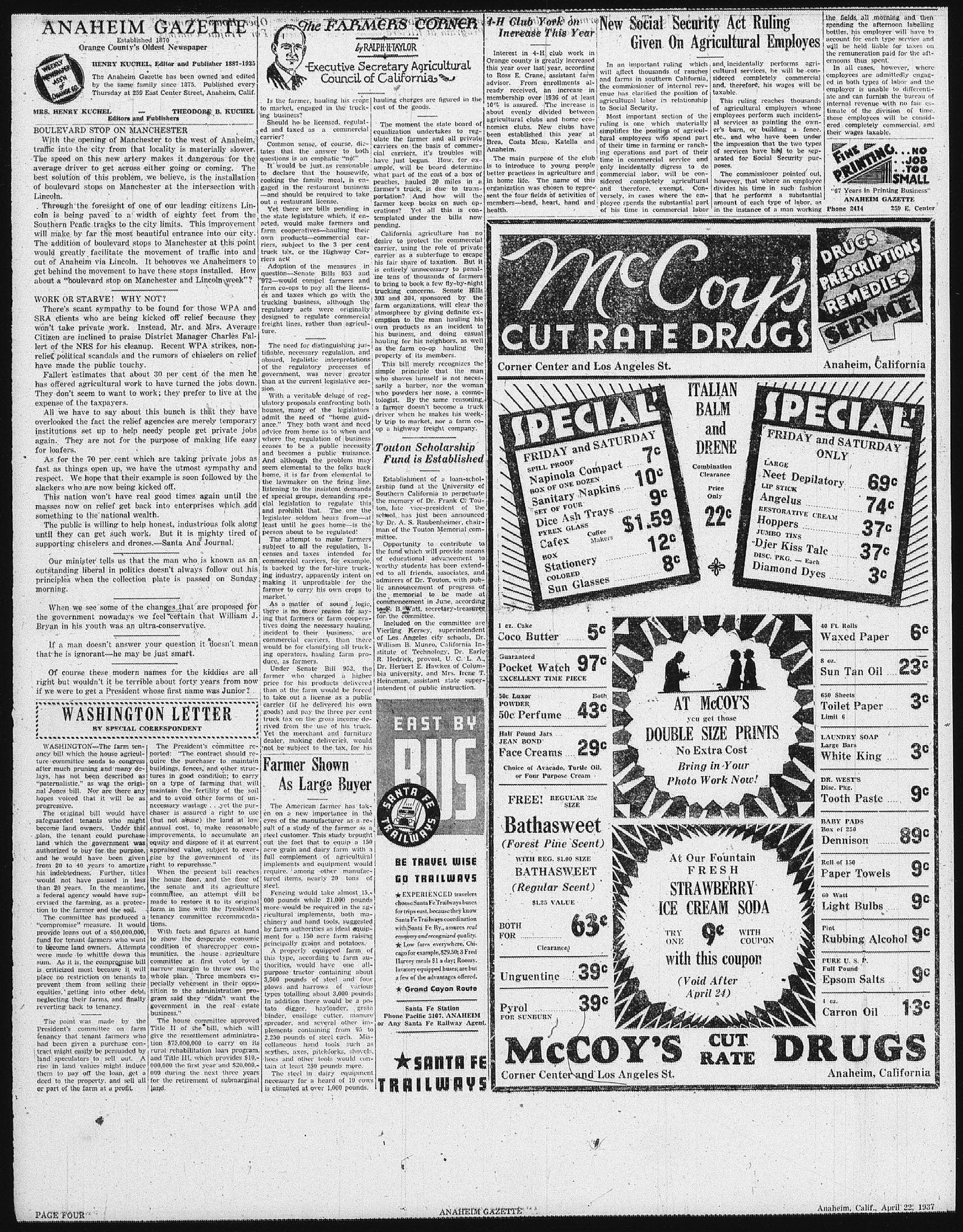
Searchable text
ANAHEIM GAZETTE
Established 1870
Orange County's Oldest Newspaper
HENRY KUCHEL, Editor and Publisher 1887-1935
The Anaheim Gazette has been owned and edited by the same family since 1875. Published every Thursday at 259 East Center Street, Anaheim, Calif.
MRS. HENRY KUCHEL — THEODORE B. KUCHEL
Editors and Publishers
BOULEVARD STOP ON MANCHESTER
With the opening of Manchester to the west of Anaheim, traffic into the city from that locality is materially slower. The speed on this new artery makes it dangerous for the average driver to get across either going or coming. The best solution of this problem, we believe, is the installation of boulevard stops on Manchester at the intersection with Lincoln.
Through the foresight of one of our leading citizens Lincoln is being paved to a width of eighty feet from the Southern Pacific tracks to the city limits. This improvement will make by far the most beautiful entrance into our city. The addition of boulevard stops to Manchester at this point would greatly facilitate the movement of traffic into and out of Anaheim via Lincoln. It behooves we Anaheimers to get behind the movement to have these stops installed. How about a "boulevard stop on Manchester and Lincoln week"?
WORK OR STARVE! WHY NOT?
There's scant sympathy to be found for those WPA and SRA clients who are being kicked off relief because they won't take private work. Instead, Mr. and Mrs. Average Citizen are inclined to praise District Manager Charles Fallert of the NRS for his cleanup. Recent WPA strikes, non-relief political scandals and the rumors of chiselers on relief have made the public touchy.
Fallert estimates that about 30 per cent of the men he has offered agricultural work to have turned the jobs down. They don't seem to want to work; they prefer to live at the expense of the taxpayers.
All we have to say about this bunch is that they have overlooked the fact the relief agencies are merely temporary institutions set up to help needy people get private jobs again. They are not for the purpose of making life easy for loafers.
As for the 70 per cent which are taking private jobs as
have made the public touchy.
Fallert estimates that about 30 per cent of the men he has offered agricultural work to have turned the jobs down. They don't seem to want to work; they prefer to live at the expense of the taxpayers.
All we have to say about this bunch is that they have overlooked the fact the relief agencies are merely temporary institutions set up to help needy people get private jobs again. They are not for the purpose of making life easy for loafers.
As for the 70 per cent which are taking private jobs as fast as things open up, we have the utmost sympathy and respect. We hope that their example is soon followed by the slackers who are now being kicked off.
This nation won't have real good times again until the masses now on relief get back into enterprises which add something to the national wealth.
The public is willing to help honest, industrious folk along until they can get such work. But it is mighty tired of supporting chiselers and drones.—Santa Ana Journal.
Our minister tells us that the man who is known as an outstanding liberal in politics doesn't always follow out his principles when the collection plate is passed on Sunday morning.
When we see some of the changes that are proposed for the government nowadays we feel certain that William J. Bryan in his youth was an ultra-conservative.
If a man doesn't answer your question it doesn't mean that he is ignorant—he may be just smart.
Of course these modern names for the kiddies are all right but wouldn't it be terrible about forty years from now if we were to get a President whose first name was Junior?
WASHINGTON LETTER
BY SPECIAL CORRESPONDENT
WASHINGTON—The farm tenancy bill which the house agriculture committee sends to congress after much pruning and many delays, has not been described as "paternalistic," as was the original Jones bill. Nor are there any hopes voiced that it will be as progressive.
The original bill would have safeguarded tenants who might become land owners. Under this plan, the tenant could purchase land which the government was authorized to buy for the purpose, and he would have been given from 20 to 40 years to amortize
The President's committee reported: "The contract should require the purchaser to maintain buildings, fences, and other structures in good condition; to carry on a type of farming that will maintain the fertility of the soil and to avoid other forms of unnecessary wastage... yet the purchaser is assured a right to use (but not abuse) the land at low annual cost, to make reasonable improvements, to accumulate an equity and dispose of it at current appraised value, subject to exercise by the government of its right to repurchase."
Farmer Shown As Large Buyer
The American farmer has been on a new importance in eyes of the manufacturer as a result of a study of the farmer steel customer. This study brok out the fact that to equip a acre grain and dairy farm with full complement of agricultures implements and equipment
lays, has not been described as "paternalistic," as was the original Jones bill. Nor are there any hopes voiced that it will be as progressive.
The original bill would have safeguarded tenants who might become land owners. Under this plan, the tenant could purchase land which the government was authorized to buy for the purpose, and he would have been given from 20 to 40 years to amortize his indebtedness. Further, titles would not have passed in less than 20 years. In the meantime, a federal agency would have supervised the farming, as a protection to the farmer and the soil.
The committee has produced a "compromise" measure. It would provide loans out of a $50,000,000 fund for tenant farmers who want to become land owners. Attempts were made to whittle down this sum. As it is, the compromise bill is criticized most because it will place no restriction on tenants to prevent them from selling their equities, getting into other debt, neglecting their farms, and finally reverting back to tenancy.
The point was made by the President's committee on farm fency that tenant farmers who had been given a purchase contract might easily be persuaded by land speculators to sell out. A rise in land values might induce them to pay off the loan, get a deed to the property, and sell all or part of the farm at a profit.
The house committee approved Title II of the bill, which will give the resettlement administration $75,000,000 to carry on its rural rehabilitation loan program, and Title III, which provides $10,-000,000 the first year and $20,000,-000 during the next three years for the retirement of submarginal land.
The American farmer has been on a new importance in eyes of the manufacturer as a sult of a study of the farmer's steel customer. This study brought out the fact that to equip a acre grain and dairy farm with full complement of agricultural implements and equipment we require, among other manufactured items, nearly 20 tons of steel.
Fencing would take almost 1,000 pounds while 21,000 pounds more would be required in the cultural implements, both chinery and hand tools, suggest by farm authorities as ideal equipment for a 150 acre farm rather principally grains and potatoes.
A properly equipped farm this type, according to farm thorities, would have one purpose tractor containing about 3,500 pounds of steel and plows and harrows of various types totalling about 3,000 pounds. In addition there would be a tato digger, hayloader, ginder, ensilage cutter, mapper spreader, and several other implements containing from 2,250 pounds of steel each.
Cellaneous hand tools such as scythes, axes, pitchforks, shovels and other tools would retain at least 250 pounds more.
The steel in dairy equipment necessary for a heard of 10 cents is estimated at over 1,000 pounds.
The FARMERS CORNER
by RALPH H. TAYLOR
Executive Secretary Agricultural Council of California
he farmer, hauling his crops market, engaged in the truck-business?
Did he be licensed, regulated, taxed as a commercial farm sense, of course, dislike that the answer to both jobs is an emphatic "no!" Should be just, as reasonable share that the housewife, the family meal, is enlisted in the restaurant business should be required to take restaurant license.
There are bills pending in the legislature which, if enwould make farmers and cooperatives—hauling their products—commercial car-subject to the 3 per cent tax, or the Highway Car-net?
Action of the measures in—Senate Bills 953 and would compel farmers and coops to pay all the licens-taxes which go with the big business, although the story acts were originally used to regulate commercial lines, rather than agricultural need for distinguishing jus-nessy necessary regulation, and legalistic interpretations regulatory processes of ment, was never greater at the current legislative ses-sion.
A veritable deluge of reg-proposals confronting both many of the legislators the need of "home guid-They both want and need from home as to when and the regulation of business to be a public necessity becomes a public nuisance, although the problem may hauling charges are figured in the cost of the goods.
The moment the state board of equalization undertakes to regulate the farmer and all private carriers on the basis of commercial carriers, it's troubles will have just begun. How, for example, will be board determine what part of the cost of a box of peaches, hauled 20 miles in a farmer's truck, is due to transportation? And how will the farmer keep books on such operations? Yet all this is contemplated under the bills now pending.
California agriculture has no desire to protect the commercial carrier, using the role of private carrier as a subterfuge to escape his fair share of taxation. But it is entirely unnecessary to penalize tens of thousands of farmers to bring to book a few fly-by-night trucking concerns. Senate Bills 303 and 304, sponsored by the farm organizations, will clear the atmosphere by giving definite exemption to the man hauling his own products as an incident to his business, and doing casual hauling for his neighbors, as well as the farm co-op hauling the property of its members.
This bill merely recognizes the simple principle that the man who shaves himself is not necessarily a barber, nor the woman who powders her nose, a cosmetologist. By the same reasoning, a farmer doesn't become a truck driver when he makes his weekly trip to market, nor a farm co-op a highway freight company.
Touton Scholarship Fund is Established
4-H Club York on Increase This Year
Interest in 4-H club work in Orange county is greatly increased this year over last year, according to Ross E. Crane, assistant farm advisor. From enrollments already received, an increase in membership over 1936 of at least 10% is assured. The increase is about evenly divided between agricultural clubs and home economics clubs. New clubs have been established this year at Brea, Costa Mesa, Katella and Anaheim.
The main purpose of the club is to introduce to young people better practices in agriculture and in home life. The name of this organization was chosen to represent the four fields of activities of members—head, heart, hand and health.
Most important section ruling is one which m simplifies the position of natural employees who spend of their time in farming o ing operations and part t time in commercial servi only incidentally digress commercial labor, will sidered completely agr and therefore, exempl versely, in cases where eployee spends the substan of his time in commerce.
MC CUT RATE
Corner Center and Los Angeles St.
SPECIAL
FRIDAY and SATURDAY
7c
This bill merely recognizes the simple principle that the man who shaves himself is not necessarily a barber, nor the woman who powders her nose, a cosmetologist. By the same reasoning, a farmer doesn't become a truck driver when he makes his weekly trip to market, nor a farm co-op a highway freight company.
Touton Scholarship Fund is Established
Establishment of a loan-scholarship fund at the University of Southern California to perpetuate the memory of Dr. Frank C. Touton, late vice-president of the school, has just been announced by Dr. A. S. Raubenheimer, chairman of the Touton Memorial committee.
Opportunity to contribute to the fund which will provide means of educational advancement to worthy students has been extended to all friends, associates, and admirers of Dr. Touton, with public announcement of progress of the memorial to be made at commencement in June, according to E. B. Watt, secretary-treasurer for the committee.
Included on the committee are Vierling Kersey, superintendent of Los Angeles city schools, Dr. William B. Munro, California Institute of Technology, Dr. Earle R. Hedrick, provost, U. C. L. A., Dr. Herbert E. Hawkes of Columbia university, and Mrs. Irene T. Heineman, assistant state superintendent of public instruction.
EAST BY BUS
SANTA FE TRAILWAYS
BE TRAVEL WISE
As Large Buyer
American farmer has taken a new importance in the field of the manufacturer as a result of a study of the farmer as a customer. This study brought the fact that to equip a 150 grain and dairy farm with a complement of agricultural implements and equipment would be among other manufactures, nearly 20 tons of cargo would take almost 15 pounds while 21,000 pounds would be required in the agricultural implements, both maize and hand tools, suggested by authorities as ideal equipment for a 150 acre farm raising paddy grains and potatoes. Properly equipped farm type, according to farm auctions, would have one all-steel tractor containing about 3,000 pounds of steel and four and harrows of various totalling about 3,000 pounds condition there would be a post-digger, hayloader, grainer, ensilage cutter, manureeder, and several other implements containing from 75 to 85 pounds of steel each. Miscellaneous hand tools such as axes, axes, pitchforks, shovels, and other tools would contain at least 250 pounds more. Steel in dairy equipment is necessary for a heard of 10 cows estimated at over 1,000 pounds.
SANTA FE TRAILWAYS
BE TRAVEL WISE GO TRAILWAYS
★ EXPERIENCED travelers choose Santa Fe Trailways buses for trips east, because they know Santa Fe Trailways coordination with Santa Fe Ry., assures real economy and recognized quality.
★ Low fares everywhere, Chicago for example, $29.50; 3 Fred Harvey meals $1 a day; Roomy lavatory equipped buses; are but a few of the advantages offered.
★ Grand Cayon Route
Santa Fe Station
Phone Pacific 3107, ANAHEIM or Any Santa Fe Railway Agent.
SANTA FE TRAILWAYS
FREE! REGULAR 25c SIZE
Bathasweet (Forest Pine Scent)
WITH REG. $1.00 SIZE
BATHASWEET (Regular Scent)
$1.25 VALUE
BOTH FOR ... Clearance
Unguentine ... 39¢
Pyrol ... 39¢
McCOY'S Corner Center and Los Angeles St.
ANAHEIM GAZETTE
New Social Security Act Ruling Given On Agricultural Employes
In an important ruling which will affect thousands of ranches and farms in southern California, the commissioner of internal revenue has clarified the position of agricultural labor in relationship to Social Security.
Most important section of the ruling is one which materially simplifies the position of agricultural employees who spend part of their time in farming or ranching operations and part of their time in commercial service and only incidentally digress to do commercial labor, will be considered completely agricultural and therefore exempt. Conversely, in cases where the employee spends the substantial part of his time in commercial labor and incidentally performs agricultural services, he will be considered completely commercial and, therefore, his wages will be taxable.
This ruling reaches thousands of agricultural employers whose employees perform such incidental services as painting the owner's barn, or building a fence, etc., and who have been under the impression that the two types of services have had to be separated for Social Security purposes.
The commissioner pointed out, however, that where an employee divides his time in such fashion that he performs a substantial amount of each type of labor, as in the instance of a man working the fields all morning and then spending the afternoon labelling bottles, his employer will have to account for each type service and will be held liable for taxes on the remuneration paid for the afternoons thus spent.
In all cases, however, where employees are admittedly engaged in both types of labor and the employer is unable to differentiate and can furnish the bureau of internal revenue with no fair estimate of the division of time. those employees will be considered completely commercial, and their wages taxable.
FINE PRINTING...NO JOB TOO SMALL
"67 Years in Printing Business"
ANAHEIM GAZETTE
Phone 2414 259 E. Center
McCoy's Rate Drugs
Los Angeles St.
Anaheim, California
DRUGS PRESCRIPTIONS REMEDIES SERVICE
ITALIAN BALM and DRENE
SPECIAL FRIDAY and SATURDAY ONLY
ITALIAN BALM and DRENE
Combination Clearance
Price Only
22¢
SPECIAL
FRIDAY and SATURDAY ONLY
LARGE
Neet Depilatory 69¢
LIP STICK 74¢
Angelus 37£
RESTORATIVE CREAM
Hoppers 37£
JUMBO TINS 37£
Djer Kiss Talc 37£
DISC. PKG. — Each
Diamond Dyes 3¢
AT McCOY'S
you get those
DOUBLE SIZE PRINTS
No Extra Cost
Bring in Your
Photo Work Now!
At Our Fountain
FRESH
Photo Work Now!
At Our Fountain
FRESH
STRAWBERRY
ICE CREAM SODA
TRY ONE 9¢ WITH COUPON
with this coupon
(Void After April 24)
DR. WEST'S
Disc. Pkg.
Tooth Paste ... 9¢
BABY PADS
Box of 250
Dennison ... 89¢
Roll of 150
Paper Towels ... 9¢
60 Watt
Light Bulbs ... 9¢
Pint
Rubbing Alcohol ... 9¢
PURE U. S. P.
Full Pound
Epsom Salts ... 9¢
4 oz.
Carron Oil ... 13¢
OY'S CUT RATE DRUGS
Los Angeles St.
Anaheim, California
Anaheim, Calif., April 22, 1937