anaheim-gazette 1936-05-21
Scanned page
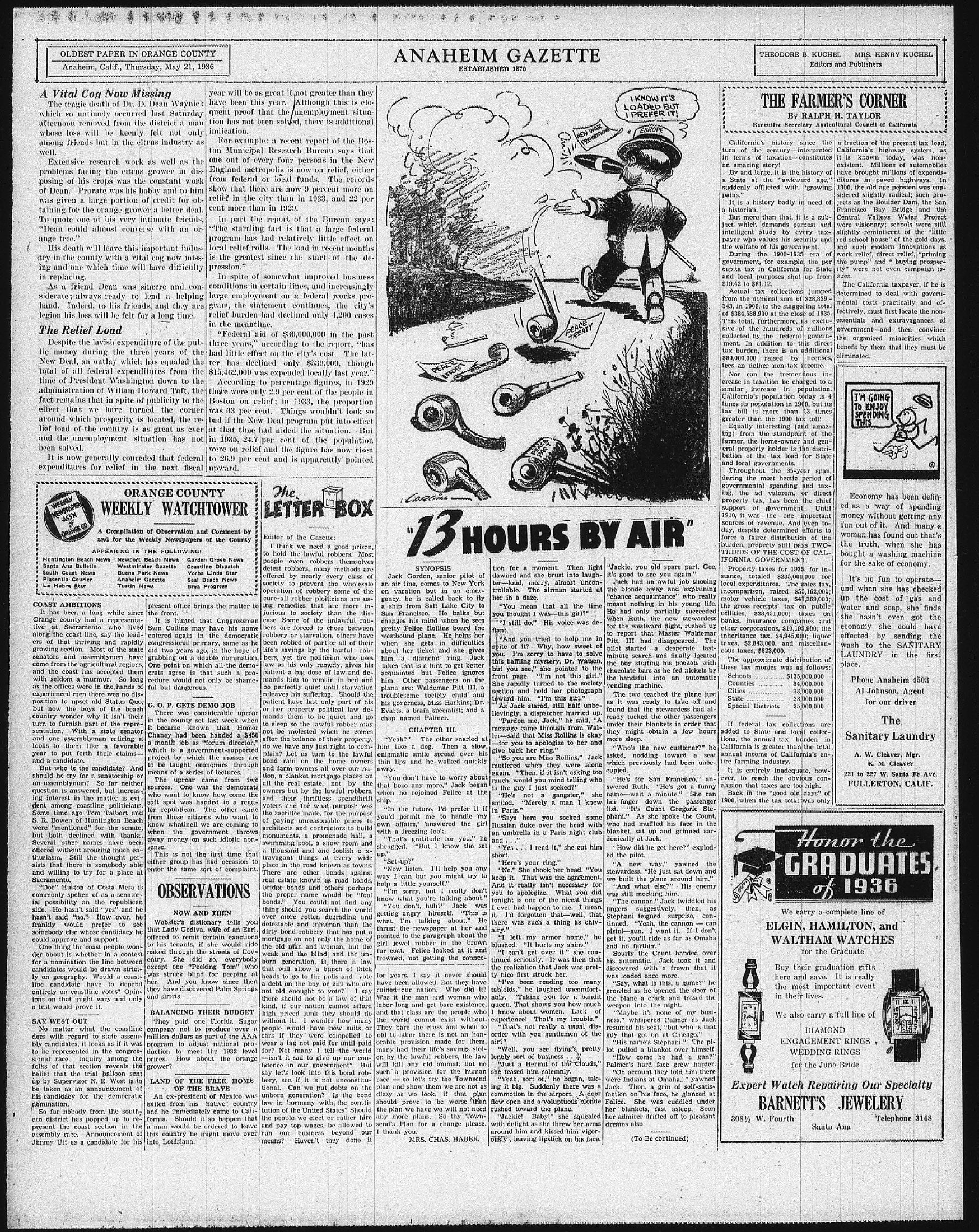
Searchable text
A Vital Cog Now Missing
The tragic death of Dr. D. Dean Waynick which so untimely occurred last Saturday afternoon removed from the district a man whose loss will be keenly felt not only among friends but in the citrus industry as well.
Extensive research work as well as the problems facing the citrus grower in disposing of his crops was the constant work of Dean. Prorate was his hobby and to him was given a large portion of credit for obtaining for the orange grower a better deal. To quote one of his very intimate friends, "Dean could almost converse with an orange tree."
His death will leave this important industry in the county with a vital cog now missing and one which time will have difficulty in replacing.
As a friend Dean was sincere and considerate; always ready to lend a helping hand. Indeed, to his friends, and they are legion his loss will be felt for a long time.
The Relief Load
Despite the lavish expenditure of the public money during the three years of the New Deal, an outlay which has equaled the total of all federal expenditures from the time of President Washington down to the administration of William Howard Taft, the fact remains that in spite of publicity to the effect that we have turned the corner around which prosperity is located, the relief load of the country is as great as ever and the unemployment situation has not been solved.
It is now generally conceded that federal year will be as great if not greater than that have been this year. Although this is evident proof that the unemployment situation has not been solved, there is additional indication.
For example: a recent report of the Boston Municipal Research Bureau says that one out of every four persons in the New England metropolis is now on relief, either from federal or local funds. The record show that there are now 9 percent more relief in the city than in 1933, and 22 percent more than in 1929.
In part the report of the Bureau says "The startling fact is that a large federal program has had relatively little effect on local relief rolls. The load in recent months is the greatest since the start of the depression."
In spite of somewhat improved business conditions in certain lines, and increasing large employment on a federal works program, the statement continues, the city relief burden had declined only 4,200 cases in the meantime.
"Federal aid of $30,000,000 in the past three years," according to the report, "he had little effect on the city's cost. The latter has declined only $539,000, though $15,462,000 was expended locally last year.
According to percentage figures, in 1933 there were only 2.9 per cent of the people in Boston on relief; in 1933, the proportion was 33 per cent. Things wouldn't look bad if the New Deal program put into effect at that time had aided the situation. By in 1935, 24.7 per cent of the population were on relief and the figure has now risen to 26.9 per cent and is apparently pointless."
ORANGE COUNTY
WEEKLY WATCHTOWER
A Compilation of Observation and Comment by
and for the Weekly Newspapers of the County
APPEARING IN THE FOLLOWING:
Huntington Beach News Newport Beach News Garden Grove News
Santa Ana Bulletin Westminster Gazette Coastline Dispatch
South Coast News Buena Park News Yorba Linda Star
Placentia Courler Anaheim Gazette Seal Beach News
La Habra Star Tustin News Brea Progress
COAST AMBITIONS
It has been a long while since Orange county had a representative at Sacramento who lived along the coast line, say the leaders of that thriving and rapidly growing section. Most of the state senators and assemblymen have come from the agricultural regions, and the coast has accepted them with seldom a murmur. So long as the offices were in the hands of experienced men there was no disposition to upset old Status Quo, but now the boys of the beach country wonder why it isn't their turn to furnish part of the representation. With a state senator and one assemblyman retiring it looks to them like a favorable year to put forth their claims—and a candidate.
But who is the candidate? And should he try for a senatorship or an assemblyman? So far neither question is answered, but increasing interest in the matter is evident among coastline politicians. Some time ago Tom Talbert and S. R. Bowen of Huntington Beach were "mentioned" for the senate, but both declined with thanks. Several other names have been offered without arousing much enthusiasm. Still the thought persists that there is somebody able present office brings the matter to the front.
It is hinted that Congressman Sam Collins may have his name entered again in the democratic congressional primary, same as he did two years ago, in the hope of grabbing off a double nomination. One point on which all the democrats agree is that such a procedure would not only be shameful but dangerous.
G. O. P. GETS DEMO JOB
There was considerable uproar in the county set last week when it became known that Homer Chaney had been handed a $450 a month job as "forum director," which is a government-supported project by which the masses are to be taught economics through means of a series of lectures.
The uproar came from two sources. One was the democrats who want to know how come the soft spot was handed to a regular republican. The other came from those citizens who want to know whatinell we are coming to when the government throws away money on such idiotic nonsense.
This is not the first time that either group has had occasion to enter the same sort of complaint.
Editor of the Gazette:
I think we need a good prize to hold the lawful robbers. Many people even robbers themselves detest robbers, many methods are offered by nearly every class of society to prevent the wholesale operation of robbery some of the cure-all robber plotticians are using remedies that are more injurious to society than the dase case. Some of the unlawful robbers are forced to choose between robbery or starvation, others have been robbed of part or all of their life's savings by the lawful robbers, yet the politician who uses law as his only remedy, gives patient a big dose of law and orders him to remain in bed and be perfectly quiet until starvation releases his suffering. Should this patient have last only part of her or her property political law or mands them to be quiet and not sleep so the lawful robber must not be molested when he comes after the balance of their property do we have any just right to complain? Let us turn to the lawful bond raid on the home owner and farm owners all over our nation, a blanket mortgage placed on all the real estate, not by the owners but by the lawful robber and their thriftless spendthrift voters and for what purpose will the sacrifice made, for the purpose of paying unreasonable prices for architects and contractors to build monuments, a promenade hall, swimming pool, a show room and a thousand and one foolish eavesdropping things at every wifi place in the road known as town.
should he try for a senatorship or an assemblyman? So far neither question is answered, but increasing interest in the matter is evident among coastline politicians. Some time ago Tom Talbert and S. R. Bowen of Huntington Beach were "mentioned" for the senate, but both declined with thanks. Several other names have been offered without arousing much enthusiasm. Still the thought persists that there is somebody able and willing to try for a place at Sacramento.
"Doc" Huston of Costa Mesa is commonly spoken of as a senatorial possibility an republican side. He hasn't said "yes" and he hasn't said "no." How ever, he frankly would prefer to see somebody else whose candidacy he could approve and support.
One thing the coast people wonder about is whether in a contest for a nomination the line between candidates would be drawn strictly on geography. Would a coastline candidate have to depend entirely on coastline votes? Opinions on that might vary and only a test would prove it.
SAY WEST OUT
No matter what the coastline does with regard to state assembly candidates, it looks as if it was to be represented in the congressional race. Inquiry among the folks of that section reveals the belief that the trial balloon sent up by Supervisor N. E. West is to be taken as an announcement of his candidacy for the democratic nomination.
So far nobody from the southern district has popped up to represent the coast section in the assembly race. Announcement of Jimmy Utt as a candidate for his means of a series of lectures.
The uproar came from two sources. One was the democrats who want to know how come the soft spot was handed to a regular republican. The other came from those citizens who want to know whatinell we are coming to when the government throws away money on such idiotic nonsense.
This is not the first time that either group has had occasion to enter the same sort of complaint.
OBSERVATIONS
NOW AND THEN
Webster's dictionary tells you that Lady Godiva, wife of an Earl, offered to remit certain exactions to his tenants, if she would ride naked through the streets of Coventry. She did so, everybody except one "Peeking Tom" who was struck blind for peeping at her. And you know since then they have discovered Palm Springs and shorts.
BALANCING THEIR BUDGET
They paid one Florida Sugar company not to produce over a million dollars as part of the AAA program to adjust national production to meet the 1932 level prices. How about the orange grower?
LAND OF THE FREE, HOME OF THE BRAVE
An ex-president of Mexico was exiled from his native country and he immediately came to California. Should it so happen that a man would be ordered to leave this country he might move over into Louisiana.
TION, a blanket mortgage placed all the real estate, not by the owners but by the lawful robbery and their thriftless spendthrift voters and for what purpose was the sacrifice made, for the purpose of paying unreasonable prices for architects and contractors to build monuments, a promenade hall, swimming pool, a show room and a thousand and one foolish ee-travagant things at every wifi place in the road known as town. There are other bonds against real estate known as road bond bridge bonds and others perhaps the proper name would be "for bonds."
You could not find anything should you search the world over more rotten degrading and detestable and inhuman than dirty bond robbery that has put mortgage on not only the home of the old plan and woman, but the weak and the blind, and the unborn generation, is there a law that will allow a bunch of heads to go to the polls and vote a debt on the boy or girl who are not old enough to vote? I say there should not be a law of that kind, if our nation cannot afford high priced junk they should do without it. I wonder how many people would have new suits or cars if they were compelled to wear a tag not paid for until pay for? Not many I tell the work—isn't it sad to give up our confidence in our government? But say let's look into this bond robbery, see if it is not unconstitutional. Can we put debts on the unborn generation? Is the bond law in hormany with the constitution of the United States? Should the people we elect or rather hire and pay top wages, be allowed to run our business beyond our means? Haven't they done
ANAHEIM GAZETTE
ESTABLISHED 1870
I KNOW IT'S LOADED BUT I PREFER IT!
NEW WAR PROPAGANDA
EUROPE
Recent report of the Bosch Research Bureau says that our persons in the New York is now on relief, either financial funds. The records show 9 percent more on loan in 1933, and 22 per cent in 1929.
Of the Bureau says: it is that a large federal initiative little effect on the load in recent months at the start of the de-
that improved business lines, and increasingly a federal works program continues, the city's declined only 4,200 cases.
30,000,000 in the past going to the report, "has the city's cost. The lat- only $539,000, though ended locally last year." Percentage figures, in 1929 per cent of the people in 1933, the proportion things wouldn't look so program put into effect needed the situation. But amount of the population figure has now risen is apparently pointed
"13 HOURS BY AIR"
SYNOPSIS
Jack Gordon, senior pilot of an air line, comes to New York on vacation but in an emergency, he is called back to fly a ship from Salt Lake City to San Francisco. He balks but changes his mind when he sees pretty Felice Rollins board the westbound plane. He helps her when she gets in difficulties about her ticket and she gives him a diamond ring. Jack takes that is a hint to get better acquainted but Felice ignores him. Other passengers on the plane are: Waldemar Pitt III, a troublesome society child and his governess, Miss Harkins; Dr. Evarts, a brain specialist; and a chap named Palmer.
CHAPTER III.
"Yeah?" The other snarled at him like a dog. Then a slow, enigmatic smile spread over his thin lips and he walked quickly away.
"You don't have to worry about that bozo any more," Jack began when he rejoined Felice at the ship.
In the future, I'd prefer it if you'd permit me to handle my own affairs,' answered the girl with a freezing look.
"That's gratitude for you." he shrugged. "But I know the set up."
"Set-up?"
Now listen. I'll help you any tion for a moment. Then light dawned and she brust into laughter—loud, merry, almost uncontrollable. The airman started at her in a daze.
"You mean that all the time you thought I was—this girl?"
"I still do." His voice was defiant.
"And you tried to help me in spite of it? Why, how sweet of you. I'm sorry to have to solve this baffling mystery, Dr. Watson, but you see," she pointed to the front page. "I'm not this girl."
She rapidly turned to the society section and held her photograph toward him. "I'm this girl."
As Jack stared, still half unbelievingly, a dispatcher hurried up.
"Pardon me, Jack," he said, "A message came through from Walter—said that Miss Rollins is okay—for you to apologize to her and give back her ring."
"So you are Miss Rollins," Jack muttered when they were alone again. "Then, if it isn't asking too much, would you mind telling who is the guy I just socked?"
"He's not a gangster," she smiled. "Merely a man I knew in Paris."
"Says here you socked some Russian duke over the head with an umbrella in a Paris night club and . . ."
"Yes . . . I read it," she cut him short.
"Here's your ring."
"No." She shook her head. "You Jackie, you old spare part it's good to see you again. Jack had an awful job the blonde away and exchanged nothing in his eyes. He had only partially sued when Ruth, the new step for the westward flight, ruined report that Master Witt, III had disappeared pilot started a desperate minute search and finally the boy stuffing his pocket chocolate bars as he fed nibbles the handsful into an auvending machine.
The two reached the plaza as it was ready to take off found that the stewardess had ready tucked the other pass under their blankets in order they might obtain a few more sleep.
"Who's the new custom asked, nodding toward which previously had been cupped."
"He's for San Francisco swerved Ruth. He's got a name—wait a minute." She finger down the pallet. "It's Count Gregor phani." As she spoke the who had muffled his face blanket, sat up and grinned donically at Jack.
"How did he get here?" ed the pilot.
"A new way," yawning stares. "We just got there."
blanket mortgage placed on real estate, not by the but by the lawful robbers, their thriftless spendthrift and for what purpose was office made, for the purpose unreasonable prices to bills and contractors to build cents, a promenade hall, a long pool, a show room and one foolish ex-ent things at every wide road known as towns. Are other bonds against state known as road bonds, bonds and others perhaps per name would be "fool You could not find any should you search the world more rotten degrading and hide inhuman than the robbery that has put a lie on not only the home of man and woman, but the blind and the ungeneration, is there a law allow a bunch of thick go to the polls and vote on the boy or girl who are enought to vote? I say would not be a law of that our nation cannot affordiced junk they should do it. I wonder how many would have new suits or they were compelled to tag not paid for until付 it many I tell the world sad to give up our contain our government? But look into this bond robber if it is not unconstitu-tion generation? Is the bond morrany with the constitution United States? Should mole we elect or rather hire top wages, be allowed to our business beyond our Haven't they done it
"You don't have to worry about that bozo any more," Jack began when he rejoined Felice at the ship.
"In the future, I'd prefer it if you'd permit me to handle my own affairs,' answered the girl with a freezing look.
"That's gratitude for you." he shrugged. "But I know the set up."
"Set-up?"
"Now listen. I'll help you any way I can but you might try to help a little yourself."
"I'm sorry, but I really don't know what you're talking about."
"You don't, huh?" Jack was getting angry himself. "This is what I'm talking about." He thrust the newspaper at her and pointed to the paragraph about the girl jewel robber in the brown fur coat. Felice looked at it and frowned, not getting the connection for years, I say it never should have been allowed. But they have ruined our nation. Who did it? Was it the man and woman who labor long and get bare existence, and that class are the people who the world cannot exist without. They bare the cross and when to old to labor there is not an honorable provision made for them, many had their life's savings stolen by the lawful robbers, the law will kill any old animal; but no such a provision for the human race — so let's try the Townsend plan and show them we are not as dizzy as we look, if that plan should prove to be worse than the plan we have we will not need any more plans. So thy Townsend's Plan for a change please. I thank you.
MRS. CHAS. HABER.
"He's not a gangster," she smiled. "Merely a man I knew in Paris."
"Says here you socked some Russian duke over the head with an umbrella in a Paris night club and . . ."
"Yes . . . I read it," she cut him short.
"Here's your ring."
"No." She shook her head. "You keep it. That was the agreement. And it really isn't necessary for you to apologize. What you did tonight is one of the nicest things I ever had happen to me. I mean it. I'd forgotten that—well, that there was such a thing as chivalry."
"I left my arm home," he blushed. "It hurts my shins."
"I can't get over it," she continued seriously. It was then that the realization that Jack was pretty nice first struck her.
"I've been reading too many tabloids," he laughed uncomfortably. "Taking you for a bandit queen. That shows you how much I know about women. Lack of experience! That's my trouble."
"That's not really a usual disorder with you gentlemen of the air?"
"Well, you see flying's pretty lonely sort of business . . ."
"Just a Hermit of the Clouds," she teased him solemnly.
"Yeah, sort of," he began, taking it big. Suddenly there was a commotion in the airport. A door flew open and a voluptious blonde rushed toward the plane.
"Jackie! Baby!" she squealed with delight as she threw her arms around him and kissed him vigorously, leaving lipstick on his face.
"He's for San Francisco swered Ruth. 'He's got a name—wait a minute." She her finger down the pal list. "It's Count Gregory phani." As she spoke she who had muffled his face blanket, sat up and grinned donically at Jack.
"How did he get here?" ed the pilot.
"A new way," yawning stewardess. "He just sat down we built the plane around." And what else? His was still mocking him.
"The cannon," Jack twisted fingers suggestively, the Stephani feigned surprise tinnued. "Yeah, the cannon pistol—gun. I want it. If get it, you'll ride as far as and no farther."
Sourly the Count handed his automatic. Jack took discovered with a frown was loaded once more.
"Say, what is this, a gang growled as he opened the plane a crack and toss weapon into the night.
"Maybe it's none of my mess," whispered Palmer he resumed his seat, "but who guy that got on at Chicago"
"His name's Stephani." lot pulled a blanket over him.
"How come he had a Palmer's hard face grew." On account they told him were Indians at Omaha,...." Jack. Then, a grin of self-faction on his face, he glanced Felice. She was cuddled her blankets, fast asleep, her admirer drifted off to p dreams also.
(To Be continued)
THE EODORE B. KUCHEL MRS. HENRY KUCHEL
Editors and Publishers
THE FARMER'S CORNER
By RALPH H. TAYLOR
Executive Secretary Agricultural Council of California
California's history since the turn of the century—interpreted in terms of taxation—constitutes an amazing story!
By and large, it is the history of a State at the "awkward age," suddenly afflicted with "growing pains."
It is a history badly in need of a historian.
But more than that, it is a subject which demands earnest and intelligent study by every taxpayer who values his security and the welfare of his government.
During the 1900-1935 era of government, for example, the per capita tax in California for State and local purposes shot up from $19.42 to $61.12.
Actual tax collections jumped from the nominal sum of $28,839,-343, in 1900, to the staggering total of $384,588,900 at the close of 1935.
This total, furthermore, is exclusive of the hundreds of millions collected by the federal government. In addition to this direct tax burden, there is an additional $80,000,000 raised by licenses, fees and dother non-tax income.
Nor can the tremendous increase in taxation be charged to a similar increase in population. California's population today is 4 times its population in 1900, but its tax bill is more than 13 times greater than the 1900 tax toll!
Equally interesting (and amazing) from the standpoint of the farmer, the home-owner and general property holder is the distribution of the tax load for State a fraction of the present tax load, California's highway system, as it is known today, was nonexistent. Millions of automobiles have brought millions of expenditures in paved highways. In 1900, the old age pension was considered slightly radical; such projects as the Boulder Dam, the San Francisco Bay Bridge and the Central Valleys Water Project were visionary; schools were still slightly reminiscent of the "little red school house" of the gold days, and such modern innovations as work relief, direct relief, "priming the pump" and "buying prosperity" were not even campaign issues.
The California taxpayer, if he is determined to deal with governmental costs practically and effectively, must first locate the nonessentials and extravagances of government—and then convince the organized minorities which benefit by them that they must be eliminated.
Nor can the tremendous increase in taxation be charged to a similar increase in population. California's population today is 4 times its population in 1900, but its tax bill is more than 13 times greater than the 1900 tax toll.
Equally interesting (and amazing) from the standpoint of the farmer, the home-owner and general property holder is the distribution of the tax load for State and local governments.
Throughout the 35-year span, during the most hectic period of governmental spending and taxing, the ad valorem, or direct property tax, has been the chief support of government. Until 1910, it was the one important sources of revenue. And even today, despite determined efforts to force a fairer distribution of the burden, property still pays TWO-THIRDS OF THE COST OF CALIFORNIA GOVERNMENT.
Property taxes for 1935, for instance, totaled $235,000,000 for local expenditures. The sales tax, incomparison, raised $55,162,000; motor vehicle taxes, $47,369,000; the gross receipts' tax on public utilities, $28,451,000; taxes on banks, insurance companies and other corporations, $10,195,900; the inheritance tax, $4,945,000; liquor taxes, $2,843,000, and miscellaneous taxes, $623,000.
The approximate distribution of these tax monies was as follows:
Schools ... $135,000,000
Counties ... 84,000,000
Cities ... 78,000,000
State ... 38,000,000
Special Districts ... 25,000,000
If federal tax collections are added to State and local collections, the annual tax burden in California is greater than the total annual income of California's entire farming industry.
It is entirely inadequate, however, to reach the obvious conclusion that taxes are too high.
Back in the "good old days" of 1900, when the tax total was only
Economy has been defined as a way of spending money without getting any fun out of it. And many a woman has found out that's the truth, when she has bought a washing machine for the sake of economy.
It's no fun to operate—and when she has checked up the cost of gas and water and soap, she finds she hasn't even got the economy she could have effected by sending the wash to the SANITARY LAUNDRY in the first place.
Phone Anaheim 4503
Al Johnson, Agent
for our driver
The Sanitary Laundry
A. W. Cleaver, Mgr.
K. M. Cleaver
221 to 227 W. Santa Fe Ave.
FULLERTON, CALIF.
"He's for San Francisco," answered Ruth. "He's got a funny time—wait a minute." She ran her finger down the passenger seat. "It's Count Gregorie Steani." As she spoke the Count, no had muffled his face in the tanket, sat up and grinned sarically at Jack.
"How did he get here?" exploded the pilot.
"A new way," yawned theewardess. "He just sat down and built the plane around him."
"And what else?" His enemy was still mocking him.
"The cannon." Jack twiddled his fingers suggestively, then, as Stephani feigned surprise, continued. "Yeah, the cannon — cap pistol—gun. I want it. If I don't it, you'll ride as far as Omaha and no farther."
Sourly the Count handed over its automatic. Jack took it and discovered with a frown that it was loaded once more.
"Say, what is this, a game?" he bowled as he opened the door of the plane a crack and tossed the weapon into the night.
"Maybe it's none of my business," whispered Palmer as Jack assumed his seat, "but who is that boy that got on at Chicago."
"His name's Stephani." The pilot pulled a blanket over himself. "How come he had a gun?" Palmer's hard face grew harder. On account they told him there were Indians at Omaha,..." yawnedck. Then, a grin of self-satisfaction on his face, he glanced at Alice. She was cuddled under her blankets, fast asleep. Soon admirer drifted off to pleasant dreams also.
(HoBe continued)