anaheim-gazette 1933-09-28
Scanned page
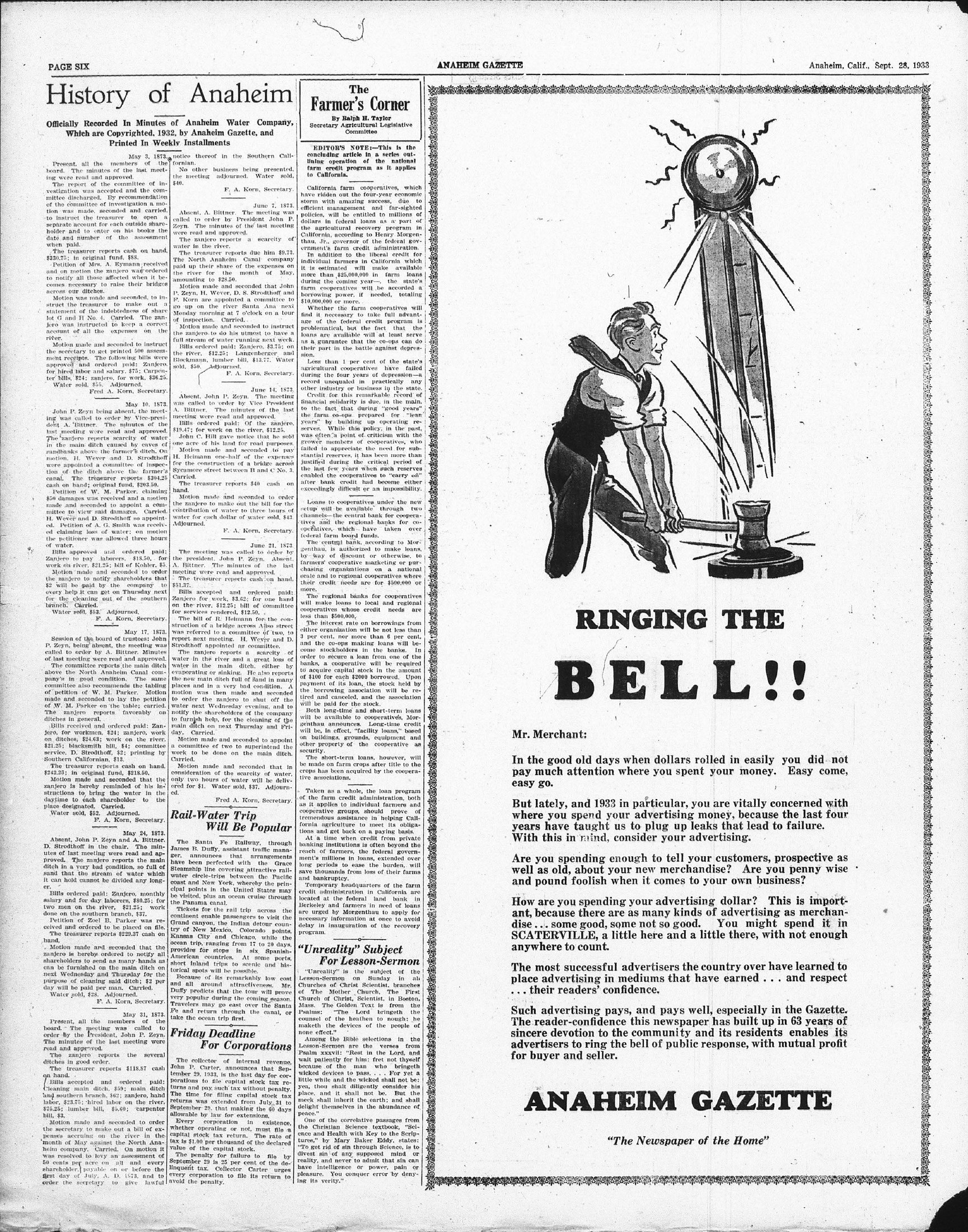
Searchable text
History of Anaheim
Officially Recorded In Minutes of Anaheim Water Company,
Which are Copyrighted, 1932, by Anaheim Gazette, and Printed In Weekly Installments
May 3, 1873.
Present, all the members of the board. The minutes of the last meeting were read and approved.
The report of the committee of investigation was accepted and the committee discharged. By recommendation of the committee of investigation a motion was made, seconded and carried, to instruct the treasurer to open a separate account for each outside shareholder and to enter on his books the date and number of the assessment when paid.
The treasurer reports cash on hand, $330.75; in original fund, $88.
Petition of Mrs. A. Eymann received and on motion the zanjero was ordered to notify all those affected when it becomes necessary to raise their bridges across our ditches.
Motion was made and seconded, to instruct the treasurer to make out a statement of the indebtedness of share lot G and H No. 4. Carried. The zanjero was instructed to keep a correct account of all the expenses on the river.
Motion made and seconded to instruct the secretary to get printed 500 assessment receipts. The following bills were approved and ordered paid: Zanjero, for hired labor and salary, $75; Carpenter bills, $24; zanjero, for work, $36.25.
Water sold, $55. Adjourned.
Fred A. Korn, Secretary.
May 10, 1873.
John P. Zeyn being absent, the meeting was called to order by Vice-president A. Bittner. The minutes of the last meeting were read and approved. The zanjero reports scarcity of water in the main ditch caused by caves of sandbanks above the farmer's ditch. On motion, H. Wever and D. Strodtheff notice thereof in the Southern California.
No other business being presented, the meeting adjourned. Water sold, $40.
F. A. Korn, Secretary.
June 7, 1873.
Absent, A. Bittner. The meeting was called to order by President John P. Zeyn. The minutes of the last meeting were read and approved.
The zanjero reports a scarcity of water in the river.
The treasurer reports due him $9.73. The North Anaheim Canal company paid up their share of the expenses on the river for the month of May, amounting to $28.50.
Motion made and seconded that John P. Zeyn, H. Wever, D. S. Strodthoff and F. Korn are appointed a committee to go up on the river Santa Ana next Monday morning at 7 o'clock on a tour of inspection. Carried.
Motion made and seconded to instruct the zanjero to do his utmost to have a full stream of water running next week.
Bills ordered paid: Zanjero, $3.75; on the river, $12.25; Langenberger and Blockmann, lumber bill, $13.77. Water sold, $50. Adjourned.
F. A. Korn, Secretary.
June 14, 1873.
Absent, John P. Zeyn. The meeting was called to order by Vice-President A. Bittner. The minutes of the last meeting were read and approved.
Bills ordered paid: Of the zanjero, $19.47; for work on the river, $12.25.
John C. Hill gave notice that he sold one acre of his land for road purposes.
Motion made and seconded to pay H. Heimann one-half of the expenses
California farm can have ridden out the storm with amazing efficient management policies, will be entailed dollars in federal law the agricultural re- California, according thau, Jr., governor's farm cree.
In addition to the individual farmers it is estimated will more than $25,000,000 during the coming year farm cooperatives borrowing power, in $10,000,000 or more.
Whether the farm find it necessary to age of the federal problematical, but loans are available as a guarantee than their part in the basement.
Less than 1 per agricultural cooperative during the four years record unequaled in other industry or business.
Credit for this re- financial solidarity to the fact that the farm co-ops pay years" by building serves. While this was often a point of grower members of failed to appreciate stantial reserves, it
May 10, 1873.
John P. Zeyn being absent, the meeting was called to order by Vice-president A. Bittner. The minutes of the last meeting were read and approved. The zanjero reports scarcity of water in the main ditch caused by caves of sandbanks above the farmer's ditch. On motion, H. Wever and D. Strodthoff were appointed a committee of inspection of the ditch above the farmer's canal. The treasurer reports $304.25 cash on hand; original fund, $203.50.
Petition of W. M. Parker, claiming $50 damages was received and a motion made and seconded to appoint a committee to view said damages. Carried. H. Wever and D. Strodthoff so appointed. Petition of A. G. Smith was received claiming loss of water; on motion the petitioner was allowed three hours of water.
Bills approved and ordered paid; Zanjero to pay laborers, $18.50, for work on river, $21.25; bill of Kohler, $5.
Motion made and seconded to order the zanjero to notify shareholders that $2 will be paid by the company to every help it can get on Thursday next for the cleaning out of the southern branch. Carried.
Water sold, $53. Adjourned.
F. A. Korn, Secretary.
May 17, 1873.
Session of the board of trustees: John P. Zeyn, being absent, the meeting was called to order by A. Bittner. Minutes of last meeting were read and approved.
The committee reports the main ditch above the North Anaheim Canal company's in good condition. The same committee also recommends the tabling of petition of W. M. Parker. Motion made and seconded to lay the petition of W. M. Parker on the table; carried. The zanjero reports favorably on ditches in general.
Bills received and ordered paid: Zanjero, for workmen, $24; zanjero, work on ditches, $24.63; work on the river, $21.25; blacksmith bill, $4; committee service, D. Strodthoff, $2; printing by Southern Californian, $13.
The treasurer reports cash on hand, $242.25; in original fund, $218.50.
Motion made and seconded that the zanjero is hereby reminded of his instructions to bring the water in the daytime to each shareholder to the place designated. Carried.
Water sold, $52. Adjourned.
F. A. Korn, Secretary.
May 24, 1873.
Absent, John P. Zeyn and A. Bittner. D. Strodthoff in the chair. The minutes of last meeting were read and approved. The zanjero reports the main ditch in a very bad condition, so full of
June 14, 1873.
Absent, John P. Zeyn. The meeting was called to order by Vice President A. Bittner. The minutes of the last meeting were read and approved.
Bills ordered paid: Of the zanjero, $19.47; for work on the river, $12.25.
John C. Hill gave notice that he sold one acre of his land for road purposes.
Motion made and seconded to pay H. Heimann one-half of the expenses for the construction of a bridge across Sycamore street between B and C No. 3.
Carried.
The treasurer reports $40 cash on hand.
Motion made and seconded to order the zanjero to make out the bill for the contribution of water to three hours of water for each dollar of water sold, $43.
Adjourned.
F. A. Korn, Secretary.
June 21, 1873.
The meeting was called to order by the president, John P. Zeyn. Absent. A. Bittner. The minutes of the last meeting were read and approved.
The treasurer reports cash on hand, $51.37.
Bills accepted and ordered paid: Zanjero for work, $3.62; for one hand on the river, $12.25; bill of committee for services rendered, $12.50.
The bill of R. Heimann for the construction of a bridge across Allo street was referred to a committee of two, to report next meeting. H. Wever and D. Strodthoff appointed as committee.
The zanjero reports a scarcity of water in the river and a great loss of water in the main ditch, either by evaporating or sinking. He also reports the new main ditch full of sand in many places and in a very bad condition. A motion was then made and seconded to order the zanjero to shut off the water next Wednesday evening, and to notify the shareholders of the company to furnish help, for the cleaning of the main ditch on next Thursday and Friday. Carried.
Motion made and seconded to appoint a committee of two to superintend the work to be done on the main ditch. Carried.
Motion made and seconded that in consideration of the scarcity of water, only two hours of water will be delivered for $1. Water sold, $37.
Adjourned.
Fred A. Korn, Secretary.
Rail-Water Trip Will Be Popular
The Santa Fe Railway, through James B. Duffy, assistant traffic manager, announces that arrangements have been perfected with the Grace Steamship line covering attractive rail-
Motion made and seconded that the zanjero is hereby reminded of his instructions to bring the water in the daytime to each shareholder to the place designated. Carried.
Water sold, $52. Adjourned.
F. A. Korn, Secretary.
May 24, 1873.
Absent, John P. Zeyn and A. Bittner.
D. Strodthoff in the chair. The minutes of last meeting were read and approved. The zanjero reports the main ditch in a very bad condition, so full of sand that the stream of water which it can hold cannot be divided any longer.
Bills ordered paid: Zanjero, monthly salary and for day laborers, $80.25; for two men on the river, $21.25; work done on the southern branch, $37.
Petition of Zoel B. Parker was received and ordered to be placed on file.
The treasurer reports $229.37 cash on hand.
Motion made and seconded that the zanjero is hereby ordered to notify all shareholders to send as many hands as can be furnished on the main ditch on next Wednesday and Thursday for the purpose of cleaning said ditch; $2 per day will be paid per man. Carried.
Water sold, $28. Adjourned.
F. A. Korn, Secretary.
May 31, 1873.
Present, all the members of the board. The meeting was called to order by the President, John P. Zeyn. The minutes of the last meeting were read and approved.
The zanjero reports the several ditches in good order.
The treasurer reports $118.87 cash on hand.
Bills accepted and ordered paid: Cleaning main ditch, $59; main ditch and southern branch, $62; zanjero, hand labor, $23.75; hired labor on the river, $75.25; lumber bill, $5.60; carpenter bill, $3.
Motion made and seconded to order the secretary to make out a bill of expenses accruing on the river in the month of May against the North Anaheim company. Carried. On motion it was resolved to levy an assessment of 50 cents per acre on all and every shareholder, payable on or before the first day of July, A. D. 1873, and to order the secretary to give lawful consideration of the scarcity of water, only two hours of water will be delivered for $1. Water sold, $37. Adjourned.
Fred A. Korn, Secretary.
Rail-Water Trip Will Be Popular
The Santa Fe Railway, through James B. Duffy, assistant traffic manager, announces that arrangements have been perfected with the Grace Steamship line covering attractive rail-water circle-trips between the Pacific coast and New York, whereby the principal points in the United States may be visited, plus an ocean cruise through the Panama canal.
Tickets for the rail trip across the continent enable passengers to visit the Grand canyon, the Indian detour country of New Mexico, Colorado points, Kansas City and Chicago, while the ocean trip, ranging from 17 to 20 days, provides for stops in six Spanish-American countries. At some ports, short inland trips to scenic and historical spots will be possible.
Because of its remarkably low cost and all around attractiveness, Mr. Duffy predicts that the tour will prove very popular during the coming season. Travelers may go cast over the Santa Fe and return through the canal, or take the ocean trip first.
Friday Deadline For Corporations
The collector of internal revenue, John P. Carter, announces that September 29, 1933, is the last day for corporations to file capital stock tax returns and pay such tax without penalty. The time for filing capital stock tax returns was extended from July 31 to September 29, that making the 60 days allowable by law for extensions.
Every corporation in existence, whether operating or not, must file a capital stock tax return. The rate of tax is $1.00 per thousand of the declared value of the capital stock.
The penalty for failure to file by September 29 is 25 per cent of the delinquent tax. Collector Carter urges every corporation to file its return to avoid the penalty.
Taken as a whole of the farm credit agency as it applies to indi- cooperative groups, tremendous assistance formia agriculture tions and get back o-
At a time when banking institutions reach of farmers, ther ment's millions in long periods to eas- save thousands from and bankruptcy.
Temporary headquarter credit administration located at the federal Berkeley and farmer are urged by Morges necessary information delay in inauguration program.
"Unreality" For Less
"Unreality" is the Lesson-Sermon on Churches of Christ of The Mother C Church of Christ, S Mass. The Golden T Psalms: "The L counsel of the heath maketh the devices none effect."
Among the Bible Lesson-Sermon are Psalm xxxvii: "Rest wait patiently for him because of the ma wicked devices to pay little while and the w yea, thou shalt dilig- place, and it shall meek shall inherit tha delight themselves in peace."
One of the correlations the Christian Science ence and Health wit tures," by Mary Ba- "To get rid of sin tha divest sin of any su- reality, and never to have intelligence on pleasure. You conq uing its verity."
The Farmer's Corner
By Ralph H. Taylor
Secretary Agricultural Legislative Committee
EDITOR'S NOTE:—This is the concluding article in a series outlining operation of the national farm credit program as it applies to California.
California farm cooperatives, which have ridden out the four-year economic storm with amazing success, due to efficient management and far-sighted policies, will be entitled to millions of dollars in federal loans as a part of the agricultural recovery program in California, according to Henry Morgenthau, Jr., governor of the federal government's farm credit administration.
In addition to the liberal credit for individual farmers in California which it is estimated will make available more than $25,000,000 in farm loans during the coming year—the state's farm cooperatives will be accorded a borrowing power, if needed, totaling $10,000,000 or more.
Whether the farm cooperatives will find it necessary to take full advantage of the federal credit program is problematical, but the fact that the loans are available will at least serve as a guarantee that the co-ops can do their part in the battle against depression.
Less than 1 per cent of the state's agricultural cooperatives have failed during the four years of depression—a record unequaled in practically any other industry or business in the state.
Credit for this remarkable record of financial solidarity is due, in the main, to the fact that during "good years" the farm co-ops prepared for "lean years" by building up operating reserves. While this policy, in the past, was often a point of criticism with the grower members of cooperatives, who failed to appreciate the need for substantial reserves, it has been more than
Less than 1 per cent of the state's agricultural cooperatives have failed during the four years of depression—a record unequaled in practically any other industry or business in the state.
Credit for this remarkable record of financial solidarity is due, in the main, to the fact that during "good years" the farm co-ops prepared for "lean years" by building up operating reserves. While this policy, in the past, was often a point of criticism with the grower members of cooperatives, who failed to appreciate the need for substantial reserves, it has been more than justified during the critical period of the last few years when such reserves enabled the cooperatives to "carry on" after bank credit had become either exceedingly difficult or an impossibility.
Loans to cooperatives under the new setup will be available through two channels—the central bank for cooperatives and the regional banks for cooperatives, which have taken over federal farm board funds.
The central bank, according to Morgenthau, is authorized to make loans, by way of discount or otherwise, to farmers' cooperative marketing or purchasing organizations on a national scale and to regional cooperatives where their credit needs are for $500,000 or more.
The regional banks for cooperatives will make loans to local and regional cooperatives whose credit needs are less than $500,000.
The interest rate on borrowings from either organization will be not less than 3 per cent, nor more than 6 per cent, and the co-ops making loans will become stockholders in the banks. In order to secure a loan from one of the banks, a cooperative will be required to acquire capital stock in the amount of $100 for each $2000 borrowed. Upon payment of its loan, the stock held by the borrowing association will be retired and canceled, and the association will be paid for the stock.
Both long-time and short-term loans will be available to cooperatives, Morgenthau announces. Long-time credit will be, in effect, "facility loans," based on buildings, grounds, equipment and other property of the cooperative as security.
The short-term loans, however, will be made on farm crops after title to the crops has been acquired by the cooperative associations.
Taken as a whole, the loan program of the farm credit administration, both as it applies to individual farmers and cooperative groups, should prove of tremendous assistance in helping California agriculture to meet its obligations and get back on a paying basis.
At a time when credit from private banking institutions is often beyond the reach of farmers, the federal government's millions in loans, extended over long periods to ease the burden, will pay thousands of dollars each year.
Taken as a whole, the loan program of the farm credit administration, both as it applies to individual farmers and cooperative groups, should prove of tremendous assistance in helping California agriculture to meet its obligations and get back on a paying basis.
At a time when credit from private banking institutions is often beyond the reach of farmers, the federal government's millions in loans, extended over long periods to ease the burden, will save thousands from loss of their farms and bankruptcy.
Temporary headquarters of the farm credit administration in California are located at the federal land bank in Berkeley and farmers in need of loans are urged by Morgenthau to apply for necessary information at once to avoid delay in inauguration of the recovery program.
"Unreality" Subject For Lesson-Sermon
"Unreality" is the subject of the Lesson-Sermon on Sunday in all Churches of Christ Scientist, branches of The Mother Church, The First Church of Christ, Scientist, in Boston, Mass. The Golden Text is from the Psalms: "The Lord bringeth the counsel of the heathen to nough; he maketh the devices of the people of none effect."
Among the Bible selections in the Lesson-Sermon are the verses from Psalm xxxvii: "Rest in the Lord, and wait patiently for him: fret not thyself because of the man who bringeth wicked devices to pass. . . . For yet a little while and the wicked shall not be: yea, thou shalt diligently consider his place, and it shall not be. But the meek shall inherit the earth; and shall delight themselves in the abundance of peace."
One of the correlative passages from the Christian Science textbook, "Science and Health with Key to the Scriptures," by Mary Baker Eddy, states: "To get rid of sin through Science, is to divest sin of any supposed mind or reality, and never to admit that sin can have intelligence or power, pain or pleasure. You conquer error by denying its verity."
Anaheim, Calif., Sept. 28, 1933
INGING THE
ELL!!
ays when dollars rolled in easily you did not
on where you spent your money. Easy come,
33 in particular, you are vitally concerned with
your advertising money, because the last four
us to plug up leaks that lead to failure.
consider your advertising.
enough to tell your customers, prospective as
your new merchandise? Are you penny wise
33 in particular, you are vitally concerned with your advertising money, because the last four us to plug up leaks that lead to failure.
consider your advertising.
enough to tell your customers, prospective as your new merchandise? Are you penny wise when it comes to your own business?
selling your advertising dollar? This is import-are as many kinds of advertising as merchan- some not so good. You might spend it in a little here and a little there, with not enough
ful advertisers the country over have learned to in mediums that have earned . . . and respect confidence.
pays, and pays well, especially in the Gazette.ence this newspaper has built up in 63 years of the community and its residents enables its the bell of public response, with mutual profit er.
HEIM GAZETTE
"The Newspaper of the Home"