anaheim-gazette 1933-08-24
Scanned page
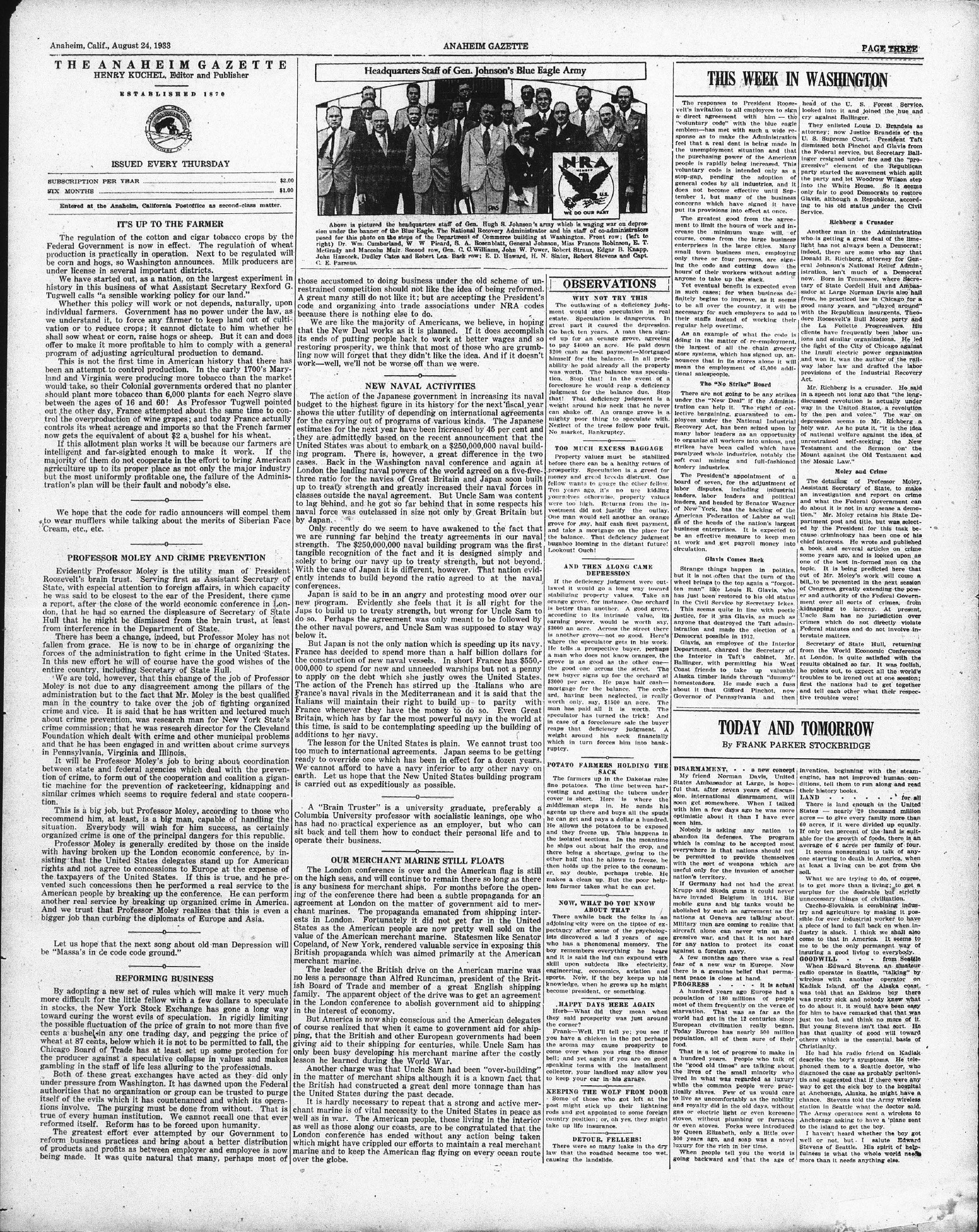
Searchable text
THE ANAHEIM GAZETTE
HENRY KUCHEL, Editor and Publisher
ESTABLISHED 1870
ISSUED EVERY THURSDAY
SUBSCRIPTION PER YEAR ... $2.00
SIX MONTHS ... $1.00
Entered at the Anaheim, California Postoffice as second-class matter.
IT'S UP TO THE FARMER
The regulation of the cotton and cigar tobacco crops by the Federal Government is now in effect. The regulation of wheat production is practically in operation. Next to be regulated will be corn and hogs, so Washington announces. Milk producers are under license in several important districts.
We have started out, as a nation, on the largest experiment in history in this business of what Assistant Secretary Rexford G. Tugwell calls "a sensible working policy for our land."
Whether this policy will work or not depends, naturally, upon individual farmers. Government has no power under the law, as we understand it, to force any farmer to keep land out of cultivation or to reduce crops; it cannot dictate to him whether he shall sow wheat or corn, raise hogs or sheep. But it can and does offer to make it more profitable to him to comply with a general program of adjusting agricultural production to demand.
This is not the first time in American history that there has been an attempt to control production. In the early 1700's Maryland and Virginia were producing more tobacco than the market would take, so their Colonial governments ordered that no planter should plant more tobacco than 6,000 plants for each Negro slave between the ages of 16 and 60! As Professor Tugwell pointed out the other day, France attempted about the same time to control the overproduction of wine grapes; and today France actually controls its wheat acreage and imports so that the French farmer now gets the equivalent of about $2 a bushel for his wheat.
If this allotment plan works it will be because our farmers are intelligent and far-sighted enough to make it work. If the majority of them do not cooperate in the effort to bring American
This is not the first time in American history that there has been an attempt to control production. In the early 1700's Maryland and Virginia were producing more tobacco than the market would take, so their Colonial governments ordered that no planter should plant more tobacco than 6,000 plants for each Negro slave between the ages of 16 and 60! As Professor Tugwell pointed out the other day, France attempted about the same time to control the overproduction of wine grapes; and today France actually controls its wheat acreage and imports so that the French farmer now gets the equivalent of about $2 a bushel for his wheat.
If this allotment plan works it will be because our farmers are intelligent and far-sighted enough to make it work. If the majority of them do not cooperate in the effort to bring American agriculture up to its proper place as not only the major industry but the most uniformly profitable one, the failure of the Administration's plan will be their fault and nobody's else.
We hope that the code for radio announcers will compel them to wear mufflers while talking about the merits of Siberian Face Cream, etc., etc.
PROFESSOR MOLEY AND CRIME PREVENTION
Evidently Professor Moley is the utility man of President Roosevelt's brain trust. Serving first as Assistant Secretary of State, with especial attention to foreign affairs, in which capacity he was said to be closest to the ear of the President, there came a report, after the close of the world economic conference in London, that he had so earned the displeasure of Secretary of State Hull that he might be dismissed from the brain trust, at least from interference in the Department of State.
There has been a change, indeed, but Professor Moley has not fallen from grace. He is now to be in charge of organizing the forces of the administration to fight crime in the United States. In this new effort he will of course have the good wishes of the entire country, including Secretary of State Hull.
We are told, however, that this change of the job of Professor Moley is not due to any disagreement among the pillars of the administration but to the fact that Mr. Moley is the best qualified man in the country to take over the job of fighting organized crime and vice. It is said that he has written and lectured much about crime prevention, was research man for New York State's crime commission; that he was research director for the Cleveland Foundation which dealt with crime and other municipal problems and that he has been engaged in and written about crime surveys in Pennsylvania, Virginia and Illinois.
It will be Professor Moley's job to bring about coordination between state and federal agencies which deal with the prevention of crime, to form out of the cooperation and coalition a gigantic machine for the prevention of racketeering, kidnapping and similar crimes which seems to require federal and state cooperation.
This is a big job, but Professor Moley, according to those who recommend him, at least, is a big man, capable of handling the situation. Everybody will wish for him success, as certainly organized crime is one of the principal dangers for this republic.
Professor Moley is generally credited by those on the inside with having broken up the London economic conference, by insisting that the United States delegates stand up for American rights and not agree to concessions to Europe at the expense of...
tion of crime, to form out of the cooperation and coalition a gigantic machine for the prevention of racketeering, kidnapping and similar crimes which seems to require federal and state cooperation.
This is a big job, but Professor Moley, according to those who recommend him, at least, is a big man, capable of handling the situation. Everybody will wish for him success, as certainly organized crime is one of the principal dangers for this republic.
Professor Moley is generally credited by those on the inside with having broken up the London economic conference, by insisting that the United States delegates stand up for American rights and not agree to concessions to Europe at the expense of the taxpayers of the United States. If this is true, and he prevented such concessions then he performed a real service to the American people by breaking up the conference. He can perform another real service by breaking up organized crime in America. And we trust that Professor Moley realizes that this is even a bigger job than curbing the diplomats of Europe and Asia.
Let us hope that the next song about old-man Depression will be "Massa's in de code code ground."
REFORMING BUSINESS
By adopting a new set of rules which will make it very much more difficult for the little fellow with a few dollars to speculate in stocks, the New York Stock Exchange has gone a long way toward curing the worst evils of speculation. In rigidly limiting the possible fluctuation of the price of grain to not more than five cents a bushel in any one trading day, and pegging the price of wheat at 87 cents, below which it is not to be permitted to fall, the Chicago Board of Trade has at least set up some protection for the producer against a speculative collapse in values and makes gambling in the staff of life less alluring to the professionals.
Both of these great exchanges have acted as they did only under pressure from Washington. It has dawned upon the Federal authorities that no organization or group can be trusted to purge itself of the evils which it has countenanced and which its operations involve. The purging must be done from without. That is true of every human institution. We cannot recall one that ever reformed itself. Reform has to be forced upon humanity.
The greatest effort ever attempted by our Government to reform business practices and bring about a better distribution of products and profits as between employer and employee is now being made. It was quite natural that many, perhaps most of
ANAHEIM GAZETTE
Headquarters Staff of Gen. Johnson's Blue Eagle Army
Above is pictured the headquarters staff of Gen. Hugh S. Johnson’s army which is waging war on depression under the banner of the Blue Eagle. The National Recovery Administrator and his staff of co-administrators posed for this photo on the steps of the Department of Commerce building at Washington. Front row; (left to right) Dr. Wm. Cumberland, W. W Picard, S. A. Rosenblatt, General Johnson, Miss Frances Robinson, E. T. McGrady and Maccolm Muir. Second row, Gen. C. C. Williams, John W. Power, Robert Straus, Edgar B. Knapp, John Hancock, Dudley Cates and Robert Lea. Back row; E. D. Howard, H. N. Slater, Robert Stevens and Capt. C. E. Parsons.
those accustomed to doing business under the old scheme of unrestrained competition should not like the idea of being reformed. A great many still do not like it; but are accepting the President’s code and organizing into trade associations under NRA codes because there is nothing else to do.
We are like the majority of Americans, we believe, in hoping that the New Deal works as it is planned. If it does accomplish its ends of putting people back to work at better wages and so restoring prosperity, we think that most of those who are grumbling now will forget that they didn’t like the idea. And if it doesn’t work—well, we’ll not be worse off than we were.
NEW NAVAL ACTIVITIES
The action of the Japanese government in increasing its naval budget to the highest figure in its history for the next fiscal year shows the utter futility of depending on international agreements for the carrying out of programs of various kinds. The Japanese estimates for the next year have been increased by 45 per cent and they are admittedly based on the recent announcement that the United States was about to embark on a $250,000,000 naval building program. There is, however, a great difference in the two
OBSERVATIONS
WHY NOT TRY THIS
The outlawing of a deficiency judgment would stop speculation in real estate. Speculation is dangerous. In great part it caused the depression. Go back ten years. A man then signed up for an orange grove, agreeing to pay $4000 an acre. He paid down $200 cash as first payment—Mortgaged himself for the balance. In all probability he paid already all the property was worth. The balance was speculation. Stop that! In the event of a foreclosure he would reap a deficiency judgment for the balance due. Stop that! That deficiency judgment is a weight around his neck that he never can shake off. An orange grove is a mighty poor thing to speculate with. Neglect of the trees follow poor fruit. No market, Bankruptcy.
TOO MUCH EXCESS BAGGAGE
Property values must be stabilized
NEW NAVAL ACTIVITIES
The action of the Japanese government in increasing its naval budget to the highest figure in its history for the next fiscal year shows the utter futility of depending on international agreements for the carrying out of programs of various kinds. The Japanese estimates for the next year have been increased by 45 per cent and they are admittedly based on the recent announcement that the United States was about to embark on a $250,000,000 naval building program. There is, however, a great difference in the two cases. Back in the Washington naval conference and again at London the leading naval powers of the world agreed on a five-five-three ratio for the navies of Great Britain and Japan soon built up to treaty strength and greatly increased their naval forces in classes outside the naval agreement. But Uncle Sam was content to lag behind, and he got so far behind that in some respects his naval force was outclassed in size not only by Great Britain but by Japan.
Only recently do we seem to have awakened to the fact that we are running far behind the treaty agreements in our naval strength. The $250,000,000 naval building program was the first tangible recognition of the fact and it is designed simply and solely to bring our navy up to treaty strength, but not beyond. With the case of Japan it is different, however. That nation evidently intends to build beyond the ratio agreed to at the naval conferences.
Japan is said to be in an angry and protesting mood over our new program. Evidently she feels that it is all right for the Japs to build up to treaty strength, but wrong for Uncle Sam to do so. Perhaps the agreement was only meant to be followed by the other naval powers, and Uncle Sam was supposed to stay way below it.
But Japan is not the only nation which is speeding up its navy. France has decided to spend more than a half billion dollars for the construction of new naval vessels. In short France has $550,-000,000 to spend for new and unneeded warships but not a penny to apply on the debt which she justly owes the United States. The action of the French has stirred up the Italians who are France's naval rivals in the Mediterranean and it is said that the Italians will maintain their right to build up to parity with France whenever they have the money to do so. Even Great Britain, which has by far the most powerful navy in the world at this time, is said to be contemplating speeding up the building of additions to her navy.
The lesson for the United States is plain. We cannot trust too much to international agreements. Japan seems to be getting ready to override one which has been in effect for a dozen years. We cannot afford to have a navy inferior to any other navy on earth. Let us hope that the New United States building program is carried out as expeditiously as possible.
A "Brain Truster" is a university graduate, preferably a Columbia University professor with socialistic leanings, one who has had no practical experience as an employer, but who can sit back and tell them how to conduct their personal life and to operate their business.
OUR MERCHANT MARINE STILL FLOATS
The London conference is over and the American flag is still ability he paid already all the property was worth. The balance was speculation. Stop that! In the event of a foreclosure he would reap a deficiency judgment for the balance due. Stop that! That deficiency judgment is a weight around his neck that he never can shake off. An orange grove is a mighty poor thing to speculate with. Neglect of the trees follow poor fruit. No market, Bankruptcy.
TOO MUCH EXCESS BAGGAGE
Property values must be stabilized before there can be a healthy return of prosperity. Speculation is a greed for money and greed breeds distrust. One fellow wants to gudge the other fellow. Ten years ago, it's no use kidding yourselves otherwise. property values were too high. Returns from the investment did not justify the outlay. One man would sell another an orange grove for say, half cash first payment, and take a mortgage on the place for the balance.. That deficiency judgment bugaboo looming in the distant future! Lookout! Ouch!
AND THEN ALONG CAME DEPRESSION
If the deficiency judgment were outlawed it would go a long way toward stabilizing property values. Take an orange grove, for instance. One orchard is better than another. A good grove, according to its intrinsic value, its earning power, would be worth say, $3000 an acre. Across the street there is another grove—not so good. Here's where the speculator gets in his work. He tells a prospective buyer, perhaps a man who does not know oranges, the grove is as good as the other one—the good one across the street. The new buyer signs up for the orchard at $3000 per acre. He pays half cash—mortgage for the balance. The orchard, having been neglected, is really worth only, say, $1500 an acre. The man has paid all it is worth. The speculator has turned the trick! And in case of a foreclosure sale the buyer reaps that deficiency judgment. A weight around his neck financially which in turn forces him into bankruptcy.
POTATO FARMERS HOLDING THE SACK
The farmers up in the Dakotas raise fine potatoes. The time between harvesting and getting the tubers under cover is short. Here is where the middleman steps in. He sends his agents up there and buys all the spuds he can get and pays a dollar a hundred. He allows the potatoes to be exposed and they freeze up. This happens in the isolated sections. In the meantime he ships out about half the crop, and there being a shortage, owing to the other half that he allows to freeze, he then holds up the price to the consum-
A "Brain Truster" is a university graduate, preferably a Columbia University professor with socialistic leanings, one who has had no practical experience as an employer, but who can sit back and tell them how to conduct their personal life and to operate their business.
OUR MERCHANT MARINE STILL FLOATS
The London conference is over and the American flag is still on the high seas, and will continue to remain there so long as there is any business for merchant ships. For months before the opening of the conference there had been a subtle propaganda for an agreement at London on the matter of government aid to merchant marines. The propaganda emanated from shipping interests in London. Fortunately it did not get far in the United States as the American people are now pretty well sold on the value of the American merchant marine. Statesmen like Senator Copeland, of New York, rendered valuable service in exposing this British propaganda which was aimed primarily at the American merchant marine.
The leader of the British drive on the American marine was no less a personage than Alfred Runciman, president of the British Board of Trade and member of a great English shipping family. The apparent object of the drive was to get an agreement in the London conference to abolish government aid to shipping in the interest of economy.
But America is now ship conscious and the American delegates of course realized that when it came to government aid for shipping, that the British and other European governments had been giving aid to their shipping for centuries, while Uncle Sam has only been busy developing his merchant marine after the costly lesson he learned during the World War.
Another charge was that Uncle Sam had been "over-building" in the matter of merchant ships although it is a known fact that the British had constructed a great deal more tonnage than has the United States during the past decade.
It is hardly necessary to repeat that a strong and active merchant marine is of vital necessity to the United States in peace as well as in war. The American people, those living in the interior as well as those along our coasts, are to be congratulated that the London conference has ended without any action being taken which might have crippled our efforts to maintain a real merchant marine and to keep the American flag flying on every ocean route over the globe.
The farmers up in the Dakotas raise fine potatoes. The time between harvesting and getting the tubers under cover is short. Here is where the middleman steps in. He sends his agents up there and buys all the spuds he can get and pays a dollar a hundred. He allows the potatoes to be exposed and they freeze up. This happens in the isolated sections. In the meantime he ships out about half the crop, and there being a shortage, owing to the other half that he allows to freeze, he then holds up the price to the consumer, say double, perhaps treble. He makes a clean up. But the poor helpless farmer takes what he can get.
NOW, WHAT DO YOU KNOW ABOUT THAT
There awhile back the folks in an adjoining city were on the tiptoe of expectancy after some of the psychologists discovered a lad 3 years of age who has a phenomenal memory. The boy remembers everything he hears and it is said the lad can expound with skill upon subjects like electricity, engineering, economics, aviation and sports. Now, if the boy keeps up his knowledge, when he grows up he might become president, or something.
HAPPY DAYS HERE AGAIN
Herb—What did they mean when they said prosperity was just around the corner?
Frank—Well, I’ll tell ye; you see if you have a chicken in the pot perhaps the aroma may cause prosperity to come over when you ring the dinner bell; and yet again if you are on good speaking terms with the installment collector, your landlord may allow you to keep your car in his garage.
KEEPING THE WOLF FROM DOOR
Some of those who got left at the post might stick up their lightning rods and get appointed to some foreign country position; or, oh yes, they might take up life insurance.
DETOUR, FELLERS!
There were so many leaks in the dry law that the roadbed became too wet, causing the landslide.
THIS WEEK IN WASHINGTON
The responses to President Roosevelt's invitation to all employers to sign a direct agreement with him — the "voluntary code" with the blue eagle emblem—has met with such a wide response as to make the Administration feel that a real dent is being made in the unemployment situation and that the purchasing power of the American people is rapidly being increased. This voluntary code is intended only as a stop-gap, pending the adoption of general codes by all industries, and it does not become effective until September 1, but many of the business concerns which have signed it have put its provisions into effect at once.
The greatest good from the agreement to limit the hours of work and increase the minimum wage will, of course, come from the large business enterprises in the large cities. Many small town business men, employing only three or four persons, are signing the code and cutting down the hours' of their workers without adding anyone to take up the slack.
Yet eventual benefit is expected even in such cases; for when business definitely begins to improve, as it seems to be all over the country, it will be necessary for such employers to add to their staffs instead of working their regular help overtime.
As an example of what the code is adding in the matter of re-employment, the largest of all the chain grocery store systems, which has signed up, announces that in its stores alone it will mean the employment of 45,000 additional salespeople.
The "No Strike" Board
There are not going to be any strikes under the "New Deal" if the Administration can help it. The right of collective bargaining, guaranteed to employees under the National Industrial Recovery Act, has been seized upon by many labor leaders as an opportunity to organize all workers into unions, and strikes have been called which have paralyzed whole industries, notably the soft coal mining industry.
head of the U. S. Forest Service, looked into it and joined the hue and cry against Ballinger.
They enlisted Louis D. Brandels as attorney; now Justice Brandels of the U. S. Supreme Court. President Taft dismissed both Pinchot and Glavis from the Federal service, but Secretary Ballinger resigned under fire and the "progressive" element of the Republican party started the movement which split the party and let Woodrow Wilson step into the White House. So it seems only fair to good Democrats to restore Glavis, although a Republican, according to his old status under the Civil Service.
Richberg a Crusader
Another man in the Administration who is getting a great deal of the limelight has not always been a Democrat; indeed, there are some who say that Donald R. Richberg, attorney for General Johnson's National Relief Administration, isn't much of a Democrat now. Born in Tennessee, where Secretary of State Cordell Hull and Ambassador at Large Norman Davis also hail from, he practiced law in Chicago for a good many years, and "played around" with the Republican insurgents, Theodore Roosevelt's Bull Moose party and the La Follette Progressives. His clients have frequently been labor unions and similar organizations. He led the fight of the City of Chicago against the Insull electric power organization and won it, was the author of the railway labor law and drafted the labor provisions of the Industrial Recovery Act.
Mr. Richberg is a crusader. He said in a speech not long ago that "the long-discussed revolution is actually under way in the United States, a revolution by the pen and voice." The war on depression seems to Mr. Richberg a holy war. As he puts it, "it is the idea of national welfare against the idea of unrestrained self-seeking; the New Testament and the Sermon on the Mount against the Old Testament and
TODAY AND TOMORROW
By FRANK PARKER STOCKBRIDGE
DISARMAMENT, a new concept
My friend Norman Davis, United States Ambassador at Large, is hopeful that, after seven years of discussion, international disarmament will soon get somewhere. When I talked with him a few days ago he was more optimistic about it than I have ever seen him.
Nobody is asking any nation to abandon its defenses. The program which is coming to be accepted most everywhere is that nations should not be permitted to provide themselves with the sort of weapons which are useful only for the invasion of another invention, beginning with the steam-engine, has not improved human conditions, tell them to run along and read their history books.
LAND for all
There is land enough in the United States — nearly 20 thousand million acres — to give every family more than 60 acres, if it were divided up equally. If only ten percent of the land is suitable for the growth of foods, there is an average of 6 acres per family of four.
It seems nonsensical to talk of anyone starving to death in America, when at least a living can be got from the
YOU KNOW THAT
the folks in an
in the meantime
half the crop, and
age, owing to the
flows to freeze, he
face to the consumhaps treble. He
but the poor helpat he can get.
WHERE AGAIN
they mean when
was just around
well ye; you see if
on the pot perhaps
use prosperity to
ring the dinner
you are on good
the installment
and may allow you
his garage.
SELF FROM DOOR
to got left at the
their lightning
and to some foreign
yes, they might
be.
ELLERS!
by leaks in the dry
became too wet,
My friend Norman Davis, United States Ambassador at Large, is hopeful that, after seven years of discussion, international disarmament will soon get somewhere. When I talked with him a few days ago he was more optimistic about it than I have ever seen him.
Nobody is asking any nation to abandon its defenses. The program which is coming to be accepted most everywhere is that nations should not be permitted to provide themselves with the sort of weapons which are useful only for the invasion of another nation's territory.
If Germany had not had the great Krupp and Skoda guns it could never have invaded Belgium in 1914. Big mobile guns and big tanks would be abolished by such an agreement as the nations at Geneva are talking about. Military men are coming to realize that aircraft alone can never win an aggressive war, and that it is not hard for any nation to protect its coast against a foreign navy.
A few months ago there was a real fear of a new war in Europe. Now there is a genuine belief that permanent peace is close at hand.
PROGRESS ... It is actual
A hundred years ago Europe had a population of 180 millions of people most of them frequently on the verge of starvation. That was as far as the world had got in the 12 centuries since European civilization really began. Today Europe has nearly 500 million population, all of them sure of their food.
That is a lot of progress to make in a hundred years. People who talk of the "good old times" are talking about the lives of the small minority who lived in what was regarded as luxury while the common people were practically slaves. Few of us would care to live as uncomfortably as the nobility and royalty did in the old days, without gas or electric light or even kerosene stoves, without plumbing or furnaces or even stoves. Forks were introduced by Queen Elizabeth, only a little over 300 years ago, and soap was a novel luxury for the rich in her time.
When people tell you the world is going backward and that the age of engine, has not improved human conditions, tell them to run along and read their history books.
LAND ... for all
There is land enough in the United States — nearly 20 thousand million acres — to give every family more than 60 acres, if it were divided up equally. If only ten percent of the land is suitable for the growth of foods, there is an average of 6 acres per family of four.
It seems nonsensical to talk of anyone starving to death in America, when at least a living can be got from the soil.
What we are trying to do, of course, is to get more than a living; to get a surplus for the desirable but strictly unnecessary things of civilization.
Czecho-Slovakia is combining industry and agriculture by making it possible for ever industrial worker to have a piece of land to fall back on when industry is slack. I think we shall also come to that in America. It seems to me to be the only permanent way of insuring a good living to everybody.
GOODWILL ... from Seattle
When Edward Stevens, an amateur radio operator in Seattle, "talking" by wireless with another operator on Kadiak Island, off the Alaska coast, was told that an Eskimo boy there was pretty sick and nobody knew what to do about it. It would have been easy for him to have remarked that that was just too bad, and think no more of it. But young Stevens isn't that sort. He has that quality of good will toward others which is the essential basis of Christianity.
He had his radio friend on Kadiak describe the boy's symptoms. He telephoned them to a Seattle doctor, who diagnosed the case as probably peritoniis and suggested that if there were any way to get the sick boy to the hospital at Anchorage, Alaska, he might have a chance. Stevens told the Army wireless station in Seattle what the doctor said. The Army operators sent a wireless to Anchorage asking to have a 'plane sent to the island to get the boy.
I haven't heard whether the boy got well or not, but I salute Edward Stevens of Seattle. His spirit of helpfulness is what the whole world needs more than it needs anything else.