anaheim-gazette 1933-08-24
Scanned page
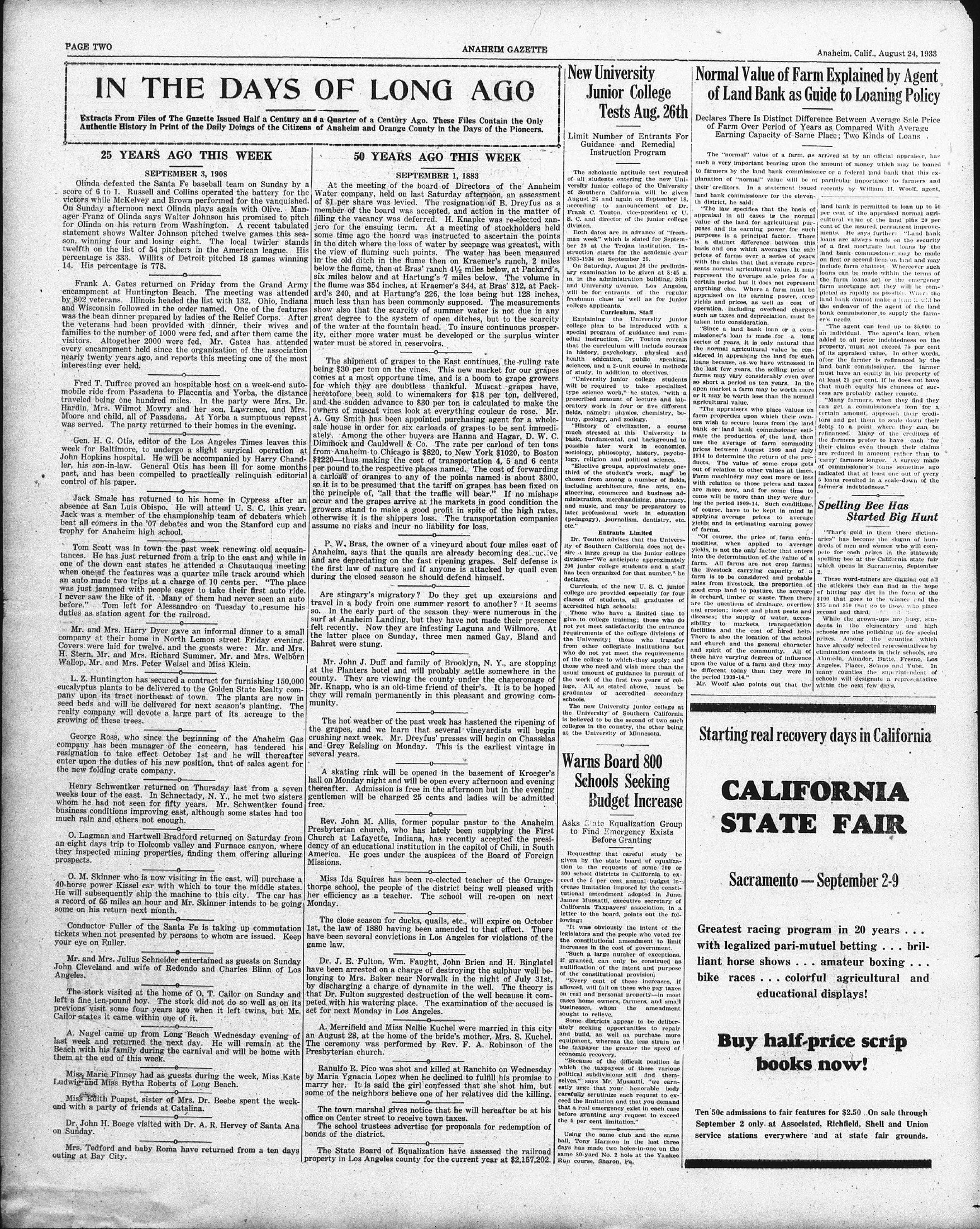
Searchable text
IN THE DAYS OF
Extracts From Files of The Gazette Issued Half a Century and a Quarter of Authentic History in Print of the Daily Doings of the Citizens of Anaheim
25 YEARS AGO THIS WEEK
SEPTEMBER 3, 1908
Olinda defeated the Santa Fe baseball team on Sunday by a score of 6 to 1. Russell and Collins operated the battery for the victors while McKelvey and Brown performed for the vanquished. On Sunday afternoon next Olinda plays again with Olive. Manager Franz of Olinda says Walter Johnson has promised to pitch for Olinda on his return from Washington. A recent tabulated statement shows Walter Johnson pitched twelve games this season, winning four and losing eight. The local twirler stands twelfth on the list of 54 pitchers in the American league. His percentage is 333. Willits of Detroit pitched 18 games winning 14. His percentage is 778.
Frank A. Gates returned on Friday from the Grand Army encampment at Huntington Beach. The meeting was attended by 802 veterans. Illinois headed the list with 132. Ohio, Indiana and Wisconsin followed in the order named. One of the features was the bean dinner prepared by ladies of the Relief Corps. After the veterans had been provided with dinner, their wives and families to the number of 1000 were fed, and after them came the visitors. Altogether 2000 were fed. Mr. Gates has attended every encampment held since the organization of the association nearly twenty years ago, and reports this meeting one of the most interesting ever held.
Fred T. Tuffree proved an hospitable host on a week-end automobile ride from Pasadena to Placentia and Yorba, the distance traveled being one hundred miles. In the party were Mrs. Dr. Hardin, Mrs. Wilmot Mowry and her son, Lawrence, and Mrs. Moore and child, all of Pasadena. At Yorba a sumptuous repast was served. The party returned to their homes in the evening.
Gen. H. G. Otis, editor of the Los Angeles Times leaves this week for Baltimore, to undergo a slight surgical operation at John Hopkins hospital. He will be accompanied by Harry Chand.
At the meet Water company of $1 per share member of the filling the vacancy jero for the some time ago in the ditch w the view of fl in the old ditch below the flume six miles below the flume was ard's 240, and much less than show also that great degree of the water arity, either mo water must be
The shipment being $30 per comes at a mo for which they heretofore bee and the sudden owners of mus A. Guy Smith sale house in oately. Among Dimnock and from Anaheim
Fred T. Tuffree proved an hospitable host on a week-end automobile ride from Pasadena to Placentia and Yorba, the distance traveled being one hundred miles. In the party were Mrs. Dr. Hardin, Mrs. Wilmot Mowry and her son, Lawrence, and Mrs. Moore and child, all of Pasadena. At Yorba a sumptuous repast was served. The party returned to their homes in the evening.
Gen. H. G. Otis, editor of the Los Angeles Times leaves this week for Baltimore, to undergo a slight surgical operation at John Hopkins hospital. He will be accompanied by Harry Chandler, his son-in-law. General Otis has been ill for some months past, and has been compelled to practically relinquish editorial control of his paper.
Jack Smale has returned to his home in Cypress after an absence at San Luis Obispo. He will attend U. S. C. this year. Jack was a member of the championship team of debaters which beat all comers in the '07 debates and won the Stanford cup and trophy for Anaheim high school.
Tom Scott was in town the past week renewing old acquaintances. He has just returned from a trip to the east and while in one of the down east states he attended a Chautauqua meeting when one of the features was a quarter mile track around which an auto made two trips at a charge of 10 cents per. "The place was just jammed with people eager to take their first auto ride. I never saw the like of it. Many of them had never seen an auto before." Tom left for Alessandro on Tuesday to resume his duties as station agent for the railroad.
Mr. and Mrs. Harry Dyer gave an informal dinner to a small company at their home in North Lemon street Friday evening. Covers were laid for twelve, and the guests were: Mr. and Mrs. H. Stern, Mr. and Mrs. Richard Summer, Mr. and Mrs. Welborn Wallop, Mr. and Mrs. Peter Weisel and Miss Klein.
L. Z. Huntington has secured a contract for furnishing 150,000 eucalyptus plants to be delivered to the Golden State Realty company upon its tract northeast of town. The plants are now in seed beds and will be delivered for next season's planting. The realty company will devote a large part of its acreage to the growing of these trees.
George Ross, who since the beginning of the Anaheim Gas company has been manager of the concern, has tendered his resignation to take effect October 1st and he will thereafter enter upon the duties of his new position, that of sales agent for the new folding crate company.
Henry Schwentker returned on Thursday last from a seven weeks tour of the east. In Schnectady, N. Y., he met two sisters whom he had not seen for fifty years. Mr. Schwentker found business conditions improving east, although some states had too much rain and others not enough.
O. Lagman and Hartwell Bradford returned on Saturday from an eight days trip to Holcomb valley and Furnace canyon, where they inspected mining properties, finding them offering alluring prospects.
Henry Schwentker returned on Thursday last from a seven weeks tour of the east. In Schnectady, N.Y., he met two sisters whom he had not seen for fifty years. Mr. Schwentker found business conditions improving east, although some states had too much rain and others not enough.
O. Lagman and Hartwell Bradford returned on Saturday from an eight days trip to Holcomb valley and Furnace canyon, where they inspected mining properties, finding them offering alluring prospects.
O. M. Skinner who is now visiting in the east, will purchase a 40-horse power Kissel car with which to tour the middle states. He will subsequently ship the machine to this city. The car has a record of 65 miles an hour and Mr. Skinner intends to be going some on his return next month.
Conductor Fuller of the Santa Fe is taking up commutation tickets when not presented by persons to whom are issued. Keep your eye on Fuller.
Mr. and Mrs. Julius Schneider entertained as guests on Sunday John Cleveland and wife of Redondo and Charles Blinn of Los Angeles.
The stork visited at the home of O. T. Cailor on Sunday and left a fine ten-pound boy. The stork did not do so well as on its previous visit some four years ago when it left twins, but Mr. Cailor states it came within one of it.
A. Nagel came up from Long Beach Wednesday evening of last week and returned the next day. He will remain at the Beach with his family during the carnival and will be home with them at the end of this week.
Miss Marie Finney had as guests during the week, Miss Kate Ludwig and Miss Bytha Roberts of Long Beach.
Miss Edith Poapst, sister of Mrs. Dr. Beebe spent the weekend with a party of friends at Catalina.
Dr. John H. Boege visited with Dr. A. R. Hervey of Santa Ana on Sunday.
Mrs. Tedford and baby Roma have returned from a ten days outing at Bay City.
50 YEARS AGO THIS WEEK
SEPTEMBER 1, 1883
At the meeting of the board of Directors of the Anaheim Water company, held on last Saturday afternoon, an assessment of $1 per share was levied. The resignation of B. Dreyfus as a member of the board was accepted, and action in the matter of filling the vacancy was deferred. H. Knapke was re-elected zanjero for the ensuing term. At a meeting of stockholders held some time ago the board was instructed to ascertain the points in the ditch where the loss of water by seepage was greatest, with the view of fluming such points. The water has been measured in the old ditch in the flume then on Kraemer's ranch, 2 miles below the flume, then at Bras' ranch 4½ miles below, at Packard's, six miles below and at Hartung's 7 miles below. The volume in the flume was 354 inches, at Kraemer's 344, at Bras' 312, at Packard's 240, and at Hartung's 226, the loss being but 128 inches, much less than has been commonly supposed. The measurements show also that the scarcity of summer water is not due in any great degree to the system of open ditches, but to the scarcity of the water at the fountain head. To insure continuous prosperity, either more water must be developed or the surplus winter water must be stored in reservoirs.
The shipment of grapes to the East continues, the ruling rate being $30 per ton on the vines. This new market for our grapes comes at a most opportune time, and is a boom to grape growers for which they are doubtless thankful. Muscat grapes have, heretofore been sold to winemakers for $18 per ton, delivered, and the sudden advance to $30 per ton is calculated to make the owners of muscat vines look at everything couleur de rose. Mr. A. Guy Smith has been appointed purchasing agent for a wholesale house in order for six carloads of grapes to be sent immediately. Among the other buyers are Hanna and Hagar, D. W. C. Dimmock and Cauldwell & Co. The rate per carload of ten tons from Anaheim to Chicago is $820, to New York $1020, to Boston
New University Junior College Tests Aug. 26th
Limit Number of Entrants For Guidance and Remedial Instruction Program
The scholastic aptitude test required of all students entering the new University junior college of the University of Southern California will be given August 26 and again on September 18, according to announcement of Dr. Frank C. Touton, vice-president of U. S. C. and director of the junior college division.
Both dates are in advance of "freshman week" which is slated for September 20 at the Trojan institution. Instruction starts for the academic year 1933-1934 on September 25.
On Saturday, August 26 the preliminary examination to be given at 8:45 a.m. in the administration building, 36th and University avenue, Los Angeles, will be for entrants of the regular freshman class as well as for junior college applicants.
Curriculum, Staff
Explaining the University junior college plan to be introduced with a special program of guidance and remedial instruction, Dr. Touton reveals that the curriculum will include courses in history, psychology, physical and health education, public speaking, sciences, and a 2-unit course in methods of study, in addition to electives.
"University junior college students will be required to take specialized type science work," he states, "with a prescribed amount of lecture and laboratory work in four or five different fields, namely: physics, chemistry, botany, geology, and zoology."
"History of civilization, a course much stressed at this University is basic, fundamental, and background to possible later work in economics, sociology, philosophy, history, psychology, religion and political science."
The shipment of grapes to the East continues, the ruling rate being $30 per ton on the vines. This new market for our grapes comes at a most opportune time, and is a boom to grape growers for which they are doubtless thankful. Muscat grapes have, heretofore been sold to winemakers for $18 per ton, delivered, and the sudden advance to $30 per ton is calculated to make the owners of muscat vines look at everything couleur de rose. Mr. A. Guy Smith has been appointed purchasing agent for a wholesale house in order for six carloads of grapes to be sent immediately. Among the other buyers are Hanna and Hagar, D. W. C. Dimmock and Cauldwell & Co. The rate per carload of ten tons from Anaheim to Chicago is $820, to New York $1020, to Boston $1220—thus making the cost of transportation 4, 5 and 6 cents per pound to the respective places named. The cost of forwarding a carload of oranges to any of the points named is about $300, so it is to be presumed that the tariff on grapes has been fixed on the principle of, "all that the traffic will bear." If no mishaps occur and the grapes arrive at the markets in good condition the growers stand to make a good profit in spite of the high rates, otherwise it is the shippers loss. The transportation companies assume no risks and incur no liability for loss.
P. W. Bras, the owner of a vineyard about four miles east of Anaheim, says that the quails are already becoming destructive and are depredating on the fast ripening grapes. Self defense is the first law of nature and if anyone is attacked by quail even during the closed season he should defend himself.
Are stingary's migratory? Do they get up excursions and travel in a body from one summer resort to another? It seems so. In the early part of the season they were numerous in the surf at Anaheim Landing, but they have not made their presence felt recently. Now they are infesting Laguna and Willmore. At the latter place on Sunday, three men named Gay, Bland and Bahret were stung.
Mr. John J. Duff and family of Brooklyn, N. Y., are stopping at the Planters hotel and will probably settle somewhere in the county. They are viewing the county under the chaperonage of Mr. Knapp, who is an old-time friend of their's. It is to be hoped they will remain permanently in this pleasant and growing community.
The hot weather of the past week has hastened the ripening of the grapes, and we learn that several vineyardists will begin crushing next week. Mr. Dreyfus' presses will begin on Chasselas and Grey Reisling on Monday. This is the earliest vintage in several years.
A skating rink will be opened in the basement of Kroeger's hall on Monday night and will be open every afternoon and evening thereafter. Admission is free in the afternoon but in the evening gentlemen will be charged 25 cents and ladies will be admitted free.
Rev. John M. Allis, former popular pastor to the Anaheim Presbyterian church, who has lately been supplying the First Church at Lafayette, Indiana, has recently accepted the presidency of an educational institution in the capitol of Chili, in South America. He goes under the auspices of the Board of Foreign Missions.
University junior college students will be required to take specialized type science work," he states, "with a prescribed amount of lecture and laboratory work in four or five different fields, namely: physics, chemistry, botany, geology, and zoology.
History of civilization, a course much stressed at this University is basic, fundamental, and background to possible later work in economics, sociology, philosophy, history, psychology, religion and political science.
Elective groups, approximately one-third of the student's work, may be chosen from among a number of fields, including architecture, fine arts, engineering, commerce and business administration, merchandising, pharmacy, and music, and may be preparatory to later professional work in education (pedagogy), journalism, dentistry, etc."
Entrants Limited
Dr. Touton advises that the University of Southern California does not desire a large group in the junior college division—"We anticipate approximately 200 junior college students and a staff has been organized for that number," he declares.
Curricula of the new U. S. C. junior college are provided especially for four classes of students, all graduates of accredited high schools:
Those who have a limited time to give to college training; those who do not yet meet satisfactorily the entrance requirements of the college divisions of the University; those who transfer from other collegiate institutions but who do not yet meet the requirements of the college to which they apply; and those who need and wish more than the usual amount of guidance in pursuit of the work of the first two years of college. All, as stated above, must be graduates of accredited secondary schools.
The new University junior college at the University of Southern California is believed to be the second of two such colleges in the country, the other being at the University of Minnesota.
Warns Board 800 Schools Seeking Budget Increase
Asks State Equalization Group to Find Emergency Exists Before Granting
Requesting that careful study be given by the state board of equalization to the requests of some 700 or
A skating rink will be opened in the basement of Kroeger's hall on Monday night and will be open every afternoon and evening thereafter. Admission is free in the afternoon but in the evening gentlemen will be charged 25 cents and ladies will be admitted free.
Rev. John M. Allis, former popular pastor to the Anaheim Presbyterian church, who has lately been supplying the First Church at Lafayette, Indiana, has recently accepted the presidency of an educational institution in the capitol of Chili, in South America. He goes under the auspices of the Board of Foreign Missions.
Miss Ida Squires has been re-elected teacher of the Orange-thorpe school, the people of the district being well pleased with her efficiency as a teacher. The school will re-open on next Monday.
The close season for ducks, quails, etc., will expire on October 1st, the law of 1880 having been amended to that effect. There have been several convictions in Los Angeles for violations of the game law.
Dr. J. E. Fulton, Wm. Faught, John Brien and H. Binglatel have been arrested on a charge of destroying the sulphur well belonging to Mrs. Baker near Norwalk in the night of July 31st, by discharging a charge of dynamite in the well. The theory is that Dr. Fulton suggested destruction of the well because it competed with his watering place. The examination of the accused is set for next Monday in Los Angeles.
A. Merrifield and Miss Nellie Kuchel were married in this city an August 28, at the home of the bride's mother, Mrs. S. Kuchel. The ceremony was performed by Rev. F. A. Robinson of the Presbyterian church.
Ranulfo R. Pico was shot and killed at Ranchito on Wednesday by Maria Ygnacia Lopez when he declined to fulfill his promise to marry her. It is said the girl confessed that she shot him, but some of the neighbors believe one of her relatives did the killing.
The town marshal gives notice that he will hereafter be at his office on Center street to receive town taxes.
The school trustees advertise for proposals for redemption of bonds of the district.
The State Board of Equalization have assessed the railroad property in Los Angeles county for the current year at $2,157,202.
Schools Seeking Budget Increase
Asks State Equalization Group to Find Emergency Exists Before Granting
Requesting that careful study be given by the state board of equalization to the requests of some 700 or 800 school districts in California to exceed the 5 per cent annual budget increase limitation imposed by the constitutional amendment adopted in June, James Mussatti, executive secretary of California Taxpayers' association, in a letter to the board, points out the following:
"It was obviously the intent of the legislators and the people who voted for the constitutional amendment to limit increases in the cost of government."
"Such a large number of exceptions, if granted, can only be construed as nullification of the intent and purpose of the constitutional provision."
"Every cent of these increases, if allowed, will fall on those who pay taxes on real and personal property—in most cases home owners, farmers, and small businesses, whom the amendment sought to relieve.
Some districts appear to be deliberately seeking opportunities to repair and build, as well as purchase more equipment, whereas the less strain on the taxpayer the greater the speed of economic recovery."
"Because of the difficult position in which the taxpayers of these various political subdivisions still find themselves," says Mr. Mussatti, "we earnestly urge that your honorable body carefully scrutinize each request to exceed the limitation and that you demand that a real emergency exist in each case before granting any request to exceed the 5 per cent limitation."
Using the same club and the same ball, Tony Harmon in the last three days has made two holes-in-one on the same 80-yard No. 2 hole at the Yankee Run course, Sharon, Pa.
Normal Value of Farm Explained by Agent of Land Bank as Guide to Loaning Policy
Declares There Is Distinct Difference Between Average Sale Price of Farm Over Period of Years as Compared With Average Earning Capacity of Same Place; Two Kinds of Loans.
The "normal" value of a farm, as arrived at by an official appraiser, has such a very important bearing upon the amount of money which may be loaned to farmers by the land bank commissioner or a federal land bank that this explanation of "normal" value will be of particular importance to farmers and their creditors. In a statement issued recently by William H. Woolf, agent, land bank commissioner for the eleventh district, he said:
"The law specifies that the basis of appraisal in all cases is the normal value of the land for agricultural purposes and its earning power for such purposes is a principal factor. There is a distinct difference between this basis and one which averages the sale prices of farms over a series of years with the claim that that average represents normal agricultural value. It may represent the average sale price for a certain period but it does not represent anything else. Where a farm must be appraised on its earning power, crop yields and prices, as well as cost of operation, including overhead charges such as taxes and depreciation, must be taken into consideration.
"Since a land bank loan or a commissioner's loan is made for a long series of years, it is only natural that the normal agricultural value be considered in appraising the land for such loans because, as we have witnessed in the last few years, the selling price of farms may vary considerably even over so short a period as ten years. In the open market a farm may be worth more or it may be worth less than the normal agricultural value.
"The appraisers who place values on farm properties upon which their owners wish to secure loans from the land bank or land bank commissioner estimate the production of the land, then use the average of farm commodity prices between August 1909 and July 1914 to determine the return of the pro-
land bank is permitted to loan up to 50 per cent of the appraised normal agricultural value of the land plus 20 per cent of the insured, permanent improvements. He says further: "Land bank loans are always made on the security of a first mortgage but loans by the land bank commissioner may be made on first or second liens on land and may include farm chattels. Wherever such loans can be made within the terms of the farm loans act or the emergency farm mortgage act they will be completed as rapidly as possible. Where the land bank cannot make a loan it will be the endeavor of the agent of the land bank commissioner to supply the farmer's needs."
"The agent can lend up to $5,000 to an individual. The agent's loan, when added to all prior indebtedness on the property, must not exceed 75 per cent of its appraised value. In other words, after the farmer is refinanced by the land bank commissioner, the farmer must have an equity in his property of at least 25 per cent. If he does not have that much equity his chances of success are probably rather remote.
"Many farmers, when they find they can get a commissioner's loan for a certain amount, approach their creditors and get them to scale down their debts to a point where they can be refinanced. Many of the creditors of the farmers prefer to have cash for their claims even though their claims are reduced in amount rather than to..."
Starting real recovery days in California
CALIFORNIA STATE FAIR
CALIFORNIA
STATE FAIR
Sacramento — September 2-9
Greatest racing program in 20 years . . .
with legalized pari-mutuel betting . . . brilliant horse shows . . . amateur boxing . . .
bike races . . . colorful agricultural and educational displays!
Buy half-price scrip books now!
Ten 50c admissions to fair features for $2.50 ... On sale through September 2 only at Associated, Richfield, Shell and Union service stations everywhere and at state fair grounds.