anaheim-gazette 1933-06-15
Scanned page
Searchable text
THE ANAHEIM GAZETTE
HENRY KUCHEL, Editor and Publisher
ESTABLISHED 1870
ISSUED EVERY THURSDAY
SUBSCRIPTION PER YEAR ... $2.00
SIX MONTHS ... $1.00
Entered at the Anaheim, California Postoffice as second-class matter.
GOODBYE, ECONOMY!
If the so-called Riley-Stewart tax plan, proposition No. 1 on the June 27 special ballot, is approved by the electorate, we might just as well kiss governmental economies goodbye. Economies, the only true friends of the taxpayers, have been much abused. High-powered lobbies treat them worse than poor relations. The mere thought of cutting expenses violently disturbs political weasels who sucked the taxpayers dry, and now plan to administer a sugar-coated pill to revive the governmental beasts of burden in order that they might be sucked still drier.
Let us diagnose the proposition. Technically and accurately, it is constitutional amendment No. 30. Its three divisions are: Expenditure control, revenue system, and relief to real estate. The first section sounds alluring, indeed. The first five of the eight sub-divisions limit to five per cent the annual increase in state, county, municipality and other political sub-division expenses. Mind that increases are limited, when prescribing decreases would be a lot more in harmony with the deflated condition of the taxpayers' pocketbooks. The point we must not forget is that limiting increases, in the face of all the hungry wolves dressed in lobbyist clothing, is inviting them.
But in section six, practically all of the expensive functions of local government are exempted from limitation after 1935. In No. 7, the legislature is allowed to limit taxes the county and city and county can place on real or personal property, but municipalities and other political subdivisions are not included. Then, in No. 8, the climax is reached by limiting to 25 per cent the amount of the total budget of the state which can be raised by an ad valorem tax.
The revenue system dissects property, returns (after 1935)
tion of the taxpayers pocketbooks. The point we must not forget is that limiting increases, in the face of all the hungry wolves dressed in lobbyist clothing, is inviting them.
But in section six, practically all of the expensive functions of local government are exempted from limitation after 1935. In No. 7, the legislature is allowed to limit taxes the county and city and county can place on real or personal property, but municipalities and other political subdivisions are not included. Then, in No. 8, the climax is reached by limiting to 25 per cent the amount of the total budget of the state which can be raised by an ad valorem tax.
The revenue system dissects property, returns (after 1935) utility operative property to the local assessment rolls, defines loosely how a state board of equalization shall operate on inter-county assessments, retains the present methods for taxation of notes, debentures, shares of capital stock, bonds, solvent bonds, etc., and insurance companies; empowers the lawmakers to raise revenue in any form not prohibited by the constitution (which puts the sky as the limit, because no taxation is prohibited); empowers the legislature to raise money for subventions to counties, and changes the four per cent net income clause for taxation of banks. For relief of real estate, it transfers to the state the present mandatory county high and elementary school expenses; and returns operative tax roll to local tax rolls.
The measure itself reflects the spirit under which it was drawn. To get a real picture of its meaning, we must turn to the records of the legislature during the past winter. When it convened in March after the short recess more lobbyists than legislators swarmed into the state capitol. The lobbyists, pulling all the strings which special interests had woven like a spider's net around assemblymen and senators, successfully blocked every attempt our legislators made at cutting fixed expenses of the state. Since fixed charges mount to within four million dollars of the total estimated revenue of the state, and the deficit for the present biennium ate up that difference and another six millions besides, the situation looked hopeless. The all-powerful school lobby would not let the legislators lay a finger on the mandatory school expenses, which alone amounted to 57 per cent of the general budget. The legislators had to do something to save their face, because the people began to realize that this legislature was proving the biggest fiasco in California history.
Consequently, all the lobbyists got together. Representatives of the farm bureau federation, the school lobbyists, the various groups pulling in the interests of minority groups, finally approved a plan that suited them all. It was a plan to change the tax system of the state, because loopholes in the state law were getting fewer. Some groups are not paying their proportionate share of taxes, but they are paying more than they ever did before. Something had to be done about that. Then real estate representatives decided that property is bearing too much taxes. Everybody admitted it. So the school lobby came forward with a plan to shift the mandatory county elementary and grammar school costs to the state, this to be met, obstensibly at least, by a two-cent sales tax. As shown elsewhere in the Gazette this week, the additional taxes to owners of property valued at $2,000 are $26.78, as a result of this shift, but to owners of vast property holdings running into the hundreds of thousands and millions of dollars, the saving is tremendous. Here too, under the sales tax the average man must pay much more in proportion than his wealthy cousin. The poor man is out-of-pocket what the rich man saves. The plan also was calculated to stop the public clamor for decreased school costs—by not reducing school extoo high for any gigs—the nations realize that value is desirable, but own bone to the excuse.
Particularly is the MacDonald, in violation velt that war debts tioned them in his neath, the nations o other problem. The tion alone, to let there a deadening trud, or row, if only they con the success of the c issue. To America, w sider the debt issue
Despite the fact despite the fact that to pay the war debts considers this debt o because of Europe's
This simply illus tives at the conferen monetary stabilization order that world trade lems, to us, are of gr depression, they are
If we can wean diplomacy, bringing agreement, Roosevelt the impossible. In th tricked American rep rthe American taxpay Europe is trying
New Yorkers are said to be eating But this isn't much roof from over you having overhead eat PROG
After studying a does not relieve tax expenditures, that a well as pertinent to renor of Massachusetts ions to the general o "All progress is " There is a limit increased rates prod intangible securities
body admitted it. So the school lobby came forward with a plan to shift the mandatory county elementary and grammar school costs to the state, this to be met, obstensibly at least, by a two-cent sales tax. As shown elsewhere in the Gazette this week, the additional taxes to owners of property valued at $2,000 are $26.78, as a result of this shift, but to owners of vast property holdings running into the hundreds of thousands and millions of dollars, the saving is tremendous. Here too, under the sales tax the average man must pay much more in proportion than his wealthy cousin. The poor man is out-of-pocket what the rich man saves. The plan also was calculated to stop the public clamor for decreased school costs—by not reducing school expenses a penny.
The whole thing is a lobbyist-inspired document. It fairly breathes through loopholes by which rich corporations, utilities, large landowners and their kind may escape taxation. It is cleverly designed to allay suspicion of the taxpayer by making him believe it actually will accomplish tax relief. It does no such thing. More than ever it shifts the burden of taxation from the shoulders of those best able to carry it, to the shoulders of the man earning less than $5,000 a year, and owning property assessed at less than $20,000. It is a fine bill for everybody but the average man.
Corporations and utilities are not championing the measure, because to do so would ruin their chances. Likewise, which is just as eloquent, you do not see any substantial organized opposition to the proposition. The heavy taxpayers of today are keeping silent in the hopes the average small taxpayer will walk into the trap.
The average man’s taxes are unbearable because government for many years enjoyed a spending-spree. Now the interests that profited from the spree, and the representatives of certain interests have decided that another spree would not be so bad—if the man with a small income can be led to foot the bill.
We are confident the taxpayers of California will rise up in righteous indignation on June 27, and smite this monster, conceived in selfishness and begot by lobbyists. It is the most unfair proposition ever submitted to the people of California.
IT MIGHT BE SECRET, TOO
Since we have a very select society of those who “came over on the Mayflower,” probably it will not be long until somebody starts an organization of the survivors of the famous Morgan list.
DIFFERENT VIEWPOINTS
While experts from the leading nations are busy trying to reach an agreement at the world economic conference now underway in London, we should not allow ourselves to build our hopes
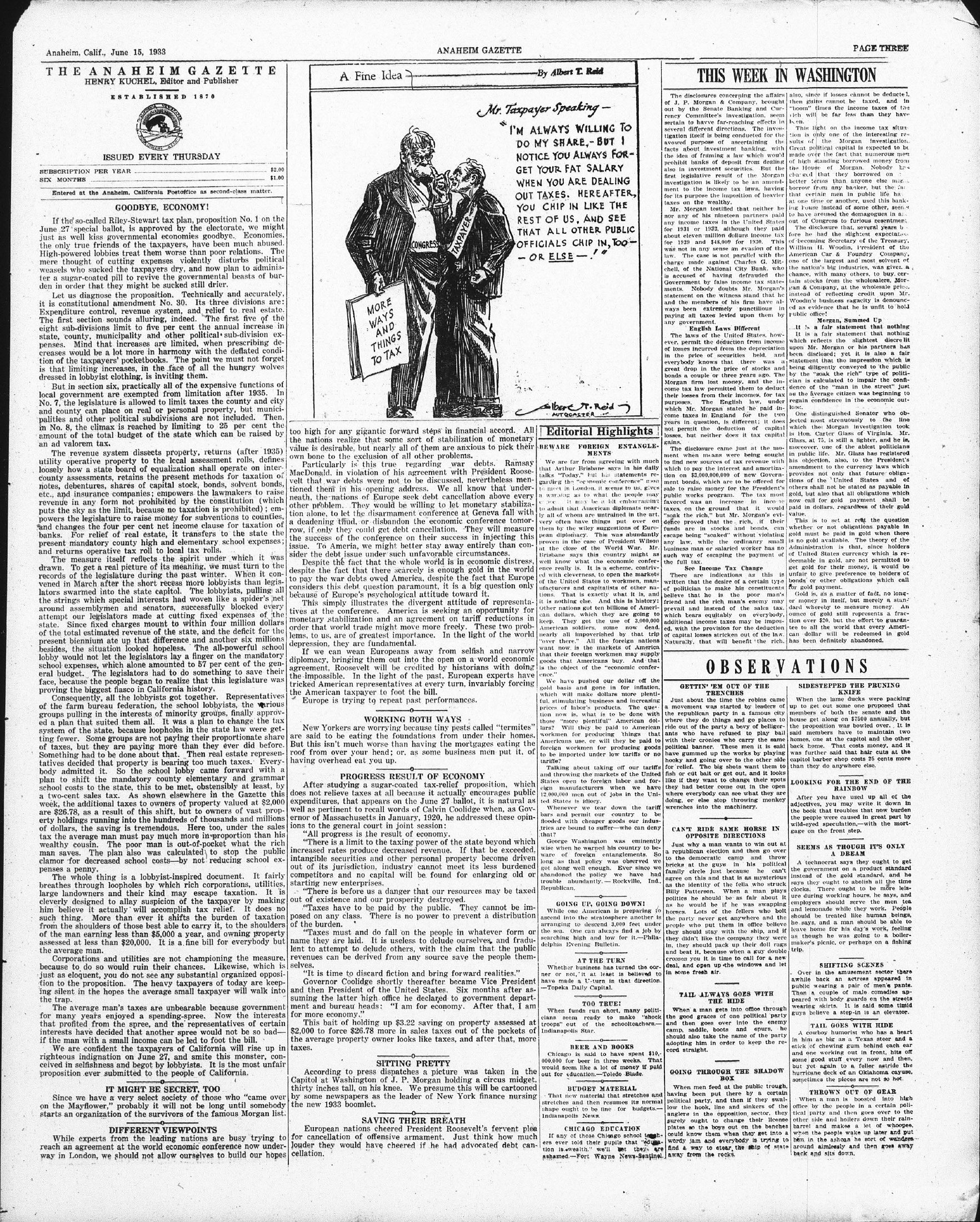
A Fine Idea — By Albert T. Reid
Mr. Taxpayer Speaking —
"I'm always willing to do my share, but I notice you always forget your fat salary when you are dealing out taxes. Hereafter, you chip in like the rest of us, and see that all other public officials chip in, too—or else—!"
Albert T. Reid
Autographer
Editorial Highlights
BEWARE FOREIGN ENTANGLEMENTS
too high for any gigantic forward steps in financial accord. All the nations realize that some sort of stabilization of monetary value is desirable, but nearly all of them are anxious to pick their own bone to the exclusion of all other problems.
Particularly is this true regarding war debts. Ramsay MacDonald, in violation of his agreement with President Roosevelt that war debts were not to be discussed, nevertheless mentioned them in his opening address. We all know that underneath, the nations of Europe seek debt cancellation above every other problem. They would be willing to let monetary stabilization alone, to let the disarmament conference at Geneva fall with a deadening thud, or disbandon the economic conference tomorrow, if only they could get debt cancellation. They will measure the success of the conference on their success in injecting this issue. To America, we might better stay away entirely than consider the debt issue under such unfavorable circumstances.
Despite the fact that the whole world is in economic distress, despite the fact that there scarcely is enough gold in the world to pay the war debts owed America, despite the fact that Europe considers this debt question paramount, it is a big question only because of Europe's psychological attitude toward it.
This simply illustrates the divergent attitude of representatives at the conference. America is seeking an opportunity for monetary stabilization and an agreement on tariff reductions in order that world trade might move more freely. These two problems, to us, are of greatest importance. In the light of the world depression, they are fundamental.
If we can wean Europeans away from selfish and narrow diplomacy, bringing them out into the open on a world economic agreement, Roosevelt will be credited by historians with doing the impossible. In the light of the past, European experts have tricked American representatives at every turn, invariably forcing the American taxpayer to foot the bill.
Europe is trying to repeat past performances.
WORKING BOTH WAYS
New Yorkers are worrying because tiny pests called "termites" are said to be eating the foundations from under their homes. But this isn't much worse than having the mortgages eating the roof from over your head; or, as some business men put it, of having overhead eat you up.
PROGRESS RESULT OF ECONOMY
After studying a sugar-coated tax-relief proposition, which does not relieve taxes at all because it actually encourages public expenditures, that appears on the June 27 ballot, it is natural as well as pertinent to recall words of Calvin Coolidge when, as Governor of Massachusetts in January, 1920, he addressed these opinions to the general court in joint session:
"All progress is the result of economy.
There is a limit to the taxing power of the state beyond which increased rates produce decreased revenue. If that be exceeded, intangible securities and other personal property become driven
Editorial Highlights
BEWARE FOREIGN ENTANGLEMENTS
We are far from agreeing with much that Arthur Brisbane says in his daily talks "Today," but his statements regarding the "economic conference" soon meet in London. It seems to us, gives a warning as to what the people may expect. It may be a bit embarrassing: to admit that American diplomats nearly all of whom are untrained in the art, very often have things put over on them by the wiley suggestions of European diplomacy. This was abundantly proven in the case of President Wilson at the close of the World War. Mr. Brisbane says this country might as well know what the economic conference really is. It is a scheme, contrived with cleverness, to open the markets of the United States to workmen, manufacturers and capitalists of other nations. That is exactly what it is, and it is nothing else. And this is history: Other nations got ten billions of American dollars, which they are going to keep. They got the use of 3,000,000 American soldiers, some now dead, nearly all impoverished by that trip "over there." All the foreign nations want now is the markets of America that their foreign workmen may supply goods that Americans buy. And that is the object of the "economic conference."
We have pushed our dollar off the gold basis and gone in for inflation, which will make dollars more plentiful, stimulating business and increasing prices of labor's products. The question now is, what is to be done with those "more plentiful" American dollars? Will they be paid to American workmen for producing things that Americans use, or will they be paid to foreign workmen for producing goods to be imported under low tariffs or no tariffs?
Talking about taking off our tariffs and throwing the markets of the United States open to foreign labor and foreign manufacturers when we have 12,000,000 men out of jobs in the United States is idiocy.
Whenever we tear down the tariff bars and permit our country to be flooded with cheaper goods our industries are bound to suffer—who can deny that?
George Washington was eminently wise when he warned his country to bear off foreign entanglements. So long as that policy was observed we
PROGRESS RESULT OF ECONOMY
After studying a sugar-coated tax-relief proposition, which does not relieve taxes at all because it actually encourages public expenditures, that appears on the June 27 ballot, it is natural as well as pertinent to recall words of Calvin Coolidge when, as Governor of Massachusetts in January, 1920, he addressed these opinions to the general court in joint session:
"All progress is the result of economy.
There is a limit to the taxing power of the state beyond which increased rates produce decreased revenue. If that be exceeded, intangible securities and other personal property become driven out of its jurisdiction, industry cannot meet its less burdened competitors and no capital will be found for enlarging old or starting new enterprises.
There is before us a danger that our resources may be taxed out of existence and our prosperity destroyed.
Taxes have to be paid by the public. They cannot be imposed on any class. There is no power to prevent a distribution of the burden.
Taxes must and do fall on the people in whatever form or name they are laid. It is useless to delude ourselves, and fradulent to attempt to delude others, with the claim that the public revenues can be derived from any source save the people themselves.
"It is time to discard fiction and bring forward realities."
Governor Coolidge shortly thereafter became Vice President and then President of the United States. Six months after assuming the latter high office he declared to government department and bureau heads: "I am for economy. After that, I am for more economy."
This bait of holding up $3.22 saving on property assessed at $2,000 to force $26.78 more in sales taxes out of the pockets of the average property owner looks like taxes, and after that, more taxes.
SITTING PRETTY
According to press dispatches a picture was taken in the Capitol at Washington of J. P. Morgan holding a circus midget, thirty inches tall, on his knee. We presume this will be cartooned by some newspapers as the leader of New York finance nursing the new 1933 boomlet.
SAVING THEIR BREATH
European nations cheered President Roosevelt's fervent plea for cancellation of offensive armament. Just think how much louder they would have cheered if he had advocated debt cancellation.
THIS WEEK IN WASHINGTON
The disclosures concerning the affairs of J. P. Morgan & Company, brought out by the Senate Banking and Currency Committee's investigation, seem sertain to have far-reaching effects in several different directions. The investigation itself is being conducted for the avowed purpose of ascertaining the facts about investment banking, with the idea of framing a law which would prohibit banks of deposit from dealing also in investment securities. But the first legislative result of the Morgan investigation is likely to be an amendment to the income tax laws, having for its purpose the imposition of heavier taxes on the wealthy.
Mr. Morgan testified that neither he nor any of his nineteen partners paid any income taxes in the United States for 1931 or 1932, although they paid about eleven million dollars income tax for 1929 and $48,000 for 1930. This was not in any sense an evasion of the law. The case is not parallel with the charge made against Charles G. Mitchell, of the National City Bank, who is accused of having defrauded the Government by false income tax statements. Nobody doubts Mr. Morgan's statement on the witness stand that he and the members of his firm have always been extremely punctilious in paying all taxes levied upon them by any government.
English Laws Different
The laws of the United States, however, permit the deduction from income of losses incurred from the depreciation in the price of securities held, and everybody knows that there was a great drop in the price of stocks and bonds a couple or three years ago. The Morgan firm lost money, and the income tax law permitted them to deduct their losses from their incomes, for tax purposes. The English law, under which Mr. Morgan stated he paid income taxes in England for the two years in question, is different; it does not permit the deduction of capital losses, but neither does it tax capital gains.
The disclosure came just at the moment when means were being sought also, since if losses cannot be deducted, then gains cannot be taxed, and in "boom" times the income taxes of the rich will be far less than they have been.
This light on the income tax situation is only one of the interesting results of the Morgan investigation. Great political capital is expected to be made over the fact that numerous men of high standing borrowed money from the House of Morgan. Nobody has charged that they borrowed on better terms than anyone else might borrow from any banker, but the fact that certain men in public life had at one time or another, used this banking house instead of some other, seems to have aroused the demagogues in all out of Congress to furious resentment.
The disclosure that, several years before he had the slightest expectation of becoming Secretary of the Treasury, William H. Woodin, President of the American Car & Foundry Company, one of the largest and most solvent of the nation's big industries, was given a chance, with many others, to buy certain stocks from the wholesalers, Morgan & Company, at the wholesale price instead of reflecting credit upon Mr. Woodin's business sagacity is denounced as evidence that he is unfit to hold public office!
Morgan, Summed Up
It is a fair statement that nothing it is a fair statement that nothing which reflects the slightest discrepancy upon Mr. Morgan or his partners has been disclosed; yet it is also a fair statement that the impression which is being diligently conveyed to the public by the "soak the rich" type of politician is calculated to impair the confidence of the "man in the street" just as the average citizen was beginning to regain confidence in the economic outlook.
One distinguished Senator who objected most strenuously to the line which the Morgan investigation took is Hon. Carter Glass of Virginia, Mr. Glass, at 75, is still a fighter, and he is moreover, one of the ablest politicians in public life. Mr. Glass has registered
ENTANGLEing with much
days in his daily
statements reconference" soon
comes to us, gives
the people may
at embarrassing
diplomats nearlined in the art.
put over on
questions of Eurowas abundantly
president Wilson
World War. Mr.
entry might as
economic conferscheme, contriven the markets
workmen, manners of other nawhat it is, and
this is history:
millions of Ameriy are going to
house of 3,000,000
now dead,
by that trip
foreign nations
sets of America
when may supply
buy. And that
economic conferscheme, contriven the markets
workmen, manners of other nawhat it is, and
this is history:
millions of Ameriy are going to
house of 3,000,000
now dead,
by that trip
foreign nations
sets of America
when may supply
buy. And that
economic conferscheme, contriv-
everybody knows that there was a great drop in the price of stocks and bonds a couple or three years ago. The Morgan firm lost money, and the income tax law permitted them to deduct their losses from their incomes, for tax purposes. The English law, under which Mr. Morgan stated he paid income taxes in England for the two years in question, is different; it does not permit the deduction of capital losses, but neither does it tax capital gains.
The disclosure came just at the moment when means were being sought to find new sources of tax revenue with which to pay the interest and amortization on $3,000,000,000 of new Government bonds, which are to be offered for sale to raise money for the President's public works program. The tax most favored was an increase in income taxes, on the ground that it would "soak the rich," but Mr. Morgan's evidence proved that the rich, if their funds are in stocks and bonds, can escape being "soaked" without violating any law, while the ordinarily small business man or salaried worker has no such way of escaping the payment of the full tax.
See Income Tax Change
There are indications as this is written that the desire of a certain type of politician to make his constituents believe that he is the poor man's friend and the rich man's enemy may prevail and instead of the sales tax, which bears equitably on everybody, additional income taxes may be imposed, with the provision for the deduction of capital losses stricken out of the law. Naturally, that will benefit the rich.
OBSERVATIONS
GETTIN' EM OUT OF THE TRENCHES
Just about the time the robins came a movement was started by leaders of the republican party in a famous city where they do things and go places to ride out of the party a bevy of belligerants who have refused to play ball with their cronies who carry the same political banner. These men it is said have gummed up the works by playing hooky and going over to the other side for relief. The big shots want them to fish or cut bait or get out, and it looks like if they want to change their spots they had better come out in the open where everybody can see what they are doing, or else stop throwing monkey wrenches into the machinery.
CANT RIDE SAME HORSE IN OPPOSITE DIRECTIONS
Just why a man wants to win out at a republican election and then go over to the democratic camp and throw himself in his political statement that the impression which is being diligently conveyed to the public by the "soak the rich" type of politician is calculated to impair the confidence of the "man in the street" just as the average citizen was beginning to regain confidence in the economic outlook.
One distinguished Senator who objected most strenuously to the line which the Morgan investigation took is Hon. Carter Glass of Virginia. Mr. Glass, at 75, is still a fighter, and he is moreover one of the ablest politicians in public life. Mr. Glass has registered his objection, also, to the President's amendment to the currency laws which provides not only that future obligations of the United States and of others shall not be stated as payable in gold, but also that all obligations which now call for gold payment shall be paid in dollars, regardless of their gold value.
This is to set at rest the question whether or not obligations payable in gold must be paid in gold when there is no gold available. The theory of the Administration is that, since holders of United States currency which is redeemable in gold, are not permitted to get gold for their money, it would be unfair to give preference to holders of bonds or other obligations which call for gold payment.
Gold is, as a matter of fact, no longer money in itself, but merely a standard whereby to measure money. An ounce of gold still represents a fraction over $20, but the effort to guarantee to all the world that every American dollar will be redeemed in gold has been definitely abandoned.
LOOKING FOR THE END OF THE RAINBOW
After you have used up all of the adjectives, you may write it down in the book that troubles that now burden the people were caused in great part by wild-eyed speculation—with the mortgage on the front step.
SEEMS AS THOUGH IT'S ONLY A DREAM
A technocrat says they ought to get
CANT RIDE SAME HORSE IN OPPOSITE DIRECTIONS
Just why a man wants to win out at a republican election and then go over to the democratic camp and throw bricks at the guys in his political family circle just because he can't agree on this and that is as mysterious as the identity of the fella who struck Billy Patterson. When a man plays politics he should be as fair about it as he would be if he was swapping horses. Lots of the fellers who bolt the party never get anywhere and the people who put them in office believe they should stay with the ship, and if they didn't like the company they were in, they should pack up their doll rags and beat it, because when a guy double crosses you it is time to call for a new deal, and open up the windows and let in some fresh air.
TAIL ALWAYS GOES WITH THE HIDE
When a man gets into office through the good graces of one political party and then goes over into the enemy camp, saddle, boots and spurs, he should also take the name of the party adopting him in order to keep the record straight.
GOING THROUGH THE SHADOW BOX
When men feed at the public trough, having been put there by a certain political party, and then if they swallow the hook, line and sinkers of the anglers in the opposition sector, they surely ought to change their license plates so the boys out on the benches could know them when they get into a wordy jam and everybody is trying to find a way to stear the ship of state away from the rocks.
LOOKING FOR THE END OF THE RAINBOW
After you have used up all of the adjectives, you may write it down in the book that troubles that now burden the people were caused in great part by wild-eyed speculation,—with the mortgage on the front step.
SEEMS AS THOUGH IT'S ONLY A DREAM
A technocrat says they ought to get the government on a product standard instead of the gold standard, and he says they ought to abolish all the time clocks. There ought to be more leisure during working hours, he says, and employers should serve the men tea and lemonade while they work. People should be treated like human beings, he says, and a man should be able to leave home for his day's work, feeling as though he was going to a boller-maker's picnic, or perhaps on a fishing trip.
SHIFTING SCENES
Over in the amusement sector there awhile back an actress appeared in public wearing a pair of men's pants. Then a couple of male comedies appeared with body guards on the streets wearing skirts. It is said some timid guys believe a step-in is an elevator.
TAIL GOES WITH HIDE
A cowboy humorist who has a heart in him as big as a Texas steer and a stick of chewing gum behind each ear and one working out in front, hits off some good stuff every now and then, but yet again to a feller astride the hurricane deck of an Oklahoma cayuse, sometimes the pieces are not so hot.
THROWN OUT OF GEAR
When a man is boosted into high office by the people in a certain political party and then goes over to the other side and hollers down their rain-barrel and makes a lot of whoopee, when the people wake up later and put him in the ashcan he sort of wanders around aimlessly and then goes away back and sits down.