anaheim-gazette 1933-06-15
Scanned page
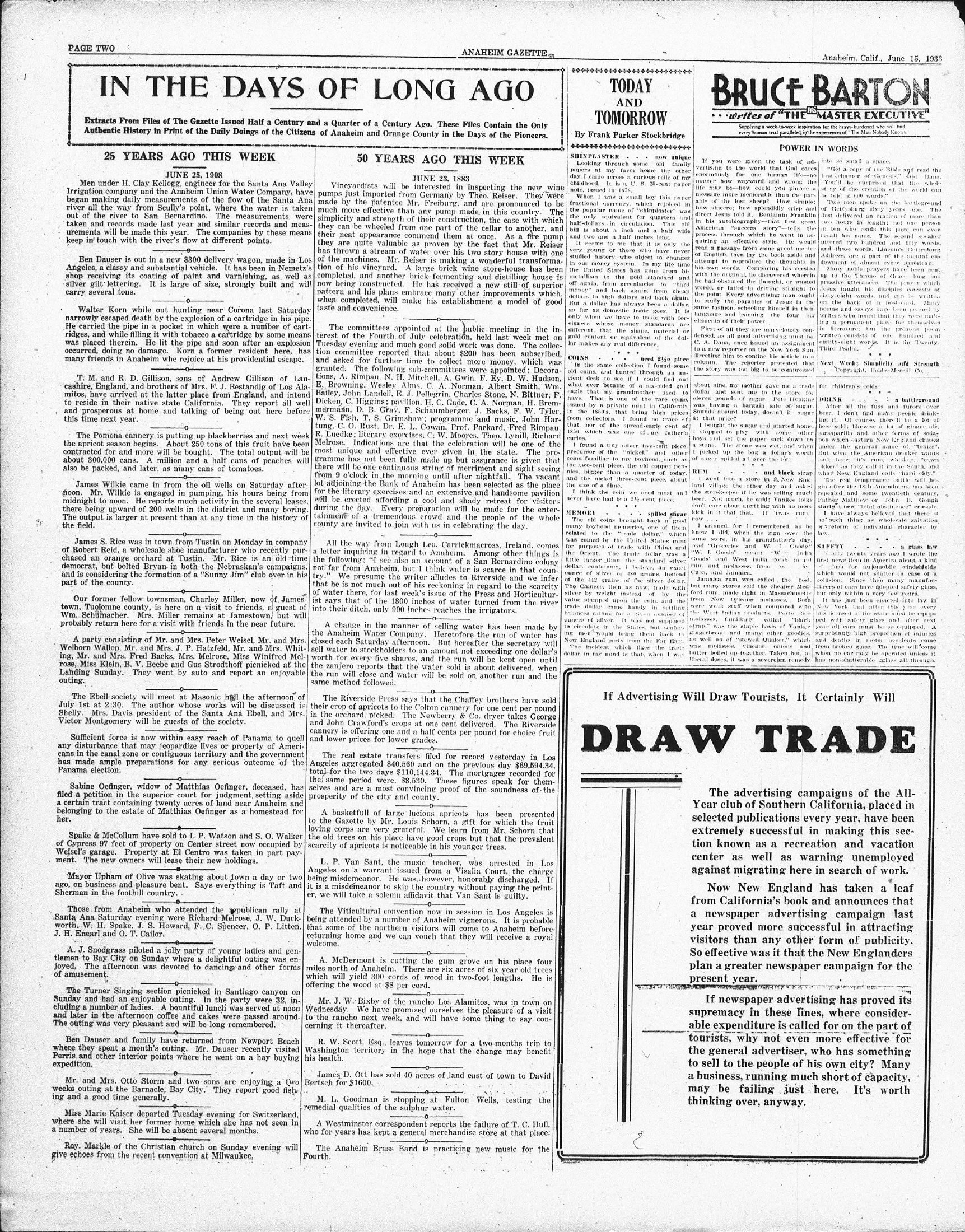
Searchable text
IN THE DAYS OF
Extracts From Files of The Gazette Issued Half a Century and a Quarterly Authentic History in Print of the Daily Doings of the Citizens of Anaheim
25 YEARS AGO THIS WEEK
JUNE 25, 1908
Men under H. Clay Kellogg, engineer for the Santa Ana Valley Irrigation company and the Anaheim Union Water Company, have began making daily measurements of the flow of the Santa Ana river all the way from Scully's point, where the water is taken out of the river to San Bernardino. The measurements were taken and records made last year and similar records and measurements will be made this year. The companies by these means keep in touch with the river's flow at different points.
Ben Dauser is out in a new $300 delivery wagon, made in Los Angeles, a classy and substantial vehicle. It has been in Nemetz's shop receiving its coating of paint and varnishing, as well as silver gilt lettering. It is large of size, strongly built and will carry several tons.
Walter Korn while out hunting near Corona last Saturday narrowly escaped death by the explosion of a cartridge in his pipe. He carried the pipe in a pocket in which were a number of cartridges, and while filling it with tobacco a cartridge by some means was placed therein. He lit the pipe and soon after an explosion occurred, doing no damage. Korn a former resident here, has many friends in Anaheim who rejoice at his providential escape.
T. M. and R. D. Gillison, sons of Andrew Gillison of Lancashire, England, and brothers of Mrs. F. J. Bestandig of Los Alamitos, have arrived at the latter place from England, and intend to reside in their native state California. They report all well and prosperous at home and talking of being out here before this time next year.
The Pomona cannery is putting up blackberries and next week the apricot season begins. About 250 tons of this fruit have been contracted for and more will be bought. The total output will be about 300,000 tons.
T. M. and R. D. Gillison, sons of Andrew Gillison of Lancashire, England, and brothers of Mrs. F. J. Bestandig of Los Alamitos, have arrived at the latter place from England, and intend to reside in their native state California. They report all well and prosperous at home and talking of being out here before this time next year.
The Pomona cannery is putting up blackberries and next week the apricot season begins. About 250 tons of this fruit have been contracted for and more will be bought. The total output will be about 300,000 cans. A million and a half cans of peaches will also be packed, and later, as many cans of tomatoes.
James Wilkie came in from the oil wells on Saturday afternoon. Mr. Wilkie is engaged in pumping, his hours being from midnight to noon. He reports much activity in the several leases, there being upward of 200 wells in the district and many boring. The output is larger at present than at any time in the history of the field.
James S. Rice was in town from Tustin on Monday in company of Robert Reid, a wholesale shoe manufacturer who recently purchased an orange orchard at Tustin. Mr. Rice is an old time democrat, but bolted Bryan in both the Nebraskan’s campaigns, and is considering the formation of a “Sunny Jim” club over in his part of the county.
Our former fellow townsman, Charley Miller, now of Jamestown, Tuolomne county, is here on a visit to friends, a guest of Wm. Schumacher. Mrs. Miller remains at Jamestown, but will probably return here for a visit with friends in the near future.
A party consisting of Mr. and Mrs. Peter Weisel, Mr. and Mrs. Welborn Wallop, Mr. and Mrs. J. P. Hatzfeld, Mr. and Mrs. Whiting, Mr. and Mrs. Fred Backs, Mrs. Melrose, Miss Winifred Melrose, Miss Klein, B. V. Beebe and Gus Strodthoff picnicked at the Landing Sunday. They went by auto and report an enjoyable outing.
The Ebell society will meet at Masonic hall the afternoon of July 1st at 2:30. The author whose works will be discussed is Shelly. Mrs. Davis president of the Santa Ana Ebell, and Mrs. Victor Montgomery will be guests of the society.
Sufficient force is now within easy reach of Panama to quell any disturbance that may jeopardize lives or property of Americans in the canal zone or contiguous territory and the government has made ample preparations for any serious outcome of the Panama election.
Sabine Oefinger, widow of Matthias Oefinger, deceased, has filed a petition in the superior court for judgment setting aside a certain tract containing twenty acres of land near Anaheim and belonging to the estate of Matthias Oefinger as a homestead for her.
Spake & McCollum have sold to I. P. Watson and S. O. Walker of Cypress 97 feet of property on Center street now occupied by Weisel’s garage. Property at El Centro was taken in part payment. The new owners will lease their new holdings.
Sabine Oefinger, widow of Matthias Oefinger, deceased, has filed a petition in the superior court for judgment setting aside a certain tract containing twenty acres of land near Anaheim and belonging to the estate of Matthias Oefinger as a homestead for her.
Spake & McCollum have sold to I. P. Watson and S. O. Walker of Cypress 97 feet of property on Center street now occupied by Weisel's garage. Property at El Centro was taken in part payment. The new owners will lease their new holdings.
Mayor Upham of Olive was skating about town a day or two ago, on business and pleasure bent. Says everything is Taft and Sherman in the foothill country.
Those from Anaheim who attended the Republican rally at Santa Ana Saturday evening were Richard Melrose, J. W. Duckworth, W. H. Spake, J. S. Howard, F. C. Spencer, O. P. Litten, J. H. Enearl and O. T. Cailor.
A. J. Snodgrass piloted a jolly party of young ladies and gentlemen to Bay City on Sunday where a delightful outing was enjoyed. The afternoon was devoted to dancing and other forms of amusement.
The Turner Singing section picnicked in Santiago canyon on Sunday and had an enjoyable outing. In the party were 32, including a number of ladies. A bountiful lunch was served at noon and later in the afternoon coffee and cakes were passed around. The outing was very pleasant and will be long remembered.
Ben Dauser and family have returned from Newport Beach where they spent a month's outing. Mr. Dauser recently visited Perris and other interior points where he went on a hay buying expedition.
Mr. and Mrs. Otto Storm and two sons are enjoying a two weeks outing at the Barnacle, Bay City. They report good fishing and a good time generally.
Miss Marie Kaiser departed Tuesday evening for Switzerland, where she will visit her former home which she has not seen in a number of years. She will be absent several months.
Rey Markle of the Christian church on Sunday evening will give echoes from the recent convention at Milwaukee.
50 YEARS AGO THIS WEEK
JUNE 23, 1883
Vineyardists will be interested in inspecting the new wine pumps just imported from Germany by Theo. Reiser. They were made by the patentee Mr. Freiburg, and are pronounced to be much more effective than any pump made in this country. The simplicity and strength of their construction, the ease with which they can be wheeled from one part of the cellar to another, and their neat appearance commend them at once. As a fire pump they are quite valuable as proven by the fact that Mr. Reiser has thrown a stream of water over his two story house with one of the machines. Mr. Reiser is making a wonderful transformation of his vineyard. A large brick wine store-house has been completed, and another brick fermenting and distilling house is now being constructed. He has received a new still of superior pattern and his plans embrace many other improvements which, when completed, will make his establishment a model of good taste and convenience.
The committees appointed at the public meeting in the interest of the Fourth of July celebration, held last week met on Tuesday evening and much good solid work was done. The collection committee reported that about $200 has been subscribed, and asked for further time to collect more money, which was granted. The following sub-committees were appointed: Decorations, A. Rimpau, N. H. Mitchell, A. Gwin, F. Ey, D. W. Hudson, E. Browning, Wesley Alms, C. A. Norman, Albert Smith, Wm. Bailey, John Landell, E. J. Pellegrin, Charles Stone, N. Bittner, F. Dicken, C. Higgins; pavilion, H. C. Gade, C. A. Norman, H. Bremermann, D. B. Gray, F. Schaumberger, J. Backs, F. W. Tyler, W. S. Fish, T. S. Grimshaw; programme and music, John Hartung, C. O. Rust, Dr. E. L. Cowan, Prof. Packard, Fred Rimpau, R. Luedke; literary exercises, C. W. Moores, Theo. Lynill, Richard Melrose.
Indications are that the celebration will be one of the most unique and effective ever given in the state. The programme has not been fully made up but assurance is given that
The following sub-committees were appointed: Decorations, A. Rimpau, N. H. Mitchell, A. Gwin, F. Ey, D. W. Hudson, E. Browning, Wesley Alms, C. A. Norman, Albert Smith, Wm. Bailey, John Landell, E. J. Pellegrin, Charles Stone, N. Bittner, F. Dicken, C. Higgins; pavilion, H. C. Gade, C. A. Norman, H. Bremmermann, D. B. Gray, F. Schaumberger, J. Backs, F. W. Tyler, W. S. Fish, T. S. Grimshaw; programme and music, John Hartung, C. O. Rust, Dr. E. L. Cowan, Prof. Packard, Fred Rimpau, R. Luedke; literary exercises, C. W. Moores, Theo. Lynill, Richard Melrose.
Indications are that the celebration will be one of the most unique and effective ever given in the state. The programme has not been fully made up but assurance is given that there will be one continuous string of merriment and sight seeing from 9 o'clock in the morning until after nightfall. The vacant lot adjoining the Bank of Anaheim has been selected as the place for the literary exercises and an extensive and handsome pavilion will be erected affording a cool and shady retreat for visitors during the day. Every preparation will be made for the entertainment of a tremendous crowd and the people of the whole county are invited to join with us in celebrating the day.
All the way from Lough Lea, Carrickmacross, Ireland, comes a letter inquiring in regard to Anaheim. Among other things is the following: "I see also an account of a San Bernardino colony not far from Anaheim, but I think water is scarce in that country." We presume the writer alludes to Riverside and we infer that he is not much out of his reckoning in regard to the scarcity of water there, for last week's issue of the Press and Horticulturist says that of the 1800 inches of water turned from the river into their ditch, only 900 inches reaches the irrigators.
A change in the manner of selling water has been made by the Anaheim Water Company. Heretofore the run of water has closed each Saturday afternoon. But hereafter the secretary will sell water to stockholders to an amount not exceeding one dollar's worth for every five shares, and the run will be kept open until the zanjero reports that the water sold is about delivered, when the run will close and water will be sold on another run and the same method followed.
The Riverside Press says that the Chaffey brothers have sold their crop of apricots to the Colton cannery for one cent per pound in the orchard, picked: The Newberry & Co. dryer takes George and John Crawford's crops at one cent delivered. The Riverside cannery is offering one and a half cents per pound for choice fruit and lower prices for lower grades.
The real estate transfers filed for record yesterday in Los Angeles aggregated $40,560 and on the previous day $69,594.34, total for the two days $110,144.34. The mortgages recorded for the same period were, $8,530. These figures speak for themselves and are a most convincing proof of the soundness of the prosperity of the city and county.
A basketfull of large lucious apricots has been presented to the Gazette by Mr. Louis Schorn, a gift for which the fruit loving corps are very grateful. We learn from Mr. Schorn that the old trees on his place have good crops but that the prevalent scarcity of apricots is noticeable in his younger trees.
L. P. Van Sant, the music teacher, was arrested in Los Angeles on a warrant issued from a Vigelia Court, the change...
A basketfull of large lucious apricots has been presented to the Gazette by Mr. Louis Schorn, a gift for which the fruit loving corps are very grateful. We learn from Mr. Schorn that the old trees on his place have good crops but that the prevalent scarcity of apricots is noticeable in his younger trees.
L. P. Van Sant, the music teacher, was arrested in Los Angeles on a warrant issued from a Visalia Court, the charge being misdemeanor. He was, however, honorably discharged. If it is a misdemeanor to skip the country without paying the printer, we will take a solemn affidavit that Van Sant is guilty.
The Viticultural convention now in session in Los Angeles is being attended by a number of Anaheim vignerons. It is probable that some of the northern visitors will come to Anaheim before returning home and we can vouch that they will receive a royal welcome.
A. McDermont is cutting the gum grove on his place four miles north of Anaheim. There are six acres of six year old trees which will yield 300 cords of wood in two-foot lengths. He is offering the wood at $8 per cord.
Mr. J. W. Bixby of the rancho Los Alamitos, was in town on Wednesday. We have promised ourselves the pleasure of a visit to the rancho next week, and will have some thing to say concerning it thereafter.
R. W. Scott, Esq., leaves tomorrow for a two-months trip to Washington territory in the hope that the change may benefit his health.
James D. Ott has sold 40 acres of land east of town to David Bertsch for $1600.
M. L. Goodman is stopping at Fulton Wells, testing the remedial qualities of the sulphur water.
A Westminster correspondent reports the failure of T. C. Hull, who for years has kept a general merchandise store at that place.
The Anaheim Brass Band is practicing new music for the Fourth.
TODAY AND TOMORROW
Bark Parker Stockbridge
BRUCE BARTON
writes of "THE MASTER EXECUTIVE"
Supplying a week-to-week inspiration for the heavy-burdened who will fund every human trial paralleled by the experiences of "The Man Nobody Knows"
POWER IN WORDS
If you were given the task of advertising to the world that God cares enormously for one human life—no matter how wayward and wrong the life may be—how could you phrase a message more memorable than the parable of the lost sheep? How simple; how sincere; how splendidly crisp and direct Jesus told it. Benjamin Franklin in his autobiography—that first great American "success story"—tells the process through which he went in acquiring an effective style. He would read a passage from some great master of English, then lay the book aside and attempt to reproduce the thoughts in his own words. Comparing his version with the original, he discovered wherein he had obscured the thought, or wasted words, or failed in driving straight to the point. Every advertising man ought to study the parables of Jesus in the same fashion, schooling himself in their language and learning the four big elements of their power.
First of all they are marvelously condensed, as all good advertising must be. C. A. Dana, once issued an assignment to a new reporter on the New York Sun, directing him to confine his article to a column. The reporter protested that the story was too big to be compressed about nine, my mother gave me a trade dollar and sent me to the store for eleven pounds of sugar. Pete Hopkins was having a bargain sale of sugar. Sounds absurd today, doesn't it—sugar at that price?
I bought the sugar and started home. I stopped to play with some other boys and set the paper sack down on a stone. The stone was wet, and when I picked up the bag a dollar's worth of sugar spilled all over the lot.
into so small a space.
"Get a copy of the Bible and read the first chapter of Genesis," said Dana. "You'll be surprised that the whole story of the creation of the world can be told in 600 words."
Two men spoke on the battleground of Gettyburg sixty years ago. The first delivered an oration of more than two hours in length; not one person in ten who reads this page can even recall his name. The second speaker uttered two hundred and fifty words, and those words, Lincoln's Gettyburg Address, are a part of the mental endowment of almost every American.
Many noble prayers have been sent up to the Throne of Grace long impressive utterances. The prayer which Jesus taught his disciples consists of sixty-eight words, and can be written on the back of a post-card. Many poems and essays have been peaned by writers who hoped that they were making a permanent place for themselves in literature; but the greatest poem written consists of one hundred and eighty-eight words. It is the Twenty-Third Psalm.
Next Week: Simplicity and Strength
Copyright, Bobbs-Merrill Co.
about nine, my mother gave me a trade dollar and sent me to the store for eleven pounds of sugar. Pete Hopkins was having a bargain sale of sugar. Sounds absurd today, doesn't it—sugar at that price?
I bought the sugar and started home. I stopped to play with some other boys and set the paper sack down on a stone. The stone was wet, and when I picked up the bag a dollar's worth of sugar spilled all over the lot!
RUM and black strap
I went into a store in New England village the other day and asked the storekeeper if he was selling much beer. Not much, he said; Yankee folks don't care about anything with no more kick in it that that. If 'twas rum, now.
I grinned, for I remembered, as he knew I did, when the sign over the same store, in his grandfather's day, read "Groceries and W. L. Goods" "W. J. Goods" meant "West India Goods" and West India goods in rum and molasses, from Cuba, and Jamaica.
Jamaica rum was called the best but many stores sold the cheaper Medford rum, made right in Massachusetts from New Orleans molasses. Both were weak stuff when compared with the West Indian products. Porto Rice molasses, familiarly called "black strap," was the staple basis of Yankee gingerbread and many other goodies, as well as of "stewed Quaker," which was molasses, vinegar, onions and butter boiled up together. Taken hot, in liberal doses, it was a sovereign remedy for children's colds!
DRINK a battleground
After all the fuss and furore over beer, I don't find many people drinking it. Of course, there'll be a lot of beer sold; likewise a lot of ginger ale, sarsaparilla and other forms of soda-pop which eastern New England classes under the general name of "tonics". But what the American drinker wants isn't beer; it's rum, whiskey, "cawn likker" as they call it in the South, and what New England calls "hard cidy."
The real temperance battle will begin after the 18th Amendment has been repealed and some twentieth century Father Matthew or John B. Gough starts a new "total abstinence" crusade.
I have always believed that there is no such thing as wholesale salvation or reform of individual character by law.
SAFETY a glass law
Nearly twenty years ago I wrote the first news item in America about a kind glass for automobile windshields which would not shatter in case of a collision. Since then many manufacturers of cars have adopted safety glass, but only within a very few years.
It has just been enacted into law in New York that after this year every license in the state must be equipped with safety glass and after next year all cars must be so equipped. A surprisingly high proportion of injuries and deaths in motor accidents come from broken glass. The time will come when no car may be operated unless it has non-shatterable gglass all through.
If Advertising Will Draw Tourists, It Certainly Will
The advertising campaigns of the All-Year club of Southern California, placed in selected publications every year, have been extremely successful in making this section known as a recreation and vacation center as well as warning unemployed against migrating here in search of work.
The advertising campaigns of the All-Year club of Southern California, placed in selected publications every year, have been extremely successful in making this section known as a recreation and vacation center as well as warning unemployed against migrating here in search of work.
Now New England has taken a leaf from California’s book and announces that a newspaper advertising campaign last year proved more successful in attracting visitors than any other form of publicity. So effective was it that the New Englanders plan a greater newspaper campaign for the present year.
If newspaper advertising has proved its supremacy in these lines, where considerable expenditure is called for on the part of tourists, why not even more effective for the general advertiser, who has something to sell to the people of his own city? Many a business, running much short of capacity, may be failing just here. It’s worth thinking over, anyway.