anaheim-gazette 1933-03-23
Scanned page
Searchable text
THE ANAHEIM GAZEITE
HENRY KUCHEL, Editor and Publisher
ESTABLISHED 1870
ISSUED EVERY THURSDAY
SUBSCRIPT PER YEAR ... $2.00
SIX MONTHS ... $1.00
Entered at the Anaheim, California Postoffice as second-class matter.
WE WANT SCHOOL ECONOMIES — NOT ALIBIS
State Superintendent of Schools Vierling Kersey, Susan B. Dorsey of Los Angeles and other well known educational leaders of California recently have written articles for the Parent-Teacher association magazine. Throughout, the articles portray a sensitiveness to criticism of the schools. Almost without exception, the expositions we have had the pleasure of reading take up the sacredness of the American public school system. All of the writers interpret criticism of school expenditures as criticism of public schools.
Page after page of the magazine is devoted to repetition of the ideal of free education. The cry is raised that if we shut down free education, turning thousands of young children upon the street for want of something to do, we would ruin America.
Certainly we would. We agree with everything each and every one of the writers says about the ideals of free education as it applies to America’s school children. We agree that if we closed the schools for one day, or even one hour a week for economy’s sake, we would be making a big mistake.
There is no argument about the principle of free schooling.
As far as argument and logic go, those writers are wasting their breath. Back of these articles on education is a motive. Their aim is to divert the attention of the citizens of California, by the use of idealistic platitudes, from the objective of economies in schools, with increased efficiency from our educational system.
Certainly we would. We agree with everything each and every one of the writers says about the ideals of free education as it applies to America's school children. We agree that if we closed the schools for one day, or even one hour a week for economy's sake, we would be making a big mistake.
There is no argument about the principle of free schooling.
As far as argument and logic go, those writers are wasting their breath. Back of these articles on education is a motive. Their aim is to divert the attention of the citizens of California, by the use of idealistic platitudes, from the objective of economies in schools, with increased efficiency from our educational system.
The objection of the organized teacher group is understandable. It is based upon the theory that if less money is paid into our school funds, less money will be paid to school teachers. Insofar as the 1,600 one-teacher schools of California could be consolidated with larger units in order to provide increased efficiency, the teachers' contention is right. Why hire 1,000 teachers just to pay them a salary, when by consolidating schools we could eliminate the heavy overhead of a room, teaching equipment, heating and janitor service, and a thousand other economies? Why should not each teacher have a full class, and put in a full day?
The best part of the program is that the children in consolidated schools would get a better education than in the present one-teacher schools. Economies are secondary, in this instance.
Another pertinent suggestion to better our school system is to consolidate small school districts into larger districts, possibly following the general program of the high school districts of the state, of which there are 295. There now are 3,533 school districts in California, with authority so divided that it is next to impossible to allocate responsibility, to know who is responsible for the good things that appear, to know whom to blame for mistakes that are made. Responsible school authorities should be given authority to make improvements in efficiency and economy where they are required—this can be done in larger districts, where responsibility and authority are made co-equal.
Is attacking the frozen traditions of small school districts, where inefficiency is promoted and such restrictions placed upon initiative that progress is stifled, attacking the principle of free education? For the sake of our school children and education, let us remove the biggest barrier to educational efficiency and progress, and create larger school districts.
Introduced at Scramento now by the California state chamber of commerce is a bill to standardize school accounting. The purpose of the measure is to prevent juggling of charges to make them appear what they are not. When we have made certain funds available for a specific purpose, they could be used for that and no other, and in no greater amount than budgeted.
Is that attacking the principle of free education?
Another big reason why larger school district, (if not on the county unit basis then on the high school district basis), would be advantageous is because in larger units the great variation between taxable wealth tends to disappear. Under our present district system, which was expedient 100 years ago but now nearly that far out of date, one district may be wealthy, and a neighboring one so poor that a rate imposed upon the first would not begin to raise enough for the needs of the second. This difference, while it could not be wiped out by the one plan of larger districts, certainly would be lessened.
Is that attacking the principle of free education?
Another big reason why larger school district, (if not on the county unit basis then on the high school dictrict basis), would be advantageous is because in larger units the great variation between taxable wealth tends to disappear. Under our present district system, which was expedient 100 years ago but now nearly that far out of date, one district may be wealthy, and a neighboring one so poor that a rate imposed upon the first would not begin to raise enough for the needs of the second. This difference, while it could not be wiped out by the one plan of larger districts, certainly would be lessened.
When we look our school system squarely in the face—and we must face facts in times of stress—we see a number of improvements which would cut down our terrific tax burden and at the same time increase the efficiency of our schools. As a matter of fact, the average citizen is getting mighty tired of having our educators attempt to justify as necessary every dollar now being spent. This continual crying about the threatened closing of schools if we question where our tax dollar goes, is nothing but a smoke-screen thrown up to divert attention from the stark truth that many millions of dollars are being wasted every year by an inefficient school system.
What we want is co-operation on the part of our educational leaders to the end that school efficiency be increased and school costs cut—and not a smoke-screen of alibis.
NEW LEADERSHIP AND A NEW ERA
Passage of the Rooseveltian economy bill, in one stroke slashing half a billion dollars from the veterans' welfare fund and federal payrolls, points to a workable form of government, in which the welfare of the whole country would receive consideration, in contrast to special concessions for special interests.
For a good many years the people have watched with complacence while congress grabbed more and more authority for running the federal government. The citizens saw congress dicker and fuss over pork barrel legislation, spending money ruthlessly for vote-getting projects, wasting precious months by petty argument. What the average citizen did not fully realize until recently, however, is that under the system of letting congressmen and senators split the spoils, the presidency more and more was being made a clerkship. As the system developed, the incredible evil of lobbying grew by leaps and bounds. Congressmen and senators found that organized minorities seemed to be the only ones watching their actions. In consequence, more and more legislation was passed in conformity with the dictates of special interests, because these selfish minorities would stir up a veritable hornet's nest in the congressman's home district unless
ANAHEIM GAZETTE
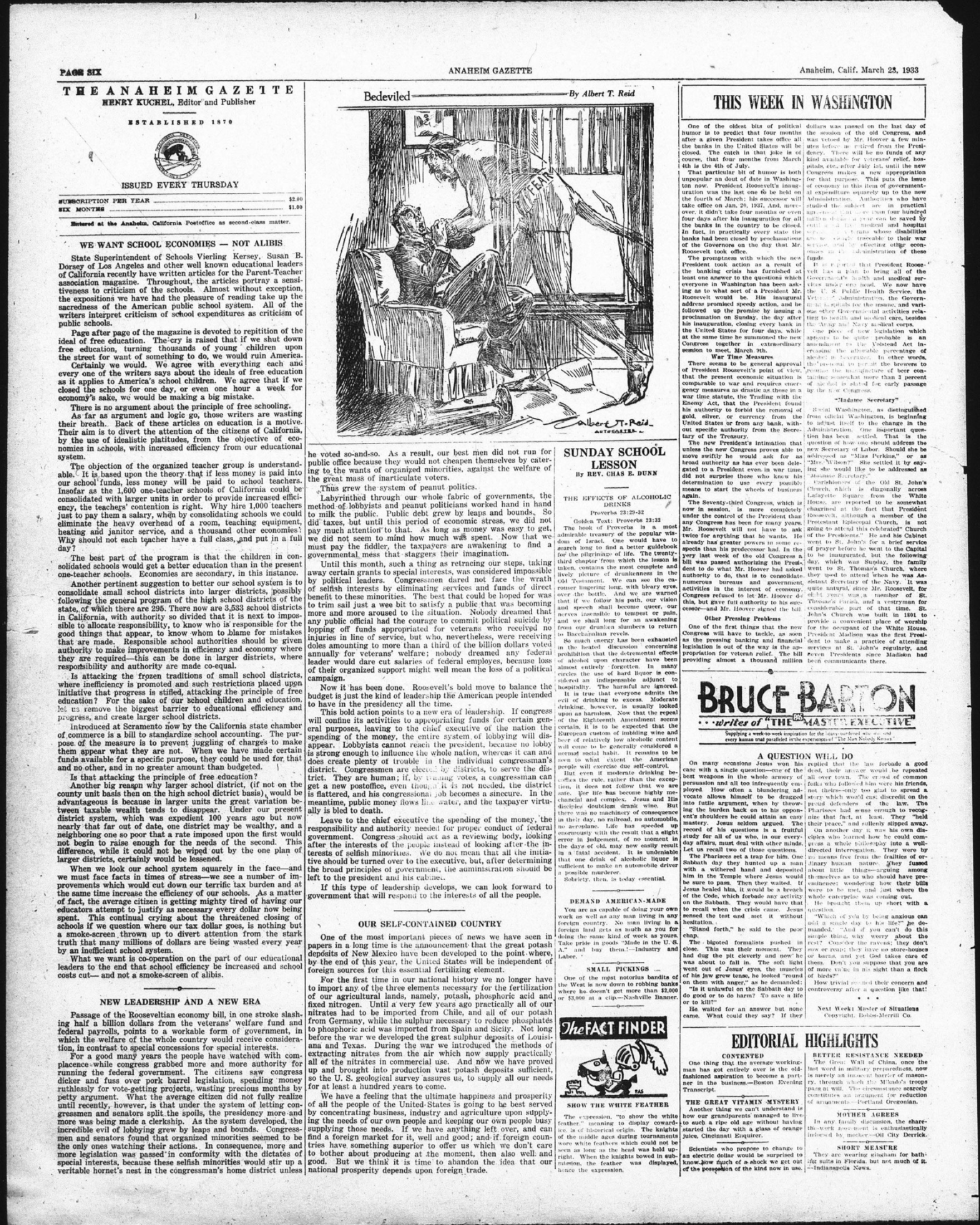
Bedeviled — By Albert T. Reid
he voted so-and-so. As a result, our best men did not run for SUNDAY SCHOOL
he voted so-and-so. As a result, our best men did not run for public office because they would not cheapen themselves by catering to the wants of organized minorities, against the welfare of the great mass of inarticulate voters.
Thus grew the system of peanut politics.
Labyrinthed through our whole fabric of governments, the method of lobbyists and peanut politicians worked hand in hand to milk the public. Public debt grew by leaps and bounds. So did taxes, but until this period of economic stress, we did not pay much attention to that. As long as money was easy to get, we did not seem to mind how much was spent. Now that we must pay the fiddler, the taxpayers are awakening to find a governmental mess that staggers their imagination.
Until this month, such a thing as retracing our steps, taking away certain grants to special interests, was considered impossible by political leaders. Congressmen dared not face the wrath of selfish interests by eliminating services and funds of direct benefit to these minorities. The best that could be hoped for was to trim sail just a wee bit to satisfy a public that was becoming more and more aroused to the situation. Nobody dreamed that any public official had the courage to commit political suicide by lopping off funds appropriated for veterans who received no injuries in line of service, but who, nevertheless, were receiving doles amounting to more than a third of the billion dollars voted annually for veterans' welfare; nobody dreamed any federal leader would dare cut salaries of federal employees, because loss of their organized support might well mean the loss of a political campaign.
Now it has been done. Roosevelt's bold move to balance the budget is just the kind of leadership the American people intended to have in the presidency all the time.
This bold action points to a new era of leadership. If congress will confine its activities to appropriating funds for certain general purposes, leaving to the chief executive of the nation the spending of the money, the entire system of lobbying will disappear. Lobbyists cannot reach the president, because no lobby is strong enough to influence the whole nation, whereas it can and does create plenty of trouble in the individual congressman's district. Congressmen are elected by districts, to serve the district. They are human; if, by training votes, a congressman can get a new postoffice, even though it is not needed, the district is flattered, and his congressional job becomes a sinecure. In the meantime, public money flows like water, and the taxpayer virtually is bled to death.
Leave to the chief executive the spending of the money, the responsibility and authority needed for proper conduct of federal government. Congress should act as a reviewing body, looking after the interests of the people instead of looking after the interests of selfish minorities. We do not mean that all the initiative should be turned over to the executive, but, after determining
SUNDAY SCHOOL LESSON
By REV. CHAS E. DUNN
THE EFFECTS OF ALCOHOLIC DRINKS
Proverbs 23:29-32
Golden Text: Proverbs 23:32
The book of Proverbs is a most admirable treasury of the popular wisdom of Israel. One would have to search long to find a better guidebook for the pilgrimage of life. The twenty-third chapter from which the lesson is taken, contains the most complete and lively picture of drunkenness in the Old Testament. We can see the carousel lingering long, with bleary eyes, over the bottle. And we are warned that if we follow his path, our vision and speech shall become queer, our nerves insensible to tempest or pain, and we shall long for an awakening from our drunken slumbers to return to Bacchanalian revels.
So much energy has been exhausted in the heated discussion concerning prohibition that the detrimental effects of alcohol upon character have been almost entirely forgotten. In many circles the use of hard liquor is considered an indispensable adjunct to hospitality. The harmful are ignored.
It is true that everyone admits the evil of drinking to excess. Moderate drinking, however, is usually looked upon as harmless. Now that the repeal of the Eighteenth Amendment seems certain, it is to be expected that the European custom of imbiding wine and beer of relatively low alcoholic content will come to be generally considered a normal social habit. It remains to be seen to what extent the American people will exercise due self-control.
But even if moderate drinking becomes the rule, rather than the exception, it does not follow that we are safe. For life has become highly mechanical and complex. Jesus and His disciples doubtless drank wine. But there was no machinery of consequence in their day, no railroad, no automobile, no aeroplane. Life has speeded up enormously with the result that a slight error in judgement, of no moment in the days of old, may now easily result in a fatal accident. It is undeniable that one drink of alcoholic liquor is sufficient to make an automobile driver
Congressmen are elected by districts to serve the district. They are human; if, by training votes, a congressman can get a new postoffice, even though it is not needed, the district is flattered, and his congressional job becomes a sinecure. In the meantime, public money flows like water, and the taxpayer virtually is bled to death.
Leave to the chief executive the spending of the money, the responsibility and authority needed for proper conduct of federal government. Congress should act as a reviewing body, looking after the interests of the people instead of looking after the interests of selfish minorities. We do not mean that all the initiative should be turned over to the executive, but, after determining the broad principles of government, the administration should be left to the president and his cabinet.
If this type of leadership develops, we can look forward to government that will respond to the interests of all the people.
OUR SELF-CONTAINED COUNTRY
One of the most important pieces of news we have seen in papers in a long time is the announcement that the great potash deposits of New Mexico have been developed to the point where, by the end of this year, the United States will be independent of foreign sources for this essential fertilizing element.
For the first time in our national history we no longer have to import any of the three elements necessary for the fertilization of our agricultural lands, namely, potash, phosphoric acid and fixed nitrogen. Until a very few years ago practically all of our nitrates had to be imported from Chile, and all of our potash from Germany, while the sulphur necessary to reduce phosphates to phosphoric acid was imported from Spain and Sicily. Not long before the war we developed the great sulphur deposits of Louisiana and Texas. During the war we introduced the methods of extracting nitrates from the air which now supply practically all of the nitrates in commercial use. And now we have proved up and brought into production vast potash deposits sufficient, so the U.S. geological survey assures us, to supply all our needs for at least a hundred years to come.
We have a feeling that the ultimate happiness and prosperity of all the people of the United States is going to be best served by concentrating business, industry and agriculture upon supplying the needs of our own people and keeping our own people busy supplying those needs. If we have anything left over, and can find a foreign market for it, well and good; and if foreign countries have something superior to offer us which we don't care to bother about producing at the moment, then also well and good. But we think it is time to abandon the idea that our national prosperity depends upon foreign trade.
But even if moderate drinking becomes the rule, rather than the exception, it does not follow that we are safe. For life has become highly mechanical and complex. Jesus and His disciples doubtless drank wine. But there was no machinery of consequence in their day, no railroad, no automobile, no aeroplane. Life has speeded up enormously with the result that a slight error in judgement, of no moment in the days of old, may now easily result in a fatal accident. It is undeniable that one drink of alcoholic liquor is sufficient to make an automobile driver a possible murderer.
Sobriety, then, is today essential.
DEMAND AMERICAN-MADE
You are as capable of doing your own work as well as any man living in any foreign country. No man living in a foreign land gets as much as you for doing the same kind of work as yours. Take pride in goods "Made in the U.S.A." and buy them!—Industry and Labor.
SMALL PICKINGS ...
One of the most notorious bandits of the West is now down to robbing banks where he doesn't get more than $2,000 or $3,000 at a clip—Nashville Banner.
THE FACT FINDER
The expression, "to show the white feather," meaning to display cowardice, is of historical origin. The knights of the middle ages during tournaments wore white feathers which could not be seen as long as the head was held upright. When the knights bowed in submission, the feather was displayed, hence the expression.
THIS WEEK IN WASHINGTON
One of the oldest bits of political humor is to predict that four months after a given President takes office all the banks in the United States will be closed. The catch in that joke is of course, that four months from March 4th is the 4th of July.
That particular bit of humor is both unpopular an dout of date in Washington now. President Roosevelt's inauguration was the last one to be held on the fourth of March; his successor will take office on Jan. 20, 1937. And, moreover, it didn't take four months or even four days after his inauguration for all the banks in the country to be closed. In fact, in practically every state the banks had been closed by proclamations of the Governors on the day that Mr. Roosevelt took office.
The promptness with which the new President took action as a result of the banking crisis has furnished at least one answer to the questions which everyone in Washington has been asking as to what sort of a President Mr. Roosevelt would be. His inaugural address promised speedy action, and he followed up the promise by issuing a proclamation on Sunday, the day after his inauguration, closing every bank in the United States for four days, while at the same time he summoned the new Congress together in extraordinary session to meet, March 9th.
War Time Measures
There seems to be general approval of President Roosevelt's point of view, that the present economic situation is comparable to war and requires emergency measures as drastic as those in a war time statute, the Trading with the Enemy Act, that the President found his authority to forbid the removal of gold, silver, or currency from the United States or from any bank, without specific authority from the Secretary of the Treasury.
The new President's intimation that unless the new Congress proves able to move swiftly he would ask for as dollars was passed on the last day of the session of the old Congress, and was vetoed by Mr. Hoover a few minutes before he retired from the Presidency. There will be no funds of any kind available for veterans' relief, hospitals, etc., after July 1st, until the new Congress makes a new appropriation for that purpose. This puts the issue of economy in this item of governmental expenditure squarely up to the new Administration. Authorities who have studied the subject are in practical agreement that more than four hundred million dollars a year can be saved by cutting free medical and hospital services for veterans whose disabilities are not clearly traceable to their war service, and by effecting other economies in the administration of these funds.
It is reported that President Roosevelt has a plan to bring all of the Government's health and medical services under one head. We now have the U.S. Public Health Service, the Veterans Administration, the Government hospitals for the insane, and various other Governmental activities relating to health and medical care, besides the Army and Navy medical corps.
One piece of new legislation which appears to be quite probable is an amendment to the Volstead Act increasing the allowable percentage of alcohol in beverages. In other words, the proposal to permit the brewers to resume the manufacture of beer containing somewhat more than 3 percent of alcohol is slated for early passage by the new Congress.
"Madame Secretary"
Social Washington, as distinguished from official Washington, is beginning to adjust itself to the change in the Administration. One important question has been settled. That is the question of how one should address the new Secretary of Labor. Should she be addressed as "Miss Perkins," or as
There seems to be general approval of President Roosevelt's point of view that the present economic situation is comparable to war and requires emergency measures as drastic as those in a war time statute, the Trading with the Enemy Act, that the President found his authority to forbid the removal of gold, silver, or currency from the United States or from any bank, without specific authority from the Secretary of the Treasury.
The new President's intimation that unless the new Congress proves able to move swiftly he would ask for as broad authority as has ever been delegated to a President even in war time, did not surprise those who know his determination to use every possible means to start the wheels of business again.
The Seventy-third Congress, which is now in session, is more completely under the control of the President than any Congress has been for many years. Mr. Roosevelt will not have to ask twice for anything that he wants. He already has greater powers in some respects than his predecessor had. In the very last week of the old Congress a bill was passed authorizing the President to do what Mr. Hoover had asked authority to do, that is to consolidate numerous bureaus and government activities in the interest of economy. Congress refused to let Mr. Hoover do this, but gave full authority to his successor—and Mr. Hoover signed the bill.
Other Pressing Problems
One of the first things that the new Congress will have to tackle, as soon as the pressing banking and financial legislation is out of the way is the appropriation for veteran relief. The bill providing almost a thousand million dollars will be built in 1801 to provide a convenient place of worship for the occupant of the White House. President Madison was the first President to make a practice of attending services at St. John's regularly, and seven Presidents since Madison had been communicants there.
A QUESTION WILL DO
On many occasions Jesus won his case with a single question—one of the best weapons in the whole armory of persuasion and all too infrequently employed. How often a blundering advocate allows himself to be dragged into futile argument, when by throwing the burden back on to his opponent's shoulders he could attain an easy mastery. Jesus seldom argued. The record of his questions is a fruitful study for all of us who, in our everyday affairs, must deal with other minds. Let us recall two of those questions.
The Pharisees set a trap for him. One Sabbath day they hunted up a man replied that the law forbade a good deed, their answer would be repeated all over town. The crowd of common folks who followed him were his friends, not theirs—only too glad to spread a story which would cast discredit on the proud defenders of the law. The Pharisees had sense enough to recognize that fact, at least. They "held their peace," and sullenly slipped away.
On another day it was his own disciples who learned how he could compress a whole philosophy into a well-directed interrogation. They were by no means free from the frailties of ordinary human nature. They fussed
EDITORIAL HIGHLIGHTS
CONTENTED
One thing that the average working-man has got entirely over is the old-fashioned aspiration to become a partner in the business.—Boston Evening Transcript.
THE GREAT VITAMIN MYSTERY
Another thing we can't understand is how our grandparents managed to live to such a ripe old age without having started the day with a glass of orange juice, Cincinnati Enquirer.
Scientists who propose to change to an electric dollar would be surprised to know how much of a shock we get out of the possession of the kind now in use.
BETTER RESISTANCE NEEDED
The Great Wall of China, once the last word in military preparedness, now is merely an innocent barrier of masonry, through which the Mikado's troops pass at will. The circumstance scarcely constitutes an argument for reduction of armaments.—Portland Oregonian.
MOTHER AGREES
In any family discussion, the share-the-work movement is enthusiastically indorsed by mother—Oil City Derrick.
SHORT MEASURE
They are wearing gingham for bathing suits in Florida, but not much of it.—Indianapolis News.