anaheim-gazette 1933-02-02
Scanned page
Searchable text
THE ANAHEIM GAZEITE
HENRY KUCHEL, Editor and Publisher
ESTABLISHED 1870
ISSUED EVERY THURSDAY
SUBSCRIPTION PER YEAR ... $2.00
SIX MONTHS ... $1.00
Entered at the Anaheim, California Postoffice as second-class matter.
FARMERS MUST BE THEIR OWN MASTERS
The sooner Uncle Sam’s farmers and politicians quit groping for some legislative panacea, and face the bitter fact that America’s far-famed “rugged individualism” is largely responsible for the farmers’ woes, the sooner we will be on the road to prosperity.
Since the halcyon days when two-dollar wheat sent Mid-West acreage soaring to unheard-of prices, the farmer has been the victim of continued deflation. Improvement in farming methods brought increased production per acre, with less labor. Heavy debts incurred for new machinery with which to compete forced the farmer to plant more acreage. His margin of profit grew less. Production increased and prices decreased until his buying power has been at a virtual standstill for three years. His sad plight drew the attention of the nation, resulting in the farm board, which boasted California’s far-famed C. C. Teague as chief organizer of farmer co-operatives. The board tried earnestly to meet the emergency, but the individualism of the farmer was too much to cope with. Political expediency directed the purchasing of millions of bushels of wheat and millions of bales of cotton in an effort to stabilize prices. The farmer believed his Utopia had arrived. When Teague and other farm board members strongly advised against planting too much wheat and cotton in 1930, they received a dirisive laugh. More acreage than ever before in the history of America was planted. Instead of $1 wheat that fall, the farmer got 25 cents. Cotton growers suffered likewise. Over production was their downfall. The farm board flopped.
Another panacea masquerades under the general title of the “farmers' allotment plan,” which is receiving serious consideration by President-elect Roosevelt and the democrats of both
much to cope with. Political expediency directed the purchasing of millions of bushels of wheat and millions of bales of cotton in an effort to stabilize prices. The farmer believed his Utopia had arrived. When Teague and other farm board members strongly advised against planting too much wheat and cotton in 1930, they received a dirisive laugh. More acreage than ever before in the history of America was planted. Instead of $1 wheat that fall, the farmer got 25 cents. Cotton growers suffered likewise. Over production was their downfall. The farm board flopped.
Another panacea masquerades under the general title of the "farmers' allotment plan," which is receiving serious consideration by President-elect Roosevelt and the democrats of both houses. The plan is so far-reaching and complicated that it cannot be explained here in detail. Briefly, it is a sales tax dole, levied upon buyers of major farm commodities and passed on to the eventual consumer. Farmers are supposed to agree to limitation of crops in order to receive certificate aid, but loose political juggling the bill received in preliminary legislative skirmishes removes in practice even that merit.
Co-operatives in California, originating with the citrus industry and now grown to include walnuts, raisins, prunes, apricots, peaches and others, have proved that in controlled marketing lies the secret of fair returns to the farmer. Success of growers' co-operatives was fully demonstrated last June when the prorate plan brought a fair price for oranges. Then the prorate broke up and fruit prices scooted downward. Now the growers realize as never before the full necessity of co-operation. They paid the price in lessened returns, but they proved that controlled marketing pays.
Farmers must be brought to realize that they will make more money by acting in unison and planting 80 acres instead of 100 apiece and eliminating from the market the poorer grades of all their produce in sufficient quantities to bring a fair price for the best. The objective of co-operatives is just that. It is flexible. Wise leadership would dispose of poorer grades of produce through by-product plants. The farmers thus would be their own masters, instead of peddling their independence off to a gigantic governmental bureau which would be subject to the same political pressure and Utopia-hunting fallacies that marked the farm board's stabilizing plans.
Limiting production via legislative channels is not in the cards, especially where no adequate check of one farmer against another is envoked. The present bill leaves determination of whether or not voluntary limitation is practiced by the individual farmer up to the secretary of agriculture. This bodes no good, nor does it promise any effective control.
Hence the farmer must look for another panacea next year or come down to the plain fact that he is his own best helper. The way out plainly points to strong co-operatives.
WISE IN OUR OWN CONCEIT
We enjoy a little by-play in the serious business of living in this troubled world. Our humor is at the expense of ourselves and our fellow scribes who take themselves too seriously.
Not long ago Yorba Linda’s Henry Hodges, deacon-like, peered through the reverse end of a telescope. He saw Will Rogers cramming illiteracy down the throats of our nation’s school children. He saw Harry Carr’s lancer doing irreparable damage to the sensibilities of humanity. Then Brea’s Jack Phillips yodels his appreciation of Henry’s originality, and Santa Ana’s Merle Hus-song does a sing-song without getting anywhere, with this one
WISE IN OUR OWN CONCEIT
We enjoy a little by-play in the serious business of living in this troubled world. Our humor is at the expense of ourselves and our fellow scribes who take themselves too seriously.
Not long ago Yorba Linda's Henry Hodges, deacon-like, peered through the reverse end of a telescope. He saw Will Rogers cramming illiteracy down the throats of our nation's school children. He saw Harry Carr's lancer doing irreparable damage to the sensibilities of humanity. Then Brea's Jack Phillips yodels his appreciation of Henry's originality, and Santa Ana's Merle Hussong does a sing-song without getting anywhere, with this one important exception: he noted that both columnists started at scratch and had "arrived." This betrays the common fallacy of worshipping success in itself, which in some more enlightened time will be as out of fashion as leg o' mutton sleeves and hoops in the days of knee-length skirts.
Frankly, we read Will Rogers and Harry Carr every morning. We enjoy them. We like the leavening humor of Will's philosophy. We admire his unassuming common sense. To us, what he says is vastly more important than the way he says it. His poor English is much better understood by every-day Americans than the high-sounding plather of erudite professors. If Will can implant the idea of forceful expression on youthful America, and if he can hammer away at congressional inertia until there is some semblance of action for the national welfare, then he deserves the highest awards the fourth estate can heap upon him. He is not infallible, but his 200-word articles put to shame such lengthy observations as this editorial. Harry, on the other hand, has a knack of expressing our pet peeves. To us he serves no other useful purpose, but we can see where he crystalizes favorable and unfavorable opinion.
As we re-read what we have written we get another chuckle. Our enlarged ego has led us into the same trap that caught our contemporaries. Well, why not? We are just adding our opinions to those of Henry, Jack, and Merle, which with those of Harry and Will and the rest of humanity, make a diversified world.
Pardon one more chuckle. This sounds like the mellowness of seventy years instead of the out-pourings of thirty-four.
BUSINESS SHOULD CLEAN ITS OWN HOUSE
President-elect F. D. Roosevelt wields the big stick in a way that sends shivers down the spines of public utility men all over the country.
When visiting Muscle Shoals, the government's great $150,-000,000 white elephant of wartime memories, Roosevelt turned to
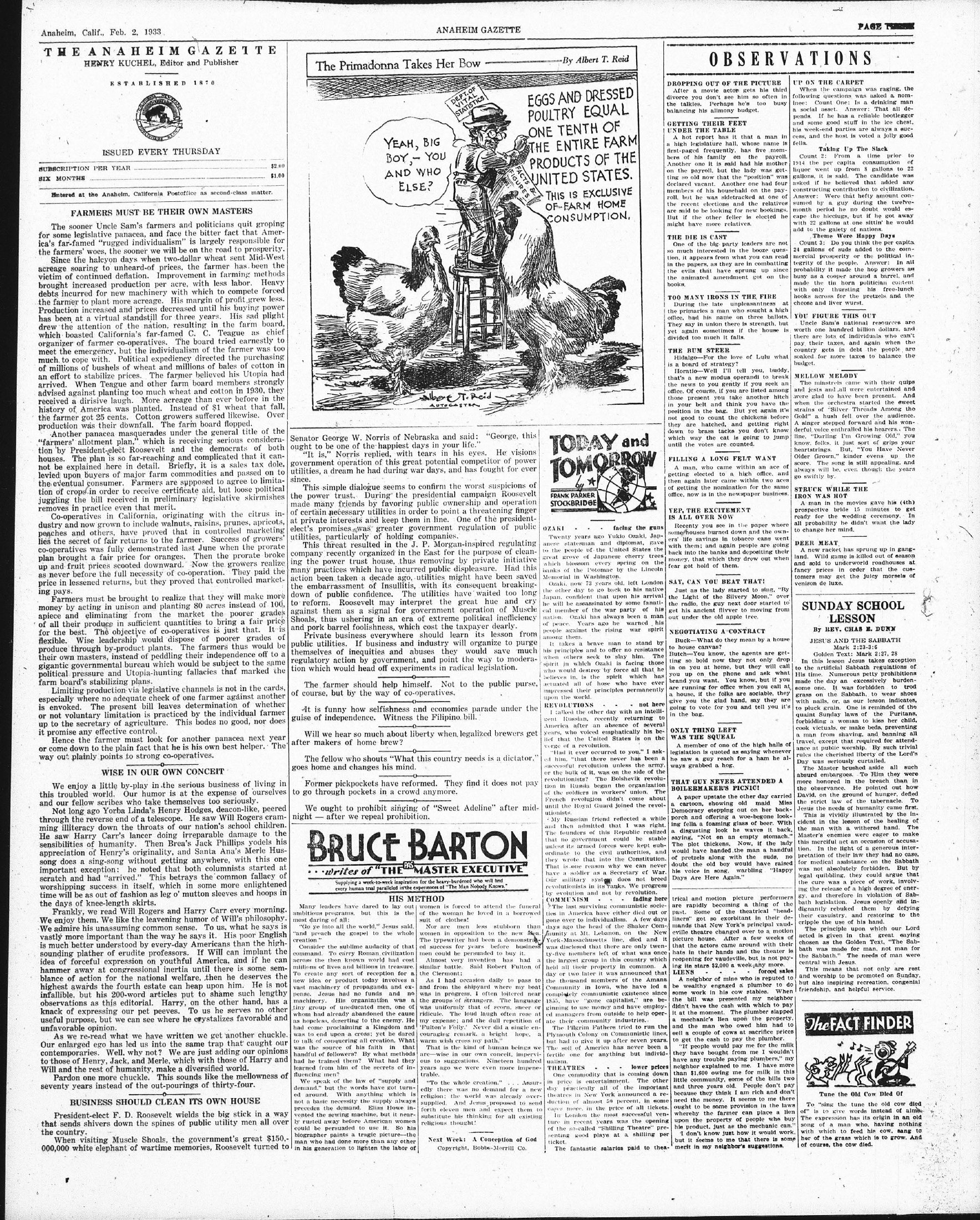
The Primadonna Takes Her Bow — By Albert T. Reid
EGGS AND DRESSED POULTRY EQUAL ONE TENTH OF THE ENTIRE FARM PRODUCTS OF THE UNITED STATES.
THIS IS EXCLUSIVE OF-FARM HOME CONSUMPTION.
Yeah, Big Boy, - You and Who Else?
Senator George W. Norris of Nebraska and said: "George, this ought to be one of the happiest days in your life."
"It is," Norris replied with tears in his eyes. He visions
Senator George W. Norris of Nebraska and said: "George, this ought to be one of the happiest days in your life."
"It is," Norris replied, with tears in his eyes. He visions government operation of this great potential competitor of power utilities, a dream he had during war days, and has fought for ever since.
This simple dialogue seems to confirm the worst suspicions of the power trust. During the presidential campaign Roosevelt made many friends by favoring public ownership and operation of certain necessary utilities in order to point a threatening finger at private interests and keep them in line. One of the president-elect's promises was greater government regulation of public utilities, particularly of holding companies.
This threat resulted in the J. P. Morgan-inspired regulating company recently organized in the East for the purpose of cleaning the power trust house, thus removing by private initiative many practices which have incurred public displeasure. Had this action been taken a decade ago, utilities might have been saved the embarrassment of Insullitis, with its consequent breaking-down of public confidence. The utilities have waited too long to reform. Roosevelt may interpret the great hue and cry against them as a signal for government operation of Muscle Shoals, thus ushering in an era of extreme political inefficiency and pork barrel foolishness, which cost the taxpayer dearly.
Private business everywhere should learn its lesson from public utilities. If business and industry will organize to purge themselves of inequities and abuses they would save much regulatory action by government, and point the way to moderation which would head off experiments in radical legislation.
The farmer should help himself. Not to the public purse, of course, but by the way of co-operatives.
It is funny how selfishness and economics parade under the guise of independence. Witness the Filipino bill.
Will we hear so much about liberty when legalized brewers get after makers of home brew?
The fellow who shouts "What this country needs is a dictator," goes home and changes his mind.
Former pickpockets have reformed. They find it does not pay to go through pockets in a crowd anymore.
We ought to prohibit singing of "Sweet Adeline" after midnight — after we repeal prohibition.
TODAY and TOMORROW
FRANK PARKER STOCKBRIDGE
OZAKI facing the guns
Twenty years ago Yukio Ozaki, Japanese statesman and diplomat, gave to the people of the United States the great grove of Japanese cherry trees which blossom every spring on the banks of the Potomac by the Lincoln Memorial in Washington.
Ozaki, now 73 years old, left London the other day to go back to his native Japan, confident that upon his arrival he will be assassinated by some fanatical member of the war party of his nation. Ozaki has always been a man of peace. Years ago he warned his people against the rising war spirit among them.
It takes a brave man to stand by his principles and to offer no resistance when others seek to slay him. The spirit in which Ozaki is facing those who would destroy by force all that he believes in, is the spirit which has actuated all of hose who have ever impressed their principles permanently upon the world.
REVOLUTIONS not here
I talked the other day with an intelligent Russian, recently returning to America after an absence of several years, who voiced emphatically his belief that the United States is on the verge of a revolution.
"Had it ever occurred to you," I asked him, "that there never has been a successful revolution unless the army, or the bulk of it, was on the side of the revolutionists? The Bolshevik revolution in Russia began the organization of the soldiers in workers' union. The French revolution didn't come about until the Royal Guard joined the revolutionists.
My Russian friend reflected a while and then admitted that I was right. The founders of this Republic realized that no government could be stable unless its armed forces were kept subordinate to the civil authorities, and they wrote that into the Constitution.
Former pickpockets have reformed. They find it does not pay to go through pockets in a crowd anymore.
We ought to prohibit singing of "Sweet Adeline" after midnight — after we repeal prohibition.
BRUCE BARTON
writes of "THE MASTER EXECUTIVE"
Supplying a week-to-week inspiration for the heavy-burdened who will find every human trial paralleled in the experiences of "The Man Nobody Knows."
HIS METHOD
Many leaders have dared to lay out ambitious programs, but this is the most daring of all:
"Go ye into all the world," Jesus said, "and preach the gospel to the whole creation."
Consider the sublime audacity of that command. To carry Roman civilization across the then known world had cost millions of lives and billions in treasure. To create any sort of reception for a new idea or product today involves a vast machinery of propaganda and expense. Jesus had no funds and no machinery. His organization was a tiny group of uneducated men, one of whom had already abandoned the cause as hopeless, deserting to the enemy. He had come proclaiming a Kingdom and was to end upon a cross; yet he dared to talk of conquering all creation. What was the source of his faith in that handful of followers? By what methods had he trained them? What had they learned from him of the secrets of influencing men?
We speak of the law of "supply and demand," but the words have got turned around. With anything which is not a basic necessity the supply always precedes the demand. Elias Howe invented the sewing machine, but it nearly rusted away before American women could be persuaded to use it. So his biographer paints a tragic picture—the man who had done more than any other in his generation to lighten the labor of women is forced to attend the funeral of the woman he loved in a borrowed suit of clothes!
Nor are men less stubborn than women in opposition to the new ideal. The typewriter had been a demonstrated success for years before businessmen could be persuaded to buy it.
Almost very invention has had a similar battle. Said Robert Fulton of the Clermont:
As I had occasion daily to pass to and from the shipyard where my boat was in progress, I often loitered near the groups of strangers. The language was uniformly that of scorn, sneer or ridicule. The loud laugh often rose at my expense; and the dull repetition of 'Fulton's Folly.' Never did a single encouraging remark, a bright hope, a warm wish cross my path.
That is the kind of human beings we are—wise in our own conceit, impervious to suggestions. Nineteen hundred years ago we were even more impenetrable.
"To the whole creation." . . Assuredly there was no demand for a new religion; the world was already oversupplied. And Jesus proposed to send forth eleven men and expect them to substitute his thinking for all existing religious thought!
Next Week: A Conception of God
Copyright, Bobbs-Merrill Co.
The last surviving communistic societies in America have either died out or gone over to individualism. A few days ago the head of the Shaker Community at Mt. Lebanon, on the New York-Massachusetts line, died and it was disclosed that there are only twenty-five members left of what was once the largest group in this country which held all their property in common. A day or two later it was announced that the thousand members of the Amana Community in Iowa, who have led a completely communistic existence since 1855, have "gone capitalist," are beginning to use money and have employed managers from outside to help operate their community industries.
The Pilgrim Fathers tried to run the Plymouth Colony on Communistic lines, but had to give it up after seven years. The soil of America has never been a fertile one for anything but individualism.
THEATRES . . . lower prices
One commodity that is coming down in price is entertainment. The other day practically all of the important theatres in New York announced a reduction of almost 50 percent, in some cases more, in the price of all tickets.
In London the most successful venture in recent years was the opening of the so-called "Shilling Theatre" presenting good plays at a shilling per ticket.
The fantastic salaries paid to thea-
OBSERVATIONS
DROPPING OUT OF THE PICTURE
After a movie actor gets his third divorce you don't see him so often in the talkies. Perhaps he's too busy balancing his alimony budget.
GETTING THEIR FEET
UNDER THE TABLE
A hot report has it that a man in a high legislature hall, whose name is first-paged frequently, has five members of his family on the payroll. Another one it is said had his mother on the payroll, but the lady was getting so old now that the "position" was declared vacant. Another one had four members of his household on the payroll, but he was sidetracked at one of the recent elections and the relatives are said to be looking for new bookings. But if the other feller is elected he might have more relatives.
THE DIE IS CAST
One of the big-party leaders are not so much interested in the booze question, it appears from what you can read in the papers, as they are in combatting the evils that have sprung up since the animated amendment got on the books.
TOO MANY IRONS IN THE FIRE
During the late unpleasantness at the primaries a man who sought a high office, had his name on three ballots. They say in union there is strength, but yet again sometimes if the house is divided too much it falls.
THE BUM STEER
Hidalgo—For the love of Lulu what is a board of strategy?
Horatio—Well I'll tell you, buddy, that's a new modus operandi to break the news to you gently if you seek an office. Of course, if you are listed among those present you take another hitch in your belt and think you have the position in the bag. But yet again it's not good to count the chickens before they are hatched, and getting right down to brass tacks you don't know which way the cat is going to jump until the votes are counted.
UP ON THE CARPET
When the campaign was raging, the following questions was asked a nominee: Count One; Is a drinking man a social asset. Answer: That all depends. If he has a reliable bootlegger and some good stuff in the ice chest, his week-end parties are always a success, and the host is voted a jolly good fella.
Taking Up The Slack
Count 2: From a time prior to 1914 the per capita consumption of liquor went up from 8 gallons to 22 gallons, it is said. The candidate was asked if he believed that added any constructing contribution to civilization. Answer: Were that hefty amount consumed by a guy during the twelve-month period he no doubt would escape the hiccups, but if he got away with 22 gallons at one sittin' he would add to the gaiety of nations.
Theme Were Happy Days
Count 3: Do you think the per capita 24 gallons of suds added to the commercial prosperity or the political integrity of the people. Answer: In all probability it made the hop growers as busy as a cooper around a barrel, and made the tin horn politician content with only thrusting his free-lunch hooks across for the pretzels and the cheese and liver wurst.
YOU FIGURE THIS OUT
Uncle Sam's national resources are worth one hundred billion dollars, and there are lots of individuals who can't pay their taxes, and again when the country gets in debt the people are soaked for more taxes to balance the budget.
MELLOW MELODY
The minstrels came with their quips and jests and all were entertained and were glad to have been present. And when the orchestra started the sweet strains of "Silver Threads Among the Gold" a hush fell over the audience. A singer stepped forward and his wonderful voice enthralled his hearers.. The line, "Darling I'm Growing Old," you know, folks, it just sort of grips your heartstrings. But, "You Have Never
Horatio—Well I'll tell you, buddy, that's a new modus operandi to break the news to you gently if you seek an office. Of course, if you are listed among those present you take another hitch in your belt and think you have the position in the bag. But yet again it's not good to count the chickens before they are hatched, and getting right down to brass tacks you don't know which way the cat is going to jump until the votes are counted.
FILLING A LONG FELT WANT
A man, who came within an ace of getting elected to a high office, and then again later came within two aces of getting the nomination for the same office, now is in the newspaper business.
YEP, THE EXCITEMENT IS ALL OVER NOW
Recently you see in the paper where some houses burned down and the owners' life savings in tobacco cans went with them; and again people are going back into the banks and depositing their money, that which they drew out when fear got hold of them.
SAY, CAN YOU BEAT THAT!
Just as the lady started to sing, "By the Light of the Silvery Moon," over the radio, the guy next door started to get his ancient flivver to moving from out under the old apple tree.
NEGOTIATING A CONTRACT
Buck—What do they mean by a house to house canvas?
Butch—You know, the agents are getting so bold now they not only drop in on you at home, but they will call you up on the phone and ask what brand you want. You know, but if you are running for office when you call at a house, if the folks are sociable, they give you the glad hand, say they are going to vote for you and tell you it's in the bag.
ONLY THING LEFT WAS THE SQUEAL
A member of one of the high halls of legislation is quoted as saying whenever he saw a guy reach for a ham he always grabbed a hog.
THAT GUY NEVER ATTENDED A BOILEMAKER'S PICNIC!
A paper upstate the other day carried a cartoon, showing old maid Miss Democracy stepping out on her backporch and offering a woe-begone looking fella a foaming glass of beer. With a disgusting look he waves it back, saying, "Not on an empty stomach." The plot thickens. Now, if the lady would have handed the man a handful of pretzels along with the suds, no budget.
MELLOW MELODY
The minstrels came with their quips and jests and all were entertained and were glad to have been present. And when the orchestra started the sweet strains of "Silver Threads Among the Gold" a hush fell over the audience. A singer stepped forward and his wonderful voice enthralled his hearers.. The line, "Darling I'm Growing Old," you know, folks, it just sort of grips your heartstrings. But, "You Have Never Older Grown," kinder evens up the score. The song is still appealing, and always will be, even though the years go swiftly by.
STRUCK WHILE THE IRON WAS HOT
A man in the movies gave his (4th) prospective bride 15 minutes to get ready for the wedding ceremony. In all probability he didn't want the lady to change her mind.
DEER MEAT
A new racket has sprung up in gangland. Wild game is killed out of season and sold to underworld roadhouses at fancy prices in order that the customers may get the juicy morsels of venison de luxe.
SUNDAY SCHOOL LESSON
By REV. CHAS M. DUNN
JESUS AND THE SABBATH
Mark 2:23-3:6
Golden Text: Mark 2:27, 28
In this lesson Jesus takes exception to the artificial Sabbath regulations of His time. Numerous petty prohibitions made the day an excessively burdensome one. It was forbidden to trod grass on the Sabbath, to wear shoes with nails, or, as our lesson indicates, to pluck grain. One is reminded of the quaint Sunday laws of the Puritans, forbidding a woman to kiss her child, cook victuals, or make beds, preventing a man from shaving, and banning all travel, except that required for attendance at public worship. By such trivial rules the cherished liberty of the Lord's Day was seriously curtailed.
The Master brushed aside all such absurd embargoes. To Him they were more honored in the breach than in the observance. He pointed out how David, on the ground of hunger, defied the strict law of the tabernacle. To Jesus the needs of humanity came first.
This is vividly illustrated by the incident in the lesson of the healing of the man with a withered hand. The Master's enemies were eager to make this merciful act an occasion of accusation. In the light of a generous interpretation of their law they had no case, for medical assistance on the Sabbath
THAT GUY NEVER ATTENDED A BOILEBMAKER'S PICNIC!
A paper upstate the other day carried a cartoon, showing old maid Miss Democracy stepping out on her backporch and offering a woe-begone looking fella a foaming glass of beer. With a disgusting look he waves it back, saying, "Not on an empty stomach." The plot thickens. Now, if the lady would have handed the man a handful of pretzels along with the suds, no doubt the old boy would have raised his voice in song, warbling "Happy Days Are Here Again."
trical and motion picture performers are rapidly becoming a thing of the past. Some of the theatrical "headliners" got so exorbitant in their demands that New York's principal vaudeville theatre changed over to a motion picture house. After a few weeks of that the actors came around with their hats in their hands and the theater is reopening for vaudeville, but is not paying its stars $2,000 a week any more.
LIENS FORCED SALES
A neighbor of mine who is reputed to be wealthy engaged a plumber to do some work in his cow stables. When the bill was presented my neighbor didn't have the cash with which to pay it at the moment. The plumber slapped a mechanic's lien upon the property, and the man who owed him had to sell a couple of cows at sacrifice prices to get the cash to pay the plumber.
"If people would pay me for the milk they have bought from me I wouldn't have any trouble paying plumbers," my neighbor explained to me. I have more than $1,600 owing me for milk in this little community, some of the bills two and three years old. People don't pay because they think I am rich and don't need the money. It seems to me there ought to be some provision in the laws whereby the farmer can place a lien upon the property of people who buy his product, just as the mechanic can."
I don't know just how it would work, but it seems to me that there is some merit in my neighbor's suggestions.
The Master brushed aside all such absurd embargoes. To Him they were more honored in the breach than in the observance. He pointed out how David, on the ground of hunger, defied the strict law of the tabernacle. To Jesus the needs of humanity came first.
This is vividly illustrated by the incident in the lesson of the healing of the man with a withered hand. The Master's enemies were eager to make this merciful act an occasion of accusation. In the light of a generous interpretation of their law they had no case, for medical assistance on the Sabbath was not absolutely forbidden. But by legal quibbling, they could argue that the cure was a piece of work, involving the release of a high degree of energy, and therefore in violation of Sabbath legislation. Jesus openly and indignantly rebuked them by defying their casuistry, and restoring to the cripple the use of his hand.
The principle upon which our Lord acted is given in that great saying chosen as the Golden Text, "The Sabbath was made for man, not man for the Sabbath." The needs of man were central with Jesus.
This means that not only are rest and worship to be promoted on Sunday, but also inspiring recreation, congenial friendship, and helpful service.
Tune the Old Cow Died Of
To "sing the tune the old cow died of" is to give words instead of alms. The expression has its origin in an old song of a man who, having nothing with which to feed his cow, sang to her of the grass which is to grow. And of course, the cow died.