anaheim-gazette 1933-02-02
Scanned page
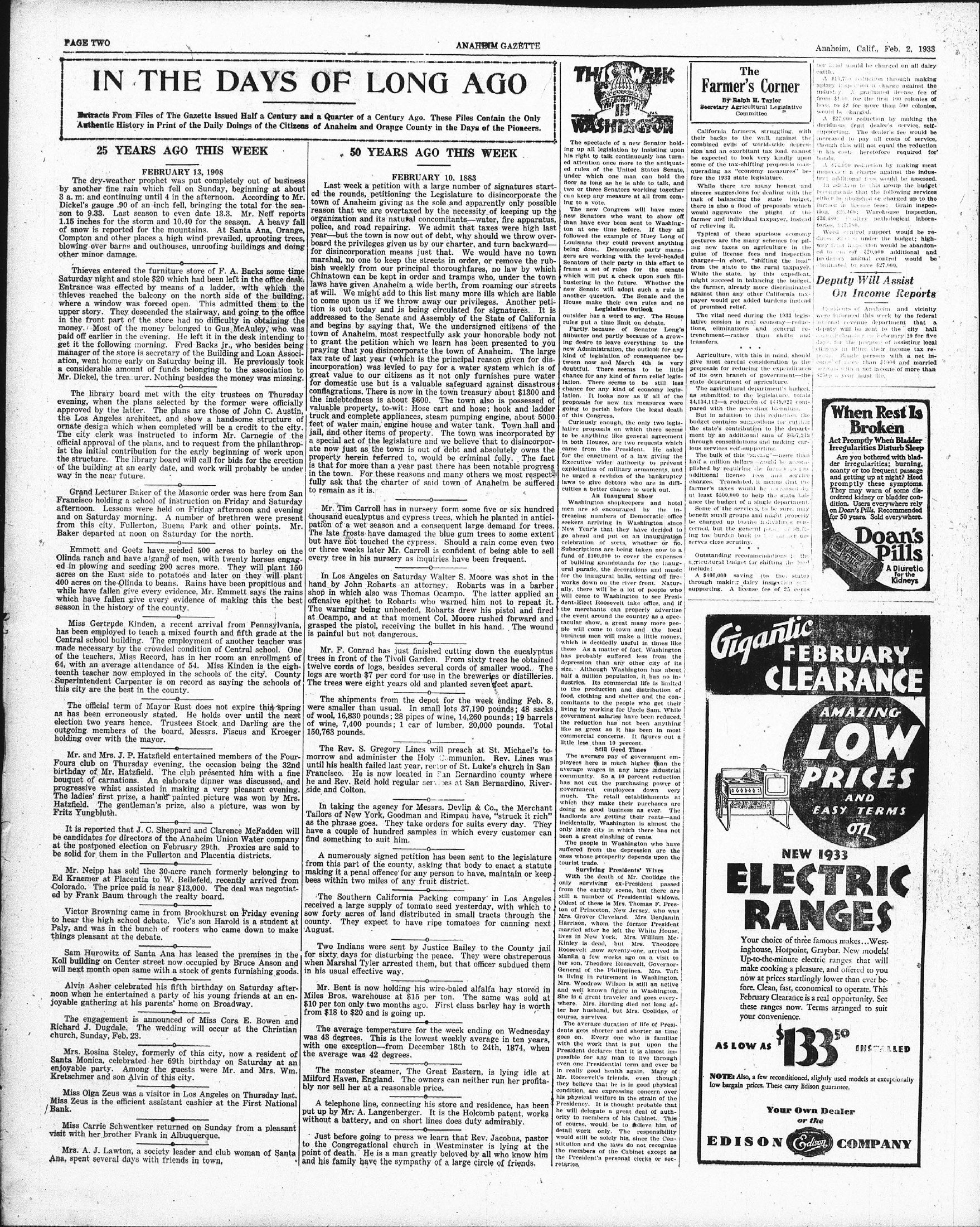
Searchable text
IN THE DAYS OF
Extracts From Files of The Gazette Issued Half a Century and a Quarter of Authentic History in Print of the Daily Doings of the Citizens of Anaheim and
25 YEARS AGO THIS WEEK
FEBRUARY 13, 1908
The dry-weather prophet was put completely out of business by another fine rain which fell on Sunday, beginning at about 3 a.m. and continuing until 4 in the afternoon. According to Mr. Dickel's gauge .90 of an inch fell, bringing the total for the season to 9.33. Last season to even date 13.3. Mr. Neff reports 1.15 inches for the storm and 10.40 for the season. A heavy fall of snow is reported for the mountains. At Santa Ana, Orange, Compton and other places a high wind prevailed, uprooting trees, blowing over barns and outhouses, unroofing buildings and doing other minor damage.
Thieves entered the furniture store of F. A. Backs some time Saturday night and stole $20 which had been left in the office desk. Entrance was effected by means of a ladder, with which the thieves reached the balcony on the north side of the building, where a window was forced open. This admitted them to the upper story. They descended the stairway, and going to the office in the front part of the store had no difficulty in obtaining the money. Most of the money belonged to Gus McAuley, who was paid off earlier in the evening. He left it in the desk intending to get it the following morning. Fred Backs jr., who besides being manager of the store is secretary of the Building and Loan Association, went home early on Saturday being ill. He previously took a considerable amount of funds belonging to the association to Mr. Dickel, the treasurer. Nothing besides the money was missing.
The library board met with the city trustees on Thursday evening, when the plans selected by the former were officially approved by the latter. The plans are those of John C. Austin, the Los Angeles architect, and show a handsome structure of ornate design which when completed will be a credit to the city. The city clerk was instructed to inform Mr. Carnegie of the official approval of the plans, and to request from the philanthropist the initial contribution for the early beginning of work upon last week ed the rounds, town of Anaheim reason that we organization and police, and road year—but the board the privilge for disincorporation marshal, no one bish weekly free Chinatown can laws have given at will. We must come upon us tion is out today addressed to th and begins by town of Anaheim to grant the praying that ye tax rate of last incorporation) great value to for domestic use conflagrations. the indebtedne valuable proper truck and comp feet of water m jail, and other a special act of ate now just as property herei
The library board met with the city trustees on Thursday evening, when the plans selected by the former were officially approved by the latter. The plans are those of John C. Austin, the Los Angeles architect, and show a handsome structure of ornate design which when completed will be a credit to the city. The city clerk was instructed to inform Mr. Carnegie of the official approval of the plans, and to request from the philanthropist the initial contribution for the early beginning of work upon the structure. The library board will call for bids for the erection of the building at an early date, and work will probably be under way in the near future.
Grand Lecturer Baker of the Masonic order was here from San Francisco holding a school of instruction on Friday and Saturday afternoon. Lessons were held on Friday afternoon and evening and on Saturday morning. A number of brethren were present from this city, Fullerton, Buena Park and other points. Mr. Baker departed at noon on Saturday for the north.
Emmett and Goetz have seeded 500 acres to barley on the Olinda ranch and have a gang of men, with twenty horses engaged in plowing and seeding 200 acres more. They will plant 150 acres on the East side to potatoes and later on they will plant 400 acres on the Olinda to beans. Rains have been propitious and while have fallen give every evidence, Mr. Emmett says the rains which have fallen give every evidence of making this the best season in the history of the county.
Miss Gertrude Kinden, a recent arrival from Pennsylvania, has been employed to teach a mixed fourth and fifth grade at the Central school building. The employment of another teacher was made necessary by the crowded condition of Central school. One of the teachers, Miss Record, has in her room an enrollment of 64, with an average attendance of 54. Miss Kinden is the eighteenth teacher now employed in the schools of the city. County Superintendent Carpenter is on record as saying the schools of this city are the best in the county.
The official term of Mayor Rust does not expire this spring as has been erroneously stated. He holds over until the next election two years hence. Trustees Stock and Darling are the outgoing members of the board, Messrs. Fiscus and Kroeger holding over with the mayor.
Mr. and Mrs. J. P. Hatzfield entertained members of the Four-Fours club on Thursday evening, the occasion being the 32nd birthday of Mr. Hatzfield. The club presented him with a fine bouquet of carnations. An elaborate dinner was discussed, and progressive whist assisted in making a very pleasant evening. The ladies' first prize, a hand-painted picture was won by Mrs. Hatzfield. The gentleman's prize, also a picture, was won by Fritz Yungbluth.
It is reported that J. C. Sheppard and Clarence McFadden will be candidates for directors of the Anaheim Union Water company at the postponed election on February 29th. Proxies are said to be solid for them in the Fullerton and Placentia districts.
birthday of Mr. Hatzfield. The club presented him with a fine bouquet of carnations. An elaborate dinner was discussed, and progressive whist assisted in making a very pleasant evening. The ladies' first prize, a hand-painted picture was won by Mrs. Hatzfield. The gentleman's prize, also a picture, was won by Fritz Yungbluth.
It is reported that J. C. Sheppard and Clarence McFadden will be candidates for directors of the Anaheim Union Water company at the postponed election on February 29th. Proxies are said to be solid for them in the Fullerton and Placentia districts.
Mr. Neipp has sold the 30-acre ranch formerly belonging to Ed Kraemer at Placentia to W. Beilefeld, recently arrived from Colorado. The price paid is near $13,000. The deal was negotiated by Frank Baum through the realty board.
Victor Browning came in from Brookhurst on Friday evening to hear the high school debate. Vic's son Harold is a student at Paly, and was in the bunch of rooters who came down to make things pleasant at the debate.
Sam Hurowitz of Santa Ana has leased the premises in the Koll building on Center street now occupied by Bruce Anson and will next month open same with a stock of gents furnishing goods.
Alvin Asher celebrated his fifth birthday on Saturday afternoon when he entertained a party of his young friends at an enjoyable gathering at his parents' home on Broadway.
The engagement is announced of Miss Cora E. Bowen and Richard J. Dugdale. The wedding will occur at the Christian church, Sunday, Feb. 23.
Mrs. Rosina Steley, formerly of this city, now a resident of Santa Monica, celebrated her 69th birthday on Saturday at an enjoyable party. Among the guests were Mr. and Mrs. Wm. Kretschmer and son Alvin of this city.
Miss Olga Zeus was a visitor in Los Angeles on Thursday last. Miss Zeus is the efficient assistant cashier at the First National Bank.
Miss Carrie Schwentker returned on Sunday from a pleasant visit with her brother Frank in Albuquerque.
Mrs. A. J. Lawton, a society leader and club woman of Santa Ana, spent several days with friends in town,
50 YEARS AGO THIS WEEK
FEBRUARY 10, 1883
Last week a petition with a large number of signatures started the rounds, petitioning the Legislature to disincorporate the town of Anaheim giving as the sole and apparently only possible reason that we are overtaxed by the necessity of keeping up the organization and its natural concomitants—water, fire apparatus, police, and road repairing. We admit that taxes were high last year—but the town is now out of debt, why should we throw overboard the privileges given us by our charter, and turn backward—for disincorporation means just that. We would have no town marshal, no one to keep the streets in order, or remove the rubbish weekly from our principal thoroughfares, no law by which Chinatown can be kept in order and tramps who, under the town laws have given Anaheim a wide berth, from roaming our streets at will. We might add to this list many more ills which are liable to come upon us if we throw away our privileges. Another petition is out today and is being circulated for signatures. It is addressed to the Senate and Assembly of the State of California and begins by saying that, We the undersigned citizens of the town of Anaheim, most respectfully ask your honorable body not to grant the petition which we learn has been presented to you praying that you disincorporate the town of Anaheim. The large tax rate of last year (which is the principal reason given for disincorporation) was levied to pay for a water system which is of great value to our citizens as it not only furnishes pure water for domestic use but is a valuable safeguard against disastrous conflagrations. There is now in the town treasury about $1300 and the indebtedness is about $600. The town also is possessed of valuable property, to-wit: Hose cart and hose; hook and ladder truck and complete appliances, steam pumping engine, about 5000 feet of water main, engine house and water tank. Town hall and jail, and other items of property. The town was incorporated by a special act of the legislature and we believe that to disincorporate now just as the town is out of debt and absolutely owns the property herein referred to would be criminal felony.
The spectacle of a new Senator holding up all legislation by insisting upon his right to talk continuously has turned attention once more to the antiquated rules of the United States Senate, under which one man can hold the floor as long as he is able to talk, and two or three Senators working together can keep any measure at all from coming to a vote.
The new Congress will have more new Senators who want to show off than have ever been sent to Washington at one time before. If they all followed the example of Huey Long of Louisiana they could prevent anything being done. Democratic party managers are working with the level-headed Senators of their party in this effort to frame a set of rules for the senate which will put a check upon such filibustering in the future. Whether the new Senate will adopt such a rule is another question. The Senate and the House make their own rules and no Legislative Outlook outsider has a word to say. The House rules put a time limit on debate.
Partly because of Senator Long's filibuster and partly because of a growing desire to leave everything to the new Administration, the outlook for any kind of legislation of consequence between now and March 4th is very doubtful. There seems to be little chance for any kind of farm relief legislation. There seems to be still less chance for any kind of economy legislation. It looks now as if all of the proposals for new tax measures were going to perish before the legal death of this Congress.
Curiously enough, the only two legislative proposals on which there seems to be anything like general agreement in both Houses, are two requests which came from the President. He asked for the enactment of a law giving the
Mr. Tim Carroll has in nursery form some five or six hundred thousand eucalyptus and cypress trees, which he planted in anticipation of a wet season and a consequent large demand for trees. The late frosts have damaged the blue gum trees to some extent but have not touched the cypress. Should a rain come even two or three weeks later Mr. Carroll is confident of being able to sell every tree in his nursery as inquiries have been frequent.
In Los Angeles on Saturday Walter S. Moore was shot in the hand by John Robarts an attorney. Robarts was in a barber shop in which also was Thomas Ocampo. The latter applied an offensive epithet to Robarts who warned him not to repeat it. The warning being unheeded, Robarts drew his pistol and fired at Ocampo, and at that moment Col. Moore rushed forward and grasped the pistol, receiving the bullet in his hand. The wound is painful but not dangerous.
Mr. F. Conrad has just finished cutting down the eucalyptus trees in front of the Tivoli Garden. From sixty trees he obtained twelve cords of logs, besides several cords of smaller wood. The logs are worth $7 per cord for use in the breweries or distilleries. The trees were eight years old and planted seven feet apart.
The shipments from the depot for the week ending Feb. 8, were smaller than usual. In small lots 37,190 pounds; 48 sacks of wool, 16,830 pounds; 28 pipes of wine, 14,260 pounds; 19 barrels of wine, 7,400 pounds; 1 car of lumber, 20,000 pounds. Total 150,763 pounds.
The Rev. S. Gregory Lines will preach at St. Michael's tomorrow and administer the Holy Communion. Rev. Lines was until his health failed last year, rector of St. Luke's church in San Francisco. He is now located in San Bernardino county where he and Rev. Reid hold regular services at San Bernardino, River-side and Colton.
In taking the agency for Messrs. Devlin & Co., the Merchant Tailors of New York, Goodman and Rimpau have, "struck it rich" as the phrase goes. They take orders for suits every day. They have a couple of hundred samples in which every customer can find something to suit him.
A numerously signed petition has been sent to the legislature from this part of the county, asking that body to enact a statute
tween now and March 4th is very doubtful. There seems to be little chance for any kind of farm relief legislation. There seems to be still less chance for any kind of economy legislation. It looks now as if all of the proposals for new tax measures were going to perish before the legal death of this Congress.
Curiously enough, the only two legislative proposals on which there seems to be anything like general agreement in both Houses, are two requests which came from the President. He asked for the enactment of a law giving the Executive wider authority to prevent exploitation of military armaments, and he urged a revision of the bankruptcy laws to give debtors who are in difficulties a better chance to work out.
An Inaugural Show
Washington shopkeepers and hotel men are so encouraged by the increasing numbers of Democratic office seekers arriving in Washington since New Year's that they have decided to go ahead and put on an inauguration celebration of sorts, whether or no. Subscriptions are being taken now to a fund of $100,000 to cover the expenses of building grandstands for the inaugural parade, the decorations and music for the inaugural balls, setting off fireworks down on the river front. Naturally, there will be a lot of people who will come to Washington to see President-Elect Roosevelt take office, and if the merchants can properly advertise the event around the country as a spectacular show, a great many more people will come to town and the local business men will make a little money, which is decidedly useful in times like these As a matter of fact, Washington has probably suffered less from the depression than any other city of its size. Although Washington has about half a million population, it has no industries Its commercial life is limited to the production and distribution of food, clothing and shelter and the concomitants to the people who get their living by working for Uncle Sam. While government salaries have been reduced, the reduction has not been anything like as great as it has been in most commercial concerns. It figures out a little less than 10 percent.
Still Good Times
The average pay of government employees here is much higher than the average wages in any large industrial community. So a 10 percent reduction has not cut the purchasing power of government employees down very much. The retail establishments at which they make their purchases are doing as good business as ever. The landlords are getting their rents—and incidentally, Washington is almost the only large city in which there has not been a great slashing of rents.
The people in Washington who have suffered from the depression are the ones whose prosperity depends upon the tourist trade.
Francisco. He is now located in San Bernardino county where he and Rev. Reid hold regular services at San Bernardino, River-side and Colton.
In taking the agency for Messrs. Devlin & Co., the Merchant Tailors of New York, Goodman and Rimpau have, "struck it rich" as the phrase goes. They take orders for suits every day. They have a couple of hundred samples in which every customer can find something to suit him.
A numerously signed petition has been sent to the legislature from this part of the county, asking that body to enact a statute making it a penal offence for any person to have, maintain or keep bees within two miles of any fruit district.
The Southern California Packing company in Los Angeles received a large supply of tomato seed yesterday, with which to sow forty acres of land distributed in small tracts through the county. They expect to have ripe tomatoes for canning next August.
Two Indians were sent by Justice Bailey to the County jail for sixty days for disturbing the peace. They were obstreperous when Marshal Tyler arrested them, but that officer subdued them in his usual effective way.
Mr. Bent is now holding his wire-baled alfalfa hay stored in Miles Bros. warehouse at $15 per ton. The same was sold at $10 per ton only two months ago. First class barley hay is worth from $18 to $20 and is going up.
The average temperature for the week ending on Wednesday was 43 degrees. This is the lowest weekly average in ten years, with one exception—from December 18th to 24th, 1874, when the average was 42 degrees.
The monster steamer, The Great Eastern, is lying idle at Milford Haven, England. The owners can neither run her profitably nor sell her at a reasonable price.
A telephone line, connecting his store and residence, has been put up by Mr. A. Langenberger. It is the Holcomb patent, works without a battery, and on short lines does duty admirably.
Just before going to press we learn that Rev. Jacobus, pastor to the Congregational church in Westminster is lying at the point of death. He is a man greatly beloved by all who know him and his family have the sympathy of a large circle of friends.
Surviving Presidents' Wives
With the death of Mr. Coolidge the only surviving ex-President passed from the earthly scene, but there are still a number of Presidential widows. Oldest of these is Mrs. Thomas F. Preston of Princeton, New Jersey, who was Mrs. Grover Cleveland. Mrs. Benjamin Harrison, whom the former President married after he left the White House, lives in New York. Mrs. William McKinley is dead, but Mrs. Theodore Roosevelt, now seventy-one, arrived in Manila a few weeks ago on a visit to her son, Theodore Roosevelt, Governor-General of the Philippines. Mrs. Taft is living in retirement in Washington. Mrs. Woodrow Wilson is still an active and well known figure in Washington. She is a great traveler and goes everywhere. Mrs. Harding died not long after her husband, but Mrs. Coolidge, of course, survives.
The average duration of life of Presidents gets shorter and shorter as time goes on. Every one who is familiar with the work that is put upon the President declares that it is almost impossible for any man to live through even one Presidential term and ever be in really good health again. Many of Mr. Roosevelt's friends, even though they believe that he is in good physical condition, are expressing concern over his physical welfare in the strain of the Presidency. It is thought probable that he will delegate a great deal of authority to members of his Cabinet. This of course would be to believe him of detail work only. The responsibility would still be solely his, since the Constitution and the laws do not recognize the members of the Cabinet except as the President's personal clerks or secretaries.
The Farmer's Corner
By Ralph H. Taylor
Secretary Agricultural Legislative Committee
California farmers, struggling with their backs to the wall, against the combined evils of world-wide depression and an exorbitant tax load, cannot be expected to look very kindly upon some of the tax-shifting proposals masquerading as "economy measures" before the 1933 state legislature.
While there are many honest and sincere suggestions for dealing with the task of balancing the state budget, there is also a flood of proposals which would aggravate the plight of the farmer and individual taxpayer, instead of relieving it.
Typical of these spurious economy gestures are the many schemes for piling new taxes on agriculture in the guise of license fees and inspection charges—in short, "shifting the load" from the state to the rural taxpayer. While the state, by this expedient, might succeed in balancing the budget, the farmer, already more discriminated against than any other California taxpayer would get added burdens instead of promised relief.
The vital need during the 1933 legislative session is real economy—reductions, eliminations and general retrenchment—rather than shifts and transfers.
Agriculture, with this in mind, should give most careful consideration to the proposals for reducing the expenditures of its own branch of government—the state department of agriculture.
The agricultural department's budget, as submitted to the legislature, totals $4,134,112—a reduction of $449,027 compared with the preceding biennium.
But in addition to this reduction, the budget contains suggestions for cutting the state's contribution to the department by an additional sum of $697,213 through consolidations and making various services self-supporting.
The bulk of this "saving"—more than per head would be charged on all dairy cattle.
A $10,750 reduction through making apiary inspection a charge against the industry. A graduated license fee of from $1,000 for the first 100 colonies of bees, to $2 for more than 500 colonies, would be charged.
A $27,000 reduction by making the deciduous fruit dealer’s service self-supporting. The dealer’s fee would be increased to pay all costs of service, though this will not equal the reduction in his costs heretofore required for bonds.
A $74,000 reduction by making meat inspectors a charge against the industry; additional fees would be assessed.
In addition to this group the budget recommends that the following services either be abolished or charged up to the farmer in license fees: Grain inspection, $25,460; Warehouse inspection, $36,480; Quality pathological laboratories, $17,580.
Weed control support would be reduced $20,000 under the budget; highway foot inspection would be abandoned to cut off $20,000 additional and predatory animal control would be eliminated to save $27,000.
Deputy Will Assist On Income Reports
Residents of Anaheim and vicinity were informed this week by the federal internal revenue department that a deputy will be sent to the city hall council chamber on February 20 for five days, for the purpose of assisting local citizens in filling their income tax reports. Single persons with a net income of more than $1900 and married persons with a net income of more than $250p a year must file.
March 4th is very seems to be little kind of farm relief legislation to be still less kind of economy legislation now as if all of the new tax measures were before the legal death
The only two legislations which there seems like general agreement are two requests which President. He asked out of a law giving the authority to prevent military armaments, and mention of the bankruptcy victims who are in difficulty to work out.
Augural Show topkeepers and hotel occupants by the insistence of Democratic office in Washington since they have decided to put on an inauguration sports, whether or not being taken now to a to cover the expenses stands for the inaugur decorations and music balls, setting off fire-eye river front. Naturally a lot of people who washington to see Presidelt take office, and if can properly advertise the country as a spec-great many more peo-town and the local make a little money, any useful in times like war of fact, Washington offered less from the many other city of its Washington has about population, it has no commercial life is limited and distribution of shelter and the con-people who get their for Uncle Sam. While sales have been reduced, does not been anything it has been in most turns. It figures out a 50 percent.
Good Times day of government em-ment much higher than the any large industrial 10 percent reduction purchasing power of employees down very small establishments at their purchases are business as ever. The putting their rents—and washington is almost the which there has not ning of rents.
Washington who have depression are the charity depends upon the give most careful consideration to the proposals for reducing the expenditures of its own branch of government—the state department of agriculture.
The agricultural department's budget, as submitted to the legislature, totals $4,134,112—a reduction of $449,027 compared with the preceding biennium.
But in addition to this reduction, the budget contains suggestions for cutting the state's contribution to the department by an additional sum of $697,213 through consolidations and making various services self-supporting.
The bulk of this "saving"—more than half a million dollars—would be accomplished by requiring the farmer to pay additional license fees and service charges. Translated, it means that the farmer's taxes would be increased by at least $500,000 to help the state balance the budget of a single department.
Some of the services, to be sure, may benefit small groups and might properly be charged up to the individuals concerned, but the general point is shifting the burden back to the larger reserves close scrutiny.
Outstanding recommendations in the agricultural budget for shifting the local include:
A $400,000 saving (to the state) through making dairy inspection self-supporting. A license fee of 25 cents
Gigantic FEBRUARY CLEARANCE
AMAZING LOW PRICES AND EASY TERMS ON
NEW 1933
PRICES
AND
EASY TERMS
ON
NEW 1933
ELECTRIC
RANGES
Your choice of three famous makes...Westinghouse, Hotpoint, Graybar. New models!
Up-to-the-minute electric ranges that will make cooking a pleasure, and offered to you now at prices startlingly lower than ever before. Clean, fast, economical to operate. This February Clearance is a real opportunity. See these ranges now. Terms arranged to suit your convenience.
AS LOW AS $133.50 INSTALLED
NOTE: Also, a few reconditioned, slightly used models at exceptionally low bargain prices. These carry Edison guarantee.
Your Own Dealer
or the
EDISON COMPANY