anaheim-gazette 1932-09-29
Scanned page
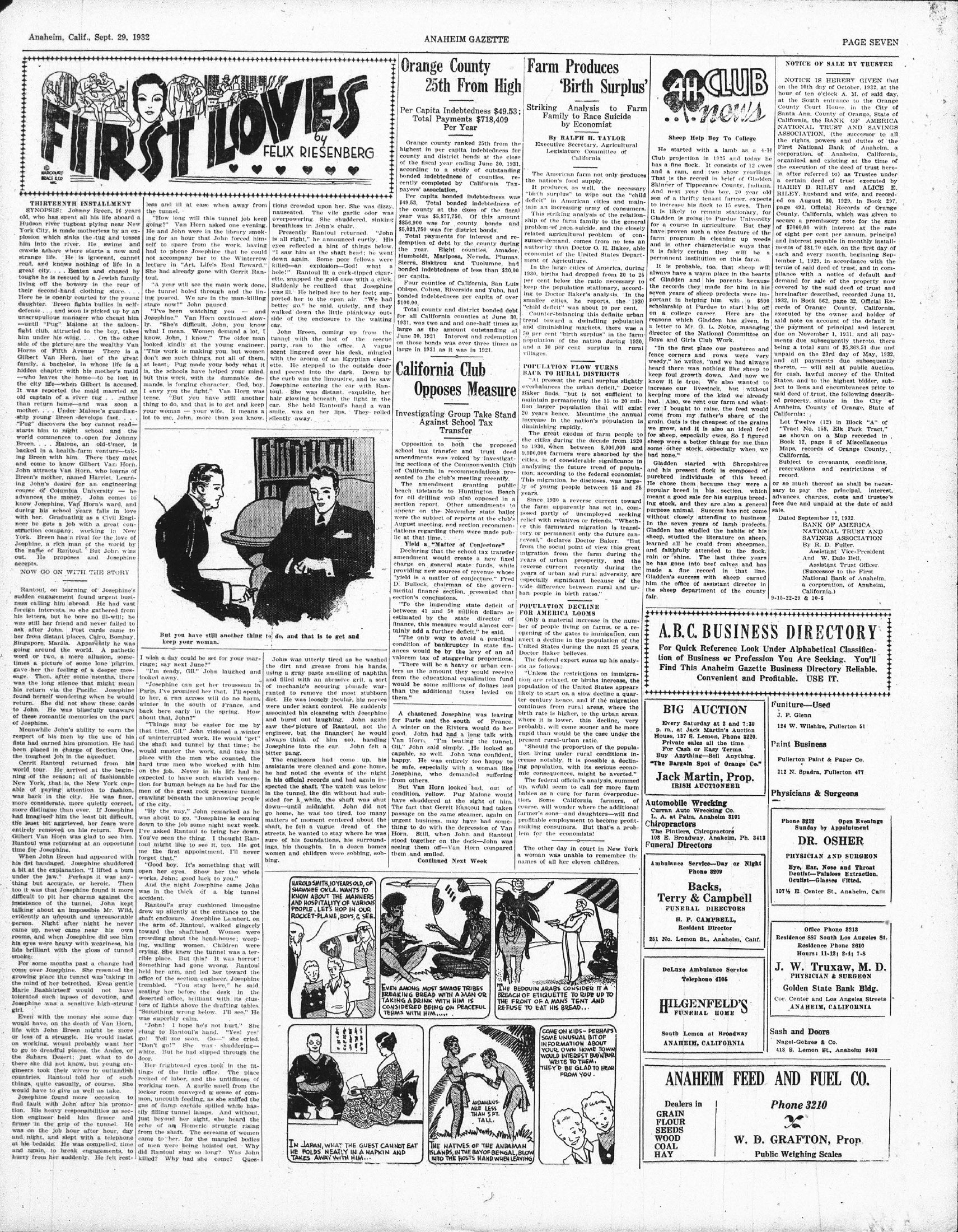
Searchable text
THIRTEENTH INSTALLMENT
SYNOPSIS: Johnny Breen, 16 years old, who has spent all his life aboard a Hudson river tugboat plying near New York City, is made motherless by an explosion which sinks the tug and tosses him into the river. He swims and crawls ashore where starts a new and strange life. He is ignorant, cannot read, and knows nothing of life in a great city. Beaten and chased by toughs he is rescued by a Jewish family living off the bowery in the rear of their second-hand clothing store. Here he is openly courted by the young daughter. Breen fights bullies in self-defense and soon is picked up by an unscrupulous manager who cheast him—until "Pug" Malone at the saloon-fight club, attracted to the boy, takes him under his wing. On the other side of the picture are the wealthy Van Horns of Fifth Avenue There is a Gilbert Van Horn, last of the great family, a bachelor, in whose life is a hidden chapter with his mother's maid—who leaves the home—to be lost in the city life—when Gilbert is accused. It was reported the maid married an old captain of a river tug... rather than return home—and was soon a mother. Under Malone's guardianship young Breen develops fast. "Pug" discovers the boy cannot read—starts him to night school and the world commences to open for Johnny Breen. Malone, an old-timer, is backed in a health-farm venture—taking Breen with him. There they meet less and ill at ease when away from the tunnel.
"How long will this tunnel job keep going?" Van Horn asked one evening. He and John were in the library smoking for an hour that John forced himself to spare from the work, having had to phone Josephine that he could not accompany her to the Winterrow lecture in "Art, Life's Real Reward." She had already gone with Gerrit Rantoul.
"A year will see the main work done, the tunnel holed through and the lining poured. We are in the man-killing stage now!" John paused.
"I've been watching you — and Josephine." Van Horn continued slowly. "She's difficult, John, you know what I mean. Women demand a lot, I know, John, I know." The older man looked kindly at the young engineer. "This work is making you, but women don't see such things, not all of them, at least. Pug made your body what it is, the schools have helped your mind, but this work, with its damnable demands, is forging character. God, boy, I envy you the fight." Van Horn was tense. "But you have still another thing to do, and that is to get and keep your woman — your wife. It means a lot to me, John, more than you know."
tions crowded upon her. She nauseated. The vile garlic overpowering. She shuddered breathless in John's chair.
Presently Rantoul returns is all right," he announced eyes reflected a hint of the "I saw him at the shaft head down again. Some poor for killed—an explosion—God! hole!" Rantoul lit a cork-theette, snapped the gold case w Suddenly he realized that was ill. He helped her to her ported her to the open air better go." he said, quietly walked down the little plank side of the enclosure to the car.
John Breen, coming up tunnel with the last of the party, ran to the office. Scent lingered over his despair with the aroma of an Egyptianette. He stepped to the door and peered into the dark. The curb was the limousire, a Josephine entering the car toul. She was distant, exquisite hair glowing beneath the light car. She held Rantoul's hail smile, was on her lips. T silently away.
family, a bachelor, in whose life is a hidden chapter with his mother's maid—who leaves the home—to be lost in the city life—when Gilbert is accused. It was reported the maid married an old captain of a river tug...rather than return home—and was soon a mother. Under Malone's guardianship young Breen develops fast.
"Pug" discovers the boy cannot read—starts him to night school and the world commences to open for Johnny Breen. Malone, an old-timer, is backed in a health-farm venture—taking Breen with him. There they meet and come to know Gilbert Van Horn. John attracts Van Horn, who learns of Breen's mother, named Harriet. Learning John's desire for an engineering course of Columbia University—he advances the money. John comes to know Josephine, Van Horn's ward, and during his school years falls in love with her. Graduating as a Civil Engineer he gets a job with a great construction company, working in New York. Breen has a rival for the love of Josephine, a rich man of the world by the name of Rantoul. But John wins out. He proposes and Josephine accepts.
NOW GO ON WITH THE STORY
Rantoul, on learning of Josephine's sudden engagement found urgent business calling him abroad. He had vast foreign interests, so she gathered from his letters, but he bore no ill-will; he was still her friend and never failed to ask after John. Post cards came to her from distant places, Cairo, Bombay, Singapore, Manila. Apparently he was going around the world. A pathetic word or two, a mere allusion, sometimes a picture of some lone pilgrim, gave her the feeling of a deeper message. Then, after some months, there was the long silence that might mean his return via the Pacific. Josephine found herself wondering when he would return. She did not show these cards to John. He was blissfully unaware of these romantic memories on the part of Josephine.
Meanwhile John's ability to earn the respect of his men by the use of his flats had earned him promotion. He had been placed in charge of Section One, the toughest job in the aqueduct.
Cerrit Rantoul returned from his world tour. He arrived at the beginning of the season; all of fashionable New York, that is, the New York capable of paying attention to fashion, was back in the city. He was finer, more considerate, more quietly correct, more distingue than ever. If Josephine had imagined him the least bit difficult, the least bit aggrieved, her fears were entirely removed on his return. Even Gilbert Van Horn was glad to see him. Rantoul was returning at an opportune time for Josephine.
When John Breen had appeared with his first bandaged, Josephine shuddered a bit at the explanation "I lifted a hum at least." Pug made your body what it is, the schools have helped your mind, but this work, with its damnable demands, is forging character. God, boy, I envy you the fight." Van Horn was tense. "But you have still another thing to do, and that is to get and keep your woman — your wife. It means a lot to me, John, more than you know.
But you have still another thing to do, and that is to get and keep your woman.
I wish a day could be set for your marriage; say next June?
"I'm ready, Gil." John laughed and looked away.
"Josephine can get her trousseau in Paris, I've promised her that. I'll speak to her, a run across will do no harm, winter in the south of France, and back here early in the spring. How about that, John?"
"Things may be easier for me by that time, Gil." John visioned a winter of uninterrupted work. He would "get" the shaft and tunnel by that time; he would master the work, and take his place with the men who counted, the hard true men who worked with him on the job. Never in his life had he expected to have such slavish veneration for human beings as he had for the men of the great rock pressure tunnel crawling beneath the unknowing people of the city.
"By the way," John remarked as he was about to go. "Josephine is coming down to the job some night next week. I've asked Rantoul to bring her down. You've seen the thing. I thought Rantoul might like to see it, too. He got me the first appointment, I'll never forget that."
Good boy. It's something that will enlarge your body what it is, the schools have helped your mind, but this work, with its damnable demands, is forging character. God, boy, I envy you the fight." Van Horn was tense. "But you have still another thing to do, and that is to get and keep your woman — your wife. It means a lot to me, John, more than you know.
John was utterly tired as he left the dirt and grease from his using a gray paste smelling oil and filled with an abrasive grout of mechanic's scouring pomade to remove the most dirt. He was loosely jocular, he were under scant control. He associated his cleansing with water and burst out laughing. Joan saw the picture of Rantoul engineer, but the financier (always think of him so), Josephine into the car. Job bitter pang.
The engineers had come and assistants were cleaned and gone he had noted the events of him in his official records and had suspected the shaft. The watch wilt in the tunnel, the din without siding for a while, the shaft down—until midnight. John goes home, he was too tired, the matters of moment centered on shaft, he felt a vague dread streets; he wanted to stay where sure of his foundations, his thoughts. In a dozen women and children were sobbing.
ning of the season; all of fashionable New York, that is, the New York capable of paying attention to fashion, was back in the city. He was finer, more considerate, more quietly correct, more distingue than ever. If Josephine had imagined him the least bit difficult, the least bit aggrieved, her fears were entirely removed on his return. Even Gilbert Van Horn was glad to see him. Rantoul was returning at an opportune time for Josephine.
When John Breen had appeared with his fist bandaged. Josephine shuddered a bit at the explanation. "I lifted a bum under the jaw." Perhaps it was anything but accurate, or heroic. Then too it was that Josephine found it more difficult to pit her charms against the insistence of the tunnel. John kept talking about an impossible Mr. Wild, evidently an uncouth and unreasonable person. Night after night he never came up, never came near his own rooms, and when Josephine did see him his eyes were heavy with weariness, his lids brilliant with the gloss of tunnel smoke.
For some months past a change had come over Josephine. She resented the growing place the tunnel was taking in the mind of her betrothed. Even gentle Marie Bashkirtseff would not have tolerated such lapses of devotion, and Josephine was a sensitive high-strung girl.
Even with the money she some day would have, on the death of Van Horn, life with John Breen might be more or less of a struggle. He would insist on working, woul probably want her to go to dreadful places, the Andes, or the Sahara Desert; just what to do there she did not know, but young engineers took their wives to outlandish countries. Rantoul told her of such things, quite casually, of course. She would have to give as well as take.
Josephine found more occasion to find fault with John after his promotion. His heavy responsibilities as section engineer held him firmer and firmer in the grip of the tunnel. He was on the job hour after hour, day and night, and slept with a telephone at his bedside. He was compelled, time and again, to break engagements, to hurry from her suddenly. He felt rest-
expected to have such slavish veneration for human beings as he had for the men of the great rock pressure tunnel crawling beneath the unknowing people of the city.
"By the way," John remarked as he was about to go. "Josephine is coming down to the job some night next week. I've asked Rantoul to bring her down. You've seen the thing. I thought Rantoul might like to see it, too. He got me the first appointment, I'll never forget that."
"Good boy. It's something that will open her eyes. Show her the whole works, John; good luck to you."
And the night Josephine came John was in the thick of a big tunnel accident.
Rantoul's gray cushioned limousine drew up silently at the entrance to the shaft enclosure. Josephine Lambert, on the arm of Rantoul, walked gingerly toward the shafthead. Women were crowding about the head-house; weeping, walling women. Children were crying. She knew the tunnel was a terrible place. But this? It was horror! Something had gone wrong. Rantoul held her arm, and led her toward the office of the section engineer, Josephine trembled. "You stay here," he said, seating her before the desk in the deserted office, brilliant with its clusters of lights above the drafting tables. "Something wrong below. I'll see." He was superbly calm.
"John! I hope he's not hurt." She clung to Rantoul's hand. "Yes! yes! go! Tell me soon. Go—" she cried. "Don't go!" She was shuddering—white. But he had slipped through the door.
Her frightened eyes took in the fittings of the little office. The place reeked of labor, and the untidiness of working men. A garlic smell from the locker room conveyed a sense of common, uncouth feeding, as she sniffed the gas of damp carbide spilled while hastily filling tunnel lamps. And without, just beyond her sight, she heard the echo of an Homeric struggle rising from the shaft. The screams of women came to her, for the mangled bodies of men were being hoisted out. Why did Rantoul stay so long? Was John killed? Why had she come? Ques-
ANAHEIM GAZETTE
Orange County
25th From High
Per Capita Indebtedness $49.53; Total Payments $718,409 Per Year
Orange county ranked 25th from the highest in per capita indebtedness for county and district bonds at the close of the fiscal year ending June 30, 1931, according to a study of outstanding bonded indebtedness of counties, recently completed by California Taxpayers' association.
Per capita bonded indebtedness was $49.53. Total bonded indebtedness of the county at the close of the fiscal year was $5,877,750. Of this amount $856,900 was for county bonds and $5,021,750 was for district bonds.
Total payments for interest and redemption of debt by the county during the year. Eight counties, Amador, Humboldt, Mariposa, Nevada, Plumas, Sierra, Siskiyou and Tuolumne, had bonded indebtedness of less than $20,000 per capita.
Four counties of California, San Luis Obispo, Colusa, Riverside and Yuba, had bonded indebtedness per capita of over $100,000.
Total county and district bonded debt for all California counties at June 30, 1931, was two and one-half times as large as the amount outstanding at June 30, 1921. Interest and redemption on these bonds was over three times as large in 1931 as it was in 1921.
California Club
Opposes Measure
Investigating Group Take Stand Against School Tax Transfer
Opposition to both the proposed school tax transfer and trust deed amendments was voiced by investigat-
Farm Produces 'Birth Surplus'
Striking Analysis to Farm Family to Race Suicide by Economist
By RALPH H. TAYLOR
Executive Secretary, Agricultural Legislature Committee of California
The American farm not only produces the nation's food supply.
It produces, as well, the necessary "birth surplus" to wipe out the "child deficit" in American cities and maintain an increasing army of consumers.
This striking analysis of the relationship of the farm family to the general problem of race suicide, and the closely related agricultural problem of consumer-demand, comes from no less an authority than Doctor O. E. Baker, able economist of the United States Department of Agriculture.
In the large cities of America, during 1930, births had dropped from 20 to 25 per cent below the ratio necessary to keep the population stationary, according to Doctor Baker's analysis. In the smaller cities, he reports, the 1930 "child deficit" was about 10 per cent.
Counter-balancing this definite urban trend toward a dwindling population and diminishing markets, there was a 50 per cent "birth surplus" in the farm population of the nation during 1930, and a 30 per cent surplus in rural villages.
POPULATION FLOW TURNS BACK TO RURAL DISTRICTS
At present the rural surplus slightly overbalances the urban deficit." Doctor Baker finds," but is not sufficient to maintain permanently the 15 to 20 million larger population that will exist 20 years hence. Meantime the annual increase in the nation's population is diminishing rapidly.
The great exodus of farm people to the cities during the decade from 1920 to 1930, when between 8,000,000 and 9,000,000 farmers were absorbed by the cities is of considerable significance.
California Club
Opposes Measure
Investigating Group Take Stand Against School Tax Transfer
Opposition to both the proposed school tax transfer and trust deed amendments was voiced by investigating sections of the Commonwealth Club of California in recommendations presented to the club's meeting recently.
The amendment granting public beach tidelands to Huntington Beach for oil drilling was also opposed in a section report. Other amendments to appear on the November state ballot were the subject of reports at the club's August meeting, and section recommendations regarding them were made public at that time.
Yield a "Matter of Conjecture"
Declaring that the school tax transfer amendment would create a new fixed charge on general state funds, while providing new sources of revenue whose "yield is a matter of conjecture," Fred D. Bullock, chairman of the governmental finance section, presented that section's conclusions.
"To the impending state deficit of between 41 and 50 million dollars as estimated by the state director of finance, this measure would almost certainly add a further deficit," he said.
"The only way to avoid a practical condition of bankruptcy in state finances would be by the levy of an ad valorem tax of staggering proportions."
There will be a heavy or urban centers as the amount they would receive from the educational equalization fund would be some millions of dollars less than the additional taxes levied on them."
A chastened Josephine was leaving for Paris and the south of France. A winter on the Riviera would do her good. John had had a long talk with Van Horn. "I'm beating the tunnel, Gil," John said simply. He looked so capable, so well. John was confident, happy. He was entirely too happy to be safe, especially with a woman like Josephine, who demanded suffering from others.
But Van Horn looked bad, out of condition, yellow. Pug Malone would have shuddered at the sight of him. The fact that Gerrit Rantoul had taken passage on the same steamer, again on urgent business, may have had something to do with the depression of Van Horn. Still, when John and Rantoul stood together on the deck—John was seeing them off—Van Horn compared them and smiled.
Continued Next Week
POPULATION FLOW TURNS BACK TO RURAL DISTRICTS
At present the rural surplus slightly overbalances the urban deficit." Doctor Baker finds, "but is not sufficient to maintain permanently the 15 to 20 million larger population that will exist 20 years hence. Meantime the annual increase in the nation's population is diminishing rapidly.
The great exodus of farm people to the cities during the decade from 1920 to 1930, when between 8,000,000 and 9,000,000 farmers were absorbed by the cities, is of considerable significance in analyzing the future trend of population; according to the federal economist. This migration, he discloses, was largely of young people between 15 and 25 years.
Since 1930 a reverse current toward the farm apparently has set in, composed partly of unemployed seeking relief with relatives or friends. "Whether this farmward migration is transitory or permanent only the future can reveal," declares Doctor Baker. "But from the social point of view this great migration from the farm during the years of urban prosperity, and the reverse current recently during the years of urban and rural adversity, are especially significant because of the wide difference between rural and urban people in birth rates."
POPULATION DECLINE FOR AMERICA LOOMS
Only a material increase in the number of people living on farms, or a reopening of the gates to immigration, can avert a decline in the population of the United States during the next 25 years, Doctor Baker believes.
The federal expert sums up his analysis as follows:
"Unless the restrictions on immigration are relaxed, or births increase, the population of the United States appears likely to start on a slow decline a quarter century hence, and if the migration continues from rural areas, where the birth rate is higher, to the urban areas, where it is lower, this decline, very probably, will come sooner and be more rapid than would be the case under the present rural-urban ratio.
"Should the proportion of the population living under rural conditions increase notably, it is possible a declining population, with its serious economic consequences, might be averted."
The federal official's analysis, summed up, would seem to call for more farm babies as a cure for farm overproduction. Some California farmers, of course, will wonder where the additional farmer's sons—and daughters—will find profitable employment to become profit-making consumers. But that's a problem for the economists!
The other day in court in New York a woman was unable to remember the names of all her eleven children.
But Van Horn looked bad, out of condition, yellow. Pug Malone would have shuddered at the sight of him. The fact that Gerrit Rantoul had taken passage on the same steamer, again on urgent business, may have had something to do with the depression of Van Horn. Still, when John and Rantoul stood together on the deck—John was seeing them off—Van Horn compared them and smiled.
Continued Next Week
The other day in court in New York a woman was unable to remember the names of all her eleven children.
HAROLD SMITH, 10 YEARS OLD, OF SHAWNEE OKLA. WANTS TO KNOW ABOUT THE MANNERS AND HOSPITALITY OF VARIOUS PEOPLE. LET'S HOP IN OUR ROCKET-PLANE, BOYS, & SEE.
EVEN AMONG MOST SAVAGE TRIBES BREAKING BREAD WITH A MAN OR TAKING A DRINK WITH HIM IS CONSIDERED BEING ON PEACEFUL TERMS WITH HIM...
THE BEDOUIN ARABS CONSIDER IT A BREACH OF ETIQUETTE TO RIDE UP TO THE FRONT OF A MAN'S TENT AND REFUSE TO EAT HIS BREAD...
IN JAPAN, WHAT THE GUEST CANNOT EAT HE FOLDS NEATLY IN A NAPKIN AND TAKES AWAY WITH HIM...
ANDAMANS ARE LESS THAN 5 PT. TALL.
THE NATIVEES OF THE ANDAMAN ISLANDS, IN THE BAY OF BENGAL, BLOW INTO THE HOSTS HAND WHEN LEAVING.
NOTICE OF SALE BY TRUSTEE
NOTICE IS HEREBY GIVEN that on the 10th day of October, 1932, at the hour of ten o'clock A.M. of said day, at the South entrance to the Orange County Court House, in the City of Santa Ana, County of Orange, State of California, the BANK OF AMERICA NATIONAL TRUST AND SAVINGS ASSOCIATION, (the successor to all the rights, powers and duties of the First National Bank of Anaheim, a corporation, of Anaheim, California, organized and existing at the time of the execution of the deed of trust here-in after referred to) as Trustee under a certain deed of trust executed by HARRY D. RILEY and ALICE E. RILEY, husband and wife, and recorded on August 30, 1929, in Book 297, page 492, Official Records of Orange County, California, which was given to secure a promissory note for the sum of $7000.00 with interest at the rate of eight per cent per annum, principal and interest payable in monthly installments of $81.70 each, on the first day of each and every month, beginning September 1, 1929, in accordance with the terms of said deed of trust, and in compliance with a notice of default and demand for sale of the property now covered by the said deed of trust and herelinafter described, recorded June 11, 1932, in Book 562, page 32, Official Records of Orange County, California, executed by the owner and holder of said note on account of the default in the payment of principal and interest due on November 1, 1931, and all payments due subsequently thereto, there being a total sum of $5,368.51 due and unpaid on the 23rd day of May, 1932, and all payments due subsequently thereto, — will sell at public auction, for cash, lawful money of the United States, and to the highest bidder, subject to lions and encumbrances prior to said deed of trust, the following described property, situate in the City of Anaheim, County of Orange, State of California:
Lot Twelve (12) in Block "A" of "Tract No. 158, Elk Park Tract," as shown on a Map recorded in Book 12, page 8 of Miscellaneous Maps, records of Orange County, California.
BURNS
ORIGINALS
surplus slightly
efficil.” Doctor
sufficient to
15 to 20 million will exist
the annual
population is
arm people to
made from 1920
8,000,000 and
assorbed by the
significance in
and of populatural economist.
ies, was largeten 15 and 25
current toward
set in, commenced seeking
bands. “Whethton is transite future canBaker. “But
new this great
during the
day, and the
during the
adversity, are
ause of the
natural and ur-
in the nummers, or a renigation, can
relation of the
next 25 years,
up his analyon immigraincrease, the
rates appears
cline a quarhe migration,
where the
urban areas,
decline, very
and be more
use under the
of the populaconditions include a declinorious econobe averted."
ysis, summed
or more farm
overproducfarmers, of
the additional
ers—will find
become profitthat's a prob-
in New York
remember the
children.
A.B.C. BUSINESS DIRECTORY
For Quick Reference Look Under Alphabetical Classification of Business or Profession You Are Seeking. You'll
Find This Anaheim Gazette Business Directory Reliable,
Convenient and Profitable. USE IT.
BIG AUCTION
Every Saturday at 2 and 7:30
p.m., at Jack Martin's Auction House, 137 S. Lemon, Phone 3220.
Private sales all the time.
For Cash or Easy Terms.
Buy Anything—Sell Anything.
“The Bargain Spot of Orange Co.”
Jack Martin, Prop.
IRISH AUCTIONEER
Automobile Wrecking
Curran Auto Wrecking Co.
L. A. at Palm, Anaheim 3101
Chiropractors
The Pintlers, Chiropractors
108 E. Broadway, Anaheim, Ph. 3413
Funeral Directors
Funiture—Used
J. P. Glenn
124 W. Willshire, Fullerton 51
Paint Business
Fullerton Paint & Paper Co.
212 N. Spadra, Fullerton 477
Physicians & Surgeons
Phone 3212 Open Evenings
Sunday by Appointment
DR. OSHER
PHYSICIAN AND SURGEON
Eye, Ear, Nose and Throat
Jack Martin, Prop.
IRISH AUCTIONEER
Automobile Wrecking
Curran Auto Wrecking Co.
L. A. at Palm, Anaheim 3101
Chiropractors
The Pintlers, Chiropractors
108 E. Broadway, Anaheim, Ph. 3413
Funeral Directors
Ambulance Service—Day or Night
Phone 3209
Backs,
Terry & Campbell
FUNERAL DIRECTORS
H. P. CAMPBELL,
Resident Director
251 No. Lemon St., Anaheim, Calif.
DeLuxe Ambulance Service
Telephone 4105
HILGENFELD'S
FUNERAL HOME
South Lemon at Broadway
ANAHEIM, CALIFORNIA
Physicians & Surgeons
Phone 3212 Open Evenings
Sunday by Appointment
DR. OSHER
PHYSICIAN AND SURGEON
Eye, Ear, Nose and Throat
Dentist—Painless Extraction.
Oculist—Glasses Fitted.
107½ E. Center St., Anaheim, Calif.
Office Phone 3213
Residence 887 South Los Angeles St.
Residence Phone 2610
Hours: 11-12; 2-4; 7-8
J. W. Truxaw, M. D.
PHYSICIAN & SURGEON
Golden State Bank Bldg.
Cor. Center and Los Angeles Streets
ANAHEIM, CALIFORNIA
Sash and Doors
Nagel-Gohres & Co.
418 S. Lemon St., Anaheim 2403
ANAHEIM FEED AND FUEL CO.
Dealers in
GRAIN
FLOUR
SEEDS
WOOD
COAL
HAY
Phone 3210
W. D. GRAFTON, Prop
Public Weighing Scales