anaheim-gazette 1931-06-25
Scanned page
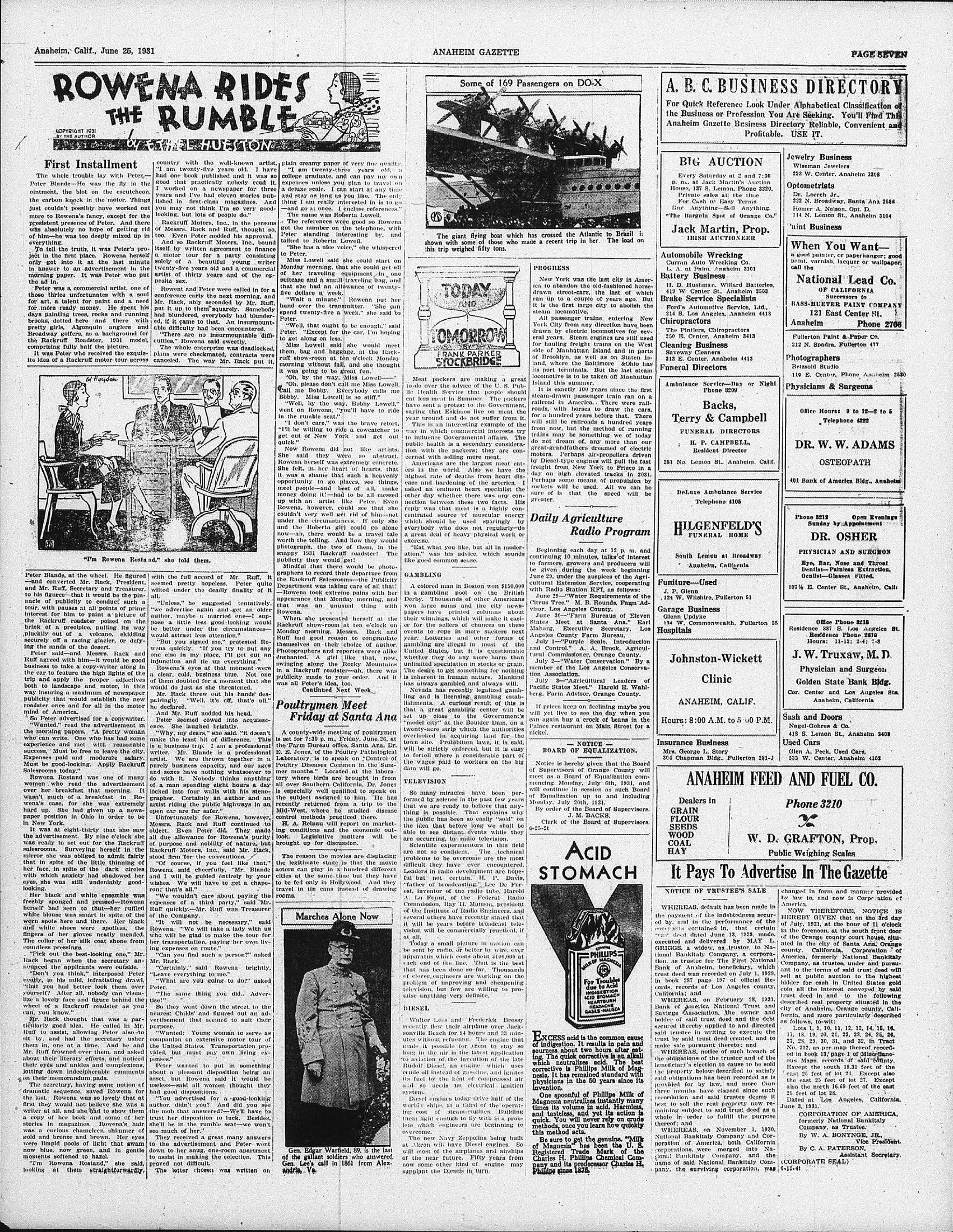
Searchable text
Anaheim, Calif., June 25, 1931
ROWENA RIDES THE RUMBLE
by FINE HUETTON
First Installment
The whole trouble lay with Peter.—Peter Blande—He was the fly in the ointment, the blot on the escutcheon, the carbon knock in the motor. Things just couldn't possibly have worked out more to Rowena's fancy, except for the presistent presence of Peter. And there was absolutely no hope of getting rid of him—he was too deeply mixed up in everything.
To tell the truth, it was Peter's project in the first place. Rowena herself only got into it at the last minute in answer to an advertisement in the morning paper. It was Peter who put the ad in.
Peter was a commercial artist, one of those thrice unfortunates with a soul for art, a talent for paint and a need for more ready money. He spent his days painting trees, rocks and running brooks, dotted here and there with pretty girls, Algonquin anglers and Broadway golfers, as a background for the Rackruff Roadster, 1931 model, comprising fully half the picture.
It was Peter who received the exquisite idea of a Rackruff motor tour across country with the well-known artist, "I am twenty-five years old. I have had one book published and it was so good that practically nobody read it. I worked on a newspaper for three years and I've had eleven stories published in first-class magazines. And you may not think I'm so very good-looking, but lots of people do."
Rackruff Motors, Inc., in the persons of Messrs. Rack and Ruff, thought so, too. Even Peter nodded his approval.
And so Rackruff Motors, Inc., bound itself by written agreement to finance a motor tour for a party consisting solely of a beautiful young writer twenty-five years old and a commercial artist of thirty years and of the opposite sex.
Rowent and Peter were called in for a conference early the next morning, and Mr. Rack, ably seconded by Mr. Ruff, put it up to them squarely. Somebody had blundered, everybody had blundered, if it came to that. An insurmountable difficulty had been encountered.
"There are no insurmountable difficulties," Rowena said sweetly.
The whole enterprise was deadlocked, plans were checkmated, contracts were canceled. The way Mr. Rack put it,
"I am twenty-three college graduate, and can expenses unless you play a deluxe scale. I can strand and stay as long as you thing I am really interested—and go at once. I enclave the name was Roberta.
The references were given the number on the Peter standing interest talked to Roberta Lowell.
"She has a nice voice," to Peter.
Miss Lowell said she Monday morning, that she of her traveling equipment suitcase and a small travel that she had an allowance five dollars a week.
"Wait a minute." Rowent over the transmission spend twenty-five a week Peter.
"Well, that ought to be Peter. "Except for the case to get along on less.
Miss Lowell said she them, bag and baggage, ruff show-room at ten o'clock without fall, and it was going to be great.
"Oh, by the way, Miss."
"Oh, please don't call me Call me Bobby. Everyboby. Miss Lowell is."
"Well, by the way, B went on Rowena, 'you'll in the rumble seat."
"I don't care," was the "I'll be willing to ride a get out of New York quick."
Now Rowena did not She said they were
"I'm Rowena Rostand," she told them.
Peter Blande, at the wheel. He figured—and converted Mr. Rack, President, and Mr. Ruff, Secretary and Treasurer, to his figures—that it would be the pinnacle of publicity to conduct such a tour, with pauses at all points of prime interest for him to paint a picture of the Rackruff roadster poised on the brink of a precipice, pulling its way pluckily out of a volcano, skidding securely off a racing glacier, or defying the sands of the desert.
Peter said—and Messrs. Rack and Ruff agreed with him—it would be good business to take a copy-writer along in the car to feature the high lights of the trip and apply the proper adjectives both to landscape and motor, in this way insuring a maximum of newspaper publicity that would establish the new roadster once and for all in the motor mind of America.
So Peter advertised for a copywriter.
"Wanted," read the advertisement in the morning papers. "A pretty woman who can write. One who has had some experience and met with reasonable success. Must be free to leave the city. Expenses paid and moderate salary. Must be good-looking. Apply Rackruff Salesrooms today."
Rowena Rostand was one of many women who read the advertisement over her breakfast that morning. It wasn't much of a breakfast in Rowena's case, for she was extremely hard up. She had given up a newspaper position in Ohio in order to be in New York.
It was at eight-thirty that she saw the advertisement. By nine o'clock she was ready to set out for the Rackruff salesrooms. Surveying herself in the mirror she was obliged to admit fairly that in spite of the little thinning of her face, in spite of the dark circles with the full accord of Mr. Ruff, it seemed pretty hopeless. Peter quite wilted under the deadly finality of it all.
"Unless," he suggested tentatively, "we advertise again and get an older author, maybe a married one—I suppose a little less look-inking would be better under the circumstances—would attract less attention."
"But you signed me," protested Rowena quickly. "If you try to put any one else in my place, I'll get out an injunction and tie up everything."
Rowena's eyes at that moment-were a clear, cold, business blue. Not one of them doubted for a moment that she would do just as she threatened.
Mr. Rack threw out his hands despairingly. "Well, it's off, that's all," he declared.
And Mr. Ruff nodded his head.
Peter seemed cowed into acquiescence. She laughed brightly.
"Why, my dears," she said. "It doesn't make the least bit of difference. This is a business trip. I am a professional writer. Mr. Blande is a professional artist. We are thrown together in a purely business capacity, and our ages and sexes have nothing whatsoever to do with it. Nobody thinks anything of a man spending eight hours a day locked into four walls with his stenographer. Certainly an author and an artist riding the public highways in an open car are far safer."
Unfortunately for Rowena, however, Messrs. Rack and Ruff continued to object. Even Peter did. They made all due allowance for Rowena's purity of purpose and nobility of nature, but Rackruff Motors, Inc., said Mr. Rack, stood firm for the conventions.
"Of course, if you feel like that," Rowena said cheerfully.
"I'm Rowena Rostand," she told them.
Peter Blande, at the wheel. He figured—and converted Mr. Rack, President, and Mr. Ruff, Secretary and Treasurer, to his figures—that it would be the pinnacle of publicity to conduct such a tour, with pauses at all points of prime interest for him to paint a picture of the Rackruff roadster poised on the brink of a precipice, pulling its way pluckily out of a volcano, skidding securely off a racing glacier, or defying the sands of the desert.
Peter said—and Messrs. Rack and Ruff agreed with him—it would be good business to take a copy-writer along in the car to feature the high lights of the trip and apply the proper adjectives both to landscape and motor, in this way insuring a maximum of newspaper publicity that would establish the new roadster once and for all in the motor mind of America.
So Peter advertised for a copywriter.
"Wanted," read the advertisement over her breakfast that morning. It wasn't much of a breakfast in Rowena's case, for she was extremely hard up. She had given up a newspaper position in Ohio in order to be in New York.
It was at eight-thirty that she saw the advertisement. By nine o'clock she was ready to set out for the Rackruff salesrooms. Surveying herself in the mirror she was obliged to admit fairly that in spite of the little thinning of her face, in spite of the dark circles with the full accord of Mr. Ruff, it seemed pretty hopeless. Peter quite wilted under the deadly finality of it all.
"Unless," he suggested tentatively, "we advertise again and get an older author, maybe a married one—I suppose a little less look-inking would be better under the circumstances—would attract less attention."
"But you signed me," protested Rowena quickly. "If you try to put any one else in my place, I'll get out an injunction and tie up everything."
Rowena's eyes at that moment-were a clear, cold, business blue. Not one of them doubted for a moment that she would do just as she threatened.
Mr. Rack threw out his hands despairingly. "Well, it's off, that's all," he declared.
And Mr. Ruff nodded his head.
Peter seemed cowed into acquiescence. She laughed brightly.
"Why, my dears," she said. "It doesn't make the least bit of difference. This is a business trip. I am a professional writer. Mr. Blande is a professional artist. We are thrown together in a purely business capacity, and our ages and sexes have nothing whatsoever to do with it. Nobody thinks anything of a man spending eight hours a day locked into four walls with his stenographer. Certainly an author and an artist riding the public highways in an open car are far safer."
Unfortunately for Rowena, however, Messrs. Rack and Ruff continued to object. Even Peter did. They made all due allowance for Rowena's purity of purpose and nobility of nature, but Rackruff Motors, Inc., said Mr. Rack, stood firm for the conventions.
"Of course, if you feel like that," Rowena said cheerfully.
"I'm Rowena Rostand," she told them.
Peter Blande, at the wheel. He figured—and converted Mr. Rack, President, and Mr. Ruff, Secretary and Treasurer, to his figures—that it would be the pinnacle of publicity to conduct such a tour, with pauses at all points of prime interest for him to paint a picture of the Rackruff roadster poised on the brink of a precipice, pulling its way pluckily out of a volcano, skidding securely off a racing glacier, or defying the sands of the desert.
Peter said—and Messrs. Rack and Ruff agreed with him—it would be good business to take a copy-writer along in the car to feature the high lights of the trip and apply the proper adjectives both to landscape and motor, in this way insuring a maximum of newspaper publicity that would establish the new roadster once and for all in the motor mind of America.
So Peter advertised for a copywriter.
"Wanted," read the advertisement over her breakfast that morning. It wasn't much of a breakfast in Rowena's case, for she was extremely hard up. She had given up up a newspaper position in Ohio in order to be in New York.
It was at eight-thirty that she saw the advertisement. By nine o'clock she was ready to set out for the Rackruff salesrooms. Surveying herself in the mirror she was obliged to admit fairly that in spite of the little thinning of her face, in spite of the dark circles with the full accord of Mr. Ruff, it seemed pretty hopeless. Peter quite wilted under the deadly finality of it all.
"Unless," he suggested tentatively, "we advertise again and get an older author, maybe a married one—I suppose a little less look-inking would be better under the circumstances—would attract less attention."
"But you signed me," protested Rowena quickly. "If you try to put any one else in my place, I'll get out an injunction and tie up everything."
Rowena's eyes at that moment-were a clear, cold, business blue. Not one of them doubted for a moment that she would do just as she threatened.
Mr. Rack threw out his hands despairingly. "Well, it's off, that's all," he declared.
And Mr. Ruff nodded his head.
Peter seemed cowed into acquiescence. She laughed brightly.
"Why, my dears," she said. "It doesn't make the least bit of difference. This is a business trip. I am a professional writer. Mr. Blande is a professional artist. We are thrown together in a purely business capacity, and our ages and sexes have nothing whatsoever to do with it. Nobody thinks anything of a man spending eight hours a day locked into four walls with his stenographer. Certainly an author and an artist riding the public highways in an open car are far safer."
Unfortunately for Rowena, however, Messrs. Rack and Ruff continued to object. Even Peter did. They made all due allowance for Rowena's purity of purpose and nobility of nature, but Rackruff Motors, Inc., said Mr. Rack, stood firm for the conventions.
"Of course, if you feel like that," Rowena said cheerfully.
"I'm Rowena Rostand," she told them.
Peter Blande, at the wheel. He figured—and converted Mr.Rackruff Salesrooms—Department was taking care—Rowena took extreme pearliness that Monday that was an unusual Rowena.
When she presented her Rackruff show-room at tuesday morning, Messrs.Ruff had good reason to themselves on their choir Photographers and reporter enchanted.A girl liked swinging along the Rockin'a Rackruff roadster—publicity made to your own was all Peter's idea, too.
Continued Next
Poultrymen Friday at Sail
A county-wide meeting on is set for 7:30 p.m., Fridaythe Farm Bureau office,S.E.E Jones.of The PoultryLaboratory.is to speak on Poultry Diseases Commonmer months." Located at factory where birds are browall over Southern Californiais especially well qualifiedthe subject assignedto recently returned from A Mid-Westwhere he attentcontrol methods practiced
H.A.Reinau will reporting conditions andthelook.Legislative mattersbrought up for discussion
The reason the movies arethe legitimate stage istheactors can play ina hung
Rowena Rostand was one of many women who read the advertisement over her breakfast that morning. It wasn't much of a breakfast in Rowena's case, for she was extremely hard up. She had given up a newspaper position in Ohio in order to be in New York.
It was at eight-thirty that she saw the advertisement. By nine o'clock she was ready to set out for the Rackruff salesrooms. Surveying herself in the mirror she was obliged to admit fairly that in spite of the little thinning of her face, in spite of the dark circles with which anxiety had shadowed her eyes, she was still undeniably good-looking.
Her black and white ensemble was freshly sponged and pressed—Rowena herself had seen to that—her ruffled white blouse was smart in spite of the worn spots here and there. Her black and white shoes were spotless, the fingers of her gloves neatly mended. The collar of her silk coat shone from countless pressings.
"Pick out the best-looking one," Mr. Rack began when the secretary announced the applicants were outside.
"Don't you think," interposed Peter neatly, in his mild, infrailiating drawl, "that you had better look them over yourself? After all, nobody can visualize a lovely face and figure behind the wheel of a Rackruff roadster as you can, you know."
Mr. Rack thought that was a particularly good idea. He called in Mr. Ruff to assist, allowing Peter also to sit by, and had the secretary usher them in, one at a time. And he and Mr. Ruff frowned over them, and asked about their literary efforts, and noticed their eyes and ankles and complexions, jotting down indecipherable comments on their memorandum pads.
The secretary, having some notion of dramatic sequence, saved Rowena for the last. Rowena was so lovely that at first they would not believe she was a writer at all, and she had to show them a copy of her book and some of her stories in magazines. Rowena's hair was a curious chameleon shimmer of gold and bronze and brown. Her eyes were limpid pools of light that swam now blue, now green, and in gentle moments softened to hazel.
"I'm Rowena Rostand," she said, looking at them straightforwardly.
Nobody thinks anything of a man spending eight hours a day locked into four walls with his stenographer. Certainly an author and an artist riding the public highways in an open car are far safer.
Unfortunately for Rowena, however, Messrs. Rack and Ruff continued to object. Even Peter did. They made all due allowance for Rowena's purity of purpose and nobility of nature, but Rackruff Motors, Inc., said Mr. Rack, stood firm for the conventions.
"Of course, if you feel like that," Rowena said cheerfully, "Mr. Blande and I will be guided entirely by your wishes. We will have to get a chaperon; that's all."
"We wouldn't care about paying the expenses of a third party," said Mr. Ruff quickly. "Mr. Ruff was Treasurer of the Company.
"It will not be necessary," said Rowena. "We will take a lady with us who will be glad to make the tour for her transportation, paying her own living expenses en route."
"Can you find such a person?" asked Mr. Rack.
"Certainly," said Rowena brightly. "Leave everything to me."
"What are you going to do?" asked Peter.
"The same thing you did." Advertise!
So they went down the street to the nearest Childs' and figured out an advertisement that seemed to suit their purpose.
Wanted: Young woman to serve as companion on extensive motor tour of the United States. Transportation provided, but must pay own living expenses.
Peter wanted to put in something about a pleasant disposition being an asset, but Rowena said it would be useless—said all women thought they had good dispositions.
"You advertised for a good-looking author, didn't you? And did you see the mob that answered?—We'll have to trust her disposition to luck. Besides, she'll be in the rumble seat—we won't see much of her."
They received a great many answers to the advertisement and Peter went down to her snug, one-room apartment to assist in making the selection. This proved not difficult.
The letter chosen was written on...
plain creamy paper of very fine quality.
"I am twenty-three years old, a college graduate, and can pay my own expenses unless you plan to travel on a deluxe scale. I can start at any time and stay as long as you like. The only thing I am really interested in is to go—and go at once. I enclose references."
The name was Roberta Lowell.
The references were good so Rowena got the number on the telephone, with Peter standing interesting by, and talked to Roberta Lowell.
"She has a nice voice," she whispered to Peter.
Miss Lowell said she could start on Monday morning, that she could get all of her traveling equipment in one suitcase and a small travelling bag, and that she had an allowance of twenty-five dollars a week.
"Wait a minute." Rowena put her hand over the transmitter. "She can spend twenty-five a week," she said to Peter.
"Well, that ought to be enough," said Peter. "Except for the car, I'm hoping to get along on less.
Miss Lowell said she would meet them, bag and baggage, at the Rackruff show-room at ten o'clock Monday morning without fall, and she thought it was going to be great fun.
"Oh, by the way, Miss Lowell——"
"Oh, please don't call me Miss Lowell. Call me Bobby. Everybody calls me Bobby. Miss Lowell is so stuff."
"Well, by the way, Bobby Lowell," went on Rowena, "you'll have to ride in the rumble seat."
"I don't care," was the brave retort, "I'll be willing to ride a cowcatcher to get out of New York and get out quick."
Now Rowena did not like artists. She said they were so abstract.
Some of 169 Passengers on DO-X
The giant flying boat which has crossed the Atlantic to Brazil is shown with some of those who made a recent trip in her. The load on this trip weighed fifty tons.
PROGRESS
New York was the last city in America to abandon the old-fashioned horse-drawn street-cars, the last of which ran up to a couple of years ago. But it is the first large city to abolish the steam locomotive.
All passenger trains entering New York City from any direction have been drawn by electric locomotives for several years. Steam engines are still used for hauling freight trains on the West side of Manhattan Island and in parts of Brooklyn, as well as on Staten Island, where the Baltimore & Ohio has its port terminals. But the last steam locomotive is to be taken off Manhattan island this summer.
It is exactly 100 years since the first steam-drawn passenger train ran on a railroad in America. There were railroads, with horses to draw the cars, for a hundred years before that. There will still be railroads a hundred years from now, but the method of running trains may be something we of today do not dream of, any more than our great-grandfathers dreamed of electric motors. Perhaps air-propellers driven
morning without fall, and she thought it was going to be great fun.
"Oh, by the way, Miss Lowell—"
"Oh, please don't call me Miss Lowell. Call me Bobby. Everybody calls me Bobby. Miss Lowell is so stiff."
"Well, by the way, Bobby Lowell," went on Rowena, "you'll have to ride in the rumble seat."
"I don't care," was the brave retort, "I'll be willing to ride a cowcatcher to get out of New York and get out quick."
Now Rowena did not like artists. She said they were so abstract. Rowena herself was extremely concrete. She felt, in her heart of hearts, that it was a shame that such a heavenly opportunity to go places, see things, meet people—and best of all, make money doing it!—had to be all messed up with an artist like Peter. Even Rowena, however, could see that she couldn't very well get rid of him—not under the circumstances. If only she and the Roberta girl could go alone now—ah, there would be a travel tale worth the telling. And how they would photograph, the two of them, in the happy 1931 Rackruff roadster! The publicity they would get!
Mindful that there would be photographers to record their departure from the Rackruff Salesrooms—the Publicity Department was taking care of all that! Rowena took extreme pains with her appearance that Monday morning, and that was an unusual thing with Rowena.
When she presented herself at the Rackruff show-room at ten o'clock on Monday morning, Messrs. Rack and Ruff had good reason to congratulate themselves on their choice of author, photographers and reporters were alike enchanted. A girl like that, now swinging along the Rocky Mountains in a Rackruff roadster—a, there was publicity made to your order. And it was all Peter's idea, too.
Continued Next Week
Poultrymen Meet Friday at Santa Ana
A county-wide meeting of poultrymen is set for 7:30 p.m., Friday, June 26, at the Farm Bureau office, Santa Ana, Dr. J. E. Jones, of the Poultry Pathological Laboratory, is to speak on "Control of poultry Diseases Common in the Summer months." Located at the laboratory where birds are brought in from all over Southern California, Dr. Jones especially well qualified to speak on the subject assigned to him. He has recently returned from a trip to the Mid-West, where he studied disease control methods practiced there.
H. A. Relnau will report on marketing conditions and the economic outlook. Legislative matters will be brought up for discussion.
The reason the movies are displacing the legitimate stage is that the movie actors can play in a hundred different Meat packers are making a great do-to-over the advice of the U.S. Public Health Service that people should eat less meat in Summer. The packers have sent a protest to the Government, saying that Eskimos live on meat the year around and do not suffer from it. This is an interesting example of the way in which commercial interests try to influence Governmental affairs. The public health is a secondary consideration with the packers; they are concerned with selling more meat.
Americans are the largest meat eaters in the world. Also we have the highest rate of deaths from heart disease and hardening of the arteries. I asked an eminent heart specialist the other day whether there was any connection between these two facts. His reply was that meat is a highly concentrated source of muscular energy which should be used sparingly by everybody who does not regularly do a great deal of heavy physical work or exercise.
"Eat what you like, but all in moderation," was his advice, which sounds like good common sense.
GAMBLING
A colored man in Boston won $150,000 in a gambling pool on the British Derby. Thousands of other Americans won large sums and the city newspapers have printed columns about their winnings, which will make it easier for the sellers of chances on these events to rope in more suckers next year. Lotteries and other forms of gambling are illegal in most of the United States, but it is questionable whether they do any more harm than unlimited speculation in stocks or grain. The desire to get something for nothing is inherent in human nature. Mankind has always gambled and always will.
Nevada has recently legalized gambling and is licensing gambling establishments. A curious result of this is that a great gambling center will be set up close to the Government's "model city" at the Boulder Dam, on a twenty-acre strip which the authorities overlooked in acquiring land for the town site. Prohibition laws, it is said, will be strictly enforced, but it is easy to tortell where a considerable part of the wages paid to workers on the big dam will go.
TELEVISION
So many miracles have been performed by science in the past few years that we are ready to believe that anything is possible. That explains why the public has been so easily "sold" on the idea that before long we shall be able to see distant events while they are occurring, by radio television.
Scientific experiments in this field are not so confident. The technical problems to be overcome are the most difficult they have ever encountered.
Beginning each day at 12 p.m. and continuing 10 minutes, talks of interest to farmers, growers and producers will be given during the week beginning June 29, under the auspices of the Agricultural Extension Service, cooperating with Radio Station KFI, as follows:
June 29—"Water Requirements of the Citrus Tree." M.B. Rounds, Farn Advisor, Los Angeles County.
June 30—"Farm Bureau of Eleven States Meet at Santa Ana." Earl Maharg, Executive Secretary, Los Angeles County Farm Bureau.
July 1—"Purple Scale, Introduction and Control." A.A. Brook, Agricultural Commissioner, Orange County.
July 2—"Water Conservation." By a member of the Los Angeles Conservation Association.
July 3—"Agricultural Leaders of Pacific States Meet." Harold E. Wahlberg, Farm Advisor, Orange County.
If prices keep on declining maybe you will yet live to see the day when you can again buy a crock of beans in the Palace restaurant on Main Street for a nickel.
NOTICE BOARD OF EQUALIZATION.
Notice is hereby given that the Board of Supervisors of Orange County will meet as a Board of Equalization commencing Monday, July 6th, 1931, and will continue in session as such Board of Equalization up to and including Monday, July 20th, 1931.
By order of the Board of Supervisors.
J.M. BACKS,
Clerk of the Board of Supervisors.
6-25-2t
The reason the movies are displacing the legitimate stage is that the movie actors can play in a hundred different cities at the same time but they have to be fed only in Hollywood. And they travel in tin cans instead of drawing rooms.
TELEVISION
So many miracles have been performed by science in the past few years that we are ready to believe that anything is possible. That explains why the public has been so easily "sold" on the idea that before long we shall be able to see distant events while they are occurring, by radio television.
Scientific experimenters in this field are not so confident. The technical problems to be overcome are the most difficult they have ever encountered. Leaders in radio development are hopeful but not certain. H. P. Davis, "father of broadcasting," Lee De Forrest, inventor of the radio tube, Harold A. La Fount, of the Federal Radio Commission, Ray H. Manson, president of the Institute of Radio Engineers, and several others have recently stated that it will be years before broadcast television will be commercially practical, if at all.
Today a small picture in motion can be sent by radio, or better by wire, over apparatus which costs about $100,000 at each end of the line. That is the best that has been done so far. Thousands of clever engineers are working on the problem of improving and cheapening television, but few are willing to promise anything very definite.
DIESEL
Walter Lees and Frederick Brossy recently flew their airplane over Jacksonville Beach for 84 hours and 33 minutes without refueling. The engine that made it possible for them to stay so long in the air is the latest application to aviation of the invention of the late Rudolf Diesel, an engine which uses crude oil instead of gasoline, and ignites its fuel by the heat of compressed air and so needs no electrical ignition system.
Diesel engines today drive half of the world's ships, at a third of the operating cost of steam-engines. Building them light enough to fly with is a problem which engineers are beginning to overcome.
The new Navy Zeppelin being built at Akron will have Diesel engines. So will most of the airplanes and airships of the near future. Fifty years from now some other kind of engine may supplant the Diesels in turn.
ACID STOMACH
Excess acid is the common cause of indigestion. It results in pain and sourness about two hours after eating. The quick corrective is an alkali which neutralizes acid. The best corrective is Phillips Milk of Magnesia. It has remained standard with physicians in the 50 years since its invention.
One spoonful of Phillips Milk of Magnesia neutralizes instantly many times its volume in acid, Harmless, and tasteless, and yet its action is quick. You will never rely on crude methods, once you learn how quickly this method acts.
Be sure to get the genuine. "Milk of Magnesia" has been the U.S. Registered Trade Mark of the Charles H. Phillips Chemical Company and its predecessor Charles H. Phillips since 1876.
A. B. C. BUSINESS DIRECTORY
For Quick Reference Look Under Alphabetical Classification of the Business or Profession You Are Seeking. You'll Find This Anaheim Gazette Business Directory Reliable, Convenient and Profitable. USE IT.
BIG AUCTION
Every Saturday at 2 and 7:30 p.m., at Jack Martin's Auction House, 137 S. Lemon, Phone 3220. Private sales all the time. For Cash or Easy Terms. Buy Anything—Sell Anything. "The Bargain Spot of Orange Co."
Jack Martin, Prop.
IRISH AUCTIONEER
Automobile Wrecking
Curran Auto Wrecking Co.
L. A. at Palm, Anaheim 3101
Battery Business
H. D. Hushman, Willard Batteries,
419 W. Center St., Anaheim 3503
Brake Service Specialists
Ford's Automotive Service, Ltd.,
214 S. Los Angeles, Anaheim 4418
Chiropractors
The Pintlers, Chiropractors
250 E. Center, Anaheim 3413
Cleaning Business
Saveway Cleaners
313 E. Center, Anaheim 4413
Funeral Directors
Ambulance Service—Day or Night
Phone 8209
Backs,
Terry & Campbell
FUNERAL DIRECTORS
H. P. CAMPBELL,
Resident Director
Jewelry Business
Wiseman Jewelers
223 W. Center, Anaheim 3308
Optometrists
Dr. Loerch Jr.,
222 N. Broadway, Santa Ana 2586
Homer A. Nelson, Opt. D.
114 N. Lemon St., Anaheim 3104
Paint Business
When You Want—a good painter, or paperhanger; good paint, varnish, lacquer or wallpaper; call the National Lead Co.
OF CALIFORNIA
Successors to BASS-HUETER PAINT COMPANY
121 East Center St.
Anaheim Phone 2706
Fullerton Paint & Paper Co.
212 N. Spadra, Fullerton 477
Photographers
Betzsoid Studio
119 E. Center, Phone Anaheim 2530
Physicians & Surgeons
Office Hours: 9 to 12—2 to 5
Telephone 4822
DR. W. W. ADAMS
Funeral Directors
Ambulance Service—Day or Night
Phone 8209
Backs,
Terry & Campbell
FUNERAL DIRECTORS
H. P. CAMPBELL,
Resident Director
251 No. Lemon St., Anaheim, Calif.
DeLuxe Ambulance Service
Telephone 4105
HILGENFELD'S
FUNERAL HOME
South Lemon at Broadway
Anaheim, California
Funiture—Used
J. P. Glenn
124 W. Wilshire, Fullerton 51
Garage Business
Glenn Updyke
134 W. Commonwealth, Fullerton 55
Hospitals
Johnston-Wickett
Clinic
ANAHEIM, CALIF.
Hours: 8:00 A.M. to 5:00 P.M.
Insurance Business
Mrs. George L. Story
304 Chapman Bldg., Fullerton 281-J
ANAHEIM FEED AND FUEL CO.
Dealers in
GRAIN
FLOUR
SEEDS
WOOD
COAL
HAY
Phone 3210
W. D. GRAFTON, Prop.
Public Weighing Scales
IT PAYS TO ADVERTise IN THE GAZETTE
NOTICE OF TRUSTEE'S SALE
WHEREAS, default has been made in the payment of the indebtedness secured by, and in the performance of the contracts contained in, that certain trust deed dated June 13, 1929, made, executed and delivered by MAY L. GRIGGS, a widow, as trustor, to National Bankitaly Company, a corporation, as trustee for The First National Bank of Anaheim, beneficiary, which trust deed was recorded on July 1, 1929, in book 287 page 197 of official Records, records of Los Angeles county, California; and
WHEREAS, on February 28, 1931, Bank of America National Trust and Savings Association, the owner and holder of said trust deed and the debt secured thereby applied to and directed said trustee in writing to execute the trust by said trust deed created, and to make sale pursuant thereto; and
WHEREAS, notice of such breach of the obligations of the trustor and of the beneficiary's election to cause to be sold the property below described to satisfy said obligations has been recorded as is provided for by law, and more than three months have elapsed since such recordation and said trustee deems it best to sell the real property now remaining subject to said trust deed as a whole in order to fulfill the purpose thereof; and
WHEREAS, on November 1, 1930, National Bankitaly Company and Corporation of America, both California corporations, were merged into National Bankitaly Company, and the name of said National Bankitaly Company, the surviving corporation, was changed in form and manner provided by law to, and now is Corporation of America.
NOW THEREFORE, NOTICE IS HEREBY GIVEN that on the 3rd day of July, 1931, at the hour of 11 o'clock in the forenoon, at the south front door of the Orange county court house, situated in the city of Santa Ana, Orange county, California, Corporation of America, formerly National Bankitaly Company, as trustee, under and pursuant to the terms of said trust deed will sell at public auction to the highest bidder for cash in United States gold coin all the interest conveyed by said trust deed in and to the following described real property situated in the city of Anaheim, Orange county, California, and more particularly described as follows: to-wit:
Lots 1, 9, 10, 11, 12, 13, 14, 15, 16, 17, 18, 19, 20, 21, 22, 23, 24, 25, 26, 27, 28, 29, 30, 31, and 32 in Tract No. 212; as per map thereof recorded in book 13; page 1 of Miscellaneous Maps; records of said county. Except the south 18.31 feet of the east 25 feet of lot 26. Except also the east 25 feet of lot 27. Except also the north 16.69 feet of the east 25 feet of lot 28.
Dated at Los Angeles, California, June 3, 1931.
CORPORATION OF AMERICA,
formerly National Bankitaly Company, as Trustee.
By W. A. BONYNGE, JR., Vice President.
By C. A. PATERSON,
Assistant Secretary.
(CORPORATE SEAL)