anaheim-gazette 1929-11-07
Scanned page
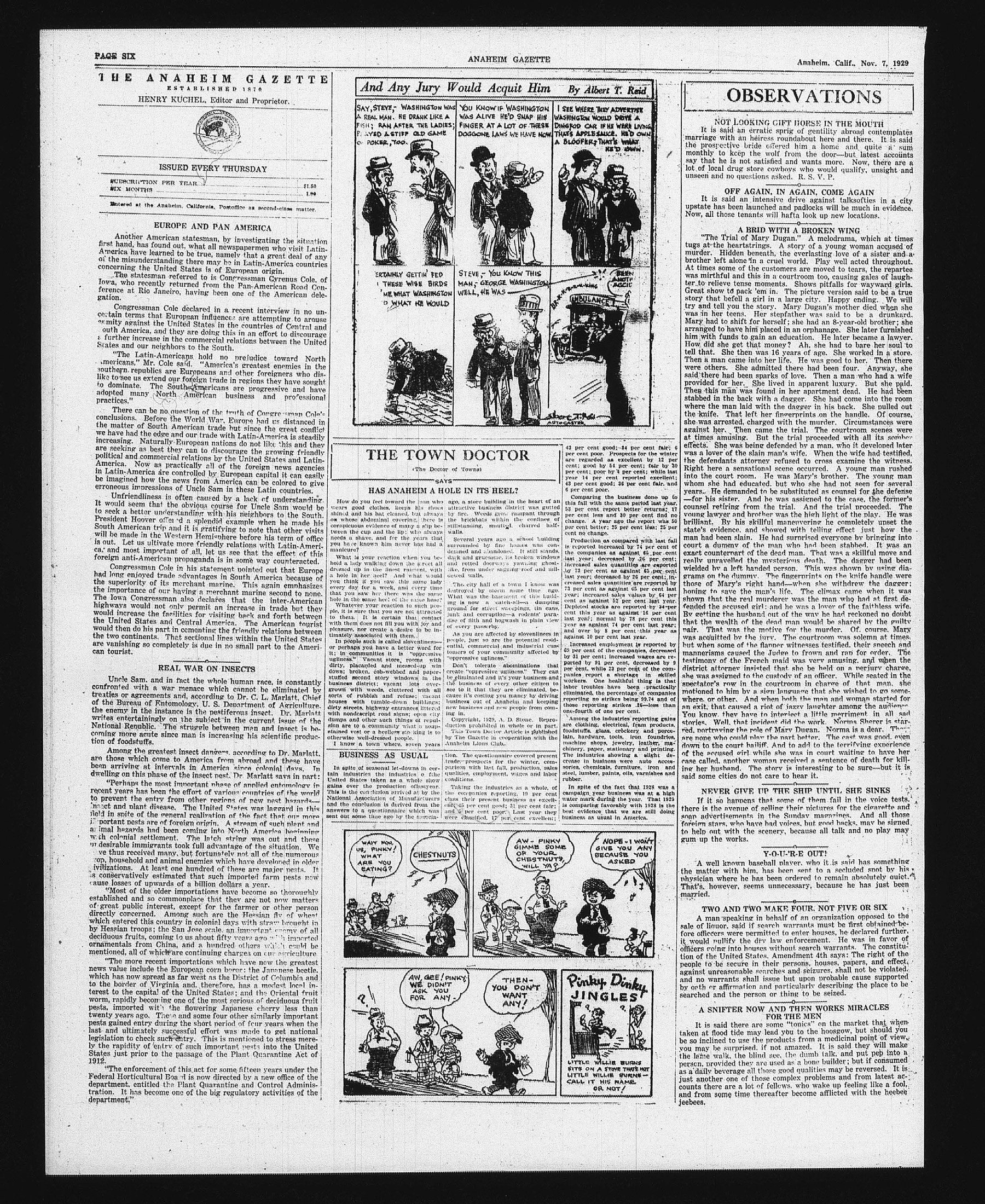
Searchable text
THE ANAHEIM GAZETTE
ESTABLISHED 1870
HENRY KUCHEL, Editor and Proprietor.
ISSUED EVERY THURSDAY
SUBSCRIPTION PER YEAR $1.50
SIX MONTHS 1.00
Entered at the Anaheim, California, Postoffice as second-class matter.
EUROPE AND PAN AMERICA
Another American statesman, by investigating the situation first hand, has found out, what all newspapermen who visit Latin-America have learned to be true, namely that a great deal of any of the misunderstanding there may be in Latin-America countries concerning the United States is of European origin.
The statesman referred to is Congressman Cyrenus Cole, of Iowa, who recently returned from the Pan-American Road Conference at Rio Janeiro, having been one of the American delegation.
Congressman Cole declared in a recent interview in no uncertain terms that European influences are attempting to arouse immunity against the United States in the countries of Central and South America, and they are doing this in an effort to discourage further increase in the commercial relations between the United States and our neighbors to the South.
"The Latin-Americans hold no prejudice toward North Americans," Mr. Cole said. "America's greatest enemies in the southern republics are Europeans and other foreigners who dislike to see us extend our foreign trade in regions they have sought to dominate. The South Americans are progressive and have adopted many North American business and professional practices."
There can be no question of the truth of Congressman Cole's conclusions. Before the World War, Europe had us distanced in the matter of South American trade but since the great conflict we have had the edge and our trade with Latin-America is steadily increasing. Naturally European nations do not like this and they are seeking as best they can to do
"The Latin-Americans hold no prejudice toward North Americans," Mr. Cole said. "America's greatest enemies in the southern republics are Europeans and other foreigners who dislike to see us extend our foreign trade in regions they have sought to dominate. The South-Americans are progressive and have adopted many North American business and professional practices."
There can be no question of the truth of Congressman Cole's conclusions. Before the World War, Europe had us distanced in the matter of South American trade but since the great conflict we have had the edge and our trade with Latin-America is steadily increasing. Naturally European nations do not like this and they are seeking as best they can to discourage the growing friendly political and commercial relations by the United States and Latin-America. Now as practically all of the foreign news agencies in Latin-America are controlled by European capital it can easily be imagined how the news from America can be colored to give erroneous impressions of Uncle Sam in these Latin countries.
Unfriendliness is often caused by a lack of understanding. It would seem that the obvious course for Uncle Sam would be to seek a better understanding with his neighbors to the South. President Hoover offered a splendid example when he made his South American trip and it is gratifying to note that other visits will be made in the Western Hemisphere before his term of office is out. Let us ultivate more friendly relations with Latin-America, and most important of all, let us see that the effect of this foreign anti-American propaganda is in some way counteracted.
Congressman Cole in his statement pointed out that Europe had long enjoyed trade advantages in South America because of the superiority of its merchant marine. This again emphasizes the importance of our having a merchant marine second to none. The Iowa Congressman also declares that the inter-American highways would not only permit an increase in trade but they would increase the facilities for visiting back and forth between the United States and Central America. The American tourist would then do his part in cementing the friendly relations between the two continents. That sectional lines within the United States are vanishing so completely is due in no small part to the American tourist.
REAL WAR ON INSECTS
Uncle Sam, and in fact the whole human race, is constantly confronted with a war menace which cannot be eliminated by treaties or agreements and, according to Dr. C. L. Marlatt, Chief of the Bureau of Entomology, U. S. Department of Agriculture, the enemy in the instance is the pestiferous insect. Dr. Marlatt writes entertainingly on the subject in the current issue of the National Republic. The struggle between man and insect is becoming more acute since man is increasing his scientific production of foodstuffs.
Among the greatest insect dangers, according to Dr. Marlatt, are those which come to America from abroad and these have been arriving at intervals in America since colonial days. In dwelling on this phase of the insect nest, Dr. Marlatt says in part:
"Perhaps the most important phase of applied entomology in recent years has been the effort of various countries of the world to prevent the entry from other regions of new pest hazards—insect and plant disease. The United States was lagged in this field in spite of the general realization of the fact that our more important pests are of foreign origin. A stream of such plant and animal hazards had been coming into North America beginning with colonial settlement. The latch string was out and these undesirable immigrants took full advantage of the situation. We
are those which come to America from abroad and these have been arriving at intervals in America since colonial days. In dwelling on this phase of the insect pest, Dr. Marlatt says in part:
"Perhaps the most important phase of applied entomology in recent years has been the effort of various countries of the world to prevent the entry from other regions of new pest hazards—insect and plant disease. The United States was lagging in this field in spite of the general realization of the fact that our more important pests are of foreign origin. A stream of such plant and animal hazards had been coming into North America beginning with colonial settlement. The latch string was out and these undesirable immigrants took full advantage of the situation. We have thus received many, but fortunately not all of the numerous crop, household and animal enemies which have developed in older civilizations. At least one hundred of these are major pests. It is conservatively estimated that such imported farm pests now cause losses of upwards of a billion dollars a year.
"Most of the older importations have become so thoroughly established and so commonplace that they are not now matters of great public interest, except for the farmer or other person directly concerned. Among such are the Hessian fly of wheat which entered this country in colonial days with straw brought in by Hessian troops; the San Jose scale, an important enemy of all deciduous fruits, coming to us about fifty years ago with imported ornamentals from China, and a hundred others which could be mentioned, all of which are continuing charges on our agriculture.
"The more recent importations which have now the greatest news value include the European corn borer: the Japanese beetle, which has now spread as far west as the District of Columbia and to the border of Virginia and, therefore, has a modest local interest to the capital of the United States; and the Oriental fruit worm, rapidly becoming one of the most serious of deciduous fruit pests, imported with the flowering Japanese cherry less than twenty years ago. These and some four other similarly important pests gained entry during the short period of four years when the last and ultimately successful effort was made to get national legislation to check such entry. This is mentioned to stress merely the rapidity of entry of such important pests into the United States just prior to the passage of the Plant Quarantine Act of 1912.
"The enforcement of this act for some fifteen years under the Federal Horticultural Board is now directed by a new office of the department, entitled the Plant Quarantine and Control Administration. It has become one of the big regulatory activities of the department."
And Any Jury Would Acquit Him By Albert T. Reid
SAY, STEVE; WASHINGTON WAS A REAL MAN. HE DRANK LIKE A FISH; RAN AFTER THE LADIES; PLAYED A STIFF OLD GAME OR POKER, TOO.
YOU KNOW IF WASHINGTON WAS ALIVE HE'D SNAP HIS FINGER AT A LOT OF THESE DOGGONE LAWS WE HAVE NOW.
I SEE WHERE THEY ADVERTISE WASHINGTON WOULD DRIVE A DINGFORD CAR IF HE WERE LIVING THAT'S APPLE SAUCE. HE'D OWN A BLOOFER; THAT'S WHAT HE'D OWN.
ERTAINLY GETTIN' FEED I THESE WISE BIRDS ME WHAT WASHINGTON D WHAT HEWOULD
STEVE; YOU KNOW THIS MAN, GEORGE WASHINGTON WELL, HE WAS
EMBOLLANCE
THE TOWN DOCTOR
(The Doctor of Towns)
SAYS
HAS ANAHEIM A HOLE IN ITS HEEL?
How do you feel toward the man who wears good clothes, keeps his shoes shined and his hat cleaned, but always on whose abdominal covering, there is conspicuous evidence of many a slip between the cup and the lip; who always needs a shave, and for the years that you have known him never has had a manicure?
What is your reaction when you behold a lady walking down the street all dressed up in the finest rament, with a hole in her heel? And what would you think if you saw this same lady every day for a week, and every time that you saw her there was the same hole in the same heel of the same hose?
Whatever your reaction to such people, it is sure that you are not attracted to them. It is certain that contact with them does not fill you with joy and pleasure, nor create a desire to be intimately associated with them.
In people such is called sloveniness—or perhaps you have a better word for it; in communities it is "oppressive ugliness." Vacant store, rooms with dirty, placarded and messed-up windows; broken cob-webbed and paper-stuffed second story windows in the business district; vacant lots overgrown with weeds, cluttered with all sorts of rubbish and refuse; vacant houses with tumble-down buildings; dirty streets, highway entrances littered with nondescript road signs; open city dumps and other such things of repulsion are to a community what a soustained vest or a heelless stocking is to otherwise well-dressed people.
I know a town where, seven years ago, a store building in the heart of an attractive business district was gutted by fire. Weeds grow rampant through the brick walls within the confines of stillstanding, smuttig, charred half-walls.
Several years ago a school building surrounded by fine homes was condemned and abandoned. It still stands, dark and gruesome, its broken windows and rotted doorways yawning ghost-like, from under sagging roof and mildewed walls.
The city hall of a town I know was destroyed by storm some time ago. What was the basement of this building is now a catch-all—a dumping ground for street sweepings, tin cans, junk and corruption—a rodents' paradise of filth and hogwash in plain view of every passerby.
As you are affected by slovenliness in people, just so are the potential residential, commercial and industrial customers of your community affected by "oppressive ugliness."
Don't tolerate abominations that create "oppressive ugliness." They can be eliminated and it's your business and the business of every other citizen to see to it that they are eliminated, because it's costing you money by driving business out of Anaheim and keeping new business and new people from coming in.
Copyright, 1929, A. D. Stone. Reproduction prohibited in whole or in part.
This Town Doctor Article is published by The Gazette in cooperation with the Anaheim Lions Club.
BUSINESS AS USUAL
In spite of seasonal let-downs in certain industries the industries o f the United States taken as a whole show gains over the production offlastyear. This is the conclusion arrived at by the National Association of Manufacturers and the conclusion is derived from the answers to a questionnaire which was sent out some time ago by the association.
The questionnaire covered present trade-prospects for the winter, comparison with last fall, production, sales qualities, employment, wages and labor conditions.
Taking the industries as a whole, of the companies reporting, 19 per cent class their present business as excellently 45 per cent good; 31 per cent fair; and 6 per cent poor. Last year they were classified, 17 per cent excellent;
43 per cent good; -34 per cent fair; 6 per cent poor. Prospects for the winter are regarded as excellent by 12 per cent; good by 54 per cent; fair by 30 per cent; poor by 7 per cent; while last year 14 per cent reported excellent; 43 per cent good; 36 per cent fair, and 6 per cent poor.
Comparing the business done up to this fall with the same period last year, 53 per cent report better returns; 17 per cent less and 30 per cent find no change. A year ago the report was 50 per cent better; 25 per cent less; 25 per cent no change.
Production as compared with last fall is reported increased by 74 per cent of the companies as against 65 per cent last year; decreased by 26 per cent; increased sales quantities are reported by 73 per cent as against 65 per cent last year; increased sales values by 64 per cent as against 52 per cent last year. Depleted stocks are reported by 44-percent this year as against 16 per cent last year; normal by 78 per cent this year as against 74 per cent last year; and over by 8 per cent this year as against 10 per cent last year.
Increased employment is reported by 69 per cent of the companies, decreased by 31 per cent; increased wages are reported by 91 per cent, decreased by 9 per cent, while 23 per cent of the companies report a shortage in skilled workers. One healthful thing is that labor troubles have been practically eliminated, the percentage of companies reporting no strikes being 99.74 and of those reporting strikes 26-less than one-fourth of one per cent.
Among the industries reporting gains are clothing, electrical, fram products, foodstuffs, glass, crockery, and porcelain, hardware, tools, iron foundries, machine shops, jewelry, leather, machinery, paper, stationary and printing.
The industries showing a slight decrease in business were auto accessories, chemicals, furniture, iron and steel, lumber, paints, oils, varnishes and rubber.
In spite of the fact that 1928 was a campaign year business was at a high water mark during the year. That 1929 is comparing favorably with 1928 is the best evidence that we are still doing business as usual in America.
In spite of seasonal let-downs in certain industries the industries o f the United States taken as a whole show gains over the production offlast year. This is the conclusion arrived at by the National Association of Manufacturers and the conclusion is derived from the answers to a questionnaire which was sent out some time ago by the association.
Taking the industries as a whole, of the companies reporting, 19 per cent class their present business as excellent; 45 per cent good; 31 per cent fair; and 6 per cent poor. Last year they were classified, 17 per cent excellent;
WAIT FOR US, PINKY! WHAT ARE YOU EATING?
CHESTNUTS
AW - PINKY GIMME SOME OR YOUR CHESTNUTS, WILL YA?
NOPE-I WON'T GIVE YOU ANY BECAUSE YOU ASKED
AW, GEE! PINKY, WE DIDN'T ASK YOU FOR ANY!
THEN- YOU DON'T WANT ANY!
Pinky, Dinky JINGLES
LITTLE WILLIE BURNS SITS ON A STONE THAT'S NOT LITTLE WILLIE BURNE—CALL IT HIS NAME OR NOT!
OBSERVATIONS
NOT LOOKING GIFT HORSE IN THE MOUTH
It is said an erratic sprig of gentility abroad contemplates marriage with an heiress roundabout here and there. It is said the prospective bride offered him a home and quite a sum monthly to keep the wolf from the door—but latest accounts say that he is not satisfied and wants more. Now, there are a lot of local drug store cowboys who would qualify, unsight and unseen and no questions asked. R. S. V. P.
OFF AGAIN, IN AGAIN, COME AGAIN
It is said an intensive drive against talksofties in a city upstate has been launched and padlocks will be much in evidence. Now, all those tenants will hafta look up new locations.
A BRID WITH A BROKEN WING
"The Trial of Mary Dugan." A melodrama, which at times tugs at the heartstrings. A story of a young woman accused of murder. Hidden beneath, the everlasting love of a sister and a brother left alone in a cruel world. Play well acted throughout. At times some of the customers are moved to tears, the repartee was mirthful and this in a courtroom too, causing gales of laughter to relieve tense moments. Shows pitfalls for wayward girls. Great show to pack 'em in. The picture version said to be a true story that befell a girl in a large city. Happy ending. We will try and tell you the story. Mary Dugan's mother died when she was in her teens. Her stepfather was said to be a drunkard. Mary had to shift for herself; she had an 8-year-old brother; she arranged to have him placed in an orphanage. She later furnished him with funds to gain an education. He later became a lawyer. How did she get that money? Ah, she had to bare her soul to tell that. She then was 16 years of age. She worked in a store. Then a man came into her life. He was good to her. Then there were others. She admitted there had been four. Anyway, she said there had been sparks of love. Then a man who had a wife provided for her. She lived in apparent luxury. But she paid. Then this man was found in her apartment dead. He had been stabbed in the back with a dagger. She had come into the room where the man laid with the dagger in his back. She pulled out the knife. That left her fingerprints on the handle. Of course, she was arrested, charged with the murder. Circumstances were against her. Then came the trial. The courtroom scenes were at times amusing. But the trial proceeded with all its somber effects. She was being defended by a man, who it developed later
NEVER GIVE UP THE SHIP UNTIL SHE SINKS
If it so happens that some of them fail in the voice tests,
there is the avenue of selling their pictures for the cigarette and soap advertisements in the Sunday magazines. And all those foreign stars, who have had voices, but good backs, may be signed to help out with the scenery, because all talk and no play may gum up the works.
NEVER GIVE UP THE SHIP UNTIL SHE SINKS
If it so happens that some of them fail in the voice tests,
there is the avenue of selling their pictures for the cigarette and soap advertisements in the Sunday magazines. And all those foreign stars, who have bad voices, but good hacks, may be signed to help out with the scenery, because all talk and no play may gum up the works.
Y-O-U-R-E OUT!
A well known baseball player, who it is said has something the matter with him, has been sent to a secluded spot by his physician where he has been ordered to remain absolutely quiet. That's, however, seems unnecessary, because he has just been married.
TWO AND TWO MAKE FOUR. NOT FIVE OR SIX
A man speaking in behalf of an organization opposed to the sale of liquor, said if search warrants must be first obtained before officers were permitted to enter houses, he declared further, it would nullify the civil law enforcement. He was in favor of officers going into houses without search warrants. The constitution of the United States, Amendment 4th says: The right of the people to be secure in their persons, houses, papers, and effect against unreasonable searches and seizures, shall not be violated, and no warrants shall issue but upon probable cause supported by oath or affirmation and particularly describing the place to be searched and the person or thing to be seized.
A SNIFTER NOW AND THEN WORKS MIRACLES FOR THE MEN
It is said there are some "tonics" on the market that when taken at flood tide may lead you to the hoosgow, but should you be so inclined to use the products from a medicinal point of view, you may be surprised, if not amazed. It is said they will make the lame walk, the blind see, the dumb talk, and put pep into a person, provided they are used as a bone builder; but if consumed as a daily beverage all those good qualities may be reversed. It is just another one of those complex problems and from latest accounts there are a lot of fellows, who wake up feeling like a fool, and from some time thereafter become afflicted with the heebee jeebees.