anaheim-gazette 1929-11-07
Scanned page
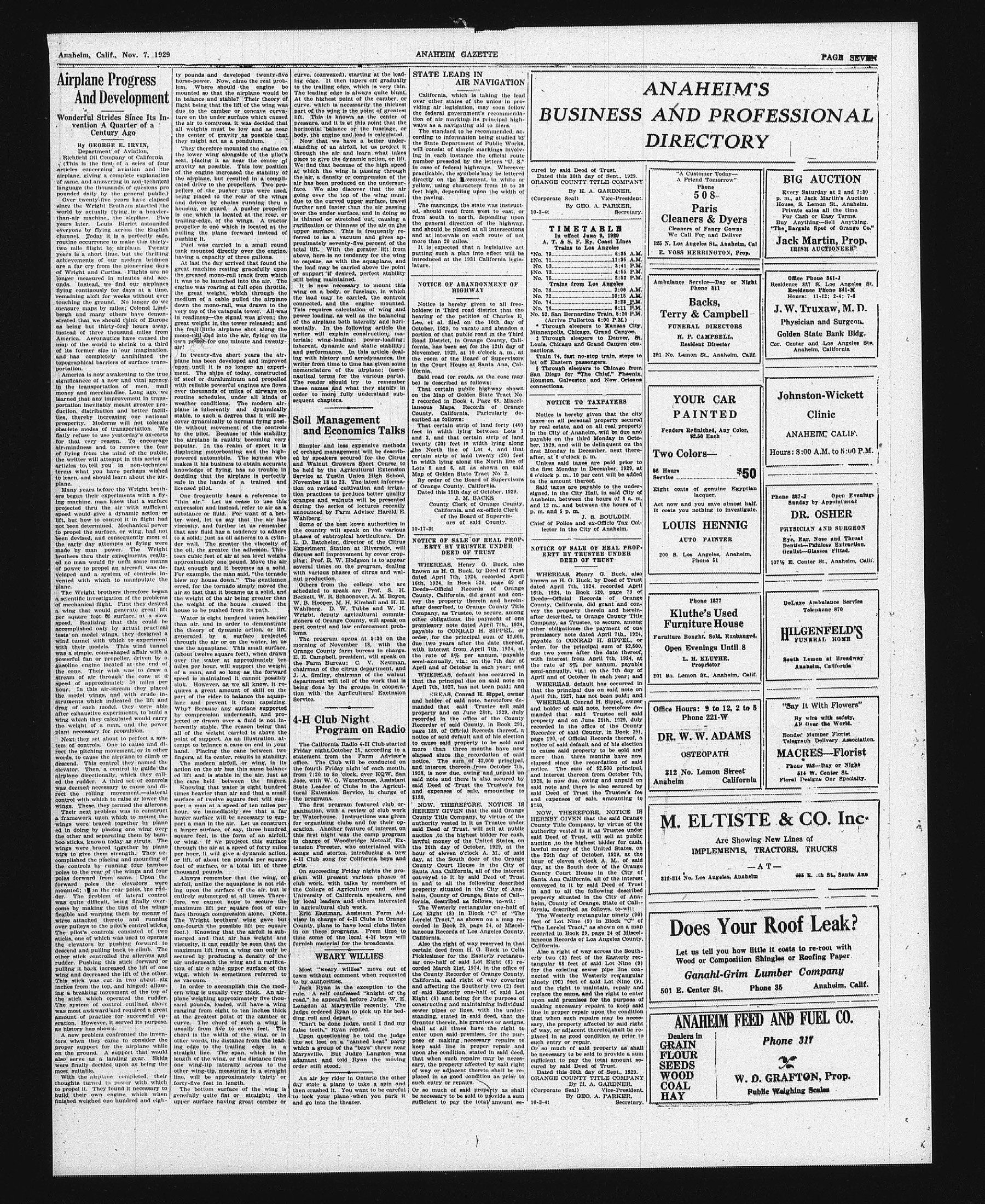
Searchable text
Airplane Progress And Development
Wonderful Strides Since Its Invention A Quarter of a Century Ago
By GEORGE E. IRVIN,
Department of Aviation,
Richfield Oil Company of California
(This is the first of four articles concerning aviation and the airplane, giving a complete explanation of same, and answering in non-technical language the thousands of questions proounded daily by the general public.)
Over twenty-five years have elapsed since the Wright Brothers started the world by actually flying in a heavier-than-air machine, the airplane. Five years later, Louis Bleriot astounded everyone by flying across the English channel. Today it is a perfectly safe, routine occurrence to make this thirty-two mile flight by airplane. Twenty years is a short time, but the thrilling achievements of our modern bridmen are a far cry from the pioneering days of Wright and Curtiss. Flights are no longer measured in minutes and seconds. Instead, we find our airplanes flying continuously for days at a time, remaining aloft for weeks without ever touching the ground. No longer do we measure maps by miles; Colonel Lindbergh and many others have demonstrated that we should think of Europe as being but thirty-four hours away, instead of three thousand miles from America. Aeronautics have caused the map of the world to shrink to a third of its former size in our imagination, and has completely annihilated the topographical barriers of surface transportation.
America is now awakening to the true significance of a new and vital agency in the transportation of men, mail money and merchandise. Long ago, we learned that any improvement in transportation inevitably meant greater production, distribution and better facilities, thereby increasing our national prosperity. Moderns will not tolerate obsolete modes of transportation. We flatly refuse to use yesterday's ox-carts for that very reason. To encourage air-mindness and to remove the feary pounds and developed twenty-five horse-power. Now, came the real problem. Where should the engine be mounted so that the airplane would be in balance and stable? Their theory of flight being that the lift of the wing was due to the camber or concave curvature on the under surface which caused the air to compress, it was decided that all weights must be low and as near the center of gravity as possible that they might act as a pendulum.
They therefore mounted the engine on the lower wing alongside of the pilot's seat, placing it as near the center of gravity as possible. This low position of the engine increased the stability of the airplane, but resulted in a complicated drive to the propellers. Two propellers of the pusher type were used, being placed to the rear of the wings and driven by chains running thru a housing, or guard. A pusher propeller is one which is located at the rear, or trailing-edge, of the wings. A tractor propeller is one which is located at the pulling the plane forward instead of pushing it.
Fuel was carried in a small round tank mounted directly over the engine, having a capacity of three gallons.
At last the day arrived that found the great machine resting gracefully upon the greased mono-rail track from which it was to be launched into the air. The engine was roaring at full open throttle, the great weight, which through the medium of a cable pulled the airplane down the mono-rail, was drawn to the very top of the catapula tower. All was in readiness—the signal was given; the great weight in the tower released; and the frail little airplane shot along the mono-rail and into the air, flying on its own power for one minute and twenty-air!
In twenty-five short years the airplane has been developed and improved upon, until it is no longer an experiment. The ships of today, constructed of steel or duraluminum and propelled with reliable powerful engines are flown over thousands of miles of airways on routine schedules, under all kinds of weather conditions. The modern airplane is inherently and dynamically stable, to such a degree that it will cover dynamically to normal flying position without movement of the controls by the pilot. Because of this stability the airplane is rapidly becoming very popular. In the realm of sport it is curve (convexed), starting edge to the trailing edge, which The leading edge is always At the highest point of the curve, which is necessarily part of the wing is the pull lift. This is known as pressure, and it is at this horizontal balance or body, the engine and load.
Now that we have a standing of an airfoil, let through the air and learn place to give the dynamic We find that because of it at which the wing is pass the air, a density or compaction We also discover going over the top of it due to the curved upper farther and faster than over the under surface, and is thinned or stretched on face. We also discover going over the top of it due to the curved upper farther and faster than over the under surface, and is thinned or stretched on face. We also discover going over the top of it due to the curved upper farther and faster than over the under surface, and is thinned or stretched on face.
It is now necessary towing on a body, or fuselage, the load may be carried attached, and the engine This requires calculation power loading, as well as of the airplane both laterally. In the following writer will explain constructions; wing-loading; inherent dynamic and structural performance. In this writing with history and aeronautic writer from time to time have nomenclature for the vane The reader should try these names and what they order to more fully understand sequent chapters.
Soil Management and Economic
Simpler and less expensive
and has completely annihilated the topographical barriers of surface transportation.
America is now awakening to the true significance of a new and vital agency in the transportation of men, mail money and merchandise. Long ago, we learned that any improvement in transportation inevitably meant greater production, distribution and better facilities, thereby increasing our national prosperity. Moderns will not tolerate obsolete modes of transportation. We flatly refuse to use yesterday's ox-carts for that very reason. To encourage air-mindness and to remove the fear of flying from the mind of the public, the writer will attempt in this series of articles to tell you in non-technical terms what you have perhaps wished to learn, and should learn about the airplane.
Many years before the Wright brothers began their experiments with a flying machine, man knew that a surface projected thru the air with sufficient speed would give a dynamic action or lift, but how to control it in flight had not been determined. Mechanical power to propel the surface, or wing, had not been devised, and consequently most of the early day attempts at flying were made by man power. The Wright brothers thru their experiments, realized no man would fly until some means of power to propel an aircraft was developed and a system of controls invented with which to manipulate the plane.
The Wright brothers therefore began a scientific investigation of the problems of mechanical flight. First they desired a wing that would generate great lift per square foot of surface, at a slow speed. Realizing that this could be accomplished only by actual practical tests on model wings, they designed a wind tunnel with which to experiment with their models. This wind tunnel was a simple, cone-shaped affair with a powerful fan or propeller, driven by a gasoline engine located at the end of the cone. Their wish was to draw a stream of air through the cone at a speed of approximately 50 miles per hour. In this air-stream they placed the model wings, and with crude instruments which indicated the lift and drag of each model, they were able after exhaustive experiments, to build a wing which they calculated would carry the weight of a man, and the power plant necessary for propulsion.
Next they set about to perfect a system of controls. One to cause and direct the pitching movement, or in other words, to cause the airplane to climb or descend. This control they named the elevator. Then, a control to guide the airplane directionally, which they called the rudder. A third set of controls was deemed necessary to cause and direct the rolling movement—alateral control with which to raise or lower the wings. These, they termed the allerons.
Their next problem was to construct a framework upon which to mount the wings were braced together by plane ed in doing by placing one wing over the other and separating them by bamboo sticks, known today as struts. The wings were braced together by plano
In twenty-five short years the airplane has been developed and improved upon; until it is no longer an experiment. The ships of today, constructed of steel or duraluminum and propelled with reliable powerful engines are flown over thousands of miles of airways on routine schedules, under all kinds of weather conditions. The modern airplane is inherently and dynamically stable, to such a degree that it will recover dynamically to normal flying position without movement of the controls by the pilot. Because of this stability the airplane is rapidly becoming very popular. In the realm of sport it is displacing motorboating and the high-powered automobile. The layman who makes it his business to obtain accurate knowledge of flying, has no trouble in deciding that the airplane is perfectly safe in the hands of a trained and licensed pilot.
One frequently hears a reference to "thin air." Let us cease to use this expression and instead, refer to air as a substance or fluid. For want of a better word, let us say that the air has viscosity, and further let us remember that any fluid has a tendency to adhere to a solid; just as oil adheres to a cylinder wall. The greater the viscosity of the oil, the greater the adhesion. Thirteen cubic feet of air at sea level weighs approximately one pound. Move the air fast enough and it becomes as a solid. For example, the man said, "the tornado blew my house down." The gentlemen erred, for the tornado simply moved the air so fast that it became as a solid, and the weight of the air being greater than the weight of the house caused the house to be pushed from its path.
Water is eight hundred times heavier than air, and in order to demonstrate the theory of dynamic action, or lift, generated by a surface projected through the air or on the water, let us use the aquaplane. This small surface (about twelve square feet), when drawn over the water at approximately ten miles per hour, will support the weight of a man, and so long as the forward speed is maintained it cannot possibly sink. However, as we all know, it requires a great amount of skill on the part of the rider to balance the aquaplane and prevent it from capsize. Why? Because any surface supported by compression underneath, and projected or drawn over a fluid is not inherently stable. The reason being that all of the weight carried is above the point of support. As an illustration, attempt to balance a cane on end in your hand. Placing the cane between two fingers, at its center, results in stability.
The modern airfoil, or wing, in its action on the air has this same balanced lift and is stable in the air, just as the cane held between the fingers.
Knowing that water is eight hundred times heavier than air and that a small surface of twelve square feet will support a man at a speed of ten miles per hour, we immediately see that a far larger surface will be necessary to support a man in the air. Let us construct a larger surface, of say three hundred square feet, in the form of an airfoil, or wing. If we project this surface through the air at a speed of forty miles
Soil Management and Economic Simpler and less expensive of orchard management wired by speakers secured for Walnut Growers Shore be held by the Agricultural Service at Tustin Union November 18 to 23. The laction on revised cultivation practices to produce oranges and walnuts will during the series of lectures announced by Farm Advice Wahiberg.
Some of the best kowns in the country will speak on phases of subtropical horticulture L.D. Batchelor, director Experiment Station at R discuss soil improvement being; Prof. R.W.Hodgson several times on the program with various phases of citi nut production.
Others from the college scheduled to speak are Beckett, W.R.Schoonover, W.B.Hooper, M.H.Kimbwa Wahiberg, D.W.Tubbs Wright, deputy agriculturists of Orange County pest control and law enforcement lems.
The program opens at morning of November 18 Orange County farm bureau E.E.Campbell president, the Farm Bureau; C.chairman of the citrus department J.A.Smiley, chairman o department will tell of these being done by the groupation with the Agricultural Service.
4-H Club Night Program o
The California Radio 4-H Friday night October 25,a statement from the Farn office.The Club will be onthe fourth Friday night ofrom 7:20to 8'clock.overJosewith W.G.Waterhouse State Leader of Clubs intural Extension Service,the programs.
The first program feature organization, with a review by Waterhouse. Instruction for organizing clubs and education.Another feature this first night was the call in charge of Woodbridge tension Forester, who ent
words, to cause the airplane to climb or descend. This control they named the elevator. Then, a control to guide the airplane directionally, which they called the rudder. A third set of controls was deemed necessary to cause and direct the rolling movement—alateral control with which to raise or lower the wings. These, they termed the allerons.
Their next problem was to construct a framework upon which to mount the wings were braced together by plane ed in doing by placing one wing over the other and separating them by bamboo sticks, known today as struts. The wings were braced together by piano wire to give them strength. They accomplished the placing and mounting of the controls by running four bamboo poles to the rear of the wings and four poles forward from same. Upon the forward poles the elevators were mounted; on the rear poles, the rudder. The problem of lateral control was quite difficult, being finally overcome by making the tips of the wings flexible and warping them by means of wires attached thereto and running over pulleys to the pilot's control sticks. The pilot's controls consisted of two sticks, one of which was used to operate the elevators by pushing forward to descend and pulling back to climb. The other stick controlled the allerons and rudder. Pushing this stick forward or pulling it back increased the lift of one wing and decreased the lift of the other. This stick was cut in two about six inches from the top, and hinged; allowing a breaking movement of the top of the stick which operated the rudder. The system of control outlined above was most awkward and required a great amount of practice for successful operation. However, it served its purpose, as history has shown.
A new problem confronted the inventors when they came to consider the proper support for the airplane while on the ground. A support that would also serve as a landing gear. Skids were finally decided upon as being the most suitable.
With the airplane completed, their thoughts turned to power with which to propel it. They found it necessary to build their own engine, which when finished weighed one hundred and eighty pounds.
Alaways remember that the wing, or airfoil, unlike the aquaplane is not riding upon the surface of the air, but is entirely submerged at all times. Therefore, we cannot hope to secure the maximum lift per square foot of surface through compression alone. (Note: The Wright brothers' wing gave but one-fourth the possible lift per square foot.) Knowing that the airfoil is submerged and that air has weight and viscosity, it can readily be seen that the maximum lift from a wing can only be secured by producing a density of the air underneath the wing and a ramification of air on the upper surface of the wing, which is sometimes referred to as vacuum.
In order to accomplish this the modern wing is usually very thick. An airplane weighing approximately five thousand pounds, loaded, will have a wing ranging from eight to ten inches thick at the greatest point of the camber or curve. The chord of such a wing is usually from five to seven feet. The chord is the width of the wing, or in other words, the distance from the leading edge to the trailing edge in a straight line. The span, which is the length of the wing, or the distance from one wing-tip laterally across to the other wing-tip, measuring in a straight line, will be approximately thirty or forty-five feet in length.
The bottom surface of the wing is generally quite flat or straight; the upper surface having great camber or fingers, at its center, results in stability.
The modern airfoil, or wing, in its action on the air has this same balanced lift and is stable in the air, just as the cane held between the fingers.
Knowing that water is eight hundred times heavier than air and that a small surface of twelve square feet will support a man at a speed of ten miles per hour, we immediately see that a far larger surface will be necessary to support a man in the air. Let us construct a larger surface, of say, three hundred square feet, in the form of an airfoil, or wing. If we project this surface through the air at a speed of forty miles per hour, it will give a dynamic action, or lift, of about ten pounds per square foot of surface, or a total lift of three thousand pounds.
Alaways remember that the wing, or airfoil, unlike the aquaplane is not riding upon the surface of the air, but is entirely submerged at all times. Therefore, we cannot hope to secure the maximum lift per square foot of surface through compression alone. (Note: The Wright brothers' wing gave but one-fourth the possible lift per square foot.) Knowing that the airfoil is submerged and that air has weight and viscosity, it can readily be seen that the maximum lift from a wing can only be secured by producing a density of the air underneath the wing and a ramification of air onthe upper surface ofthe wing,which is sometimes referred to as vacuum.
In order to accomplish this the modern wing is usually very thick. An airplane weighing approximately five thousand pounds, loaded, will have a wing ranging from eight to ten inches thick at the greatest point of the camber or curve. The chord of such a wing is usually from five to seven feet. The chord is the width of the wing, or in other words, the distance from the leading edge to the trailing edge in a straight line. The span, which is the length ofthe wing, orthe distance from one wing-tip laterally across tothe other wing-tip, measuring in a straight line, will be approximately thirty or forty-five feet in length.
The bottom surface ofthe wing is generally quite flat or straight;the upper surface having great camber or fingers,at its center,results in stability.
The modern airfoil,orwing,nin action ontheairhasthissamebalancedliftandisstableintheair,justascanheheldbetweenthefingerss.
Knowingthatwateriseighthundredtimesheavierthanairandthatsmallsurfaceoftwelvesquarefeetwillsupportamanatatspeedoftenmilesperhourweimmediatelyseethatafarlighersurfacewillbenecessarytosupportamanintheair.Letusconstructa largersurface,say,treshnedsquarefeet.in,theformofanairfoil.orwing.lifewithprojectthissurfacethroughtheairatatspeedoffortymilesperhour.itwillgiveadynamicactionorlift.ofabouttenpoundspersquarefootofsurface.oratatotalliftofthree thousandpounds.
Alawaysrememberthatthewing,theairfoilunliketheaquaplaneseisnotridinguponthesurfaceoftheairbutisentirelysubmergedatalltimes.Thereforewecannothopetosecurethemaximumliftpersquarefootofsurfacethroughcompressionalone.(Note:TheWrightbrothers'winggavebutone-fourththepossibleliftpersquarefoot.)Knowingthattheairfoilissubmergedandthatairhasweightandviscosityitcanreadilybeseenthatthemaximumliftfromawingcanonlybesecuredbyproducinga densityoftheairundernethethewingandrarificationofairontheuppersurfaceofthewingwhichissimestereferredtoasvacuum.
Inordertoccomplishthisthemodernwingisusuallyverythick.Anairplaneweighingapproximatelyfive thousandpoundsloadedwillhaveawingrangingfromeighttoteninchesthickatthegreatestpointofthecamberorcurve.Thechordofsuchawingisusuallyfromfivetosevenfeet.Thechordisthewidthofthewing,或inotherwords,thedistancefromtheleadingedgetothetrailingedgeinastraightline.Thespanwhichislengthofthewing,或thedistancefromonewing-tiplaterallyacrosstotheotherwing-tip.measuringinastraightline.willbeapproximatelythirtyorto forty-fivefeetinlength.
Thebottomsurfaceofthewingisgenerallyquiteflatorstraight;theuppersurfacehavinggreatcamberorfingers.atitscenter.resultsinstability.
Themodernairfoilorwing.initsactionontheairhasthissamebalancedliftandisstableintheair.justascanheheldbetweenthefingerss.
Knowingthatwateriseighthundredtimesheavierthanairandthatsmallsurfaceoftwelvesquarefeetwillsupportamanatatspeedoftenmilesperhour.lifewithprojectthissurfacethroughtheairatatspeedoffortymilesperhour.itwillgiveadynamicactionorlift.ofabouttenpoundspersquarefootofsurface.oratatotalliftofthree thousandpounds.
Alawaysrememberthatthewing,theairfoilunliketheaquaplaneseisnotridinguponthesurfaceoftheairbutisentirelysubmergedatalltimes.Thereforewecannothopetosecurethemaximumliftpersquarefootofsurfacethroughcompressionalone.(Note:TheWrightbrothers'winggavebutone-fourththepossibleliftpersquarefoot.)Knowingthattheairfoilissubmergedandthatairhasweight和viscosityitcanreadilybeseenthatthemaximumliftfromawingcanonlybesecuredbyproducinga densityoftheairundernethethewingandrarificationofairontheuppersurfaceofthewingwhichissimestereferredtoasvacuum.
Inordertoccomplishthisthemodernwingisusuallyverythick.Anairplaneweighingapproximatelyfive thousandpoundsloadedwillhaveawingrangingfromeightto十inchesthickatthegreatestpointofthecamberorcurve.Thechordofsuchawingisusuallyfromfivetosevenfeet.Thechordisthewidthofthewing,或inotherwords,thedistancefromtheleadingedgetothetrailingedgeinastraightline.Thespanwhichislengthofthewing,或thedistancefromonewing-tiplaterallyacrosstotheotherwing-tip.measuringinastraughtline.willbeapproximatelythirtyorto forty-fivefeetinlength.
Thebottomsurfaceofthewingisgenerallyquiteflatorstraight;theuppersurfacehavinggreatcamberorfingers.atitscenter.resultsinstability.
Themodernairfoilorwing.initsactionontheairhasthissamebalancedliftandisstableintheair.justascanheheldbetweenthefingerss.
Knowingthatwateriseight Hundred timesheavierthan空气和水是相同的。空气和水是相同的。
Themodernairfoilorwing.initsactionontheairhasthissamebalancedliftandisstableintheair.justascanheheldbetweenthefingerss.
Knowingthatwateriseight Hundred timesheavierthan空气、水是相同的。
Themodernairfoilorwing.initsactionontheairhasthissamebalancedliftandisstableintheair.justascanheheldbetweenthefingerss.
Knowingthatwateriseight Hundred timesheavierthan空气、水是相同的。
Themodernairfoilorwing.initsactionontheairhasthissamebalancedliftandisstableintheair.justascanheheldbetweenthefingerss.
Knowingthatwateriseight Hundred timesheavierthan空气、水是相同的。
Themodernairfoilorwing.initsactionontheairhasthissamebalancedliftandisstableintheair.justascanheheldbetweenthefingerss.
Knowingthatwateriseight Hundred timesheavierthan空气、水是相同的。
Themodernairfoilorwing.initsactionontheairhasthissamebalancedliftandisstableintheair.justascanheheldbetweenthefingerss.
Knowingthatwateriseight Hundred timessheavierthan空气、水是相同的。
Themodernairfoilorwing.initsactionontheairhasthissamebalancedliftandisstableintheair.justascanheheldbetweenthefingerss.
Knowingthatwateriseight Hundred timessheavierthan空气、水是相同的。
Themodernairfoilorwing.initsactionontheairhasthissamebalancedliftandisstableintheair.justascanheheldbetweenthefingerss.
Knowingthatwateriseight Hundred timessheavierthan空气、水是相同的。
Themodernairfoilorwing.initsactionontheairhasthissamebalancedliftandisstableintheair.justascanheheldbetweenthefingerss.
Knowingthatwateriseight Hundred timessheavierthan空气、水是相同的。
Themodernairfoilorwing.initsactionontheairhasthissamebalancedliftandisstablein.theair.justascanheheldbetween.thefingerss.
Knowingthatwateriseight Hundred timessheavierthan空气、水是相同的。
Themodernairfoilorwing.initsactionontheairhasthissamebalancedliftandisstablein.theair.justascanheheldbetween.thefingerss.
Knowingthatwateriseight Hundred timessheavierthan空气、水是相同的。
Themodernairfoilorwing.initsactionontheairhasthissamebalancedliftandisstablein.theair.justascanheheldbetween.thefingerss.
Knowingthatwaterisseight Hundred timessheavierthan空气、水是相同的。
Themodernairfoilorwing.initsactionontheairhasthissamebalancedliftandisstablein.theair.justascanheheldbetween.thefingerss.
Knowingthatwaterisseight Hundred timessheavierthan空气、水是相同的。
Themodernairfoilorwing.initsactionontheairhasthissamebalancedliftandisstablein.theair.justascanheheldbetween.thefingerss.
Knowingthatwaterisseight Hundred timessheavierthan空气、水是相同的。
Themodernairfoilorwing.initsactionontheairhasthissamebalancedliftandisstablein.theair.justascan heheldbetween.thefingerss.
Knowingthatwaterisseight Hundred timesshevierthan空气、水是相同的。
Themodernairfoilorwing.initsactionontheairhasthissamebalancedliftandisstablein.theair.justascan heheldbetween.thefingerss.
Knowingthatwaterisseight Hundred timesshevierthan空气、水是相同的。
Themodernairfoilorwing.initsactionontheairhasthissamebalancedliftandisstablein.theair.justascan heheldbetween.thefingerss.
Knowingthatwaterisseight Hundred timesshevierthan空气、水是相同的。
Themodernairfoilorwing.initsactionontheairhasthissamebalancedliftandisstablein.theair.justascan heheldbetween.thefingerss.
Knowingthatwaterisseight Hundred timesshevierthan空气、水是相同的。
Themodernairfoilorwing.initsactionontheairhasthissamebalancedliftandisstablein.theair.justascan heheldbetween.thefingerss.
Knowingthatwaterisseight Hundred timesshevierthan空气、水是相同的。
Themodernairfoilorwing.initsactionontheairhasthissamebalancedliftandisstablein.theair.justascan heheldbetween.thefingerss.
Knowingthatwaterisseight Hundred timesshevierthan空气、水是相同的。
Themodernairfoilorwing.initsactionontheairhasthissamebalancedliftandisstablein.theair.justascan heheldbetween.thefingerss.
Knowingthatwaterisseight Hundred timesshevierthan空气、水是相同的。
Themodernairfoilorwing.initsactionontheairhasthissamebalancedliftandisstablein.the Air.JUSTASCAN HEADED CLUBS INTERNATIONAL EXTENSION SERVICE,
THE FIRST PROGRAM FEATURES AN INDUCTION FROM THE OFFICE OFFICE OF THE HIGH CLUB COUNTY,
PLANTS TO HAVE LOCATED ON THE LEAVEN AND OTHER LEAVES FOR ENGINEERING AND ORGANIZATION OF THE CLUBS INTERNATIONAL EXTENSION SERVICE,
THE FIRST PROGRAM FEATURES AN INDUCTION FROM THE OFFICE OFFICE OF THE HIGH CLUB COUNTY,
PLANTS TO HAVE LOCATED ON THE LEAVEN AND OTHER LEAVES FOR ENGINEERING AND ORGANIZATION OF THE CLUBS INTERNATIONAL EXTENSION SERVICE,
THE FIRST PROGRAM FEATURES AN INDUCTION FROM THE OFFICE OFFICE OF THE HIGH CLUB COUNTY,
PLANTS TO HAVE LOCATED ON THE LEAVEN AND OTHER LEAVES FOR ENGINEERING AND ORGANIZATION OF THE CLUBS INTERNATIONAL EXTENSION SERVICE,
THE FIRST PROGRAM FEATURES AN INDUCTION FROM THE OFFICE OFFICE OF THE HIGH CLUB COUNTY,
PLANTS TO HAVE LOCATED ON THE LEAVEN AND OTHER LEAVES FOR ENGINEERING AND ORGANIZATION OF THE CLUBS INTERNATIONAL EXTENSION SERVICE,
THE FIRST PROGRAM FEATURES AN INDUCTION FROM THE OFFICE OFFICE OF THE HIGH CLUB COUNTY,
PLANTS TO HAVE LOCATED ON THE LEAVEN AND OTHER LEAVES FOR ENGINEERING AND ORGANIZATION OF THE CLUBS INTERNATIONAL EXTENSION SERVICE,
THE FIRST PROGRAM FEATURES AN INDUCTION FROM THE OFFICE OFFICE OF THE HIGH CLUB COUNTY,
PLANTS TO HAVE LOCATED ON THE LEAVEN AND OTHER LEAVES FOR ENGINEERING AND ORGANIZATION OF THE CLUBS INTERNATIONAL EXTENSION SERVICE,
THE FIRST PROGRAM FEATURES AN INDUCTION FROM THE OFFICE OFFICE OF THE HIGH CLUB COUNTY,
PLANTS TO HAVE LOCATED ON THE LEAVEN AND OTHER LEAVES FOR ENGINEERING AND ORGANIZATION OF THE CLUBS INTERNATIONAL EXTENSION SERVICE,
THE FIRST PROGRAM FEATURES AN INDUCTION FROM THE OFFICE OFFICE OF THE HIGH CLUB COUNTY,
PLANTS TO HAVE LOCATED ON THE LEAVEN AND OTHER LEAVES FOR ENGINEERING AND ORGANIZATION OF THE CLUBS INTERNATIONAL EXTENSION SERVICE,
THE FIRST PROGRAM FEATURES AN INDUCTION FROM THE OFFICE OFFICE OF THE HIGH CLUB COUNTY,
PLANTS TO HAVE LOCATED ON THE LEAVEN AND OTHER LEAVES FOR ENGINEERING AND ORGANIZATION OF THE CLUBS INTERNATIONAL EXTENSION SERVICE,
THE FIRST PROGRAM FEATURES AN INDUCTION FROM THE OFFICE OFFICE OF THE HIGH CLUB COUNTY,
PLANTS TO HAVE LOCATED ON THE LEAVEN AND OTHER LEAVES FOR ENGINEERING AND ORGANIZATION OF THE CLUBS INTERNATIONAL EXTENSION SERVICE,
THE FIRST PROGRAM FEATURES AN INDUCTION FROM THE OFFICE OFFICE OF THE HIGH CLUB COUNTY,
PLANTS TO HAVE LOCATED ON THE LEAVEN AND OTHER LEAVES FOR ENGINEERING AND ORGANIZATION OF THE CLUBS INTERNATIONAL EXTENSION SERVICE,
THE FIRST PROGRAM FEATURES AN INDUCTION FROM THE OFFICE OFFICE OF THE HIGH CLUB COUNTY,
PLANTS TO HAVE LOCATED ON THE LEAVEN AND OTHER LEAVES FOR ENGINEERING AND ORGANIZATION OF THE CLUBS INTERNATIONAL EXTENSION SERVICE,
THE FIRST PROGRAM FEATURES AN INDUCTION FROM THE OFFICE OFFICE OF THE HIGH CLUB COUNTY,
PLANTS TO HAVE LOCATED ON THE LEAVEN AND OTHER LEAVES FOR ENGINEERING AND ORGANIZATION OF THE CLUBS INTERNATIONAL EXTENSION SERVICE,
THE FIRST PROGRAM FEATURES AN INDUCTION FROM THE OFFICE OFFICE OF THE HIGH CLUB COUNTY,
PLANTS TO HAVE LOCATED ON THE LEAVEN AND OTHER LEAVES FOR ENGINEERING AND ORGANIZATION OF THE CLUBS INTERNATIONAL EXTENSION SERVICE,
THE FIRST PROGRAM FEATURES AN INDUCTION FROM THE OFFICE OFFICE OF THE HIGH CLUB COUNTY,
PLANTS TO HAVE LOCATED ON THE LEAVEN AND OTHER LEAVES FOR ENGINEERING AND ORGANIZATION OF THE CLUBS INTERNATIONAL EXTENSION SERVICE,
THE FIRST PROGRAM FEATURES AN INDUCTION FROM THE OFFICE OFFICE OF THE HIGH CLUB COUNTY,
PLANTS TO HAVE LOCATED ON THE LEAVEN AND OTHER LEAVES FOR ENGINEERING AND ORGANIZATION OF THE CLUBS INTERNATIONAL EXTENSION SERVICE,
THE FIRST PROGRAM FEATURES AN INDUCTION FROM THEOFFICEOFTHEHIGHCLUBCOUNTSINTERNATIONALEXTENSIONSERVICE,
THE FIRST PROGRAM FEATURES AN INDUCTION FROM THEOFFICEOFTHEHIGHCLUBCOUNTSINTERNATIONALEXTENSIONSERVICE,
THE FIRST PROGRAM FEATURES AN INDUCTION FROMTHEOFFICEOFTHEHIGHCLUBCOUNTSINTERNATIONALEXTENSIONSERVICE,
THE FIRST PROGRAM FEATURES AN INDUCTIONFROMTHEOFFICEOFTHEHIGHCLUBCOUNTSINTERNATIONALEXTENSIONSERVICE,
THE FIRST PROGRAM FEATURES AN INDUCTIONFROMTHEOFFICEOFTHEHIGHCLUBCOUNTSINTERNATIONALEXTENSIONSERVICE,
THE FIRST PROGRAM FEATURES AN INDUCTIONFROMTHEOFFICEOFTHEHIGHCLUBCOUNTSINTERNATIONALEXTENSIONSERVICE,
THE FIRST PROGRAM FEATURES AN INDUCTIONFROMTHEOFFICEOFTHEHIGHCLUBCOUNTSINTERNATIONALEXTENSIONSERVICE,
THE FIRST PROGRAM FEATURES AN INDUCTIONFROMTHEOFFICEOFTHEHIGHCLUBCOUNTSINTERNATIONALEXTENSIONSERVICE,
THE FIRST PROGRAM FEATURES AN INDUCTIONFROMTHEOFFICEOFTHEHIGHCLUBCOUNTSINTERNATIONALEXTENSIONSERVICE,
THE FIRST PROGRAM FEATURES AN INDUCTIONFROMTHISPROGRAMFEATURESTHEFIRSTPROGRAMFEATURESTHEFIRSTPROGRAMFEATURESTHEFIRSTPROGRAMFEATURESTHEFIRSTPROGRAMFEATURESTHEFIRSTPROGRAMFEATURESTHEFIRSTPROGRAMFEATURESTHEFIRSTPROGRAMFEATURESTHEFIRSTPROGRAMFEATURESTHEFIRSTPROGRAMFEATURESTHEFIRSTPROGRAMFEATURESTHEFIRSTPROGRAMFEATURESTHEFIRSTPROGRAMFEATURESTHEFIRSTPROGRAMFEATURESTHEFIRSTPROGRAMFEATURESTHEFIRSTPROGRAMFEATURESTHEFIRSTPROGRAMFEATURESTHEFIRSTPROGRAMFEATURESTHEFIRSTPROGRAMFEATURESTHEFIRSTPROGRAMFEATURESTHEFIRSTPROgramFEATURESTHEFIRSTPROgramFEATURESTHEFirstProgramFEATURESTHeFirstProgramFEATUREStHeFirstProgramFEATUREStHeFirstProgramFEATUREStHeFirstProgramFEATUREStHeFirstProgramFEATUREStHeFirstProgramFEATUREStHeFirstProgramFEATUREStHeFirstProgramFEATUREStHeFirstProgramFEATUREStHeFirstProgramFEATUREStHeFirstProgramFEATUREStHeFirstProgramFEATUREStHeFirstProgramFEATUREStHeFirstProgramFEATUREStHeFirstProgramFEATUREStHeFirstProgramFEATUREStHeFirstProgramFEATUREStHeFirstProgramFEATUREStHeFirstProgramFeatureStHeFirstProgramFEATUREStHeFirstProgramFEATUREStHeFirstProgramFEATUREStHeFirstProgramFEATUREStHeFirstProgramFEATUREStHeFirstProgramFEATUREStHeFirstProgramFEATUREStHeFirstProgramFEATUREStHeFirstProgramFEATUREStHeFirstProgramFEATUREStHeFirstProgramFEATUREStHeFirstProgramFEATUREStHeFirstProgramFEATUREStHeFirstProgramFEATUREStHeFirstProgramFEATUREStHeFirstProgramFEATUREStHeFirstProgramFEATUREStHeFirstProgramFEATUREStHeFirstProgramFEATUREStHeFirstProgramFEATUREStHeFirstProgramFEatureStHeFirstProgramFEatureStHeFirstProprogramFeatureStHeFirstProgramFeatureStHeFirstProgramFeatureStHeFirstProgramFeatureStHeFirstProgramFeatureStHeFirstProgramFeatureStHeFirstProgramFeatureStHeFirstProgramFeatureStHeFirstProgramFeatureStHeFirstProgramFeatureStHeFirstProgramFeatureStHeFirstProgramFeatureStHeapfirstProgramFeatureStHeapfirstProgramFeatureStHeapfirstProgramFeatureStHeapfirstProgramFeatureStHeapfirstProgramFeatureStHeapfirstProgramFeatureStHeapfirstProgramFeatureStHeapfirstProgramFeatureStHeapfirstProgramFeatureStHeapfirstProgramFeatureStHeapfirstProgramFeatureStHeapfirstProgramFeatureStHeapfirstProgramFeatureStHeapfirstProgramFeatureStHeapfirstProgramFeatureStHeapfirstProgramFeatureStHeapfirstProgramFeaturesSTHeapfirstProgramFeaturesSTHeapfirstProgramFeaturesSTHeapfirstProgramFeaturesSTHeapfirstProgramFeaturesSTHeapfirstProgramFeaturesSTHeapfirstProgramFeaturesSTHeapfirstProgramFeaturesSTHeapfirstProgramFeaturesSTHeapfirstProgramFeaturesSTHeapfirstProgramFeaturesSTHeapfirstProgramFeaturesSTHeapfirstProgramFeaturesSTHeapfirstProgramFeaturesSTHeapfirstProgramFeaturesSTHeapfirstProgramFeaturesSTHeapfirstProgramFeeFeaturesSTHeapfirstProgramFeeFeaturesST heapfirst ProgramFee Features ST heap first Program Fe features ST heap first Program Fe features ST heap first Program Fe features ST heap first Program Fe features ST heap first Program Fe features ST heap first Program Fe features ST heap first Program Fe features ST heap first Program Fe features ST heap first Program Fe features ST heap first Program Fe features ST heap first Program Fe features ST heap first Program Fe features ST heap first Program Fe features ST heap first Program Fe features ST heap first Program Fe features ST heap first Program Fe feature St heap first Program Fe features ST heap first Program Fe features ST heap first Program Fe features ST heap first Program Fe features ST heap first Program Fe features ST heap first Program Fe features ST heap first Program Fe features ST heap first Program Fe features ST heap first Program Fe features ST heap first Program Fe features ST heap first Program Fe features ST heap first Program Fe features ST heap first Program Fe features ST heap first Program Fe feature St heap first Program Fe features ST heap first Program Fe features ST heap first Program Fe feature St heap first Program Fe features ST heap first Program Fe features ST heap first Program Fe features ST heap first Program Fe features ST heap first Program Fe features ST heap first Program Fe features ST heap first Program Fe features ST heap first Program Fe features ST heap first Programm Fe
curve, (convexed), starting at the leading edge. It then tapers off gradually to the trailing edge, which is very thin. The leading edge is always quite blunt. At the highest point of the camber, or curve, which is necessarily the thickest part of the wing is the point of greatest lift. This is known as the center of pressure, and it is at this point that the horizontal balance of the fuselage, or body, the engine and load is calculated.
Now that we have a better understanding of an airfoil, let us project it through the air and learn what takes place to give the dynamic action, or lift. We find that because of the high speed at which the wing is passing through the air, a density or compression of the air has been produced on the undersurface. We also discover that the air going over the top of the wing must due to the curved upper surface, travel farther and faster than the air passing over the under surface, and in doing so is thinned or stretched out, causing a rarification or thinness of the air on the upper surface. This is frequently referred to as a vacuum and gives approximately seventy-five percent of the total lift. With the gerater lift from above, here is no tendency for the wing to capsize, as with the aquaplane, and the load may be carried above the point of support if desired, perfect stability still being maintained.
It is now necessary to mount this wing on a body, or fuselage, in which the load may be carried, the controls connected, and the engine mounted. This requires calculation of wing and power loading, as well as the balancing of the airplane both laterally and horizontally. In the following article the writer will explain construction; materials; wing-loading; power-loading; inherent dynamic and static stability; and performance. In this article dealing with history and aerodynamics, the writer from time to time has given some nomenclature of the airplane; (aero-nautical terms for the various parts). The reader should try to remember these names and what they signify in order to more fully understand subsequent chapters.
Soil Management and Economics Talks
Simpler and less expensive methods
STATE LEADS IN AIR NAVIGATION
California, which is taking the lead over other states of the union in providing air legislation, may soon follow the federal government's recommendation of air marking its principal highways as a navigating aid to pilots.
The standard to be recommended, according to information being studied by the State Department of Public Works, will consist of simple markings involving in each instance the official route number preseded by the letters "U. S." in case of federal highways. Wherever practicable, the symbols may be lettered directly on the movement, in white or yellow, using characters from 10 to 30 feet high, depending upon the width of the paving.
The markings, the state was instructed, should read from west to east, or from south to north, depending upon the general direction of the highway, and should be placed at all intersections and at intervals on each route of not more than 20 miles.
It is expected that a legislative act putting such a plan into effect will be introduced at the 1931 California legislature.
NOTICE OF ABANDONMENT OF HIGHWAY
Notice is hereby given to all freeholders in Third road district that the hearing of the petition of Charles E. Lee, et al., filed on the 10th day of October, 1929, to vacate and abandon a portion of that public road in the Third Road District, in Orange County, California, has been set for the 12th day of November, 1929, at 10 o'clock a.m., at the room of the Board of Supervisors in the Court House at Santa Ana, California.
Salid road (or roads, as the case may be) is described as follows:
That certain public highway shown on the Map of Golden State Tract No. 2 recorded in Book 4, Page 68, Miscellaneous Maps, Records of Orange County, California, particularly described as follows:
That certain strip of land forty (40) feet in width lying between Lots 1 and 3, and that certain strip of land twenty (20) feet in width lying along the North line of Lot 4, and that
cured by said Deed of Trust.
Dated this 30th day of Sept., 1929.
ORANGE COUNTY TITLE COMPANY
By H. A. GARDNER,
(Corporate Seal)
Vice-President.
By GEO. A. PARKER,
Secretary.
TIMETABLE
In effect June 9, 1929
A. T. & S. F. By Coast Lines
Trains to Los Angeles
*No. 79.....6:35 A.M.
$No. 71.....11:25 A.M.
No. 53.....3:41 P.M.
$No. 73.....4:55 P.M.
No. 75.....8:52 P.M.
Trains from Los Angeles
No. 78.....2:09 A.M.
No. 72.....10:15 A.M.
No. 74.....3:28 P.M.
No. 76.....8:11 P.M.
No. 52, San Bernardino Train...5:20 P.M.
(Arrive Fullerton 6:00 P.M.)
*Through sleepers to Kansas City,
Minneapolis, Chicago, Grand Canyon.
*Through sleepers to Denver,
St. Louis, Chicago and Grand Canyon connections.
Train 74, fast no-stop train, stops to let off Eastern passengers.
$Through sleepers to Chicago from San Diego for "The Chief," Phoenix, Houston, Galveston and New Orleans connections.
NOTICE TO TAXPAYERS
Notice is hereby given that the city taxes on all personal property secured by real estate, and on all real property in the City of Anaheim, will be due and payable on the third Monday in October, 1929, and will be delinquent on these
Soil Management and Economics Talks
Simpler and less expensive methods of orchard management will be described by speakers secured for the Citrus and Walnut Growers Short Course to be held by the Agricultural Extension Service at Tustin Union High School, November 18 to 23. The latest information on revised cultivation and irrigation practices to produce better quality oranges and walnuts will be presented during the series of lectures recently announced by Farm Advisor Harold E. Wahlberg.
Some of the best known authorities in the country will speak on the various phases of subtropical horticulture. Dr. L. D. Batchelor, director of the Citrus Experiment Station at Riverside, will discuss soil improvement by cover cropping; Prof. R. W. Hodgson is to appear several times on the program, dealing with various phases of citrus and walnut production.
Others from the college who are scheduled to speak are Prof. S. H. Beckett, W. R. Schoonover, A. M. Boyce, W. B. Hooper, M. H. Kimball and H. E. Wahlberg. D. W. Tubbs and W. H. Wright, deputy agricultural commissioners of Orange County, will speak on pest control and law enforcement problems.
The program opens at 9:30 on the morning of November 18, with the Orange County farm bureau in charge. E. E. Campbell, president, will speak on the Farm Bureau; C. V. Newman, chairman of the citrus department, and J. A. Smiley, chairman of the walnut department will tell of the work that is being done by the groups in cooperation with the Agricultural Extension Service.
4-H Club Night Program on Radio
The California Radio 4-H Club started Friday night, October 25, according to a statement from the Farm Advisor's office. The Club will be conducted on the fourth Friday night of each month, from 7:20 to 8 o'clock, over KQW, San Jose, with W. G. Waterhouse, Assistant State Leader of Clubs in the Agricultural Extension Service, in charge of the programs.
The first program featured club organization, with a review of club work by Waterhouse. Instructions was given for organizing clubs and for their operation. Another feature of interest on this first night was the camp program in charge of Woodbridge Metcalf, Extension Forester, who entertained with room of the Board of Supervisors in the Court House at Santa Ana, California.
Said road (or roads, as the case may be) is described as follows:
That certain public highway shown on the Map of Golden State Tract No. 2 recorded in Book 4, Page 68, Miscellaneous Maps, Records of Orange County, California, particularly described as follows:
That certain strip of land forty (40) feet in width lying between Lots 1 and 3, and that certain strip of land twenty (20) feet in width lying along the North line of Lot 4, and that certain strip of land twenty (20) feet in width lying along the North line of Lots 5 and 6, all as shown on said Map of Golden State Tract No. 2.
By order of the Board of Supervisors of Orange County, California.
Dated this 15th day of October, 1929.
J. M. BACKS
County Clerk of Orange County, California, and ex-officio Clerk of the Board of Supervisors of said County.
10-17-3t
NOTICE OF SALE OF REAL PROPERTY BY TRUSTEE UNDER DEED OF TRUST
WHEREAS, Henry G. Buck, also known as H. G. Buok, by Deed of Trust dated April 7th, 1924, recorded April 16th, 1924, in Book 520, page 69 of Deeds—Official Records of Orange County, California, did grant and convey the property therein and herein after described, to Orange County Title Company, as Trustee, to secure, among other obligations, the payment of one promissory note dated April 7th, 1924, payable to CONRAD H. SIPPEL, or order, for the principal sum of $2,000 due two years after the date thereof, with interest from April 7th, 1924, at the rate of 8% per annum, payable semi-annually, viz.: on the 7th day of April and of October in each year; and
WHEREAS, default has occurred in that the principal due on said note on April 7th, 1927, has not been paid; and
CREAS, Conrad H. Sippel, owner and holder of said note, heretofore demanded that said Trustee sell said property and on June 28th, 1929, duly recorded in the office of the County Recorder of said County, in Book 291, page 189, of Official Records thereof,a notice of said default and of his election to cause said property to be sold and more than three months have now elapsed since the recordation of said notice.The sum of $2,000 principal,and interest thereon from October 7th,1928is now due, owing and unpaid on said note and there is also secured by said Deed of Trust the Trustee's fee and expenses of sale, amounting to $180.
NOW THEREFORE NOTICE IS HEREBY GIVEN that the said Orange County Title Company, by virtue of the authority vested in it as Trustee under said Deed of Trustwill sell at public auction,the highest bidder for cash,fawal money of the United States.on the 26th day of October,1929.at the room of the Board of Supervisors in the Court House at Santa Ana,California.
Said road (or roads,as the case may be) is described as follows:
That certain public highway shown on the Map of Golden State Tract No. 2 recorded in Book 4,Page 68,Miscellaneous Maps.Records of Orange County,California,Purplicarly described as follows:
That certain strip of land forty (40) feet in width lying between Lots 1 and 3,and that certain strip of land twenty (20) feet in width lying along the North line of Lot 4,and that certain strip of land twenty (20) feet in width lying along the North line of Lots 5 and 6.all as shown on said Map of Golden State Tract No. 2.
By order of the Board of Supervisors of Orange County,California.
Dated this 15th day of October,1929.
J.M.BACKS
County Clerk of Orange County,California,and ex-officio Clerkof the Board of Supervisorsof said County.
10-17-3t
NOTICE OF SALE OF REAL PROPERTY BY TRUSTEE UNDER DEED OF TRUST
WHEREAS,Henry G.Buckalso known asH.G.Buck,bysdeedofTrustdatedApril7th,1924recordApril16th,1924,在Book520,page73ofDeeds—OfficialRecordsofOrangeCounty,California,didgrantandconveythepropertythereinandhereinafterdescribed,toOrangeCountyTitleCompany,asTrustee,tosecure,amongotherobligationsthepaymentofonepromissorynotedatedApril7th,1924payabletoCONRADH.SIPPEL,或orderfortheprincipalsumof$2,$600duetwoyearsafterthedatethereofwithinterestfromApril7th,1924attherateof8%perannum,payablesemi-annually,viz:onthe7thdayofOctoberineachyear;and
WHEREASdefaulthasoccurredinthattheprincipaldueonsaidnoteonApril7th,1927,hastnotbeenpaid;and
WHEREAS.ConradH.Sippelownerandholderofsaidnote,nerefoforedemandedthatsaidTrustee sellpropertyandonJune28th,1929,dulyrecordedintheofficeoftheCountyRecorderofsaidCountry.inBook291.page189.ofOfficialRecords thereof,a noticeofsaiddefaultandofhiselectiontocausesaidpropertytobear Soldandmorethanthreemonthshavenowelapsedsincetherecordationofsaidnotice.Thesumof$2,$600principal,andinterestthereonfromOctober7th,1928isnowdueowingandunpaidonsaidnoteandthereisalsosecuredbysaidDeedofTrusttheTrusteesfeeandexpensesofsaleamountingto$180.
NOWTHEREFORENOTICEISHEREBYGIVENthatsaidOrangeCountyTitleCompany,bys virtueofauthorityvestedinitasTrusteeundersaidDeedofTrustwillsellatpublicauctiontothehighestbidderforcash,fawalmoneyoftheUnitedStates.on
statement from the Farm Advisor's office. The Club will be conducted on the fourth Friday night of each month, from 7:20 to 8:00 clock, over KQW, San Jose, with W. G. Waterhouse, Assistant State Leader of Clubs in the Agricultural Extension Service, in charge of the programs.
The first program featured club organization, with a review of club work by Waterhouse. Instructions was given for organizing clubs and for their operation. Another feature of interest on this first night was the camp program in charge of Woodbridge Metcalf, Extension Forester, who entertained with songs and stories, introducing a new 4-H Club song for California boys and girls.
On succeeding Friday nights the program will present various phases of club work, with talks by members of the College of Agriculture and other University of California speakers, and by local leaders and others interested in agricultural club work.
Eric Eastman, Assistant Farm Advisor in charge of 4-H Clubs in Orange County, plans to have local clubs listen in on these programs. From time to time some of the local 4-H boys will furnish material for the broadcasts.
WEARY WILLIES
Most "weary willies" move out of town without comment when requested to by authorities.
Jack Ryan is the exception to the rule. A self confessed "knight of the road," he appeared before Judge W. E. Langdon at Marysville recently. The Judge ordered Ryan to pick up his bedding roll and depart.
"Can't be done judge, until I find my false teeth," Ryan replied.
Upon questioning he told the judge the set lost on a "canned heat" party which a group of the "boys" threw near Marysville. But Judge Langdon was adamant and told Ryan the moving order still stood.
An air joy rider in Ontario the other day stole a plane to take a spin and then crashed it. You want to be careful to lock your plane when you park it and go into the theater.
NOW, THEREFORE, NOTICE IS HEREBY GIVEN that the said Orange County Title Company, by virtue of the authority vested in it as Trustee under said Deed of Trust, will sell at public auction, to the highest bidder for cash, lawful money of the United States, on the 26th day of October, 1929, at the hour of eleven o'clock A.M., of said day, at the South door of the Orange County Court House in the City of Santa Ana California, all of the interest conveyed to it by said Deed of Trust in and to all the following described property situated in the City of Anaheim, County of Orange, State of California, described as follows, to-wit:
The Westerly rectangular one-half of Lot Eight (8) in Block "C" of "The Loreel Tract," as shown on a map recorded in Book 29, page 24, of Miscellaneous Records of Los Angeles County, California.
Also the right of way reserved in that certain deed from H. G. Buck to Cella Picklesimer for the Easterly rectangular one-half of said Lot Eight (8) recorded March 21st, 1924, in the office of the County Recorder of Orange County, California, sold right of way covering and affecting the Southerly two (2) feet of said Easterly one-half of said Lot Eight (8) and being for the purpose of constructing and maintaining individual sewer pipes or lines, with the understanding, stated in said deed, that the Grantor therein, his grantees or assigns, shall at all times have the right to enter upon said premises, for the purpose of making necessary repairs to keep said line in proper repair and upon the condition, stated in said deed, that when such repairs may be necessary, the property affected by said right of way or adjacent thereto shall be replaced in as good condition as prior to such entry or repair.
Or so much of said property as shall be necessary to be sold to provide a sum sufficient to pay the total amount secured by said Deed of Trust.
Dated this 30th day of Sept., 1929,
ORANGE COUNTY TITLE COMPANY
By H. A. GARDNER,
(Corporate Seal)
By GEO. A. PARKER,
Secretary.
ANAHEIM'S
ESS AND PROFESSIONAL
DIRECTORY
"A Customer Today—
A Friend Tomorrow"
Phone
508
Paris
Cleaners & Dyers
Cleaners of Fancy Gowns
We Call For and Deliver
125 N. Los Angeles St., Anaheim, Cal
E. VOSS HERRINGTON, Prop.
BIG AUCTION
Every Saturday at 2 and 7:30
p.m., at Jack Martin's Auction
House, S. Lemon St., Anaheim.
Private sales all the time.
For Cash or Easy Terms.
Buy Anything—Sell Anything.
"The Bargain Spot of Orange Co."
Jack Martin, Prop.
IRISH AUCTIONEER
Ambulance Service—Day or Night
Phone 811
Backs,
Terry & Campbell
FUNERAL DIRECTORS
H. P. CAMPBELL,
Resident Director
251 No. Lemon St., Anaheim, Calif.
Office Phone 841-J
Residence 857 S. Los Angeles St.
Residence Phone 841-M
Hours: 11-12; 2-4; 7-8
J. W. Truxaw, M. D.
Physician and Surgeon.
Golden State Bank Bldg.
Cor. Center and Los Angeles St.
Anaheim, California
YOUR CAR
PAINTED
Fenders Refinished, Any Color,
$2.50 Each
Johnston-Wickett
Clinic
ANAHEIM, CALIF.
YOUR CAR PAINTED
Fenders Refinished, Any Color,
$2.50 Each
Two Colors—
86 Hours
Service $50
Eight coats of genuine Egyptian lacquer.
Act now and you save almost half.
It costs you nothing to investigate.
LOUIS HENNIG
AUTO PAINTER
200 S. Los Angeles, Anaheim,
Phone 51
Johnston-Wickett Clinic
ANAHEIM, CALIF.
Hours: 8:00 A.M. to 5:00 P.M.
Phone 387-J Open Evenings
Sunday by Appointment
DR. OSHER
PHYSICIAN AND SURGEON
Eye, Ear, Nose and Throat
Dentist—Painless Extraction.
Oculist—Glasses Fitted.
107½ E. Center St., Anaheim, Calif.
Phone 1877
Kluthe's Used
Furniture House
Furniture Bought, Sold, Exchanged.
Open Evenings Until 8
L. H. KLUTHE,
Proprietor
201 So. Lemon St., Anaheim, Calif.
DeLuxe Ambulance Service
Telephone 870
HILGENFELD'S
FUNERAL HOME
South Lemon at Broadway
Anaheim, California
Office Hours: 9 to 12, 2 to 5
Phone 221-W
DR. W. W. ADAMS
OSTEOPATH
312 No. Lemon Street
Anaheim California
"Say It With Flowers"
By wire with safety,
AP Over the World.
Bonded Member Florist
Telegraph Delivery Association.
MACRES—Florist
Phone 962—Day or Night
514 W. Center St.
Floral Designs Our Specialty.
M. ELTISTE & CO. Inc.
Are Showing New Lines of
IMPLEMENTS, TRACTORS, TRUCKS
312 No. Lemon Street
Anaheim California
M. ELTISTE & CO. Inc.
Are Showing New Lines of
IMPLEMENTS, TRACTORS, TRUCKS
— AT —
312-314 No. Los Angeles, Anaheim 405 E. 4th St, Santa Ana
Does Your Roof Leak?
Let us tell you how little it costs to re-roof with
Wood or Composition Shingles or Roofing Paper.
Ganahl-Grim Lumber Company
501 E. Center St. Phone 35 Anaheim, Calif.
ANAHEIM FEED AND FUEL CO.
Dealers in
GRAIN
FLOUR
SEEDS
WOOD
COAL
HAY
Phone 317
W. D. GRAFTON, Prop.
Public Weighing Scales