anaheim-gazette 1929-04-18
Scanned page
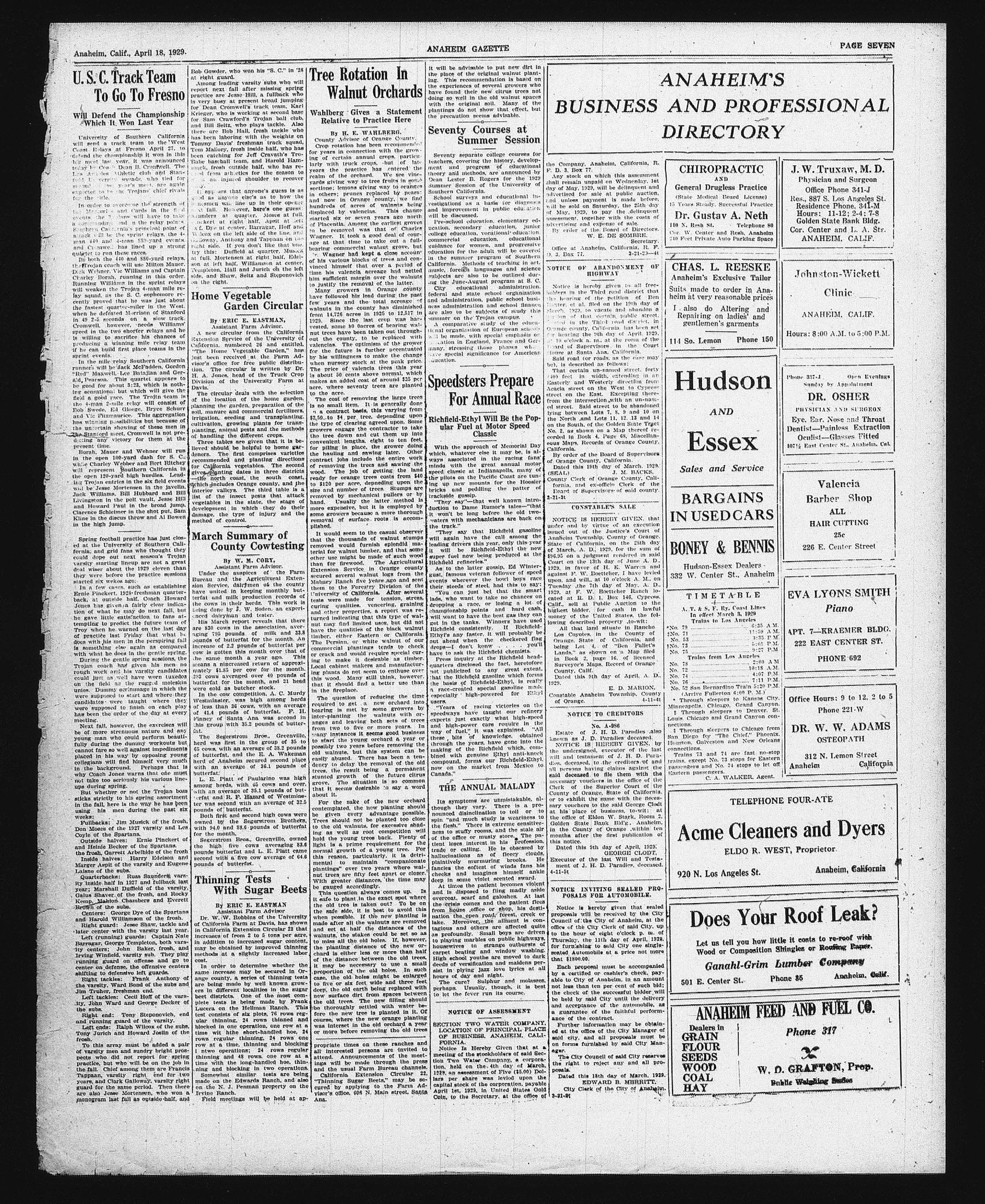
Searchable text
U.S.C. Track Team To Go To Fresno
Will Defend the Championship Which It Won Last Year
University of Southern California will send a track team to the West Coast Relays at Fresno April 27, to defend the championship it won in this big meet last year. It was announced today by Coach Dean B. Cromwell. The Los Angeles Athletic club and Stanford University squads, who tied for second last year's meet, are again expected to be the Trojans' chief rivals for the title.
In order to overcome the strength of the McCurlls and Cards in the field events, the 7 teams will have to take a commanding role in the relay poles. Southern California's principal point of attack will be the sprint relays, the 4-man 440 and 4-man $90-yard events, and Cromwell has lined up a strong quartet to run these races.
In both the 440 and $80-yard relays, the Trojan coach will use Milton Mauer, Dick Wehner, Vic Williams and Captain Charley Borah, running in this order. Running Williams in the sprint relays will weaken the Trojan 4-man mile relay squad, as the S. C. sophomore recently proved that he was just about the fastest quarter-miler in the West when he defeated Morrison of Stanford in 48-2-5 seconds on a slow track. Cromwell, however, needs Williams' speed in the two shorter relays and he is willing to sacrifice his chances of producing a winning mile relay team if he can build first place teams in the sprint events.
In the mile relay Southern California runners will be Jack McFadden, Gordon "Red" Maxwell, Lee Batajian and Gerald Pearson. This quartet appears to be good for about 3:23, which is nothing sensational but which will give the field a good race. The Trojan team is the 4-man 2-mile relay will consist of Bob Swede, Ed Gloege, Bryce Schurr and Vic Flitzmaurice. This aggregation has winning possibilities but because of the uncertain showing of these men in the Stanford meet, Cromwell is not predicting any victory for them at the present time.
Bob Gowder, who won his "S. C." in '28 at right guard.
Among leading varsity subs who will report next fall after missing spring practice are Jesse Hill, a fullback who is very busy at present broad jumping for Dean Cromwell's track team, Karl Krieger, who is working at second base for Sam Crawford's Trojan ball club, and Bill Seitz, who plays tackle. Also there are Bob Hall, frosh tackle who has been laboring with the weights on Tommy Davis' freshman track squad, Tom Mallory, frosh inside half, who has been catching for Jeff Cravath's Tro-Babe baseball team, and Harold Hamack, frosh outside half, who has reed from athletics for the season to an injured shoulder to recover any.
It appears that anyone's guess is as good as anyone else's as to how the horses will line up in their opener at fall. However, here's one guess: sounders at quarter, Moses at full, tackler at right half, Aptit at left aff. Dye at center, Barragar, Hoff and Wilcox on the left side of the line, and Galloway, Anthony and Tappaan on the right side. If you don't like that one try this: Duffield at quarter, Musck at full. Mortensen at right half, Edelson at left half. Williamson at center, Templeton, Hall and Jurich on the left side, and Shaw, Seitz and Steponovich on the right.
Home Vegetable Garden Circular
By ERIC E. EASTMAN,
Assistant Farm Advisor.
A new circular from the California Extension Service of the University of California, numbered 26 and entitled "The Home Vegetable Garden," has just been received at the Farm Advisor's office for free public distribution. The circular is written by Dr. H. A. Jones, head of the Truck Crop Division of the University Farm at Davis.
The circular deals with the selection of the location of the home garden, planning the garden, preparation of the soil, manure and commercial fertilizers, irrigation, seeding and transplanting, cultivation, growing plants for transplanting, animal pests and the methods of handling the different crops.
Three tables are given that it is believed should be helpful to home gardener.
Tree Rotation Walnut
Wahlberg Gives Relative to Pine
By H. E. W.
County Advisor of Crop rotation has for years in connection of certain annual with truck crew years the practice realm of the orchard yards giving way to sections; lemons give in others; prunes m and now in Orange hundreds of acres displaced by valence started six or seven of Placentia. Among it be removed was Wagner. It took a age at that time to bear commercial fruit. Wagner had ked of his various blocks vinced himself that time his valencia a him sufficient margin to justify the removal.
Many growers have followed his lefew years and then walnuts in the county from 14.726 acres in 1929. Since the lastvested, some 80 0acre nut trees have been out the county to valencias. The option for the future is for by his willingness to when nursery stock. The price of valence is about 50 cents all makes an added cost acre, where seventy to the acre.
The cost of removal is no small item. In a contract basis,$2.50 to $4 per tree the type of clearing growers engage them the tree down and convenient lengths, for piling in place.
In the mile relay Southern California runners will be Jack McPadden, Gordon "Red" Maxwell, Lee Batajan and Gerald Pearson. This quartet appears to be good for about 3:23, which is nothing sensational but which will give the field a good race. The Trojan team is the 4-man 2-mile relay will consist of Bob Swede, Ed Gloege, Bryce Schurr and Vic Fitzmaurice. This aggregation has winning possibilities but because of the uncertain showing of these men in the Stanford meet, Cromwell is not predicting any victory for them at the present time.
Borah, Mauer and Wehner will run in the open 100-yard dash for S. C., while Charley Webber and Bert Ritchie will represent Southern California in the open 120-yard high hurdles. Leading Trojan entries in the six field events will be Jesse Mortensen in the Javolin, Jack Williams, Bill Hubbard and Bill Livingston in the polt vault, Jesse Hill and Howard Paul in the broad jump, Clarence Schleimer in the shot put, Sam Kline in the discus throw and Al Bowen in the high jump.
Spring football practice has just closed at the University of Southern California, and grid fans who thought they could dope out next season's Trojan varsity starting lineup are not a great deal wiser about the 1929 eleven than they were before the practice sessions started six wekes ago.
In a few cases, such as establishing Ernie Pinckert, 1928-freshman quarterback, at outside half, Coach Howard Jones has given a fairly clear indication of what he may do next fall, but he gave little satisfaction to fans attempting to predict the future team of Troy when he warned on the last day of practice last Friday that what he does with his men in the perspiring fall is something else again as compared with what he does in the gentle spring.
During the gentle spring sessions, the Trojan coach has given his men no rough work and his varsity candidates could just as well have worn tuxedos on the field as the rugged molekin unies. Dummy scrimmage in which the were supposed to start and where they candidates were taught where they were supposed to finish on each play has been the order of the day at every meeting.
Next fall, however, the exercises will be of more strenuous nature and any young man who could perform beautifully during the dummy workouts but cannot fare so well against impediments placed in his way by opposing young collegians will find himself very much in the background. Perhaps that is why Coach Jones warns that one must not take too seriously his various line-ups during spring.
But whether or not the Trojan boss sticks strictly to his spring assortment in the fall, here is the way he has been using his men during the past six weeks:
Fullbacks: Jim Musick of the frog, Don Moses of the 1927 varsity and Les Coyle of the Spartans.
Outside halves: Ernie Pinckert of and Heinie Becker of the Spartans.
Just been received at the Farm Advisor's office for free public distribution. The circular is written by Dr. H. A. Jones, head of the Truck Crop Division of the University Farm at Davis.
The circular deals with the selection of the location of the home garden, planning the garden, preparation of the soil, manure and commercial fertilizers, irrigation, seeding and transplanting, cultivation, growing plants for transplanting, animal pests and the methods of handling the different crops.
Three tables are given that it is believed should be helpful to home gardeners. The first comprises varieties recommended and planting directions for California vegetables. The second gives planting dates in three districts—the north coast, the south coast, which includes Orange county, and the interior valleys. The third table is a list of the insect pests that attack vegetables in the state, the stage of development in which they do their damage, the type of injury and the method of control.
March Summary of County Cowtesting
By W. M. CORY,
Assistant Farm Advisor.
Under the auspices of the Farm Bureau and the Agricultural Extension Service, dairymen of the county have united in keeping monthly butterfat and milk production records of the cows in their herds. This work is being done by J. W. Soden, an experienced dairyman and tester.
His March report reveals that there are 830 cows in the association, averaging 795 pounds of milk and 33.8 pounds of butterfat for the month. An increase of 2.2 pounds of butterfat per cow is gotten this month over that of the same month a year ago. This means a nincreased return of approximately $1.85 per cow for the month. 293 cows averaged over 40 pounds of butterfat for the month, and 21 head were sold as butcher stock.
In the cow competition, A. C. Murdy Westminster, was high among herds of less than 36 cows, with an average of 41.4 pounds of butterfat. F. H. Finney of Santa Ana was second in this group with 35.2 pounds of butterfat.
The Segerstrom Bro., Greenville, herd was first in the group of 35 to 65 cows, with an average of 38.2 pounds of butterfat, and the E. A. Wakeman herd of Anaheim secured second place with an average of 36.1 pounds of butterfat.
L. E. Platt of Paularino was high among herds, with 65 cows and over, with an average of 35.1 pounds of butterfat and R. F. Hazard of Westminster was second with an average of 32.5 pounds of butterfat.
Segerstrom Bro., Greenville, owned the high five cows averaging 83.6 pounds of butterfat and L. E. Platt came just been received at the Farm Advisor's office for free public distribution. The circular is written by Dr. H. A. Jones, head of the Truck Crop Division of the University Farm at Davis.
The circular deals with the selection of the location of the home garden, planning the garden, preparation of the soil, manure and commercial fertilizers, irrigation, seeding and transplanting, cultivation, growing plants for transplanting, animal pests and the methods of handling the different crops.
Three tables are given that it is believed should be helpful to home gardeners.
The first comprises varieties recommended and planting directions for California vegetables. The second gives planting dates in three districts—the north coast, the south coast, which includes Orange county, and the interior valleys. The third table is a list of the insect pests that attack vegetables in the state, the stage of development in which they do their damage, the type of injury and the method of control.
It would seem to that the thousands removed would further material for walnut lumber other use might be than for firewood.
Extension Service secured several walnut mabury Ranch five them to the Forest University of California tests were made for curing qualities and other properties turned indicating that nut may find limited have the qualities of timber; either East The Persian; or with commercial planting or crack and would be to make it d Local cabinet making plants do not so this wood. Many say that it should find in the fireplace.
The question of required to get a bearing is met by inter-planting changes and leaving from two to five many instances it is to start the young possibly two years old walnuts; but it easily abused. The deny to delay these trees; the result be stunted growth or grove. The situation that it seems desirous about it.
For the sake of contemplated, he be given every Trees should not to old walnuts; ing as well as ro hold the young tree light is a prime growth or normal event...
placed in his way by opposing young collegians will find himself very much in the background. Perhaps that is why Coach Jones warns that one must not take too seriously his various line-ups during spring.
But whether or not the Trojan boss sticks strictly to his spring assortment in the fall, here is the way he has been using his men during the past six weeks:
Fullbacks: Jim Musick of the frosh, Don Moses of the 1927 varsity and Les Coyle of the Spartans.
Outside halves: Ernie Pinckert of and Heinie Becker of the Spartans. the frosh, Garrett Arbelbide of the frosh
Inside halves: Harry Edelson and Marger Aspit of the varsity and Eugene Lalane of the subs.
Quarterbacks: Russ Saunders varsity inside half in 1927 and fullback last year; Marshall Duffield of the varsity, Galus Shaver of the frosh, and Rocky Kemp, Mahlon Chambers and Everett Brown of the subs.
Centers: George Dye of the Spartans and Harold Williamson of the frosh.
Right guard: Jesse Shaw, tackle and later center with the varsity last year.
Left (running) guards: Captain Nate Barragar, George Templeton, both varsity centers; John Baker, frosh, and Irving Winfield, varsity sub. They play running guard on offense and go to center on defense, the offensive centers shifting to defensive left guards.
Right tackles: Frank Anthony of the varsity, Ward Bond of the subs and Jim Truher, freshman end.
Left tackles: Cecil Hoff of the varsity, John Ward and George Decker of the subs.
Right end: Tony Steponovich, end and running guard of the varsity.
Left ends: Ralph Wilcox of the subs, Tony Jurich and Howard Joslin of the frosh.
To this array must be added a pair of varsity men and sundry bright prospects who did not report for spring practice, but who will be on the job in the fall. Chief among them are Francis Tappaan, varsity right end for two years, and Clark Galloway, varsity right guard for the same period. Then there are also Jesse Mortensen, who won a monogram last fall as outside-half, and
Thinning Tests With Sugar Beets
By ERIC E. EASTMAN
Assistant Farm Advisor
Dr. W. W. Robblins of the University of California Farm at Davis, has shown in California Extension Circular 22 that increases of from 2 to 5 tons per acre, in addition to increased sugar content, may be obtained by improved thinning methods at a slightly increased labor cost.
In order to determine whether the same increase may be secured in Orange county, a series of thinning tests are being made by well known growers in different localities in the sugar beet districts. One of the most complete tests is being made by Frank Lucera on the Hellman Ranch. This test consists of six plots, 76 rows regular thinning, 24 rows thinned and blocked in one operation, one row at a time wit hthe short-handled hoe, 24 rows regular thinning, 24 rows one row at a time, thinning and blocking i two operations; 24 rows regular thinning and 48 rows, one row at a time with the long-handled hoe, thinning and blocking in two operations.
Somewhat similar tests are being made on the Edwards Ranch, and on the N. J. Penman property on the Irvine Ranch.
Field meetings will be held at ap-
easily abused. The dency to delay these trees, the result be stunted growth of grove. The situation that it seems desiric about it.
For the sake of contemplated, the hedr of Anaheim secured second place with an average of 36.1 pounds of butterfat:
L. E. Platt of Paularino was high among herds, with 65 cows and over, with an average of 35.1 pounds of butterfat and R. F. Hazard of Westminster was second with an average of 32.5 pounds of butterfat.
Both first and second high cows were owned by the Segerstrom Brothers, with 94.0 and 88.6 pounds of butterfat for the month.
Segerstrom Bros., Greenville, owned the high five cows averaging 83.6 pounds butterfat and L. E. Platt came second with a five cow average of 64.6 pounds of butterfat.
This question ally it safe to plant in the old tree is tall the safe side, it is when possible. If made after all the and set at half t walnuts, the stakte to miss all the old the planting distance chard is either less of the distance be it may be necesse proportion of the case, the old holes to five or six feet deep, the old earth new surface dirt for the old trees. The be thoroughly set fore the new trees course, where they was interset in th or more before re-
Tree Rotation In Walnut Orchards
Wahlberg Gives a Statement Relative to Practice Here
By H. E. WAHLBERG.
County Advisor of Orange County.
Crop rotation has been recommended for years in connection with the growing of certain annual crops, particularly with truck crops, but of late years the practice has entered the realm of the orchard.
We see vineyards giving way to tree fruits in some sections; lemons giving way to oranges in others; prunes replaced by pears; and now in Orange county, we find hundreds of acres of walnuts being displaced by valenciaes. This change started six or seven years ago north of Placentia. Among the earliest groves to be removed was that of Charles Wagner. It took a good deal of courage at that time to take out a full-bearing commercial walnut grove, but Wagner had kept a close account of his various blocks of trees and convinced himself that over a period of time his valenciae age had netted him sufficient margin over the walnuts to justify the removal of the latter.
Many growers in Orange county have followed his lead during the past few years and the total acreage of walnuts in the county has diminished from 14,726 acres in 1925 to 12,517 in 1929. Since the last crop was harvested, some 80 0acres of bearing walnut trees have been taken out throughout the county, to be replaced with valenciaes. The optimism of the grower for the future is further accentuated by his willingness to make the change when nursery stock at the peak price.
The price of valencia trees this year is about 50 cents above normal, which makes an added cost of around $35 per acre, where seventy trees are planted to the acre.
The cost of removing the large trees is no small item. It is generally done on a contract basis, this varying from $2.50 to $4 per tree, depending upon the type of clearing agreed upon. Some growers engage the contractor to take the tree down and cut them up into convenient lengths, eight to ten feet, for piling in place, the grower doing it will be advisable to put new dirt in the place of the original walnut planting. This recommendation is based on the experiences of several growers who have found their new citrus trees not doing so well in the old walnut spaces with the original soil. Many of the plantings do not show that effect, but the precaution seems advisable.
Seventy Courses at Summer Session
Seventy separate college courses for teachers, covering the history, development and progress of educational theory and methods, are announced by Dean Lester B. Rogers for the 1929 Summer Session of the University of Southern California.
School surveys and educational investigations as a basis for diagnosis and improvement in public education will be discussed.
Pre-school education, elementary education, secondary education, Junior college education, vocational education: commercial education, educational guidance for women, and progressive guidance for the adult will be covered in the summer program of Southern California. Methods of teaching in art, music, foreign languages and science subjects are also to be outlined during the June-August program at S. C. City educational administration.
Federal and state school organization and administration, public school business administration and school finance are also to be subjects of study this summer on the Trojan campus.
A comparative study of the educational organization of European schools will be made, with special emphasis on education in England, France and Germany, stressing those phases which have special significance for American education.
Speedsters Prepare For Annual Race
Richfield-Ethyl Will Be The Popular Fuel at Motor Speed Classic
With the approach of Memorial Day
the Company, Anaheim, California, R. F. D. 3, Box 77.
Any stock on which this assessment shall remain unpaid on Wednesday, 1st day of May, 1929, will be delinquent and advertised for sale at public auction, and unless payment is made before, will be sold on Saturday, the 25th day of May, 1929, to pay the delinquent assessment, together with the costs of advertising and expense of sale.
By order of the Board of Directors.
W. E. DE SOMBRE.
Secretary.
Office at Anaheim, California, R. F. D. 3, Box 77.
3-21-29—4t
NOTICE OF ABANDONMENT OF HIGHWAY
Notice is hereby given to all freeholders in the Third road district that the hearing of the petition of Ben Haxtter et al. filed on the 19th day of March, 1929, to vacate and abandon a portion of that certain public street. Listed in the Third road district, in Orange county, California has been set for hearing the 9th day of April, 1929, at 10 o'clock a.m., at the room of the Board of Supervisors. In the Court House at Santa Ana, California.
Sald road (or roads, as the case may be), is described as follows:
That certain un-named street, forty (40) feet in width, extending in an Easterly and Westerly direction from Acacia street on the West to Cypress street on the East. Excepting therefrom the intersection with an un-named street. Sald street to be abandoned lying between Lots 7, 8, 9 and 10 on the North and Lots 11, 12, 13 and 14 on the South, of the Golden State Traget No. 2, as shown on a Map thereof recorded in Book I, Page 68. Miscellaneous Maps, Records of Orange County.
by his willingness to make the change when nursery stock at the peak price. The price of valencia trees this year is about 50 cents above normal, which makes an added cost of around $35 per acre, where seventy trees are planted to the acre.
The cost of removing the large trees is no small item. It is generally done on a contract basis, this varying from $2.50 to $4 per tree, depending upon the type of clearing agreed upon. Some growers engage the contractor to take the tree down and cut them up into convenient lengths, eight to ten feet, for piling in place, the grower doing the hauling and sawing later. Other contract jobs include the entire work of removing the trees and sawing the wood. The job of getting the land ready for orange trees costs from $40 to $120 per acre, depending upon the size and number of trees. Stumps are removed by mechanical pullers or by hand. Usually the latter method is more expensive, but it is employed by some growers because a more thorough removal of surface roots is accomplished.
It would seem to the casual observer that the thousands of walnut stumps removed would furnish splendid material for walnut lumber, and that some other use might be made of such wood than for firewood. The Agricultural Extension Service in Orange county secured several walnut logs from the Mabury Ranch five years ago and sent them to the Forestry Division of the University of California. After several tests were made for tension, stress, curing qualities, veneering, graining and other properties, a report was returned indicating that this type of walnut may find limited uses, but did not have the qualities of the black walnut timber, either Eastern or California. The Persian, or white walnut of our commercial plantings tends to check or crack and would require special curing to make it desirable as timber. Local cabinet makers and manufacturing plants do not seem to enthuse over this wood. Many still think, however, that it should find a better use than in the fireplace.
The question of reducing the time required to get a new orchard into bearing is met by some growers by inter-planting the walnuts with oranges and leaving both sets of trees from two to five or more years. In many instances it seems good business to start the young orchard a year or possibly two years before removing the old walnuts, but this system can be easily abused. There has been a tendency to delay the removal of the old trees, the result being a permanent stunted growth of the future citrus grove. The situation is so common that it seems desirable to say a word about it.
For the sake of the new orchard contemplated, the new planting should be given every advantage possible. Trees should not be planted too close to the old walnuts, for excessive shading as well as root competition will hold the young trees back. Plenty of light is a prime requirement for the normal growth of a young tree. For
Speedsters Prepare For Annual Race
Richfield-Ethyl Will Be the Popular Fuel at Motor Speed Classic
With the approach of Memorial Day which, whatever else it may be, is always associated in the racing fans' minds with the great annual motor speed classic at Indianapolis, many of the pilots on the Pacific Coast are tuning up new mounts for the Hoosier bricks and peddling the patter of trackside gossip.
They say—that well known introduction to Dame Rumor's tales—"that it won't be long before the old two-waters with mechanicians are back on the track."
They say that Richfield gasoline will again have the call among the leading drivers this year, only this year it will be Richfield-Ethyl the new super fuel now being produced at the Richfield refineries."
As to the latter gossip, Ed Wintergust, famous veteran follower of speed events wherever the bowl boys race their steeds of steel, had this to say: "You can just bet that the smart lads who want to take no chances on dropping a race, or losing a lot of championship points and hard cash will want to have the best gas they can get in the tanks. Winners have used Richfield consistently. If Richfield-Ethyl's any faster, it will probably be out ahead when the checkered flag drops—I don't know you'll have to ask the Richfield chemists.
Press inquiry at the Richfield headquarters disclosed the fact, heretofore not publicized to any great extent, that the Richfield gasoline which forms the basis of Richfield-Ethyl, is really a race-created special gasoline made especially high-powered for Ethyl users.
"Years of racing victories on the speedways have taught our refinery experts just exactly what high-speed and high-power cars require in the way of fuel," it was explained. "All these bits of knowledge obtained through the years, have gone into the making of the Richfield which, combined with genuine Ethyl anti-knock compound, forms our Richfield-Ethyl now on the market from Mexico to Canada."
THE ANNUAL MALADY
Its symptoms are unmistakable, although they vary. There is a pronounced disinclination to toll or to spin "and much study is weariness to the flesh." There is extreme sensitivity to stuffy rooms, and the stale air of the office or musty store. The patient loses interest in his profession, trade or calling. He is obsessed by Said road (or roads, as the case may be), is described as follows:
That certain un-named street, forty (40) feet in width, extending in an Easterly and Westerly direction from Acacia street on the West to Cypress street on the East. Excepting there from the intersection with an un-named street. Said street to be abandoned lying between Lots 7, 8, 9 and 10 on the North and Lots 11, 12, 13 and 14 on the South, of the Golden State Trget No. 2, as shown on a Map thereof recorded in Book 4, Page 68, Miscellaneous Maps, Records of Orange County.
By order of the Board of Supervisors of Orange County, California.
Dated this 18th day of March, 1929.(SEAL)
J. M. BACKS.
County Clerk of Orange County, California,
and ex-officio Clerk of the Board of Supervisors-of said county: S-21-3t
CONSTABLE'S SALE
NOTICE IS HEREBY GIVEN that under and by virtue of an execution issued out of the Justice's Court of Anaheim Township, County of Orange.State of California.on the 28th day of March.A.D.,1929.for the sum of $96.95 on a judgment rendered in said Court on the 13th day of June A.D.,1929.in favor of H.E.Warren and against F.W.Boettcher.I have levied upon,and will.at 10 o'clock A.M.on Tuesday,the 7th day of May,A.D.,1929.at F.W.Boettcher Ranch located at R.D.1.Box 146.Cypress.Calf.,sell at Public Auction to the highest bidder,for cash in lawful money of the United States,the following described property:to-wit:
All that land situate in Rancho Los Coyotes,在the county of Orange.State of California,and being Lot 4.of "Ben Fallet's Lands,"as shown on a Map filed in Book 2.page 16.of licensed Surveyor's Maps.Record of Orange County,Calif.
Dated this 9th day of April,A.D.,1929.
E.D.MARION.
Constable Anaheim Township,县of Orange.
4-11-4t
NOTICE TO CREDITORS
No.A-986
Estate of J.H.D.Paradies also known as J.D.Paradies deceased.
NOTICE IS HEREBY GIVEN.by the undersigned,executor of the last will and testament of J.H.D.Paradies.deceased.to,the creditors.of and all persons having claims againstthe said deceased.to file them withthe necessary vouchers intheofficeoftheClerkoftheSuperiorCourtoftheCountyofOrange.StateofCalifornia.ortoexhibitthesamewiththenecessaryvoucherstothesaidGeorgeClodtathisplaceofbusiness.to-wit:attheofficeofEldonW.Stark,Room2.GoldenStateBankBld'd.g.Anachelmin.theCountyofOrange.withintenmonthsafterthefirstpublicationthisnotice.
Dated this 9th day of April,1929.
THE ANNUAL MALADY
Its symptoms are unmistakable, although they vary. There is a pronounced disinclination to toll or to spin "and much study is weariness to the flesh." There is extreme sensitivity to stuffy rooms, and the stale air of the office or musty store. The patient loses interest in his profession, trade or calling. He is obsessed by hallucinations as of fleecy clouds, plaintively murmuring brooks. He fancies the eoftest of winds fans his cheeks and imagines himself ankle deep in some violet scented sword.
At times the patient becomes violent and is disposed to fling madly aside overcoat, scarf and galoshes. At last the crisis comes and the patient flees from house, office or shop, his destination the open road, forest, creek or lake. Moreover, the aliment is contagious and others are affected quite as profoundly. Small boys are driven to playing marbles on public highways, housewives to strange outbursts of carpet beating and window washing. High school youths are moved to dark deeds of versification and maidens persist in plying jazz love lyrics at all hours of day and night.
The cure? Sulphur and molasses, perhaps. Usually, though, it is best to let the fever run its course.
NOTICE OF ASSESSMENT
SECTION TWO WATER COMPANY,
LOCATION OF PRINCIPAL PLACE
OF BUSINESS, ANAHEIM, CALIFORNIA.
Notice Is Hereby Given that at a meeting of the stockholders of said Section Two Water Company, a corporation, held on the 4th day of March, 1928, an assessment of Five ($5.00) Dollars per share was levied upon the capital stock of the corporation, payable April 1st, 1929, in United States Gold Coin, to the Secretary, at the office of will and testament of J. H. D. Paradies, deceased, to the creditors of and all persons having claims against the said deceased to file them with the necessary vouchers in the office of the Clerk of the Superior Court of the County of Orange, State of California, or to exhibit the same with the necessary vouchers to the said George Clodt at his place of business, to-wit: at the office of Eldon W. Stark, Room 2, Golden State Bank Bldg., Anaheim, in the County of Orange within ten months after the first publication of this notice.
Dated this 9th day of April, 1929.
GEORGE CLODT,
Executor of the last Will and Testament of J. H. D. Paradies, deceased.
4-11-5t
NOTICE INVITING SEALED PROPOSALS FOR AUTOMOBILE.
Notice is hereby given that sealed proposals will be received by the City Council of the City of Anaheim, at the office of the City Clerk of said City, up to the hour of eight o'clock p.m. of Thursday, the 11th day of April, 1929, for furnishing to said City one single-seated Automobile at a price not more than $1800.00.
Each proposal must be accompanied by a certified or cashier's check, payable to City of Anaheim, in an amount not less than ten per cent of such bid; the check of the successful bidder will be held by said City until the delivery and acceptance of the automobile, as a guarantee of the faithful performance of the contract.
Further information may be obtained at the office of the City Manager of said city, and all proposals must be on forms furnished by said City Manager.
The City Council of said City reserves the right to reject any and all proposals.
Dated this 18th day of March, 1929.
EDWARD B. MERRITT.
City Clerk of the City of Anaheim.
3-21-9t
ANAHEIM'S
NESS AND PROFESSIONAL
DIRECTORY
CHIROPRACTIC
AND
General Drugless Practice
(State Medical Board License)
15 Years Steady. Successful Practice
Dr. Gustav A. Neth
110 N. Resh St. Telephone 80
Cor. W. Center and Resh, Anaheim
210 Feet Private Auto Parking Space
J. W. Truxaw, M. D.
Physician and Surgeon
Office Phone 341-J
Res., 887 S. Los Angeles St.
Residence Phone, 341-M
Hours: 11-12; 2-4; 7-8
Golden State Bank Bldg.
Cor. Center and L. A. Sts.
ANAHEIM, CALIF.
CHAS. L. REESKE
Anaheim's Exclusive Tailor
Suits made to order in Anaheim at very reasonable prices
I also do Altering and Repairing on ladies' and gentlemen's garments
114 So. Lemon Phone 150
Johnston-Wickett
Clinic
ANAHEIM, CALIF.
Hours: 8:00 A.M. to 5:00 P.M.
Hudson
AND
Essex
Phone 337-J Open Evenings
Sunday by Appointment
DR. OSHER
PHYSICIAN AND SURGEON
Eye, Ear, Nose and Throat
Dentist—Painless Extraction
Oculist—Glasses Fitted
10714 East Center St., Anaheim, Cal.
Hudson
AND
Essex
Sales and Service
BARGAINS IN USEDCARS
BONEY & BENNIS
Hudson-Essex Dealers
332 W. Center St., Anaheim
TIMETABLE
A. T. & S. F. Ry. Coast Lines
In effect March 3, 1929
Trains to Los Angeles
*No. 79 ... 6:35 A.M.
$No. 71 ... 11:59 A.M.
No. 53 ... 3:35 P.M.
$No. 73 ... 5:01 P.M.
No. 75 ... 9:27 P.M.
Trains from Los Angeles
No. 78 ... 2:00 A.M.
No. 72 ... 10:18 A.M.
No. 74 ... 4:07 P.M.
No. 76 ... 7:11 P.M.
No. 52 San Bernardino Train 5:20 P.M.
(Arrive Fullerton 6:00 P.M.)
* Through sleepers to Kansas City,
Minneapolis, Chicago, Grand Canyon.
$ Through sleepers to Denver, St.
Louis, Chicago and Grand Canyon connections.
$ Through sleepers to Chicago from
San Diego for "The Chief," Phoenix,
Houston, Galveston and New Orleans
connections.
Trains 73 and 74 are fast no-stop
trains, except No. 73 stops for Eastern
passengers and No. 74 stops to let off
Eastern passengers.
C. A. WALKER, Agent.
TELEPHONE FOUR-ATE
Acme Cleaners and Dyers
ELDO R. WEST Proprietor.
TELEPHONE FOUR-ATE
Acme Cleaners and Dyers
ELDO R. WEST, Proprietor.
920 N. Los Angeles St. Anaheim, California
Does Your Roof Leak?
Let us tell you how little it costs to re-roof with
Wood or Composition Shingles or Roofing Paper.
Ganahl-Grim Lumber Company
501 E. Center St. Phone 85 Anaheim, Calif.
ANAHEIM FEED AND FUEL CO.
Dealers in
GRAIN
FLOUR
SEEDS
WOOD
COAL
HAY
Phone 317
W. D. GRAFTON, Prop.
Public Weighing Sites