anaheim-gazette 1929-04-18
Scanned page
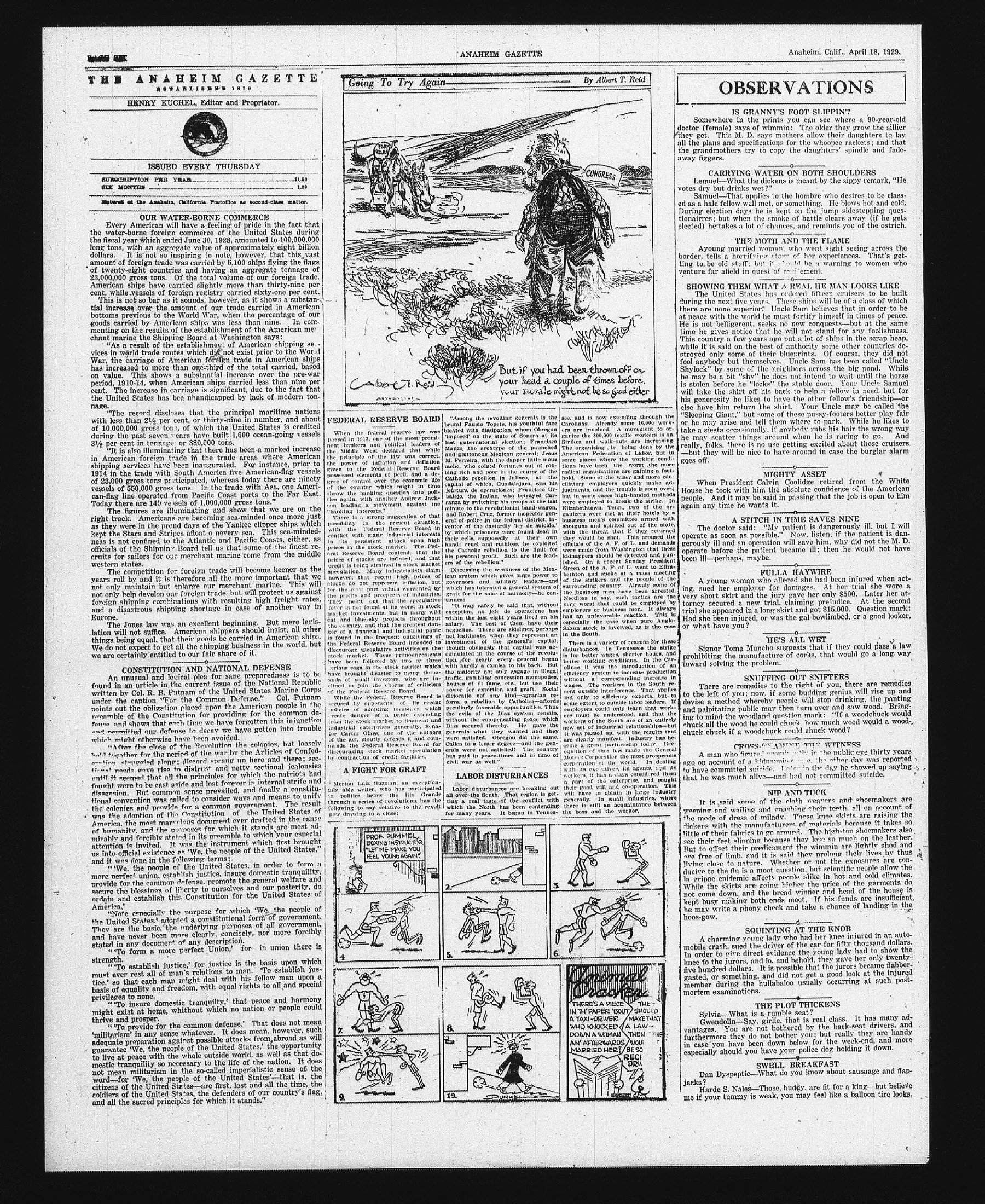
Searchable text
THE ANAHEIM GAZETTE
ESTABLISHED 1870
HENRY KUCHEL, Editor and Proprietor.
ISSUED EVERY THURSDAY
SUBSCRIPTION PER YEAR $1.50
SIX MONTHS 1.00
Mattered at the Anaheim, California Postoffice as second-class matter.
OUR WATER-BORNE COMMERCE
Every American will have a feeling of pride in the fact that the water-borne foreign commerce of the United States during the fiscal year which ended June 30, 1928, amounted to 100,000,000 long tons, with an aggregate value of approximately eight billion dollars. It is not so inspiring to note, however, that this vast amount of foreign trade was carried by 5,100 ships flying the flags of twenty-eight countries and having an aggregate tonnage of 23,000,000 gross tons. Of the total volume of our foreign trade, American ships have carried slightly more than thirty-nine per cent, while vessels of foreign registry carried sixty-one per cent.
This is not so bar as it sounds, however, as it shows a substantial increase over the amount of our trade carried in American bottoms previous to the World War, when the percentage of our goods carried by American ships was less than nine. In commenting on the results of the establishment of the American merchant marine the Shipping Board at Washington says:
"As a result of the establishment of American shipping services in world trade routes which did not exist prior to the World War, the carriage of American foreign trade in American ships has increased to more than one-third of the total carried, based on value. This shows a substantial increase over the pre-war period, 1910-14, when American ships carried less than nine per cent. The increase in carriage is significant, due to the fact that the United States has bee nhandicapped by lack of modern tonnage."
"The record discloses that the principal maritime nations with less than 2½ per cent, or thirty-nine in number, and about 10,000,000 gross tons, of which the United States is credited during the past seven years have built 1,600 ocean-going vessels 3½ per cent in tonnage or 380,000 tons."
War, the carriage of American foreign trade in American ships has increased to more than one-third of the total carried, based on value. This shows a substantial increase over the pre-war period, 1910-14, when American ships carried less than nine per cent. The increase in carriage is significant, due to the fact that the United States has bee nhandicapped by lack of modern tonnage.
"The record discloses that the principal maritime nations with less than 2½ per cent, or thirty-nine in number, and about 10,000,000 gross tons, of which the United States is credited during the past seven years have built 1,600 ocean-going vessels 3½ per cent in tonnage or 380,000 tons."
"It is also illuminating that there has been a marked increase in American foreign trade in the trade areas where American shipping services have been inaugurated. For instance, prior to 1914 in the trade with South America five American-flag vessels of 23,000 gross tons participated, whereas today there are ninety vessels of 550,000 gross tons. In the trade with Asa, one American-flag line operated from Pacific Coast ports to the Far East. Today there are 140 vessels of 1,000,000 gross tons."
The figures are illuminating and show that we are on the right track. Americans are becoming sea-minded once more just as they were in the proud days of the Yankee clipper ships which kept the Stars and Stripes afloat o nevery sea. This sea-mindedness is not confined to the Atlantic and Pacific Coasts, either, as officials of the Shipping Board tell us that some of the finest recruits for sailors for our merchant marine come from the middle western states.
The competition for foreign trade will become keener as the years roll by and it is therefore all the more important that we not only maintain but enlarge our merchant marine. This will not only help develop our foreign trade, but will protect us against foreign shipping combinations with resulting high freight rates, and a disastrous shipping shortage in case of another war in Europe.
The Jones law was an excellent beginning. But mere legislation will not suffice. American shippers should insist, all other things being equal, that their goods be carried in American ships. We do not expect to get all the shipping business in the world, but we are certainly entitled to our fair share of it.
CONSTITUTION AND NATIONAL DEFENSE
An unusual and logical plea for sane preparedness is to be found in an article in the current issue of the National Republic written by Col. R. R. Putnam of the United States Marine Corps under the caption "For the Common Defense." Col. Putnam points out the obligation placed upon the American people in the preamble of the Constitution for providing for the common defense and shows that each time we have forgotten this injunction and permitted our defense to decay we have gotten into trouble which might otherwise have been avoided.
"After the close of the Revolution the colonies, but loosely hold together for the period of the war by the Articles of Confederation strung along; discord sprang up here and there; sectional needs gave rise to distrust and petty sectional jealousies until it seemed that all the principles for which the patriots had fought were to be cast aside and lost forever in internal strife and dissension. But common sense prevailed, and finally a constitutional convention was called to consider ways and means to unify the colonies and provide for a common government. The result was the adoption of the Constitution of the United States of America, the most marvelous document ever drafted in the cause of humanity, and the purposes for which it stands are most admirably and forcibly stated in its preamble to which your especial attention is invited. It was the instrument which first brought War, the carriage of American foreign trade in American ships has increased to more than one-third of the total carried, based on value. This shows a substantial increase over the pre-war period, 1910-14, when American ships carried less than nine per cent. The increase in carriage is significant, due to the fact that the United States has bee nhandicapped by lack of modern tonnage.
"The record discloses that the principal maritime nations with less than 2½ per cent, or thirty-nine in number, and about 10,000,000 gross tons, of which the United States is credited during the past seven years have built 1,600 ocean-going vessels 3½ per cent in tonnage or 380,000 tons."
"It is also illuminating that there has been a marked increase in American foreign trade in the trade areas where American shipping services have been inaugurated. For instance, prior to 1914 in the trade with South America five American-flag vessels of 23,000 gross tons participated, whereas today there are ninety vessels of 550,000 gross tons. In the trade with Asa, one American-flag line operated from Pacific Coast ports to the Far East. Today there are 140 vessels of 1,000,000 gross tons."
The figures are illuminating and show that we are on the right track. Americans are becoming sea-minded once more just as they were in the proud days of the Yankee clipper ships which kept the Stars and Stripes afloat o nevery sea. This sea-mindedness is not confined to the Atlantic and Pacific Coasts, either, as officials of the Shipping Board tell us that some of the finest recruits for sailors for our merchant marine come from the middle western states.
The competition for foreign trade will become keener as the years roll by and it is therefore all the more important that we not only maintain but enlarge our merchant marine. This will not only help develop our foreign trade, but will protect us against foreign shipping combinations with resulting high freight rates, and a disastrous shipping shortage in case of another war in Europe.
The Jones law was an excellent beginning. But mere legislation will not suffice. American shippers should insist, all other things being equal, that their goods be carried in American ships. We do not expect to get all the shipping business in the world, but we are certainly entitled to our fair share of it.
CONSTITUTION AND NATIONAL DEFENSE
An unusual and logical plea for sane preparedness is to be found in an article in the current issue of the National Republic written by Col. R. R. Putnam of the United States Marine Corps under the caption "For the Common Defense." Col. Putnam points out the obligation placed upon the American people in the preamble of the Constitution for providing for the common defense and shows that each time we have forgotten this injunction and permitted our defense to decay we have gotten into trouble which might otherwise have been avoided.
"After the close of the Revolution the colonies, but loosely hold together for the period of the war by the Articles of Confederation strung along; discord sprang up here and there; sectional needs gave rise to distrust and petty sectional jealousies until it seemed that all the principles for which the patriots had fought were to be cast aside and lost forever in internal strife and dissension. But common sense prevailed, and finally a constitutional convention was called to consider ways and means to unify the colonies and provide for a common government. The result was the adoption of the Constitution of the United States of America, the most marvelous document ever drafted in the cause of humanity, and the purposes for which it stands are most admirably and forcibly stated in its preamble to which your especial attention is invited. It was the instrument which first brought War, the carriage of American foreign trade in American ships has increased to more than one-third of the total carried, based on value. This shows a substantial increase in American foreign trade in the trade areas where American shipping services have been inaugurated. For instance, prior to 1914 in the trade with South America five American-flag vessels of 23,000 gross tons participated, whereas today there are ninety vessels of 550,000 gross tons. In the trade with Asa, one American-flag line operated from Pacific Coast ports to the Far East. Today there are 140 vessels of 1,000,000 gross tons."
The figures are illuminating and show that we are on the right track. Americans are becoming sea-minded once more just as they were in the proud days of the Yankee clipper ships which kept the Stars and Stripes afloat o nevery sea. This sea-mindedness is not confined to the Atlantic and Pacific Coasts, either, as officials of the Shipping Board tell us that some of the finest recruits for sailors for our merchant marine come from the middle western states.
The competition for foreign trade will become keener as the years roll by and it is therefore all the more important that we not only maintain but enlarge our merchant marine. This will not only help develop our foreign trade, but will protect us against foreign shipping combinations with resulting high freight rates, and a disastrous shipping shortage in case of another war in Europe.
The Jones law was an excellent beginning. But mere legislation will not suffice. American shippers should insist, all other things being equal, that their goods be carried in American ships. We do not expect to get all the shipping business in the world, but we are certainly entitled to our fair share of it.
A FIGURE
Merton Lucian able write in politics through a serif following to now drawing
election struggle along; discord sprang up here and there; sectional needs gave rise to distrust and petty sectional jealousies until it seemed that all the principles for which the patriots had fought were to be cast aside and lost forever in internal strife and dissension. But common sense prevailed, and finally a constitutional convention was called to consider ways and means to unify the colonies and provide for a common government. The result was the adoption of the Constitution of the United States of America, the most marvelous document ever drafted in the cause of humanity, and the purposes for which it stands are most admirably and forcibly stated in its preamble to which your especial attention is invited. It was the instrument which first brought us into official existence as 'We, the people of the United States,' and it was done in the following terms:
"We, the people of the United States, in order to form a more perfect union, establish justice, insure domestic tranquility, provide for the common defense, promote the general welfare and secure the blessings of liberty to ourselves and our posterity, do ordain and establish this Constitution for the United States of America."
"Note especially the purpose for which 'We, the people of the United States,' adopted a constitutional form of government. They are the basic, the underlying purposes of all government, and have never been more clearly, concisely, nor more forcibly stated in any document of any description.
'To form a more perfect Union,' for in union there is strength.
'To establish justice,' for justice is the basis upon which must ever rest all of man's relations to man. 'To establish justice,' so that each man might deal with his fellow man upon a basis of equality and freedom, with equal rights to all and special privileges to none.
'To insure domestic tranquility,' that peace and harmony might exist at home, without which no nation or people could thrive and prosper.
'To provide for the common defense.' That does not mean 'militarism' in any sense whatever. It does mean, however, such adequate preparation against possible attacks from abroad as will guarantee 'We, the people of the United States,' the opportunity to live at peace with the whole outside world, as well as that domestic tranquility so necessary to the life of the nation. It does not mean militarism in the so-called imperialistic sense of the word—for 'We, the people of the United States'—that is, the citizens of the United States—are first, last and all the time, the soldiers of the United States, the defenders of our country's flag, and all the sacred principles for which it stands."
Going To Try Again
By Albert T. Reid
But if you had been thrown off on your head a couple of times before, your morale might not be so good either
FEDERAL RESERVE BOARD
When the federal reserve law was passed in 1913, one of the most prominent bankers and political leaders of America, Albert T. Reid, wrote:
"Among the revolting generals is the brutal Fausto Topete, his youthful face bloated with dissipation, whom Obregon 'imposed' on the state of Sonora at its last gubernatorial election; Francisco Manzo, the archetype of the paunched see, and is now extending through the Carolinas. Already some 16,000 workers are involved. A movement to organize the $300,000 textile workers is on. Strikes and walk-outs are increasing. The organizing is being done by the
FEDERAL RESERVE BOARD
When the federal reserve law was passed in 1913, one of the most prominent bankers and political leaders of the Middle West declared that while the principle of the law was correct, the power of inflation and deflation given to the Federal Reserve Board possessed elements of peril, and a degree of control over the economic life of the country which might in time throw the banking question into politics again, with another Andrew Jackson leading a movement against the "banking interests."
There is a strong suggestion of that possibility in the present situation, with the Federal Reserve Board in conflict with many industrial interests in its persistent attack upon high prices in the stock market. The Federal Reserve Board contends that the prices of stocks are inflated, and that credit is being strained in stock market speculation. Many industrialists claim however, that recent high prices of stocks do not represent inflation, but for the most part values warranted by the profits and precepts of industries. They point out that the speculative fever is not found at its worst in stock market investments, but in many wild cat and blue-sky projects throughout the country, and that the greatest danger of a financial and industrial panic is found in the frequent outgivings of the Federal Reserve Board intended to discourage speculative activities on the stock market. These pronouncements have been followed by two or three serious sags in the stock market which have brought disaster to many thousands of small investors, who are inclined to join the chorus of criticism of the Federal Reserve Board.
While the Federal Reserve Board is accused by opponents of its recent policies of adopting measures which create danger of a panic extending from the stock market to financial and industrial enterprises generally, Senator Carter Glass, one of the authors of the act, stoutly defends it and commends the Federal Reserve Board for discouraging stock market speculation by contraction of credit facilities.
A FIGHT FOR GRAFT
Merton Luiz Gluzman, an exceptionally able writer, who has participated in politics below the Rio Grande through a series of revolutions, has the following to say relative to the revolt now drawing to a close:
"Among the revolting generals is the brutal Fausto Topete, his youthful face bloated with dissipation, whom Obregon 'imposed' on the state of Sonora at its last gubernatorial election; Francisco Manzo, the archtype of the paunched and gluttonous Mexican general; Jesus M. Ferreira, with the dapper little moustache, who coined fortunes out of robbing rich and poor in the course of the Catholic rebellion in Jalisco, at the capital of which Guadalajara, was his jefatura de operaciones; Francisco Urbalejo, the Indian, who betrayed Carranza by switching his troops at the last minute to the revolutionist band-wagon, and Robert Cruz, former inspector general of police in the federal district, inventor of the disastrily 'ley de suicida,' by which prisoners were found dead in their cells, supposedly at their own hand; cruel and ruthless, he exploited the Catholic rebellion to the limit for his personal profit. Such are the leaders of the rebellion."
Discussing the weakness of the Mexican system which gives large power to governors and military leaders—and which has tolerated a general system of graft for the sake of harmony—he continues:
"It may safely be said that, without exception, no jeffe de operacione has within the last eight years lived on his salary. The best of them have their negocitios. These are sidelines, perhaps not legitimate, when they represent an investment of the general's capital, though obviously that capital was accumulated in the course of the revolution, for nearly every general began with hardly a camisa to his back. But the majority not only engage in illegal traffic, gambling concession monopolies, houses of ill fame, etc., but use their power for extortion and graft. Social dislocatio not any kind—agrarian reform, a rebellion by Catholics—affords peculiarly favorable opportunities. Thus the evils of the Díaz system remain, without the compensating peace which Díaz secured thereby. He gave the generals what they wanted and they were satisfied. Obregon did the same. Calles to a lesser degree—and the generals were not satisfied! The country has paid in peace-times and in time of civil war as well."
LABOR DISTURBANCES
Labor disturbances are breaking out all over the South. That region is getting a real taste of the conflict with which the North has been contending for many years. It began in Tennesse-
see, and is now extending through the Carolinas. Already some 16,000 workers are involved. A movement to organize the $200,000 textile workers is on Strikes and walk-outs are increasing. The organizing is being done by the American Federation of Labor, but in some places where the working conditions have been the worst, the more radical organizations are gaining a foothold. Some of the wiser and more conciliatory employers quickly make adjustments, and the trouble is soon over; but in some cases high-handed methods were employed to break the strike. In Elizabethtown, Tenn., two of the organizers were met at their hotels by a business men's committee armed with shotguns and spirited out of the field, with the threat that if they returned they would be shot. This aroused the officials of the A.F. of L. and demands were made from Washington that these kidnappers should be detected and punished. On a recent Sunday President Green of the A.F. of L. went to Elizabethton and spoke at a mass meeting of the strikers and the people of the surrounding country. Already some of the business men have been arrested. Needless to say, such tactics are the very worst that could be employed by employers or business men. It always has an unfavorable reaction. This is especially the case when pure Anglo-Saxon stock is involved, as is the case in the South.
There is a variety of reasons for these disturbances. In Tennessee the strike is for better wages, shorter hours, and better working conditions. In the Carolinas it was the introduction of an efficiency system to increase production without a corresponding increase in wages. The workers in the South resent outside interference. That applies not only to efficiency experts, but to some extent to outside labor leaders. If employers could only learn that workers must be understood, and that the workers of the South are an entirely new set of industrial relationships—but it was passed up, with the results that are clearly manifest. Industry has become a great partnership today. Recognition of that has made the General Motors Corporation the most prosperous corporation of the world. In dealing with its executives, its agents, and its workers, it has always considered them a part of the enterprise, and sought their good will and co-operation. This will have to obtain in large industry generally. In small industries, where there is still an acquaintance between the boss and the worker.
A FIGHT FOR GRAFT
Merton Luiz Guzman, an exceptionally able writer, who has participated in politics below the Rio Grande through a series of revolutions, has the following to say relative to the revolt now drawing to a close:
LABOR DISTURBANCES
Labor disturbances are breaking out all over the South. That region is getting a real taste of the conflict with which the North has been contending for many years. It began in Tennesse.
PROF. PUMMEL,
BOXING INSTRUCTOR.
"LET ME MAKE YOU FEEL YOUNG AGAIN."
THERE'S A PIECE IN TH' PAPER 'BOUT SHOULD A TAXI-DRIVER WHO KNOCKED A LAW DOWN A WOMAN AN' AFTERWARDS WOULD BE SO RECHI DRINK."
OBSERVATIONS
IS GRANNY'S FOOT SLIPPIN'?
Somewhere in the prints you can see where a 90-year-old doctor (female) says of wimmin: The older they grow the sillier they get. This M. D. says mothers allow their daughters to lay all the plans and specifications for the whoopee rackets; and that the grandmothers try to copy the daughters' spindle and fadeaway figgers.
CARRYING WATER ON BOTH SHOULDERS
Lemuel—What the dickens is meant by the zippy remark, "He votes dry but drinks wet?"
Samuel—That applies to the hombre who desires to be classed as a hale fellow well met, or something. He blows hot and cold. During election days he is kept on the jump sidestepping questionairres; but when the smoke of battle clears away (if he gets elected) he takes a lot of chances, and reminds you of the ostrich.
THE MOTH AND THE FLAME
Ayoung married woman, who went sight seeing across the border, tells a horrifying story of her experiences. That's getting to be old stuff; but it should be a warning to women who venture far afield in quest of excitement.
SHOWING THEM WHAT A REAL HE MAN LOOKS LIKE
The United States has ordered fifteen cruisers to be built during the next five years. These ships will be of a class of which there are none superior. Uncle Sam believes that in order to be at peace with the world he must fortify himself in times of peace. He is not belligerent, seeks no new conquests—but at the same time he gives notice that he will not stand for any foolishness. This country a few years ago put a lot of ships in the scrap heap, while it is said on the best of authority some other countries destroyed only some of their blueprints. Of course, they did not fool anybody but themselves. Uncle Sam has been called "Uncle Shylock" by some of the neighbors across the big pond. While he may be a bit "shv" he does not intend to wait until the horse is stolen before he "locks" the stable door. Your Uncle Samuel will take the shirt off his back to help a fellow in need, but for his generosity he likes to have the other fellow's friendship—or else have him return the shirt. Your Uncle may be called the "Sleeping Giant," but some of these pussy-footers better play fair or he may arise and tell them where to park. While he likes to take a siesta occasionally, if anybody rubs his hair the wrong way he may scatter things around when he is raring to go. And really, folks, there is no use getting excited about those cruisers...
MIGHTY ASSET
When President Calvin Coolidge retired from the White House he took with him the absolute confidence of the American people. And it may be said in passing that the job is open to him again any time he wants it.
A STITCH IN TIME SAVES NINE
The doctor said: "My patient is dangerously ill, but I will operate as soon as possible." Now, listen, if the patient is dangerously ill and an operation will save him, why did not the M.D. operate before the patient became ill; then he would not have been ill—perhaps, maybe.
FULLA HAYWIRE
A young woman who alleged she had been injured when acting, sued her employer for damages. At her trial she wore a very short skirt and the jury gave her only $500. Later her attorney secured a new trial, claiming prejudice. At the second trial she appeared in a long skirt and got $15,000. Question mark: Had she been injured, or was the gal bowlimbed, or a good looker, or what have you?
HE'S ALL WET
Signor Toma Muncho suggests that if they could pass a law prohibiting the manufacture of corks, that would go a long way toward solving the problem.
SNUFFING OUT SNIFTERS
There are remedies to the right of you, there are remedies to the left of you; now, if some budding genius will rise up and devise a method whereby people will stop drinking, the panting and palpitating public may then turn over and saw wood. Bringing to mind the woodland question mark: "If a woodchuck would chuck all the wood he could chuck how much wood would a wood-chuck chuck if a woodchuck could chuck wood?
CROSS-EXAMINE THE WITNESS
A man who figured prominently in the public eye thirty years ago on account of a kidnapping, the other day was reported to have committed suicide. Later in the day he showed up saying that he was much alive—and had not committed suicide.
NIP AND TUCK
It is said some of the cloth weavers and shoemakers are weeping and walling and smashing their teeth, all on account of the mode of dress of milady. Those knee skirts are raising the Dickens with the manufacturers of materials because it takes so little of their fabrics to go around. The high-top shoemakers also see their feet slipping because they lose so much on the leather. But to offset their predicament the wimmin are lightly shod and
NIP AND TUCK
It is said some of the cloth weavers and shoemakers are weeping and wailing and enashing their teeth, all on account of the mode of dress of milady. Those knee skirts are raising the dickens with the manufacturers of materials because it takes so little of their fabrics to go around. The high-top shoemakers also see their feet slinning because they lose so much on the leather. But to offset their predicament the wimmin are lightly shod and are free of limb, and it is said they prolong their lives by thus living close to nature. Whether or not the exposures are conducive to the flu is a moot question, but scientific people allow the la grippe endemic affects people alike in hot and cold climates. While the skirts are going higher the price of the garments do not come down, and the bread winner and head of the house is kept busy making both ends meet. If his funds are insufficient he may write a phony check and take a chance of landing in the hoos-gow.
SQUINTING AT THE KNOB
A charming young lady who had her knee injured in an automobile crash, sued the driver of the car for fifty thousand dollars. In order to give direct evidence the young lady had to show the knee to the jurors, and lo, and behold, they gave her only twenty-five hundred dollars. It is possible that the jurors became flabbergasted, or something, and did not get a good look at the injured member during the hullabaloo usually occurring at such post-mortem examinations.
THE PLOT THICKENS
Sylvia—What is a rumble seat?
Gwendolin—Say, girlie, that is real class. It has many advantages. You are not bothered by the back-seat drivers, and furthermore they do not bother you; but really they are handy in case you have been down below for the week-end, and more especially should you have your police dog holding it down.
SWELL BREAKFAST
Dan Dyspeptic—What do you know about sausaage and flap-jacks?
Harde S. Nales—Those, buddy, are fit for a king—but believe me if your tummy is weak, you may feel like a balloon tire looks.