anaheim-gazette 1928-10-18
Scanned page
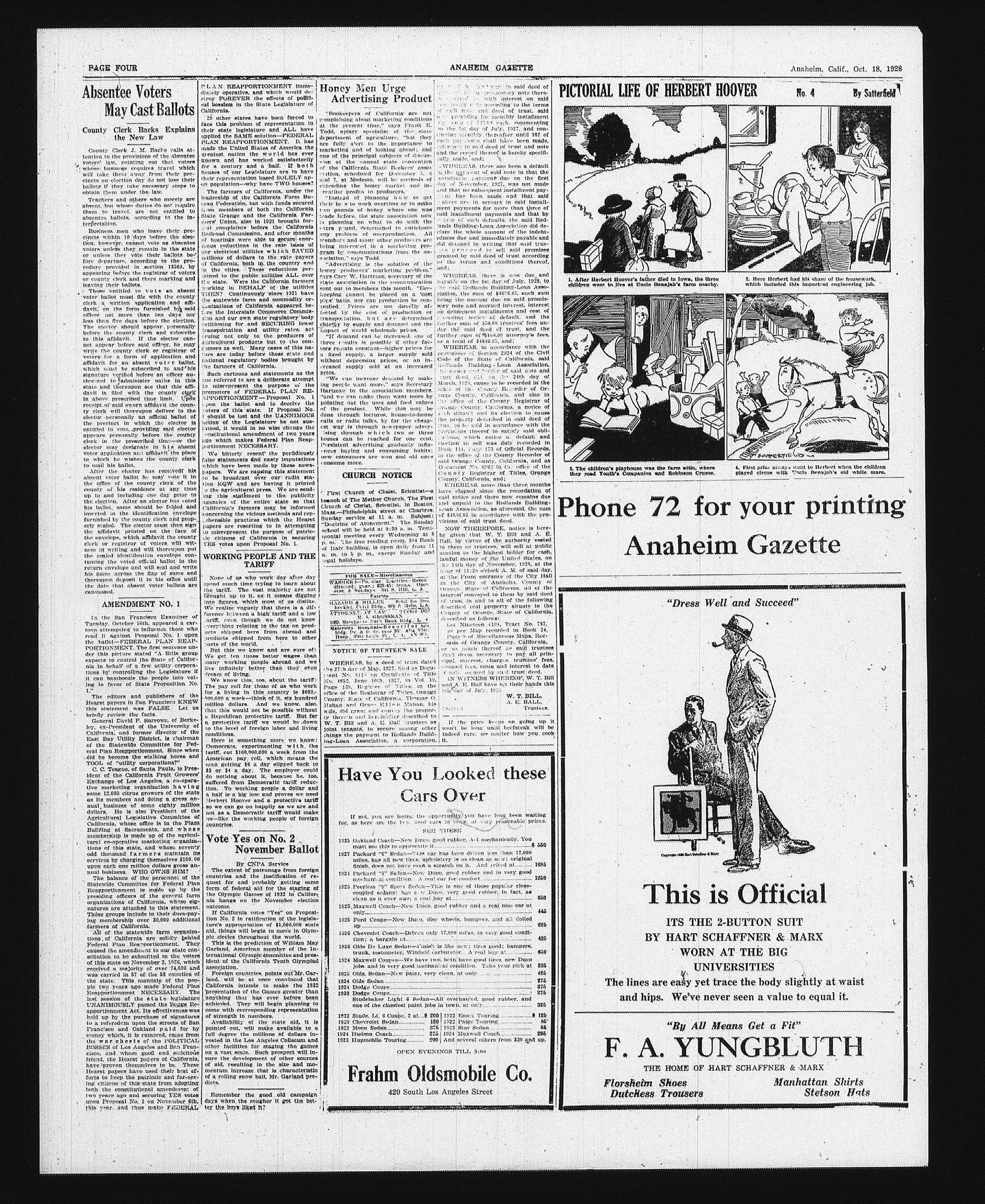
Searchable text
Absentee Voters May Cast Ballots
County Clerk J. M. Backs calls attention to the provisions of the absentee voters' law, pointing out that voters whose business requires travel which will take them away from their precinct on election day do not lose their ballots if they take necessary steps to obtain them under the law.
Teachers and others who merely are absent, but whose duties do not require them to travel, are not entitled to absentee ballots, according to the interpretation.
Business men who leave their precepts within 10 days before the election, however, cannot vote as absentee voters unless they remain in the state or unless they vote their ballots before departure, according to the procedure provided in section 13569, by appearing before the registrar of voters or county clerk and there marking and leaving their ballots.
Those entitled to vote an absent voter ballot must file with the county clerk a written application and affidavit, on the form furnished by said officer not more than ten days nor less than five days before the election. The elector should appear personally before the county clerk and subscribe to this affidavit. If the elector cannot appear before said officer, he may write the county clerk or registrar of voters for a form of application and affidavit for an absent voter ballot, which must be subscribed to and his signature verified before an officer authorized to administer oaths in this state and thereupon see that this affidavit is filed with the county clerk in above prescribed time limit. Upon receipt of said sworn affidavit the county clerk will thereupon deliver to the elector personally an official ballot of the precinct in which the elector is entitled to vote, providing said elector appears personally before the county clerk in the prescribed time—or the elector may designate in his absent PLAN REAPPORTIONMENT immediately operative, and which would destroy FOREVER the effects of political bossism in the State Legislature of California.
29 other states have been forced to face this problem of representation in their state legislature and ALL have applied the SAME solution—FEDERAL PLAN REAPPORTIONMENT. It has made the United States of America the greatest nation the world has ever known and has worked satisfactorily for a century and a half. If both houses of our Legislature are to have their representation based SOLELY upon population—why have TWO houses?
The farmers of California, under the leadership of the California Farm Bureau Federation, but with funds secured from members of both the California State Grange and the California Farmers' Union, also in 1921 brought formal complaints before the California Railroad Commission, and after months of hearings were able to secure enormous reductions in the rate basis of our electrical utilities which SAVED millions of dollars to the rate payers of California, both in the country and in the cities. These reductions permitted to the public utilities ALL over the state. Were the California farmers working in BEHALF of the utilities THEN? Continuously since 1921 have the statewide farm and commodity organizations of California appeared before the Interstate Commerce Commission and our own state regulatory body petitioning for and SECURING lower transportation and utility rates, accruing not only to the producers of agricultural products but to the consumers as well. Many cases of this nature are today before these state and national regulatory bodies brought by the farmers of California.
Such cartoons and statements as one referred to are a deliberate attempt to misrepresent the purpose of the promoters of FEDERAL PLAN REAPPORTIONMENT—Proposal No. 1 upon the ballot and to deceive the voters of this state. If Proposal No. 1 should be lost and the UANNIMOUS action of the Legislature be not sustained, it would in no wise change the constitutional amendment of two years ago which makes Federal Plan Reapportionment NECESSARY.
Honey Mead Advertising
"Hookeepers o'complaining about at the present Todd, apiary s department of c are fully alert marketing and one of the principals at the annuity of the California station, schedule and 7, at Modest extending the h creating profits."
"Instead of p their bees be to work two pounds of tobacco before, there is planning on extra pound, deny any problem of members and making interested gram by communication," says T.
"Advertising in honey producers says Cary W. Hain state association sent out to memb keeping cannot plus' basis, nor trolled. Prices feected by the c transportation." chilegy by supply impact of world.
"If demand can three results isitors remain cons a fixed supply, without depressi creased supply price."
"We can increase people want Hartman to the 'and we can man pointing out tha fof the product. done through le calls or radio tra est way is thro using through homes can be Persistent adver
voters for a form of application and affidavit for an absent voter ballot, which must be subscribed to and his signature verified before an officer authorized to administer oaths in this state and thereupon see that this affidavit is filed with the county clerk in above prescribed time limit. Upon receipt of said sworn affidavit the county clerk will thereupon deliver to the elector personally an official ballot of the precinct in which the elector is entitled to vote, providing said elector appears personally before the county clerk in the prescribed time—or the elector may designate in his absent voter application and affidavit the place to which he wishes the county clerk to mail his ballot.
After the elector has received his absent voter ballot he may vote it in the office of the county clerk of the county of his residence at any time up to and including one day prior to the election. After an elector has voted his ballot, same should be folded and inserted in the identification envelope furnished by the county clerk and properly sealed. The elector must then sign the affidavit printed on the face of the envelope, which affidavit the county clerk or registrar of voters will witness in writing and will thereupon put the sealed identification envelope containing the voted official ballot in the return envelope and will seal and write his name across the flap of same and thereupon deposit it in his office until the date that absent voter ballots are canvassed.
AMENDMENT NO. 1
In the San Francisco Examiner of Tuesday, October 16th, appeared a cartoon attempting to influence those who read it against Proposal No. 1 upon the ballot—FEDERAL PLAN REAPPORTIONMENT. The first sentence under this picture stated "A little group expects to control the State of California in behalf of a few utility corporations by controlling the Legislature if it can bamboozle the people into voting in favor of State Proposition No. 1."
The editors and publishers of the Hearst papers in San Francisco KNEW this statement was FALSE. Let us briefly review the facts.
General David P. Barrows, of Berkeley, ex-President of the University of California, and former director of the East Bay Utility District, is chairman of the Statewide Committee for Federal Plan Reapportionment. Since when did he become the stalking horse and TOOL of "utility corporations?"
C. C. Teague, of Santa Paula, is President of the California Fruit Growers' Exchange of Los Angeles, a co-operative marketing organization having some 12,000 citrus growers of the state as its members and doing a gross annual business of some eighty million dollars. He is also President of the Agricultural Legislative Committee of California, whose office is in the Plaza Building at Sacramento, and whose membership is made up of the agricultural co-operative marketing organizations of this state, and whose seventy voters for a form of application and affidavit for an absent voter ballot, which must be subscribed to and his signature verified before an officer authorized to administer oaths in this state and thereupon see that this affidavit is filed with the county clerk in above prescribed time limit. Upon receipt of said sworn affidavit the county clerk will thereupon deliver to the elector personally an official ballot of the precinct in which the elector is entitled to vote, providing said elector appears personally before the county clerk in the prescribed time—or the elector may designate in his absent voter application and affidavit the place to which he wishes the county clerk to mail his ballot.
After the elector has received his absent voter ballot he may vote it in the office of the county clerk of the county of his residence at any time up to and including one day prior to the election. After an elector has voted his ballot, same should be folded and inserted in the identification envelope furnished by the county clerk and properly sealed. The elector must then sign the affidavit printed on the face of the envelope, which affidavit the county clerk or registrar of voters will witness in writing and will thereupon put the sealed identification envelope containing the voted official ballot in the return envelope and will seal and write his name across the flap of same and thereupon deposit it in his office until the date that absent voter ballots are canvassed.
WORKING PEOPLE AND THE TARIFF
None of us who work day after day spend much time trying to learn about the tariff. The vast majority are not brought up to it, as it means digging into figures, which most of us dislike. We realize vaguely that there is a difference between a high tariff and a low tariff, even though we do not know everything relating to the tax on products shipped here from abroad and products shipped from here to other parts of the world.
But this we know and are sure of: We get ten times better wages than many working people abroad and we live infinitely better than they even dream of living.
We know this, too, about the tariff: The pay roll for those of us who work for a living in this country is $600,000 a week—think of it, six hundred million dollars. And we know, also, that this would not be possible without a Republican protective tariff. But for a protective tariff we would be down to the level of foreign labor and living conditions.
Here is something more we know: Democrats, experimenting with it, the tariff, cut $100,000,000 a week from the American pay roll, which means the man getting $6 a day slipped back to $3 or $4 a day. The employer could do nothing about it, because he, too, suffered from Democratic tariff reduction. To working people a dollar and a half is a big loss and proves we need Herbert Hoover and a protective tariff so we can go on happily as we are and not as a Democratic tariff would make us—like the working people of foreign countries.
Vote Yes on No. 2 November Ballot
C. C. Teague, of Santa Paula, is President of the California Fruit Growers' Exchange of Los Angeles, a co-operative marketing organization having some 12,000 citrus growers of the state as its members and doing a gross annual business of some eighty million dollars. He is also President of the Agricultural Legislative Committee of California, whose office is in the Plaza Building at Sacramento, and whose membership is made up of the agricultural co-operative marketing organizations of this state, and whose seventy odd thousand farmers maintain its services by charging themselves $150.00 upon each one million dollars gross annual business. WHO OWNS HIM?
The balance of the personnel of the Statewide Committee for Federal Plan Reapportionment is made up by the presiding officers of the general farm organizations of California, whose signatures are attached to this statement. These groups include in their dues-paying membership over 30,000 additional farmers of California.
All of the statewide farm organizations of California are solidly behind Federal Plan Reapportionment. They caused the amendment to our state constitution to be submitted to the voters of this state on November 2, 1926, which received a majority of over 74,000 and was carried in 57 of the 58 counties of the state. This mandate of the people two years ago made Federal Plan Reapportionment NECESSARY. The last session of the state legislature UNANIMOUSLY passed the Boggs Reapportionment Act. Its effectiveness was held up by the purchase of signatures to a referendum upon the streets of San Francisco and Oakland paid for by money which it is rumored, came from the war chests of the POLITICAL BOSSES of Los Angeles and San Francisco, and whose good and solicitous friend, the Hearst papers of California, have proven themselves to be. These Hearst papers have used their best efforts to keep the patriotic and far-seeking citizens of this state from adopting both the constitutional amendment of two years ago and securing YES votes upon Proposal No. 1 on November 6th, this year, and thus make FEDERAL American pay roll, which means the man getting $6 a day elipped back to $3 or $4 a day. The employer could do nothing about it, because he, too, suffered from Democratic tariff reduction. To working people a dollar and a half is a big loss and proves we need Herbert Hoover and a protective tariff so we can go on happily as we are and not as a Democratic tariff would make us—like the working people of foreign countries.
Vote Yes on No. 2 November Ballot
By CNPA Service
The extent of patronage from foreign countries and the justification of request for and probably getting some form of federal aid for the staging of the Olympic Games of 1932 in California hangs on the November election outcome.
If California votes "Yes" on Proposition No. 2 in ratification of the legislature's appropriation of $1,000,000 state aid, things will begin to move in Olympic circles throughout the world.
This is the prediction of William May Garland, American member of the International Olympic committee and president of the California Tenth Olympiad association.
Foreign countries points out Mr. Garland, will be at once convinced that California intends to make the 1932 presentation of the Games greater than anything that has ever before been achieved. They will begin planning to come with corresponding representation of strength in numbers.
Availability of the state aid, it is pointed out, will make available to a full degree the millions of dollars invested in the Los Angeles Coliseum and other facilities for staging the games on a vast scale. Such prospect will insure the development of other sources of aid, resulting in the size and momentum increase that is characteristic of a rolling snow ball, Mr. Garland predicts.
Remember the good old campaign days when the rougher it got the better the boys liked it?
Honey Men Urge Advertising Product
"Bookkeepers of California are not complaining about marketing conditions at the present time," says Frank E. Todd, a plary specialist of the state department of agriculture. "but they are fully alert to the importance to marketing and of looking ahead; and one of the principal subjects of discussion at the annual state convention of the California State Beekers' association, scheduled for December 5, 6 and 7, at Modesto, will be methods of extending the honey market and increasing profits to producers.
Instead of planning how to get their bests to work overtime or to make two pounds of honey where one was tade before, the state association now is planning on what to do with the extra pound, determined to anticipate any problem of overproduction. All members and many other producers are being interested in a marketing program by communications from the association," says Todd.
"Advertising is the solution of the honey producers' marketing problem," says Cary W. Hartman, secretary of the state association in the communication sent out to members this month. "Beekeeping cannot be placed on a 'cost plus' basis nor can production be controlled. Prices are not directly affected by the cost of production or transportation, but are determined chiefly by supply and demand and the impact of world wholesale prices.
If demand can be increased, one of three results is possible if other factors remain constant—higher prices for a fixed supply, a larger supply sold without depressing prices, or an increased supply sold at an increased price.
"We can increase demand by making people want more," says Secretary Hartmann to the association members, "and we can make them want more by pointing out the uses and food values of the product. While this may be done through lectures, house-to-house calls or radio talks, by far the cheapest way is through newspaper advertising through which two or three homes can be reached for one cent."
Persistent advertising gradually influences the business." In said deed of trust according to the terms of said note and deed of trust, said note providing for monthly installment payment of $75.00 each, commencing on the 1st day of July, 1927, and continuing monthly thereafter until 107 of such payments shall have been made, reference to said deed of trust and note and the record thereof is hereby specifically made and;
WHIEREAS, there has been a default in the payment of said note in that the installment payments due on the first day of November, 1927, was not made and that no subsequent installment payment has been made and that said prices are in arrears in said installment payments for more than three of said installment payments and that by reason of such defaults, the said Redlands Building-Loan Association did declare the whole amount of the indebtedness due and immediately payable and did demand in writing that said trustees proceed to sell said premises granted by said deed of trust according to the terms and conditions thereof, and;
WHIEREAS, there is now due and payable on the 1st day of July, 1928, to the said Redlands Building-Loan Association, the sum of $4696.85, such sum being the amount due on said promissory note and accrued interest, interest on delinquent installments and cost of recording notice of default, and the further sum of $50.00 trustees' fees under the said deed of trust, and the further sum of $100.00 attorney's fees, or a total of $4816.85, and;
WHIEREAS, in accordance with the provisions of Section 2924 of the Civil Code of the State of California, said Redlands Building-Loan Association, the owner and holder of said note and deed, did on the 24th day of March, 1928, cause to be recorded in the office of the County Recorder of Orange County, California, and also in the office of the County Registrar of Orange County, California, a notice of such default and its election to cause the property described in said deed of trust, to be sold in accordance with the provisions thereof to satisfy said obligations, which notice of default and election to sell was duly recorded in Book 144 Lines 173 of Official Records.
CHURCH NOTICE
First Church of Christ, Scientist—a branch of The Mother Church, The First Church of Christ, Scientist, in Boston, Massachusetts—Philadelphia street at Chartreuse Sunday service at 11 a.m. Subject: "Doctrine of Atonement." The Sunday school will be held at 9:30 a.m. Testimonial meeting every Wednesday at 8 p.m. The free reading room, 304 Bank of Italy building, is open daily from 11 a.m. to 5 p.m., except Sunday and legal holidays.
FOR SALE—Miscellaneous
WARNERS—Po. nilar. Entries—Recounted guar. $20.45; terms. Openes & Sundays. 341 S. Hill. L.A.
Patents
HAZARD & MILLER. Song for Free hecklet. Caitl Bill. 6th & Main. L.A.
ATTORNEY AT LAW. Tucker 183 M.L. GROSSMAN.
MATERIAL HOSPITAL—Reeve 1101 pet bldg. Pt. &贮仓, state $70 Alga Vist. Hosp., 329 Lehigh St. L.A. ANN.
NOTICE OF TRUSTEE'S SALE
WHEREAS, by a deed of trust dated the 27th day of May, 1927, filed as Document No. 8113 on Certificate of Title No. 4652, June 10th, 1927, in Vol. 19, Page 138, Register of Titles, in the office of the Registrar of Titles, Orange County, State of California, Thomas O. Mahan and Grace Eileen Mahan, his wife, did grant and convey the property therein and her inherit described to W.T. Bill and A.E. Ball trustees as joint tenants, to secure among other things the payment to Redlands Building-Loan Association, a corporation.
NOW THEREFORE, notice is hereby given that W.T. Bill and A.E. Ball, by virtue of the authority vested in them as trustees, will sell at public auction to the highest bidder for cash, lawful money of the United States, on the 14th day of November, 1928, at the hour of 11:20 o'clock A.M. of said day, at the Front entrance of the City Hall in the City of Anaheim, County of Orange, State of California, all of the interest conveyed to them by said deed of trust in and to all of the following described real property situate in the County of Orange, State of California, described as follows:
Lot Nineteen (19), Tract No. 787, as per Map recorded in Book 24, Page 9 of Miscellaneous Maps, Records of Orange County, California, or so much thereof as said trustees shall deem necessary to pay all principal interest, charges, trustees' fees, counsel fees, costs and interest to date of sale secured by said trust deed.
IN WITNESS WHEREOF, W.T. Bill and A.E. Ball have set their hands this 6th day of July, 1925.
W.T. BILL,
A.E. BALL,
Trustees.
If the price keeps on going up it won't be long until beefsteak will be indeed rare, no matter how you cook it.
Have You Looked these Cars Over
If not, you are losing; the opportunity you have long been waiting for, as here are the best used cars in town at very reasonable prices.
SEE THESE
1925 Oakland Coach—New Dues, good rubber, A-1 mechanically. You must see this to appreciate it... $550
Have You Looked these Cars Over
If not, you are losing; the opportunity you have long been waiting for, as here are the less used cars in town at very reasonable prices.
SEE THESE
1925 Oakland Coach—New Duco, good rubber, A-1 mechanically. You must see this to appreciate it... $ 550
1927 Packard "6" Sedan—This car has been driven less than 17,000 miles, has all new tires, upholstery is as clean as new; original finish, does not have even a scratch on it. And priced at... 1685
1924 Packard "8" Sedan—New Duco, good rubber and in very good mechanical condition. A real car for comfort... 1250
1925 Peerless "3" Sport Sedan—This is one of those popular close-coupled sedans; has new Duco, very good rubber, in fact, as clean as it ever was; a real buy at... 650
1925 Maxwell Coach—New Duco, good rubber and a real nice car at only... 445
1925 Ford Coupe—New Duco, disc wheels, bumpers, and all dolled up... 225
1926 Chevrolet Coach—Driven only 17,000 miles, in very good condition; a bargain at... 425
1926 Olds De Luxe Sedan—Finish is like new; tires good; bumpers, trunk, matometer, Winfield carburetor. A real buy at... 650
1924 Maxwell Coupes—We have two, both have good tires, new Duco jobs, and in very good mechanical condition. Take your pick at... 395
1925 Olds, Sedan—New paint, very clean, at only... 425
1924 Olds Sedan... 275
1924 Dodge Coupe... 375
1928 Dodge Coupe... 275
Studebaker Light 6 Sedan—All overhauled, good rubber, and one of the classiest paint jobs in town, at only... 325
1922 Stude. Lt. 6 Coupe, 2 at... $ 200 | 1922 Essex Touring... $ 125
1923 Chevrolet Sedan... 180 | 1922 Paige Touring... 85
1922 Moon Sedan... 375 | 1923 Star Sedan... 95
1924 Hudson Coach... 275 | 1924 Maxwell Coach... 295
1923 Hupmobile Touring... 200 | And several others from $20 and up.
OPEN EVENINGS TILL 9:00
Frahm Oldsmobile Co.
420 South Los Angeles Street
LIFE OF HERBERT HOOVER
No. 4 By Satterfield
Hoover's father died in Iowa, the three
live at Uncle Benajah's farm nearby.
2. Here Herbert had his share of the housework,
which included this important engineering job.
playhouse was the farm attic, where
Companion and Robinson Crusoe.
4. First prize always went to Herbert when the children
played circus with Vincio Benajah's old white mare.
the 72 for your printing
Anaheim Gazette
"Dress Well and Succeed"
This is Official
ITS THE 2-BUTTON SUIT
BY HART SCHAFFNER & MARX
WORN AT THE BIG
UNIVERSITIES
e lines are easy yet trace the body slightly at waist
and hips. We've never seen a value to equal it.
"By All Means Get a Fit"
T. A. YUNGBLUTH
THE HOME OF HART SCHAFFNER & MARX
orsheim Shoes Manhattan Shirts
butchess Trousers Stetson Hats