anaheim-gazette 1928-06-21
Scanned page
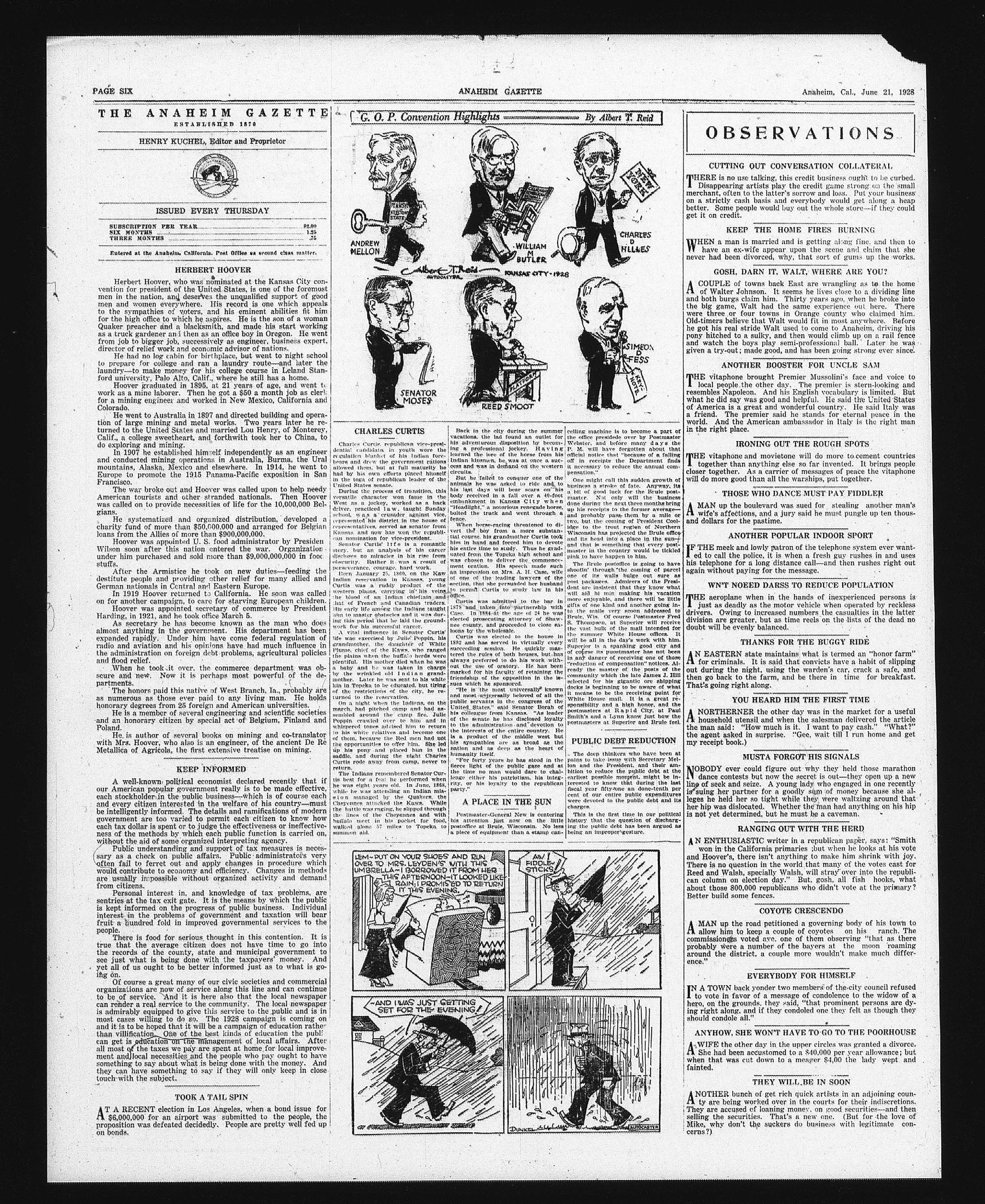
Searchable text
THE ANAHEIM GAZETTE
ESTABLISHED 1870
HENRY KUCHEL, Editor and Proprietor
ISSUED EVERY THURSDAY
SUBSCRIPTION PER YEAR.....$2.00
SIX MONTHS.....1.25
THREE MONTHS.....7.75
Entered at the Anaheim, California. Post Office as second class matter.
HERBERT HOOVER
Herbert Hoover, who was nominated at the Kansas City convention for president of the United States, is one of the foremost men in the nation, and deserves the unqualified support of good men and women everywhere. His record is one which appeals to the sympathies of voters, and his eminent abilities fit him for the high office to which he aspires. He is the son of a woman Quaker preacher and a blacksmith, and made his start working as a truck gardener and then as an office boy in Oregon. He went from job to bigger job, successively as engineer, business expert, director of relief work and economic advisor of nations.
He had no log cabin for birthplace, but went to night school to prepare for college and ran a laundry route—and later the laundry—to make money for his college course in Leland Stanford university, Palo Alto, Calif., where he still has a home.
Hoover graduated in 1895, at 21 years of age, and went to work as a mine laborer. Then he got a $50 a month job as clerk for a mining engineer and worked in New Mexico, California and Colorado.
He went to Australia in 1897 and directed building and operation of large mining and metal works. Two years later he returned to the United States and married Lou Henry, of Monterey, Calif., a college sweetheart, and forthwith took her to China, to do exploring and mining.
He had no log cabin for birthplace, but went to night school to prepare for college and ran a laundry route—and later the laundry—to make money for his college course in Leland Stanford university, Palo Alto, Calif., where he still has a home.
Hoover graduated in 1895, at 21 years of age, and went to work as a mine laborer. Then he got a $50 a month job as clerk for a mining engineer and worked in New Mexico, California and Colorado.
He went to Australia in 1897 and directed building and operation of large mining and metal works. Two years later he returned to the United States and married Lou Henry, of Monterey, Calif., a college sweetheart, and forthwith took her to China, to do exploring and mining.
In 1907 he established himself independently as an engineer and conducted mining operations in Australia, Burma, the Ural mountains, Alaska, Mexico and elsewhere. In 1914, he went to Europe to promote the 1915 Panama-Pacific exposition in San Francisco.
The war broke out and Hoover was called upon to help needy American tourists and other stranded nationals. Then Hoover was called on to provide necessities of life for the 10,000,000 Belgians.
He systematized and organized distribution, developed a charity fund of more than $50,000,000 and arranged for Belgian loans from the Allies of more than $900,000,000.
Hoover was appointed U.S. food administrator by President Wilson soon after this nation entered the war. Organization under him purchased and sold more than $9,000,000,000 in food stuffs.
After the Armistice he took on new duties—feeding the destitute people and providing other relief for many allied and German nationals in Central and Eastern Europe.
In 1919 Hoover returned to California. He soon was called on for another campaign, to care for starving European children.
Hoover was appointed secretary of commerce by President Harding, in 1921, and he took office March 5.
As secretary he has become known as the man who does almost anything in the government. His department has been expanded rapidly. Under him have come federal regulation of radio and aviation and his opinions have had much influence in the administration on foreign debt problems, agricultural policies and flood relief.
When he took it over, the commerce department was obscure and new. Now it is perhaps most powerful of the departments.
The honors paid this native of West Branch, Ia., probably are as numerous as those ever paid to any living man. He holds honorary degrees from 25 foreign and American universities.
He is a member of several engineering and scientific societies and an honorary citizen by special act of Belgium, Finland and Poland.
He is author of several books on mining and co-translator with Mrs. Hoover, who also is an engineer, of the ancient De Re Metallica of Agricola, the first extensive treatise on mining.
KEEP INFORMED
A well-known political economist declared recently that if our American popular government really is to be made effective, each stockholder in the public business—which is of course each and every citizen interested in the welfare of his country—must be intelligently informed. The details and ramifications of modern government are too varied to permit each citizen to know how each tax dollar is spent or to judge the effectiveness or ineffectiveness of the methods by which each public function is carried on, without the aid of some organized interpreting agency.
Public understanding and support of tax measures is neces-
KEEP INFORMED
A well-known political economist declared recently that if our American popular government really is to be made effective, each stockholder in the public business—which is of course each and every citizen interested in the welfare of his country—must be intelligently informed. The details and ramifications of modern government are too varied to permit each citizen to know how each tax dollar is spent or to judge the effectiveness or ineffectiveness of the methods by which each public function is carried on, without the aid of some organized interpreting agency.
Public understanding and support of tax measures is necessary as a check on public affairs. Public administrators very often fail to ferret out and apply changes in procedure which would contribute to economy and efficiency. Changes in methods are usually impossible without organized activity and demand from citizens.
Personal interest in, and knowledge of tax problems, are sentries at the tax exit gate. It is the means by which the public is kept informed on the progress of public business. Individual interest in the problems of government and taxation will bear fruit a hundred fold in improved governmental services to the people.
There is food for serious thought in this contention. It is true that the average citizen does not have time to go into the records of the county, state and municipal government to see just what is being done with the taxpayers' money. And yet all of us ought to be better informed just as to what is going on.
Of course a great many of our civic societies and commercial organizations are now of service along this line and can continue to be of service. And it is here also that the local newspaper can render a real service to the community. The local newspaper is admirably equipped to give this service to the public and is in most cases willing to do so. The 1928 campaign is coming on and it is to be hoped that it will be a campaign of education rather than villification. One of the best kinds of education the public can get is education on the management of local affairs. After all most of the taxes we pay are spent at home for local improvement and local necessities and the people who pay ought to have something to say about what is being done with the money. And they can have something to say if they will only keep in close touch with the subject.
TOOK A TAIL SPIN
AT A RECENT election in Los Angeles, when a bond issue for $6,000,000 for an airport was submitted to the people, the proposition was defeated decidedly. People are pretty well fed up on bonds.
ANAHEIM GAZETTE
G. O. P. Convention Highlights By Albert T. Reid
ANDREW MELLON
WILLIAM M BUTLER
CHARLES D HLLLES
ALBERT T. REID
KANSAS CITY - 1928
SENATOR MOSES
PLATFORM
REED SMOOT
SIMEON D FESS
KEYNOTE
CHARLES CURTIS
Charles Curtis, republican vice-president, in youth work the back in the city during the summer vacations, the lad found an outlet for his adventurous disposition by becoming a professional jockey. Having a ceiling machine is to become a part of the office presided over by Postmaster Webster, and before many days the R.M. will have forgotten about that
CHARLES CURTIS
Charles Curtis, republican vice-presidential candidate in youth wore the regulation blanket of his Indian forebears and drew the government rations allowed them, but at full maturity he had by his own efforts placed himself in the toga of republican leader of the United States senate.
During the process of transition, this versatile character won fame in the West as a jockey, worked as a hack driver, practiced law, taught Sunday school, was a crusader against vice, represented his district in the house of representatives, served as senator from Kansas, and now has won the republican nomination for vice-president.
Senator Curtis' life is a romantic story, but an analysis of his career discloses no miracles in his rise from obscurity. Rather it was a result of perseverance, courage, hard work.
Born January 25, 1860 on the Kaw Indian reservation in Kansas, young Curtis was a ruddy product of the western plains, carrying in his veins the blood of an Indian chiefain and that of French and Canadian traders. His early life among the Indians taught him to master obstacles and it was during this period that he laid the groundwork for his successful career.
A vital influence in Senator Curtis' life was exercised by Julie Poppin, his grandmother, the daughter of White Plume, chief of the Kaws, who ranged the plains when the buffalo herds were plentiful. His mother died when he was a baby and he was taken in charge by the wrinkled old Indian grandmother. Later he was sent to his white kin in Topeka to be educated, but tiring of the restrictions of the city, he returned to the reservation.
On a night when the Indians, on march, had pitched camp and had assembled around the camp fire, Julie Poppin crawled over to him and in whispered tones advised him to return to his white relatives and become one of them, because the Red men had not the opportunities to offer him. She led up his pony and placed him in the saddle, and during the night Charles Curtis rode away from camp, never to return.
The Indians remembered Senator Curtis best for a feat he performed when he was eight years old. In June, 1868, while he was attending an Indian mission managed by the Quakers, the Cheyennes attacked the Kaws. While the battle was raging, he slipped through the lines of the Cheyennes and with buffalo meet in his pocket for food, walked alone 57 miles to Topeka to summon aid.
Back in the city during the summer vacations, the lad found an outlet for his adventurous disposition by becoming a professional jockey. Having learned the lore of the horse from his Indian kinsmen, he was at once a success and was in demand on the western circuits.
But he failed to conquer one of the animals he was asked to ride and to his last days will bear scars on his body received in a fall over a 40-foot embankment in Kansas City when "Headlight," a notorious renegade horse, bolted the track and went through a fence.
When horse-racing threatened to divert the boy from a more substantial course, his grandmother Curtis took him in hand and forced him to devote his entire time to study. Thus he graduated from the Topeka high school and was chosen to deliver the commencement oration. His speech made such an impression on Mrs. A. H. Case, wife of one of the leading lawyers of the section, that she persuaded her husband to permit Curtis to study law in his office.
Curtis was admitted to the bar in 1879 and taken into partnership with Case. In 1884 at the age of 24 he was elected prosecuting attorney of Shawnee county, and proceeded to close saloons by the wholesale.
Curtis was elected to the house in 1892 and has served in virtually every succeeding session. He quickly mastered the rules of both houses, but has always preferred to do his work without the use of oratory. He has been marked for his faculty of retaining the friendship of the opposition in the issues which he sponsored.
"He is the most universally known and most universally beloved of all the public servants in the congress of the United States," said Senator Borah of his colleague from Kansas. "As leader of the Senate he has disclosed loyalty to the administration and devotion to the interests of the entire country. He is a product of the middle west but his sympathies are as broad as the nation and as deep as the heart of humanity itself."
For forty years he has stood in the fierce light of the public gaze and at the time no man would dare to challenge either his patriotism, his integrity, or his loyalty to the republican party."
A PLACE IN THE SUN
Postmaster-General New is centering his attention just now on the little postoffice at Brule, Wisconsin. No less a piece of equipment than a stamp can-celling machine is to become a part of the office presidede over by Postmaster Webster, and before many days the P. M. will have forgotten about that official notice that "because of a falling off in receipts the Department finds it necessary to reduce the annual compensation."
One might call this sudden growth of business a stroke of fate. Anyway, its a bit of good luck for the Brule postmaster. Not only will the business done during the next three months bring up his receipts to the former average—and probably pass them by a mile or two, but the coming of President Coolidge to the trout region of Northern Wisconsin has projected the Brule office and its head into a place in the sun—and that is something that every postmaster in the country would be tickled pink to have happen to him.
The Brule postoffice is going to have shootin' through 'the coming of parcel one of its walls bulge out sure as post packages. Admirers of the President are insistent that they know what will aid hi min making his vacation more enjoyable, and there will be little gifts of one kind and another going into to mails very scoop addressed to Brule, Wise. Of course Postmaster Fred S. Thompson, at Superior will receive the vast bulk of the mail intended for the summer White House offices. It will be all in the day's work with him. Superior is a spanking good city and of course its postmaster has not been in any danger of receiving one of those "reduction of compensation" notices. Already the master of the posts of the community which late James J. Hill selected for his gigantic ore shipping docks is beginning to be aware of what it means to be the receiving point for White House mail. It is a great responsibility and a high honor, and the postmasters at Rapid City, at Paul Smith's and a Lynn know just how the postmasters at Superior and Brule feel.
PUBLIC DEBT REDUCTION
The deep thinkers who have been at pains to take issue with Secretary Melton and the President, and their ambition to reduce public debt at the earliest possible moment, might be interested to know that during last fiscal year fifty-one an done-tenth percent of our entire public expenditures were devoted to the public debt and its charges.
This is the first time in our political history that the question of discharging the public debt has been argued as being an improper gesture.
The Indians remembered Senator Curtis best for a feat he performed when he was eight years old. In June, 1868, while he was attending an Indian mission managed by the Quakers, the Cheyennes attacked the Kaws. While the battle was raging, he slipped through the lines of the Cheyennes and with buffalo meet in his pocket for food, walked alone 57 miles to Topeka to summon aid.
For forty years he has stood in the fierce light of the public gaze and at the time no man would dare to challenge either his patriotism, his integrity, or his loyalty to the republican party."
A PLACE IN THE SUN
Postmaster-General New is centering his attention just now on the little postoffice at Brule, Wisconsin. No less a piece of equipment than a stamp can pains to take issue with Secretary Melton and the President, and their ambition to reduce the public debt at the earliest possible moment, might be interested to know that during the last fiscal year fifty-one an done-tenth percent of our entire public expenditures were devoted to the public debt and its charges.
This is the first time in our political history that the question of discharging the public debt has been argued as being an improper gesture.
OBSERVATIONS
CUTTING OUT CONVERSATION COLLATERAL
THERE is no use talking, this credit business ought to be curbed.
Disappearing artists play the credit game strong on the small merchant, often to the latter's sorrow and loss. Put your business on a strictly cash basis and everybody would get along a heap better. Some people would buy out the whole store—if they could get it on credit.
KEEP THE HOME FIRES BURNING
WHEN a man is married and is getting along fine, and then to have an ex-wife appear upon the scene and claim that she never had been divorced, why, that sort of gums up the works.
GOSH, DARN IT, WALT, WHERE ARE YOU?
A COUPLE of towns back East are wrangling as to the home of Walter Johnson. It seems he lives close to a dividing line and both burgs claim him. Thirty years ago, when he broke into the big game, Walt had the same experience out here. There were three or four towns in Orange county who claimed him. Old-timers believe that Walt would fit in most anywhere. Before he got his real stride Walt used to come to Anaheim, driving his pony hitched to a sulky, and then would climb up on a rail fence and watch the boys play semi-professional ball. Later he was given a try-out; made good, and has been going strong ever since.
ANOTHER BOOSTER FOR UNCLE SAM
THE vitaphone brought Premier Mussolini's face and voice to local people the other day. The premier is stern-looking and resembles Napoleon. And his English vocabulary is limited. But what he did say was good and helpful. He said the United States of America is a great and wonderful country. He said Italy was a friend. The premier said he stands for eternal peace in the world. And the American ambassador in Italy is the right man in the right place.
IRONING OUT THE ROUGH SPOTS
ANOTHER BOOSTER FOR UNCLE SAM
THE vitaphone brought Premier Mussolini's face and voice to local people the other day. The premier is stern-looking and resembles Napoleon. And his English vocabulary is limited. But what he did say was good and helpful. He said the United States of America is a great and wonderful country. He said Italy was a friend. The premier said he stands for eternal peace in the world. And the American ambassador in Italy is the right man in the right place.
IRONING OUT THE ROUGH SPOTS
THE vitaphone and movietone will do more to cement countries together than anything else so far invented. It brings people closer together. As a carrier of messages of peace the vitaphone will do more good than all the warships, put together.
THOSE WHO DANCE MUST PAY FIDDLER
MAN up the boulevard was sued for stealing another man's wife's affections, and a jury said he must pungle up ten thousand dollars for the pastime.
ANOTHER POPULAR INDOOR SPORT
IF THE meek and lowly patron of the telephone system ever wanted to call the police, it is when a fresh guy rushes in and uses his telephone for a long distance call—and then rushes out again without paying for the message.
WN'T NOEED DARSS TO REDUCE POPULATION
THE aeroplane when in the hands of inexperienced persons is just as deadly as the motor vehicle when operated by reckless drivers. Owing to increased numbers the casualties in the latter division are greater, but as time reels on the lists of the dead no doubt will be evenly balanced.
THANKKS FOR THE BUGGY RIDE
AN EASTERN state maintains what is termed an "honor farm" for criminals. It is said that convicts have a habit of slipping out during the night, using the warden's car, crack a safe, and then go back to the farm, and be there in time for breakfast. That's going right along.
YOU HEARD HIM THE FIRST TIME
AN ORTHERNER the other day was in the market for a useful household utensil and when the salesman delivered the article the man said: "How much is it. I want to pay cash." "What?" the agent asked in surprise. "Gee, wait till I run home and get my receipt book."
MUSTA FORGOT HIS SIGNALS
NOBODY ever could figure out why they held those marathon dance contests but now the secret is out—they open up a new line of seek and seize. A young lady who engaged in one recently suing her partner for a goodly sum of money because she alleged he held her so tight while they were waltzing around that her hip was dislocated. Whether the man had anything on his hip is not yet determined, but he must be a caveman.
RANGING OUT WITH THE HERD
AN ENTHUSIASTIC writer in a republican paper, says: "Smith won in the California primaries; but when he looks at his vote
NOBODY ever could figure out why they held those marathon dance contests but now the secret is out—they open up a new line of seek and seize. A young lady who engaged in one recently is suing her partner for a goodly sum of money because she alleges he held her so tight while they were waltzing around that her hip was dislocated. Whether the man had anything on his hip is not yet determined, but he must be a caveman.
RANGING OUT WITH THE HERD
AN ENTHUSIASTIC writer in a republican paper, says: "Smith won in the California primaries; but when he looks at his vote and Hoover's, there isn't anything to make him shrink with joy. There is no question in the world that many of the votes cast for Reed and Walsh, specially Walsh, will stray over into the republican column on election day." But, gosh, all fish hooks, what about those 800,000 republicans who didn't vote at the primary? Better build some fences.
COYOTE CRESCENDO
MAN up the road petitioned a governing body of his town to allow him to keep a couple of coyotes on his ranch. The commissioner voted ave. one of them observing "that as there probably were a number of the bayers at the moon roaming around the district, a couple more wouldn't make much difference."
EVERYBODY FOR HIMSELF
IN A TOWN back yonder two members of the city council refused to vote in favor of a message of condolence to the widow of a hero, on the grounds, they said, "that prominent persons are dying right along, and if they condoled one they felt as though they should condole all."
ANYHOW, SHE WON'T HAVE TO GO TO THE POORHOUSE
WIFE the other day in the upper circles was granted a divorce. She had been accustomed to a $40,000 per year allowance; but when that was cut down to a meager $4,00 the lady wept and fainted.
THEY WILL BE IN SOON
NOTHER bunch of get rich quick artists in an adjoining county are being worked over in the courts for their indiscretions. They are accused of loaning money, on good securities—and then selling the securities. That's a new one. (But for the love of Mike, why don't the suckers do business with legitimate concerns?)