anaheim-gazette 1928-03-08
Scanned page
Searchable text
THE ANAHEIM GAZETTE
ESTABLISHED 1870.
HENRY KUCHEL, Editor and Proprietor
ISSUED EVERY THURSDAY
SUBSCRIPTION PER YEAR..... $2.00
SIX MONTHS..... 1.25
THREE MONTHS..... 7.75
Buried at the Anaheim, California, Post Office as second class matter.
TARIFF AND ARGENTINA
ONE of the big sensations of the closing days of the Pan-American conference was the attempt by Dr. Pueyrredon, chairman of the Argentine delegation, to raise the cry of "economic barriers" and attempt to put over in the conference some sort of an agreement for the elimination of the tariffs between the Pan-American countries. When he received no support for his idea the doctor resigned both as head of the Argentine delegation to the Pan-American conference and as Argentine ambassador to the United States.
The significance of the doctor's effort to raise the tariff issue will not be lost on the American producer and especially on the American farmer. The free traders like to tell us that the tariff does not help the farmer. But the ineffective effort of Dr. Pueyrredon to break down our tariff would seem to indicate otherwise. Argentine is the one country in South America adversely affected by our tariff. And Argentine is a nation of farmers and stockmen. It is apparent therefore that any effort to regulate our tariff through Pan-American action is an effort to get Argentine corn, and Argentine beef into the United States under lower duties. What other purpose could the plan have in view? And since the Argentine representative got excited enough about the matter to resign, it must be that the American tariff is protecting the American farmer against cheap Argentine products.
It will not do to try to answer by saying that Dr. Pueyrredon was playing politics, that he made the anti-tariff gesture and
Dr. Pueyrredon to break down our tariff would seem to indicate otherwise. Argentine is the one country in South America adversely affected by our tariff. And Argentine is a nation of farmers and stockmen. It is apparent therefore that any effort to regulate our tariff through Pan-American action is an effort to get Argentine corn, and Argentine beef into the United States under lower duties. What other purpose could the plan have in view? And since the Argentine representative got excited enough about the matter to resign, it must be that the American tariff is protecting the American farmer against cheap Argentine products.
It will not do to try to answer by saying that Dr. Pueyrredon was playing politics, that he made the anti-tariff gesture and then resigned just to become a candidate for president of Argentine. This only strengthens the argument on the tariff side. When politicians become candidates for office they try to espouse the popular side. Therefore, if the good doctor is a candidate for president of the Argentine Republic, and takes a stand for breaking down the American tariff, it must be that he knows such a stand would be popular with the farmers and stockmen in his own country, since these are the only classes in Argentina who are interested in our tariff.
As a matter of fact, the tariff is protecting the American farmer and he is intelligent enough to know it. The case of Argentine is only one of a number of proofs of that assertion.
THE OLD BATTLE FLAGS
AMONG the amenities of our times, one of the most agreeable is the apparently growing inclination on the part of the states embattled during the war between the North and the South to return captured flags. Recently, representatives of the state of Maine went to Washington and, meeting there officials of the states of Virginia, South Carolina, and Texas and survivors of the Confederacy, gave back to the southern states these treasured relics of idealism and courage. Later, North Carolinans gathered at Trenton, where they were presented with flags captured by New Jersey troops in 1863. No indication has been given as to how these pleasing exchanges began. It is clear that Maine led off by returning flags to South Carolina, but is this a general movement under way? It would be a fine thing if that were so. Americans never proved their mettle more conclusively than when they fought one another during the '60s, and their records of gallantry stand as the pride of each state then in the field. There must be many southern flags in northern states, and in the South there are still standards which were taken by the men of Lee and Jackson. These flags are proud family heirlooms, and it is not surprising that the descendants of brave American soldiers should value among their possessions color which their ancestors brought home from the war. But they would mean so much to the people of the states in whose name they were borne, and hung on the walls of the state capitols, they would be a constant reminder of a glorious, if unhappy, past. Each flag could be draped above a tablet reciting where, when and by whom it was taken and celebrating the fraternal spirit back of the restitution. There is a sentiment involved in this which could be used to mitigate the forgetfulness of a busy, materialistic age.
THE FARMERS' WAY OUT
WHERE are America's farmers heading? Toward a new prosperity—or toward peasantry? Speakers at the meeting of the Ohio Farm Bureau Federation recently seemed worried over the farmers' outlook. Prof. W. E. Dodd of the University of
Each flag could be draped above a tablet reciting where, when and by whom it was taken and celebrating the fraternal spirit back of the restitution. There is a sentiment involved in this which could be used to mitigate the forgetfulness of a busy, materialistic age.
THE FARMERS' WAY OUT
WHERE are America's farmers heading? Toward a new prosperity—or toward peasantry? Speakers at the meeting of the Ohio Farm Bureau Federation recently seemed worried over the farmers' outlook. Prof. W. E. Dodd of the University of Chicago was pessimistic, asserting that neither the farmer nor his friends "seem able to check the downward drift of agriculture."
Not so gloomy, however, was L. B. Palmer, president of the federation. The farmer, he asserted, "must become well versed on all basic problems, not only of production but of marketing, purchasing, legislation and home and community development." In this way, he predicted, the farmer could win a new prosperity.
Most of us will be inclined to think his view is the right one. The farmer has a difficult row to hoe, to be sure; but there seems little reason to suppose that industry, scientific management and careful planning will not see him through it.
GREAT HONOR FOR COAST
TO THE Pacific Northwest goes the chairmanship of the ways and means committee of the House, a position which brings upon its holder the national limelight and keeps it upon him throughout each session of Congress. By the retirement from the halls of legislation of William R. Green of Iowa after seventeen years of service in the House, the ranking member, Willis Chatman Hawley of the First Oregon district, takes the chair, the occupancy of which did so much to make known everywhere the name of McKinley of Ohio, Dingley of Maine, Wilson of West Virginia—to name no others.
The new chairman has had more than twenty years' experience as a congressman. His parents went to the coast even before the Forty-niners began to sail around The Horn or make the long journey by stage coach and wagon train to the western country. Mr. Hawley was president of Willmette college before he was elected to the House in 1906. He has ranked as one of the leaders of the House for a long time. In the sixty-ninth Congress he was chairman of the Republican caucus—a high honor to be accorded by his colleagues, and also the certainty of a very responsible task.
ANAHEIM GAZETTE
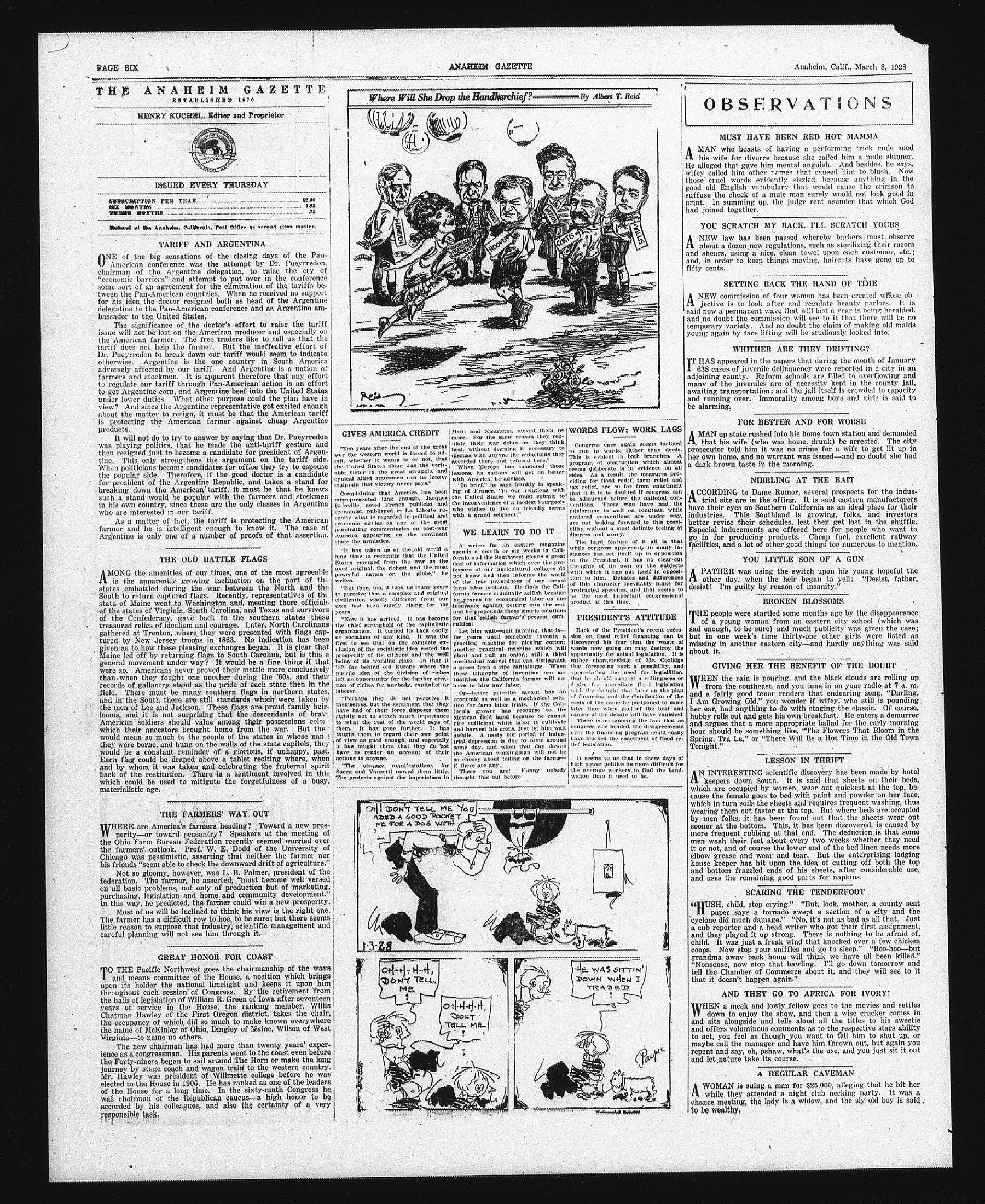
Where Will She Drop the Handkerchief? By Albert T. Reid
GIVES AMERICA CREDIT
"Ten years after the end of the great
Haiti and Nicaragua moved them no more. For the same reason they regulate their war debts as they think best without deeming it necessary to
WORDS FLOW; WORK LAGS
Congress once again seems inclined
GIVES AMERICA CREDIT
"Ten years after the end of the great war the western world is forced to admit, whether it wants to or not, that the United States alone was the veritable victor in the great struggle, and cynical allied statesmen can no longer maintain that victory never pays."
Complaining that America has been misrepresented long enough, Jacques Bainville, noted French publicist and economist, published in La Liberte recently what is regarded in political and economic circles as one of the most penetrating commentaries on post-war America appearing on the continent since the armistice.
"It has taken us of the old world a long time to recognize that the United States emerged from the war as the most original, the richest and the most powerful nation on the globe," he writes.
"But then, too, it took us many years to perceive that a complex and original civilization wholly different from our own had been slowly rising for 150 years.
Now it has arrived. It has become the chief strengthhold of the capitalistic organization. It turned its back coolly on socialism of any kind. It was the first to see that on the complete exclusion of the socialistic idea rested the prosperity of its citizens and the well-being of its working class. In that it left far behind old Europe where the puerile idea of the division of riches left no opportunity for the further creation of riches for anybody, capitalist or laborer.
Perhaps they do not perceive themselves, but the sentiment that they have had of their force disposes them rightly not to attach much importance to what the rest of the world says of them. It has gone further. It has taught them to regard their own point of view as good enough, and especially it has taught them that they do not have to render an account of their actions to anyone.
The strange manifestations for Sacco and Vanzetti moved them little. The protests against the imperialism in Haiti and Nicaragua moved them no more. For the same reason they regulate their war debts as they think best, without deeming it necessary to discuss with anyone the reductions they accord there and refused here."
When Europe has mastered those lessons, its nations will get on better with America, he advises.
"In brief," he says frankly in speaking of France, "in our relations with the United States we must submit to the inconvenience of a modest bourgeois who wishes to live on friendly terms with a grand seigneur."
WE LEARN TO DO IT
A writer for an eastern magazine spends a month or six weeks in California and the Southwest gleams a great deal of information which even the professors of our agricultural colleges do not know and then informs the world of the true inwardness of our casual farm labor problem. He finds the California farmer criminally selfish because he years for economical labor as one insurance against getting into the red, and he propounds these simple solutions for that selfish farmer's present difficulties:
Let him wait—quit farming, that is for years until somebody invents a practical machine for picking cotton; another practical machine which will plant and pull an onion; still a third mechanical marvel that can distinguish a green from a ripe cantaloupe. When these triumphs of invention are actualities, the California farmer will not have to hire any labor.
Or—better yet—the savant has an economic as well as a mechanical solution for farm labor trials. If the California grower has recourse to the Mexican field hand because he cannot hire sufficient white labor to cultivate and harvest his crops, just let him wait awhile. A nasty big period of industrial depression is due to come around some day, and when that day dawns the American workingman will not be so choosy about tolling on the farms—if there are any.
There you are! Funny nobody thought this out before.
WORDS FLOW; WORK LAGS
Congress once again seems inclined to run to words, rather than deeds. This is evident in both branches. A program of obstruction which almost seems deliberate is in evidence on all sides. As a result, the measures providing for flood relief, farm relief and tax relief, are so far from enactment that it is to be doubted if congress can be adjourned before the national conventions. Those who have had the misfortune to wait on congress, while national conventions are under way, are not looking forward to this possibility without a most definite feeling of distress and worry.
The hard feature of it all is that while congress apparently in many instances has set itself up in opposition to the President, it has no clear-cut thoughts of its own on the subjects with which it has put itself in opposition to him. Debates and differences of this character inevitably make for protracted speeches, and that seems to be the most important congressional product at this time.
PRESIDENT'S ATTITUDE
Back of the President's recent recession on flood relief financing can be discovered his fear that the waste of words now going on may destroy the opportunity for actual legislation. It is rather characteristic of Mr. Coolidge that foreseeing such a possibility, and appreciating the need for legislation, that he should suggest a willingness or desire for immediate flood legislation with the thought that later on the plan of financing and the distribution of the costs of the same be postponed to some later time when part of the heat and rancor of the debate will have vanished.
There is no ignoring the fact that as congress was headed, the disagreements over the financing program could easily have blocked the enactment of flood relief legislation.
It seems to us that in these days of high power politics its more difficult for the average workers to find the bandwagon than it used to be.
actions to anyone.
"The strange manifestations for Sacco and Vanzetti moved them little. The protests against the imperialism in so choosy about tolling on the farms—if there are any. There you are! Funny nobody thought this out before.
OH! DON'T TELL ME YOU ADED A GOOD POCKET FE FOR A DOG WITH
1-3-28
OH-H-H-H,
DON'T TELL ME!
OH-H-H-H,
DON'T TELL ME!
HE WAS SITTIN'
DOWN WHEN I TRADED!
Распеч
OBSERVATIONS
MUST HAVE BEEN RED HOT MAMMA
A MAN who boasts of having a performing trick mule sued his wife for divorce because she called him a mule skinner. He alleged that gave him mental anguish. And besides, he says, wifey called him other names that caused him to blush. Now those cruel words evidently sizzled, because anything in the good old English vocabulary that would cause the crimson to suffuse the cheek of a mule man surely would not look good in print. In summing up, the judge rent asunder that which God had joined together.
YOU SCRATCH MY BACK, ILL SCRATCH YOURS
A NEW law has been passed whereby barbers must observe about a dozen new regulations, such as sterilizing their razors and shears, using a nice, clean towel upon each customer, etc.; and, in order to keep things moving, haircuts have gone up to fifty cents.
SETTING BACK THE HAND OF TIME
A NEW commission of four women has been created whose objective is to look after and regulate beauty parlors. It is said now a permanent wave that will last a year is being heralded, and no doubt the commission will see to it that there will be no temporary variety. And no doubt the claim of making old maids young again by face lifting will be studiously looked into.
WHITHER ARE THEY DRIFTING?
IT HAS appeared in the papers that during the month of January 638 cases of juvenile delinquency were reported in a city in an adjoining county. Reform schools are filled to overflowing and many of the juveniles are of necessity kept in the county jail, awaiting transportation; and the jail itself is crowded to capacity and running over. Immorality among boys and girls is said to be alarming.
FOR BETTER AND FOR WORSE
A MAN up state rushed into his home town station and demanded that his wife (who was home, drunk) be arrested. The city prosecutor told him it was no crime for a wife to get lit up in
IT HAS appeared in the papers that during the month of January 638 cases of juvenile delinquency were reported in a city in an adjoining county. Reform schools are filled to overflowing and many of the juveniles are of necessity kept in the county jail, awaiting transportation; and the jail itself is crowded to capacity and running over. Immorality among boys and girls is said to be alarming.
FOR BETTER AND FOR WORSE
MAN up state rushed into his home town station and demanded that his wife (who was home, drunk) be arrested. The city prosecutor told him it was no crime for a wife to get lit up in her own home, and no warrant was issued—and no doubt she had a dark brown taste in the morning.
NIBBLING AT THE BAIT
ACCORDING to Dame Rumor, several prospects for the industrial site are in the offing. It is said eastern manufacturers have their eyes on Southern California as an ideal place for their industries. This Southland is growing, folks, and investors better revise their schedules, lest they get lost in the shuffle. Especial inducements are offered here for people who want to go in for producing products. Cheap fuel, excellent railway facilities, and a lot of other good things too numerous to mention.
YOU LITTLE SON OF A GUN
FATHER was using the switch upon his young hopeful the other day, when the heir began to yell: "Desist, father, desist! I'm guilty by reason of insanity."
BROKEN BLOSSOMS
THE people were startled some months ago by the disappearance of a young woman from an eastern city school (which was sad enough, to be sure) and much publicity was given the case; but in one week's time thirty-one other girls were listed as missing in another eastern city—and hardly anything was said about it.
GIVING HER THE BENEFIT OF THE DOUBT
WHEN the rain is pouring, and the black clouds are rolling up from the southeast, and you tune in on your radio at 7 a.m. and a fairly good tenor renders that endearing song, "Darling, I Am Growing Old," you wonder if wifey, who still is pounding her ear, had anything to do with staging the classic. Of course, hubby rolls out and gets his own breakfast. He enters a demurrer and argues that a more appropriate ballad for the early morning hour should be something like, "The Flowers That Bloom in the Spring, Tra La," or "There Will Be a Hot Time in the Old Town Tonight."
LESSON IN THRIFT
AN INTERESTING scientific discovery has been made by hotel keepers down South. It is said that sheets on their beds, which are occupied by women, wear out quickest at the top, because the female goes to bed with paint and powder on her face, which in turn soils the sheets and requires frequent washing, thus wearing them out faster at the top. But where beds are occupied by men folks, it has been found out that the sheets wear out sooner at the bottom. This, it has been discovered, is caused by more frequent rubbing at that end. The deduction is that some men wash their feet about every two weeks whether they need it or not, and of course the lower end of the bed linen needs more
LESSON IN THRIFT
AN INTERESTING scientific discovery has been made by hotel keepers down South. It is said that sheets on their beds, which are occupied by women, wear out quickest at the top, because the female goes to bed with paint and powder on her face, which in turn soils the sheets and requires frequent washing, thus wearing them out faster at the top. But where beds are occupied by men folks, it has been found out that the sheets wear out sooner at the bottom. This, it has been discovered, is caused by more frequent rubbing at that end. The deduction is that some men wash their feet about every two weeks whether they need it or not, and of course the lower end of the bed linen needs more elbow grease and wear and tear. But the enterprising lodging house keeper has hit upon the idea of cutting off both the top and bottom frazzled ends of his sheets, after considerable use, and uses the remaining good parts for napkins.
SCARING THE TENDERFOOT
"HUSH, child, stop crying." "But, look, mother, a county seat paper says a tornado swept a section of a city and the cyclone did much damage." "No, it's not as bad as all that. Just a cub reporter and a head writer who got their first assignment, and they played it up strong. There is nothing to be afraid of, child. It was just a freak wind that knocked over a few chicken coops. Now stop your sniffles and go to sleep." "Boo-hoo—but grandma away back home will think we have all been killed." "Nonsense, now stop that bawling. I'll go down tomorrow and tell the Chamber of Commerce about it, and they will see to it that it doesn't happen again."
AND THEY GO TO AFRICA FOR IVORY!
WHEN a meek and lowly fellow goes to the movies and settles down to enjoy the show, and then a wise cracker comes in and sits alongside and tells aloud all the titles to his sweetie and offers voluminous comments as to the respective stars ability to act, you feel as though you want to tell him to shut up, or maybe call the manager and have him thrown out, but again you repent and say, oh, pshaw, what's the use, and you just sit it out and let nature take its course.
A REGULAR CAVEMAN
A WOMAN is suing a man for $25,000, alleging that he bit her while they attended a night club necking party. It was a chance meeting, the lady is a widow, and the sly old boy is said to be wealthy.