anaheim-gazette 1928-02-23
Scanned page
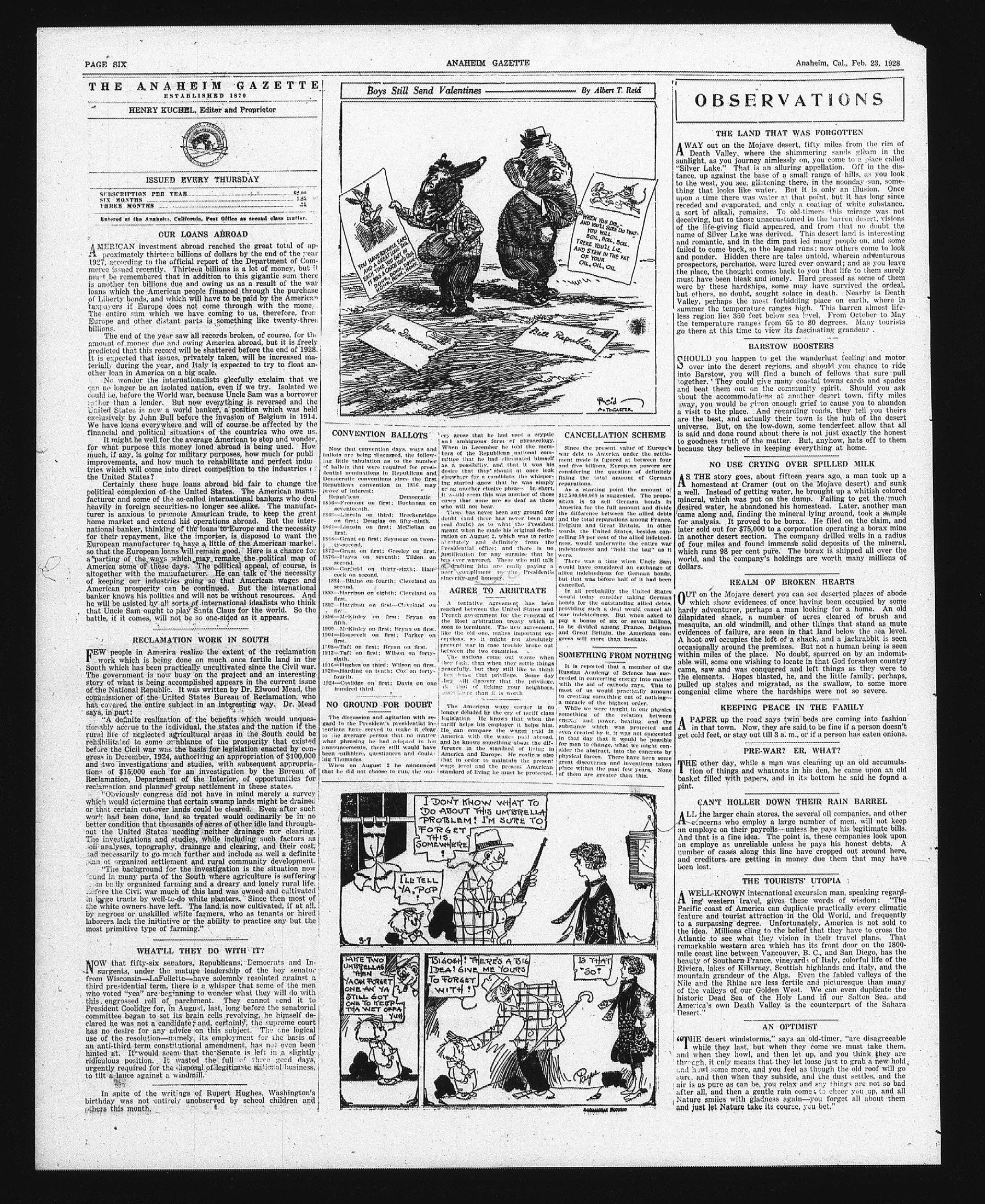
Searchable text
THE ANAHEIM GAZETTE
ESTABLISHED 1970
HENRY KUCHEL, Editor and Proprietor
ISSUED EVERY THURSDAY
SUBSCRIPTION PER YEAR..... $2.00
SIX MONTHS..... 1.25
THREE MONTHS..... 1.25
Entered at the Anaheim, California, Post Office as second class matter.
OUR LOANS ABROAD
AMERICAN investment abroad reached the great total of approximately thirteen billions of dollars by the end of the year 1927, according to the official report of the Department of Commerce issued recently. Thirteen billion is a lot of money, but it must be remembered that in addition to this gigantic sum there is another ten billion due and owing us as a result of the war loans which the American people financed through the purchase of Liberty bonds, and which will have to be paid by the American taxpayers if Europe does not come through with the money. The entire sum which we have coming to us, therefore, from Europe and other distant parts is something like twenty-three billion.
The end of the year saw all records broken, of course, for the amount of money due and owing America abroad, but it is freely predicted that this record will be shattered before the end of 1928. It is expected that issues, privately taken, will be increased materially during the year, and Italy is expected to try to float another loan in America on a big scale.
No wonder the internationalists gleefully exclaim that we can no longer be an isolated nation, even if we try. Isolated we could be, before the World war, because Uncle Sam was a borrower rather than a lender. But now everything is reversed and the United States is now a world banker, a position which was held exclusively by John Bull before the invasion of Belgium in 1914. We have loans everywhere and will of course be affected by the financial and political situations of the countries who owe us.
It might be well for the average American to stop and wonder, for what purpose this money loned abroad is being used. How
It is expected that issues, privately taken, will be increased materially during the year, and Italy is expected to try to float another loan in America on a big scale.
No wonder the internationalists gleefully exclaim that we can no longer be an isolated nation, even if we try. Isolated we could be, before the World war, because Uncle Sam was a borrower rather than a lender. But now everything is reversed and the United States is now a world banker, a position which was held exclusively by John Bull before the invasion of Belgium in 1914. We have loans everywhere and will of course be affected by the financial and political situations of the countries who owe us.
It might be well for the average American to stop and wonder, for what purpose this money loned abroad is being used. How much, if any, is going for military purposes, how much for public improvements, and how much to rehabilitate and perfect industries which will come into direct competition to the industries of the United States?
Certainly these huge loans abroad bid fair to change the political complexion of the United States. The American manufacturer and some of the so-called international bankers who deal heavily in foreign securities no longer see alike. The manufacturer is anxious to promote American trade, to keep the great home market and extend his operations abroad. But the international banker, thinking of the loans to Europe and the necessity for their repayment, like the importer, is disposed to want the European manufacturer to have a little of the American market; so that the European loans will remain good. Here is a chance for a parting of the ways which may remake the political map of America some of these days. The political appeal, of course, is altogether with the manufacturer. He can talk of the necessity of keeping our industries going so that American wages and American prosperity can be continued. But the international banker knows his politics and will not be without resources. And he will be assisted by all sorts of international idealists who think that Uncle Sam ought to play Santa Claus for the world. So the battle, if it comes, will not be so one-sided as it appears.
RECLAMATION WORK IN SOUTH
Few people in America realize the extent of the reclamation work which is being done on much once fertile land in the South which has been practically uncultivated since the Civil war. The government is now busy on the project and an interesting story of what is being accomplished appears in the current issue of the National Republic. It was written by Dr. Elwood Mead, the commissioner of the United States Bureau of Reclamation, who has covered the entire subject in an interesting way. Dr. Mead says, in part:
"A definite realization of the benefits which would unquestionably accrue to the individual, the states and the nation if the rural life of neglected agricultural areas in the South could be rehabilitated to some semblance of the prosperity that existed before the Cicil war was the basis for legislation enacted by congress in December, 1924, authorizing an appropriation of $100,000 and two investigations and studies, with subsequent appropriations of $15,000 each for an investigation by the Bureau of Reclamation, Department of Interior, of opportunities for reclamation and planned group settlement in these states."
Obviously congress did not have in mind merely a survey which would determine that certain swamp lands might be drained or that certain cut-over lands could be cleared. Even after such work had been done, land so treated would ordinarily be in no better condition than thousands of acres of other idle land throughout the United States needing neither drainage nor clearing. The investigations and studies, while including such factors as soil analyses, topography, drainage and clearing, and their cost,
gress in December, 1924, authorizing an appropriation of $100,000 and two investigations and studies, with subsequent appropriations of $15,000 each for an investigation by the Bureau of Reclamation, Department of the Interior, of opportunities for reclamation and planned group settlement in these states.
"Obviously congress did not have in mind merely a survey which would determine that certain swamp lands might be drained or that certain cut-over lands could be cleared. Even after such work had been done, land so treated would ordinarily be in no better condition than thousands of acres of other idle land throughout the United States needing neither drainage nor clearing. The investigations and studies, while including such factors as soil analyses, topography, drainage and clearing, and their cost, had necessarily to go much further and include as well a definite plan of organized settlement and rural community development.
"The background for the investigation is the situation now found in many parts of the South where agriculture is suffering from badly organized farming and a dreary and lonely rural life. Before the Civil war much of this land was owned and cultivated in large tracts by well-to-do white planters. Since then most of the white owners have left. The land is now cultivated, if at all, by negroes or unskilled white farmers, who as tenants or hired laborers lack the initiative or the ability to practice any but the most primitive type of farming."
WHATLL THEY DO WITH IT?
Now that fifty-six senators, Republicans, Democrats and Insurgents, under the mature leadership of the boy senator from Wisconsin—LaFollette—have solemnly resolved against a third presidential term, there is a whisper that some of the men who voted "yea" are beginning to wonder what they will do with this engrossed roll of parchment. They cannot send it to President Coolidge for, in August, last, long before the senatorial committee began to set its brain cells revolving, he himself declared he was not a candidate; and, certainly, the supreme court has no desire for any advice on this subject. The one logical use of the resolution—namely, its employment for the basis of an anti-third term constitutional amendment, has not even been hinted at. It would seem that the Senate is left in a slightly ridiculous position. It wasted the full of three good days, urgently required for the disposal of legitimate national business, to tilt a lance against a windmill.
In spite of the writings of Rupert Hughes, Washington's birthday was not entirely unobserved by school children and others this month.
ANAHEIM GAZETTE
Boys Still Send Valentines By Albert T. Reid
YOU HAVE BEEN WRITE EARS AND A GREAT LONG TAIL EACH THREE YOU GOT IN IT MAS A CRUNCH TOO TALL DONK, DONK, DONK, HONK, HONK, HONK
WHEN YOU DIE, AND YOU'LL SURE DO THAT YOU WILL BOIL, BOIL, BOIL.
THERE YOU'LL LIE, AND STEW IN THE FAT OF YOUR OIL, OIL, OIL
Raid AUTOCASTER
CONVENTION BALLOTS
Now that convention days ways and cry arose that he had used a cryptic and ambiguous form of phraseology. When in December he told the mem-
CANCELLATION SCHEME
Since the present value of Europe's
CONVENTION BALLOTS
Now that convention days, ways and ballots are being discussed, the following little tabulation as to the number of ballots that were required for presidential nominations in Republican and Democratic conventions since the first Republican convention in 1856 may prove of interest:
Republican: Democrat
1856—Fremont on first; Buehanan on seventeenth.
1860—Lincoln on third; Breckenridge on first; Douglas on fifty-ninth.
1864—Lincoln on first; McClellan on first.
1868—Grant on first; Seymour on twenty-second.
1872—Grant on first; Greeley on first.
1876—Hayes on seventh; Tilden on second.
1880—Carfield on thirty-sixth; Hancock on second.
1884—Blaine on fourth; Cleveland on second.
1888—Harrison on eighth; Cleveland on first.
1892—Harrison on first—Cleveland on first.
1896—McKinley on first; Bryan on fifth.
1900—McKinley on first; Bryan on first.
1904—Roosevelt on first; Parker on first.
1908—Taft on first; Bryan on first.
1912—Taft on first; Wilson on forty-sixth.
1916—Hughes on third; Wilson on first.
1920—Harding on tenth; Cox on forty-fourth.
1924—Coolidge on first; Davis on one hundred third.
NO GROUND FOR DOUBT
The discussion and agitation with regard to the President's presidential intentions have served to make it clear to the average person that no matter what phrasing he had adopted in his announcements, there still would have been quibbles, questioners and doubting Thomases.
When on August 2 he announced that he did not choose to run, the outcry arose that he had used a cryptic and ambiguous form of phraseology. When in December he told the members of the Republican national committee that he had eliminated himself as a possibility, and that it was his desire that they should at once look elsewhere for a candidate, the whispering started anew that he was simply urging another elusive phrase. In short, it would seem this was another of those cases that none are so deaf as those who will not hear.
There has never been any ground for doubt (and there has never been any real doubt) as to what the President meant when he made his original declaration on August 2, which was to retire absolutely and definitely from the Presidential office; and there is no justification for any surmise that he has ever wavered. Those who still talk of drafting him are really paying a poor compliment to the President's sincerity and honesty.
AGREE TO ARBITRATE
A tentative agreement has been reached between the United States and French government for the renewal of the Root arbitration treaty which is soon to terminate. The new agreement, like the old one, makes important exceptions, so it might not absolutely prevent war in case trouble broke out between the two countries.
The nations come out worse when they fight than when they settle things peacefully, but they still like to think they have that privilege. Some day they will discover that the privilege is part of flicking your neighbors, cost more than it is worth.
The American wage earner is no longer deluded by the cry of tariff class legislation. He knows that when the tariff helps his employer it helps him. He can compare the wages paid in America with the wages paid abroad, and he knows something about the difference in the standard of living in America and Europe. He realizes also that in order to maintain the present wage level and the present American standard of living he must be protected.
CANCELLATION SCHEME
Since the present value of Europe's war debt to America under the settlement made is figured at between four and five billions, European powers are considering the question of definitively fixing the total amount of German reparations.
As a starting point the amount of $12,500,000,000 is suggested. The proposition is to sell German bonds in America for the full amount and divide the difference between the allied debts and the total reparations among France, Belgium and Great Britain. In other words, the United States, besides canceling 50 per cent of the allied indebtedness, would underwrite the entire war indebtedness and "hold the bag" as it were.
There was a time when Uncle Sam would have considered an exchange of allied indebtedness for German bonds, but that was before half of it had been cancelled.
In all probability the United States would today consider taking German bonds for the outstanding allied debts, providing such a deal would cancel all war indebtedness. But when asked to pay a bonus of six or seven billion, to be divided among France, Belgium and Great Britain, the American congress will more than hesitate.
SOMETHING FROM NOTHING
It is reported that a member of the Russian Academy of Science has succeeded in converting energy into matter with the aid of cathode rays. This to most of us would practically amount to creating something out of nothing—a miracle of the highest order.
While we were taught in our physics something of the relation between energy and power, heating, and the substance which was protected and even created by it, it was not suggested in that day that it would be possible for men to change, what we might consider the abstract, into the concrete by physical forces. There have been some great discoveries and inventions taken place within the past few years. None of them are greater than this.
I DON'T KNOW WHAT TO DO ABOUT THIS UMBRELLA PROBLEM! I'M SURE TO FORGET THIS SOMEWHERE!
I'll TELL YA, POP!
TAKE TWO UMBRELLAS THEN YA CHOO FORGET ONE AN' YA STILL GOT ONE TO KEEP THE WET OPPA YUH
BIGOSH! THERE'S A BIG IDEA! GIVE ME YOURS TO FORGET WITH!
IS THAT "SO?"
Payne
OBSERVATIONS
THE LAND THAT WAS FORGOTTEN
AWAY out on the Mojave desert, fifty miles from the rim of Death Valley, where the shimmering sands gleam in the sunlight, as you journey aimlessly on, you come to a place called "Silver Lake." That is an alluring appellation. Off in the distance, up against the base of a small range of hills, as you look to the west, you see, glistening there, in the noonday sun, something that looks like water. But it is only an illusion. Once upon a time there was water at that point, but it has long since receded and evaporated, and only a coating of white substance, a sort of alkali, remains. To old-timers this mirage was not deceiving, but to those unaccustomed to the barren desert, visions of the life-giving fluid appeared, and from that no doubt the name of Silver Lake was derived. This desert land is interesting and romantic, and in the dim past led many people on, and some failed to come back, so the legend runs; now others come to look and ponder. Hidden there are tales untold, wherein adventurous prospectors, perchance, were lured ever onward; and as you leave the place, the thought comes back to you that life to them surely must have been bleak and lonely. Hard pressed as some of them were by these hardships, some may have survived the ordeal, but others, no doubt, sought solace in death. Nearby is Death Valley, perhaps the most forbidding place on earth, where in summer the temperature ranges high. This barren almost lifeless region lies 350 feet below sea level. From October to May the temperature ranges from 65 to 80 degrees. Many tourists go there at this time to view its fascinating grandeur.
BARSTOW BOOSTERS
SHOULD you happen to get the wanderlust feeling and motor over into the desert regions, and should you chance to ride into Barstow, you will find a bunch of fellows that sure pull together. They could give many coastal towns cards and spades and beat them out on the community spirit. Should you ask about the accommodations at another desert town, fifty miles away, you would be given enough grief to cause you to abandon a visit to the place. And regarding roads, they tell you theirs are the best, and actually their town is the hub of the desert universe. But, on the low-down, some tenderfeet allow that all is said and done round about there is not just exactly the honest to goodness truth of the matter. But, anyhow, hats off to them because they believe in keeping everything at home.
SHOULD you happen to get the wanderlust feeling and motor over into the desert regions, and should you chance to ride into Barstow, you will find a bunch of fellows that sure pull together. They could give many coastal towns cards and spades and beat them out on the community spirit. Should you ask about the accommodations at another desert town, fifty miles away, you would be given enough grief to cause you to abandon a visit to the place. And regarding roads, they tell you theirs are the best, and actually their town is the hub of the desert universe. But, on the low-down, some tenderfeet allow that all is said and done round about there is not just exactly the honest to goodness truth of the matter. But, anyhow, hats off to them because they believe in keeping everything at home.
NO USE CRYING OVER SPILLED MILK
AS THE story goes, about fifteen years ago, a man took up a homestead at Cramer (out on the Mojave desert) and sunk a well. Instead of getting water, he brought up a whitish colored mineral, which was put on the dump. Failing to get the much desired water, he abandoned his homestead. Later, another man came along and, finding the mineral lying around, took a sample for analysis. It proved to be borax. He filed on the claim, and later sold out for $75,000 to a corporation operating a borax mine in another desert section. The company drilled wells in a radius of four miles and found immense solid deposits of the mineral, which runs 98 per cent pure. The borax is shipped all over the world, and the company's holdings are worth many millions of dollars.
REALM OF BROKEN HEARTS
OUT on the Mojave desert you can see deserted places of abode which show evidences of once having been occupied by some hardy adventurer, perhaps a man looking for a home. An old dilapidated shack, a number of acres cleared of brush and mesquite, an old windmill, and other things that stand as mute evidences of failure, are seen in that land below the sea level. A hoot owl occupies the loft of a shack, and a jackrabbit is seen occasionally around the premises. But not a human being is seen within miles of the place. No doubt, spurred on by an indomitable will, some one wishing to locate in that God forsaken country came, saw and was conquered and left things as they were to the elements. Hopes blasted, he, and the little family, perhaps, pulled up stakes and migrated, as the swallow, to some more congenial clime where the hardships were not so severe.
KEEPING PEACE IN THE FAMILY
PAPER up the road says twin beds are coming into fashion in that town. Now, they are said to be fine if a person doesn't get cold feet, or stay out till 3 a.m., or if a person has eaten onions.
PRE-WAR? ER, WHAT?
THE other day, while a man was cleaning up an old accumulation of things and whatnots in his den, he came upon an old basket filled with papers, and in its bottom he said he found a pint.
CANT HOLLER DOWN THEIR RAIN BARREL
ALL the larger chain stores, the several oil companies, and other concerns who employ a large number of men, will not keep an employee on their payrolls—unless he pays his legitimate bills. And that is a fine idea. The point is, these companies look upon an employee as unreliable unless he pays his honest debts. A
THE other day, while a man was cleaning up an old accumulation of things and whatnots in his den, he came upon an old basket filled with papers, and in its bottom he said he found a pint.
CAN'T HOLLER DOWN THEIR RAIN BARREL
ALL the larger chain stores, the several oil companies, and other concerns who employ a large number of men, will not keep an employee on their payrolls—unless he pays his legitimate bills. And that is a fine idea. The point is, these companies look upon an employee as unreliable unless he pays his honest debts. A number of cases along this line have cropped out around here, and creditors are getting in money due them that may have been lost.
THE TOURISTS' UTOPIA
A WELL-KNOWN international excursion man, speaking regarding western travel, gives these words of wisdom: "The Pacific coast of America can duplicate practically every climatic feature and tourist attraction in the Old World, and frequently to a surpassing degree. Unfortunately, America is not sold to the idea. Millions cling to the belief that they have to cross the Atlantic to see what they vision in their travel plans. That remarkable western area which has its front door on the 1800-mile coast line between Vancouver, B. C., and San Diego, has the beauty of Southern France, vineyards of Italy, colorful life of the Riviera, lakes of Killarney, Scottish highlands and Italy, and the mountain grandeur of the Alps. Even the fabled valleys of the Nile and the Rhine are less fertile and picturesque than many of the valleys of our Golden West. We can even duplicate the historic Dead Sea of the Holy Land in our Salton Sea, and America's own Death Valley is the counterpart of the Sahara Desert."
AN OPTIMIST
"The desert windstorms," says an old-timer, "are disagreeable while they last, but when they come we must take them, and when they howl, and then let up, and you think they are through, it only means that they let loose just to grab a new hold and howl some more, and you feel as though the old roof will go sure, and then when they subside, and the dust settles, and the air is as pure as can be, you relax and say things are not so bad after all, and then a gentle rain comes to cheer you up, and all Nature smiles with gladness again—you forget all about them and just let Nature take its course, you bet."