anaheim-gazette 1927-12-22
Scanned page
Searchable text
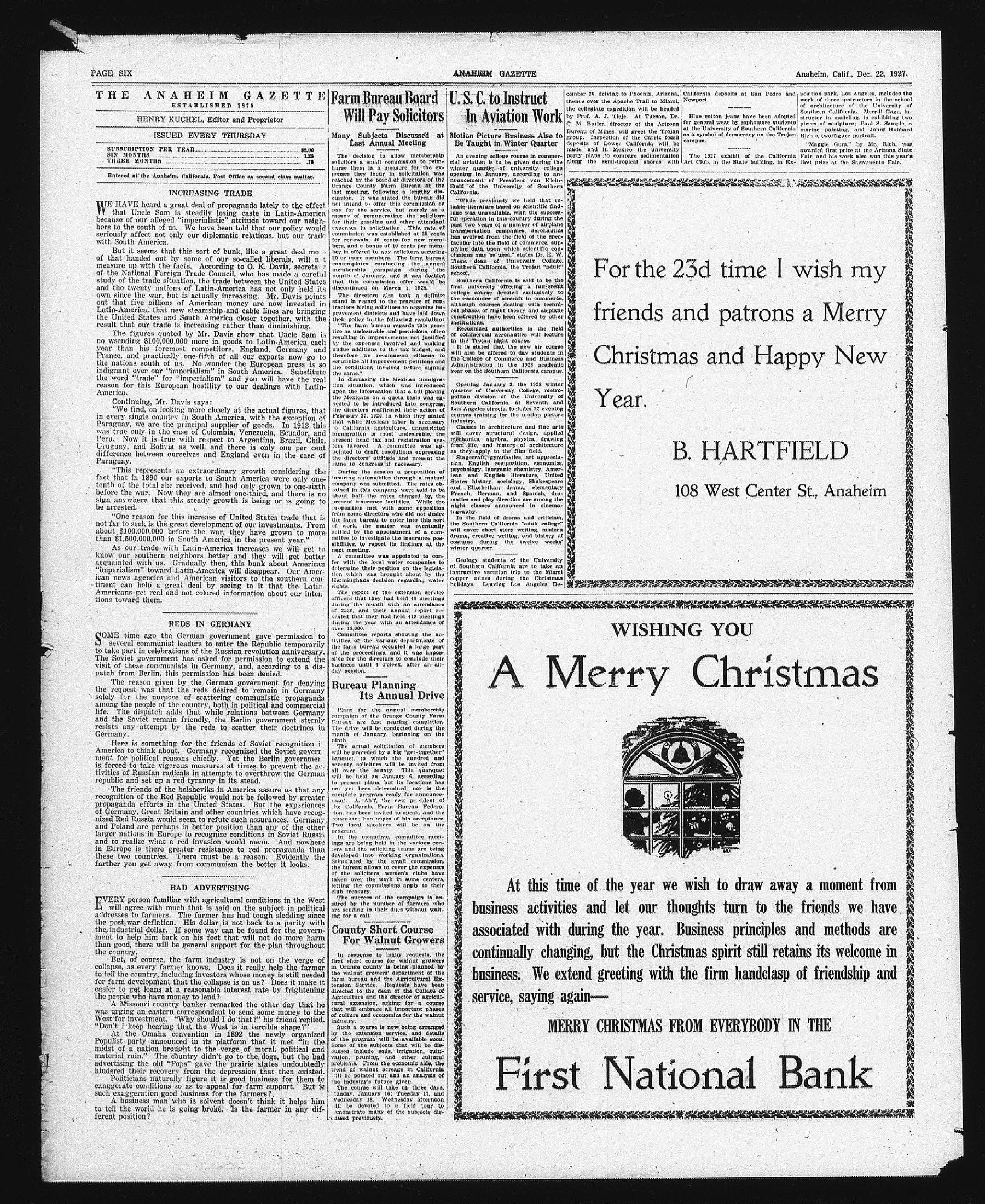
THE ANAHEIM GAZETTE
ESTABLISHED 1870
HENRY KUCHEL, Editor and Proprietor
ISSUED EVERY THURSDAY
SUBSCRIPTION PER YEAR $2.00
SIX MONTHS 1.55
THREE MONTHS .76
Entered at the Anaheim, California, Post Office as second class matter.
INCREASING TRADE
WE HAVE heard a great deal of propaganda lately to the effect that Uncle Sam is steadily losing caste in Latin-America because of our alleged "imperialistic" attitude toward our neighbors to the south of us. We have been told that our policy would seriously affect not only our diplomatic relations, but our trade with South America.
But it seems that this sort of bunk, like a great deal more of that handed out by some of our so-called liberals, will not measure up with the facts. According to O. K. Davis, secretary of the National Foreign Trade Council, who has made a careful study of the trade situation, the trade between the United States and the twenty nations of Latin-America has not only held its own since the war, but is actually increasing. Mr. Davis points out that five billions of American money are now invested in Latin-America, that new steamship and cable lines are bringing the United States and South America closer together, with the result that our trade is increasing rather than diminishing.
The figures quoted by Mr. Davis show that Uncle Sam is no wsending $100,000,000 more in goods to Latin-America each year than his foremost competitors, England, Germany and France, and practically one-fifth of all our exports now go to the nations south of us. No wonder the European press is so indignant over our "imperialism" in South America. Substitute the word "trade" for "imperialism" and you will have the real reason for this European hostility to our dealings with Latin-America.
Continuing, Mr. Davis says:
"We find, on looking more closely at the actual figures, that in every single country in South America, with the exception of Paraguay, we are the principal supplier of goods. In 1913 this was true only in the case of Colombia, Venezuela, Ecuador, and Peru. Now it is true with respect to Argentina, Brazil, Chile, Uruguay, and Bolivia as well, and there is only one per cent..."
France, and practically one-fifth of all our exports now go to the nations south of us. No wonder the European press is so indignant over our "imperialism" in South America. Substitute the word "trade" for "imperialism" and you will have the real reason for this European hostility to our dealings with Latin-America.
Continuing, Mr. Davis says:
"We find, on looking more closely at the actual figures, that in every single country in South America, with the exception of Paraguay, we are the principal supplier of goods. In 1913 this was true only in the case of Colombia, Venezuela, Ecuador, and Peru. Now it is true with respect to Argentina, Brazil, Chile, Uruguay, and Bolivia as well, and there is only one per cent difference between ourselves and England even in the case of Paraguay.
“This represents an extraordinary growth considering the fact that in 1890 our exports to South America were only one-tenth of the total she received, and had only grown to one-sixth before the war. Now they are almost one-third, and there is no sign anywhere that this steady growth is being or is going to be arrested.
“One reason for this increase of United States trade that is not far to seek is the great development of our investments. From about $100,000,000 before the war, they have grown to more than $1,500,000,000 in South America in the present year.”
As our trade with Latin-America increases we will get to know our southern neighbors better and they will get better acquainted with us. Gradually then, this bunk about American "imperialism" toward Latin-America will disappear. Our American news agencies and American visitors to the southern continent can help a great deal by seeing to it that the Latin Americans get real and not colored information about our intentions toward them.
REDS IN GERMANY
SOME time ago the German government gave permission to several communist leaders to enter the Republic temporarily to take part in celebrations of the Russian revolution anniversary. The Soviet government has asked for permission to extend the visit of these communists in Germany, and, according to a dispatch from Berlin, this permission has been denied.
The reason given by the German government for denying the request was that the reds desired to remain in Germany solely for the purpose of scattering communistic propaganda among the people of the country, both in political and commercial life. The dispatch adds that while relations between Germany and the Soviet remain friendly, the Berlin government sternly resists any attempt by the reds to scatter their doctrines in Germany.
Here is something for the friends of Soviet recognition in America to think about. Germany recognized the Soviet government for political reasons chiefly. Yet the Berlin government is forced to take vigorous measures at times to prevent the activities of Russian radicals in attempts to overthrow the German republic and set up a red tyranny in its stead.
The friends of the bolsheviks in America assure us that any recognition of the Red Republic would not be followed by greater propaganda efforts in the United States. But the experiences of Germany, Great Britain and other countries which have recognized Red Russia would seem to refute such assurances. Germany and Poland are perhaps in better position than any of the other larger nations in Europe to recognize conditions in Soviet Russia and to realize what a red invasion would mean. And nowhere in Europe is there greater resistance to red propaganda than
BAD ADVERTISING
EVERY person familiar with agricultural conditions in the West will agree with much that is said on the subject in political addresses to farmers. The farmer has had tough sledding since the post-war deflation. His dollar is not back to a parity with the industrial dollar. If some way can be found for the government to help him back on his feet that will not do more harm than good, there will be general support for the plan throughout the country.
But, of course, the farm industry is not on the verge of collapse, as every farmer knows. Does it really help the farmer to tell the country, including investors whose money is still needed for farm development that the collapse is on us? Does it make it easier to get loans at a reasonable interest rate by frightening the people who have money to lend?
A Missouri country banker remarked the other day that he was urging an eastern correspondent to send some money to the West for investment. "Why should I do that?" his friend replied. "Don't I keep hearing that the West is in terrible shape?"
At the Omaha convention in 1892 the newly organized Populist party announced in its platform that it met "in the midst of a nation brought to the verge of moral, political and material ruin." The country didn't go to the dogs, but the bad advertising the old "Pops" gave the prairie states undoubtedly hindered their recovery from the depression that then existed.
Politicians naturally figure it is good business for them to exaggerate conditions so as to appeal for farm support. But is such exaggeration good business for the farmers?
A business man who is solvent doesn't think it helps him to tell the world he is going broke. Is the farmer in any different position?
ANAHEIM GAZETTE
Farm Bureau Board Will Pay Solicitors
Many Subjects Discussed at Last Annual Meeting
The decision to allow membership solicitors a small commission to reimburse them in a measure for the expenses they incur in solicitation was reached by the board of directors of the Orange County Farm Bureau at the last meeting, following a lengthy discussion. It was stated the bureau did not intend to offer this commission as pay for the service, but merely as a means of remunerating the solicitors for their gasoline and other attendant expenses in solicitation. This rate of commission was established at 25 cents for renewals, 40 cents for new members, and a bonus of 10 cents per member is offered to any solicitors securing 20 or more members. The farm bureau contemplates conducting the annual membership campaign during the month of January, and it was decided that this commission offer would be discontinued on March 1, 1928.
The directors also took a definite stand in regard to the practice of contractors hiring solicitors to organize improvement districts and have laid down their policy in the following resolution:
"The farm bureau regards this practice as undesirable and pernicious, often resulting in improvements not justified by the expenses involved and making undue additions to the tax budget, and therefore we recommend citizens to scrutinize all improvement petitions and the conditions involved before signing the same."
In discussing the Mexican immigration situation, which was introduced upon the information that a bill placing the Mexicans on a quota basis was expected to be introduced into congress, the directors reaffirmed their action of February 27, 1926, in which they stated that while Mexican labor is necessary o California agriculture, unrestricted immigration is most undesirable, the present head tax and registration system favored. A committee was ap-
December 26, driving to Phoenix, Arizona, thence over the Apache Trail to Miami, the collegiate expedition will be headed by Prof. A. J. Tieje. At Tucson, Dr. C. M. Butler, director of the Arizona Bureau of Mines, will greet the Trojan group. Inspection of the Carriz fossil deposits of Lower California will be made, and in Mexico the university party plans to compare sedimentation along the semi-tropical shores with
For the 23 friends and Christmas Year.
In discussing the Mexican immigration situation, which was introduced upon the information that a bill placing the Mexicans on a quota basis was expected to be introduced into congress, the directors reaffirmed their action of February 27, 1926. In which they stated that while Mexican labor is necessary to California agriculture, unrestricted immigration is most undesirable, the present head tax and registration system favored. A committee was appointed to draft resolutions expressing the directors' attitude and present the same to congress if necessary.
During the session a proposition of insuring automobiles through a mutual company was submitted. The rates obtained in this company were said to be about half the rates charged by, the present insurance facilities. While the proposition met with some opposition from some directors who did not desire the farm bureau to enter into this sort of work, the matter was eventually settled by the appointment of a committee to investigate the insurance possibilities, to report its findings at the next meeting.
A committee was appointed to confer with the local water companies to determine their position on the legislation which was brought about by the Herminghaus decision regarding water rights.
The report of the extension service officers that they had held 40 meetings during the month with an attendance of 2530, and their annual report revealed that they had held 419 meetings during the year with an attendance of over 19,000.
Committee reports showing the activities of the various departments of the farm bureau occupied a large part of the proceedings, and it was impossible for the directors to conclude their business until 4 o'clock, after an all-day session.
Bureau Planning Its Annual Drive
Plans for the annual membership campaign of the Orange County Farm Bureau are fast nearing completion. The drive will be conducted during the month of January, beginning on the ninth.
The actual solicitation of members will be preceded by a big "get-together" banquet, to which the hundred and seventy solicitors will be invited from all over the county. This quanquet will be held on January 6, according to present plans, but its locations has not yet been determined, nor is the complete program ready for announcement.
A. Allif, the new president of the California Farm Bureau Federation, has been invited to speak, and the committee has hopes of his acceptance. Two local speakers will be on the program.
In the meantime, committee meetings are being held in the various centers and the soliciting teams are being
At this time of the year we will business activities and let our thoughts associated with during the year. Business continually changing, but the Christmas business. We extend greeting with the service, saying again—
MERRY CHRISTMAS FROM First Nation
County Short Course For Walnut Growers
In response to many requests, the first short course for walnut growers in Orange county is being planned by the walnut growers' department of the farm bureau and the Agricultural Extension Service. Requests have been directed to the dean of the College of Agriculture and the director of agricultural extension, asking for a course that will embrace all important phases of culture and economics for the walnut industry.
Such a course is now being arranged by the extension service, and details of the program will be available soon. Some of the subjects that will be discussed include soils, irrigation, cultivation, pruning, and other cultural problems. From the economic side, the trend of walnut acreage in California will be pointed out and an analysis of the industry's future given.
The course will take up three days, Monday, January 16; Tuesday 17, and Wednesday 18. Wednesday afternoon will be devoted to a field tour to demonstrate many of the subjects discussed previously.
Anaheim, Calif., Dec. 22, 1927.
California deposits at San Pedro and Newport.
Blue cotton jeans have been adopted for general wear by sophomore students at the University of Southern California as a symbol of democracy on the Trojan campus.
The 1927 exhibit of the California Art Club, in the State building, in Exposition park, Los Angeles, includes the work of three instructors in the school of architecture of the University of Southern California. Merrill Gage, instructor in modeling, is exhibiting two pieces of sculpture; Paul S. Sample, a marine painting, and John Hubbard Rich a two-figure portrait.
"Maggie Gum," by Mr. Rich, was awarded first prize at the Arizona State Fair, and his work also won this year's first prize at the Sacramento Fair.
B. HARTFIELD
108 West Center St., Anaheim
the year we wish to draw away a moment from
let our thoughts turn to the friends we have
the year. Business principles and methods are
the Christmas spirit still retains its welcome in
meeting with the firm handclasp of friendship and
CHRISTMAS FROM EVERYBODY IN THE
National Bank