anaheim-gazette 1919-07-24
Scanned page
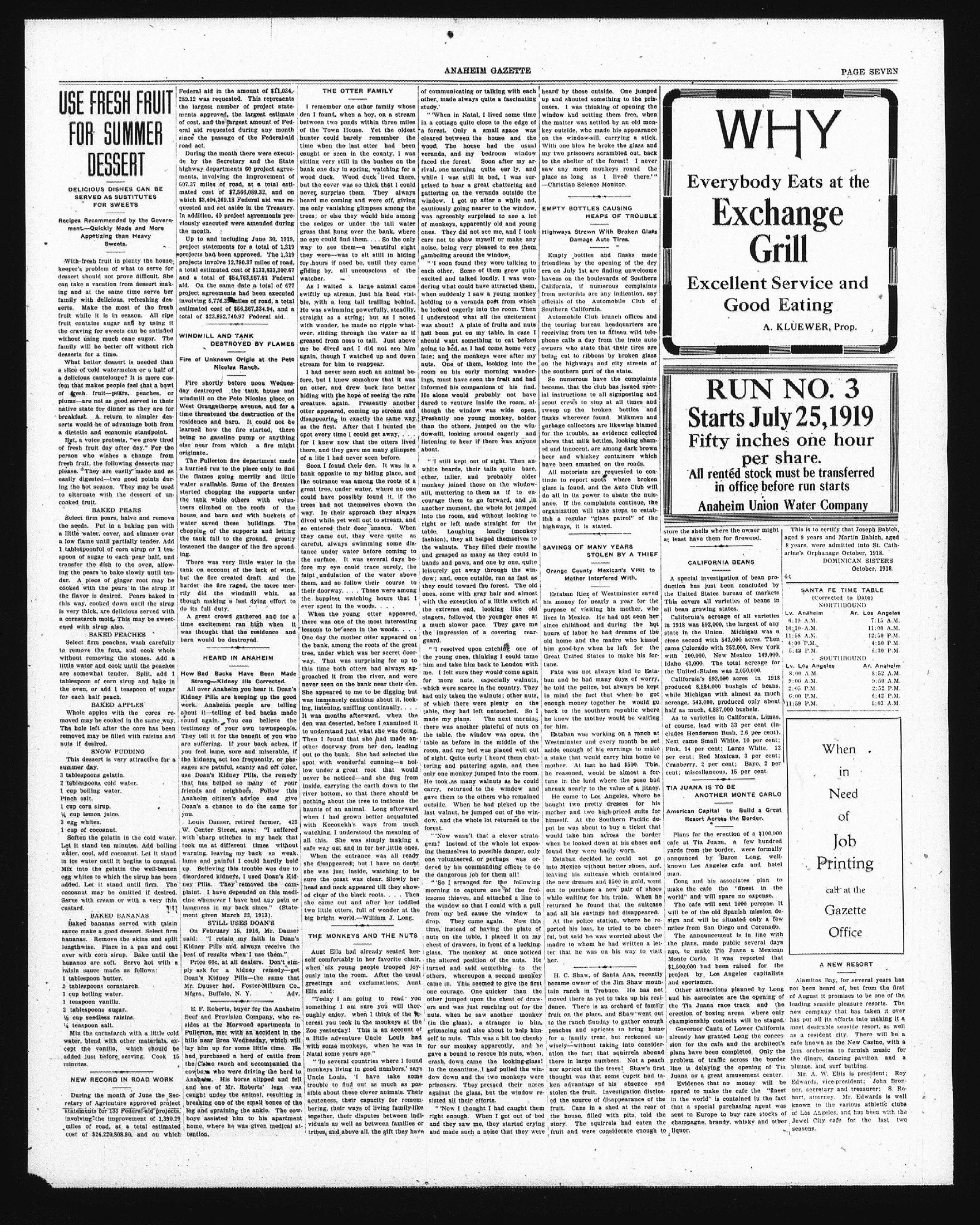
Searchable text
USE FRESH FRUIT FOR SUMMER DESSERT
DELICIOUS DISHES CAN BE SERVED AS SUSTITUTES FOR SWEETS
Recipes Recommended by the Government—Quickly Made and More Appetizing than Heavy Sweets.
With fresh fruit in plenty the housekeeper's problem of what to serve for dessert should not prove difficult. She can take a vacation from dessert making and at the same time serve her family with delicious, refreshing desserts. Make the most of the fresh fruit while it is in season. All ripe fruit contains sugar and by using it the craving for sweets can be satisfied without using much cane sugar. The family will be better off without rich desserts for a time.
What better dessert is needed than a slice of cold watermelon or a half of a delicious canteloupe? It is mere custom that makes people feel that a bowl of fresh fruit—pears, peaches, or plums—are not as good served in their native state for dinner as they are for breakfast. A return to simpler desserts would be of advantage both from a dietetic and economic standpoint.
But, a voice protests, "we grow tired of fresh fruit day after day." For the person who wishes a change from Federal aid in the amount of $11,034.289.12 was requested. This represents the largest number of project statements approved, the largest estimate of cost, and the largest amount of Federal aid requested during any month since the passage of the Federal-aid road act.
During the month there were execute by the Secretary and the State highway departments 60 project agreements, involving the improvement of 507.37 miles of road, at a total estimated cost of $7,566,089.32, and on which $3,404,269.18 Federal aid was requested and set aside in the Treasury. In addition, 40 project agreements previously executed were amended during the month.
Up to and including June 30, 1919, project statements for a total of 1,319 projects had been approved. The 1,319 projects involve 12,790.37 miles of road, a total estimated cost of $133,833,300.67 and a total of $54,763,957.81 Federal aid. On the same date a total of 677 project agreements had been executed involving 5,776.35 miles of road, a total estimated cost of $56,367,334.94, and a total of $23,892,740.97 Federal aid.
WINDMILL AND TANK DESTROYED BY FLAMES
Fire of Unknown Origin at the Pete Nicolas Ranch.
Fire shortly before noon Wednesday destroyed the tank house and windmill on the Pete Nicolas place on West Orangethorpe avenue, and for a time threatened the destruction of the residence and barn. It could not be learned how the fire started, there being no gasoline pump or anything else near from which a fire might originate.
THE OTTER
I remember one other den I found, when a breeze between two ponds whiffed at the Town House. Hunter could barely catch or seen in the sitting very still in the bank one day in spring wood duck. Wood duck but the cover was so thick that never surprise them. He heard me coming and me only vanishing glimpses; or else they wandered grass that hung over no eye could find them way to see them—a they were—was to slay for hours if need be, gliding by, all unconcerned watcher.
As I waited a long swiftly up stream, just able, with a long tail He was swimming power straight as a string; with wonder, he made ever, sliding through greased from nose to nose he dived and I came again, though I watched stream for him to reach.
I had never seen such fore, but I knew someone an otter, and drew him hiding with the hope of creature again. Potter appeared, coming disappearing in exactness as the first. After this spot every time I could for I knew now that there, and they gave me life I had never known.
What better dessert is needed than a slice of cold watermelon or a half of a delicious canteloupe? It is mere custom that makes people feel that a bowl of fresh fruit—pears, peaches, or plums—are not as good served in their native state for dinner as they are for breakfast. A return to simpler desserts would be of advantage both from a dietetic and economic standpoint.
But, a voice protests, "we grow tired of fresh fruit day after day." For the person who wishes a change from fresh fruit, the following desserts may please. They are easily made and as easily digested—two good points during the hot season. They may be used to alternate with the dessert of uncooked fruit.
BAKED PEARS
Select firm pears, halve and remove the seeds. Put in a baking pan with a little water, cover, and simmer over a low flame until partially tender. Add 1 tablespoonful of corn sirup or 1 teaspoon of sugar to each pear half, and transfer the dish to the oven, allowing the pears to bake slowly until tender. A piece of ginger root may be cooked with the pears in the sirup if the flavor is desired. Pears baked in this way, cooked down until the sirup is very thick, are delicious served with a cornstarch mold. This may be sweetened with sirup also.
BAKED PEACHES
Select firm peaches, wash carefully to remove the fuzz, and cook whole without removing the stones. Add a little water and cook until the peaches are somewhat tender. Split, add 1 tablespoon of corn sirup and bake in the oven, or add 1 teaspoon of sugar for each half peach.
BAKED APPLES
Whole apples with the cores removed may be cooked in the same way. The hole left after the core has been removed may be filled with raisins and nuts if desired.
SNOW PUDDING
This dessert is very attractive for a summer day.
3 tablespoons gelatin.
2 tablespoons cold water.
1 cup boiling water.
Pinch salt.
1 cup corn sirup.
¼ cup lemon juice.
3 egg whites.
1 cup of cocoanut.
Soften the gelatin in the cold water. Let it stand ten minutes. Add boiling water, cool, add cocoanut. Let it stand in ice water until it begins to congeal.
Fire shortly before noon Wednesday destroyed the tank house and windmill on the Pete Nicolas place on West Orangethorpe avenue, and for a time threatened the destruction of the residence and barn. It could not be learned how the fire started, there being no gasoline pump or anything else near from which a fire might originate.
The Fullerton fire department made a hurried run to the place only to find the flames going merrily and little water available. Some of the firemen started chopping the supports under the tank while others with volunteers climbed on the roofs of the house and barn and with buckets of water saved these buildings. The chopping of the supports and letting the tank fall to the ground, greatly lessened the danger of the fire spreading.
There was very little water in the tank on account of the lack of wind, but the fire created draft and the harder the fire raged, the more merriily did the windmill whiz, as though making a last dying effort to do its full duty.
A great crowd gathered and for a time excitement ran high when it was thought that the residence and barn would be destroyed.
HEARD IN ANAHEIM
How Bad Backs Have Been Made
Strong—Kidney Ills Corrected.
All over Anaheim you hear it. Doan's Kidney Pills are keeping up the good work. Anaheim people are telling about it—telling of bad backs made sound again. You can believe the testimony of your own townspeople. They tell it for the benefit of you who are suffering. If your back aches, if you feel lame, sore and miserable, if the kidneys act too frequently, or passages are painful, scanty and off color, use Doan's Kidney Pills, the remedy that has helped so many of your friends and neighbors. Follow this Anaheim citizen's advice and give Doan's a chance to do the same for you.
Louis Dauser, retired farmer, 425 W. Center Street, says: "I suffered with sharp stitches in my back that took me at different times without warning, leaving my back so weak, lame and painful I could hardly hold stream for him to read.
I had never seen such fore, but I knew some an otter, and drew them hiding with the hope of creature. Again. Printer appeared, coming disappearing in exactly as the first. After this spot every time I could for I knew now that there, and they gave me of a life I had never seen.
Soon I found their bank opposite to my entrance was among great tree, under water could have possibly trees had not themselves way. In their approach dived while yet well out so entered their door they came out, they careful, always swimming tance under water by the surface. It was fore my eye could failpt undulation of them, and so follow their doorway... The happiest watching ever spent in the wood.
When the young there was one of these lessons to be seen in One day the mother of the bank, among the tree, under which was way. That was surprize this time both otters proached it from there never seen on the bar. She appeared to me that was immensely cautioning, listening, sniffing. It was months after den was deserted, before to understand just what Then I found that she other doorway from out to the bank. She spot with wonderful low under a great r never be noticed—and inside, carrying the e river bottom, so that nothing about the tree haunts of an animal when I had grown with Keeonekh's watching. I understood all this. She was safe way out and in.
When the entrance she disappeared; but
BAKED BANANAS
Baked bananas served with raisin sauce make a good dessert. Select firm bananas. Remove the skins and split lengthwise. Place in a pan and coat over with corn sirup. Bake until the bananas are soft. Serve hot with a raisin sauce made as follows:
1 tablespoon butter.
2 tablespoons cornstarch.
1 cup boiling water.
1 teaspoon vanilla.
2 tablespoons sugar.
½ cup seedless raisins.
¼ teaspoon salt.
Mix the cornstarch with a little cold water, blend with other materials, except the vanilla, which should be added just before serving. Cook 15 minutes.
NEW RECORD IN ROAD WORK
During the month of June the Secretary of Agriculture approved project statements for 133 Federal aid projects, involving the improvement of 1,390.29 miles of road, at a total estimated cost of $24,220,808.90, and on which use Doan's Kidney Pills, the remedy that has helped so many of your friends and neighbors. Follow this Anaheim citizen's advice and give Doan's a chance to do the same for you.
Louis Dauser, retired farmer, 425 W. Center Street, says: "I suffered with sharp stitches in my back that took me at different times without warning, leaving my back so weak, lame and painful I could hardly hold up. Believing this trouble was due to disordered kidneys, I used Doan's Kidney Pills. They removed the complaint. I have depended on this medicine whenever I have had any pain or lameness in my back since." (Statement given March 22, 1913).
STILL USES DOAN'S
On February 15, 1916, Mr. Dauser said: "I retain my faith in Doan's Kidney Pills and always receive the best of results when I use them."
Price 60c, at all dealers. Don't simply ask for a kidney remedy—get Doan's Kidney Pills—the same that Mr. Dauser had. Foster-Milburn Co., Mfgrs., Buffalo, N. Y.
Adv.
E. F. Roberts, buyer for the Anaheim Beef and Provision Company, who resides at the Marwood apartments in Fullerton, met with an accident in the hills near Brea Wednesday, which will lay him up for some little time. He had purchased a herd of cattle from the Cama ranch and accompanied the cowboy who were driving the herd to Anaheim. His horse slipped and fell and one of Mr. Roberts' legs was caught under the animal, resulting in breaking one of the small bones of the leg and spraining the ankle. The cowboys assisted him to his apartment home, where he was given medical attention.
"In several county monkeys living in gorilla Uncle Louis," I trouble to find out sible about these clever acuteness, their care bering, their ways of together, their displei viduals as well as their tribes, and above all low under a great re never be noticed—and inside, carrying the e river bottom, so that nothing about the tree haunts of an animal. when I had grown b with Keeonekh's w watching. I understood all this. She was in safe way out and in it.
When the entrance she disappeared; but she was just inside sure the coast was head and neck appeared clear of the black she came out and two little otters, full big bright world.—W
THE OTTER FAMILY
I remember one other family whose den I found, when a boy, on a stream between two ponds within three miles of the Town House. Yet the oldest hunter could barely remember the time when the last otter had been caught or seen in the county. I was sitting very still in the bushes on the bank one day in spring, watching for a wood duck. Wood duck lived there, but the cover was so thick that I could never surprise them. They always heard me coming and were off, giving me only vanishing glimpses among the trees; or else they would hide among the sedges or under the tall water grass that hung over the bank, where no eye could find them... So the only way to see them—a beautiful sight they were—was to sit still in hiding for hours if need be, until they came gliding by, all unconscious of the watcher.
As I waited a large animal came swiftly up stream, just his head visible, with a long tail trailing behind. He was swimming powerfully, steadily, straight as a string; but as I noted with wonder, he made no ripple whatever, sliding through the water as if greased from nose to tail. Just above me he dived and I did not see him again, though I watched up and down stream for him to reappear.
I had never seen such an animal before, but I knew somehow that it was an otter, and drew back into better hiding with the hope of seeing the rare creature again. Presently another otter appeared, coming up stream and disappearing in exactly the same way as the first. After that I hunted the spot every time I could get away... for I knew now that the otters lived there, and they gave me many glimpses of a life I had never seen before.
of communicating or talking with each other, made always quite a fascinating study.
"When in Natal, I lived some time in a cottage quite close to the edge of a forest. Only a small space was cleared between the house and the wood. The house had the usual veranda, and my bedroom window faced the forest. Soon after my arrival, one morning quite earlly, and while I was still in bed, I was surprised to hear a great chattering and pattering on the veranda outside the window. I got up after a while and cautiously going nearer to the window, was agreeably surprised to see a lot of monkeys, apparently old and young ones. They did not see me, and I took care not to show myself or make any noise, being very pleased to see them gamboling around the window.
"I soon found they were talking to each other. Some of them grew quite excited and talked loudly. I was wondering what could have attracted them, when suddenly I saw a young monkey holding to a veranda post from which he looked eagerly into the room. Then I understood what all the excitement was about! A plate of fruits and nuts had been put on my table, in case I should want something to eat before going to bed, as I had come home very late; and the monkeys were after my nuts. One of them, looking into the room on his early morning wanderings, must have seen the fruit and had informed his companions of his find. He alone would probably not have dared to venture inside the room, although the window was wide open. Presently one young monkey, bolder than the others, jumped on the window-sill, looking around eagerly and listening to hear if there was anyone about."
heard by those outside. One jumped up and shouted something to the prisoners. I was thinking of opening the window and setting them free, when the matter was settled by an old monkey outside, who made his appearance on the window-sill, carrying a stick. With one blow he broke the glass and my two prisoners scrambled out, back to the shelter of the forest! I never saw any more monkeys round the place as long as I lived there." —Christian Science Monitor.
EMPTY BOTTLES CAUSING HEAPS OF TROUBLE
Highways Strewn With Broken Glass Damage Auto Tires.
Empty bottles and flasks made friendless by the opening of the dry era on July 1st are finding unwelcomehavens on the boulevards of Southern California, if numerous complaints from motorists are any indication, say officials of the Automobile Club of Southern California.
Automobile Club branch offices and the touring bureau headquarters are receiving from ten to fifteen wild telephone calls a day from the irate auto owners who state that their tires are being cut to ribbons by broken glass on the highways and city streets of the southern part of the state.
So numerous have the complaints become, that the club has issued special instructions to all signposting and scout crews to stop at all times and sweep up the broken bottles and flasks wherever found. Milkmen and garbage collectors are likewise blamed for the trouble, as evidence collected shows that milk bottles, looking shamed and innocent, are among dark brown beer and whiskey containers which
I had never seen such an animal before, but I knew somehow that it was an otter, and drew back into better hiding with the hope of seeing the rake creature again. Presently another otter appeared, coming up stream and disappearing in exactly the same way as the first. After that I hunted the spot every time I could get away... for I knew now that the otters lived there, and they gave me many glimpses of a life I had never seen before.
Soon I found their den. It was in a bank opposite to my hiding place, and the entrance was among the roots of a great tree, under water, where no one could have possibly found it, if the trees had not themselves shown the way. In their approach they always dived while yet well out to stream, and so entered their door unseen. When they came out, they were quite as careful, always swimming some distance under water before coming to the surface. It was several days before my eye could trace surely, the faipt undulation of the water above them, and so follow their course to their doorway... Those were among the happiest watching hours that I ever spent in the woods.
When the young otter appeared, there was one of the most interesting lessons to be seen in the woods. One day the mother otter appeared on the bank, among the roots of the great tree, under which was her secret doorway. That was surprising for up to this time both otters had always approached it from the river, and were never seen on the bank near their den. She appeared to me to be digging but was immensely cautious about it, looking, listening, sniffing continually... It was months afterward, when the den was deserted, before I examined it to understand just what she was doing. Then I found that she had made another doorway from her den, leading out to the bank. She had selected the spot with wonderful cunning—a hollow under a great root that would never be noticed—and she dug from inside, carrying the earth down to the river bottom, so that there should be nothing about the tree to indicate the haunts of an animal. Long afterward when I had grown better acquainted with Keeonekh's ways from much watching, I understood the meaning of all this. She was simply making a safe way out and in for her little ones.
When the entrance was all ready she disappeared; but I have no doubt nuts. One of them, looking into the room on his early morning wanderings, must have seen the fruit and had informed his companions of his find. He alone would probably not have dared to venture inside the room, although the window was wide open. Presently one young monkey, bolder than the others, jumped on the window-sill, looking around eagerly and listening to hear if there was anyone about.
"I still kept out of sight. Then an white beards, their tails quite bare, other, taller, and probably older monkey joined those on the window-sill, muttering to them as if to encourage them to go forward, and in another moment, the whole lot jumped into the room, and without looking to right or left made straight for the table. Laughing loudly (monkey fashion), they all helped themselves to the walnuts. They filled their mouths and grasped as many as they could in hands and paws, and one by one, quite leisurely got away through the window; and, once outside, ran as fast as they could toward the forest. The old ones, some with gray hair and almost with the exception of a little switch at the extreme end, looking like old stagers, followed the younger ones at a much slower pace. They gave me the impression of a covering rear-guard.
"I resolved upon catching one of the young ones, thinking I could tame him and take him back to London with me. I felt sure they would come again for more nuts, especially walnuts, which were scarce in the country. They had only taken the walnuts; other nuts, of which there were plenty on the table, they had left untouched. So I made my plans. The next morning there was another plateful of nuts on the table, the window was open, the table as before in the middle of the room, and my bed was placed well out of sight. Quite early I heard them chattering and patterting again, and then only one monkey jumped into the room. He took as many walnuts as he could carry, returned to the window and gave them to the others who remained outside. When he had picked up the last walnut, he jumped out of the window, and the whole lot returned to the forest.
"Now wasn't that a clever stratagem? Instead of the whole lot exposing themselves to possible danger, only one volunteered, or perhaps was ordered on the highways and city streets of the southern part of the state.
So numerous have the complaints become, that the club has issued special instructions to all signposting and scout crews to stop at all times and sweep up the broken bottles and flasks wherever found. Milkmen and garbage collectors are likewise blamed for the trouble, as evidence collected shows that milk bottles, looking shamed and innocent, are among dark brown beer and whiskey containers which have been smashed on the roads.
All motorists are requested to continue to report spots where broken glass is found, and the Auto Club will do all in its power to abate the nuisance. If the complaints continue, the organization will take steps to establish a regular "glass patrol" of the highways, it is stated.
SAVINGS OF MANY YEARS
STOLEN BY A THIEF
Orange County Mexican's Visit to Mother Interfered With.
Estaban Riez of Westminster saved his money for nearly a year for the purpose of visiting his mother, who lives in Mexico. He had not seen her since childhood and during the hot hours of labor he had dreams of the old home and the madre who kissed him good-bye when he left for the Great United States to make his fortune.
Fate was not always kind to Estaban and he had many days of worry, he told the police, but always he kept in mind the fact that when he got enough money together he would go back to the southern republic where he knew the mother would be waiting for him.
Estaban was working on a ranch at Westminster and every month he set aside enough of his earnings to make a stake that would carry him home to mother. At last he had $500. This, he reasoned, would be almost a fortune in the land where the peso had shrunk nearly to the value of a jitney.
He came to Los Angeles, where he bought two pretty dresses for his mother and two high-priced suits for himself. At the Southern Pacific depot he was about to buy a ticket that would take him across the border when he looked down at his shoes and found they were badly worn.
Estaban decided he could not go store at least here.
THE MONKEYS AND THE NUTS
Aunt Ella had already seated herself comfortably in her favorite chair, when six young people trooped joyously into the room. After the usual greetings and exclamations; Aunt Ella said:
"Today I am going to read you something I am sure you will thoroughly enjoy, when I think of the interest you took in the monkeys at the Zoo yesterday! This is an account of a little adventure Uncle Louis had with some monkeys, when he was in Natal some years ago."
"'In several countries where I found monkeys living in good numbers,' says Uncle Louis. 'I have take some trouble to find out as much as possible about these clever animals. Their acuteness, their capacity for remembering, their ways of living family-like together, their disputes between individuals as well as between families or tribes, and above all, the gift they have low under a great root that would never be noticed—and she dug from inside, carrying the earth down to the river bottom, so that there should be nothing about the tree to indicate the haunts of an animal. Long afterward when I had grown better acquainted with Keeonekh's ways from much watching, I understood the meaning of all this. She was simply making a safe way out and in for her little ones.
When the entrance was all ready she disappeared; but I have no doubt she was just inside, watching to be sure the coast was clear. Slowly her head and neck appeared till they showed clear of the black roots. . . Then she came out and after her toddled two little otters, full of wonder at the big bright world.—William J. Long.
'Now wasn't that a clever strata-gem? Instead of the whole lot exposing themselves to possible danger, only one volunteered, or perhaps was ordered by his commanding officer to do the dangerous job for them all!
'So I arranged for the following morning to capture one of the frolicsome thieves, and attached a line to the window so that I could with a pull from my bed cause the window to drop. They came again. Now this time, instead of having the plate of nuts on the table, I placed it on my chest of drawers, in front of a looking-glass. The monkey at once noticed the altered position of the nuts. He turned and said something to the others, whereupon a second monkey came in. This seemed to give the first one courage. One quicker than the other jumped upon the chest of drawers and was just reaching out for the nuts, when he saw another monkey (in the glass), a stranger to him, grimacing and also about to help himself to nuts. This was a bit too cheeky for our monkey apparently, and he gave a bound to rescue his nuts, when, crash, down came the looking-glass! In the meantime, I had pulled the window down and the two monkeys were prisoners. They pressed their noses against the glass, but the window resisted all their efforts.
'Now I thought I had caught them right enough. When I got out of bed and they saw me, they started crying and made such a noise that they were he reasoned, would be almost a fortune in the land where the peso had shrunk nearly to the value of a jitney.
He came to Los Angeles, where he bought two pretty dresses for his mother and two high-priced suits for himself. At the Southern Pacific depot he was about to buy a ticket that would take him across the border when he looked down at his shoes and found they were badly worn.
Estaban decided he could not go into Mexico without better shoes, and leaving his suitcase which contained the new dresses and $500 in gold, went out to purchase a new pair of shoes while waiting for his train. When he returned he found that the suitcase and all his savings had disappeared.
At the police station, where he reported his loss, he tried to be cheerful, but said he was worried about the madre to whom he had written a letter that he was on his way to visit her.
H. C. Shaw, of Santa Ana, recently became owner of the Jim Shaw mountain ranch in Trabuco. He has not moved there as yet to take up his residence. There is an orchard of family fruit on the place, and Shaw went out to the ranch Sunday to gather enough peaches and apricots to bring home for a family treat, but reckoned unwisely—without taking into consideration the fact that squirrels abound there in large numbers. Not a peach nor apricot on the trees! Shaw's first thought was that some cuprit had taken advantage of his absence and stolen the fruit. Investigation disclosed the source of disappearance of the fruit. Cans in a shed at the rear of the house, filled with pits, told the story. The squirrels had eaten the fruit and were considerate enough to
PAGE SEVEN
WHY
Everybody Eats at the Exchange Grill
Excellent Service and Good Eating
A. KLUEWER, Prop.
RUN NO. 3
Starts July 25,1919
Fifty inches one hour per share
RUN NO. 3
Starts July 25,1919
Fifty inches one hour per share.
All rented stock must be transferred in office before run starts
Anaheim Union Water Company
CALIFORNIA BEANS
A special investigation of bean production has just been concluded by the United States bureau of markets. This covers all varieties of beans in all bean growing states.
California's acreage of all varieties in 1918 was 592,000, the largest of any state in the Union. Michigan was a close second with 543,000 acres. Then came Colorado with 252,000, New York with 200,000, New Mexico 149,000, Idaho 43,000. The total acreage for the United States was 2,050,000.
California's 592,000 acres in 1918 produced 8,584,000 bushels of beans, while Michigan with almost as much acreage, 543,000, produced only about half as much, 4,887,000 bushels.
As to varieties in California, Limas, of course, lead with 33 per cent (includes Henderson Bush, 2.6 per cent). Next came Small White, 10 per cent; Pink, 14 per cent; Large White, 12 per cent; Red Mexican, 3 per cent; Cranberry, 2 per cent; Bayo, 2 per cent; miscellaneous, 15 per cent.
TIA JUANA IS TO BE ANOTHER MONTE CARLO
American Capital to Build a Great Resort Across the Border.
Plans for the erection of a $100,000 cafe at Tia Juana, a few hundred yards from the border, were formally announced by Baron Long, well-known Los Angeles cafe and hotel.
This is to certify that Joseph Babich, aged 9 years and Martin Babich, aged 8 years, were admitted into St. Catharine's Orphanage October, 1918.
DOMINICAN SISTERS
October, 1918.
SANTA FE TIME TABLE
(Corrected to Date)
NORTHBOUND
Lv. Anaheim Ar. Los Angeles
6:19 A.M. 7:15 A.M.
10:10 A.M. 11:00 A.M.
11:58 A.M. 12:50 P.M.
4:00 P.M. 4:50 P.M.
5:43 P.M. 6:30 P.M.
SOUTHBOUND
Lv. Los Angeles Ar. Anaheim
8:00 A.M. 8:52 A.M.
9:00 A.M. 9:50 A.M.
2:05 P.M. 2:52 P.M.
6:00 P.M. 6:42 P.M.
11:59 P.M. 1:03 A.M.
TIA JUANA IS TO BE ANOTHER MONTE CARLO
American Capital to Build a Great Resort Across the Border.
Plans for the erection of a $100,000 cafe at Tia Juana, a few hundred yards from the border, were formally announced by Baron Long, well-known Los Angeles cafe and hotel man.
Long and his associates plan to make the cafe the "finest in the world" and will spare no expense.
The cafe will seat 1000 persons. It will be of the old Spanish mission design and will be situated only a few miles from San Diego and Coronado.
The announcement is in line with the plans, made public several days ago, to make Tia Juana a Mexican Monte Carlo. It was reported that $1,500,000 had been raised for the project by Los Angeles capitalists and sportsmen.
Other attractions planned by Long and his associates are the opening of the Tia Juana race track and the erection of boxing arena where only championship contests will be staged.
Governor Cantu of Lower California already has granted Long the concession for the cafe and the architect's plans have been completed. Only the problem of traffic across the border line is delaying the opening of Tia Juana as a great amusement center.
Evidence that no money will be spared to make the cafe the "finest in the world" is contained in the fact that a special purchasing agent was sent to Europe to buy rare stocks of champagne, brandy, whisky and other liquor.
Alamitos Bay, for several years has not been heard of, but from the first of August it promises to be one of the leading seaside pleasure resorts. The new company that has taken it over has put all its efforts into making it a most desirable seaside resort, as well as a resident city. There will be a cafe known as the New Casino, with a jazz orchestra to furnish music for the diners, dancing pavilion and a plunge, and surf bathing.
Mr. A. W. Ellis is president; Roy Edwards, vice-president; John Bronner, secretary and treasurer; S. Rehart, attorney. Mr. Edwards is well known to the various athletic clubs of Los Angeles, and has been with the Jewel City cafe for the last two seasons.