anaheim-gazette 1919-07-24
Scanned page
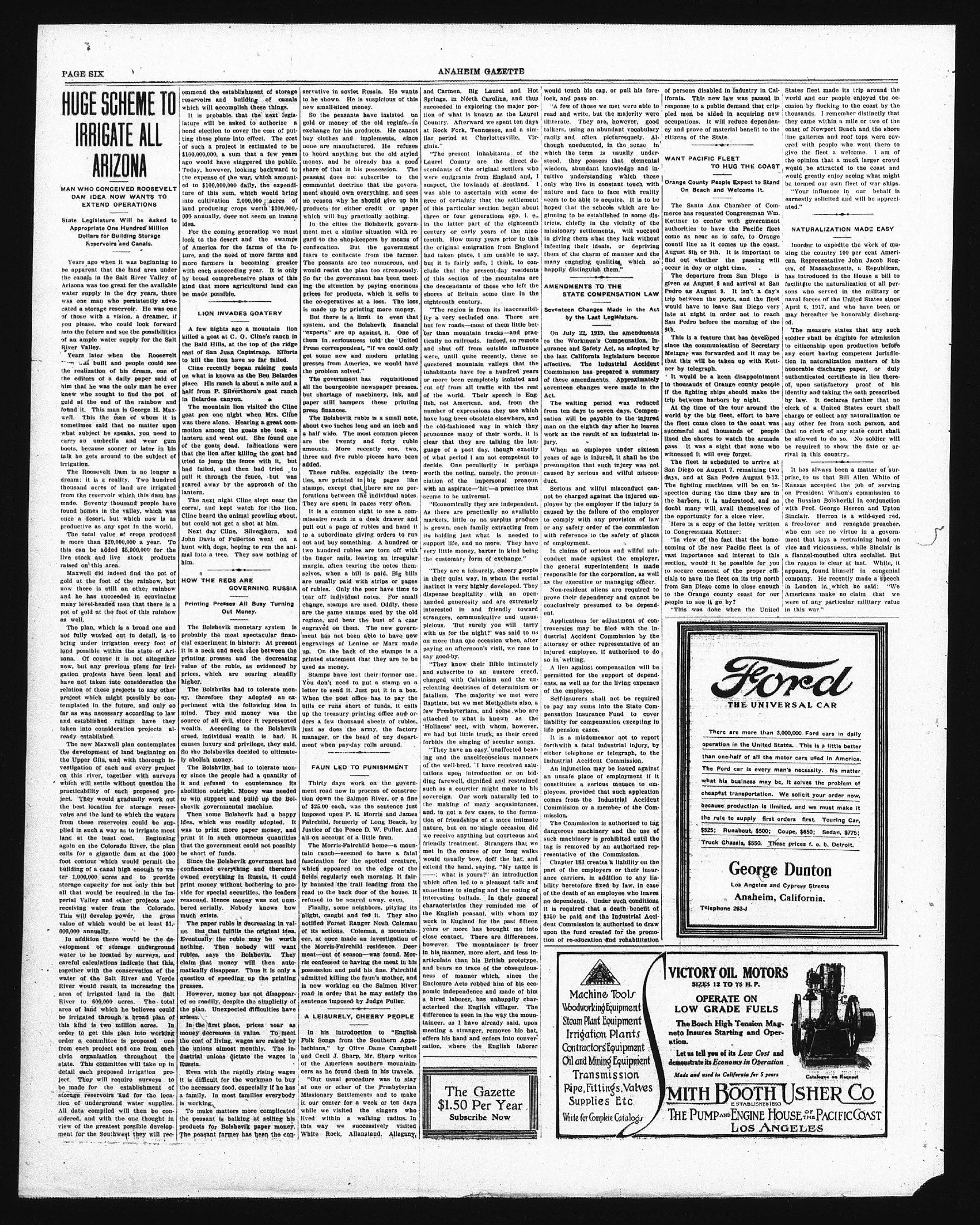
Searchable text
HUGE SCHEME TO IRRIGATE ALL ARIZONA
MAN WHO CONCEIVED ROOSEVELT DAM IDEA NOW WANTS TO EXTEND OPERATIONS
State Legislature Will be Asked to Appropriate One Hundred Million Dollars for Building Storage Reservoirs and Canals.
Years ago when it was beginning to be apparent that the land area under the canals in the Salt River Valley of Arizona was too great for the available water supply in the dry years, there was one man who persistently advocated a storage reservoir. He was one of those with a vision, a dreamer, if you please, who could look forward into the future and see the possibilities of an ample water supply for the Salt River Valley.
Years later when the Roosevelt Dam was built and people could see the realization of his dream, one of the editors of a daily paper said of him that he was the only man he ever knew who sought to find the pot of gold at the end of the rainbow and found it. This man is George H. Maxwell. This the man of whom it is sometimes said that no matter upon what subject he speaks, you need to carry an umbrella and wear gum boots, because sooner or later in his talk he gets around to the subject of commend the establishment of storage reservoirs and building of canals which will accomplish these things.
It is probable that the next legislature will be asked to authorize a bond election to cover the cost of putting these plans into effect. The cost of such a project is estimated to be $100,000,000, a sum that a few years ago would have staggered the public. Today, however, looking backward to the expense of the war, which amounted to $100,000,000 daily, the expenditure of this sum, which would bring into cultivation 2,000,000 acres of land producing crops worth $200,000,000 annually, does not seem an insane idea.
For the coming generation we must look to the desert and the swamps of America for the farms of the future, and the need of more farms and more farmers is becoming greater with each succeeding year. It is only by broad comprehensive plans of this kind that more agricultural land can be made possible.
LION INVADES GOATERY
A few nights ago a mountain lion killed a goat at C. O. Cline's ranch in the Bald Hills, at the top of the ridge east of San Juan Capistrano. Efforts to kill the lion have so far failed.
Cline recently began raising goats on what is known as the Ben Belardes place. His ranch is about a mile and a half from P. Silverthorn's goat ranch in Belardes canyon.
The mountain lion visited the Cline goat pen one night when Mrs. Cline was there alone. Hearing a great comotion among the goats she took a lantern and went out. She found one of the goats dead. Indications were that the lion after killing the goat had servative in soviet Russia to be shown. He is now small-sized money.
So the peasants have gold or money of the exchange for his produce buy clothes and linens none are manufactured to hoard anything but money, and he already share of that in his peasant does not support communist doctrine should own even no reason why he should products for either which will buy practice.
In the cities the government met a similar garder to the shop-keeper confiscation. But fears to confiscate them would resist the plan. So far the governmenting the situation by prices for products, the co-operatives at is made up by printers.
But there is a limit system, and the Bolshevik "experts" are up against them in seriousness. Press correspondent, get some new and presses from America the problem solved."
The government has all the bourgeoisie now but shortage of maid paper still hampers press finances.
The Bolshevik rubbish about two inches long a half wide. The most are the twenty amounts. More recount three and five rubles.
was built and people could see the realization of his dream, one of the editors of a daily paper said of him that he was the only man he ever knew who sought to find the pot of gold at the end of the rainbow and found it. This man is George H. Maxwell. This the man of whom it is sometimes said that no matter upon what subject he speaks, you need to carry an umbrella and wear gum boots, because sooner or later in his talk he gets around to the subject of irrigation.
The Roosevelt Dam is no longer a dream; it is a reality. Two hundred thousand acres of land are irrigated from the reservoir which this dam has made. Seventy thousand people have found homes in the valley, which was once a desert, but which now is as productive as any spot in the world.
The total value of crops produced is more than $20,000,000 a year. To this can be added $5,000,000 for the live stock and live stock products raised on this area.
Maxwell did indeed find the pot of gold at the foot of the rainbow, but now there is still an other rainbow and he has succeeded in convincing many level-headed men that there is a pot of gold at the foot of this rainbow as well.
The plan, which is a broad one and not fully worked out in detail, is to bring under irrigation every foot of land possible within the state of Arizona. Of course it is not altogether new, but any previous plans for irrigation projects have been local and have not taken into consideration the relation of these projects to any other project which might possibly be contemplated in the future, and only so far as was necessary according to law and established rulings have they taken into consideration projects already established.
The new Maxwell plan contemplates the development of land beginning on the Upper Gila, and with thorough investigation of each and every project on this river, together with surveys which will settle without question the practicability of each proposed project. They would gradually work out the best location for storage reservoirs and the land to which the waters from these reservoirs could be supplied in such a way as to irrigate most land at the least cost. Beginning again on the Colorado River, the plan calls for a gigantic dam at the 1000 foot contour which would permit the
Cline recently began raising goats on what is known as the Ben Belardes place. His ranch is about a mile and a half from P. Silverthorn's goat ranch in Belardes canyon.
The mountain lion visited the Cline goat pen one night when Mrs. Cline was there alone. Hearing a great comotion among the goats she took a lantern and went out. She found one of the goats dead. Indications were that the lion after killing the goat had tried to jump the fence with it, but had failed, and then had tried to pull it through the fence, but was scared away by the approach of the lantern.
The next night Cline slept near the corral, and kept watch for the lion. Cline heard the animal prowling about, but could not get a shot at him.
Next day Cline, Silverthorn, and John Davis of Fullerton went on a hunt with dogs, hoping to run the animal into a tree. They saw nothing of him.
HOW THE REDS ARE GOVERNING RUSSIA
Printing Presses All Busy Turning Out Money.
The Bolshevik monetary system is probably the most spectacular financial experiment in history: At present it is a neck and neck race between the printing presses and the decreasing value of the ruble, as evidenced by prices, which are soaring steadily higher.
The Bolshviks had to tolerate money, therefore they adopted an experiment with the following idea in mind. They said money was the source of all evil, since it represented wealth. According to the Bolshevik creed, individual wealth is bad. It causes luxury and privilege, they said. So the Bolsheviks decided to ultimately abolish money.
The Bolshviks had to tolerate money since the people had a quantity of it and refused to countenance its abolition outright. Money was needed to win support and build up the Bolshevik governmental machine.
Then some Bolsheviks had a happy idea, which was readily adopted. It was to print more paper money, and print it in such enormous quantities that the government could not possibly be short of funds.
Since the Bolshevik government had to kill the lion have so far failed.
The government has all the bourgeoisie no doubt but shortage of maid paper still hampers press finances.
The Bolshevik rubble about two inches long a half wide. The mode are the twenty and amounts. More recent three and five rubles added.
These rubbles, especially stamps, are printed in stamps except that forations between them. They are spent in paper.
It is a common sign missaire reach in a pull out a page of ruin to a subordinate giving out and buy something two hundred rubles at the finger nails, leaving margin, often tearing selves, when a bill is usually paid within rubles. Only the pear off individual change, stamps are used are the same stamps regime, and bear their engraved on them.
ment has not been an engravings of Lenin up. On the back of printed statement that used as money.
Stamps have lost to You don't need to put letter to send it. Just When the post office bills or runs short up up the treasury printers a few thousand just as does the an manager, or the headman when pay-day runs.
FAUN LED TO P
Thirty days work ment road now in production down the Salmon of $25.00 each, was imposed upon P. E. M Fairchild, formerly of Justice of the Peace all on account of a life.
The Morris-Fairchild tain ranch—seemed fascination for the
restigation of each and every project on this river, together with surveys which will settle without question the practicability of each proposed project. They would gradually work out the best location for storage reservoirs and the land to which the waters from these reservoirs could be supplied in such a way as to irrigate most land at the least cost. Beginning again on the Colorado River, the plan calls for a gigantic dam at the 1000 foot contour which would permit the building of a canal high enough to water 1,000,000 acres and to provide storage capacity for not only this but all that would be required in the Imperial Valley and other projects now receiving water from the Colorado. This will develop power, the gross value of which would be at least $1,000,000 annually.
In addition there would be the development of storage underground water to be located by surveys, and careful calculations indicate that this, together with the conservation of the water of the Salt River and Verde River would result in increasing the area of irrigated land in the Salt River to 600,000 acres. The total area of land which he believes could be irrigated through a broad plan of this kind is two million acres. In order to get this plan into working order a committee is proposed one from each project and one from each civic organization throughout the state. This committee will take up in detail each proposed irrigation project. They will require surveys to be made for the establishment of storage reservoirs and for the location of underground water supplies. All data compiled will then be considered, and with the one thought in view of the greatest possible development for the Southwest they will rec-
ANAHEIM GAZETTE
servative in soviet Russia. He wants to be shown. He is suspicious of this new small-sized money.
So the peasants have insisted on gold or money of the old regime, in exchange for his products. He cannot buy clothes and implements, since none are manufactured. He refuses to hoard anything but the old styled money, and he already has a good share of that in his possession. The peasant does not subscribe to the communist doctrine that the government should own everything, and sees no reason why he should give up his products for either credit or paper which will buy practically nothing.
In the cities the Bolshevik government met a similar situation with regard to the shop-keepers by means of confiscation. But the government fears to confiscate from the farmer. The peasants are too numerous, and would resist the plan too strenuously. So far the government has been meeting the situation by paying enormous prices for products, which it sells to the co-operatives at a loss. The loss is made up by printing more money.
But there is a limit to even that system, and the Bolshevik financial "experts" are up against it. One of them in seriousness told the United Press correspondent, "If we could only get some new and modern printing presses from America, we would have the problem solved."
The government has requisitioned all the bourgeois newspaper presses, but shortage of machinery, ink, and paper still hampers these printing press finances.
The Bolshevik ruble is a small note, about two inches long and an inch and a half wide. The most common pieces are the twenty and forty ruble amounts. More recently one, two, three and five ruble pieces have been
and Carmen, Big Laurel and Hot Springs, in North Carolina, and thus succeeded in exploring the major portion of what is known as the Laurel Country. Afterward we spent ten days at Rock Fork, Tennessee, and a similar period at Charlottesville, Virginia."
"The present inhabitants of the Laurel County are the direct descendants of the original settlers who were emigrants from England and, I suspect, the lowlands of Scotland. I was able to ascertain with some degree of certainty that the settlement of this particular section began about three or four generations ago. I e., in the latter part of the eighteenth century or early years of the nineteenth. How many years prior to this the original emigration from England had taken place, I am unable to say, but it is fairly safe, I think, to conclude that the present-day residents of this section of the mountains are the descendants of those who left the shores of Britain some time in the eighteenth century.
"The region is from its inaccessibility a very secluded one. There are but few roads—most of them little better than mountain tracks—and practically no railroads. Indeed, so remote and shut off from outside influence were, until quite recently, these sequestered mountain valleys that the inhabitants have for a hundred years or more been completely isolated and cut off from all traffic with the rest of the world. Their speech is English, not American, and, from the number of expressions they use which have long been obsolete elsewhere, and the old-fashioned way in which they pronounce many of their words, it is clear that they are talking the language of a past day, though exactly of what period I am not competent to
would touch his cap, or pull his forelock, and pass on.
"A few of those we met were able to read and write, but the majority were illiterate. They are, however, good talkers, using an abundant vocabulary racily and often picturesquely. Although uneducated, in the sense in which the term is usually understood, they possess that elemental wisdom, abundant knowledge and intuitive understanding which those only who live in constant touch with nature and face to face with reality seem to be able to acquire. It is to be hoped that the schools which are beginning to be established in some districts, chiefly in the vicinity of the missionary settlements, will succeed in giving them what they lack without infecting their ideals, or depriving them of the charm of manner and the many engaging qualities which so happily distinguish them."
AMENDMENTS TO THE STATE COMPENSATION LAW
Seventeen Changes Made in the Act by the Last Legislature.
On July 22, 1919, the amendments to the Workmen's Compensation Insurance and Safety Act, as adopted by the last California legislature become effective. The Industrial Accident Commission has prepared a summary of these amendments. Approximately seventeen changes were made in the Act.
The waiting period was reduced from ten days to seven days. Compensation will be payable to the injured man on the eighth day after he leaves work as the result of an industrial injury.
When an employee under sixteen years of age is injured it shall be the person if it is not injured.
of personnel if it is not injured.
The San mercer has pleaded memorially come as count line August 8th find out out occur in
The de given as Pedro as trip between late at San Pedro 9th.
This is since the Metzgar that this ner by teh It would to thousand if the flight trip between At the world by the fleet successful lined the pass. It witnessed
presses from America, we would have the problem solved."
The government has requisitioned all the bourgeois newspaper presses, but shortage of machinery, ink, and paper still hampers these printing press finances.
The Bolshevik ruble is a small note, about two inches long and an inch and a half wide. The most common pieces are the twenty and forty ruble amounts. More recently one, two, three and five ruble pieces have been added.
These rubles, especially the twenties, are printed in big pages like stamps, except that there are no perforations between the individual notes. They are spent in pages very often.
It is a common sight to see a commissaire reach in a desk drawer and pull out a page of rubles and hand it to a subordinate giving orders to run out and buy something. A hundred or two hundred rubles are torn off with the finger nails, leaving an irregular margin, often tearing the notes themselves, when a bill is paid. Big bills are usually paid with strips or pages of rubles. Only the poor have time to tear off individual notes. For small change, stamps are used. Oddly, these are the same stamps used by the old regime, and bear the bust of a czar engraved on them. The new government has not been able to have new engravings of Lenine or Marx made up. On the back of the stamps is a printed statement that they are to be used as money.
Stamps have lost their former use. You don't need to put a stamp on a letter to send it. Just put it in a box. When the post office has to pay the bills or runs short of funds, it calls up the treasury printing office and orders a few thousand sheets of rubles, just as does the army, the factory manager, or the head of any department when pay-day rolls around.
FAUN LED TO PUNISHMENT
Thirty days work on the government road now in process of construction down the Salmon River, or a fine of $25.00 each, was the sentence just imposed upon P. E. Morris and James Fairchild, formerly of Long Beach, by Justice of the Peace D. W. Fuller. And all on account of a little faun.
The Morris-Fairchild home—a mountain ranch—seemed to have a fatal fascination for the spotted creature, questered mountain valleys that the inhabitants have for a hundred years or more been completely isolated and cut off from all traffic with the rest of the world. Their speech is English, not American, and, from the number of expressions they use which have long been obsolete elsewhere, and the old-fashioned way in which they pronounce many of their words, it is clear that they are talking the language of a past day, though exactly of what period I am not competent to decide. One peculiarity is perhaps worth the noting, namely, the pronunciation of the impersonal pronoun with an aspirate—'hit'—a practice that seems to be universal.
"Economically they are independent. As there are practically no available markets, little or no surplus produce is grown, each family extracting from its holding just what is needed to support life, and no more. They have very little money, barter in kind being the customary form of exchange."
"They are a leisurely, cheery people in their quiet way, in whom the social instinct is very highly developed. They dispense hospitality with an open-handed generosity and are extremely interested in and friendly toward strangers, communicative and unsuspicious. 'But surely you will tarry with us for the night?' was said to us on more than one occasion when, after paying an afternoon's visit, we rose to say good-by.
"They know their Bible intimately and subscribe to an austere creed, charged with Calvinism and the unrelenting doctrines of determinism or fatalism. The majority we met were Baptists, but we met Methodists also, a few Presbyterians, and some who are attached to what is known as the 'Holliness' sect, with whom, however, we had but little truck; as their creed forbids the singing of secular songs.
"They have an easy, unaffected bearing and the unselfconscious manners of the well-bred." I have received salutations upon introduction or on bidding farewell, dignified and restrained such as a courtier might make to his sovereign. Our work naturally led to the making of many acquaintances, and, in not a few cases, to the formation of friendships of a more intimate nature, but on no single occasion did we receive anything but courteous and friendly treatment. Strangers that we met in the course of our long walks would usually bow, doff the hat, and extend their hand.
The Industrial Accident Commission has prepared a summary of these amendments. Approximately seventeen changes were made in the Act.
The waiting period was reduced from ten days to seven days. Compensation will be payable to the injured man on the eighth day after he leaves work as the result of an industrial injury.
When an employee under sixteen years of age is injured, it shall be the presumption that such injury was not caused by serious and wilful misconduct.
Serious and wilful misconduct cannot be charged against the injured employee by the employer if the injury is caused by the failure of the employer to comply with any provision of law or any safety order of the commission with reference to the safety of places of employment.
In claims of serious and wilful misconduct made against the employer, the general superintendent is made responsible for the corporation, as well as the executive or managing officer.
Non-resident aliens are required to prove their dependency and cannot be conclusively presumed to be dependent.
Applications for adjustment of controversies may be filed with the Industrial Accident Commission by the attorney or other representative of an injured employee. If authorized to do so in writing.
A lien against compensation will be permitted for the support of dependents, as well as for the living expenses of the employee.
Self-insurers shall not be required to pay any sums into the State Compensation Insurance Fund to cover liability for compensation excepting in life pension cases.
It is a misdemeanor not to report forthwith a fatal industrial injury, by either telephone or telegraph, to the Industrial Accident Commission.
An injunction may be issued against an unsafe place of employment if it constitutes a serious menace to employees, provided that such application comes from the Industrial Accident Commission or a member of the Commission.
The Commission is authorized to tag dangerous machinery and the use of such machinery is prohibited until the tag is removed by an authorized representative of the Commission.
Chapter 183 creates a liability on the
Thirty days work on the government road now in process of construction down the Salmon River, or a fine of $25.00 each, was the sentence just imposed upon P. E. Morris and James Fairchild, formerly of Long Beach, by Justice of the Peace D. W. Fuller. And all on account of a little faun.
The Morris-Fairchild home—a mountain ranch—seemed to have a fatal fascination for the spotted creature, which appeared on the edge of the fields regularly each morning. It fairly haunted the trail leading from the road to the back door of the house. It refused to be scared away, even.
Finally, some neighbors, pitying its plight, caught and fed it. They also notified Forest Ranger Noah Coleman of its actions. Coleman, a mountaineer, at once made an investigation of the Morris-Fairchild residence. Deer meat—out of season—was found. Morris confessed to having the meat in his possession and paid his fine. Fairchild admitted killing the faun's mother, and is now working on the Salmon River road in order that he may satisfy the sentence imposed by Judge Fuller.
A LEISURELY, CHEERY PEOPLE
In his introduction to "English Folk Songs from the Southern Appalachians," by Olive Dame Campbell and Cecl J. Sharp, Mr. Sharp writes of the American southern mountainers as he found them in his travels.
"Our usual procedure was to stay at one or other of the Presbyterian Missionary Settlements and to make it our center for a week or ten days while we visited the singers who lived within a walking radius. In this way we successively visited White Rock, Allangstand, Allegany,
The Gazette
$1.50 Per Year
Subscribe Now
of persons disabled in Industry in California. This new law was passed in response to a public demand that crippled men be aided in acquiring new occupations. It will reduce dependency and prove of material benefit to the citizens of the State.
WANT PACIFIC FLEET TO HUG THE COAST
Orange County People Expect to Stand On Beach and Welcome It.
The Santa Ana Chamber of Commerce has requested Congressman Wm. Kettner to confer with government authorities to have the Pacific fleet come as near as is safe, to Orange countl line as it comes up the coast, August 8th or 9th. It is important to find out whether the passing will occur in day or night time.
The departure from San Diego is given as August 8 and arrival at San Pedro as August 9. It isn’t a day’s trip between the ports, and the fleet would have to leave San Diego very late at night in order not to reach San Pedro before the morning of the 9th.
This is a feature that has developed since the communication of Secretary Metzgar was forwarded and it may be that this will be taken up with Kettner by telegraph.
It would be a keen disappointment to thousands of Orange county people if the fighting ships should make the trip between harbors by night.
At the time of the tour around the world by the big fleet, effort to have the fleet come close to the coast was successful and thousands of people lined the shores to watch the armada pass. It was a sight that none who witnessed it will ever forget.
States fleet made its trip around the world and our people enjoyed the occasion by flocking to the coast by the thousands. I remember distinctly that they came within a mile or two of the coast of Newport Beach and the shore line galleries and roof tops were covered with people who went there to give the fleet a welcome. I am of the opinion that a much larger crowd would be attracted to the coast and would greatly enjoy seeing what might be termed our own fleet of war ships.
“Your influence in our behalf is earnestly solicited and will be appreciated.”
NATURALIZATION MADE EASY
In order to expedite the work of making the country 100 per cent American, Representative John Jacob Rogers, of Massachusetts, a Republican, has introduced in the House a bill to facilitate the naturalization of all persons who served in the military or naval forces of the United States since April 6, 1917, and who have been or may hereafter be honorably discharged.
The measure states that any such soldier shall be eligible for admission to citizenship upon production before any court having competent jurisdiction in naturalization matters of his honorable discharge paper, or duly authenticated certificate in lieu thereof, upon satisfactory proof of his identity and taking the oath prescribed by law. It declares further that no clerk of a United States court shall charge or collect any naturalization or any other fee from such person, and that no clerk of any state court shall be allowed to do so. No soldier will be required to show the date or arrival in this country..
It was reduced days. Compens to the injured after he leaves on industrial in under sixteen it shall be the injury was not wilful misconduct can the injured emil if the injury is of the employer provision of law the commission safety of places and wilful mis the employer, incident is madeoration, as well managing officer. are required to and cannot be to be depend-iment of con- with the In-mission by the representative of an authorized to do sensation will be port of depend- living expenses not be required the State Com-ound to cover on excepting in not to report trial injury, by egraph, to the commission. issued against employment if it menace to em-uch application trial Accident order of the Com-authorized to tag and the use of exhibited until the authorized rep-mission. illability on the that this will be taken up with Kettner by telegraph.
It would be a keen disappointment to thousands of Orange county people if the fighting ships should make the trip between harbors by night.
At the time of the tour around the world by the big fleet, effort to have the fleet come close to the coast was successful and thousands of people lined the shores to watch the armada pass. It was a sight that none who witnessed it will ever forget.
The fleet is scheduled to arrive at San Diego on August 7, remaining two days, and at San Pedro August 9-13. The fighting machines will be on inspection during the time they are in the harbors, it is understood, and no doubt many will avail themselves of the opportunity for a close view.
Here is a copy of the letter written to Congressman Kettner:
"In view of the fact that the homecoming of the new Pacific fleet is of vast importance and interest to this section, would it be possible for you to secure consent of the proper officials to have the fleet on its trip north from San Diego come in close enough to the Orange county coast for our people to see it go by?
"This was done when the United
It has always been a matter of surprise to us that Bill Allen White of Kansas accepted the job of serving on President Wilson's commission to the Russian Bolshevik in conjunction with Prof. George Herron and Upton Sinclair. Herron is a wild-eyed red, a free-lover and renegade preacher, who can see no virtue in a government that lays a restraining hand on vice and viciousness, while Sinclair is a flannel-mouthed ultra socialist. But the reason is clear at last. White, it appears, found himself in congenial company. He recently made a speech in London in which he said: "We Americans make no claim that we were of any particular military value in this war."
Ford
THE UNIVERSAL CAR
There are more than 3,000,000 Ford cars in daily operation in the United States. This is a little better than one-half of all the motor cars used in America. The Ford car is every man's necessity. No matter what his business may be, it solves the problem of cheapest transportation. We solicit your order now, because production is limited, and we must make it the rule to supply first orders first. Touring Car,
$525; Runabout, $500; Coupe, $650; Sedan, $775;
Truck Chassis, $550. These prices f. o. b. Detroit.
VICTORY OIL MOTORS
SIZES 12 TO 75 H.P.
OPERATE ON
LOW GRADE FUELS
The Bosch High Tension Magneto Insures Starting and Operation.
Let us tell you of its Low Cost and demonstrate its Economy in Operation
Made and used in California for 5 years
MITH BOOTH USHER CO
ESTABLISHED 1893
THE PUMP AND ENGINE HOUSE OF THE PACIFIC COAST
LOS ANGELES