anaheim-gazette 1919-07-24
Scanned page
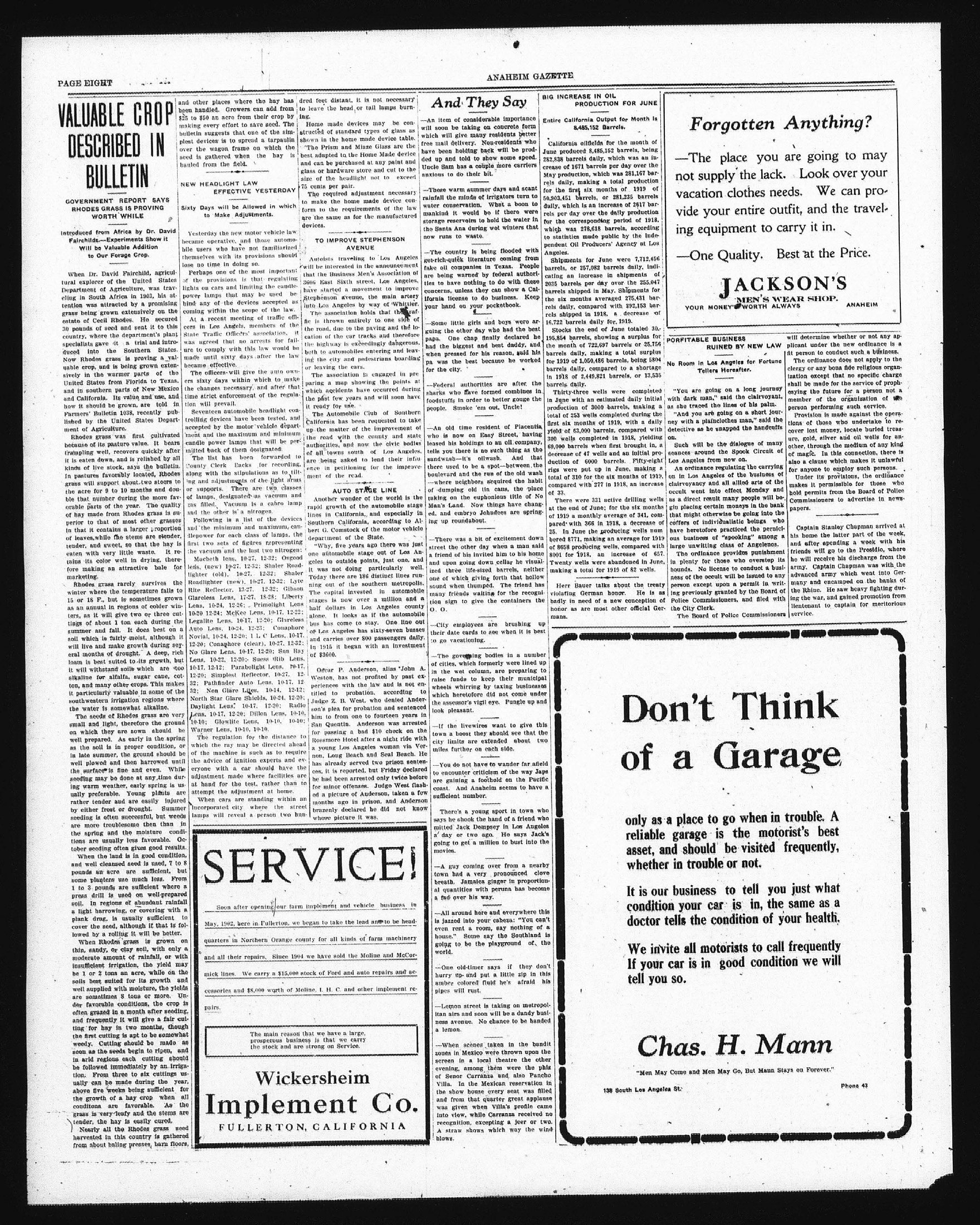
Searchable text
VALUABLE CROP DESCRIBED IN BULLETIN
GOVERNMENT REPORT SAYS RHODES GRASS IS PROVING WORTH WHILE
Introduced from Africa by Dr. David Fairchilds.—Experiments Show it Will be Valuable Addition to Our Forage Crop.
When Dr. David Fairchild, agricultural explorer of the United States Department of Agriculture, was traveling in South Africa in 1903, his attention was attracted by a promising grass being grown extensively on the estate of Cecil Rhodes. He secured 30 pounds of seed and sent it to this country, where the department's plant specialists gave it a trial and introduced into the Southern States. Now Rhodes grass is proving a valuable crop, and is being grown extensively in the warmer parts of the United States from Florida to Texas, and in southern parts of New Mexico and California. Its value and use, and how it should be grown, are told in Farmers' Bulletin 1038, recently published by the United States Department of Agriculture.
Rhodes grass was first cultivated because of its pasture value. It bears trampling well, recovers quickly after and other places where the hay has been handled. Growers can add from $25 to $50 an acre from their crop by making every effort to save seed. The bulletin suggests that one of the simplest devices is to spread a tarpaulin over the wagon frame on which the seed is gathered when the hay is hauled from the field.
NEW HEADLIGHT LAW EFFECTIVE YESTERDAY
Sixty Days will be Allowed in which to Make Adjustments.
Yesterday the new motor vehicle law became operative, and those automobile users who have not familiarized themselves with its provisions should lose no time in doing so.
Perhaps one of the most important of the provisions is that regulating lights on cars and limiting the candle-power lamps that may be used behind any of the devices accepted as coming within the scope of the law.
At a recent meeting of traffic officers in Los Angeles, members of the State Traffic Officers' association, it was agreed that no arrests for failure to comply with this law would be made until sixty days after the law became effective.
The officers-will give the auto owners sixty days within which to make the changes necessary, and after that time strict enforcement of the regulation will prevail.
Seventeen automobile headlight controlling devices have been tested, and accepted by the motor vehicle department and the maximum and minimum candle power lamps that will be permitted back of them designated.
The list has been forwarded to dred feet distant, it is to leave the head or ing.
Home made devices constructed of standard material shown in the home market. The Prism and Miracle best adapted to the Heathland can be purchased at glass or hardware store size of the headlight 75 cents per pair.
The required adjustment to make the home more form to the requirements are the same as for these devices.
TO IMPROVE STREET AVENUE
Autoists traveling will be interested in that the Business Meets 3606 East Sixth Street have started a movie Stephenson avenue, into Los Angeles by.
The association hotel is thrown entirely on the road, due to the location of the car tractor highway is exceed both to automobiles using the city and peacock or leaving the cars.
The association is paring a map showing which accidents have occurred the past few years and it ready for use.
The Automobile California has been up to the matter of the road with the authorities, and now all towns south
Now Rhodes grass is proving uable crop, and is being grown extensively in the warmer parts of the United States from Florida to Texas, and in southern parts of New Mexico and California. Its value and use, and how it should be grown, are told in Farmers' Bulletin 1038, recently published by the United States Department of Agriculture.
Rhodes grass was first cultivated because of its pasture value. It bears trampling well, recovers quickly after it is eaten down, and is relished by all kinds of live stock, says the bulletin. In pastures favorably located, Rhodes grass will support about two steers to the acre for 9 to 10 months and double that number during the more favorable parts of the year. The quality of hay made from Rhodes grass is superior to that of most other grasses in that it contains a larger proportion of leaves, while the stems are slender, tender, and sweet, so that the hay is eaten with very little waste. It retains its color well in drying, therefore making an attractive bale for marketing.
Rhodes grass rarely survives the winter where the temperature falls to 15 or 18 F., but is sometimes grown as an annual in regions of colder winters, as it will give two or three cuttings of about 1 ton each during the summer and fall. It does best on a soil which is fairly moist, although it will live and make growth during several months of drought. A deep, rich loam is best suited to its growth, but it will withstand soils which are too alkaline for alfalfa, sugar cane, cotton, and many other crops. This makes it particularly valuable in some of the southwestern irrigation regions where the water is somewhat alkaline.
The seeds of Rhodes grass are very small and light, therefore the ground on which they are sown should be well prepared. As early in the spring as the soil is in proper condition, or in late summer, the ground should be well plowed and then harrowed until the surface is fine and even. While seeding may be done at any time during warm weather, early spring is usually preferable. Young plants are rather tender and are easily injured by either frost or drought. Summer seeding is often successful, but weeds are more troublesome than in the spring and the moisture conditions are usually less favorable. October seeding often gives good results.
When the land is in good condition, and well cleansed seed is used, 7 to 8 became effective.
The officers will give the auto owners sixty days within which to make the changes necessary, and after that time strict enforcement of the regulation will prevail.
Seventeen automobile headlight controlling devices have been tested, and accepted by the motor vehicle department and the maximum and minimum candle power lamps that will be permitted back of them designated.
The list has been forwarded to County Clerk Eacks for recording, along with the stipulations as to tilting and adjustments of the light arms or supports. There are two classes of lamps designated as vacuum and gas filled. Vacuum is a cabro lamp and the other is a nitrogen.
Following is a list of the devices and the minimum and maximum canlepower for each class of lamps, the first two sets of figures representing the vacuum and the last two nitrogen:
Macbeth lens, 10-27, 12-32; Osgood lens, (new) 10-27, 12-32; Shaler Roadlighter (old), 10-27, 12-32; Shaler Roadlighter (new), 10-27, 12-32; Lyte Rite Reflector, 13-27, 12-32; Gibson Glareless Lens, 17-27, 18-28; Liberty Lens, 10-24, 12-26; Primolight Lens 10-20 12-24; McKee Lens, 10-17, 12-22; Legalite Lens, 10-17, 12-20; Glareless Auto Lens, 10-24, 12-23; Conaphore Novial, 10-24, 12-20; I.L.C Lens, 10-17, 12-20; Conaphore (clear), 10-27, 12-32; No Glare Lens, 10-17, 12-20; Sun Ray Lens, 10-22, 12-20; Suess Rib Lens, 10-17, 12-12; Parabolight Lens, 10-17, 12-20; Simplest Reflector, 10-27, 12-32; Pathfinder Auto Lens, 10-17, 12-32; Non Glare Lites, 10-14, 12-12; North Star Glare Shields, 10-24, 12-20; Daylight Lens, 10-17, 12-20; Radio Lens, 10-17, 12-20; Dillon Lens, 10-10; Glowlite Lens, 10-10; Warner Lens, 10-10, 10-10;
The regulation for the distance to which the ray may be directed ahead of the machine is such as to require the advice of ignition experts and everyone with a car should have the adjustment made where facilities are at hand for the test, rather than to attempt the adjustment at home.
When cars are standing within an incorporated city where the street lamps will reveal a person two hunts became effective.
The officers will give the auto owners sixty days within which to make the changes necessary, and after that time strict enforcement of the regulation will prevail.
Seventeen automobile headlight controlling devices have been tested, and accepted by the motor vehicle department and the maximum and minimum candle power lamps that will be permitted back of them designated.
The list has been forwarded to County Clerk Eacks for recording, along with the stipulations as to tilting and adjustments of the light arms or supports. There are two classes of lamps designated as vacuum and gas filled. Vacuum is a cabro lamp and the other is a nitrogen.
Following is a list of the devices and the minimum and maximum canlepower for each class of lamps,the first two sets of figures representing the vacuum and the last two nitrogen:
Macbeth lens, 10-27, 12-32; Osgood lens,(new) 10-27, 12-32; Shaler Roadlighter (old), 10-27, 12-32; Shaler Roadlighter (new), 10-27, 12-32; Gibson Glareless Lens, 17-27, 18-28; Liberty Lens, 10-24, 12-26; Primolight Lens 10-20 12-24; McKee Lens, 10-17, 12-22; Legalite Lens, 10-17, 12-20; Glareless Auto Lens, 10-24,12-23; Conaphore Novial,10-24,12-20;I.L.C Lens,10-17,12-32;Non Glare Lites,10-14,12-12;North Star Glare Shields,10-24,12-20;Daylight Lens,10-17,12-20;Radio Lens,10-17,12-20;Dillon Lens,10-10;Glowlite Lens,10-10,10-10;Warner Lens,10-10,10-
seeding may be done at any time during warm weather, early spring is usually preferable. Young plants are rather tender and are easily injured by either frost or drought. Summer seeding is often successful, but weeds are more troublesome than in the spring and the moisture conditions are usually less favorable. October seeding often gives good results.
When the land is in good condition, and well cleansed seed is used, 7 to 8 pounds an acre are sufficient, but some planters use much less. From 1 to 3 pounds are sufficient where a press drill is used on well-prepared soil. In regions of abundant rainfall a light harrowing, or covering with a plank drag, is usually sufficient to cover the seed, although if that is followed by a rolling it will be better.
When Rhodes grass is grown on thin, sandy, or clay soil, with only a moderate amount of rainfall, or with insufficient irrigation, the yield may be 1 or 2 tons an acre, while on the soils best suited for its growth and well supplied with moisture, the yields are sometimes 8 tons or more. Under favorable conditions, the crop is often grazed in a month after seeding, and frequently it will give a fair cutting for hay in two months, though the first cutting is apt to be somewhat weedy. Cutting should be made as soon as the seeds begin to ripen, and in arid regions each cutting should be followed immediately by irrigation. From three to six cuttings usually can be made during the year, above five weeks being sufficient for the growth of a hay crop when all conditions are favorable. As the grass is very leafy and the stems are tender, the hay is easily cured.
Nearly all the Rhodes grass seed harvested in this country is gathered from about baling presses, barn floors,
SERVIC
Soon after opening our farm implement and vehicle
May, 1902, here in Fullerton, we began to take the lead
quarters in Northern Orange county for all kinds of
and all their repairs. Since 1904 we have sold the Mick lines. We carry a $15,000 stock of Ford and auto accessories and $8,000 worth of Moline, I. H. C. and other pairs.
The main reason that we have a large prosperous business is that we carry the stock and are strong on Service.
Wickersheim Implement
FULLERTON, CALIFO
dred feet distant, it is not necessary to leave the head or tail lamps burning.
Home made devices may be constructed of standard types of glass as shown in the home made device table. The Prism and Miaze Glass are the best adapted to the Home Made device and can be purchased at any paint and glass or hardware store and cut to the size of the headlight not to exceed 75 cents per pair.
The required adjustment necessary to make the home made device conform to the requirements of the law are the same as for the manufactured devices.
TO IMPROVE STEPHENSON AVENUE
Autoists traveling to Los Angeles will be interested in the announcement that the Business Men's Association of 3606 East Sixth street, Los Angeles, have started a movement to improve Stephenson avenue, the main artery into Los Angeles by way of Whittier.
The association holds that the traffic is thrown entirely to one side of the road, due to the paving and the location of the car tracks and therefore the highway is exceedingly dangeroous, both to automobiles entering and leaving the city and pedestrians boarding or leaving the cars.
The association is engaged in preparing a map showing the points at which accidents have occurred during the past few years and will soon have it ready for use.
The Automobile Club of Southern California has been requested to take up the matter of the improvement of the road with the county and state authorities, and now the civic bodies of all towns south of Los Angeles.
And They Say
An item of considerable importance will soon be taking on concrete form which will give many residents better free mail delivery. Non-residents who have been holding back will be produced up and told to show some speed. Uncle Sam has a couple more carriers anxious to do their bit.
These warm summer days and scant rainfall the minds of irrigators turn to water conservation. What a boon to mankind it would be if there were storage reservoirs to hold the water in the Santa Ana during wet winters that now runs to waste.
The country is being flooded with get-rich-quick literature coming from fake oil companies in Texas. People are being warned by federal authorities to have nothing to do with these concerns, unless they can show a California license to do business. Keep your hand on your pocketbook.
Some little girls and boys were arguing the other day who had the best papa. One chap finally declared he had the biggest and best daddy, and when pressed for his reason, said his pa was the best because he worked for the city.
Federal authorities are after the sharks who have formed combines in foodstuffs in order to better gouge the people. Smoke 'em out, Uncle!
An old time resident of Placentia who is now on Easy Street, having leased his holdings to an oil company, tells you there is no such thing as the big increase in oil production for June.
Entire California Output for Month is 8,485,152 Barrels.
California oilfields for the month of June produced 8,485,152 barrels, being 282,838 barrels daily, which was an increase of 1671 barrels per day over the May production, which was 281,167 barrels daily, making a total production for the first six months of 1919 of 50,903,451 barrels, or 281,235 barrels daily, which is an increase of 2617 barrels per day over the daily production for the corresponding period of 1918, which was 278,618 barrels, according to statistics made public by the Independent Oil Producers' Agency at Los Angeles.
Shipments for June were 7,712,456 barrels, or 257,082 barrels daily, indicating an increase in shipments of 2035 barrels per day over the 255,047 barrels shipped in May. Shipments for the six months averaged 275,431 barrels daily, compared with 292,153 barrels shipped in 1918, a decrease of 16,722 barrels daily for 1919.
Stocks the end of June totaled 30,-195,854 barrels, showing a surplus for the month of 722,697 barrels or 25,756 barrels daily, making a total surplus for 1919 of 1,050,486 barrels, being 5804 barrels daily, compared to a shortage in 1918 of 2,449,821 barrels, or 13,535 barrels daily.
Thirty-three wells were completed in June with an estimated daily initial production of 3000 barrels, making a total of 253 wells completed during the first six months of 1919, with a daily yield of 63,000 barrels, compared with 300 wells completed in 1918, yielding 69,000 barrels when first brought in, a decrease of 47 wells and an initial pro-
The association is engaged in preparing a map showing the points at which accidents have occurred during the past few years and will soon have it ready for use.
The Automobile Club of Southern California has been requested to take up the matter of the improvement of the road with the county and state authorities, and now the civic bodies of all towns south of Los Angeles are being asked to lend their influence in petitioning for the improvement of the road.
AUTO STAGE LINE
Another wonder of the world is the rapid growth of the automobile stage lines in California, and especially in Southern California, according to Albert G. Comstock of the motor vehicle department of the State.
"Why, five years ago there was just one automobile stage out of Los Angeles to outside points, Just one, and it was not doing particularly well. Today there are 186 distinct lines running out of the southern metropolis. The capital invested in automobile stages is now over a million and a half dollars in Los Angeles county alone. It looks as if the automobile bus has come to stay. One line out of Los Angeles has sixty-seven busses and carries over 800 passengers daily. In 1915 it began with an investment of $3600."
Oscar P. Anderson, alias John A. Weston, has not profited by past experiences with the law and is not entitled to probation, according to Judge Z. B. West, who denied Anderson's plea for probation and sentenced him to from one to fourteen years in San Quentin. Anderson was arrested for passing a bad $10 check on the Rossmore Hotel after a night ride with a young Los Angeles woman via Vernon, Long Beach and Seal Beach. He has already served two prison sentences, it is reported, but Friday declared he had been arrested only twice before for minor offenses. Judge West flashed a picture of Anderson, taken a few months ago in prison, and Anderson brazenly declared he did not know whose picture it was.
Federal authorities are after the sharks who have formed combines in foodstuffs in order to better gouge the people. Smoke 'em out, Uncle!
An old time resident of Placentia who is now on Easy Street, having leased his holdings to an oil company, tells you there is no such thing as the sandwash—it's oilwash. And that there used to be a spot—between the boulevard and the run of the old wash—where neighbors acquired the habit of dumping old tin cans, the place taking on the euphonious title of No Man's Land. Now things have changed, and embryo Johndees are springing up roundabout.
There was a bit of excitement down street the other day when a man said a friend of his invited him to his home and upon going down cellar he visualized three life-sized barrels, neither one of which giving forth that hollow sound when thumped. The friend has many friends waiting for the recognition sign to give the containers the O. O.
City employees are brushing up their date cards to see when it is best to go vacationing.
The governing bodies in a number of cities, which formerly were lined up in the wet column, are preparing to raise funds to keep their municipal wheels whirring by taxing businesses which heretofore did not come under the assessor's vigil eye. Pungle up and look pleasant.
If the livewires want to give this town a boost they should see that the city limits are extended about two miles further on each side.
You do not have to wander far afield to encounter criticism of the way Japs are gaining a foothold on the Pacific coast. And Anaheim seems to have a sufficient number.
There's a young sport in town who says he shook the hand of a friend who mitted Jack Dempsey in Los Angeles a day or two ago. He says Jack's going to get a million to bust into the movies.
Thirty-three wells were completed in June with an estimated daily initial production of 3000 barrels, making a total of 253 wells completed during the first six months of 1919, with a daily yield of 63,000 barrels, compared with 300 wells completed in 1918, yielding 69,000 barrels when first brought in, a decrease of 47 wells and an initial production of 6000 barrels. Fifty-eight rigs were put up in June, making a total of 310 for the six months of 1919, compared with 277 in 1918, an increase of 33.
There were 331 active drilling wells at the end of June; for the six months of 1919 a monthly average of 341, compared with 366 in 1918, a decrease of 25. In June the producing wells numbered 8771, making an average for 1919 of 8658 producing wells, compared with 8001 for 1918, an increase of 657. Twenty wells were abandoned in June, making a total for 1919 of 82 wells.
Herr Bauer talks about the treaty violating German honor. He is as badly in need of a new conception of honor as are most other official Germans.
it is reported, but Friday declared he had been arrested only twice before for minor offenses. Judge West flash-ed a picture of Anderson, taken a few months ago in prison, and Anderson brazenly declared he did not know whose picture it was.
There's a young sport in town who says he shook the hand of a friend who mitted Jack Dempsey in Los Angeles a day or two ago. He says Jack's going to get a million to bust into the movies.
A guy coming over from a nearby town had a very pronounced clove breath. Jamaica ginger in proportional quantities with peruna has become a fad over his way.
All around here and everywhere this is jazzed into your cabeza: "You can't even rent a room, say nothing of a house." Some say the Southland is going to be the playground of the world.
One old-timer says if they don't hurry up and put a little zip in this amber colored fluid he's afraid his pipes will rust.
Lemon street is taking on metropolitan airs and soon will be a dandy business avenue. No chance to be handed a lemon.
When scenes taken in the bandit zones in Mexico were thrown upon the screen in a local theatre the other evening, among them were the phiz of Senor Carranza and also Pancho Villa. In the Mexican reservation in the show house every seat was filled and from that quarter great applause was given when Villa's profile came into view, while Carranza received no recognition, excepting a jeer or two. A straw shows which way the wind blows.
Forgotten Anything?
—The place you are going to may not supply the lack. Look over your vacation clothes needs. We can provide your entire outfit, and the traveling equipment to carry it in.
—One Quality. Best at the Price.
JACKSON'S
MEN'S WEAR SHOP.
YOUR MONEY' WORTH ALWAYS ANAHEIM
PORFITABLE BUSINESS
RUINED BY NEW LAW
No Room in Los Angeles for Fortune Tellers Hereafter.
"You are going on a long journey with dark man," said the clairvoyant, as she traced the lines of his palm.
"And you are going on a short journey with a plainclothes man," said the detective as he snapped the handcuffs on.
Such will be the dialogue of many seances around the Spook Circuit of will determine whether or not any applicant under the new ordinance is a fit person to conduct such a business.
The ordinance does not apply to the clergy or any bona fide religious organization except that no specific charge shall be made for the service of prophesying the future for a person not a member of the organization of the person performing such service.
Provision is made against the operations of those who undertake to recover lost money, locate buried treasure, gold, silver and oil wells for another, through the medium of any kind of magic. In this connection, there is
"You are going on a long journey with dark man," said the clairvoyant, as she traced the lines of his palm.
"And you are going on a short journey with a plainclothes man," said the detective as he snapped the handcuffs on.
Such will be the dialogue of many seances around the Spook Circuit of Los Angeles from now on.
An ordinance regulating the carrying on in Los Angeles of the business of clairvoyancy and all allied arts of the occult went into effect Monday and as a direct result many people will begin placing certain moneys in the bank that might otherwise be going into the coffers of individualistic beings who have heretofore practiced the pernicious business of "spooking" among a large unwitting class of Angelenos.
The ordinance provides punishment in plenty for those who overstep its bounds. No license to conduct a business of the occult will be issued to any person except upon a permit in writing previously granted by the Board of Police Commissioners, and filed with the City Clerk.
The Board of Police Commissioners
Don't Think of a Garage
only as a place to go when in trouble. A reliable garage is the motorist's best asset, and should be visited frequently, whether in trouble or not.
only as a place to go when in trouble. A reliable garage is the motorist's best asset, and should be visited frequently, whether in trouble or not.
It is our business to tell you just what condition your car is in, the same as a doctor tells the condition of your health.
We invite all motorists to call frequently if your car is in good condition we will tell you so.
Chas. H. Mann
"Men May Come and Men May Go, But Mann Stays on Forever."
South Los Angeles St.
Phone 43