anaheim-gazette 1916-02-10
Scanned page
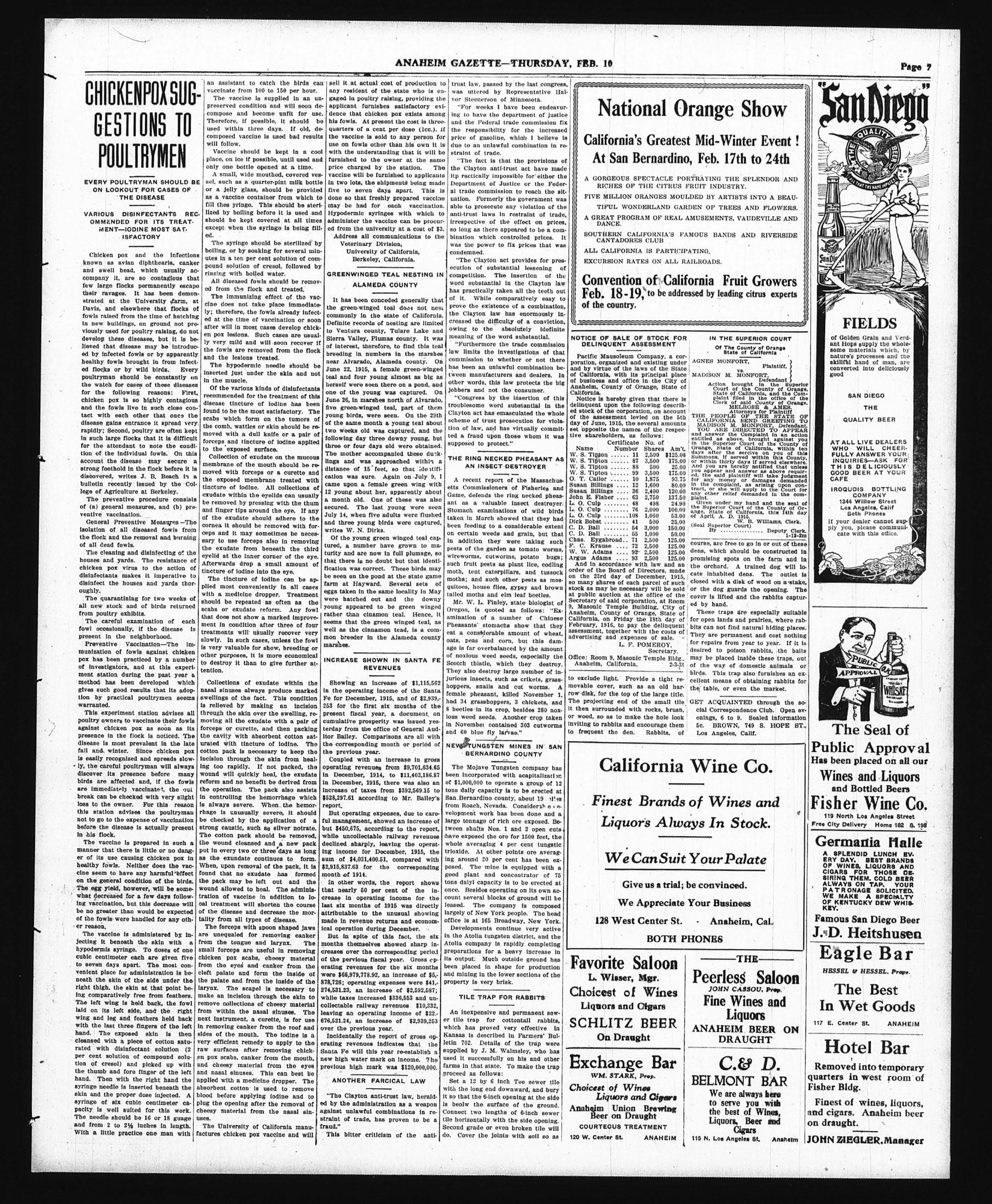
Searchable text
CHICKENPOX SUGGESTIONS TO POULTRYMEN
EVERY POULTRYMAN SHOULD BE ON LOOKOUT FOR CASES OF THE DISEASE
VARIOUS DISINFECTANTS RECOMMENDED FOR ITS TREATMENT—IODINE MOST SATISFACTORY
Chicken pox and the infections known as avian diphthearia, canker and swell head, which usually accompany it, are so contagious that few large flocks permanently escape their ravages. It has been demonstrated at the University farm, at Davis, and elsewhere that flocks of fowls raised from the time of hatching in new buildings, on ground not previously used for poultry raising, do not develop these diseases, but it is believed that disease may be introduced by infected fowls or by apparently healthy fowls brought in from infected flocks or by wild birds. Every poultryman should be constantly on the watch for cases of these diseases for the following reasons: First, chicken pox is so highly contagious and the fowls live in such close contact with each other that once the disease gains entrance it spread very rapidly; Second, poultry are often kept in such large flocks that it is difficult for the attendant to note the condition to catch the birds can vaccinate from 100 to 150 per hour.
The vaccine is supplied in an unpreserved condition and will soon decompose and become unfit for use. Therefore, if possible, it should be used within three days. If old, decomposed vaccine is used bad results will follow.
Vaccine should be kept in a cool place, on ice if possible, until used and only one bottle opened at a time.
A small, wide mouthed, covered vessel, such as a quarter-pint milk bottle or a jelly glass, should be provided as a vaccine container from which to fill the yringe. This should be sterilized by boiling before it is used and should be kept covered at all times except when the syringe is being filled.
The syringe should be sterilized by boiling, or by soaking for several minutes in a ten per cent solution of compound solution of cresol, followed by rinsing with boiled water.
All diseased fowls should be removed from the flock and treated.
The immunizing effect of the vaccine does not take place immediately; therefore, the fowls already infected at the time of vaccination or soon after will in most cases develop chicken pox lesions. Such cases are usually very mild and will soon recover if the fowls are removed from the flock and the lesions treated.
The hypodermic needle should be inserted just under the skin and not in the muscle.
Of the various kinds of disinfectants recommended for the treatment of this disease tincture of iodine has been found to be the most satisfactory. The scabs which form on the tumors of the comb, wattles or skin should be removed with a dull knife or a pair of forceps and tincture of iodine applied to the exposed surface.
sell it at actually any resident gaged in poultry applicant furdence that chick his fowls. At quarters of a the vaccine is use on fowls with the under furnished to price charged vaccine will be in two lots, five to seven done so that may be had Hypodermic administer them ed from the un Address all Veterinary Universi Berke GREENWING ALAM It has been the green-wing commonly in Definite record to Ventura co Sierra Valley, of interest, the breeding in nu near Alvarado June 22, 1915, teal and four herself were se one of the young June 26, in many five green-wing young birds, w of the same me two weeks old following day three or four
by infected fowls or by apparently healthy fowls brought in from infected flocks or by wild birds. Every poultryman should be constantly on the watch for cases of these diseases for the following reasons: First, chicken pox is so highly contagious and the fowls live in such close contact with each other that once the disease gains entrance it spread very rapidly; Second, poultry are often kept in such large flocks that it is difficult for the attendant to note the condition of the individual fowls. On this account the disease may secure a strong foothold in the flock before it is discovered, writes J. B. Beach in a bulletin recently issued by the College of Agriculture at Berkeley.
The preventive procedure consists of (a) general measures, and (b) preventive vaccination.
General Preventive Measures—The isolation of all diseased fowls from the flock and the removal and burning of all dead fowls.
The cleaning and disinfecting of the houses and yards. The resistance of chicken pox virus to the action of disinfectants makes it imperative to disinfect the houses and yards thoroughly.
The quarantining for two weeks of all new stock and of birds returned from poultry exhibits.
The careful examination of each fowl occasionally, if the disease is present in the neighborhood.
Preventive Vaccination—The immunization of fowls against chicken pox has been practiced by a number of investigators, and at this experiment station during the past year a method has been developed which gives such good results that its adoption by practical poultrymen seems warranted.
This experiment station advises all poultry owners to vaccinate their fowls against chicken pox as soon as its presence in the flock is noticed. The disease is most prevalent in the late fall and winter. Since chicken pox is easily recognized and spreads slowly, the careful poultryman will always discover its presence before many birds are affected and, if the fowls are immediately vaccinated, the outbreak can be checked with very slight loss to the owner. For this reason this station advises the poultryman not to go to the expense of vaccination before the disease is actually present in his flock.
The vaccine is prepared in such a manner that there is little or no danger by infected fowls or by apparently healthy fowls brought in from infected flocks or by wild birds. Every poultryman should be constantly on the watch for cases of these diseases for the following reasons: First, chicken pox is so highly contagious and the fowls live in such close contact with each other that once the disease gains entrance it spread very rapidly; Second, poultry are often kept in such large flocks that it is difficult for the attendant to note the condition of the individual fowls. On this account the disease may secure a strong foothold in the flock before it is discovered, writes J. B. Beach in a bulletin recently issued by the College of Agriculture at Berkeley.
The preventive procedure consists of (a) general measures, and (b) preventive vaccination.
General Preventive Measures—The isolation of all diseased fowls from the flock and the removal and burning of all dead fowls.
The cleaning and disinfecting of the houses and yards. The resistance of chicken pox virus to the action of disinfectants makes it imperative to disinfect the houses and yards thoroughly.
The quarantining for two weeks of all new stock and of birds returned from poultry exhibits.
The careful examination of each fowl occasionally, if the disease is present in the neighborhood.
Preventive Vaccination—The immunization of fowls against chicken pox has been practiced by a number of investigators, and at this experiment station during the past year a method has been developed which gives such good results that its adoption by practical poultrymen seems warranted.
This experiment station advises all poultry owners to vaccinate their fowls against chicken pox as soon as its presence in the flock is noticed. The disease is most prevalent in the late fall and winter. Since chicken pox is easily recognized and spreads slowly, the careful poultryman will always discover its presence before many birds are affected and, if the fowls are immediately vaccinated, the outbreak can be checked with very slight loss to the owner. For this reason this station advises the poultryman not to go to the expense of vaccination before the disease is actually present in his flock.
The vaccine is prepared in such a manner that there is little or no danger by infected fowls or by apparently healthy fowls brought in from infected flocks or by wild birds. Every poultryman should be constantly on the watch for cases of these diseases for the following reasons: First, chicken pox is so highly contagious and the fowls live in such close contact with each other that once the disease gains entrance it spread very rapidly; Second, poultry are often kept in such large flocks that it is difficult for the attendant to note the condition of the individual fowls. On this account the disease may secure a strong foothold in the flock before it is discovered, writes J. B. Beach in a bulletin recently issued by the College of Agriculture at Berkeley.
The preventive procedure consists of (a) general measures, and (b) preventive vaccination.
General Preventive Measures—The isolation of all diseased fowls from the flock and the removal and burning of all dead fowls.
The cleaning and disinfecting of the houses and yards. The resistance of chicken pox virus to the action of disinfectants makes it imperative to disinfect the houses and yards thoroughly.
The quarantining for two weeks of all new stock and of birds returned from poultry exhibits.
The careful examination of each fowl occasionally, if the disease is present in the neighborhood.
Preventive Vaccination—The immunization of fowls against chicken pox has been practiced by a number of investigators, and at this experiment station during the past year a method has been developed which gives such good results that its adoption by practical poultrymen seems warranted.
This experiment station advises all poultry owners to vaccinate their fowls against chicken pox as soon as its presence in the flock is noticed. The disease is most prevalent in the late fall and winter. Since chicken pox is easily recognized and spreads slowly, the careful poultryman will always discover its presence before many birds are affected and, if the fowls are immediately vaccinated, the outbreak can be checked with very slight loss to the owner. For this reason this station advises the poultryman not to go to the expense of vaccination before the disease is actually present in his flock.
The vaccine is prepared in such a manner that there is little or no danger by infected fowls or by apparently healthy fowls brought in from infected flocks or by wild birds. Every poultryman should be constantly on the watch for cases of these diseases for the following reasons: First, chicken pox is so highly contagious and the fowls live in such close contact with each other that once the disease gains entrance it spread very rapidly; Second, poultry are often kept in such large flocks that it is difficult for the attendant to note the condition of the individual fowls. On this account the disease may secure a strong foothold in the flock before it is discovered, writes J. B. Beach in a bulletin recently issued by the College of Agriculture at Berkeley.
The preventive procedure consists of (a) general measures, and (b) preventive vaccination.
General Preventive Measures—The isolation of all diseased fowls from the flock and the removal and burning of all dead fowls.
The cleaning and disinfecting of the houses and yards. The resistance of chicken pox virus to the action of disinfectants makes it imperative to disinfect the houses and yards thoroughly.
The quarantining for two weeks of all new stock and of birds returned from poultry exhibits.
The careful examination of each fowl occasionally, if the disease is present in the neighborhood.
Preventive Vaccination—The immunization of fowls against chicken pox has been practiced by a number of investigators, and at this experiment station during the past year a method has been developed which gives such good results that its adoption by practical poultrymen seems warranted.
This experiment station advises all poultry owners to vaccinate their fowls against chicken pox as soon as its presence in the flock is noticed. The disease is most prevalent in the late fall and winter. Since chicken pox is easily recognized and spreads slowly, the careful poultryman will always discover its presence before many birds are affected and, if the fowls are immediately vaccinated, the outbreak can be checked with very slight loss to the owner. For this reason this station advises the poultryman not to go to the expense of vaccination before the disease is actually present in his flock.
The vaccine is prepared in such a manner that there is little or no danger by infected fowls or by apparently healthy fowls brought in from infected flocks or by wild birds. Every poultryman should be constantly on the watch for cases of these diseases for the following reasons: First, chicken pox is so highly contagious and the fowls live in such close contact with each other that once the disease gains entrance it spread very rapidly; Second, poultry are often kept in such large flocks that it is difficult for the attendant to note the condition of the individual fowls. On this account the disease may secure a strong foothold in the flock before it is discovered, writes J. B. Beach in a bulletin recently issued by the College of Agriculture at Berkeley.
The preventive procedure consists of (a) general measures, and (b) preventive vaccination.
General Preventive Measures—The isolation of all diseased fowls from the flock and the removal and burning of all dead fowles.
The cleaning and disinfecting of the houses and yards. The resistance of chicken pox virus to the action of disinfectants makes it imperative to disinfectthe houses and yards thoroughly.
The quarantining for two weeks of all new stock and of birds returned from poultry exhibits.
The careful examination of each fowl occasionally, if the disease is present in the neighborhood.
Preventive Vaccination—The immunization of fowls against chicken pox has been practiced by a number of investigators, and at this experiment station during the past year a method has been developed which gives such good results that its adoption by practical poultrymen seems warranted.
This experiment station advises all poultry owners to vaccinate their fowls against chicken pox as soon as its presence in the flock is noticed. The disease is most prevalent in the late fall and winter. Since chicken pox is easily recognized and spreads slowly, the careful poultryman will always discover its presence before many birds are affected and, if the fowls are immediately vaccinated, the outbreak can be checked with very slight loss to the owner. For this reason this station advises them poultrymen seem warranted.
This experiment station advises all poultry owners to vaccinate their fowls against chicken pox as soon as its presence in the flock is noticed. The disease is most prevalent in the late fall and winter. Since chicken pox is easily recognized and spreads slowly, the careful poultryman will always discover its presence before many birds are affected and, if they fowls are immediately vaccinated, they outbreak can be checked with very slight loss to their owner. For this reason this station advises them poultrymen seem warranted.
This experiment station advises all poultry owners to vaccinate their fowls against chicken pox as soon as its presence in the flock is noticed. The disease is most prevalent in the late fall and winter. Since chicken pox is easily recognized and spreads slowly, they outbreak can be checked with very slight loss to their owner. For this reason this station advises them poultrymen seem warranted.
This experiment station advises all poultry owners to vaccinate their fowls against chicken pox as soon as its presence in th...
is easily recognized and spreads slowly, the careful poultryman will always discover its presence before many birds are affected and, if the fowls are immediately vaccinated, the out break can be checked with very slight loss to the owner. For this reason this station advises the poultryman not to go to the expense of vaccination before the disease is actually present in his flock.
The vaccine is prepared in such a manner that there is little or no danger of its use causing chicken pox in healthy fowls. Neither does the vaccine seem to have any harmful effect on the general condition of the birds. The egg yield, however, will be somewhat decreased for a few days following vaccination, but this decrease will be no greater than would be expected of the fowls were handled for any other reason.
The vaccine is administered by injecting it beneath the skin with a hypodermis syringe. To doses of one cubic centimeter each are given five to seven days apart. The most convenient place for administration is beneath the skin of the side under the right thigh, the skin at that point being comparatively free from feathers. The left wing is held back, the fowl laid on its left side, and the right wing and leg and feathers held back with the last three fingers of the left hand. The exposed skin is then cleansed with a piece of cotton saturated with disinfectant solution (2 per cent solution of compound solution of cresol) and picked up with the thumb and fore finger of the left hand. Then with the right hand the syringe needle is inserted beneath the skin and the proper dose injected. A syringe of six cubic centimeter capacity is well suited for this work. The needle should be 16 or 18 guage and from 2 to 2½ inches in length. With a little practice one man with incision through the skin from healing too rapidly. If not packed, the wound will quickly heal, the exudate reform and no benefit be derived from the operation. The pack also assists in controlling the hemorrhage which is always severe. When the hemorrhage is unusually severe, it should be checked by the application of a strong caustic, such as silver notrate. The cotton pack should be removed, the wound cleansed and a new pack put in every two or three days as long as the exudate continues to form. When, upon removal of the pack, it is found that no exudate has formed the pack may be left out and the wound allowed to heal. The administration of vaccine in addition to local treatment will shorten the course of the disease and decrease the mortality from all types of disease.
The forceps with spoon shaped jaws are unequalled for removing canker from the tongue and larynx. The small forceps are useful in removing chicken pox scabs, cheesy material from the eyes and canker from the cleft palate and form the inside of the palate and from the inside of the larynx. The scapel is necessary to make an incision through the skin to remove collections of cheesy material from within the nasal sinuses. The next instrument, a curette, is for use in removing canker from the roof and sides of the mouth. The iodine is a very efficient remedy to apply to the raw surfaces after removing chicken pox scabs, canker from the mouth, and cheesy material from the eyes and nasal sinuses. This can best be applied with a medicine dropper. The absorbent cotton is used to remove blood before applying iodine and to plug the opening after the removal of cheesy material from the nasal sinuses.
The University of California manufactures chicken pox vaccine and will
Coupled with operating revenue in December, in December, an increase of tax $528,297.61 account report.
But operating ful management but $450,675, while uncollectively declined sharply income for sum of $4,031,429,155,837.63 for month of 1914.
In other words that nearly 50 percent increase in operations attributable to made in revenueical operation did.
But in spite months themselves creases over the of the pervious erating revenues were $66,979,778,878,726; operating 274,531.23, an while taxes increase collectable railway leaving an open 676,521.24, an over the previous Incidentally this erating revenues Santa Fe will this new high water previous high m
ANAHEIM GAZETTE—THURSDAY, FEB. 10
National Orang
California’s Greatest M
At San Bernardino, I
A GORGEOUS SPECTACLE PORTR
RICHES OF THE CITRUS FRUIT
FIVE MILLION ORANGES MOULDED
TIFUL WONDERLAND GARDEN
A GREAT PROGRAM OF REAL AMUSE
DANCE.
SOUTHERN CALIFORNIA’S FAMOUS
CANTADORES CLUB
ALL CALIFORNIA IS PARTICIPATING
EXCURSION RATES ON ALL RAILROAD
Convention of California
Feb. 18-19, to be addressed
of the country.
NOTICE OF SALE OF STOCK FOR DELINQUENT ASSESSMENT
Pacific Mausoleum Company, a corporation, organized and existing under and by virtue of the laws of the State of California, with its principal place of business and office in the City of Anaheim, County of Orange, State of California.
Notice is hereby given that there is delinquent upon the following described stock of the corporation, on account of the assessment levied on the 5th day of June, 1915, the several amounts set opposite the names of the respective shareholders, as follows:
Certificate No. of Name Number Shares Amount
INCREASE SHOWN IN SANTA FE REVENUES
Showing an increase of $1,115,562 in the operating income of the Santa Fe for December, 1915, and of $2,939,253 for the first six months of the present fiscal year, a document on cumulative prosperity was issued yesterday from the office of General Auditor Bailey. Comparisons are all with the corresponding month or period of the previous year.
Coupled with an increase in gross operating revenues from $9,701,634.65 in December, 1914, to $11,403,186.87 in December, 1915, there was also an increase of taxes from $392,569.15 to $528,297.61 according to Mr. Bailey's report.
But operating expenses, due to careful management, showed an increase of but $450,675, according to the report, while uncollectable railway revenues declined sharply, leaving the operating income in December, 1915.
THE RING NECKED PHEASANT AS AN INSECT DESTROYER
A recent report of the Massachusetts Commissioners of Fisheries and Game, defends the ring necked pheasant as a valuable insect destroyer. Stomach examinations of wild birds taken in March showed that they had been feeding to a considerable extent on certain weeds and grain, but that in addition they were taking such pests of the garden as tomato worms, wireworms, cutworms, potato bugs; such fruit pests as plant lice, codling moth, tent caterpillars, and tussock moths; and such other pests as mosquitoes, house flies, gypsy and brown tailed moths and elm leaf beetles.
Mr. W. L. Finley, state biologist of Oregon, is quoted as follows: "Examination of a number of Chinese Pheasants' stomachs show that they eat a considerable amount of wheat, oats, peas and corn, but this damage is far overbalanced by the amount of noxious weed seeds, especially the Scotch thistle, which they destroy. They also destroy large number of injurious insects, such as crickets, grasshoppers, snails and cut worms. A female pheasant, killed November 1, had 34 grasshoppers, 3 chickets, and 8 beetles in its crop, besides 280 noxious weed seeds. Another crop taken in November contained 303 cutworms and 60 blue fly larvae."
NEW TUNGSTEN MINES IN SAN BERNARDINO COUNTY
The Mojave Tungsten company has been incorporated with acapitalization of $1,000,000 to operate a group of 12 tons daily capacity to be erected at San Bernardino county, about 19 miles from Roach, Nevada. Considerable development work has been done and a large tonnage of rich ore exposed. Between shafts Nos. 1 and 2 open cuts have exposed the ore for 1500 feet, the whole averaging 4 per cent tungstic triloxide. At another point the commission to whether or not there has been an unlawful combination between manufacturers and dealers. In other words, this law protects the big jobbers and not the consumer.
"Congress by the insertion of this troublesome word substantial in the Clayton act has emasculated the whole scheme of trust prosecution for violation of law, and has virtually committed a fraud upon those whom it was supposed to protect."
Pacific Mausoleum Company, a corporation, organized and existing under and by virtue of the laws of the State of California, with its principal place of business and office in the City of Anaheim, County of Orange, State of California.
Notice is hereby given that there is delinquent upon the following described stock of the corporation, on account of the assessment levied on the 5th day of June, 1915, the several amounts set opposite the names of the respective shareholders, as follows:
| Certificate | No. of Name | Number | Shares | Am't |
| :--- | :--- | :--- | :--- | :--- |
| W. S. Tipton | ... | 11 | 2,500 | $125.00 |
| W. S. Tipton | ... | 87 | 3,500 | 175.00 |
| W. S. Tipton | ... | 88 | 500 | 25.00 |
| W. S. Tipton | ... | 99 | 3,500 | 175.00 |
| O. T. Callor | ... | 10 | 1,875 | 93.75 |
| Susan Billings | ... | 12 | 1,600 | 80.00 |
| Susan Billings | ... | 36 | 2,400 | 120.00 |
| John E. Fisher | ... | 63 | 2,750 | 137.50 |
| L. O. Culp | ... | 48 | 498 | 24.90 |
| L. O. Culp | ... | 76 | 2,000 | 100.00 |
| L. O. Culp | ... | 108 | 1,060 | 53.00 |
| Dick Bobst | ... | 41 | 500 | 25.00 |
| C. D. Ball | ... | 54 | 3,000 | 150.00 |
| C. D. Ball | ... | 55 | 1,000 | 50.00 |
| Chas. Eygabroad | ... | 71 | 2,500 | 125.00 |
| F. C. Krause | ... | 72 | 2,500 | 125.00 |
| W. W. Adams | ... | 92 | 2,500 | 125.00 |
| Argus Adams | ... | 93 | 2,500 | 125.00 |
And in accordance with law and an order of the Board of Directors, made on the 23rd day of December, 1915, so many shares of each parcel of such stock as may be necessary will be sold at public auction at the office of the Secretary of said corporation, at Room 9, Masonic Temple Building, City of Anaheim, County of Orange, State of California, on Friday the 18th day of February, 1916, to pay the delinquent assessment, together with the costs of advertising and expenses of sale.
L. F. POMEROY,
Secretary.
Office: Room 9, Masonic Temple Bldg., Anaheim, California.
2-3-3t
to exclude light. Provide a tight removable cover, such as an old harrow disk, for the top of the large title.
The projecting end of the small tile it then surrounded with rocks, brush, or wood, so as to make the hole look inviting to rabbits and encourage them to frequent the den. Rabbitts,
California Vine
Finest Brands of
Liquors Always
Coupled with an increase in gross operating revenues from $9,701,634.65 in December, 1914, to $11,403,186.87 in December, 1915, there was also an increase of taxes from $392,569.15 to $528,297.61 according to Mr. Bailey's report.
But operating expenses, due to careful management, showed an increase of but $450,675, according to the report, while uncollectable railway revenues declined sharply, leaving the operating income for December, 1915, the sum of $4,031,400.51, compared with $2,915,837.63 for the corresponding month of 1914.
In other words, the report shows that nearly 50 per cent of the increase in operating income for the last six months of 1915 was directly attributable to the unusual showing made in revenue returns and economical operation during December.
But in spite of this fact, the six months themselves showed sharp increases over the corresponding period of the pervious fiscal year. Gross operating revenues for the six months were $66,979,778.92, an increase of $5,878,726; operating expenses were $41,274,531.23, an increase of $2,592,587; while taxes increased $336,553 and uncollectable railway revenues $10,332, leaving an operating income of $22,676,521.24, an increase of $2,939,253 over the previous year.
Incidentally the report of gross operating revenues indicates that the Santa Fe will this year re-establish a new high water mark on income. The previous high mark was $120,000,000.
ANOTHER FARCICAL LAW
"The Clayton anti-trust law, heralded by the administration as a weapon against unlawful combinations in restraint of trade, has proven to be a fraud."
This bitter criticism of the anti-
The Mojave Tungsten company has been incorporated with acapitalization of $1,000,000 to operate a group of 12 tons daily capacity is to be erected at San Bernardino county, about 19 miles from Roach, Nevada. Considerable development work has been done and a large tonnage of rich ore exposed. Between shafts Nos. 1 and 2 open cuts have exposed the ore for 1500 feet, the whole averaging 4 per cent tungstic trioxide. At other points ore averaging around 20 per cent has been exposed. The mine is equipped with a good plant and concentrator of 75 tons daily capacity is to be erected at once. Besides operating on its own account several blocks of ground will be leased. The company is composed largely of New York people. The head office is at 165 Broadway, New York.
Developments continue very active in the Atolla tungsten district, and the Atolia company is rapidly completing preparations for a heavy increase in its output: Much outside ground has been placed in shape for production and mining in the lower sections of the property is very brisk.
TILE TRAP FOR RABBITS
An inexpensive and permanent sewer tile trap for cottontail rabbits, which has proved very effective in Kansas is described in Farmers' Bulletin 702. Details of the trap were supplied by J. M. Walmsley, who has used it successfully on his and other farms in that state. To make the trap proceed as follows:
Set a 12 by 6 inch Tee sewer tile with the long end downward, and bury it so that the 6-inch opening at the side is beolw the surface of the ground. Connect two lengths of 6-inch sewer tile horizontally with the side opening. Second grade or even broken tile will do. Cover the joints with soil so as
National Orange Show
California's Greatest Mid-Winter Event!
San Bernardino, Feb. 17th to 24th
US SPECTACLE PORTRAYING THE SPLENDOR AND
THE CITRUS FRUIT INDUSTRY.
ORANGES MOULDED BY ARTISTS INTO A BEAUWONDERLAND GARDEN OF TREES AND FLOWERS.
PROGRAM OF REAL AMUSEMENTS, VAUDEVILLE AND
CALIFORNIA'S FAMOUS BANDS AND RIVERSIDE
DORES CLUB
CALIFORNIA IS PARTICIPATING.
RATES ON ALL RAILROADS.
Action of California Fruit Growers
- 19, to be addressed by leading citrus experts
country.
LE OF STOCK FOR
ASSESSMENT
IN THE SUPERIOR COURT
Of The County of Orange
State of California
AGNES MONFORT,
Plaintiff,
vs.
MADISON M. MONFORT,
Defendant
Action brought in the Superior
Court of the County of Orange,
State of California, and the Complainant filed in the office of the
Clerk of said County of Orange,
MELROSE & AMES.
Attorneys for Plaintiff
THE PEOPLE OF THE STATE OF
CALIFORNIA SEND GREETING TO
MADISON M. MONFORT, Defendant.
YOU ARE DIRECTED TO APPEAR
and answer the Complaint in an action
entitled as above, brought against you
in the Superior Court of the County of
Orange, State of California, within ten
FIELDS
of Golden Grain and Verdant Hops supply the wholesome materials which, by nature's processes and the skillful hand of man, are converted into deliciously good
SAN DIEGO
THE
QUALITY BEER
AT ALL LIVE DEALERS WHO WILL CHEER
AGNES MONFORT,
Plaintiff,
vs.
MADISON M. MONFORT,
Defendant
Action brought in the Superior Court of the County of Orange, State of California, and the Complaint filed in the office of the Clerk of said County of Orange, MELROSE & AMES.
Attorneys for Plaintiff
THE PEOPLE OF THE STATE OF CALIFORNIA SEND GREETING TO MADISON M. MONFORT, Defendant. YOU ARE DIRECTED TO APPEAR and answer the Complaint in an action entitled as above, brought against you in the Superior Court of the County of Orange, State of California, within ten days after the servee on your of this Summons, if served within this County, or within thirty days if served elsewhere. And you are hereby notified that unless you appear and answer as above required, the said plaintiff will take judgment for any money or damages demanded in the complaint, as arising upon contract, or she will apply to the Court for any other relief demanded in the complaint.
Given under my hand and the seal of the Superior Court of the County of Orange, State of California, this 14th day of April, A. D. 1915.
W. B. Williams, Clerk.
(Seal Superior Court)
By ... Deputy Clerk.
1-13-2m
course, are free to go in or out of these dens, which should be constructed in promising spots on the farm and in the orchard. A trained dog will locate inhabited dens. The outlet is closed with a disk of wood on a stake, or the dog guards the opening. The cover is lifted and the rabbits captured by hand.
These traps are especially suitable for open lands and prairies, where rabbits can not find natural hiding places. They are permanent and cost nothing for repairs from year to year. If it is desired to poison rabbits, the baits may be placed inside these traps, out of the way of domestic animals or birds. This trap also furnishes an excellent means of obtaining rabbits for the table, or even the market.
GET ACQUAINTED through the social Correspondence Club. Open evenings, 6 to 9. Sealed information 5c. BROWN, 749 S. HOPE ST., Los Angeles, Calif.
The Seal of Public Approval Has been placed on all our Wines and Liquors and Bottled Beers
Fisher Wine Co.
119 North Los Angeles Street
Free City Delivery Home 182 S. 198
Germania Halle
California Wine Co.
Best Brands of Wines and Liquors Always In Stock.
We Can Suit Your Palate
Give us a trial; be convinced.
We Appreciate Your Business
West Center St. Anaheim, Cal.
BOTH PHONES
The Saloon
er, Mgr.
of Wines
and Cigars
TZ BEER
draught
The Peerless Saloon
JOHN CASSOU, Prop.
Fine Wines and Liquors
ANAHEIM BEER ON DRAUGHT
C. & D.
BELMONT BAR
We are always here to serve you with the best of Wines, Liquors, Beer and Cigars
115 N. Los Angeles St. Anaheim
Has been placed on all our
Wines and Liquors
and Bottled Beers
Fisher Wine Co.
119 North Los Angeles Street
Free City Delivery Home 182 S. 198
Germania Halle
A splendid LUNCH EVERY DAY. BEST BRANDS OF WINES, LIQUORS AND CIGARS FOR THOSE DESIRING THEM. COLD BEER ALWAYS ON TAP. YOUR PATRONAGE SOLICITED. WE MAKE A SPECIALTY OF KENTUCKY DEW WHISKEY.
Famous San Diego Beer
J.D. Heitshusen
Eagle Bar
HESSEL & HESSEL, Props.
The Best In Wet Goods
117 E. Center St. ANAHEIM
Hotel Bar
Removed into temporary quarters in west room of Fisher Bldg.
Finest of wines, liquors, and cigars. Anaheim beer on draught.
JOHN ZIEGLER, Manager