anaheim-gazette 1916-02-10
Scanned page
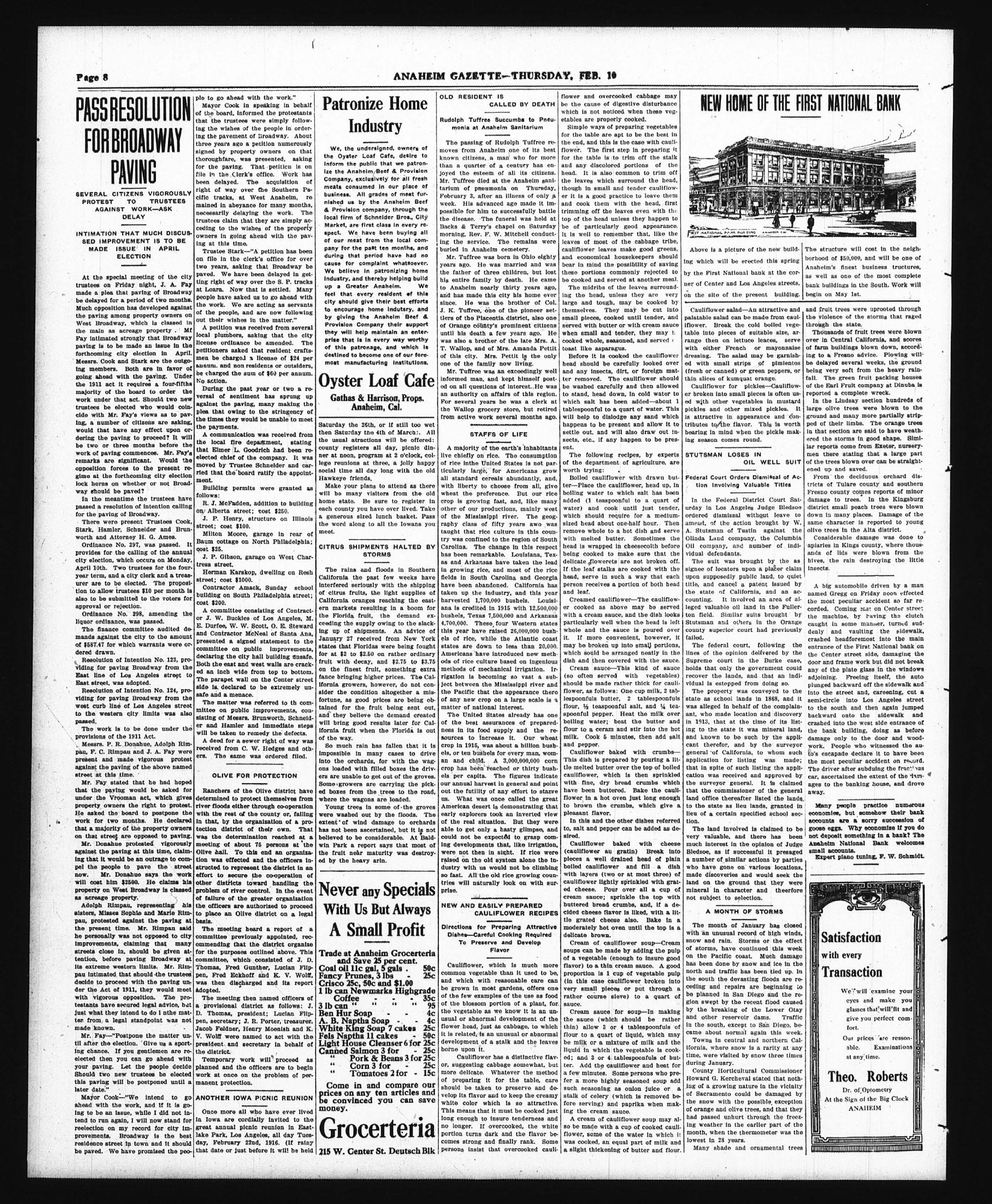
Searchable text
PASS RESOLUTION FOR BROADWAY PAVING
SEVERAL CITIZENS VIGOROUSLY PROTEST TO TRUSTEES AGAINST WORK—ASK DELAY
INTIMATION THAT MUCH DISCUSSED IMPROVEMENT IS TO BE MADE ISSUE IN APRIL ELECTION
At the special meeting of the city trustees on Friday night, J. A. Fay made a plea that paving of Broadway be delayed for a period of two months. Much opposition has developed against the paving among property owners on West Broadway, which is classed in the main as acreage property. Mf Fay intimated strongly that Broadway paving is to be made an issue in the forthcoming city election in April. Messrs. Cook and Stark are the outgoing members. Both are in favor of going ahead with the paving. Under the 1911 act it requires a four-fifths majority of the board to order the work under that act. Should two new trustees be elected who would coincide with Mr. Fay's views as to paving, a number of citizens are asking, would that have any effect upon ordering the paving to proceed? It will be two or three months before the people to go ahead with the work."
Mayor Cook in speaking in behalf of the board, informed the protestants that the trustees were simply following the wishes of the people in ordering the pavement of Broadway. About three years ago a petition numerously signed by property owners on that thoroughfare, was presented, asking for the paving. That petition is on file in the Clerk's office. Work has been delayed. The acquisition of right of way over the Southern Pacific tracks, at West Anaheim, remained in abeyance for many months, necessarily delaying the work. The trustees claim that they are simply acceding to the wishes of the properly owners in going ahead with the paving at this time.
Trustee Stark—"A petition has been on file in the clerk's office for over two years, asking that Broadway be paved. We have been delayed in getting right of way over the S. P. tracks at Loara. Now that is settled. Many people have asked us to go ahead with the work. We are acting as servants of the people, and are now following out their wishes in the matter."
A petition was received from several local plumbers, asking that the city license ordinance be amended. The petitioners asked that resident craftsmen be charged a license of $24 per annum, and non residents or outsiders, be charged the sum of $60 per annum. No action.
During the past year or two a reversal of sentiment has sprung up against the paving, many making the plea that owing to the stringency of the times they would be unable to meet the payments.
A communication was received from the local fire department, stating that Filmer Goodrich had no
fortcoming city election in April.
Messrs. Cook and Stark are the outgoing members. Both are in favor of going ahead with the paving. Under the 1911 act it requires a four-fifths majority of the board to order the work under that act. Should two new trustees be elected who would coincide with Mr. Fay's views as to paving, a number of citizens are asking, would that have any effect upon ordering the paving to proceed? It will be two or three months before the work of paving commences. Mr. Fay's remarks are significant. Would the opposition forces to the present regime at the forthcoming city election lock horns on whether or not Broadway should be paved?
In the meantime the trustees have passed a resolution of intention calling for the paving of Broadway.
There were present Trustees Cook, Stark, Hamler, Schneider and Brunworth and Attorney H. G. Ames.
Ordinance No. 297, was passed. It provides for the calling of the annual city election, which occurs on Monday, April 10th. Two trustees for the four-year term, and a city clerk and a treasurer are to be elected. The proposition to allow trustees $10 per month is also to be submitted to the voters for approval or rejection.
Ordinance No. 298, amending the liquor ordinance, was passed.
The finance committee audited demands against the city to the amount of $587.47 for which warrants were ordered drawn.
Resolution of Intention No. 123, providing for paving Broadway from the East line of Los Angeles street to East street, was adopted.
Resolution of Intention No. 124, providing for paving Broadway from the west curb line of Los Angeles street to the western city limits was also passed.
The work is to be done under the provisions of the 1911 Act.
Messrs. P. R. Donahue, Adolph Rimpau, F. C. Rimpau and J. A. Fay were present and made vigorous protest against the paving of the above named street at this time.
Mr. Fay stated that he had hoped that the paving would be asked for under the Vrooman act, which gives property owners the right to protest. He asked the board to postpone the work for two months. He declared that a majority of the property owners on that street are opposed to paving.
Mr. Donahue protested vigorously against the paving at this time.
OLIVE FOR PROTECTION
Ranchers of the Olive district have determined to protect themselves from river floods either through co-operation with the rest of the county or, falling in that, by the organization of a protection district of their own. That was the determination reached at a meeting of about 75 persons at the men be charged a license of $24 per annum, and non residents or outsiders, be charged the sum of $60 per annum. No action.
During the past year or two a reversal of sentiment has sprung up against the paving, many making the plea that owing to the stringency of the times they would be unable to meet the payments.
A communication was received from the local fire department, stating that Elmer L. Goodrich had been rejected chief of the company. It was moved by Trustee Schneider and carried that the board ratify the appointment.
Building permits were granted as follows:
R. J. McFadden, addition to building on Alberta street; cost $250.
J. P. Henry, structure on Illinois street; cost $100.
Milton Moore, garage in rear of Baum cottage on North Philadelphia; cost $25.
J. P. Gibson, garage on West Char-tress street.
Herman Karskop, dwelling on Resh street; cost $1000.
Contractor Amack, Sunday school building on South Philadelphia street; cost $200.
A committee consisting of Contractor J. W. Buckles of Los Angeles, M. E. Durfee, W. W. Scott, O. E. Steward and Contractor McNeal of Santa Ana, presented a signed statement to the committee on public improvements, declaring the city hall building unsafe. Both the east and west walls are cracked an inch wide from top to bottom. The parapet wall on the Center street side is declared to be extremely unsafe and a menace.
The matter was referred to th committee on public improvements, consisting of Messrs. Brunworth, Schneider and Hamler and immediate steps will be taken to remedy the defects.
A deed for a sewer right of way was received from C. W. Hedges and others. The same was ordered filed.
Saturday the 26th then Saturday that the usual attractive county registers ner at noon, proge le reunions at social time all day Hawkeye friends.
Make your plan will be many v home state. Be each county you u generous sized the word along t meet.
CITRUS SHIPMENT STORE
The rains and California the pr interfered serious of citrus fruits, California orange err markets resi Florida fruit ceeding the supplying up of shipm January 27 receive states that Florida for at $2 to $2.5 fruit with decay on the finest france bringing his lifornia growers, sider the condition fortune, as good tained for the f and they believe will bring good lifornia fruit whef of the way.
So much rain impossible in m into the orchard ons loaded with ers are unable to Some growers ar ed boxes from th where the wagon Young trees in were washed out extent'of wind has not been ascie believed to be co win Park a repo
Mr. Fay stated that he had hoped that the paving would be asked for under the Vrooman act, which gives property owners the right to protest. He asked the board to postpone the work for two months. He declared that a majority of the property owners on that street are opposed to paving.
Mr. Donahue protested vigorously against the paving at this time, claiming that it would be an outrage to compel the people to pave the street now. Mr. Donahue says the work will cost him $2500. He claims his property on West Broadway is classed as acreage property.
Adolph Rimpau, representing his sisters, Misses Sophie and Marie Rimpau, protested against the paving at the present time. Mr. Rimpau said he personally was not opposed to city improvements, claiming that many streets close in, should be given attention, before paving Broadway at its extreme western limits. Mr. Rimpau intimated that should the trustees decide to proceed with the paving under the Act of 1911, they would meet with vigorous opposition. The protestants have secured legal advice, but just what they intend to do in the matter from a legal standpoint was not made known.
Mr. Fay—"Postpone the matter until after the election. Give us a sporting chance. If you gentlemen are re-elected then you can go ahead with your paving. Let the people decide Should two new trustees be elected this paving will be postponed until a later date."
Mayor Cook—"We intend to go ahead with the work, and if it is going to be an issue, while I did not intend to run again, I will now stand for reelection on my record for city improvements. Broadway is the best residence street in town and it should be paved. We have promised the peo-
OLIVE FOR PROTECTION
Ranchers of the Olive district have determined to protect themselves from river floods either through co-operation with the rest of the county or, failing in that, by the organization of a protection district of their own. That was the determination reached at a meeting of about 75 persons at the Olive hall. To this end an organization was effected and the officers instructed to represent the district in an effort to secure the co-operation of other districts toward handling the problem of river control. In the event of failure of the greater organization the officers are authorized to proceed to place an Olive district on a legal basis.
The meeting heard a report of a committee previously appointed, recommending that the district organize for the purposes outlined above. This committee, which consisted of J. D. Thomas, Fred Gunther, Lucian Flippen, Fred Eckhoff and K. V. Wolff, was then discharged and its report adopted.
The meeting then named officers of a provisional district as follows: J. D. Thomas, president; Lucian Flippen, secretary; J. R. Porter, treasurer. Jacob Feldner, Henry Moenish and K. V. Wolff were named to act with the president and secretary in behalf of the district.
Temporary work will proceed as planned and the officers are to begin work at once on the problem of permanent protection.
ANOTHER IOWA PICNIC REUNION
Once more all who have ever lived in Iowa are cordially invited to the great annual picnic reunion in East-lake Park, Los Angeles, all day Tuesday, February 22nd, 1916. (If rainy that date or just before it will be held
ANAHEIM GAZETTE—THURSDAY, FEB. 10
Patronize Home Industry
We, the undersigned, owners of the Oyster Loaf Cafe, desire to inform the public that we patronize the Anaheim Beef & Provision Company, exclusively for all fresh meats consumed in our place of business. All grades of meat furnished us by the Anaheim Beef & Provision company, through the local firm of Schneider Bros., City Market, are first class in every respect. We have been buying all of our meat from the local company for the past ten months, and during that period have had no cause for complaint whatsoever. We believe in patronizing home industry, and thereby helping build up a Greater Anaheim. We feel that every resident of this city should give their best efforts to encourage home indusry, and by giving the Anaheim Beef & Provision Company their support they will help maintain an enterprise that is in every way worthy of this patronage, and which is destined to become one of our foremost manufacturing institutions.
Oyster Loaf Cafe
Gathas & Harrison, Props. Anaheim, Cal.
Saturday the 26th, or if still too wet then Saturday the 4th of March). All the usual attractions will be offered: county registers all day, picnic dinners.
OLD RESIDENT IS
CALLED BY DEATH
Rudolph Tuffree Succumbs to Pneumonia at Anaheim Sanitarium
The passing of Rudolph Tuffree removes from Anaheim one of its best known citizens, a man who for more than a quarter of a century has enjoyed the esteem of all its citizens. Mr. Tuffree died at the Anaheim sanitarium of pneumonia on Thursday, February 3, after an illness of only a week. His advanced age made it impossible for him to successfully battle the disease. The funeral was held at Backs & Terry's chapel on Saturday morning, Rev. F. W. Mitchell conducting the service. The remains were buried in Anaheim cemetery.
Mr. Tuffree was born in Ohio eighty years ago. He was married and was the father of three children, but lost his entire family by death. He came to Anaheim nearly thirty years ago, and has made this city his home ever since. He was the brother of Col. J. K. Tuffree, one of the pioneer settlers of the Placentia district, also one of Orange County's prominent citizens until his death a few years ago. He was also a brother of the late Mrs. A. T. Wallop, and of Mrs. Amanda Pettit of this city. Mrs. Pettit is the only one of the family now living.
Mr. Tuffree was an exceedingly well informed man, and kept himself posted on all questions of interest. He was an authority on affairs of this region. For several years he was a clerk at the Wallop grocery store, but retired from active work several months ago.
STAFFS OF LIFE
A majority of the earth's inhabitants flower and overcooked cabbage may be the cause of digestive disturbance which is not noticed when these vegetables are properly cooked.
Simple ways of preparing vegetables for the table are apt to be the best in the end, and this is the case with cauliflower. The first step in preparing it for the table is to trim off the stalk and any discolored portions of the head. It is also common to trim off the leaves which surround the head, though in small and tender cauliflower it is a good practice to leave them and cook them with the head, first trimming off the leaves even with the top of the head unless they happen to be particularly good appearance. It is well to remember that, like the leaves of most of the cabbage tribe, cauliflower leaves make good greens, and economical housekeepers should bear in mind the possibility of saving these portions commonly rejected to be cooked and served at another meal.
The midribs of the leaves surrounding the head, unless they are very large and tough, may be cooked by themselves. They may be cut into small pieces, cooked until tender, and served with butter or with cream sauce when small and tender, they may be cooked whole, seasoned, and served toast like asparagus.
Before it is cooked the cauliflower head should be carefully looked over and any insects, dirt, or foreign matter removed. The cauliflower should be washed carefully and then allowed to stand, head down, in cold water to which salt has been added—about 1 tablespoonful to a quart of water. This will help to dislodge any sand which happens to be present and allow it to settle out, and will also draw out insects, etc., if any happen to be present.
Saturday the 26th, or if still too wet then Saturday the 4th of March. All the usual attractions will be offered: county registers all day, picnic dinner at noon, program at 2 o'clock, college reunions at three, a jolly happy social time all day long with the old Hawkeye friends.
Make your plans to attend as there will be many visitors from the old home state. Be sure to register in each county you have ever lived. Take a generous sized lunch basket. Pass the word along to all the lowans you meet.
CITRUS SHIPMENTS HALTED BY STORMS
The rains and floods in Southern California the past few weeks have interfered seriously with the shipping of citrus fruits, the light supplies of California oranges reaching the eastern markets resulting in a boom for the Florida fruit, the demand exceeding the supply owing to the slacking up of shipments. An advice of January 27 received from New York states that Floridas were being fought for at $2 to $2.50 on rather ordinary fruit with decay, and $2.75 to $3.75 on the finest fruit, something extra fance bringing higher prices. The California growers, however, do not consider the condition altogether a misfortune, as good prices are being obtained for the fruit being sent out, and they believe the demand created will bring good results later for California fruit when the Florida is out of the way.
So much rain has fallen that it is impossible in many cases to drive into the orchards, for with the wagons loaded with filled boxes the drivers are unable to get out of the groves. Some growers are carrying the picked boxes from the trees to the road, where the wagons are loaded.
Young trees in some of the groves were washed out by the floods. The extent of wind damage to orchards has not been ascertained, but it is not believed to be considerable. At Baldwin Park a report says that most of this city. Mrs. Pettit is the only one of the family now living.
Mr. Tuffree was an exceedingly well informed man, and kept himself posted on all questions of interest. He was an authority on affairs of this region. For several years he was a clerk at the Wallop grocery store, but retired from active work several months ago.
STAFFS OF LIFE
A majority of the earth's inhabitants live chiefly on rice. The consumption of rice in the United States is not particularly large, for Americans grow all standard cereals abundantly, and, with liberty to choose from all, give wheat the preference. But our rice crop is growing fast, and, like many other of our productions, mainly west of the Mississippi river. The geography class of fifty years awa was taught that rice culture in this country was confined to the region of South Carolina. The change in this respect has been remarkable. Louisiana, Texas and Arkansas have taken the lead in growing rice, and most of the rice fields in South Carolina and Georgia have been abandoned. California has taken up the industry, and this year harvested 1,700,000 bushels. Louisiana is credited in 1915 with 12,500,000 bushels, Texas 7,500,000 and Arkansas 4,700,000. These four Western states this year have raised 26,000,000 bushels of rice, while the Atlantic coast states are down to less than 20,000. Americans have introduced new methods of rice culture based on ingenious methods of mechanical irrigation. Irrigation is becoming so vast a subject between the Mississippi river and the Pacific that the appearance thereof any new crop on a large scale is a matter of national interest.
The United States already has one of the best assurances of preparedness in its food supply and the resources to increase it. Our wheat crop in 1915, was about a billion bushels, or ten bushels for every man, woman and child. A 3,000,000,000 corn crop has been reached or thirty bushels per capita. The figures indicate our annual harvest in general and point out the futility of any effort to starve us. What was once called the great American desert is demonstrating that early explorers took an inverted view of the real situation. But they were able to get only a hasty glimpse, and could not be expected to grasp coming developments that, like irrigation,
Before it is cooked the cauliflower head should be carefully looked over and any insects, dirt, or foreign matter removed. The cauliflower should be washed carefully and then allowed to stand, head down, in cold water to which salt has been added—about 1 tablespoonful to a quart of water. This will help to dislodge any sand which happens to be present and allow it to settle out, and will also draw out insects, etc., if any happen to be present.
The following recipes, by experts of the department of agriculture, are worth trying:
Boiled cauliflower with drawn butter—Place the cauliflower, head up, in boiling water to which salt has been added (1 teaspoonful to a quart of water) and cook until just tender, which should require for a medium-sized head about one-half hour. Then remove whole to a hot dish and serve with melted butter. Sometimes the head is wrapped in cheesecolth before being cooked to make sure that the delicate flowerets are not broken off. If the leaf stalks are cooked with the head, serve in such a way that each person receives a portion of both head and leaf.
Creamed cauliflower—The cauliflower cooked as above may be served with a cream sauce, and the dish looks particularly well when the head is left whole and the sauce is poured over it. If more convenient, however, it may be broken up into small portions, which would be arranged neatly in the dish and then covered with the sauce.
Cream sauce—This kind of sauce (so often served with vegetables) should be made rather thick for cauliflower, as follows: One cup milk, 2 tablespoonful butter, 2 tablespoonful flour, ½ teaspoonful salt, and¼ teaspoonful pepper. Heat the milk over boiling water; beat the butter and flour to a ceram and stir into the hot milk. Cook 5 minutes, then add salt and pepper.
Cauliflower baked with crumbs—This dish is prepared by pouring a little melted butter over the top of boiled cauliflower, which is then sprinkled with fine, dry bread crumbs which have been buttered. Bake the cauliflower in a hot oven just long enough to brown the crumbs, which give a pleasant flavor.
In this and the other dishes referred to, salt and pepper can be added as desired.
Cauliflower baked with cheese (cauliflower gratin) Break info
Never any Specials With Us But Always A Small Profit
Trade at Anaheim Grocerteria and Save 25 per cent.
Coal oil 11c gal, 5 gals - 50c
Fancy Prunes, 3 lbs - 25c
Crisco 25c, 50c and $1.00
1 lb can Newmarks Highgrade Coffee - 35c
3 lb can " - 95
Ben Hur Soap - 4c
A. B. Naptha Soap - 4c
White King Soap 7 cakes - 25c
Fels Naptha 11 cakes - 50c
Light House Cleanser 6 for 25c
Canned Salmon 3 for - 25c
Pork & Beans 3 for 25c
Corn 3 for - 25c
Tomatoes 2 for - 15c
Come in and compare our prices on any ten articles and be convinced you can save money.
Grocerteria
215 W. Center St. Deutsch Blk
NEW HOME OF THE FIRST NATIONAL BANK
Above is a picture of the new building which will be erected this spring by the First National bank at the corner of Center and Los Angeles streets, on the site of the present building.
Cauliflower salad—An attractive and palatable salad can be made from cauliflower. Break the cold boiled vegetable into pieces of suitable size, arrange then on lettuce leaves, serve with either French or mayonnaise dressing. The salad may be garnished with small strips of pimentos (fresh or canned) or green peppers, or thin slices of kumquat orange.
Cauliflower for pickles—Cauliflower broken into small pieces is often used with other vegetables in mustard pickles and other mixed pickles. It is attractive in appearance and contributes to the flavor. This is worth bearing in mind when the pickle making season comes round.
The structure will cost in the neighborhood of $50,000, and will be one of Anaheim's finest business tructures, as well as one of the most complete bank buildings in the South. Work will begin on May 1st.
Thousands of fruit trees were blown over in Central California, and scores of farm buildings blown down, according to a Fresno advice. Plowing will be delayed several weeks, the ground being very soft from the heavy rainfall. The green fruit packing houses of the Earl Fruit company at Dinuba is reported a complete wreck.
In the Lindsay section hundreds of large olive trees were blown to the ground and many more partially stripped of their limbs. The orange trees in that section are said to have weathered the storms in good shape. Similar reports come from Exeter, nursery-
STUTSMAN LOSES IN
OIL WELL SUIT
Federal Court Orders Dismissal of Action Involving Valuable Titles
In the Federal District Court Saturday in Los Angeles Judge Bledsoe ordered dismissal without leave to amend, of the action brought by W. A. Stutsman of Tustin against the Olinda Land company, the Columbia Oil company, and number of individual defendants.
The suit was brought by the asignee of locators upon a placer claim upon supposedly public land, to quiet title, and cancel a patent issued by the state of California, and an accounting. It involved an area of alleged valuable oil land in the Fullerton field. Similar suits brought by Stutsman and others in the Orange county superior court had previously failed.
The federal court, following the lines of the opinion delivered by the Supreme court in the Burke case, holds that only the government could recover the lands, and that an individual is estopped from doing so.
The property was conveyed to the state as school lands in 1868, and it was alleged in behalf of the complainant, who made location and discovery in 1913, that at the time of its listing to the state it was mineral land, and known to be such by the applicant therefor, and by the surveyor general of California, to whom such application for listing was made; that in spite of such listing the application was received and approved by the surveyor general. It is claimed that the commissioner of the general land office thereafter listed the lands to the state as lieu lands, granted in lieu of a certain specified school section.
The land involved is claimed to be very valuable, and there has been much interest in the opinion of Judge Bladeo.
ing to a Fresno advice. Plowing will be delayed several weeks, the ground being very soft from the heavy rainfall. The green fruit packing houses of the Earl Fruit company at Dinuba is reported a complete wreck.
In the Lindsay section hundreds of large olive trees were blown to the ground and many more partially stripped of their limbs. The orange trees in that section are said to have weathered the storms in good shape. Similar reports come from Exeter, nurserymen there stating that a large part of the trees blown over can be straightened up and saved.
From the deciduous orchard districts of Tulare county and southern Fresno county comes reports of minor damage to trees. In the Kingsburg district small peach trees were blown down in many places. Damage of the same character is reported to young olive trees in the Alta district.
Considerable damage was done to apiaries in Kings county, where thousands of lids were blown from the hives, the rain destroying the little insects.
A big automobile driven by a man named Gregg on Friday noon effected the most peculiar accident so far recorded. Coming east on Center street the machine, by having the clutch caught in some manner, turned suddenly and vaulting the sidewalk, crashed headforemost into the main entrance of the First National bank on the Center street side, damaging the door and frame work but did not break any of the plate glass in the windows adjoining. Freeing itself, the auto plunged backward off the sidewalk and into the street and, careening, cut a semi-circle into Los Angeles street to the south and then again jumped backward onto the sidewalk and crashed into the west side entrance of the bank building, doing as before damage only to the door and woodwork. People who witnessed the auto's escapade declare it to have been the most peculiar accident on record. The driver after subduing the fractious car, ascertained the extent of the damages to the banking house, and drove away.
Many people practice numerous economies, but somehow their bank accounts are a sorry succession of goose eggs. Why economize if you do not deposit something in a bank? The Anaheim National Bank welcomes small accounts.
application for listing was made; that in spite of such listing the application was received and approved by the surveyor general. It is claimed that the commissioner of the general land office thereafter listed the lands to the state as lieu lands, granted in lieu of a certain specified school section.
The land involved is claimed to be very valuable, and there has been much interest in the opinion of Judge Bledsoe, as if successful it presaged a number of similar actions by parties who have gone on various locations, made discoveries and would seek the land on the ground that they were mineral in character and therefore not subject to selection.
A MONTH OF STORMS
The month of January has closed with an unusual record of high winds, snow and rain. Storms or the effect of storms, have continued this week on the Pacific coast. Much damage has been done by snow and ice in the north and traffic has been tied up. In the south the devastating floods are receding and repairs are beginning to be planned in San Diego and the region swept by the recent flood caused by the breaking of the Lower Otay and other reservoir dams. Traffic in the south, except to San Diego, became about normal again this week.
Towns in central and northern California, where snow is a rarity at any time, were visited by snow three times during January.
County Horticultural Commissioner Howard G. Kercheval stated that nothing of a growing nature in the vicinity of Sacramento could be damaged by the snow with the possible exception of orange and olive trees, and that they had passed unhurt through the freezing weather in the earlier part of the month, when the thermometer was the lowest in 28 years.
Many shade and ornamental trees