anaheim-gazette 1915-07-08
Scanned page
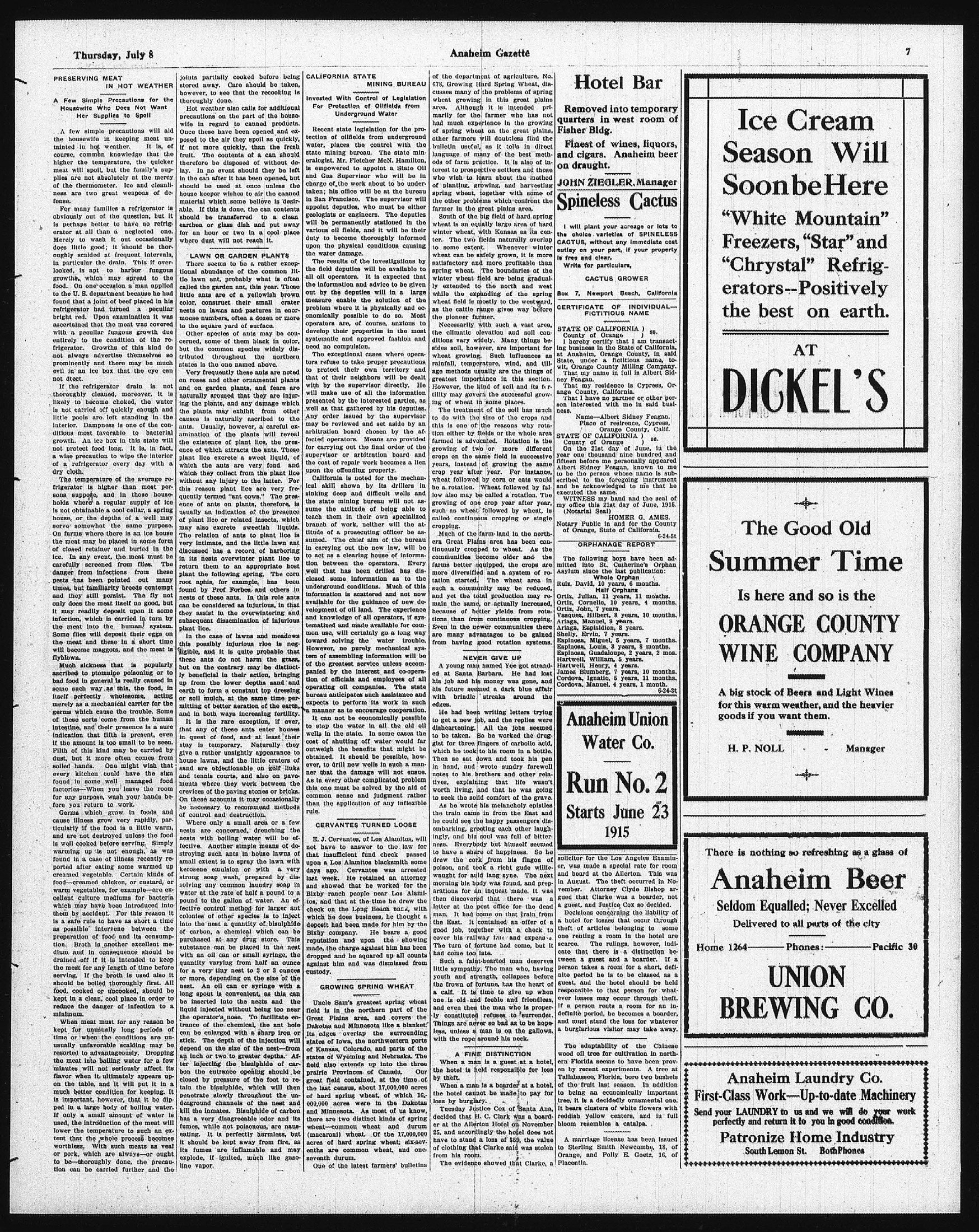
Searchable text
PRESERVING MEAT
IN HOT WEATHER
A Few Simple Precautions for the Housewife Who Does Not Want Her Supplies to Spoil
A few simple precautions will aid the housewife in keeping meat untainted in hot weather. It is, of course, common knowledge that the higher the temperature, the quicker meat will spoil, but the family's supplies are not absolutely at the mercy of the thermometer. Ice and cleanliness are two great weapons of defense.
For many families a refrigerator is obviously out of the question, but it is perhaps better to have no refrigerator at all than a neglected one. Merely to wash it out occasionally does little good; it should be thoroughly scalded at frequent intervals, in particular the drain. This if overlooked, is apt to harbor fungous growths, which may spread to the food. On one occasion a man applied to the U.S. department because he had found that a joint of beef placed in his refrigerator had turned a peculiar bright red. Upon examination it was ascertained that the meat was covered with a peculiar fungous growth due entirely to the condition of the refrigerator. Growths of this kind do not always advertise themselves so prominently and there may be much evil in an ice box that the eye can not detect.
If the refrigerator drain is not thoroughly cleaned, moreover, it is likely to become choked, the water is not carried off quickly enough and little pools are left standing in the interior. Dampness is one of the conditions most favorable to bacterial growth. An ice box in this state will not protect food long. It is, in fact, a wise precaution to wipe the interior joints partially cooked before being stored away. Care should be taken, however, to see that the recooking is thoroughly done.
Hot weather also calls for additional precautions on the part of the housewife in regard to canned products. Once these have been opened and exposed to the air they spoil as quickly, if not more quickly, than the fresh fruit. The contents of a can should therefore be disposed of without delay. In no event should they be left in the can after it has been opened, but should be used at once unless the house keeper wishes to air the canned material which some believe is desirable. If this is done, the can contents should be transferred to a clean carthen or glass dish and put away for an hour or two in a cool place where dust will not reach it.
LAWN OR GARDEN PLANTS
There seems to be a rather exceptional abundance of the common little lawn ant, probably what is often called the garden ant, this year. These little ants are of a yellowish brown color, construct their small crater nests on lawns and pastures in enormous numbers, often a dozen or more to the square yard of surface.
Other species of ants may be concerned, some of them black in color, but the common species widely distributed throughout the northern states is the one named above.
Very frequently these ants are noted on roses and other ornamental plants and on garden plants, and fears are naturally aroused that they are injuring the plants, and any damage which the plants may exhibit from other causes is naturally ascribed to the ants. Usually, however, a careful examination of the plants will reveal the existence of plant lice, the presence of which attracts the ants. These plant lice excrete a sweet liquid, of CALIFORNIA STATE
Invested With Control For Protection Of Underground
Recent state legislation of oilfields and water places the state mining bureau eralogist, Mr. Fletcher, is empowered to act and Gas Supervision charge of the work taken; his office will in San Francisco appoint deputies, who geologists or engineers will be permanently various oil fields, and duty to become ther upon the physical damage to the water damage.
The results of this field deputies will all oil operators. The information and out by the deputies measure enable them problem where it isonomically possible operators are, of develop their proper systematic and apply need no compulsion.
The exceptionalitors refuse to take to protect their own that of their neighbor with by the superiors will make use of it presented by the inspector well as that gathered Any order issued may be reviewed and arbitration board effected operators. For carrying out their supervisor or arbiter
prominently and there may be much evil in an ice box that the eye can not detect.
If the refrigerator drain is not thoroughly cleaned, moreover, it is likely to become choked, the water is not carried off quickly enough and little pools are left standing in the interior. Dampness is one of the conditions most favorable to bacterial growth. An ice box in this state will not protect food long. It is, in fact, a wise precaution to wipe the interior of a refrigerator every day with a dry cloth.
The temperature of the average refrigerator is higher than most persons suppose, and in those households where a regular supply of ice is not obtainable a cool cellar, a spring house, or the depths of a well may serve somewhat the same purpose. On farms where there is an ice house the meat may be placed in some form of closed retainer and buried in the ice. In any event, the meat must be carefully screened from files. The danger from infections from these pests has been pointed out many times, but familiarity breeds contempt and they still persist. The fly not only does the meat itself no good, but it may readily deposit upon it some infection, which is carried in turn by the meat into the human system. Some flies will deposit their eggs on the meat and these in a short time will become maggots, and the meat is flyblown.
Much sickness that is popularly ascribed to ptomaine poisoning or to bad food in general is really caused in some such way as this, the food, in itself perfectly wholesome, acting merely as a mechanical carrier for the germs which cause the trouble. Some of these sorts come from the human intestine, and their presence is a sure indication that fifth is present, even if the amount is too small to be seen. Fifth of this kind may be carried by dust, but it more often comes from soiled hands. One might wish that every kitchen could have the sign found in some well managed food factories—When you leave the room for any purpose, wash your hands before you return to work.
Germs which grow in foods and cause illness grow very rapidly, particularly if the food is a little warm, and are not destroyed unless the food is well cooked before serving. Simply warming up is not enough, as was found in a case of illness recently reported after eating some warmed up prominently and there may be much evil in an ice box that the eye can not detect.
If the refrigerator drain is not thoroughly cleaned, moreover, it is likely to become choked, the water is not carried off quickly enough and little pools are left standing in the interior. Dampness is one of the conditions most favorable to bacterial growth. An ice box in this state will not protect food long. It is, in fact, a wise precaution to wipe the interior of a refrigerator every day with a dry cloth.
The temperature of the average refrigerator is higher than most persons suppose, and in those households where a regular supply of ice is not obtainable a cool cellar, a spring house, or the depths of a well may serve somewhat the same purpose. On farms where there is an ice house the meat may be placed in some form of closed retainer and buried in the ice. In any event, the meat must be carefully screened from files. The danger from infections from these pests has been pointed out many times, but familiarity breeds contempt and they still persist. The fly not only does the meat itself no good, but it may readily deposit upon it some infection, which is carried in turn by the meat into the human system. Some flies will deposit their eggs on the meat and these in a short time will become maggots, and the meat is flyblown.
Much sickness that is popularly ascribed to ptomaine poisoning or to bad food in general is really caused in some such way as this, the food, in itself perfectly wholesome, acting merely as a mechanical carrier for the germs which cause the trouble. Some of these sorts come from the human intestine, and their presence is a sure indication that fifth is present, even if the amount is too small to be seen. Fifth of this kind may be carried by dust, but it more often comes from soiled hands. One might wish that every kitchen could have the sign found in some well managed food factories—When you leave the room for any purpose, wash your hands before you return to work.
Germs which grow in foods and cause illness grow very rapidly, particularly if the food is a little warm, and are not destroyed unless the food is well cooked before serving. Simply warming up is not enough, as was found in a case of illness recently reported after eating some warmed up prominently and there may be much evil in an ice box that the eye can not direct.
If the refrigerator drain is not thoroughly cleaned, moreover, it is likely to become choked, the water is not carried off quickly enough and little pools are left standing in the interior. Dampness is one of the conditions most favorable to bacterial growth. An ice box in this state will not protect food long. It is, in fact, a wise precaution to wipe the interior of a refrigerator every day with a dry cloth.
The temperature of the average refrigerator is higher than most persons suppose, and in those households where a regular supply of ice is not obtainable a cool cellar, a spring house, or the depths of a well may serve somewhat the same purpose. On farms where there is an ice house the meat may be placed in some form of closed retainer and buried in the ice. In any event, the meat must be carefully screened from files. The danger from infections from these pests has been pointed out many times, but familiarity breeds contempt and they still persist. The fly not only does the meat itself no good, but it may readily deposit upon it some infection, which is carried in turn by the meat into the human system. Some flies will deposit their eggs on the meat and these in a short time will become maggots, and the meat is flyblown.
Much sickness that is popularly ascribed to ptomaine poisoning or to bad food in general is really caused in some such way as this, the food, in itself perfectly wholesome, acting merely as a mechanical carrier for the germs which cause the trouble. Some of these sorts come from the human intestine, and their presence is a sure indication that fifth is present, even if the amount is too small to be seen. Fifth of this kind may be carried by dust, but it more often comes from soiled hands. One might wish that every kitchen could have the sign found in some well managed food factories—When you leave the room for any purpose, wash your hands before you return to work.
Germs which grow in foods and cause illness grow very rapidly, particularly if the food is a little warm, and are not destroyed unless the food is well cooked before serving. Simply warming up is not enough, as was found in a case of illness recently reported after eating some warmed up prominently and there may be much evil in an ice box that the eye can not direct.
If the refrigerator drain is not thoroughly cleaned, moreover, it is likely to become choked, the water is not carried off quickly enough and little pools are left standing in the interior. Dampness is one of the conditions most favorable to bacterial growth. An ice box in this state will not protect food long. It is, in fact, a wise precaution to wipe the interior of a refrigerator every day with a dry cloth.
The temperature of the average refrigerator is higher than most persons suppose, and in those households where a regular supply of ice is not obtainable a cool cellar, a spring house, or the depths of a well may serve somewhat the same purpose. On farms where there is an ice house the meat may be placed in some form of closed retainer and buried in the ice. In any event, the meat must be carefully screened from files. The danger from infections from these pests has been pointed out many times, but familiarity breeds contempt and they still persist. The fly not only does the meat itself no good, but it may readily deposit upon it some infection, which is carried in turn by the meat into the human system. Some flies will deposit their eggs on the meat and these in a short time will become maggots, and the meat is flyblown.
Much sickness that is popularly ascribed to ptomaine poisoning or to bad food in general is really caused in some such way as this, the food, in itself perfectly wholesome, acting merely as a mechanical carrier for the germs which cause the trouble. Some of these sorts come from the human intestine, and their presence is a sure indication that fifth is present, even if the amount is too small to be seen. Fifth of this kind may be carried by dust, but it more often comes from soiled hands. One might wish that every kitchen could have the sign found in some well managed food factories—When you leave the room for any purpose, wash your hands before you return to work.
Germs which grow in foods and cause illness grow very rapidly, particularly if the food is a little warm, and are not destroyed unless the food is well cooked before serving. Simply warming up is not enough, as was found in a case of illness recently reported after eating some warmed up prominently and there may be much evil in an ice box that the eye can not direct.
If the refrigerator drain is not thoroughly cleaned, moreover, it is likely to become choked, the water is not carried off quickly enough and little pools are left standing in the interior. Dampness is one of the conditions most favorable to bacterial growth. An ice box in this state will not protect food long. It is, in fact, a wise precaution to wipe the interior of a refrigerator every day with a dry cloth.
The temperature of the average refrigerator is higher than most persons suppose, and in those households where a regular supply of ice is not obtainable a cool cellar, a spring house, or the depths of a well may serve somewhat the same purpose. On farms where there is an ice house the meat may be placed in some form of closed retainer and buried in the ice. In any event, the meat must be carefully screened from files. The danger from infections from these pests has been pointed out many times, but familiarity breeds contempt and they still persist. The fly not only does the meat itself no good, but it may readily deposit upon it some infection, which is carried in turn by the meat into the human system. Some flies will deposit their eggs on the肉和这些在容器中放置的植物上。某些植物可能导致某些植物的死亡。
California is noted for its local skill shown at sinking deep and at state mining boree at attitude teach them in branch of work; no attitude summed. The chief effort in carrying out this task act as a clearing tion between two well that has been closed some information available for government development oil land; and knowledge of certainized and made man use; will certainly toward solving this However no pure item of assembling of greatest sea panied by intention of officials an operating oil company bureau anticipates expects to perform a manner as to encircle
It cannot be eaten stopting water wells in state coat of shutting out outweighing benefit obtained. It should ever to drill new water nor that damage As in every other case this one must be common sense and than application rule.
CERVANTES T
E.J.Cervantes do not have answer that insufficient fright upon Los Alamitos days ago Cervantes
every kitchen could have the sign found in some well managed food factories—When you leave the room for any purpose, wash your hands before you return to work.
Germs which grow in foods and cause illness grow very rapidly, particularly if the food is a little warm, and are not destroyed unless the food is well cooked before serving. Simply warming up is not enough, as was found in a case of illness recently reported after eating some warmed up creamed vegetable. Certain kinds of food—creamed chicken, or custard, or warm vegetables, for example—are excellent culture mediums for bacteria which may have been introduced into them by accident. For this reason it is a safe rule to have as short a time as possible intervene between the preparation of food and its consumption. Broth is another excellent medium and in consequence should be drained off if it is intended to keep the meat for any length of time before serving. If the broth is used also it should be boiled thoroughly first. All food, cooked or uncooked, should be kept in a clean, cool place in order to reduce the danger of infection to a minimum.
When meat must for any reason be kept for unusually long periods of time or when the conditions are unusually unfavorable scalding may be resorted to advantageously. Dropping the meat into boiling water for a few minutes will not seriously affect its flavor when it ultimately appears upon the table, and it will put it in a much better condition for keeping. It is important, however, that it be dipped in a large body of boiling water. If only a small amount of water is used, the introduction of the meat will lower the temperature to such an extent that the whole process becomes worthless. With such meats as veal or pork, which are always—or ought to be—thoroughly done, the precaution can be carried further and the tennis courts, and also on pavements where they work between the crevices of the paving stones or bricks. On these accounts it may occasionally be necessary to recommend methods of control and destruction.
Where only a small area or a few nests are concerned, drenching the nests with boiling water will be effective. Another simple means of destroying such ants in house lawns of small extent is to spray the lawn with kerosene emulsion or with a very strong soap wash, prepared by dissolving any common laundry soap in water at the rate of half a pound to a pound to the gallon of water. An effective control method for larger ant colonies of other species is to inject into the nest a quantity of bisulphide of carbon, a chemical which can be purchased at any drug store. This substance can be placed in the nest with an oil can or small syringe, the quantity varying from half an ounce for a very tiny nest to 2 or 3 ounces or more, depending on the size of the nest. An oil can or syringe with a long spout is convenient, as this can be inserted into the necks and the liquid injected without being too near the operator's nose. To facilitate entrance of the chemical, the ant hole can be enlarged with a sharp iron or stick. The depth of the injection will depend on the size of the nest—from an inch or two to greater depths. After injecting the bisulphide of carbon the entrance opening should be closed by pressure of the foot to retain the bisulphide, which will then penetrate slowly throughout the underground channels of the nest and kill the inmates. Bisulphide of carbon has a very disagreeable odor and its fumes, while not poisonous, are nauseating. It is perfectly harmless, but it should be kept away from fire, as its fumes are inflammable and may explode, if ignited, much like gasoline vapor.
E. J. Cervantes, does not have to answer that insufficient fruit upon a Los Alamitos days ago. Cervant last week. He re- and showed that Bixby ranch people to, and that at the check on the Long which he does business deposit had been made Bixby company. reputation and up made, the charge a dropped and he so against him and v custody.
GROWING SPACE
Uncle Sam's great field is in the no Great Plains area Dakotas and Minnesota Its edges overlap states of Iowa, the of Kansas, Colorado states of Wyoming field also extends prairie Provinces great field contain the last census, ab of hard spring with 000,000 acres west and Minnesota. At there are two districts wheat—common w (macaroni) wheat acres of hard spring thents are common seventh durum.
One of the latest
CALIFORNIA STATE
MINING BUREAU
Invested With Control of Legislation For Protection of Oilfields from Underground Water
Recent state legislation for the protection of oilfields from underground water, places the control with the state mining bureau. The state mineralogist, Mr. Fletcher McN. Hamilton, is empowered to appoint a State Oil and Gas Supervisor who will be in charge of the work about to be undertaken; his office will be at the bureau in San Francisco. The supervisor will appoint deputies, who must be either geologists or engineers. The deputies will be permanently stationed in the various oil fields, and it will be their duty to become thoroughly informed upon the physical conditions causing the water damage.
The results of the investigations by the field deputies will be available to all oil operators. It is expected that the information and advice to be given out by the deputies will in a large measure enable the solution of the problem where it is physically and economically possible to do so. Most operators are, of course, anxious to develop their properties in the most systematic and approved fashion and need no compulsion.
The exceptional cases where operators refuse to take proper precautions to protect their own territory and that of their neighbors will be dealt with by the supervisor directly. He will make use of all the information presented by the interested parties, as well as that gathered by his deputies. Any order issued by the supervisor may be reviewed and set aside by an arbitration board chosen by the affected operators. Means are provided for carrying out the final order of the supervisor or arbitration board and of the department of agriculture, No. 678, Growing Hard Spring Wheat, discusses many of the problems of spring wheat growing in this great plains area. Although it is intended primarily for the farmer who has not had much experience in the growing of spring wheat on the great plains, other farmers will doubtless find the bulletin useful, as it tells in direct language of many of the best methods of farm practice. It is also of interest to prospective settlers and those who wish to learn about the method of planting, growing, and harvesting spring wheat, together with some of the other problems which confront the farmer in the great plains area.
South of the big field of hard spring wheat is an equally large area of hard winter wheat, with Kansas as its center. The two fields naturally overlap to some extent. Whenever winter wheat can be safely grown, it is more satisfactory and more profitable than spring wheat. The boundaries of the winter wheat field are being gradually extended to the north and west while the expanding of the spring wheat field is mostly to the westward, as the cattle range gives way before the pioneer farmer.
Necessarily with such a vast area, the climatic elevation and soil conditions vary widely. Many things besides soil, however, are important for wheat growing. Such influences as rainfall, temperature, wind, and tillage methods usually are the things of greatest importance in this section. However, the kind of soil and its fertility may govern the successful growing of wheat in some places.
The treatment of the soil has much to do with the size of the crops and this is one of the reasons why rotation either by fields or the whole area farmed is advocated. Rotation is the growing of two or more different crops on the same field in successive seasons.
Hotel Bar
Removed into temporary quarters in west room of Fisher Bldg.
Finest of wines, liquors, and cigars. Anaheim beer on draught.
JOHN ZIEGLER, Manager
Spineless Cactus
I will plant your acreage or lots to the choice varieties of SPINELESS CACTUS, without any immediate cost outlay on your part, if your property is free and clear.
Write for particulars,
CACTUS GROWER
Box 7, Newport Beach, California
CERTIFICATE OF INDIVIDUAL—FICTITIOUS NAME
STATE OF CALIFORNIA ) County of Orange )
88.
I hereby certify that I am transacting business in the State of California, at Anaheim, Orange County, in said State, under a fictitious name, to-wit, Orange County Milling Company.
That my name in full is Albert Sidney Feagan.
That my residence is Cypress, Orange County, California.
That I have no partner or other person interested with me in said business.
Name—Albert Sidney Feagan.
Place of resirence: Cypress,
Orange County, Calif.
STATE OF CALIFORNIA ) County of Orange )
88.
On the 21st day of June, in the year one thousand nine hundred and
tors refuse to take proper precautions to protect their own territory and that of their neighbors will be dealt with by the supervisor directly. He will make use of all the information presented by the interested parties, as well as that gathered by his deputies. Any order issued by the supervisor may be reviewed and set aside by an arbitration board chosen by the affected operators. Means are provided for carrying out the final order of the supervisor or arbitration board and the cost of repair work becomes a lien upon the offending property.
California is noted for the mechanical skill shown by its drillers in sinking deep and difficult wells and the state mining bureau will not assume the attitude of being able to teach them in their own specialized branch of work, neither will the attitude of a prosecuting officer be assumed. The chief aim of the bureau in carrying out the new law, will be to act as a clearing house of information between the operators. Every well that has been drilled has disclosed some information as to the underground conditions. Much of this information is scattered and not now available for the guidance of new development of oil land. The experience and knowledge of all operators, if systematized and made available for common use, will certainly go a long way toward solving the water trouble. However, no purely mechanical system of assembling information will be of the greatest service unless accompanied by the interest and co-operation of officials and employees of all operating oil companies. The state bureau anticipates such assistance and expects to perform its work in such a manner as to encourage cooperation.
It can not be economically possible to stop the water in all the old oil wells in the state. In some cases the cost of shutting off water would far outweigh the benefits that might be obtained. It should be possible, however, to drill new wells in such a manner that the damage will not ensue. As in every other complicated problem this one must be solved by the aid of common sense and judgment rather than the application of any inflexible rule.
CERVANTES TURNED LOOSE
E. J. Cervantes, of Los Alamitos, will not have to answer to the law for that insufficient fund check passed upon a Los Alamitos blacksmith some days ago. Cervantes was arrested rainfall, temperature, wind, and tillage methods usually are the things of greatest importance in this section. However, the kind of soil and its fertility may govern the successful growing of wheat in some places.
The treatment of the soil has much to do with the size of the crops and this is one of the reasons why rotation either by fields or the whole area farmed is advocated. Rotation is the growing of two or more different crops on the same field in successive years, instead of growing the same crop year after year. For instance, wheat followed by corn or oats would be a rotation. Wheat followed by fall also may be called a rotation. The growing of one crop year after year, such as wheat followed by wheat, is called continuous cropping or single cropping.
Much of the farm-land in the northern Great Plains area has been continuously cropped to wheat. As the communities become older and the farms better equipped, the crops are more diversified and a system of rotation started. The wheat area in such a community may be reduced, and yet the total production may remain the same, or actually increased, because of better yields from rotations than from continuous cropping. Even in the newer communities there are many advantages to be gained from having good rotation systems.
NEVER GIVE UP
A young man named Yoe got stranded at Santa Barbara. He had lost his job and his money was gone, and his future seemed a dark blue affair with brindle streaks around the edges.
He had been writing letters trying to get a new job, and the replies were disheartening. All the jobs seemed to be taken. So he worked the drugist for three fingers of carbolic acid, which he took to his room in a bottle. Then se sat down and took his pen in hand, and wrote sundry farewell notes to his brothers and other relatives, explaining that life wasn't worth living, and that he was going to seek the solid comfort of the grave.
As he wrote his melancholy epistles the train came in from the East and he could see the happy passengers disembarking, greeting each other laughingly, and his soul was full of bitterness. Everybody but himself seemed to have a share of happiness. So he drew the cork from his flagon of poison, and took a right gude willie-
CERVANTES TURNED LOOSE
E. J. Cervantes, of Los Alamitos, will not have to answer to the law for that insufficient fund check passed upon a Los Alamitos blacksmith some days ago. Cervantes was arrested last week. He retained an attorney and showed that he worked for the Blixby ranch people near Los Alamitos, and that at the time he drew the check on the Long Beach park, with which he does business, he thought a deposit had been made for him by the Blixby company. He bears a good reputation and upon the showing made, the charge against him has been dropped and he squared up all counts against him and was dismissed from custody.
GROWING SPRING WHEAT
Uncle Sam's greatest spring wheat field is in the northern part of the Great Plains area, and covers the Dakotas and Minnesota like a blanket. Its edges overlap the surrounding states of Iowa, the northwestern ports of Kansas, Colorado, and parts of the states of Wyoming and Nebraska. The field also extends up into the three prairie Provinces of Canada. Our great field contained, at the time of the last census, about 17,000,000 acres of hard spring wheat, of which 16,000,000 acres were in the Dakotas and Minnesota. As most of us know, there are two distinct kinds of spring wheat—common wheat and durum (macaroni) wheat. Of the 17,000,000 acres of hard spring wheat, six-sevenths are common wheat, and one-seventh durum.
One of the latest farmers' bulletins notes to his brothers and other relatives, explaining that life wasn't worth living, and that he was going to seek the solid comfort of the grave.
As he wrote his melancholy epistles the train came in from the East and he could see the happy passengers disembarking, greeting each other laughingly, and his soul was full of bitterness. Everybody but himself seemed to have a share of happiness. So he drew the cork from his flagon of poison, and took a right gude willlewaught for auil lang syne. The next morning his body was found, and preparations for an inquest made. It was then discovered that there was a letter at the post office for the dead man. It had come on that train from the East. It contained an offer of a good job, together with a check to cover his railway fare and expenses. The turn of fortune had come, but it had come too late.
Such a faint-hearted man deserves little sympathy. The man who, having youth and strength, collapses before the frown of fortune, has the heart of a calf. It is time to give up when one is old and feeble and friendless, and even then the man who is properly constituted refuses to surrender. Things are never so bad as to be hopeless, unless a man is on the gallows, with the rope around his neck.
A FINE DISTINCTION
When a man is a guest at a hotel, the hotel is held responsible for loss by theft.
When a man is a boarder at a hotel, the hotel cannot be made to pay for loss by burglary.
Tuesday Justice Cox of Santa Ana, decided that H. C. Clark was a boarder at the Allerton Hotel on November 25, and accordingly the hotel does not have to stand a loss of $59, the value of clothing that Clarke said was stolen from his room.
The evidence showed that Clarke, a solicitor for the Los Angeles Examiner, was made a special rate for room and board at the Allerton. This was in August. The theft occurred in November. Attorney Clyde Bishop argued that Clarke was a boarder, not a guest, and Justice Cox so decided.
Decisions concerning the liability of a hotel for losses that occur through theft of articles belonging to some one renting a room in the hotel are scarce. The rulings, however, indicate that there is a distinction between a guest and a boarder. If a person takes a room for a short, definite period he is to be classed as a guest, and the hotel should be held responsible to that person for whatever losses may occur through theft. If a person rents a room for an indefinite period, he becomes a boarder, and must stand the loss for whatever a burglarious visitor may take away.
The adaptability of the Chinese wood oil tree for cultivation in northern Florida seems to have been proven by recent experiments. A tree at Tallahassee, Florida, bore two bushels of the fruit last season. In addition to being an economically important tree, it is a decidedly ornamental one. It bears clusters of white flowers with reddish yellow centers, and in full bloom resembles a catalpa.
A marriage license has been issued to Sterling Smith Newcombe, 18, of Orange, and Polly E. Goetz, 16, of Placentia.
Ice Cream Season Will SoonbeHere
"White Mountain"
Freezers, "Star" and
"Chrystal" Refrigerators--Positively the best on earth.
AT
DICKEL'S
DICKEL'S
The Good Old Summer Time
Is here and so is the ORANGE COUNTY WINE COMPANY
A big stock of Beers and Light Wines for this warm weather, and the heavier goods if you want them.
H. P. NOLL - Manager
There is nothing so refreshing as a glass of
There is nothing so refreshing as a glass of
Anaheim Beer
Seldom Equalled; Never Excelled
Delivered to all parts of the city
Home 1264——Phones:——Pacific 30
UNION
BREWING CO.
Anaheim Laundry Co.
First-Class Work—Up-to-date Machinery
Send your LAUNDRY to us and we will do your work perfectly and return it to you in good condition.
Patronize Home Industry
South Lemon St. BothPhones