anaheim-gazette 1915-07-08
Scanned page
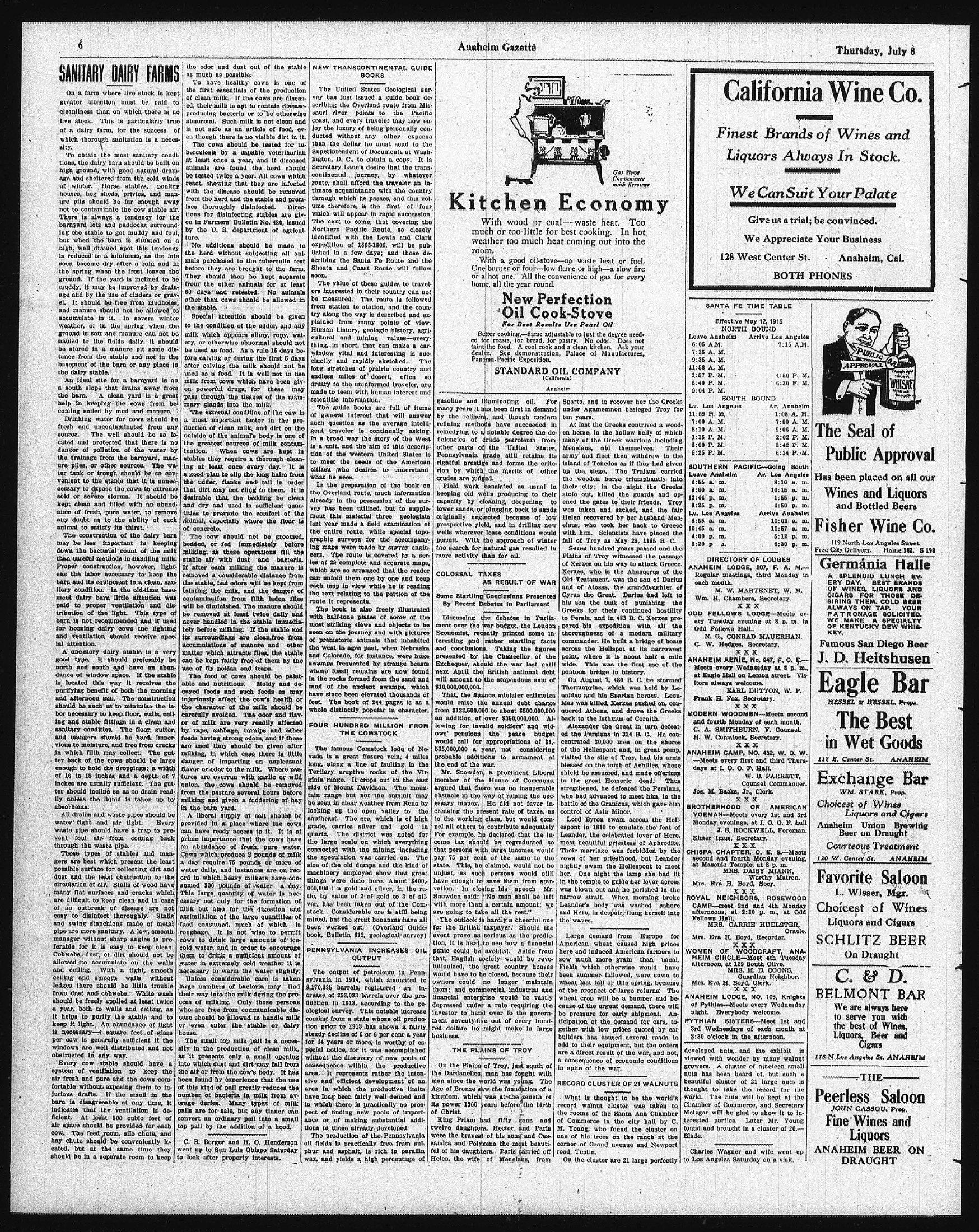
Searchable text
SANITARY DAIRY FARMS
On a farm where live stock is kept greater attention must be paid to cleanliness than on which there is no live stock. This is particularly true of a dairy farm, for the success of which thorough sanitation is a necessity.
To obtain the most sanitary conditions, the dairy barn should be built on high ground, with good natural drainage and sheltered from the cold winds of winter. Horse stables, poultry houses, hog sheds, privies, and manure pits should be far enough away not to contaminate the cow stable air. There is always a tendency for the barnyard lots and paddocks surrounding the stable to get muddy and foul, but when the barn is situated on a high, well drained spot this tendency is reduced to a minimum, as the lots soon become dry after a rain and in the spring when the frost leaves the ground. If the yard is inclined to be muddy, it may be improved by drainage and by the use of clinders or gravel. It should be free from mudholes, and manure should not be allowed to accumulate in it. In severe winter weather, or in the spring when the ground is soft and manure can not be nailed to the fields daily, it should be stored in a manure pit some distance from the stable and not in the basement of the barn or any place in the dairy stable.
An ideal site for a barnyard is on a south slope that drains away from the barn. A clean yard is a great help in keeping the cows from becoming soiled by mud and manure.
Drinking water for cows should be fresh and uncontaminated from any source. The well should be so located and protected that there is no danger of pollution of the water by the drainage from the barnyard, manure or dust out of the stable as much as possible.
To have healthy cows is one of the first essentials of the production of clean milk. If the cows are diseased, their milk is apt to contain disease-producing bacteria or to be otherwise abnormal. Such milk is not clean and is not safe as an article of food, even though there is no visible dirt in it.
The cows should be tested for tuberculosis by a capable veterinarian at least once a year, and if diseased animals are found the herd should be tested twice a year. All cows which react, showing that they are infected with the disease should be removed from the herd and the stable and premises thoroughly disinfected. Directions for disinfecting stables are given in Farmers' Bulletin No. 480, issued by the U.S. department of agriculture.
No additions should be made to the herd without subjecting all animals purchased to the tuberculin test before they are brought to the farm. They should then be kept separate from the other animals for at least 60 days and retested. No animals other than cows should be allowed in the stable.
Special attention should be given to the condition of the udder, and any milk which appears slimy, ropy, watery, or otherwise abnormal should not be used as food. As a rule 15 days before calving or during the first 5 days after calving the milk should not be used as a food. It is well not to use milk from cows which have been given powerful drugs, for these may pass through the tissues of the mammary glands into the milk.
The external condition of the cow is a most important factor in the production of clean milk, and dirt on the outside of the animal's body is one of the greatest sources of milk contamination. When cows are kept in stables they require a thorough cleaning of the odor and dust out of the stable as much as possible.
The United States has just issued scribing the Over-sourl river poli coast, and every joy the luxury of ducted without than the dollar Superintendent of Ington, D.C., to Secretary Lane's continental journey, shall afford climate acquaintance through which heume therefore, is which will appear. The next to come Northern Pacific identified with the expedition of 180 lished in a few scribing the San Shasta and Coast soon.
The value of thars interested in be measured. Trom station to str try along the way plained from ma Human history, g cultural and min thing, in short, t window vital and clinically and rapid long stretches of endless miles of dreary to the unit made to team with scientific informa
The guide book of general interest such question as gent traveler is In a broad way this is a unit, and thion of the west
An ideal site for a barnyard is on a south slope that drains away from the barn. A clean yard is a great help in keeping the cows from becoming soiled by mud and manure.
Drinking water for cows should be fresh and uncontaminated from any source. The well should be so located and protected that there is no danger of pollution of the water by the drainage from the barnyard, manure piles, or other sources. The water tank or trough should be so convenient to the stable that it is unnecessary to expose the cows to extreme sold or severe storms. It should be kept clean and filled with an abundance of fresh, pure water, to remove any doubt as to the ability of each animal to satisfy its thirst.
The construction of the dairy barn may be less important in keeping down the bacterial count of the milk than careful methods in handling milk. Proper construction, however, lightens the labor necessary to keep the barn and its equipment in a clean, sanitary condition. In the old-time basement dairy barn little attention was paid to proper ventilation and distribution of the light. This type of barn is not recommended and if used for housing dairy cows the lighting and ventilation should receive special attention.
A one-story dairy stable is a very good type. It should preferably be north and south and have an abundance of window space. If the stable is located this way it receives the purifying benefit of both the morning and afternoon sun. The construction should be such as to minimize the labor necessary to keep floor, walls, ceiling and stable fittings in a clean and sanitary condition. The floor, gutter, and mangers should be hard, impervious to moisture, and free from cracks in which filth may collect. The gutter back of the cows should be large enough to hold the droppings; a width of 16 to 18 inches and a depth of 7 inches are usually sufficient. The gutter should incline so as to drain readily unless the liquid is taken up by absorbents.
All drains and waste pipes should be water tight and air tight. Every waste pipe should have a trap to prevent foul air from coming back through the waste pipe.
Those types of stables and managers are best which present the least possible surface for collecting dirt and after calving the milk should not be used as a food. It is well not to use milk from cows which have been given powerful drugs, for these may pass through the tissues of the mammary glands into the milk.
The external condition of the cow is a most important factor in the production of clean milk, and dirt on the outside of the animal's body is one of the greatest sources of milk contamination. When cows are kept in stables they require a thorough cleaning at least once every day. It is a good plan to clip the long hairs from the udder, flanks and tail in order that dirt may not cling to them. It is desirable that the bedding be clean and dry and used in sufficient quantities to promote the comfort of the animal, especially where the floor is of concrete.
The cow should not be groomed, bedded, or fed immediately before milking, as these operations fill the stable air with dust and bacteria. If after each milking the manure is removed a considerable distance from the stable, bad odors will be kept from tainting the milk, and the danger of contamination from filth laden files will be diminished. The manure should be removed at least twice daily and never handled in the stable immediately before milking. If the stable and its surroundings are clean, free from accumulations of manure and other matter which attracts flies, the stable can be kept fairly free of them by the use of fly poison and traps.
The feed of cows should be palatable and nutritious. Moldy and decayed feeds and such feeds as may injuriously affect the cow's health or the character of the milk should be carefully avoided. The odor and flavor of milk are very readily affected by rape, cabbage, turnips and other feeds having strong odors, and if these are used they should be given after milking, in which case there is little danger of imparting an unpleasant flavor or odor to the milk. Where pastures are overrun with garlic or wild onion, the cows should be removed from the pasture several hours before milking and given a foddering of hay in the barn yard.
A liberal supply of salt should be provided in a place where the cows can have ready access to it. It is of prime importance that the cows have an abundance of fresh, pure water. Cows which produce 2 pounds of milk a day require 75 pounds or more of water daily, and instances are on record.
The guide book of general interest such question as gent traveler is in a broad way that is a unit, and the tion of the westward to meet the need citizen who deserves what he sees.
In the preparation the Overland route already in the paper has been util ment this material last year made a few entire route, graphic surveys im ing maps were mae ers. The route les of 29 complete which are so array can unfold them on each map in view of the text relating to route it represent.
The book is all with half-tone pla most striking view seen on the journe of prehistoric ank e west in ages p and Colorado, for swamps frequent whose fossil remi n in the rocks formed mud of the ancien have since been el feet. The book o whole distinctly p
FOUR HUNDRENS
THE CO
The famous Cow vada is a great f long, along a line Tertliary eruptive ginla range. It cr eats side of Mount Da tin range but nee be seen in clear w looking up the o southeast. The o grade, carries sil quartz. The dist riche large scale o connected with th e speculation w size of the old dur
of 16 to 18 inches and a depth of 7 inches are usually sufficient. The gutter should incline so as to drain readily unless the liquid is taken up by absorbents.
All drains and waste pipes should be water tight and air tight. Every waste pipe should have a trap to prevent foul air from coming back through the waste pipe.
Those types of stables and managers are best which present the least possible surface for collecting dirt and dust and the least obstruction to the circulation of air. Stalls of wood have many flat surfaces and cracks which are difficult to keep clean and in case of an outbreak of disease are not easy to disinfect thoroughly. Stalls and swing stanchions made of metal pipe are more sanitary. A low, smooth manager without sharp angles is preferable for it is easy to keep clean, Cobwebs, dust, or dirt should not be allowed to accumulate on the walls and ceiling. With a tight, smooth ceiling and smooth walls without ledges there should be little trouble from dust and cobwebs. White wash should be freely applied at least twice a year, both to walls and ceiling, as it helps to purify the stable and to keep it light. An abundance of light is necessary—4 square feet of glass per cow is generally sufficient if the windows are well distributed and not obstructed in any way.
Every cow stable should have a system of ventilation to keep the air fresh and pure and the cows comfortable without exposing them to injurious drafts. If the smell in the barn is disagreeable at any time, it indicates that the ventilation is deficient. At least 500 cubic feet of air space should be provided for each cow. The feed room, silo chute, and hay chute should be conveniently located, but at the same time they should be in a separate room to keep
A liberal supply of salt should be provided in a place where the cows can have ready access to it. It is of prime importance that the cows have an abundance of fresh, pure water. Cows which produce 2 pounds of milk a day require 75 pounds or more of water daily, and instances are on record in which heavy milkers have consumed 300 pounds of water a day. This large quantity of water is necessary not only for the formation of milk but also for the digestion and assimilation of the large quantities of food consumed, much of which is roughage. It is not wise to permit cows to drink large amounts of ice-cold water, and in order to encourage them to drink a sufficient amount of water in extremely cold weather it is necessary to warm the water slightly.
Unless considerable care is taken large numbers of bacteria may find their way into the milk during the process of milking. Only those persons who are free from communicable disease should be allowed to handle milk or even enter the stable or dairy house.
The small top milk pall is a necessity in the production of clean milk, as it presents only a small opening into which dust and dirt may fall from the air or from the cow's body. It has been found by experience that the use of this kind of pall greatly reduces the number of bacteria in milk from average daries. Many types of milk palls are for sale, but any tinner can convert an ordinary pall into a small top pall by the addition of a hood.
C. B. Berger and H. O. Henderson went up to San Luis Obispo Saturday to look after property interests.
NEW TRANSCONTINENTAL GUIDE BOOKS
The United States Geological survey has just issued a guide book describing the Overland route from Missouri river points to the Pacific coast, and every traveler may now enjoy the luxury of being personally conducted without any other expense than the dollar he must send to the Superintendent of Documents at Washington, D. C., to obtain a copy. It is Secretary Lane's desire that the transcontinental journey, by whatever route, shall afford the traveler an intimate acquaintance with the country through which he passes, and this volume therefore, is the first of four which will appear in rapid succession. The next to come, that covering the Northern Pacific Route, so closely identified with the Lewis and Clark expedition of 1803-1806, will be published in a few days; and those describing the Santa Fe Route and the Shasta and Coast Route will follow soon.
The value of these guides to travelers interested in their country can not be measured. The route is followed from station to station, and the country along the way is described and explained from many points of view. Human history, geologic history, agricultural and mining values—everything. In short, that can make a car window vital and interesting is succinctly and rapidly sketched. The long stretches of prairie country and endless miles of desert, often so dreary to the uninformed traveler, are made to teem with human interest and scientific information.
The guide books are full of items of general interest that will answer such question as the average intelligent traveler is continually asking. In a broad way the story of the West is a unit, and the aim of this description of the western United States is gasoline and illuminating oil. For many years it has been first in demand by the refiner, and though modern refining methods have succeeded in remedying to a notable degree the deficiencies of crude petroleum from other parts of the United States, Pennsylvania grade still retains its Sparta, and to recover her the Greeks under Agamemnon besleged Troy for ten years.
At last the Greeks contrived a wood-en horse, in the hollow belly of which many of the Greek warriors including Menelaus, hid themselves. Their army and fleet then withdrew to the
STANDARD OIL COMPANY
(California)
Anaheim
The guide books are full of items of general interest that will answer such question as the average intelligent traveler is continually asking. In a broad way the story of the West is a unit, and the aim of this description of the western United States is to meet the needs of the American citizen who desires to understand what he sees.
In the preparation of the book on the Overland route, much information already in the possession of the survey has been utilized, but to supplement this material three geologists last year made a field examination of the entire route, while special topographic surveys for the accompanying maps were made by survey engineers. The route is covered by a series of 29 complete and accurate maps, which are so arranged that the reader can unfold them one by one and keep each map in view while he is reading the text relating to the portion of the route it represents.
The book is also freely illustrated with half-tone plates of some of the most striking views and objects to be seen on the journey and with pictures of prehistoric animals that inhabited the west in ages past, when Nebraska and Colorado, for instance, were huge swamps frequented by strange beasts whose fossil remains are now found in the rocks formed from the sand and mud of the ancient swamps, which have since been elevated thousands of feet. The book of 244 pages is as a whole distinctly popular in character.
FOUR HUNDRED MILLION FROM THE COMSTOCK
The famous Comstock lode of Nevada is a great fissure vein, 4 miles long, along a line of faulting in the Tertiary eruptive rocks of the Virginia range. It crops out on the east side of Mount Davidson. The mountain range but not the summit may be seen in clear weather from Reno by looking up the open valley to the southeast. The ore, which is of high grade, carries silver and gold in quartz. The district was noted for the large scale on which everything connected with the mining, including the speculation was carried on. The size of the old dumps and the kind of gasoline and illuminating oil. For many years it has been first in demand by the refiners, and though modern refining methods have succeeded in remedying to a notable degree the deficiencies of crude petroleum from other parts of the United States, Pennsylvania grade still retains its rightful prestige and forms the criterion by which the merits of other crudes are judged.
Field work consisted as usual in keeping old wells producing to their capacity by cleaning, deepening to lower sands, or plugging back to sands originally neglected because of low prospective yield, and in drilling new wells wherever lease conditions would permit. With the approach of winter tree search for natural gas resulted in more activity than for oil.
COLOSSAL TAXES AS RESULT OF WAR
Some Startling Conclusions Presented By Recent Debates in Parliament
Discussing the debates in Parliament over the war budget, the London Economist, recently printed some interesting and rather startling facts and conclusions. Taking the figures presented by the Chancellor of the Exchequer, should the war last until next April the British national debt will amount to the stupendous sum of $10,000,000,000.
That, the finance minister estimates would raise the annual debt charge from $122,500,000 to about $500,000,000 an addition of over $350,000,000. Allowing for invalid soldiers' and widows' pensions the peace budget would call for appropriations of $1-535,000,000 a year, not considering probable additions to armament at the end of the war.
Mr. Snowden, a prominent Liberal member of the House of Commons, argued that there was no insuperable obstacle in the way of raising the necessary money. He did not favor increasing the present rate of taxes, as to the working class, but would compel all others to contribute adequately. For example, he declared that the income tax should be regraduated so that persons with large incomes would pay 75 per cent of the same to the state. This, he claimed, would not be Sparta, and to recover her the Greeks under Agamemnon besieged Troy for ten years.
At last the Greeks contrived a wooden horse, in the hollow belly of which many of the Greek warriors including Menelaus, hid themselves. Their army and fleet then withdrew to the island of Tehedos as if they had given up the siege. The Trojans carried the wooden horse triumphantly into their city; in the night the Greeks stole out, killed the guards and opened the gates to their friends. Troy was taken and sacked, and the fair Helen recovered by her husband Menelaus, who took her back to Greece with him. Scientists have placed the fall of Troy as May 29, 1185 B.C.
Seven hundred years passed and the Plains of Troy witnessed the passage of Xerxes on his way to attack Greece. Xerxes, who is the Ahasuerus of the Old Testament, was the son of Darius and of Atossa, the granddaughter of Cyrus the Great. Darius had left to his son the task of punishing the Greeks for their continued hostility to Persia, and in 483 B.C. Xerxes prepared his expedition with all the thoroughness of a modern military commander. He built a bridge of boats across the Hellspot at its narrowest point, where it is about half a mile wide. This was the first use of the pontoon bridge in history.
On August 7, 480 B.C. he stormed Thermopylae, which was held by Leonidas was killed, Xerxes pushed on, conquered Athens, and drove the Greeks back to Isthmus of Cornith.
Alexander the Great in turn defeated the Persians in 334 B.C. He concentrated 30,000 men on the shores of the Hellespont and, in great pomp, visited the site of Troy, had his arms blessed on the tomb of Achilles, whose shield he assumed, and made offerings to the great Homeric dead. Thus strengthened, he defeated the Persians, who had advanced to meet him, in the battle of the Granicus, which gave him control of Asia Minor.
Lord Byron swam across the Hellespont in 1810 to emulate the feat of Leander, the celebrated lover of Hero, most beautiful priestess of Aphrodite. Their marriage was forbidden by the vows of her priesthood, but Leander nightly swam the Hellespont to meet
PENNSYLVANIA INCREASES OIL OUTPUT
The output of petroleum in Pennsylvania in 1914, which amounted to 8,170,335 barrels, registered an increase of 258,033 barrels over the production in 1913, according to the geological survey. This notable increase coming from a state whose oil production prior to 1913 has shown a fairly steady decline of 5 or 6 per cent a year for 14 years or more, is worthy of special notice, for it was accomplished without the discovery of new pools of consequence within the productive area. It represents rather the intensive and efficient development of an area in which the productive limits have long been fairly well defined and in which there is practically no prospect of finding new pools of importance or of making substantial additions to those already developed.
The production of the Pennsylvania oil fields is practically free from sulphur and asphalt, is rich in paraffin wax, and yields a high percentage of
Mr. Snowden, a prominent Liberal member of the House of Commons, argued that there was no insuperable obstacle in the way of raising the necessary money. He did not favor increasing the present rate of taxes, as to the working class, but would compel all others to contribute adequately. For example, he declared that the income tax should be regraduated so that persons with large incomes would pay 75 per cent of the same to the state. This, he claimed, would not be unjust, as such persons would still have enough to save them from starvation. In closing his speech Mr. Snowden said: "No man shall be left with more than a certain amount; we are going to take all the rest."
The outlook is hardly a cheerful one for the British taxpayer. Should the event prove as serious as the prediction, it is hard to see how a financial panic could be avoided. Aside from that, English society would be revolutionized, the great country houses would have to be closed, because their owners could no longer maintain them; and commercial, industrial and financial enterprise would be vastly depressed under a rule requiring the investor to hand over to the government seventy-five out of every hundred dollars he might make in large business.
THE PLAINS OF TROY
On the Plains of Troy, just south of the Dardanelles, man has fought with man since the world was young. The Age of Bronze saw the foundation of a kingdom, which was at the zenith of its power 1200 years before the birth of Christ.
King Priam had fifty sons and twelve daughters, Hector and Paris were the bravest of his sons and Cassandra and Polyxena the most beautiful of his daughters. Paris carried off Helen, the wife of Menelaus, from
Large demand from Europe for American wheat caused high prices here and induced American farmers to sow much more grain than usual. Fields which otherwise would have been summer fallowed, were sown to wheat last fall or this spring, because of the prospect of large returns. The wheat crop will be a bumper and because of the urgent demand, there will be pressure for early shipment. Anticipation of the demand for cars, together with low prices quoted by car builders has caused several roads to add to their equipment, but the orders are a direct result of the war, and not, a consequence of economic conditions in spite of the war.
RECORD CLUSTER OF 21 WALNUTS
What is thought to be the world's record walnut cluster was taken to the rooms of the Santa Ana Chamber of Commerce in the city hall by C. M. Young, who found the cluster on one of his trees on the ranch at the corner of Grand avenue and Newport road, Tustin.
On the cluster are 21 large perfectly
California Wine Co.
Finest Brands of Wines and
Liquors Always In Stock.
We Can Suit Your Palate
Give us a trial; be convinced.
We Appreciate Your Business
128 West Center St. Anaheim, Cal.
BOTH PHONES
SANTA FE TIME TABLE
Effective May 12, 1915
NORTH BOUND
Leave Anaheim Arrive Los Angeles
6:05 A.M. 7:15 A.M.
7:35 A.M.
9:35 A.M.
11:58 A.M.
3:57 P.M. 4:50 P.M.
6:40 P.M. 6:30 P.M.
9:04 P.M.
SOUTH BOUND
Lv. Los Angeles Ar. Anaheim
11:59 P.M. 1:08 A.M.
7:00 A.M. 7:50 A.M.
8:10 A.M. 9:06 A.M.
11:15 P.M. 2:02 P.M.
3:00 P.M. 3:42 P.M.
5:25 P.M. 6:14 P.M.
The Seal of Public Approval
The Trojans carried horse triumphantly into the night the Greeks and the guards and opened their friends. Troy sacked, and the fair by her husband Menorah her back to Greece. Artists have placed the May 29, 1185 B.C. years passed and the witnessed the passage way to attack Greece. The Ahasuerus of the was the son of Darius the granddaughter of Darius had left to kill of punishing the continued hostility 483 B.C. Xerxes predeiction with all the modern military built a bridge of boats spot at its narrowest is about half a mile the first use of the in history.
480 B.C. he stormed which was held by Leopartan heroes. Leon-Kerxes pushed on, con- and drove the Greeks mus of Cornith. Great in turn defeat- in 334 B.C. He con- men on the shores it and, in great pomp, of Troy, had his arms emb of Achilles, whose did, and made offerings americic dead. Thus defeated the Persians, and to meet him, in the micus, which gave him Minor.
Swam across the Hell-o emulate the feat of obrated lover of Hero, priestess of Aphrodite. Was forbidden by the seethood, but Leander the Hellespont to meet
11:58 A.M.
3:57 P.M.
4:50 P.M.
5:40 P.M.
6:30 P.M.
9:04 P.M.
SOUTH BOUND
Lv. Los Angeles Ar. Anaheim
11:59 P.M. 1:08 A.M.
7:00 A.M. 7:50 A.M.
8:10 A.M. 9:06 A.M.
1:15 P.M. 2:02 P.M.
3:00 P.M. 3:42 P.M.
5:25 P.M. 6:14 P.M.
SOUTHERN PACIFIC—Goling South
Leave Anaheim Ar. Los Angeles
6:55 a.m. 8:10 a.m.
9:00 a.m. 10:15 a.m.
12:44 p.m. 1:55 p.m.
8:35 p.m. 4:50 p.m.
Lv. Los Angeles Arrive Anaheim
8:55 a.m. 10:02 a.m.
10:45 a.m. 11:57 a.m.
4:00 p.m. 5:12 p.m.
5:20 p.m. 6:30 p.m.
DIRECTORY OF LODGES
ANAHEIM LODGE, 207, F.A.M.- Regular meetings, third Monday in each month.
M.W.MARTENET, W.M.
Wm.H. Chambers, Secretary.
XX X
ODD FELLOWS LODGE—Meets every Tuesday evening at 8 p.m. in Odd Fellows Hall..
N.G., CONRAD MAUERHAN.
C.W.Hedges, Secretary.
XX X
ANAHEIM AERIE, No. 947, F.O.E.- Meets every Wednesday at 8 p.m., at Eagle Hall on Lemon street. Visitors always welcome.
EARL DUTTON, W.P.
Frank H.Fox, Secretary.
XX X
MODERN WOODMEN—Meets second and fourth Monday of each month.
C.A.SMITHBURN, V.Counsel.
H.W.Comstock, Secretary.
XX X
ANAHEIM CAMP, NO. 432, W.O.W.- Meets every first and third Thursdays at I.O.O.F.Hall.
W.B.PARRETT, Counsel Commander.
Jos.M.Backs Jr., Clerk.
XX X
BROTHERHOOD OF AMERICAN YOEMAN—Meets every 1st and 3rd Monday evenings, at I.O.O.F.hall.
J.S.ROCKWELL, Foreman.
Elmer Imus, Secretary.
XX X
CHISPA CHAPTER, O.E.S.- Meets second and fourth Monday evening, at Masonlo Temple, at 8 p.m.
The Seal of Public Approval
Has been placed on all our Wines and Liquors and Bottled Beers
Fisher Wine Co.
119 North Los Angeles Street Free City Delivery Home 182 S 191
Germânia Halle
A SPLENDID LUNCH EVERY DAY. BEST BRANDS OF WINES, LIQUORS AND CIGARS FOR THOSE DESIRING THEM. COLD BEER ALWAYS ON TAP. YOUR PATRONAGE SOLICITED. WE MAKE A SPECIALTY OF KENTUCKY DEW WHISKEY.
Famous San Diego Beer J.D. Heitshusen
Eagle Bar
HESSEL & HESSEL, Props.
The Best in Wet Goods
117 E.Center St ANAHEIM
Exchange Bar
WM.STARK, Prop.
Choicest of Wines Liquors and Cigars
Anaheim Union Brewing Beer on Draught
Courteous Treatment
120 W.Center St ANAHEIM
Exchange Bar
WM. STARK, Prop.
Choicest of Wines
Liquors and Cigars
Anaheim Union Brewing
Beer on Draught
Courteous Treatment
120 W. Center St. ANAHEIM
Favorite Saloon
L. Wisser, Mgr.
Choicest of Wines
Liquors and Cigars
SCHLITZ BEER
On Draught
C. & D.
BELMONT BAR
We are always here to serve you with the best of Wines,
Liquors, Beer and Cigars
115 N.Los Angeles St. ANAHEIM
THE
Peerless Saloon
JOHN CASSOU, Prop.
Fine Wines and Liquors
ANAHEIM BEER ON DRAUGHT
developed nuts, and the exhibit is viewed with wonder by many walnut growers. A cluster of nineteen small nuts has been heard of, but such a beautiful cluster of 21 large nuts is thought to take the record for the world. The nuts will be kept at the Chamber of Commerce, and Secretary Metzgar will be glad to show it to interested parties. Later Mr. Young found and brought in a cluster of 20.—Blade.
Charles Wagner and wife went up to Los Angeles Saturday on a visit.