anaheim-gazette 1915-07-08
Scanned page
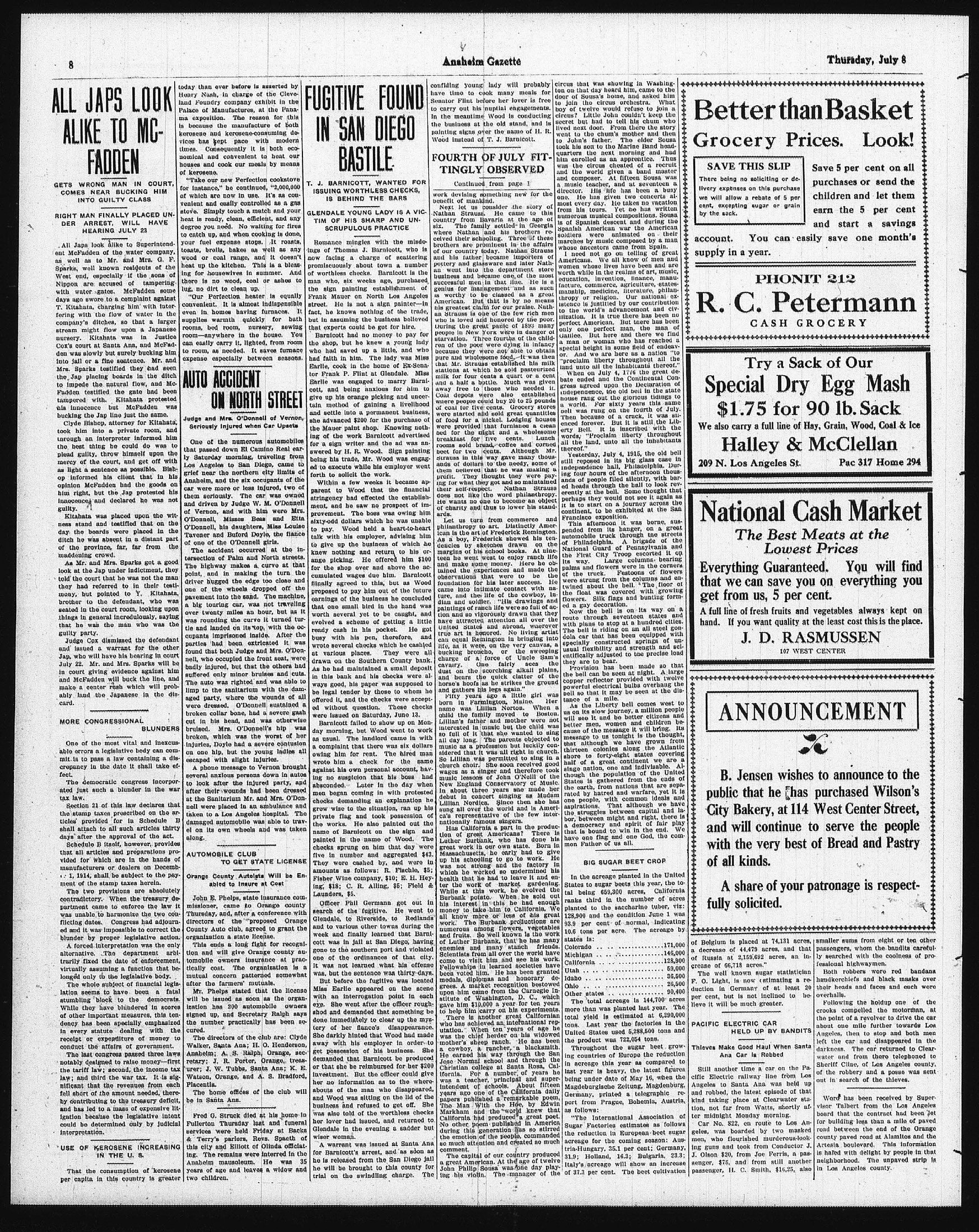
Searchable text
ALL JAPS LOOK ALIKE TO MC-FADDEN
GETS WRONG MAN IN COURT,
COMES NEAR BUCKING HIM INTO GUILTY CLASS
RIGHT MAN FINALLY PLACED UNDER ARREST, WILL HAVE HEARING JULY 23
All Japs look alike to Superintendent McFadden of the water company, as well as to Mr. and Mrs. G. F. Sparks, well known residents of the West end, especially if the sons of Nippon are accused of tampering with water gates. McFadden some days ago swore to a complaint against T. Kitahata, charging him with interfering with the flow of water in the company's ditches, so that a larger stream might flow upon a Japanese nursery. Kitahata was in Justice Cox's court at Santa Ana, and McFadden was slowly but surely bucking him into jail or a fine sentence. Mr. and Mrs. Sparks testified they had seen the Jap placing boards in the ditch to impede the natural flow, and McFadden testified the gate had been tampered with. Kitahata protested his innocence but McFadden was bucking the Jap line just the same.
Clyde Bishop, attorney for Kitahata, took him into a private room, and through an interpreter informed him the best thing he could do was to plead guilty, throw himself upon the today than ever before is asserted by Henry Nash, In charge of the Cleveland Foundry company exhibit in the Palace of Manufactures, at the Panama exposition. The reason for this is because the manufacture of both kerosene and kerosene-consuming devices has kept pace with modern times. Consequently it is both economical and convenient to heat our houses and cook our meals by means of kerosene.
"Take our new Perfection cookstove for instance," he continued, "2,000,000 of which are now in use. It's as convenient and easily controlled as a gas stove. Simply touch a match and your heat is ready, clean, efficient, and any degree you need. No waiting for fires to catch up, and when cooking is done, your fuel expense stops. It roasts, toasts, broilis, bakes as well as any wood or coal range, and it doesn't heat up the kitchen. This is a blessing for housewives in summer. And there is no wood, coal or ashes to lug, no dirt to clean up.
Our Perfection heater is equally convenient. It is almost indispensable even in homes having furnaces. It supplies warmth quickly for bath rooms, bed room, nursery, sewing room—anywhere in the house. You can easily carry it, lighted, from room to room, as needed. It saves furnace expense especially between seasons.
AUTO ACCIDENT ON NORTH STREET
Judge and Mrs. O'Donnell of Vernon, Seriously Injured when Car Upsets
One of the numerous automobiles that passed down El Camino Real early Saturday morning, traveling from today than ever before is asserted by Henry Nash, In charge of the Cleveland Foundry company exhibit in the Palace of Manufactures, at the Panama exposition. The reason for this is because the manufacture of both kerosene and kerosene-consuming devices has kept pace with modern times. Consequently it is both economical and convenient to heat our houses and cook our meals by means of kerosene.
"Take our new Perfection cookstove for instance," he continued, "2,000,000 of which are now in use. It's as convenient and easily controlled as a gas stove. Simply touch a match and your heat is ready, clean, efficient, and any degree you need. No waiting for fires to catch up, and when cooking is done, your fuel expense stops. It roasts, toasts, broilis, bakes as well as any wood or coal range, and it doesn't heat up the kitchen. This is a blessing for housewives in summer. And there is no wood, coal or ashes to lug, no dirt to clean up."
Our Perfection heater is equally convenient. It is almost indispensable even in homes having furnaces. It supplies warmth quickly for bathrooms, bed rooms, nursery, sewing room—anywhere in the house. You can easily carry it, lighted, from room to room, as needed. It saves furnace expense especially between seasons.
AUTO ACCIDENT ON NORTH STREET
Judge and Mrs. O'Donnell of Vernon, Seriously Injured when Car Upsets
One of the numerous automobiles that passed down El Camino Real early Saturday morning, traveling from today than ever before is asserted by Henry Nash, In charge of the Cleveland Foundry company exhibit in the Palace of Manufactures, at the Panama exposition. The reason for this is because the manufacture of both kerosene and kerosene-consuming devices has kept pace with modern times. Consequently it is both economical and convenient to heat our houses and cook our meals by means of kerosene.
"Take our new Perfection cookstove for instance," he continued, "2,000,000 of which are now in use. It's as convenient and easily controlled as a gas stove. Simply touch a match and your heat is ready, clean, efficient, and any degree you need. No waiting for fires to catch up, and when cooking is done, your fuel expense stops. It roasts, toasts, broilis, bakes as well as any wood or coal range, and it doesn't heat up the kitchen. This is a blessing for housewives in summer. And there is no wood, coal or ashes to lug, no dirt to clean up."
AUTO ACCIDENT ON NORTH STREET
Judge and Mrs. O'Donnell of Vernon, Seriously Injured when Car Upsets
One of the numerous automobiles that passed down El Camino Real early Saturday morning, traveling from Los Angeles to San Diego, came to grief near the northern city limits of Anaheim, and the six occupants of the car were more or less injured, two of them seriously. The car was owned and driven by Judge W. M. O'Donnell of Vernon, and with him were Mrs. O'Donnell, Misses Bess and Etta O'Donnell, his daughters, Miss Louise Tavener and Buford Doyle, the fliance of one of the O'Donnell girls.
The accident occurred at the intersection of Palm and North streets. The highway makes a curve at that point, and in making the turn the driver hugged the edge too close and one of the wheels dropped off the pavement into the sand. The machine, a big touring car, was not traveling over twenty miles an hour, but as it was rounding the curve it turned turtle and landed on its top, with the occupants imprisoned inside. After the parties had been extricated it was found that both Judge and Mrs. O'Donnell, who occupied the front seat, were badly injured, but that the others had suffered only minor bruises and cuts. The auto was righted and was able to limp to the sanitarium with the damaged party, where the wounds of all were dressed. O'Donnell sustained a broken collar bone, had a severe gash cut in his head, and was otherwise bruised. Mrs. O'Donnell's hip was broken, which was the worst of her injuries, Doyle had a severe contusion on one hip, but the young ladies all escaped with slight injuries.
A phone message to Vernon brought several anxious persons down in autos to look after the injured party, and after their wounds had been dressed at the Sanitarium Mr. and Mrs. O'Donnell were placed in an ambulance and taken to a Los Angeles hospital. The damaged automobile was able to travel on its own wheels and was taken along.
AUTOMOBILE CLUB TO GET STATE LICENSE
Within a few years parent to Woodland stringency had elicited and he savaged. The slxy-odd dollars to pay. Woodland talk with his emperor to give up the bus knew nothing any ange picking. He for the shop over cumulated wages finally agreed to proposed to pay his earnings of the bus that one small bus worth several years evolved a scheme ready cash in his busy with his wife wrote several checks at various places drawn on the Soil. As he had malnaught in this bank and ways good, his pay be legal tender offered it, and then ed without question were issued on S.
Barnicott failed day morning, but as usual. The law complaint that owing him for wrote him a chag against his own pains no suspicion absconded. Lawmen began combing demands grew wise to the private flag and the works. His name of Barnicott painted in the ricks checks sprung out five in number They were cash amounts as follows:
The democratic congress incorporated just such a blunder in the war tax law.
Section 21 of this law declares that the stamp taxes prescribed on the articles provided for in Schedule B shall attach to all such articles thirty days after the approval of the act.
Schedule B itself, however, provides that all articles and preparations provided for which are in the hands of manufacturers or dealers on December 1, 1914, shall be subject to the payment of the stamp taxes herein.
The two provisions are absolutely contradictory. When the treasury department came to enforce the law it was unable to harmonize the two conflicting dates. Congress had adjourned and it was impossible to correct the blunder by proper legislative action.
A forced interpretation was the only alternative. The department arbitrarily fixed the date of enforcement, virtually assuming a function that belonged only to the legislative body.
The whole subject of financial legislation seems to have been a fatal stumbling block to the democrats. While they have blundered in scores of other important measures, this tendency has been specially emphasized in every statute dealing with the receipt or expenditure of money to conduct the affairs of government.
The last congress passed three laws notably designed to raise money—first the tariff law; second, the income tax law; and third the war tax. It is significant that the revenues from each fell short of the amount needed, thereby contributing to the treasury deficit, and has led to a mass of expensive litigation because the legislative intent could be determined only by judicial interpretation.
USE OF KEROSENE INCREASING IN THE U.S.
That the consumption of kerosene per capita in this country is greater
several anxious persons down in autos to look after the injured party, and after their wounds had been dressed at the Sanitarium Mr. and Mrs. O'Donnell were placed in an ambulance and taken to a Los Angeles hospital. The damaged automobile was able to travel on its own wheels and was taken along.
AUTOMOBILE CLUB TO GET STATE LICENSE
Orange County Autoists Will be Enabled to Insure at Cost
John E. Phelps, state insurance commissioner, came to Orange county Thursday, and after a conference with directors of the proposed Orange County Auto club, agreed to grant the organization a state license.
This ends a long fight for recognition and will give Orange county automobile owners insurance at practically cost. The organization is a mutual concern patterned somewhat after the farmers' mutuals.
Mr. Phelps stated that the license will be issued as soon as the organization has 200 automobile owners signed up, and Secretary Ralph says the number practically has been secured.
The directors of the club are: Clyde Walker, Santa Ana; H. O. Henderson, Anaheim; A. S. Ralph, Orange, secretary; J. R. Porter, Orange, treasurer; J. W. Tubbs, Santa Ana; K. E. Watson, Orange, and A. S. Bradford, Placentia.
The home offices of the club will be in Santa Ana.
Fred G. Struck died at his home in Fullerton Thursday last and funeral services were held Friday at Backs & Terry's parlors, Revs. Spaeth of this city and Elliott of Olinda officiating. The remains were interred in the Anaheim mausoleum. He was 35 years of age and leaves a widow and two children.
But before the Miss Earlle app with an interrogation eye. She went ashod and demanded done immediately tery of her fiash.
She darkly hinted away with his o get possession of demanded that he or that she be re-investment. But her no information abouts of the man and Wood was sl business and ref was also told of her lover had iss Glendale in the wiser woman.
A warrant was for Barnicott's al he is released from he will be brought trial on the sw
FUGITIVE FOUND IN SAN DIEGO BASTILE.
T. J. BARNICOTT, WANTED FOR ISSUING WORTHLESS CHECKS, IS BEHIND THE BARS
GLENDALE YOUNG LADY IS A VICTIM OF HIS SHARP AND UNSCRUPULOUS PRACTICE
Romance mingles with the misdoings of Thomas J. Barnicott, who is now facing a charge of scattering promiscuously about town a number of worthless checks. Barnicott is the man who, six weeks ago, purchased the sign painting establishment of Frank Mauer on North Los Angeles street. He is not a sign painter—in fact, he knows nothing of the trade, but in assuming the business believed that experts could be got for hire.
Barnicott had no money to pay for the shop, but he knew a young lady who had saved up a little, and who had faith in him. The lady was Miss Earlele, cook in the home of Ex-Senator Frank P. Flint at Glendale. Miss Earlele was engaged to marry Barnicott, and being anxious for him to give up his orange pickling and uncertain method of gaining a livelihood and settle into a permanent business, she advanced $200 for the purchase of the Mauer paint shop. Knowing nothing of the work Barnicott advertised for a sign writer and the ad was answered by H. R. Wood. Sign painting being his trade, Mr. Wood was engaged young lady will probably have time to cook many meals for Senator Flint before her lover is free to carry out his nuptial engagements. In the meantime Wood is conducting the business at the old stand, and is painting signs over the name of H. R. Wood instead of T. J. Barnicott.
FOURTH OF JULY FIT-TINGLY OBSERVED
Continued from page 1
work devising something new for the benefit of mankind.
Next let us consider the story of Nathan Strauss. He came to this country from Bavaria at the age of six. The family settled in Georgia where Nathan and his brothers received their schooling. Three of these brothers are prominent in the affairs of our country today. Nathan Strauss and his father became importers of pottery and glassware and later Nathan went into the department store business and became one of the most successful men in that line. He is a genius for management and as such is worthy to be classed as a great American. But that is by no means his greatest claim for our praise. Nathan Strauss is one of the few rich men who is loved and honored by the poor. During the great panic of 1893 many people in New York were in danger of starvation. Three fourths of the children of the poor were dying in infancy because they were not able to obtain pure and wholesome food. It was then that Mr. Strauss established his milk stations at which he sold pasteurized milk for four cents a quart or a cent and a half a bottle. Much was given away free to those who needed it. Coat depots were also established where people could buy 20 to 25 pounds of coal for five cents. Grocery stores were started and sold great quantities of food for a nickel. Lodging houses were provided that furnished a clean bed for the night and a wholesome breakfast for five cents. Lunch rooms sold bread, coffee and corned beef for two cents. Although Mr. Strauss in this way gave many thousands of young ladies will probably have time to cook many meals for Senator Flint before her lover is free to carry out his nuptial engagements. In the meantime Wood is conducting the business at the old stand, and is painting signs over the name of H. R. Wood instead of T. J. Barnicott.
FOURTH OF JULY FIT-TINGLY OBSERVED
Continued from page 1
work devising something new for the benefit of mankind.
Next let us consider the story of Nathan Strauss. He came to this country from Bavaria at the age of six. The family settled in Georgia where Nathan and his brothers received their schooling. Three of these brothers are prominent in the affairs of our country today. Nathan Strauss and his father became importers of pottery and glassware and later Nathan went into the department store business and became one of the most successful men in that line. He is a genius for management and as such is worthy to be classed as a great American. But that is by no means his greatest claim for our praise. Nathan Strauss is one of the few rich men who is loved and honored by the poor. During the great panic of 1893 many people in New York were in danger of starvation. Three fourths of the children of the poor were dying in infancy because they were not able to obtain pure and wholesome food. It was then that Mr. Strauss established his milk stations at which he sold pasteurized milk for four cents a quart or a cent and a half a bottle. Much was given away free to those who needed it. Coat depots were also established where people could buy 20 to 25 pounds of coal for five cents. Grocery stores were started and sold great quantities of food for a nickel. Lodging houses were provided that furnished a clean bed for the night and a wholesome breakfast for five cents. Lunch rooms sold bread, coffee and corned beef for two cents.
circus that was showing in Washington on that day heard him, came to the door of Sousa's home, and asked him to join the circus orchestra. What boy of twelve would refuse to join a circus? Little John couldn't keep the secret but had to tell his chum who lived next door. From there the story went to the chum's mother and then to John's father. The elder Sousa took his son to the Marine Band headquarters the next morning and had him enrolled as an apprentice. Thus was the circus cheated of a recruit and the world given a band master and composer. At fifteen Sousa was a music teacher, and at seventeen a director. His life has been a busy one. He has given two concerts almost every day. He takes no vacation from his tours. Yet he has written numerous musical compositions. Sousa is of Spanish descent and during the Spanish American war the American soldiers were animated on their marches by music composed by a man whose ancestors came from Spain.
I need not go on telling of great Americans. We all know of men and women whose lives have been and are worth while in the realms of art, music, education, invention, finance, manufacture, commerce, agriculture, statesmanship, medicine, literature, philanthropy or religion. Our national existence is justified by our contribution to the world's advancement and civilization. It is true there has been no perfect American. But there has been only one perfect man, the man of Gaulle.
But here and there we find a man or woman who has reached a special height in some field of endeavor. And we are here as a nation "to proclaim liberty throughout all the land unto all the inhabitants thereof."
When on July 4, 1776 the great debate ended and the Continental Congress agreed upon the Declaration of independence, the old boil in the state house rang out the glorious tidings to a world. For sixty years this same bell was rung on the fourth of July. Then because of a crack, it was suenced forever. But it is still the Liberty Bell. It is inscribed with the words, "Proclaim liberty throughout all the land, unto all the inhabitants thereof."
Yesterday, July 4, 1915, the old bell
Earlie, cook in the home of Ex-Senator Frank P. Flint at Glendale. Miss Earlie was engaged to marry Barnicott, and being anxious for him to give up his orange picking and uncertain method of gaining a livelihood and settle into a permanent business, she advanced $200 for the purchase of the Mauer paint shop. Knowing nothing of the work Barnicott advertised for a sign writer and the ad was answered by H. R. Wood. Sign painting being his trade, Mr. Wood was engaged to execute while his employer went forth to solicit the work.
Within a few weeks it became apparent to Wood that the financial stringency had effected the establishment, and he saw no prospect of improvement. The boss was owing him ally-odd dollars which he was unable to pay. Wood held a heart-to-heart talk with his employer, advising him to give up the business of which he knew nothing and return to his orange picking. He offered him $100 for the shop over and above the accumulated wages due him. Barnicott finally agreed to this, but as Wood proposed to pay him out of the future earnings of the business he concluded that one small bird in the hand was worth several yet to be caught, and evolved a scheme of getting a little ready cash in his pocket. He got busy with his pen, therefore, and wrote several checks which he cashed at various places. They were all drawn on the Southern County bank. As he had maintained a small deposit in this bank and his checks were always good, his paper was supposed to be legal tender by those to whom he offered it, and the checks were accepted without question. These checks were issued on Saturday, June 13.
Barnicott failed to show up on Monday morning, but Wood went to work as usual. The landlord came in with a complaint that there was six dollars owing him for rent. The hired man wrote him a check for the same against his own personal account, having no suspicion that his boss had absconded. Later in the day when men began coming in with protested checks demanding an explanation he grew wise to the situation, ran up his private flag and took possession of the works. He also painted out the name of Barnicott on the sign and painted in the name of Wood. The checks sprung on him that day were five in number and aggregated $43. They were cashed by, and were in amounts as follows: R. Fischle $5;
Mr. Strauss established his milk stations at which he sold pasteurized milk for four cents a quart or a cent and a half a bottle. Much was given away free to those who needed it. Coat depots were also established where people could buy 20 to 25 pounds of coal for five cents. Grocery stores were started and sold great quantities of food for a nickel. Lodging houses were provided that furnished a clean bed for the night and a wholesome breakfast for five cents. Lunch rooms sold bread, coffee and corned beef for two cents. Although Mr. Strauss in this way gave many thousands of dollars to the needy, some of them believed that he was making a profit. They thought they were paying for what they got and so maintained their self-respect. Nathan Strauss does not like the word philanthropy. He wants no one to become an object of charity and thus to lower his standards.
Let us turn from commerce and philanthropy to art. Distinctly American is the art of Frederick Remington. As a boy, Frederick showed his tendencies by sketches drawn on the margins of his school books. At nineteen he went west to enjoy ranch life and make some money. Here he obtained the experiences and made the observations that were to be the foundation for his later success. He came into intimate contact with nature, and the life of the cowboy, Indian and soldier. "His drawings and paintings of ranch life were so full of action and so vigorously drawn that they have attracted attention all over the United States and abroad, wherever true art is honored. No living artist can equal Remington in bringing into life, as it were, on the very canvas, a bucking broncho, or the sweeping charge of a force of Uncle Sam's cavalry. One fairly sees the dust on the scorching alkali plains, and hears the quick clatter of the horse's hoofs as he strikes the ground and gathers his legs again."
Fifty years ago a little girl was born in Farmington, Maine. Her name was Lillian Norton. When a child the family moved to Boston. Lillian's father and mother were not interested in music but the child was so full of it that she wanted to sing all day long. The parents objected to music as a profession but luckily considered that it was all right in church. So Lillian was permitted to sing in a church choir. She soon received good wages as a singer and therefore took music lessons of John O'Neill of the New England Conservatory of Music. In about three years she made her debut in concert singing as Madam Lillian Nordica. Since then she has sung all over the world and is America's representative of the few internationally famous singers.
Has California a part in the production of great Americans? There is Luther Burbank, who has done his great work in our own state. Born in Massachusetts, he early had to give up his schooling to go to work. He was not strong and the factory in that Mr. Strauss established his milk stations at which he sold pasteurized milk for four cents a quart or a cent and a half a bottle. Much was given away free to those who needed it. Coal depots were also established where people could buy 20 to 25 pounds of coal for five cents. Grocery stores were started and sold great quantities of food for a nickel. Lodging houses were provided that furnished a clean bed for the night and a wholesome breakfast for five cents. Lunch rooms sold bread, coffee and corned beef for two cents. Although Mr. Strauss in this way gave many thousands of dollars to the needy, some of them believed that he was making a profit for what they got and so maintained their self-respect.
Nathan Strauss does not like the word philanthropy. He wants no one to become an object of charity and thus to lower his standards.
Let us turn from commerce and philanthropy to art. Distinctly American is the art of Frederick Remington. As a boy, Frederick showed his tendencies by sketches drawn on the margins of his school books. At nineteen he went west to enjoy ranch life and make some money. Here he obtained the experiences and made the observations that were to be the foundation for his later success. He came into intimate contact with nature, and the life of the cowboy, Indian and soldier. "His drawings and paintings of ranch life were so full of action and so vigorously drawn that they have attracted attention all over the United States and abroad, wherever true art is honored. No living artist can equal Remington in bringing into life, as it were, on the very canvas, a bucking broncho, or the sweeping charge of a force of Uncle Sam's cavalry. One fairly sees the dust on the scorching alkali plains, and hears the quick clatter of the horse's hoofs as he strikes the ground and gathers his legs again."
Fifty years ago a little girl was born in Farmington, Maine. Her name was Lillian Norton. When a child the family moved to Boston. Lillian's father and mother were not interested in music but the child was so full of it that she wanted to sing all day long. The parents objected to music as a profession but luckily considered that it was all right in church. So Lillian was permitted to sing in a church choir. She soon received good wages as a singer and therefore took music lessons of John O'Neill of the New England Conservatory of Music. In about three years she made her debut in concert singing as Madam Lillian Nordica. Since then she has sung all over the world and is America's representative of the few internationally famous singers.
Has California a part in the production of great Americans? There is Luther Burbank, who has done his great work in our own state. Born in Massachusetts, he early had to give up his schooling to go to work. He was not strong and the factory in that Mr. Strauss established his milk stations at which he sold pasteurized milk for four cents a quart or a cent and a half a bottle. Much was given away free to those who needed it. Coal depots were also established where people could buy 20 to 25 pounds of coal for five cents. Grocery stores were started and sold great quantities of food for a nickel. Lodging houses were provided that furnished a clean bed for the night and a wholesome breakfast for five cents. Lunch rooms sold bread, coffee and corned beef for two cents.
Although Mr. Strauss in this way gave many thousands of dollars to the needy, some of them believed that he was making a profit for what they got and so maintained their self-respect.
Nathan Strauss does not like the word philanthropy. He wants no one to become an object of charity and thus to lower his standards.
Let us turn from commerce and philanthropy to art. Distinctly American is the art of Frederick Remington. As a boy, Frederick showed his tendencies by sketches drawn on the margins of his school books. At nineteen he went west to enjoy ranch life and make some money. Here he obtained the experiences and made the observations that were to be the foundation for his later success. He came into intimate contact with nature, and the life of the cowboy, Indian and soldier. "His drawings and paintings of ranch life were so full of action and so vigorously drawn that they have attracted attention all over the United States and abroad, whereas true art is honored. No living artist can equal Remington in bringing into life, as it were, on the very canvas, a bucking broncho, or the sweeping charge of a force of Uncle Sam's cavalry. One fairly sees the dust on the scorching alkali plains, and hears the quick clatter of the horse's hoofs as he strikes the ground and gathers his legs again."
Fifty years ago a little girl was born in Farmington, Maine. Her name was Lillian Norton. When a child the family moved to Boston. Lillian's father and mother were not interested in music but the child was so full of it that she wanted to sing all day long. The parents objected to music as a profession but luckily considered that it was all right in church. So Lillian was permitted to sing in a church choir. She soon received good wages as a singer and therefore took music lessons of John O'Neill of the New England Conservatory of Music. In about three years she made her debut in concert singing as Madam Lillian Nordica. Since then she has sung all over the world and is America's representative of the few international famous singers.
Has California a part in the production of great Americans? There is Luther Burbank, who has done his great work in our own state. Born in Massachusetts, he early had to give up his schooling to go to work. He was not strong and the factory in that Mr. Strauss established his milk stations at which he sold pasteurized milk for four cents a quart or a cent and a half a bottle. Much was given away free to those who needed it. Coal depots were also established where people could buy 20 to 25 pounds of coal for five cents. Grocery stores were started and sold great quantities of food for a nickel. Lodging houses were provided that furnished a clean bed for the night and a wholesome breakfast for five cents.
Lunch rooms sold bread, coffee and corned beef for two cents.
Although Mr. Strauss in this way gave many thousands of dollars to the needy, some of them believed that he was making a profit for what they got and so maintained their self-respect.
Nathan Strauss does not like the word philanthropy. He wants no one to become an object of charity and thus to lower his standards.
Let us turn from commerce and philanthropy to art. Distinctly American is the art of Frederick Remington. As a boy, Frederick showed his tendencies by sketches drawn on the margins of his school books. At nineteen he went west to enjoy ranch life and make some money. Here he obtained the experiences and made the observations that were to be the foundation for his later success.
He came into intimate contact with nature, and the life of the cowboy, Indian and soldier." His drawings and paintings of ranch life were so full of action and so vigorously drawn that they have attracted attention all over the United States and abroad, whereas true art is honored.
No living artist can equal Remington in bringing into life, as it were, on the very canvas, a bucking broncho, or the sweeping charge of a force of Uncle Sam's cavalry.
One fairly sees the dust on the scorching alkali plains, and hears the quick clatter of the horse's hoofs as he strikes the ground and gathers his legs again."
Fifty years ago a little girl was born in Farmington, Maine. Her name was Lillian Norton. When a child the family moved to Boston.Lillian's father和mother were not interested in music butthe child was so fullofitthatshewantedtosingalldaylong.Theparentsobjectedtomusicasaprofessionbutluckilyconsideredthatitwasallrightinchurch.SoLillianwaspermittedtosinginachurchchoir.She soonreceivedgoodwagesasa singerandthereforetookmusicallessonsofJohnO'NeilloftheNewEnglandConservatoryofMusic.InaboutthreeyearsshemadeherdebutinconcertsingingasMadamLillianNordica.Sincethenshehas sungallovertheworldandisAmerica'srepresentativeofthefewinternationalfamoussingers.
Has Californiaa partinproductiongreatAmericans?ThereisLutherBurbankwhohasdonehisgreatworkinourownstate.BorninMassachusettsheearlyhadtogiveuphishoollingtogowork.Hewasnotstrongandthefactoryinhandontalltheinhabitantsthereof."
When on July 4, 1776thedebateended upontheContinentalCongressagreedupontheDeclarationofindependence,theoldbellinthehouserangouttheglorioustidingstoaworld.Forsixyearsthisdellainthelanduntoalltheinhabitantsthereof."
Yesterday,July4,1975,theoldbellinthehouserangouttheglorioustidingstoaworld.Forsixyearsthisdellainthelanduntoalltheinhabitantsthereof."
Yesterday,July4,1975,theoldbellinthehouserangouttheglorioustidingstoaworld.Forsixyearsthisdellainthelanduntoalltheinhabitantsthereof."
Yesterday,July4,1975,theoldbellinthehouserangouttheglorioustidingstoaworld.Forsixyearsthisdellainthelanduntoalltheinhabitantsthereof."
Yesterday,July4,1975,theoldbellinthehouserangouttheglorioustidingstoaworld.Forsixyearsthisdellainthelanduntoalltheinhabitantsthereof."
Yesterday,July4,1975,theoldbellinthehouserangouttheglorioustidingstoaworld.Forsixyearsthisdellaintheland untoalltheinhabitantsthereof."
Yesterday,July4,1975,theoldbellinthehouserangouttheglorioustidingstoaworld.Forsixyearsthisdellaintheland untoalltheinhabitantsthereof."
Yesterday,July4,1975,theoldbellinthehouserangouttheglorioustidingstoaworld.Forsixyearsthisdellaintheland untoalltheinhabitantsthereof."
Yesterday,July4,1975,theoldbellinthehouserangouttheglorioustidingstoaworld.Forsixyearsthisdellaintheland untoalltheinhabitantsthereof."
Yesterday,July4,1975,theoldbellinthehouserangouttheglorioustidingstoaworld.Forsixyearsthisdellaintheland untoalltheinhabitantsthereof."
Yesterday,July4,1975,theoldbellinthehouserangoutthegloroustidingstoaworld.Forsixyearsthisdellaintheland untoalltheinhabitantsthereof."
Yesterday,July4,1975,theoldbellinthehouserangoutthegloroustidingstoa世界.Forsixyearsthisdellaintheland untoalltheinhabitantsthereof."
Yesterday,July4,1975,theoldbellin.thehouserangout.thegloroustidings.to.a.world.frank.powerful.electrical.bulbs_overhang.the bell.soThat.itmaybeseenat.the.distance.of.a.mile.
AsTheLiberty bell comes west to us on its slow journey,a million people will see it and be better citizens and better men; women and children because of-themessage-itwill bring.Its message-to-us tonight is thought.Its thought-it will be thought.Its thought-it will be thought.Its thought-it will be thought.Its thought-it will be thought.Its thought-it will be thought.Its thought-it will be thought.Its thought-it will be thought.Its thought-it will be thought.Its thought-it will be thought.Its thought-it will be thought.Its thought-Its thought-Its thought-Its thought-Its thought-Its thought-Its thought-Its thought-Its thought-Its thought-Its thought-Its thought-Its thought-Its thought-Its thought-Its thought-Its thought-Its thought-Its thought-Its thought-Its thought-Its thought-Its thought-Its thought-Its thought-Its thought-Its thought-Its thoughts.Its thoughts.Its thoughts.Its thoughts.Its thoughts.Its thoughts.Its thoughts.Its thoughts.Its thoughts.Its thoughts.Its thoughts.Its thoughts.Its thoughts.Its thoughts.Its thoughts.Its thoughts.Its thoughts.Its thoughts.Its thoughts.Its thoughts.Its thoughts.Its thoughts.Iits thoughts.Iits thoughts.Iits thoughts.Iits thoughts.Iits thoughts.Iits thoughts.Iits thoughts.Iits thoughts.Iits thoughts.Iits thoughts.Iits thoughts.Iits thoughts.Iits thoughts.Iits thoughts.Iits thoughts.Iits thoughts.Iits thoughts.Iits thoughts.Iits thoughts.Iits thoughts.Iits thoughts.Iits thoughts.Iits thoughts.Iits thoughts.Iits thoughts.Iits thoughts.Iits thoughts.Iitsthoughts.Iitsthoughts.Iitsthoughts.Iitsthoughts.Iitsthoughts.Iitsthoughts.Iitsthoughts.Iitsthoughts.Iitsthoughts.Iitsthoughts.Iitsthoughts.Iitsthoughts.Iitsthoughts.Iitsthoughts.Iitsthoughts.Iitsthoughts.Iitsthoughts.Iitsthoughts.Iitsthoughts.Iitsthoughts.Iitsthoughts.little.thoughts.little.thoughts.little.thoughts.little.thoughts.little.thoughts.little.thoughts.little.thoughts.little.thoughts.little.thoughts.little.thoughts.little.thoughts.little.thoughts.little.thoughts.little.thoughts.little.thoughts.little.thoughts.little.thoughts.little.thoughts.little.thoughts.little.thoughts.little.thoughtslittle.thoughtslittle.thoughtslittle.thoughtslittle.thoughtslittle.thoughslittle.thoughslittle.thoughslittle.thoughslittle.thoughslittle.thoughslittle.thoughslittle.thoughslittle.thoughslittle.thoughslittle.thoughslittle.thoughslittle.thoughslittle.thoughslittle.thoughslittle.thoughslittle.thoughslittle.thoughslittle.thoughslittle.thoughslittethoughtslittethoughtslittethoughtslittethoughtslittethoughtslittethoughtslittethoughtslittethoughtslittethroughtslittethroughtslittethroughtslittethroughtslittethroughtslittethroughtslittethroughtslittethroughtslittethroughtslittethroughtslittethroughtslittethroughtslittethroughtslittethroughtslittethroughtslittethroughtslittethroughtslittethroughtslittethroughtslittethroughtslittethroughtslittethrought slittethoughtslittethoughtslittethoughtslittethoughtslittethoughtslittethoughtslittethoughtslittethoughtslittethroughtslittethroughtslittethroughtslittethroughtslittethroughtslittethroughtslittethroughtslittethroughtslittethroughtslittethroughtslittethroughtslittethrought slittethoughtslittethoughtslittethoughtslittethoughtslittethrought slittethoughtslittethought slittethought slittETHOTHOTHOTHOTHOTHOTHOTHOTHOTHOTHOTHOTHOTHOTHOTHOTHOTHOTHOTHOTHOTHOTHOTHOTHOTHOTHOTHOTHOTHOTHOTHOTHOTHOTHOTHOTHOTHOTHOTHOTHOTHOTHOTHOTHOTHOTHOTHOTHOTHOTHOT HOTHOTHOTHOTHOTHOTHOTHOTHOTHOTHOTHOTHOTHOTHOTHOTHOTHOTHOTHOTHOTHOTHOTHOTHOTHотнотнотнотнотнотнотнотнотнотнотнотнотнотнотнотнотнотнотнотнотнотнотнотнотнотнотнотнотнотнотнотнотнотнотнотнотнотнотнотнотнотнотнотнотнотнотнтнтнтнтнтнтнтнтнтнтнтнтнтнтнтнтнтнтнтнтнтнтнтнтнтнтнтнтнтнтнтнтнтнтнтнеттнеттнеттнеттнеттнеттнеттнеттнеттнеттнеттнеттнеттнеттнеттнеттнеттнеттнеттнеттнеттнеттнеттнеттнеттнеттнеттнеттнетт нетт нетт нетт нетт нетт нетт нетт нетт нетт нетт нетт нетт нетт Нет Нет Нет Нет Нет Нет Нет Нет Нет Нет Нет Нет Нет Нет Нет Нет Нет Нет Нет Нет Нет Нет Нет Нет Нет Нет Нет Нет Нет Нет Нет Нет Нет Нет Нет Нет Нет Нет Нет Нет Нет Нет Нет Нет Нет Нет Нет Нет Нет Нет Нет Нет Нет Нет Нет Нет Нет Нет Нет Нет Нов Нов Нов Нов Нов Нов Нов Нов Нов Нов Нов Нов Нов Нов Нов Нов Нов Нов Нов Нов Нов Нов Нов Нов Нов Нов Нов Нов Нов Нов НовНов НовНовНовНовНовНовНовНовНовНовНовНовНовНовНовНовНовНовНовНовНовНовНовНовНовНовНовНовНовНовНовНовНовНовНовНовНовНовНовновновновновновновновновновновновновновновновновновновновновновновновновновновновновновновновновновновновновновповновповповповповповповповповповповповповповповповповповповповповповповповповповповповповповповповповповповповповповповповповпровиновиновиновиновиновиновиновиновиновиновиновиновиновиновиновиновинововниковиновникововникововникововникововникововникововникововникововникововникововникововникововникововникововникововникововникововникововникововникововникововникововникововникововникововникововникововникововникововникововникововникововникововникововникововниковcovnovcovnovcovnovcovnovcovnovcovnovcovnovcovnovcovnovcovnovcovnovcovnovcovnovcovnovcovnovcovnovcovnovcovnovcovnovcovnovcovnovcovnovcovnovcovnovcovnovcovnovcovnovcovnovcovnovcovnovcovnovcovnovcovnovcovnovcovnovcovnovcovnovcovnovcovnovcovnovcovnovcovnovcovnovcovnovcovnovcovnovcovnovcovnov covNov covNov covNov covNov covNov covNov covNov covNov covNov covNov covNov covNov covNov covNov covNov covNov covNov covNov covNov covNov covNov covNov covNov covNov covNov covNov covNov covNov covNov covNov covNov covNov covNov covNov covNov covNov covNov covNov covNov covNov covNov cv Nov cv Nov cv Nov cv Nov cv Nov cv Nov cv Nov cv Nov cv Nov cv Nov cv Nov cv Nov cv Nov cv Nov cv Nov cv Nov cv Nov cv Nov cv Nov cv Nov cv Nov cv Nov cv Nov cv Nov cv Nov cv Nov cv Nov cv Nov cv Nov cv Nov cv Nov cv Nov cv Nov cv Nov cv Nov cv Nov cv Nov cv Nov cv Nov cv Nov cv Nov cv Nov cv Nov cv Nov cv NovcvNovcvNovcvNovcvNovcvNovcvNovcvNovcvNovcvNovcvNovcvNovcvNovcvNovcvNovcvNovcvNovcvNovcvNovcvNovcvNovcvNovcvNovcvNovcvNovcvNovcvNovcvNovcvNovcvNovcvNovcvNovcvNovcvNovcvNovcvNovcvNovcvNovcvNovcvNovcvNovcvNovcvNovcvNovcvNovcvNovcvNovcvNovcvNovcvNovcvNovcvNovcvNovcvNovcvNovcvNovcvNovcvNovcvNovcvNovcvNovcvNovcvNovcvNovcvNovcvNovcvNovcvNovcvNovcvNovcvNovcvNovcvNovcvNovcvNovcvNovcvNovcvNovcvNovcsvNovcsvNovcsvNovcsvNovcsvNovcsvNovcsvNovcsvNovcsvNovcsvNovcsvNovcsvNovcsvNov.csvNov.csvNov.csvNov.csvNov.csvNov.csvNov.csvNov.csvNov.csvNov.csvNov.csvNov.csvNov.csvNov.csvNov.csvNov.csvNov.csvNov.csvNov.csvNov.csvNOVCVNOVCVNOVCVNOVCVNOVCVNOVCVNOVCVNOVCVNOVCVNOVCVNOVCVNOVCVNOVCVNOVCVNOVCVNOVCVNOVCVNOVCVNOVCVNOVCVNOVCVNOVCVNOVCVNOVCVNOVCVNOVCVNOVCVNOVCVNOVCVNOVCVNOVCVNOV CV NOV CV NOV CV NOV CV NOV CV NOV CV NOV CV NOV CV NOV CV NOV CV NOV CV NOV CV NOV CV NOV CV NOV CV NOV CV NOV CV NOV CV NOV CV NOV CV NOV CV NOV CV NOV CV NOV CV NOV CV NOV CV NOV CV NOV CV NOV CV NOV CV NOV CV NOV CV NOV CV NOVCNVNOVCNVNOVCNVNOVCNVNOVCNVNOVCNVNOVCNVNOVCNV
ING no suspicion that his boss had absconded. Later in the day when men began coming in with protested checks demanding an explanation he grew wise to the situation, ran up his private flag and took possession of the works. He also painted out the name of Barnicott on the sign and painted in the name of Wood. The checks sprung on him that day were five in number and aggregated $43. They were cashed by, and were in amounts as follows: R. Fischle, $5; Fisher Wine company, $10; E. H. Heying, $18; C. R. Alling, $5; Field & Launders, $5.
Officer Phil Germann got out in search of the fugitive. He went to Glendale, to Riverside, to Redlands and to various other towns during the week and finally learned that Barnicott was in jail at San Diego, having gone to the southern port and violated one of the ordinances of that city. It was not learned what his offense was, but the sentence was thirty days.
But before the fugitive was located Miss Earle appeared on the scene with an interrogation point in each eye. She went after the officer rough-shod and demanded that something be done immediately to clear up the mystery of her flame's disappearance. She darkly hinted that Wood had made away with his employer in order to get possession of his business. She demanded that Barnicott be produced or that she be reimbursed for her $200 investment. But the officer could give her no information as to the whereabouts of the man who disappeared, and Wood was sitting on the lid of the business and refused to get off. She was also told of the worthless checks her lover had issued, and returned to Glendale in the evening a sadder but wiser woman.
A warrant was issued at Santa Ana for Barnicott's arrest, and as soon as he is released from the San Diego jail he will be brought to this county for trial on the swindling charge. The music lessons of John O'Neill of the New England Conservatory of Music. In about three years she made her debut in concert singing as Madam Lillian Nordica. Since then she has sung all over the world and is America's representative of the few internationally famous singers.
Has California a part in the production of great Americans? There is Luther Burbank, who has done his great work in our own state. Born in Massachusetts, he early had to give up his schooling to go to work. He was not strong and the factory in which he worked so undermined his health that he had to leave it and enter the work of market gardening. While at this work, he evolved the Burbank potato. When he sold out his interest in this he had enough money to take him to California. We all know more or less of his great work. The Burbank productions are numerous among flowers, vegetables and fruits. So well known is the work of Luther Burbank, that he has many enemies and many stanch friends. Scientists from all over the world have come to visit him and see his work. Fellowships in learned societies have been voted him. He has been granted medals, diplomas and honorary degrees. A market recognition bestowed upon him came from the Carnegie Institute of Washington, D. C., which gave him $10,000 a year for ten years to help him carry on his experiments.
There is another great Californian who has achieved an international reputation. When ten years of age he was the chief herder on his widowed mother's sheep ranch. He has been a cowboy, a rancher, a blacksmith. He earned his way through the San Jose Normal school and through the Christian college at Santa Rosa, California. For a number of years he was a teacher, principal and superintendent of schools. About fifteen years ago one of the California daily papers published a remarkable poem, The Man With the Hoe, by Edwin Markham and the world knew that California had produced a great poet. No other poem published in America during this generation has so stirred the emotion of the people, commanded so much attention and created so much comment.
The capital of our country produced a great American. At the age of twelve John Philip Sousa was one day playing his violin. The manager of the music lessons of John O'Neill of the New England Conservatory of Music. In about three years she made her debut in concert singing as Madam Lillian Nordica. Since then she has sung all over the world and is America's representative of the few internationally famous singers.
Has California a part in the production of great Americans? There is Luther Burbank, who has done his great work in our own state. Born in Massachusetts, he early had to give up his schooling to go to work. He was not strong and the factory in which he worked so undermined his health that he had to leave it and enter the work of market gardening. While at this work, he evolved the Burbank potato. When he sold out his interest in this he had enough money to take him to California. We all know more or less of his great work. The Burbank productions are numerous among flowers, vegetables and fruits. So well known is the work of Luther Burbank, that he has many enemies and many stanch friends. Scientists from all over the world have come to visit him and see his work. Fellowships in learned societies have been voted him. He has been granted medals, diplomas and honorary degrees. A market recognition bestowed upon him came from the Carnegie Institute of Washington, D. C., which gave him $10,000 a year for ten years to help him carry on his experiments.
There is another great Californian who has achieved an international reputation. When ten years of age he was the chief herder on his widowed mother's sheep ranch. He has been a cowboy, a rancher, a blacksmith. He earned his way through the San Jose Normal school and through the Christian college at Santa Rosa, California. For a number of years he was a teacher, principal and superintendent of schools. About fifteen years ago one of the California daily papers published a remarkable poem, The Man With the Hoe, by Edwin Markham and the world knew that California had produced a great poet. No other poem published in America during this generation has so stirred the emotion of the people, commanded so much attention and created so much comment.
The capital of our country produced a great American. At the age of twelve John Philip Sousa was one day playing his violin. The manager of the music lessons of John O'Neill of the New England Conservatory of Music. In about three years she made her debut in concert singing as Madam Lillian Nordica. Since then she has sung all over the world and is America's representative of the few internationally famous singers.
Has California a part in the production of great Americans? There is Luther Burbank, who has done his great work in our own state. Born in Massachusetts, he early had to give up his schooling to go to work. He was not strong and the factory in which he worked so undermined his health that he had to leave it and enter the work of market gardening. While at this work, he evolved the Burbank potato. When he sold out his interest in this he had enough money to take him to California. We all know more or less of his great work. The Burbank productions are numerous among flowers, vegetables and fruits. So well known is the work of Luther Burbank, that he has many enemies and many stanch friends. Scientists from all over the world have come to visit him and see his work. Fellowships in learned societies have been voted him. He has been granted medals, diplomas and honorary degrees. A market recognition bestowed upon him came from the Carnegie Institute of Washington, D. C., which gave him $10,000 a year for ten years to help him carry on his experiments.
There is another great Californian who has achieved an international reputation. When ten years of age he was the chief herder on his widowed mother's sheep ranch. He has been a cowboy, a rancher, a blacksmith. He earned his way through the San Jose Normal school and through the Christian college at Santa Rosa, California. For a number of years he was a teacher, principal and superintendent of schools. About fifteen years ago one of the California daily papers published a remarkable poem, The Man With the Hoe, by Edwin Markham and the world knew that California had produced a great poet. No other poem published in America during this generation has so stirred the emotion of the people, commanded so much attention and created so much comment.
The capital of our country produced a great American. At the age of twelve John Philip Sousa was one day playing his violin. The manager of the music lessons of John O'Neill of the New England Conservatory of Music. In about three years she made her debut in concert singing as Madam Lillian Nordica. Since then she has sung all over the world and is America's representative of the few internationally famous singers.
Has California a part in the production of great Americans? There is Luther Burbank, who has done his great work in our own state. Born in Massachusetts, he early had to give up his schooling to go to work. He was not strong and the factory in which he worked so undermined his health that he had to leave it and enter the work of market gardening. While at this work, he evolved the Burbank potato. When he sold out his interest in this he had enough money to take him to California. We all know more or less of his great work. The Burbank productions are numerous among flowers, vegetables and fruits. So well known is the work of Luther Burbank, that he has many enemies and many stanch friends. Scientists from all over the world have come to visit him and see his work.Fellowships in learned societies have been voted him. He has been granted medals, diplomas and honorary degrees.A market recognition bestowed upon him came from the Carnegie Institute of Washington, D.C., which gave him $10,000 a year for ten years to help him carry on his experiments.
There is another great Californian who has achieved an international reputation. When ten years of age he was the chief herder on his widowed mother's sheep ranch。他 has been a cowboy,a rancher,a blacksmith.他 earned his way throughthe San Jose Normal schoolandthroughtheChristiancollegeatSantaRosaCalifornia.for.a.number.of.yearsagooneoftheCaliforniadailypaperspublishedareremarkablepoem.TheManWiththeHoe,bydelinMarkhamandtheworldknewthatCaliforniahadproduceda.greatpoet.NootherpoempublishedInAmericaduringthisgenerationhasso stirredtheemotionofthepeoplecommandedsoMuchattentionandcreatedsoMuchcomment.
The capital of our country produceda.greatAmerican.AttheageoftwelveJohnPhilipSousawasonedayplayinghisviolin.ThemanagerofthemusiclessonsofJohnO'NeilloftheNewEnglandConservatoryofMusic.InaboutthreeyearsshemadeherdebutinconcertsingingasMadamLillianNordica.Burnbankproductionarenumerousamongflowers,vegetablesandfruits.SowellknownistheworkofmarketgardeningWhileatthiswork,hew evolvedtheBurbankpotato.当hesoldouthisinterestinthishehadenoughmoneytotakehimtoCaliforniaWeallknowmoreorlessofhisgreatwork.inourownstate.thetotalbeing65900acresplantedtothesaccharinetuber,viz:128900andtheconditionJune1were1939percentofnormal,andindicating10.6tonsperacre.Theacreagebystates:Colorado171000Michigan146000California128900Utah5900Idaho36500Ohio26500Otherstates90400Thetotalacreageis144700acresmorethanwasplantedlastyear.Thetotalyieldisestimatedat629000tons.LastyearthefactoriesintheUnitedStatesused5288500tonsandtheproductwass722054tons.
ThroughoutthesugarbeetgrowingcountriesofEuropethereductioninacreaturethisyearascomparedtolastyearisheavy,thelatestfiguresbeingunderdateofMay16,whentheMagdeburgischeZeitung,Magdenburg,Germany.printedateographicalreportfromPrague,Bohemia,Austria.asfollows:
"TheInternationalAssociationOfSugarFactoriesestimatesasfollowsthereductioninEuropebeet sugaracreatureforthecomingseason:Austria-Hungary351percent,Germany31:9Holland16:3Bulgaria23:3Italy'sacreagewillshowanincreaseof37:3percent.Thebeetcultivation"
Better than Basket Grocery Prices. Look!
SAVE THIS SLIP
There being no soliciting or delivery expenses on this purchase we will allow a rebate of 5 per cent, excepting sugar or grain by the sack.
Save 5 per cent on all purchases or send the children and let them earn the 5 per cent and start a savings account. You can easily save one month's supply in a year.
PHONIT 212
R. C. Petermann
CASH GROCERY
Try a Sack of Our Special Dry Egg Mash
$1.75 for 90 lb. Sack
We also carry a full line of Hay, Grain, Wood, Coal & Ice
Halley & McClellan
Special Dry Egg Mash
$1.75 for 90 lb. Sack
We also carry a full line of Hay, Grain, Wood, Coal & Ice
Halley & McClellan
209 N. Los Angeles St. Pac 317 Home 294
National Cash Market
The Best Meats at the Lowest Prices
Everything Guaranteed. You will find that we can save you on everything you get from us, 5 per cent.
A full line of fresh fruits and vegetables always kept on hand. If you want quality at the least cost this is the place.
J. D. RASMUSSEN
107 WEST CENTER
ANNOUNCEMENT
B. Jensen wishes to announce to the public that he has purchased Wilson’s City Bakery, at 114 West Center Street, and will continue to serve the people with the very best of Bread and Pastry of all kinds.
B. Jensen wishes to announce to the public that he has purchased Wilson’s City Bakery, at 114 West Center Street, and will continue to serve the people with the very best of Bread and Pastry of all kinds.
A share of your patronage is respectfully solicited.
PACIFIC ELECTRIC CAR HELD UP BY BANDITS
Thieves Make Good Haul When Santa Ana Car Is Robbed
Still another time a car on the Pacific Electric railway line from Los Angeles to Santa Ana was held up and robbed, the latest episode of that kind taking place at Clearwater station, not far from Watts, shortly after midnight Monday morning.
Car No. 822, en route to Los Angeles, was boarded by two masked men, who flourished murderous-looking guns and took from Conductor J. J. Olson $20, from Joe Ferris, a passenger, $75, and from still another passenger, H. C. Smith, $16,25, also smaller sums from eight or ten other passengers, whom the bandits carefully searched with the coolness of professional highwaymen.
Both robbers wore red bandana handkerchiefs and black masks over their heads and faces and each wore overhalls.
Following the holdup one of the crooks compelled the motorman, at the point of a revolver to drive the car about one mile further towards Los Angeles, then to stop and both men left the car and disappeared in the darkness. The car returned to Clearwater and from there telephoned to Sheriff Cline, of Los Angeles county, of the robbery and a posse was sent out in search of the thieves.
Word has been received by Supervisor Talbert from the Los Angeles board that the contract had been let for building less than a mile of paved road between the end of the Orange county paved road at Alamitos and the Artesia boulevard. This information is haled with delight by people in that neighborhood. The unpaved strip is in Los Angeles county.