anaheim-gazette 1914-12-24
Scanned page
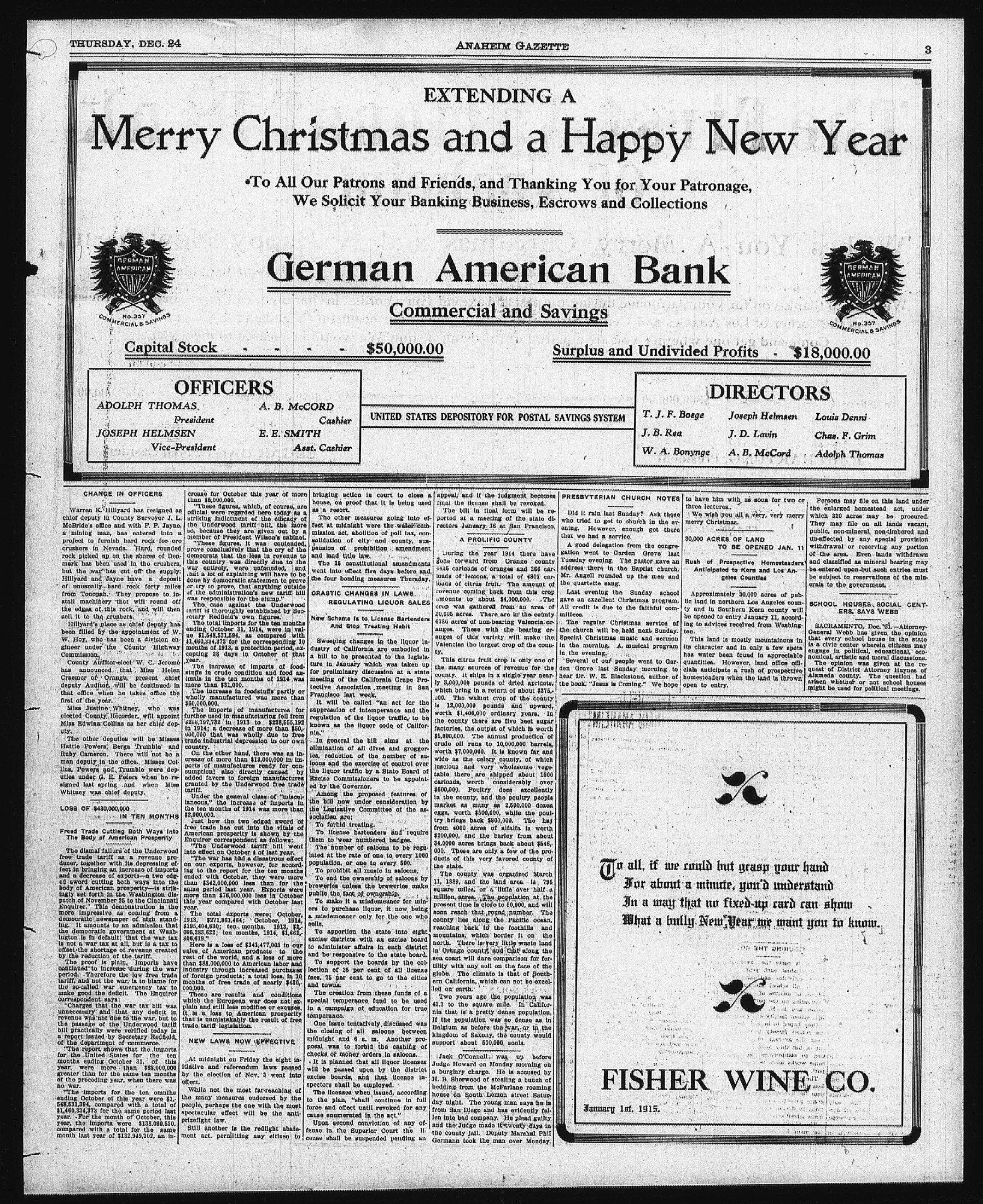
Searchable text
THURSDAY, DEC. 24
Merry Christmas
•To All Our Patrons
We Solicit
Germany
No.357
COMMERCIAL & SAVINGS
Capital Stock
OFFICERS
ADOLPH THOMAS A. B. McCORD
President Cashier
JOSEPH HELMSEN E. E. SMITH
Vice-President Asst. Cashier
OFFICERS
ADOLPH THOMAS A. B. McCORD
President Cashier
JOSEPH HELMSEN E. E. SMITH
Vice-President Asst. Cashier
CHANGE IN OFFICERS
Warren K. Hillyard has resigned as chief deputy in County Surveyor J. L. McBride's office and with F. P. Jayne, a mining man, has entered into a project to furnish hard rock for ore crushers in Nevada. Hard, rounded rock picked up on the shores of Denmark has been used in the crushers, but the war has cut off the supply. Hillyard and Jayne have a deposit of unusually hard rock forty miles from Tonopah. They propose to install machinery that will round off the edges of this rock, and will then sell it to the crushers.
Hillyard's place as chief deputy has been filled by the appointment of W. W. Hoy, who has been a division engineer under the County Highway Commission.
County Auditor-elect W. C. Jerome has announced that Miss Helen Craemer of Orange, present chief deputy Auditor, will be continued in that office when he takes office the first of the year.
Miss Justine Whitney, who was elected County Recorder, will appoint Miss Edwina Collins as her chief deputy.
The other deputies will be Misses Hattie Powers, Berga Trumble and Ruby Cameron. There will not be a man deputy in the office. Misses Collins, Powers and Trumble were deputies under G. E. Peters when he resigned last spring and when Miss Whitney was chief deputy.
LOSS OF $430,000,000
IN TEN MONTHS
Freed Trade Cutting Both Ways Into The Body of American Prosperity
The dismal failure of the Underwood increase for October this year of more than $5,000,000.
"These figures, which, of course, are official were regarded here today as a striking indictment of the efficacy of the Underwood tariff bill, the more so, because they are given out by a member of President Wilson's cabinet."
"These figures, it was contended, prove conclusively that the cry of the democrats that the loss in revenue to this country was directly due to the war entirely, were unfounded, and that a lot of explaining will have to be done by democratic statesmen to prove or try to prove, that anything outside of the administration's new tariff bill was responsible for the slump."
The case against the Underwood tariff is thoroughly established by Secretary Redfield's own figures.
The total imports for the ten months ending October 31, 1914, were in value $1,548,531,594, as compared with $1,460,834,373 for the corresponding 10 months of 1913, a protection period, excepting 28 days in October of that year.
The increase of imports of foodstuffs in crude condition and food animals in the ten months of 1914 was more than $31,000.
The increase in foodstuffs partly or wholly manufactured was more than $60,000,000.
The imports of manufactures for further use in manufacturing fell from $288,197,732 in 1913 to $238,565,192 in 1914; a decrease of more than $60,000,000 that was wholly due to free trade industrial depression in our own country.
On the other hand, there was an increase of more than $13,000,000 in imports of manufactures ready for consumption; also directly caused by added favors to foreign manufactures granted by the Underwood free trade tariff.
Under the general class of "miscellaneous," the increase of imports in the ten months of 1914 was more than $2,000,000.
Just how the two edged sword of free trade has cut into the vitals of American prosperity is shown by the Enquirer correspondent as follows:
"The Underwood tariff bill went bringing action to house, on proof that as a resort.
The other means fact at midnight mission act, abolition of pension of probation and land title law.
The 15 constitutions went into effect for the four bonding."
ORASTIC CHANGE REGULATION
New Scheme is to And Stop T
Swooping change dustry of California a bill to be presented in January wfor preliminary discussion meeting of the Collective Association Francisco last week.
It will be called suppression of int regulation of the known as the liquia."
In general the elimination of all ties, reduction of loons and the exertion of the liquor traffic Excise Commission led by the Governor.
Among the pro bono bill now under the Legislative Co-operation are:
To forbid treating To license barr them to wear numb The number of
LOSS OF $430,000,000 IN TEN MONTHS
Freed Trade Cutting Both Ways Into The Body of American Prosperity
The dismal failure of the Underwood free trade tariff as a revenue producer, together with its depressing effect in bringing an increase of imports and a decrease of exports—a two-edged sword cutting both ways into the body of American prosperity—is strikingly set forth in the Washington dispatch of November 25 to the Cincinnati Enquirer. This demonstration is the more impressive as coming from a democratic newspaper of high standing. It amounts to an admission that the democratic government at Washington is in default; that the war tax is not a war tax at all, but is a tax to offset the shortage of revenue created by the reduction of the tariff.
The proof is plain. Imports have continued to increase during the war period. Therefore the low free trade tariff, and not the war, is to blame for the so-called war emergency tax to make good the deficit. The Enquirer correspondent says:
"Charges that the war tax bill was unnecessary and that any deficit in revenue was not due to the war, but to the passage of the Underwood tariff bill practically were verified today in a report issued by Secretary Redfield, of the department of commerce.
"The report shows that the imports for the United States for the ten months ending October 31, of this year, were more than $88,000,000 greater than for the same ten months of the preceding year, when there was no war.
"The imports for the ten ommits ending October of this year were $1,648,531,394, compared with a total of $1,460,334,373 for the same period last year. For the month of October, this year, the imports were $138,080,530, compared with a total for the same month last year of $132,949,302, an increase of more than $13,000,000 in imports of manufactures ready for consumption; also directly caused by added favors to foreign manufactures granted by the Underwood free trade tariff.
Under the general class of "miscellaneous," the increase of imports in the ten months of 1914 was more than $2,000,000.
Just how the two edged sword of free trade has cut into the vitals of American prosperity is shown by the Enquirer correspondent as follows:
"The Underwood tariff bill went into effect on October 4 of last year.
"The war has had a disastrous effect on our exports, however, for according to the report for the ten months ended with October, they were more than $342,000,000 less than for the same period last year. Exports were more than $76,000,000 less in October this year compared with October last year.
The total exports were: October, 1913, $271,861,464; October, 1914, $195,404,630; ten months. 1913, $2-005,283,622; ten months, 1914, $1,662-806,619."
Here is a loss of $341,477,003 in our sales of American products to the rest of the world, and a loss of more than $88,000,000 to American labor and industry through increased purchases of foreign products; a total loss, in 10 months of free trade of nearly $430,000,000.
These are results and conditions which the European war does not explain and still loss modifies or excuses. It is a loss to American prosperity that is unmistakably the result of free trade tariff legislation.
NEW LAWS NOW EFFECTIVE
At midnight on Friday the eight initiative and referendum laws passed by the election of Nov. 3 went into effect.
While not the most far-reaching of the many measures endorsed by the people, perhaps the one with the most spectacular effect will be the anti-prizeflight law.
Still another is the redlight abatement act, permitting any citizen to increase of more than $13,000,000 in imports of manufactures ready for consumption; also directly caused by added favors to foreign manufactures granted by the Underwood free trade tariff.
Among the provisions under the Legislative Cooperation are:
To forbid treating them to wear numbies.
The number of listed at the rate of population, or one.
To prohibit all railroads.
To end the owner breweries unless public fact of.
To make it a minor or purchase illicit misdemeanor on sells.
To apportion these excise districts while administer affording and be responsive.
To support the section of 25 per cent fees, 75 per cent towns.
The creation from special temperance in a campaign of temperance.
One issue tentatively closing of all midnight and 6 a.m. posals was to forbide checks or money on it. It is planned that will be passed upon excise boards and spectators shall be enforced.
The licenses where to plan, "shall force and effect until cause enumerated."
Upon second confession in the Superintendent sense shall be suspicious.
ANAHEIM GAZETTE
EXTENDING A
Christmas and a Happy New Year
Call Our Patrons and Friends, and Thanking You for Your Paid
We Solicit Your Banking Business, Escrows and Collection
Fierman American Bank
Commercial and Savings
$50,000.00
Surplus and Undivide
McCORD
Cashier
SMITH
Aest. Cashier
UNITED STATES DEPOSITORY FOR POSTAL SAVINGS SYSTEM
T. J. F. Boe
J. B. Rea
bringing action in court to close a house, on proof that it is being used as a resort.
The other measures going into effect at midnight were the water commission act, abolition of poll tax, consolidation of city and county, suspension of prohibition amendment and land title law.
The 15 constitutional amendments went into effect five days before and the four bonding measures Thursday.
ORASTIC CHANGES IN LAWS REGULATING LIQUOR SALES
New Scheme is to License Bartenders And Stop Treating Habit
Sweeping changes in the liquor industry of California are embodied in a bill to be presented to the legislature in January which was taken up for preliminary discussion at a state meeting of the California Grape Protective Association meeting in San Francisco last week.
It will be called "an act for the suppression of intemperance and the regulation of the liquor traffic," to be known as the liquor code of California."
In general the bill aims at the elimination of all dives and groggeries, reduction of the number of saloons and the exercise of control over the liquor traffic by a State Board of Excise Commissioners to be appointed by the Governor.
Among the proposed features of the bill now under consideration by the Legislative Committee of the association are:
To forbid treating.
To license bartenders and require them to wear numbered badges.
The number of saloons to be regulated, and if the judgment becomes final the license shall be revoked.
The bill in final form will be reported at a meeting of the state directors January 16 at San Francisco.
A PROLIFIC COUNTY
During the year 1914 there have gone forward from Orange county 4435 carloads of oranges and 366 carloads of lemons, a total of 4801 carloads of citrus fruit. The amount of revenue coming back from this crop amounts to about $4,000,000. The crop was gathered from an area of 20,605 acres. There are in the county 6786 acres of non-bearing Valencia oranges. These with the bearing oranges of this variety will make the Valencias the largest crop of the county.
This citrus fruit crop is only one of the many sources of revenue for the county. It ships in a single year nearly 3,000,000 pounds of dried apricots, which bring in a return of about $375,000. The walnut crop of the county is 12,000,000 pounds and upward, worth $1,400,000 ordinary years. In the county there are five beet sugar factories, the output of which is worth $5,000,000. The annual production of crude oil runs to 10,000,000 barrels, worth $7,000,000. It is known far and wide as the celery county, of which luscious and very wholesome vegetable there are shipped about 1500 carloads, worth considerably over $600,000. Poultry does excellently in the county, and the poultry people market as many as 2,500,000 dozen eggs, worth $500,000, while the poultry brings back $800,000. The hay from 4000 acres of alfalfa is worth $200,000, and the barley from about 34,000 acres brings back about $546,000. These are only a few of the...
Among the proposed features of the bill now under consideration by the Legislative Committee of the association are:
To forbid treating.
To license bartenders and require them to wear numbered badges.
The number of saloons to be regulated at the rate of one to every 1000 population, or one to every 500.
To prohibit all music in saloons.
To end the ownership of saloons by breweries unless the breweries make public the fact of ownership.
To make it a misdemeanor for minors to purchase liquor, it now being a misdemeanor only for the one who sells.
To apportion the state into eight excise districts with an excise board to administer affairs in each district and be responsive to the state board.
To support the boards by the collection of 25 per cent of all license fees, 75 per cent to go to the cities and towns.
The creation from these funds of a special temperance fund to be used in a campaign of education for true temperance.
One issue tentatively discussed was the closing of all saloons between midnight and 6 a.m. Another proposal was to forbid the cashing of checks or money orders in saloons.
It is planned that all liquor licenses will be passed upon by the district excise boards, and that license inspectors shall be employed.
The licenses when issued, according to the plan, "shall continue in full force and effect until revoked for any cause enumerated in the act."
Upon second conviction of any offense in the Superior Court the license shall be suspended pending an
Jack O'Connell was up before Judge Howard on Monday morning on a burglary charge. He is accused by H.B. Sherwood of stealing a bunch of bedding from the McFarlane rooming house on South Lemon street Saturday night. The young man says he is from San Diego and has evidently fallen into bad company. He plead guilty and the Judge made it twenty days in the county jail. Deputy Marshal Phil Germann took the man over Monday.
Happy New Year
for Your Patronage,
and Collections
Bank
German American
No.357
COMMERCIAL & SAVINGS
and Undivided Profits - $18,000.00
DIRECTORS
T. J. F. Boege Joseph Helmsen Louis Denni
J. B. Rea J. D. Lavin Chas. F. Grim
DIRECTORS
T. J. F. Boege Joseph Helmsen Louis Denni
J. B. Rea J. D. Lavin Chas. F. Grim
W. A. Bonynge A. B. McCord Adolph Thomas
CHURCH NOTES
Sunday? Ask those to church in the even enough got there service.
On from the congregation Grove last The pastor gave an the Baptist church. Up the men and k.
The Sunday school Christmas program. To the faithful comChristmas service of held next Sunday. Music and sermon A musical program
People went to Gar-Sunday morning to blackstone, author of Coming." We hope to have him with us soon for two or three lectures..
We wish you all a very, very merry merry Christmas.
30,000 ACRES OF LAND TO BE OPENED JAN. 11
Rush of Prospective Homesteaders Anticipated to Kern and Los Angeles Counties
Approximately 30,000 acres of public land in northern Los Angeles county and in Southern Kern county will be opened to entry January 11, according to advices received from Washington.
This land is mostly mountainous in its character and in only a few spots has water been found in appreciable quantities. However, land office officials anticipate a rush of prospective homesteaders when the land is thrown open to entry.
Persons may file on this land under the enlarged homestead act, under which 320 acres may be procured. They may file on all lands vacant, public, non-mineral, non-timbered and unaffected by any special provision withdrawal or reserving any portion of the area. Even lands withdrawn and classified as mineral bearing may be entered upon-but such entries must be subject to reservations of the minerals to the government.
SCHOOL HOUSES, SOCIAL CENTERS, SAYS WEBB
SACRAMENTO, Dec. 21.-Attorney General Webb has given the opinion that every school house in the state is a civic center wherein citizens may engage in political, educational, economical, artistic and moral discussions.
The opinion was given at the request of District Attorney Haynes of Alameda county. The question had arisen whether or not school houses might be used for political meetings.
to all, if we could but grasp your hand
For about a minute, you'd understand
In a way that no fixed-up card can show
What a bully New Year we want you to know.
FISHER WINE CO.
1st, 1915.