anaheim-gazette 1912-11-21
Scanned page
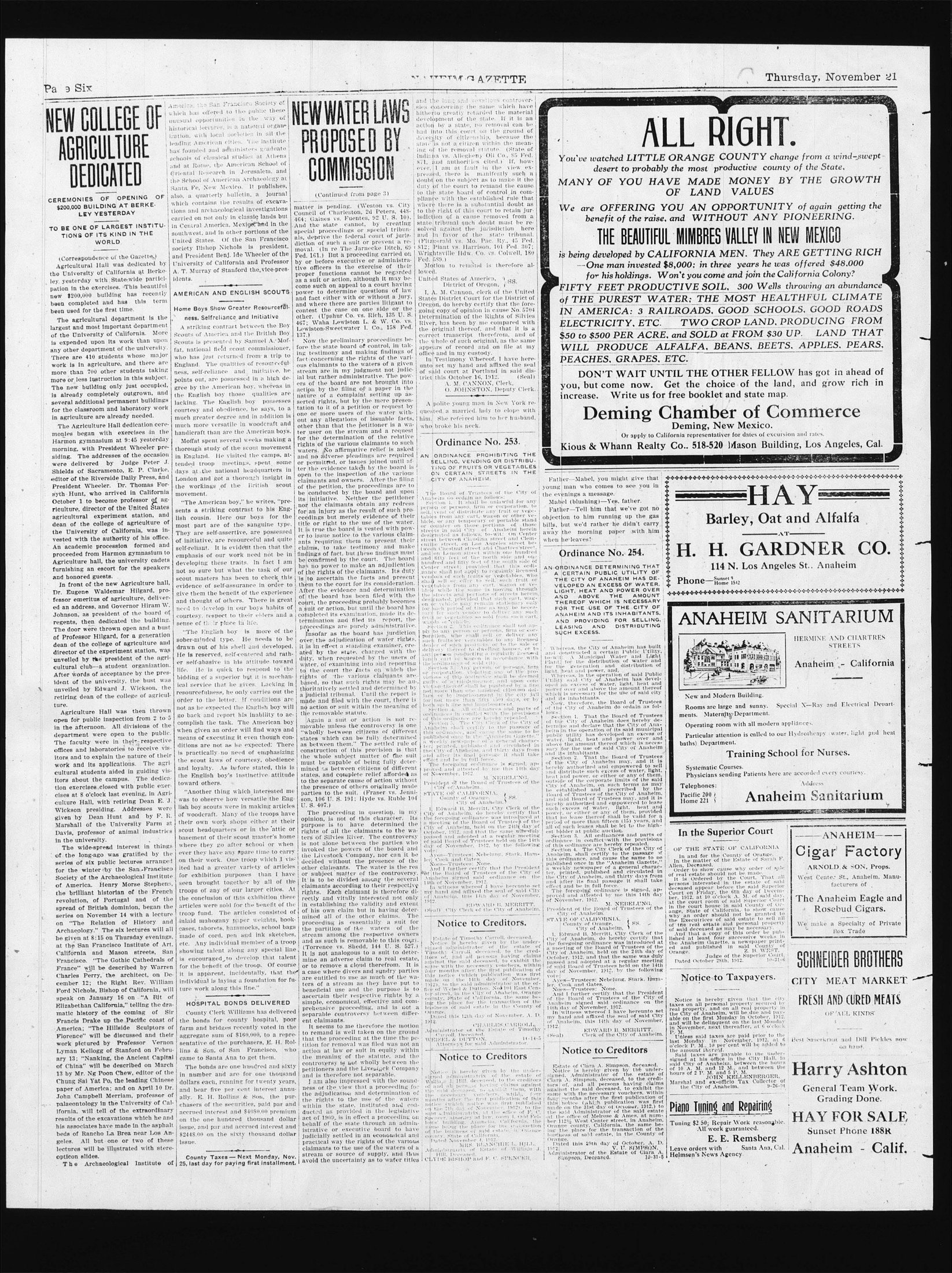
Searchable text
NEW COLLEGE OF AGRICULTURE DEDICATED
CEREMONIES OF OPENING OF $200,000 BUILDING AT BERKELEY YESTERDAY
TO BE ONE OF LARGEST INSTITUTIONS OF ITS KIND IN THE WORLD
(Correspondence of the Gazette.)
Agricultural Hall was dedicated by the University of California at Berkeley yesterday with State-wide participation in the exercises. This beautiful new $200,000 building has recently been completed and has this term been used for the first time.
The agricultural department is the largest and most important department of the University of California. More is expended upon its work than upon any other department of the university. There are 410 students whose major work is in agriculture, and there are more than 700 other students taking more or less instruction in this subject. The new building only just occupied, is already completely outgrown, and several additional permanent buildings for the classroom and laboratory work in agriculture are already needed.
The Agriculture Hall dedication ceremonies began with exercises in the Harmon gymnasium at 9:45 yesterday morning, with President Wheeler presiding. The addresses of the occasion were delivered by Judge Peter J. Shields of Sacramento, E. P. Clarke.
America, the San Francisco Society of which has offered to the public these unusual opportunities in the way of historical lectures, is a national organization, with local societies in all the leading American cities. The institute has founded and administers graduate schools of classical studies at Athens and at Rome, the American School of Oriental Research in Jerusalem, and the School of American Archaeology at Santa Fe, New Mexico. It publishes also, a quarterly bulletin, a journal which contains the results of excavations and archaeological investigations carried on not only in classic lands but in Central America, Mexico, and in the southwest, and in other portions of the United States. Of the San Francisco society Bishop Nichols is president, and President Benj. Ide Wheeler of the University of California and Professor A. T. Murray of Stanford the vice-presidents.
AMERICAN AND ENGLISH SCOUTS
Home Boys Show Greater Resourcefulness, Self-reliance and Initiative
A striking contrast between the Boy Scouts of America and the British Boy Scouts is presented by Samuel A. Moffat, national field scout commissioner, who has just returned from a trip to England. The qualities of resourcefulness, self-reliance and initiative, he points out, are possessed in a high degree by the American boy, whereas in the English boy those qualities are lacking. The English boy possesses courtesy and obedience, he says, to a much greater degree and in addition is much more versatile in woodcraft and handicraft than are the American boys.
Moffat spent several weeks making a thorough study of the scout movement in England. He visited the camps, attended troop meetings, spent some days at the national headquarters in...
The Agriculture Hall dedication ceremonies began with exercises in the Harmon gymnasium at 9:45 yesterday morning, with President Wheeler presiding. The addresses of the occasion were delivered by Judge Peter J. Shields of Sacramento, E. P. Clarke, editor of the Riverside Daily Press, and President Wheeler. Dr. Thomas Forsyth Hunt, who arrived in California October 1 to become professor of agriculture, director of the United States agricultural experiment station, and dean of the college of agriculture of the University of California, was invested with the authority of his office. An academic procession formed and proceeded from Harmon gymnasium to Agriculture hall, the university cadets furnishing an escort for the speakers and honored guests.
In front of the new Agriculture hall, Dr. Eugene Waldemar Hilgard, professor emeritus of agriculture, delivered an address, and Governor Hiram W. Johnson, as president of the board of regents, then dedicated the building. The door were thrown open and a bust of Professor Hilgard, for a generation dean of the college of agriculture and director of the experiment station, was unveiled by the president of the agricultural club—a student organization. After words of acceptance by the president of the university, the bust was unveiled by Edward J. Wickson, the retiring dean of the college of agriculture.
Agriculture Hall was then thrown open for public inspection from 2 to 5 in the afternoon. All divisions of the department were open to the public. The faculty were in their respective offices and laboratories to receive visitors and to explain the nature of their work and its applications. The agricultural students aided in guiding visitors about the campus. The dedication exercise closed with public exercises at 8 o'clock last evening, in Agriculture Hall, with retiring Dean E. J. Wickson presiding. Addresses were given by Dean Hunt and by F. R. Marshall of the University Farm at Davis, professor of animal industries in the university.
The wide-spread interest in things of the long-ago was gratified by the series of six public lectures arranged for the winter by the San Francisco Society of the Archaeological Institute of America. Henry Morse Stephens, the brilliant historian of the French population of Portugal, and of the points out, are possessed in a high degree by the American boy, whereas in the English boy those qualities are lacking. The English boy possesses courtesy and obedience, he says, to a much greater degree and in addition is much more versatile in woodcraft and handicraft than are the American boys.
Moffat spent several weeks making a thorough study of the scout movement in England. He visited the camps, attended troop meetings, spent some days at the national headquarters in London and got a thorough insight in the workings of the British scout movement.
"The American boy," he writes, "presents a striking contrast to his English cousin. Here our boys for the most part are of the sanguine type. They are self-assertive, are possessed of initiative, are resourceful and quite self-reliant. It is evident then that the emphasis of our work need not be in developing these traits. In fact I am not so sure but what the task of our scout masters has been to check this evidence of self-assurance in order to give them the benefit of the experience and thought of others. There is great need to develop in our boys habits of courtesy, respect to their elders and a sense of their place in life.
"The English boy is more of the sober-minded type. He needs to be drawn out of his shell and developed. He is reserved, self-centered and rather self-abasive in his attitude toward life. He is quick to respond to the bidding of a superior but it is mechanical service that he gives. Lacking in resourcefulness, he only carries out the order to the letter. If conditions are not as he expected the English boy will go back and report his inability to accomplish the task. The American boy when given an order will find ways and means of executing it even though conditions are not as he expected: There is practically no need of emphasizing the scout laws of courtesy, obedience and loyalty. As before stated, this is the English boy's instinctive attitude toward others.
"Another thing which interested me was to observe how versatile the English boy scouts were in making articles of woodcraft. Many of the troops have their own work shops either at their scout headquarters or in the attic or basement of their scout master's home where they go after school or whenever they have any spare time to carry on their work. One troop which I visited had a greater variety of articles for exhibition purposes than I have seen brought together by all of the troops of any of our larger cities. At the conclusion of this exhibition these points out, are possessed in a high degree by the American boy, whereas in the English boy those qualities are lacking. The English boy possesses courtesy and obedience, he says, to a much greater degree and in addition is much more versatile in woodcraft and handicraft than are the American boys.
Moffat spent several weeks making a thorough study of the scout movement in England. He visited the camps, attended troop meetings, spent some days at the national headquarters in London and got a thorough insight in the workings of the British scout movement.
"The American boy," he writes, "presents a striking contrast to his English cousin. Here our boys for the most part are of the sanguine type. They are self-assertive, are possessed of initiative, are resourceful and quite self-reliant. It is evident then that the emphasis of our work need not be in developing these traits. In fact I am not so sure but what the task of our scout masters has been to check this evidence of self-assurance in order to give them the benefit of the experience and thought of others. There is great need to develop in our boys habits of courtesy, respect to their elders and a sense of their place in life."
"The English boy is more of the sober-minded type. He needs to be drawn out of his shell and developed. He is reserved, self-centered and rather self-abasive in his attitude toward life. He is quick to respond to the bidding of a superior but it is mechanical service that he gives. Lacking in resourcefulness, he only carries out the order to the letter. If conditions are not as he expected the English boy will go back and report his inability to accomplish the task. The American boy when given an order will find ways and means of executing it even though conditions are not as he expected: There is practically no need of emphasizing the scout laws of courtesy, obedience and loyalty. As before stated, this is the English boy's instinctive attitude toward others."
"Another thing which interested me was to observe how versatile the English boy scouts were in making articles of woodcraft. Many of the troops have their own work shops either at their scout headquarters or in the attic or basement of their scout master's home where they go after school or whenever they have any spare time to carry on their work. One troop which I visited had a greater variety of articles for exhibition purposes than I have seen brought together by all of the troops of any of our larger cities. At the conclusion of this exhibition these points out, are possessed in a high degree by the American boy, whereas in the English boy those qualities are lacking. The English boy possesses courtesy and obedience, he says, to a much greater degree and in addition is much more versatile in woodcraft and handicraft than are the American boys.
Moffat spent several weeks making a thorough study of the scout movement in England. He visited the camps, attended troop meetings, spent some days at the national headquarters in London and got a thorough insight in the workings of the British scout movement.
"The American boy," he writes, "presents a striking contrast to his English cousin. Here our boys for the most part are of the sanguine type. They are self-assertive, are possessed of initiative, are resourceful and quite self-reliant. It is evident then that the emphasis of our work need not be in developing these traits. In fact I am not so sure but what the task of our scout masters has been to check this evidence of self-assurance in order to give them the benefit of the experience and thought of others. There is great need to develop in our boys habits of courtesy, respect to their elders and a sense of their place in life."
"The English boy is more of the sober-minded type. He needs to be drawn out of his shell and developed. He is reserved, self-centered and rather self-abasive in his attitude toward life. He is quick to respond to the bidding of a superior but it is mechanical service that he gives. Lacking in resourcefulness, he only carries out the order to the letter. If conditions are not as he expected the English boy will go back and report his inability to accomplish the task. The American boy when given an order will find ways and means of executing it even though conditions are not as he expected: There is practically no need of emphasizing the scout laws of courtesy, obedience and loyalty. As before stated, this is the English boy's instinctive attitude toward others."
"Another thing which interested me was to observe how versatile the English boy scouts were in making articles of woodcraft. Many of the troops have their own work shops either at their scout headquarters or in the attic or basement of their scout master's home where they go after school or whenever they have any spare time to carry on their work. One troop which I visited had a greater variety of articles for exhibition purposes than I have seen brought together by all of the troops of any of our larger cities. At the conclusion of this exhibition these points out, are possessed in a high degree by the American boy, whereas in the English boy those qualities are lacking. The English boy possesses courtesy and obedience, he says, to a much greater degree and in addition is much more versatile in woodcraft and handicraft than are the American boys."
Moffat spent several weeks making a thorough study of the scout movement in England. He visited the camps, attended troop meetings, spent some days at the national headquarters in London and got a thorough insight in the workings of the British scout movement.
"The American boy," he writes, "presents a striking contrast to his English cousin. Here our boys for the most part are of the sanguine type. They are self-assertive, are possessed of initiative, are resourceful and quite self-reliant. It is evident then that the emphasis of our work need not be in developing these traits. In fact I am not so sure but what the task of our scout masters has been to check this evidence of self-assurance in order to give them the benefit of the experience and thought of others. There is great need to develop in our boys habits of courtesy, respect to their elders and a sense of their place in life."
"The American boy," he writes, "presents a striking contrast to his English cousin. Here our boys for the most part are ofthe sanguine type. They are self-assertive, are possessedof initiative,are resourcefuland quiteself-reliant.itis truetheboardterttoissuenoticetheantsrequiringtheclaims,to takethefindingsoffact,但beconfirmedbythehasnopowertomuchoftherightsofthetheristoascertainthethemestothecourtfair.Aftertheevidenceoftheboardhasstoredit,courtestherproceedininacustomterminationandfinereproceedingsarepainl.
Insofarastheboveradjudicationitisin effectastatizedbythestatedutywhenrequestswater.ofexaminingtothecourttherightsofthevarbasedo,sothusthorritativelysettleajudicial tribunal,madeandfilewithnoactionorsuitwhetherremovablestand
Againa suitonmovableunlessthatwhollybetweenstateswhichcanassbetweenthemselvesmustbecapableindetweenstates,andcompletethepresenceofotherpartiestothesuitson106U.S.1917.U.S.$407.)"
The proceeding opinionisnotofpurposeistohidrightsofallthecottersofSilviesRiverisnotalonebetweentheotherclaimants.orsubjectmatterItistobebuildclaimantsaccordingrights.Eachclairaffectivelyandvitally."
culture Hall, with retiring Dean E. J. Wickson presiding. Addresses were given by Dean Hunt and by F. R. Marshall of the University Farm at Davis, professor of animal industries in the university.
The wide-spread interest in things of the long-ago was gratified by the series of six public lectures arranged for the winter by the San-Francisco Society of the Archaeological Institute of America. Henry Morse Stephens, the brilliant historian of the French revolution, of Portugal and of the spread of British dominion, began the series on November 14 with a lecture on "The Relation of History and Archaeology." The six lectures will all be given at 8:15 on Thursday evenings, at the San Francisco Institute of Art, California and Mason streets, San Francisco. "The Gothic Cathedrals of France" will be described by Warren Charles Perry, the architect, on December 12; the Right Rev. William Ford Nichols, Bishop of California, will speak on January 16 on "A Bit of Elizabethan California," telling the dramatic history of the coming of Sir Francis Drake up the Pacific coast of America; "The Hillside Sculptors of Florence" will be discussed and their work pictured by Professor Vernon Lyman Kellogg of Stanford on February 13; "Nanking, the Ancient Capital of China" will be described on March 13 by Mr. Ng Poon Chew, editor of the Chung Sai Yat Po, the leading Chinese paper of America; and on April 10 Dr. John Campbell Merriam, professor of palaeontology in the University of California, will tell of the extraordinary results of the excavations which he and his associates have made in the asphalt beds of Rancho La Brea near Los Angeles. All but one or two of these lectures will be illustrated with stereo-opticon slides.
The Archaeological Institute of
HOSPITAL BONDS DELIVERED
County Clerk Williams has delivered the bonds for county hospital, poor farm and bridges recently voted in the aggregate sum of $160,000, to a representative of the purchasers, E. H. Rollins & Son, of San Francisco, who came to Santa Ana to get them.
The bonds are one hundred and sixty in number and are for one thousand dollars each, running for twenty years, and bear five per cent interest annually. E. H. Rollins & Son, the purchasers of the securities, paid par and accrued interest and $4080.00 premium on the one hundred thousand dollar issue, and par and accrued interest and $2448.00 on the sixty thousand dollar issue.
County Taxes — Next Monday, Nov. 25, last day for paying first installment.
NEW WATER LAWS PROPOSED BY COMMISSION
(Continued from page 3)
matter is pending. (Weston vs. City Council of Charleston, 2d Peters, 448-464; Gaines vs. Fuentes, 92 U.S. 10). And the state cannot, by creating special proceedings or special tribunals, deprive the federal court of jurisdiction of such a suit or prevent a removal. (In re The Jarnecke Ditch, 69 Fed. 161.) But a proceeding carried on by or before executive or administrative officers in the exercise of their proper functions cannot be regarded as a suit or action, although it may become such on appeal to a court having power to determine questions of law and fact either with or without a jury, and where there are parties litigant to contest the case on one side or the other. (Upshur Co. vs. Rich, 135 U.S. 467; Waha Lewiston L. & W. Co. vs. Lewiston-Sweetwater I. Co., 158 Fed. 137.)
Now the preliminary proceedings before the state board of control, in taking testimony and making findings of fact concerning the rights of the various claimants to the waters of a given stream are in my judgment not judicial but rather administrative. The powers of the board are not brought into action by the filing of a paper in the nature of a complaint setting up asserted rights, but by the mere presentation to it of a petition or request by one or more users of the water without any allegations of issuable facts, other than that the petitioner is a water user on the stream and a request for the determination of the relative rights of the various claimants to such waters. No affirmative relief is asked and no adverse pleadings are required or permitted, or issues joined until after the evidence taken by the board is open to the inspection of the various controversies concerning the same which have hitherto greatly retarded the material development of the state. If it is an action by a state, no removal can be had into this court on the ground of diversity of citizenship, because the state is not a citizen within the meaning of the removal statute. (State of Indiana vs. Allegheny Oil Co., 85 Fed. 871, and authorities cited.) If, however, I am at fault in the view expressed, there is manifestly such a doubt on the subject as to make it the duty of the court to remand the cause to the state board of control in compliance with the established rule that where there is a substantial doubt as to the right of this court to retain jurisdiction of a cause removed from a state tribunal such doubt must be resolved against the jurisdiction here and in favor of the state tribunal. (Fitzgerald vs. Mo. Pac. Ry., 45 Fed. 812; Plant vs. Harrison, 101 Fed. 307; Wrightsville Hdw. Co. vs. Colwell, 180 Fed. 589.) Motion to remand is therefore allowed.
United States of America, District of Oregon,
I, A. M. Cannon, clerk of the United States District Court for the District of Oregon, do hereby certify that the foregoing copy of opinion in cause No. 5704 Determination of the Rights of Silvies River, has been by me compared with the original thereof, and that it is a correct transcript therefrom, and of the whole of such original, as the same appears of record and on file at my office and in my custody.
In Testimony Whereof, I have hereunto set my hand and affixed the seal of said court at Portland in said district this October 16, 1912.
A. M. CANNON, Clerk,
O. JOHNSTON, Deputy Clerk.
A polite young man in New York requested a married lady to elope with him. She referred him to her husband, who broke his neck.
Ordinance No. 253.
AN ORDINANCE PROHIBITING THE SELLING, VENDING OR DISTRIBUTION OF FRUITS OR VEGETABLES ON CERTAIN STREETS IN THE
but rather administrative. The powers of the board are not brought into action by the filing of a paper in the nature of a complaint setting up asserted rights, but by the mere presentation to it of a petition or request by one or more users of the water without any allegations of issuable facts, other than that the petitioner is a water user on the stream and a request for the determination of the relative rights of the various claimants to such waters. No affirmative relief is asked and no adverse pleadings are required or permitted, or issues joined until after the evidence taken by the board is open to the inspection of the various claimants and owners. After the filing of the petition, the proceedings are to be conducted by the board and upon its initiative. Neither the petitioner nor the claimants obtain any redress for an injury as the result of such proceedings but merely evidence of their title or right to the use of the water. It is true the board is vested with power to issue notice to the various claimants requiring them to present their claims, to take testimony and make findings of fact, but these findings must be confirmed by the court. The board has no power to make an adjudication of the rights of the claimants. Its duty is to ascertain the facts and present them to the court for its consideration. After the evidence and determination of the board has been filed with the court, the proceeding probably becomes a suit or action, but until the board has completed its examination, made its determination and filed its report, the proceedings are purely administrative.
Insofar as the board has jurisdiction over the adjudication of water rights, it is in effect a standing examiner, created by the state, charged with the duty, when requested by the users of water, of examining into and reporting to the court the facts on which the rights of the various claimants are based, so that such rights may be authoritatively settled and determined by a judicial tribunal. Until the report is made and filed with the court, there is no action or suit within the meaning of the removable statute.
Again a suit or action is not removable unless the controversy is one "wholly between citizens of different states which can be fully determined as between them." The settled rule of construction of this provision is that the whole subject matter of the suit must be capable of being fully determined as between citizens of different states, and complete relief afforded as to the separate cause of action without the presence of others originally made parties to the suit. (Fraser vs. Jennison, 106 U.S. 191; Hyde vs. Ruble 104 U.S. 407.)
The proceeding in question, in my opinion, is not of this character. Its purpose is to have determined the rights of all the claimants to the waters of Silvies River. The controversy is not alone between the parties who invoked the powers of the board and the Livestock Company, nor can it be decided without the presence of other claimants. The water is the res or subject matter of the controversy. It is to be divided among the several claimants according to their respective rights. Each claimant is therefore directly and vitally interested not only
Ordinance No. 253.
AN ORDINANCE PROHIBITING THE SELLING, VENDING OR DISTRIBUTION OF FRUITS OR VEGETABLES ON CERTAIN STREETS IN THE CITY OF ANAHEIM.
The Board of Trustees of the City of Anaheim do ordain as follows:
Section 1. It shall be unlawful for any person or persons, farm or corporation, to sell, vend or distribute any fruit or vegetables from any cart, wagon or other vehicle, or any temporary or portable stand or counter on those portions of those streets by said City of Anaheim herein designated as follows: to-wait: On Center street between Claudina street and Clemente street, on Los Angeles street between Chestnut street and Charttes street, on Lemon street within one hundred and fifty feet of the north side and one hundred and fifty feet of the south side of Center street; provided that this ordinance shall not apply to regularly licensed vendors of such fruits or vegetables, who shall sell or offer to sell, such fruit or vegetables from any cart, wagon or vehicle while the same is moving through the streets and portions of streets herein designated; provided that such cart, wagon or vehicle may remain stationary only for such period of time as may be necessary for such vendor to deliver any such fruit or vegetables so sold from such cart, wagon or vehicle.
Section 2. This ordinance shall not apply to any person or persons, firm or corporation, who shall sell or deliver any such fruits or vegetables to any licensed dealer of such products, or to the sale or delivery thereof to dwelling houses, or to any person conducting a regularly licensed lunch cart or wagon in accordance with the ordinances of said city.
Section 3. Any person or persons, firm or corporation, violating any of the provisions of this ordinance shall be deemed guilty of a misdemeanor; and upon conviction thereof shall be punished by a fine not more than one hundred ($1000) dollars or by imprisonment in the city jail for not more than fifty (50) days, or both such fine and imprisonment.
Section 4. All ordinances and parts of ordinances in conflict with the provisions of this ordinance are hereby repealed.
Section 5. The City Clerk of the City of Anaheim shall certify to the passage of this ordinance, and cause the same to be published once in the "Annaheim Gazette," a weekly newspaper of a general character, printed, published and circulated in the City of Anaheim, and thirty days from and after its final passage it shall take effect and be in full force.
The foregoing ordinance is signed, approved and attested by me this 14th day of November, 1912.
M. NEBELUNG,
President of the Board of Trustees of the City of Anaheim.
STATE OF CALIFORNIA.
County of Orange.
City of Anaheim.
L. Edward R. Merritt, City Clerk of the City of Anaheim, do hereby certify that the foregoing ordinance was introduced at a meeting of the Board of Trustees of the City of Anaheim, held on the 21st day of October, 1912, and that the same was duly passed and adopted at a regular meeting of said Board of Trustees held on the 17th day of November, 1912, by the following vote:
Aves—Trustees: Nebelung, Stark, Hamler Cook and Gates.
Noes—Trustees: None.
And I further certify that the President of the Board of Trustees of the City of Anaheim signed said ordinance on the 17th November, 1912.
In witness whereof I have hereunto set my hand and affixed the seal of said City of Anaheim, this 14th day of November, 1912.
Father—Mabel, you might give that young man who comes to see you in the evenings a message.
Mabel (blushing)—Yes, father.
Father—Tell him that we've got no objection to him running up the gas bills, but we'd rather he didn't carry away the morning paper with him when he leaves!
Ordinance No. 254.
AN ORDINANCE DETERMINING THAT A CERTAIN PUBLIC UTILITY OF THE CITY OF ANAHEIM HAS DEVELOPED AN EXCESS OF WATER, LIGHT, HEAT AND POWER OVER AND ABOVE THE AMOUNT THEREOF WHICH IS NECESSARY FOR THE USE OF THE CITY OF ANAHEIM AND ITS INHABITANTS, AND PROVIDING FOR SELLING, LEASING AND DISTRIBUTING SUCH EXCESS.
Whereas, the City of Anaheim has built and constructed a certain Public Utility, to-wait: A Municipal Water and Light Plant; for the distribution of water and for the generation and distribution of light, heat and power, and.
Whereas, in the operation of said Public Utility said City of Anaheim has developed an excess of water, light, heat and power over and above the amount thereof which is necessary for the use of said city and its inhabitants.
Now, therefore, the Board of Trustees of the City of Anaheim do ordain as follows:
Section 1. That The Board of Trustees of the City of Anaheim does hereby determine and declare that The City of Anaheim in the operation of its said municipal public utility has developed an excess of water, light, heat and power over and above the amount thereof which is necessary for the use of said city and its inhabitants.
Section 2. That The Board of Trustees of the City of Anaheim may, and it is hereby authorized and empowered to sell and distribute such excess of water, light, heat and power; or either or any thereof, provided that no lease thereof shall be valid for a period of more than fifteen (15) years, and all such leases shall be left to the highest bidder at public auction.
Section 3. All ordinances and parts of ordinances in conflict with the provisions of this ordinance are hereby repealed.
Section 4. The City Clerk of the City of Anaheim shall certify to the passage of this ordinance, and cause the same to be published once in the "Annaheim Gazette," a weekly newspaper of a general character, printed, published and circulated in the City of Anaheim and thirty days from and after its final passage it shall take effect and be in full force.
The foregoing ordinance is signed, approved and attested by me this 14th day
The proceeding in question, in my opinion, is not of this character. Its purpose is to have determined the rights of all the claimants to the waters of Silvies River. The controversy is not alone between the parties who invoked the powers of the board and the Livestock Company, nor can it be decided without the presence of the other claimants. The water is the res or subject matter of the controversy. It is to be divided among the several claimants according to their respective rights. Each claimant is therefore directly and vitally interested not only in establishing the validity and extent of his own claim but in having determined all of the other claims. The proceeding is essentially a suit for the partition of the waters of the stream among the respective owners and as such is removable to this court.
(Torrence vs. Shedd, 144 U. S. 527.) It is not analogous to a suit to determine an adverse claim to real estate, or to remove a cloud therefrom. It is a case where divers and sundry parties are entitled to use as much of the waters of a stream as they have put to beneficial use and the purpose is to ascertain their respective rights by a simple, economical, effective and comprehensive proceeding, and is not a separable controversy between different claimants.
It seems to me therefore the motion to remand is well taken on the ground that the proceeding at the time the petition for removal was filed was not an action at law or suit in equity within the meaning of the statute, and the controversy is not wholly between the petitioners and the Livestock Company and is therefore not separable.
I am also impressed with the soundness of the view that a proceeding for the adjudication and determination of the rights to the use of the waters within the state, instituted and conducted as provided in the legislative act of 1909, is in effect a proceeding on behalf of the state through an administrative or executive board to have judicially settled in an economical and practical way the rights of the various claimants to the use of the waters of a stream or source of supply, and thus avoid the uncertainty as to water titles.
Notice to Creditors.
Estate of Timothy Carroll, deceased.
Notice is hereby given by the undersigned administrator of the estate of William J. Hill, deceased, to the creditors of and all persons having claims against the said deceased, to exhibit them, with the necessary vouchers, within four months after the first publication of this notice (which notice was first published on the 7th day of November, 1912), to the said administrator, at the office of F. C. Spencer, attorney at law, room 4, Old Fellow's building, Ananema, California, the same being the place for the transaction of the business of said estate in Orange county, State of California.
Dated November 4, 1912.
MRS. BLANCHIE L. HILL,
Administrator of Estate of William J. Hill, deceased.
CLYDE BISHOP and F. C. SPENCER,
Notice to Creditors.
Estate of Clara A. Simpson, deceased.
Notice is hereby given by the undersigned Administrator of the estate of Clara A. Simpson, deceased, to the creditors of and all persons having claims against the said deceased, to exhibit them, with the necessary vouchers, within four months after the first publication of this notice (which notice was first published on the 7th day of November, 1912), to the said Administrator of the said estate at the office of Melrose & Ames, at number 112½ West Center street, in Ananema, Orange county, California, the same being the place for the transaction of the business of said estate, in the County of Orange.
Dated this 29th day of October, A. D., V. U. SIMPSON,
Administrator of the Estate of Clara A. Simpson, deceased.
ALL RIGHT.
Aatched LITTLE ORANGE COUNTY change from a wind-swept desert to probably the most productive county of the State.
OF YOU HAVE MADE MONEY BY THE GROWTH OF LAND VALUES
OFFERING YOU AN OPPORTUNITY of again getting the benefit of the raise, and WITHOUT ANY PIONEERING.
THE BEAUTIFUL MIMBRES VALLEY IN NEW MEXICO
Developed by CALIFORNIA MEN. They ARE GETTING RICH
The man invested $8,000; in three years he was offered $48,000
for his holdings. Won't you come and join the California Colony?
FEET PRODUCTIVE SOIL, 300 Wells throwing an abundance
of PUREST WATER; THE MOST HEALTHFUL CLIMATE
AMERICA: 3 RAILROADS, GOOD SCHOOLS, GOOD ROADS
RICITY, ETC. TWO CROP LAND, PRODUCING FROM
500 PER ACRE, and SOLD at FROM $30 UP. LAND THAT
PRODUCE ALFALFA, BEANS, BEETS, APPLES, PEARS,
GREES, GRAPES, ETC.
DON'T WAIT UNTIL THE OTHER FELLOW has got in ahead of
it come now. Get the choice of the land, and grow rich in
Write us for free booklet and state map.
Deming Chamber of Commerce
Deming, New Mexico.
Or apply to California representatives for dates of excursion and rates.
Whann Realty Co., 518-520 Mason Building, Los Angeles, Cal.
DEMING Chamber of Commerce
Deming, New Mexico.
Or apply to California representatives for dates of excursion and rates.
Whann Realty Co.. 518-520 Mason Building, Los Angeles, Cal.
HAY
Barley, Oat and Alfalfa
AT
H. H. GARDNER CO.
114 N. Los Angeles St., Anaheim
Phone—Sunset 9
Home 1542
ANAHEIM SANITARIUM
HERMINE AND CHARTRES STREETS
Anaheim - California
New and Modern Building.
Rooms are large and sunny. Special X-Ray and Electrical Departments. Maternity Department.
Operating room with all modern appliances.
Particular attention is called to our Hydrotheapy (water, light and heat baths) Department.
Training School for Nurses.
Systematic Courses.
Physicians sending Patients here are accorded every courtesy.
Telephones:
Pacific 200
Home 221
In the Superior Court
OF THE STATE OF CALIFORNIA
In and for the County of Orange.
In the matter of the Estate of Sarah F. Allen, Decreased.
Order to show cause why order of sale of real estate should not be made.
It is Ordered by the Court. That all persons interested in the estate of said deceased appear before the said Superior Court on Friday, the 6th day of December, 1912, at 10 o'clock A.M. of said day.
ANAHEIM
Cigar Factory
ARNOLD & SON, Props.
West Center St., Anaheim, Manufacturers of
The Anaheim Eagle and
In the Superior Court
OF THE STATE OF CALIFORNIA
In and for the County of Orange.
In the matter of the Estate of Sarah F. Allen, Deceased.
Order to show cause why order of sale of real estate should not be made.
It is Ordered by the Court, That all persons interested in the estate of said deceased appear before the said Superior Court on Friday, the 6th day of December, 1912, at 10 o'clock A.M. of said day, at the court room of said Superior Court in the court house in said County of Orange, State of California, to show cause why an order should not be granted to the Executrices of said estate to sell all of the real estate and personal property of said deceased as may be necessary.
And that a copy of this order be published at least four successive weeks in the Anaheim Gazette, a newspaper printed and published in said County of Orange.
Z. B. WEST.
Judge of the Superior Court.
Dated October 28th, 1912.
Notice to Taxpayers.
Notice is hereby given that the city taxes on all personal property secured by real property, and on all real property in the City of Anaheim, will be due and payable on the first Monday in October, 1912, and will be delinquent on the last Monday in November, next thereafter, at 6 o'clock P.M.
Unless said taxes are paid prior to the last Monday in November, 1912, at 6 o'clock P.M., 10 per cent will be added to the amount thereof.
Said taxes are payable to the undersigned at his office in the City Hall, in said City of Anaheim, between the hours of 10 A.M. and 12 M., and between the hours of 2 P.M. and 5 P.M.
JOHN KELLENBERGER,
Marshal and ex-officio Tax Collector of the City of Anaheim.
Piano Tuning and Repairing
Tuning $2.50; Repair Work reasonable.
All work guaranteed.
E. E. Remsberg
Leave orders with Santa Ana, Cal.
Helmsen's News Agency.