anaheim-gazette 1912-11-21
Scanned page
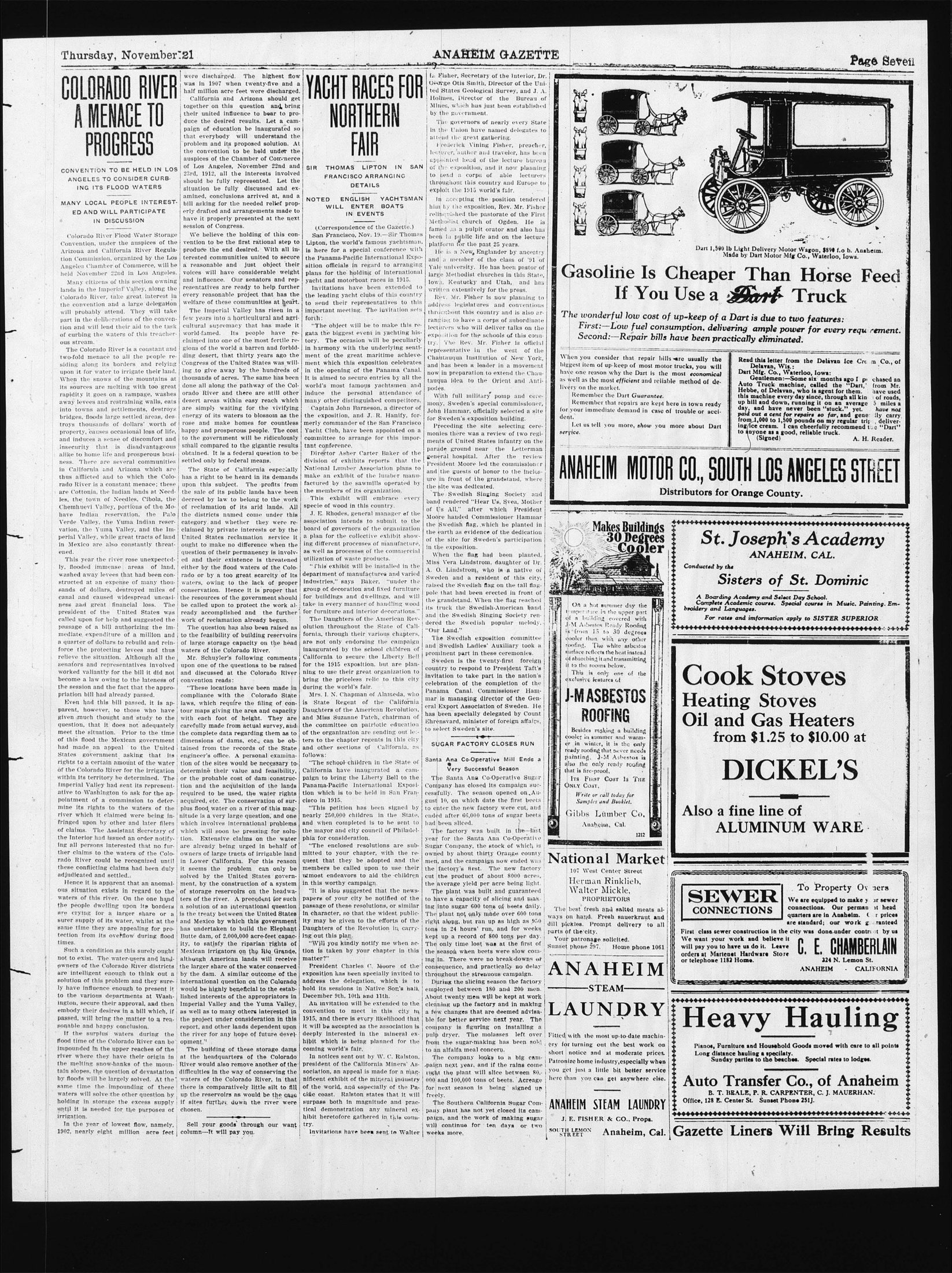
Searchable text
COLORADO RIVER
A MENACE TO PROGRESS
CONVENTION TO BE HELD IN LOS ANGELES TO CONSIDER CURBING ITS FLOOD WATERS
MANY LOCAL PEOPLE INTERESTED AND WILL PARTICIPATE IN DISCUSSION
Colorado River Flood Water Storage Convention, under the auspices of the Arizona and California River Regulation Commission, organized by the Los Angeles Chamber of Commerce, will be held November 22nd in Los Angeles.
Many citizens of this section owning lands in the Imperial Valley, along the Colorado River, take great interest in the convention and a large delegation will probably attend. They will take part in the deliberations of the convention and will lend their aid to the task of curbing the waters of this treacherous stream.
The Colorado River is a constant and two-fold menace to all the people residing along its borders and relying upon it for water to irrigate their land. When the snows of the mountains at its sources are melting with too great rapidity it goes on a rampage, washes away levees and restraining walls, eats into towns and settlements, destroys bridges, floods large settled areas, destroys thousands of dollars' worth of property, causes occasional loss of life, and induces a sense of discomfort and insecurity that is disadvantageous alike to home life and prosperous business. There are several communities in California and Arizona which are were discharged. The highest flow was in 1907 when twenty-five and a half million acre feet were discharged.
California and Arizona should get together on this question and bring their united influence to bear to produce the desired results. Let a campaign of education be inaugurated so that everybody will understand the problem and its proposed solution. At the convention to be held under the auspices of the Chamber of Commerce of Los Angeles, November 22nd and 23rd, 1912, all the interests involved should be fully represented. Let the situation be fully discussed and examined, conclusions arrived at, and a bill asking for the needed relief properly drafted and arrangements made to have it properly presented at the next session of Congress.
We believe the holding of this convention to be the first rational step to produce the end desired. With all interested communities united to secure a reasonable and just object their voices will have considerable weight and influence. Our senators and representatives are ready to help further every reasonable project that has the welfare of these communities at heart.
The Imperial Valley has risen in a few years into a horticultural and agricultural supremacy that has made it world-famed. Its people have reclaimed into one of the most fertile regions of the world a barren and forbidding desert, that thirty years ago the Congress of the United States was willing to give away by the hundreds of thousands of acres. The same has been done all along the pathway of the Colorado River and there are still other desert areas within easy reach which are simply waiting for the vivifying energy of its waters to blossom as the rose and make homes for countless happy and prosperous people. The cost to the government will be ridiculously small compared to the gigantic results obtained. It is a federal question to be settled only by federal means.
The State of California especially
When the snows of the mountains at its sources are melting with too great rapidity it goes on a rampage, washes away levees and restraining walls, eats into towns and settlements, destroys bridges, floods large settled areas, destroys thousands of dollars' worth of property, causes occasional loss of life, and induces a sense of discomfort and insecurity that is disadvantageous alike to home life and prosperous business. There are several communities in California and Arizona which are thus afflicted and to which the Colorado River is a constant menace; these are Cottonia, the Indian lands at Needles, the town of Needles, Cibola, the Chemhuevi Valley, portions of the Mohave Indian reservation, the Palo Verde Valley, the Yuma Indian reservation, the Yuma Valley, and the Imperial Valley, while great tracts of land in Mexico are also constantly threatened.
This year the river rose unexpectedly, flooded immense areas of land, washed away levees that had been constructed at an expense of many thousands of dollars, destroyed miles of canal and caused widespread uneasiness and great financial loss. The president of the United States was called upon for help and suggested the passage of a bill authorizing the immediate expenditure of a million and a quarter of dollars to rebuild and reinforce the protecting levees and thus relieve the situation. Although all the senators and representatives involved worked valiantly for the bill it did not become a law owing to the lateness of the session and the fact that the appropriation bill had already passed.
Even had this bill passed, it is apparent, however, to those who have given much thought and study to the question, that it does not adequately meet the situation. Prior to the time of this flood the Mexican government had made an appeal to the United States government asking that its rights to a certain amount of the water of the Colorado River for the irrigation within its territory be determined. The Imperial Valley had sent its representative to Washington to ask for the appointment of a commission to determine its rights to the waters of the river which it claimed were being infringed upon by other and later filers of claims. The Assistant Secretary of the Interior had issued an order notifying all persons interested that no further claims to the waters of the Colorado River could be recognized until these conflicting claims had been duly adjudicated and settled.
Hence it is apparent that an anomalous situation exists in regard to the waters of this river. On the one hand thousands of acres. The same has been done all along the pathway of the Colorado River and there are still other desert areas within easy reach which are simply waiting for the vivifying energy of its waters to blossom as the rose and make homes for countless happy and prosperous people. The cost to the government will be ridiculously small compared to the gigantic results obtained. It is a federal question to be settled only by federal means.
The State of California especially has a right to be heard in its demands upon this subject. The profits from the sale of its public lands have been decreed by law to belong to the work of reclamation of its arid lands. All the districts named come under this category and whether they were reclaimed by private interests or by the United States reclamation service it ought to make no difference when the question of their permanency is involved and their existence is threatened either by the flood waters of the Colorado or by a too great scarcity of its waters, owing to the lack of proper conservation. Hence it is proper that the resources of the government should be called upon to protect the work already accomplished and the further work of reclamation already begun.
The question has also been raised as to the feasibility of building reservoirs of large storage capacity on the head waters of the Colorado River.
Mr. Schuyler's following comments upon one of the questions to be raised and discussed at the Colorado River convention reads:
"These locations have been made in compliance with the Colorado State laws, which require the filing of contour maps giving the area and capacity with each foot of height. They are carefully made from actual survey, and the complete data regarding them as to dimensions of dams, etc., can be obtained from the records of the State engineer's office. A personal examination of the sites would be necessary to determine their value and feasibility, or the probable cost of dam construction and the acquisition of the lands required to be used, the water rights acquired, etc. The conservation of surplus flood water on a river of this magnitude is a very large question, and one which involves international problems which will soon be pressing for solution. Extensive claims on the water are already being urged in behalf of owners of large tracts of irrigable land in Lower California. For this reason it seems the problem can only be solved by the United States government, by the construction of a system of storage reservoirs on the headwaters of the river. A precedent for such thousands of acres. The same has been done all along the pathway of the Colorado River and there are still other desert areas within easy reach which are simply waiting for the vivifying energy of its waters to blossom as the rose and make homes for countless happy and prosperous people. The cost to the government will be ridiculously small compared to the gigantic results obtained. It is a federal question to be settled only by federal means."
The State of California especially has a right to be heard in its demands upon this subject. The profits from the sale of its public lands have been decreed by law to belong to the work of reclamation of its arid lands. All the districts named come under this category and whether they were reclaimed by private interests or by the United States reclamation service it ought to make no difference when the question of their permanency is involved and their existence is threatened either by the flood waters of the Colorado or by a too great scarcity of its waters, owing to the lack of proper conservation. Hence it is proper that the resources of the government should be called upon to protect the work already accomplished and the further work of reclamation already begun.
The question has also been raised as to the feasibility of building reservoirs of large storage capacity on the head waters of the Colorado River.
Mr. Schuyler's following comments upon one of the questions to be raised and discussed at the Colorado River convention reads:
"These locations have been made in compliance with the Colorado State laws, which require the filing of contour maps giving the area and capacity with each foot of height. They are carefully made from actual survey, and the complete data regarding them as to dimensions of dams, etc., can be obtained from the records of the State engineer's office. A personal examination of the sites would be necessary to determine their value and feasibility, or the probable cost of dam construction and the acquisition of the lands required to be used, the water rights acquired, etc. The conservation of surplus flood water on a river of this magnitude is a very large question, and one which involves international problems which will soon be pressing for solution. Extensive claims on the water are already being urged in behalf of owners of large tracts of irrigable land in Lower California. For this reason it seems the problem can only be solved by the United States government, by the construction of a system of storage reservoirs on the headwaters of the river. A precedent for such thousands of acres. The same has been done all along the pathway of the Colorado River and there are still other desert areas within easy reach which are simply waiting for the vivifying energy of its waters to blossom as the rose and make homes for countless happy and prosperous people. The cost to the government will be ridiculously small compared to the gigantic results obtained. It is a federal question to be settled only by federal means."
The State of California especially has a right to be heard in its demands upon this subject. The profits from the sale of its public lands have been decreed by law to belong to the work of reclamation of its arid lands. All the districts named come under this category and whether they were reclaimed by private interests or by the United States reclamation service it ought to make no difference when the question of their permanency is involved and their existence is threatened either by the flood waters of the Colorado or by a too great scarcity of its waters, owing to the lack of proper conservation. Hence it is proper that the resources of the government should be called upon to protect the work already accomplished and the further work of reclamation already begun.
The schoolchild California have pledged to bringthe Panama-Pacific Union which is to be discharged duringthe world's war.
Mrs. I. N. Chapman is State Regent Daughters of New York and Miss Suzanne McCormack is committee oneoftheorganizationstorestothechapterandothersectionsfollows:
"The schoolchild California have pledged to bringthe Panama-Pacific Union which is to be discharged duringthe world's war."
"This petition has nearly 250,000 chapmenandwhencompletenothe mayorandcityphilaforconsideration."
"The enclosed letter mittedtoyourcounselquestthattheymembersbecalledoutmostendeavorsinthisworthycarry."
"Itisalso suggestpapersofyourclients."
pointment of a commission to determine its rights to the waters of the river which it claimed were being infringed upon by other and later filers of claims. The Assistant Secretary of the Interior had issued an order notifying all persons interested that no further claims to the waters of the Colorado River could be recognized until these conflicting claims had been duly adjudicated and settled.
Hence it is apparent that an anomalous situation exists in regard to the waters of this river. On the one hand the people dwelling upon its borders are crying for a larger share or a surer supply of its water, whilst at the same time they are appealing for protection from its overflow during flood times.
Such a condition as this surely ought not to exist. The water-users and landowners of the Colorado River districts are intelligent enough to think out a solution of this problem and they surely have influence enough to present it to the various departments at Washington, secure their approval, and then embody their desires in a bill which, if passed, will bring the matter to a reasonable and happy conclusion.
If the surplus waters during the flood time of the Colorado River can be impounded in the upper reaches of the river where they have their origin in the melting snow-banks of the mountain slopes, the question of devastation by floods will be largely solved. At the same time the impounding of these waters will solve the other question by holding in storage the excess supply until it is needed for the purposes of irrigation.
In the year of lowest flow, namely, 1902, nearly eight million acre feet acquired, etc. The conservation of surplus flood water on a river of this magnitude is a very large question, and one which involves international problems which will soon be pressing for solution. Extensive claims on the water are already being urged in behalf of owners of large tracts of irrigable land in Lower California. For this reason it seems the problem can only be solved by the United States government, by the construction of a system of storage reservoirs on the headwaters of the river. A precedent for such a solution of an international question is the treaty between the United States and Mexico by which this government has undertaken to build the Elephant Butte dam, of 2,000,000 acre-feet capacity, to satisfy the riparian rights of Mexican irrigators on the Rio Grande, although American lands will receive the larger share of the water conserved by the dam. A similar outcome of the international question on the Colorado would be highly beneficial to the established interests of the appropriators in Imperial Valley and the Yuma Valley, as well as to many others interested in the project under consideration in this report, and other lands dependent upon the river for any hope of future development."
The building of these storage dams at the headquarters of the Colorado River would also remove another of the difficulties in the way of conserving the waters of the Colorado River, in that there is comparatively little silt to fill up the reservoirs as would be the case if sites further down the river were chosen.
Sell your goods through our want column—It will pay you.
YACHT RACES FOR NORTHERN FAIR
SIR THOMAS LIPTON IN SAN FRANCISCO ARRANGING DETAILS
NOTED ENGLISH YACHTSMAN WILL ENTER BOATS IN EVENTS
(Correspondence of the Gazette.)
San Francisco, Nov. 19.—Sir Thomas Lipton, the world’s famous yachtman, is here for a special conference with the Panama-Pacific International Exposition officials in regard to arranging plans for the holding of international yacht and motorboat races in 1915.
Invitations have been extended to the leading yacht clubs of this country to send their representatives to this important meeting. The invitation sets forth:
“The object will be to make this regata the biggest event in yachting history. The occasion will be peculiarly in harmony with the underlying sentiment of the great maritime achievement which this exposition celebrates in the opening of the Panama Canal. It is aimed to secure entries by all the world’s most famous yachtsmen and induce the personal attendance of many other distinguished competitors.
Captain John Barneson, a director of the exposition, and J. R. Hanify, former commander of the San Francisco Yacht Club, have been appointed on a committee to arrange for this important conference.
Director Asher Carter Baker of the division of exhibits reports that the National Lumber Association plans to make an exhibit of the lumber man.”
La Fisher, Secretary of the Interior, Dr. George Otis Smith, Director of the United States Geological Survey, and J. A. Holmes, Director of the Bureau of Mines, which has just been established by the government.
The governors of nearly every State in the Union have named delegates to attend the great gathering.
Frederick Vining Fisher, preacher, lecturer, author and traveler, has been appointed head of the lecture bureau of the exposition, and it now planning to send a corps of able lecturers throughout this country and Europe to exploit the 1915 world’s fair.
In accepting the position tendered him by the exposition, Rev. Mr. Fisher relinquished the pastorate of the First Methodist church of Ogden. He is famed as a pulpit orator and also has been in public life and on the lecture platform for the past 25 years.
He is a New Englander by ancestry and a member of the class of '91 of Yale university. He has been pastor of large Methodist churches in this State, Iowa, Kentucky and Utah, and has written extensively for the press.
Rev. Mr. Fisher is now planning to address legislatures and conventions throughout this country and is also arranging to have a corps of subordinate lecturers who will deliver talks on the exposition for the schools of this country. The Rev. Mr. Fisher is official representative in the west of the Chautauqua Institution of New York, and has been a leader in a movement now in preparation to extend the Chautauqua idea to the Orient and Antipodes.
With full military pomp and ceremony, Sweden’s special commissioner, John Hammar, officially selected a site for Sweden's exposition building.
Preceding the site selecting ceremonies there was a review of two regiments of United States infantry on the parade ground near the Letterman general hospital. After the review President Moore led the commissioner and the guests of honor to the inclus-
It is aimed to secure entries by all the world's most famous yachtsmen and induce the personal attendance of many other distinguished competitors.
Captain John Barneson, a director of the exposition, and J. R. Hanify, formerly commander of the San Francisco Yacht Club, have been appointed on a committee to arrange for this important conference.
Director Asher Carter Baker of the division of exhibits reports that the National Lumber Association plans to make an exhibit of the lumber manufactured by the sawmills operated by the members of its organization.
This exhibit will embrace every specie of wood in this country.
J. E. Rhodes, general manager of the association intends to submit to the board of governors of the organization a plan for the collective exhibit showing different processes of manufacture, as well as processes of the commercial utilization of waste products.
"This exhibit will be installed in the department of manufactures and varied industries," says Baker, "under the group of decoration and fixed furniture for buildings and dwellings, and will take in every manner of handling wood for furniture and interior decorations."
The Daughters of the American Revolution throughout the State of California, through their various chapters, are not only endorsing the campaign inaugurated by the school children of California to secure the Liberty Bell for the 1915 exposition, but are planning to use their great organization to bring the priceless relic to this city during the world's fair.
Mrs. I. N. Chapman of Alameda, who is State Regent of the California Daughters of the American Revolution, and Miss Suzanne Patch, chairman of the committee on patriotic education of the organization are sending out letters to the chapter regents in this city and other sections of California, as follows:
"The school children in the State of California have inaugurated a campaign to bring the Liberty Bell to the Panama-Pacific International Exposition which is to be held in San Francisco in 1915.
"This petition has been signed by nearly 250,000 children in the State, and when completed is to be sent to the mayor and city council of Philadelphia for consideration.
"The enclosed resolutions are submitted to your chapter, with the request that they be adopted and the members be called upon to use their utmost endeavors to aid the children in this worthy campaign.
"It is also suggested that the newspapers of your city be notified of the now in preparation to extend the Chautauqua idea to the Orient and Antipodes.
With full military pomp and ceremony, Sweden's special commissioner, John Hammar, officially selected a site for Sweden's exposition building.
Preceding the site selecting ceremonies there was a review of two regiments of United States infantry on the parade ground near the Letterman general hospital. After the review President Moore led the commissioner and the guests of honor to the inclusion in front of the grandstand, where the site was dedicated.
The Swedish Singing Society and band rendered "Hear Us, Svea, Mother of Us All," after which President Moore handed Commissioner Hammar the Swedish flag, which he planted in the earth as evidence of the dedication of the site for Sweden's participation in the exposition.
When the flag had been planted, Miss Vera Lindstrom, daughter of Dr. A. O. Lindstrom, who is a native of Sweden and a resident of this city, raised the Swedish flag on the tall flagpole that had been erected in front of the grandstand. When the flag reached its truck the Swedish-American band and the Swedish Singing Society rendered the Swedish popular melody, "Our Land."
The Swedish exposition committee and Swedish Ladies' Auxiliary took a prominent part in these ceremonies.
Sweden is the twenty-first foreign country to respond to President Taft's invitation to take part in the nation's celebration of the completion of the Panama Canal. Commissioner Hammar is managing director of the General Export Association of Sweden. He has been specially delegated by Count Ehrensvard, minister of foreign affairs, to select Sweden's site.
SUGAR FACTORY CLOSES RUN
Santa Ana Co-Operative Mill Ends a Very Successful Season
The Santa Ana Co-Operative Sugar Company has closed its campaign successfully. The season opened on August 10, on which date the first beets to enter the new factory were cut, and ended after 66,000 tons of sugar beets had been sliced.
The factory was built in the last year for the Santa Ana Co-Operative Sugar Company, the stock of which is owned by about thirty Orange county men, and the campaign now ended was the factory's first. The new factory cut the product of about 8000 acres, the average yield per acre being light.
The plant was built and guaranteed to have a capacity of slicing and macking...
This petition has been signed by nearly 250,000 children in the State, and when completed is to be sent to the mayor and city council of Philadelphia for consideration.
The enclosed resolutions are submitted to your chapter, with the request that they be adopted and the members be called upon to use their utmost endeavors to aid the children in this worthy campaign.
It is also suggested that the newspapers of your city be notified of the passage of these resolutions, or similar in character, so that the widest publicity may be given to the efforts of the Daughters of the Revolution in carrying out this plan.
Will you kindly notify me when action is taken by your chapter in this matter?"
President Charles C. Moore of the exposition has been specially invited to address the delegation, which is to hold its sessions in Native Son's hall, December 9th, 10th and 11th.
An invitation will be extended to the convention to meet in this city in 1915, and there is every likelihood that it will be accepted as the association is deeply interested in the mineral exhibit which is being planned for the coming world's fair.
In notices sent out by W. C. Ralston, president of the California Miners' Association, an appeal is made for a magnificent exhibit of the mineral industry of the world, and especially of the Pacific coast. Ralston states that it will surpass both in magnitude and practical demonstration any mineral exhibit heretofore gathered in this country.
Invitations have been sent to Walter
Dart 1,500 lb Light Delivery Motor Wagon, $890 f.o b. Anaheim.
Made by Dart Motor Mfg Co., Waterloo, Iowa.
Line Is Cheaper Than Horse Feed
If You Use a Dart Truck
Widerful low cost of up-keep of a Dart is due to two features:
1. Low fuel consumption, delivering ample power for every requirement.
2. Repair bills have been practically eliminated.
Consider that repair bills are usually the cost of up-keep of most motor trucks, you will soon why the Dart is the most economical and efficient method of delivery market.
Over the Dart Guarantee.
Other that repairs are kept here in town ready to mediate demand in case of trouble or accident.
All you more, show you more about Dart
Read this letter from the Delavan Ice Cream Co., of Delavan, Wis.
Dart Mfg. Co., Waterloo, Iowa:
Gentlemen:—Some six months ago I purchased an Auto Truck machine, called the "Dart," from Mr. Hebbe, of Delavan, who is agent for them. We have used this machine every day since, through all kinds of roads, up hill and down, running it on an average 5 miles a day, and have never been "stuck." yet. We have not paid out a cent for repairs so far, and generally carry from 1,000 to 1,500 pounds on my regular trip, delivering ice cream. I can cheerfully recommend the "Dart" to anyone as a good, reliable truck.
(Signed)
A. H. Reader.
EIM MOTOR CO., SOUTH LOS ANGELES STREET
Distributors for Orange County.
St. Joseph’s Academy
ANAHEIM, CAL.
Conducted by the
Sisters of St. Dominic
A Boarding Academy and Select Day School.
Complete Academic course. Special course in Music, Painting, Embroidery and Languages.
For rates and information apply to SISTER SUPERIOR
Cook Stoves
Heating Stoves
Oil and Gas Heaters
from $1.25 to $10.00 at
DICKEL'S
Also a fine line of
ALUMINUM WARE
SEWER
To Property Owners
Also a fine line of
ALUMINUM WARE
SEWER CONNECTIONS
To Property Owners
We are equipped to make your sewer connections. Our permanent head quarters are in Anaheim. Our prices are standard; our work guaranteed.
First class sewer construction in the city was done under contract by us.
We want your work and believe it will pay you to have us do it. Leave orders at Martenet Hardware Store or telephone 1182 Home.
C. E. CHAMBERLAIN
324 N. Lemon St.
ANAHEIM · CALIFORNIA
Heavy Hauling
Pianos, Furniture and Household Goods moved with care to all points
Long distance hauling a specilily.
Sunday parties to the beaches. Special rates to lodges.
Auto Transfer Co., of Anaheim
B. T. BEALE, P. R. CARPENTER, C. J. MAUERHAN.
Office, 128 E. Center St. Sunset Phone 251J.
Gazette Liners Will Bring Results