anaheim-gazette 1912-01-11
Scanned page
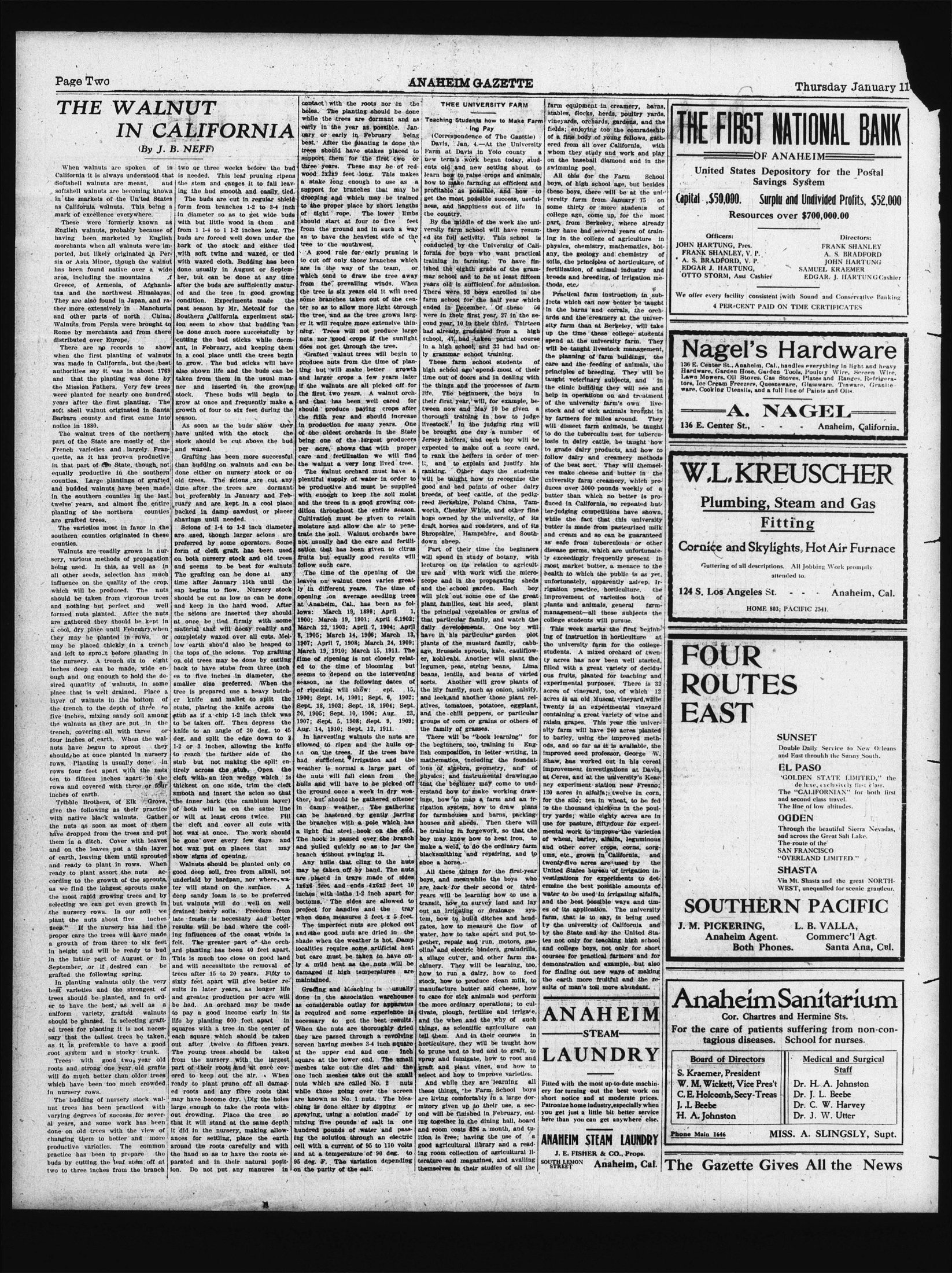
Searchable text
THE WALNUT IN CALIFORNIA
(By J. B. NEFF)
When walnuts are spoken of in California it is always understood that Softshell walnuts are meant, and softshell walnuts are becoming known in the markets of the United States as California walnuts. This being a mark of excellence everywhere.
These were formerly known as English walnuts, probably because of having been marketed by English merchants when all walnuts were imported, but likely originated in Persia or Asia Minor, though the walnut has been found native over a wide area, including the mountains of Greece, of Armenia, of Afghanistan and the northwest Himalayas. They are also found in Japan, and rather more extensively in Manchuria and other parts of north China. Walnuts from Persia were brought to Rome by merchants and from there distributed over Europe.
There are no records to show when the first planting of walnuts was made in California, but the best authorities say it was in about 1769 and that the planting was done by the Mission Fathers. Very few trees were planted for nearly one hundred years after the first planting. The soft shell walnut originated in Santa Barbara county and first came into notice in 1880.
The walnut trees of the northern part of the State are mostly of the French varieties and largely Franquette, as it has proven productive in that part of the State, though not equally productive in the southern two or three weeks before the bud is needed. This leaf pruning ripens the stem and causes it to fall leaving the bud smooth and easily tied.
The buds are cut in regular shield form from branches 1-2 to 3-4 inch in diameter so as to get wide buds with but little wood in them and from 1 1-4 to 1 1-2 inches long. The buds are forced well down under the bark of the stock and either tied with soft twine and waxed, or tied with waxed cloth. Budding has been done usually in August or September, but can be done at any time after the buds are sufficiently matured and the tree in good growing condition. Experiments made the past season by Mr. Metcalf for the Southern California experiment station seem to show that budding can be done much more successfully by cutting the bud sticks while dormant, in February, and keeping them in a cool place until the trees begin to grow. The bud sticks will have also shown life and the buds can be taken from them in the usual manner and inserted in the growing stock. These buds will begin to grow at once and frequently make a growth of four to six feet during the season.
As soon as the buds show they have united with the stock the stock should be cut above the bud and waxed.
Grafting has been more successful than budding on walnuts and can be done either on nursery stock or on contact with their holes. The plant while the trees are early in the year may or early in best. After the trees should have support them for three years. The wood 2x2x9 feet a stake long enough to support for brand drooping and which to the proper place of tight rope. Should start at from the ground as to have the tree to the south.
A good rule for cut off only those are in the way which tend to die from the prevailance of the tree is six years some branches take so as to allow the tree, and as it will require ning. Trees will nuts nor good crates does not get throughed.
Grafted walnut produce nuts from fruiting but will make larger crops if the walnuts are the first two years and that has been should produce the fifth year and in production for one of the oldest orchards being one of the per acre, shows care and fertilization the walnut a very valuable fruit.
and that the planting was done by the Mission Fathers. Very few trees were planted for nearly one hundred years after the first planting. The soft shell walnut originated in Santa Barbara county and first came into notice in 1880.
The walnut trees of the northern part of the State are mostly of the French varieties and largely Franquette, as it has proven productive in that part of the State, though not equally productive in the southern counties. Large plantings of grafted and budded walnuts have been made in the southern counties in the last twelve years, and almost the entire planting of the northern counties are grafted trees.
The varieties most in favor in the southern counties originated in these counties.
Walnuts are readily grown in nursery, various methods of propagation being used. In this, as well as in all other seeds, selection has much influence on the quality of the crop which will be produced. The nuts should be taken from vigorous trees and nothing but perfect and well formed nuts planted. After the nuts are gathered they should be kept in a cool, dry place until February, when they may be planted in rows, or may be placed thickly in a trench and left to sprout before planting in the nursery. A trench six to eight inches deep can be made, wide enough and ong enough to hold the desired quantity of walnuts, in some place that is well drained. Place a layer of walnuts in the bottom of the trench to the depth of three to five inches, mixing sandy soil among the walnuts as they are put in the trench, covering all with three or four inches of earth. When the walnuts have begun to sprout they should be at once planted in nursery rows. Planting is usually done in rows four feet apart with the nuts ten to fifteen inches apart in the rows and covered with three or four inches of earth.
Tribble Brothers, of Elk Grove, give the following as their practice with native black walnuts. Gather the nuts as soon as most of them have dropped from the trees and put them in a ditch. Cover with leaves and on the leaves put a thin layer of earth, leaving them until sprouted and ready to plant in rows. When ready to plant assort the nuts according to the growth of the sprouts, as we find the longest sprouts make the most rapid growing trees and by taken from them in the usual manner and inserted in the growing stock. These buds will begin to grow at once and frequently make a growth of four to six feet during the season.
As soon as the buds show they have united with the stock the stock should be cut above the bud and waxed.
Grafting has been more successful than budding on walnuts and can be done either on nursery stock or on old trees. The scions are cut any time after the trees are dormant but preferably in January and February and are kept in a cool place packed in damp sawdust or placer shavings until needed.
Scions of 1-4 to 1-2 inch diameter are used, though larger scions are preferred by some operators. Some form of cleft graft has been used on both nursery stock and old trees and seems to be best for walnuts. The grafting can be done at any time after January 15th until the sap begins to flow. Nursery stock should be cut as low as can be done and keep in the hard wood. After the scions are inserted they should at once be tied firmly with some material that will decay readily and completely waxed over all cuts. Mellow earth should also be heaped to the tops of the scions. Top grafting on old trees may be done by cutting back to have stubs from three inches to five inches in diameter, the smaller size preferred. When the tree is prepared use a heavy butter knife and mallet to split the stubs, placing the knife across the stub as if a chip 1-2 inch thick was to be taken off. Then depress the knife to an angle of 30 deg. to 45 deg. and split the edge down to 2-1 or 3 inches, allowing the knife to reach the farther side of the stub but not making the split entirely across the stub. Open the cleft with an iron wedge which is thickest on one side, trim the cleft smooth and insert the scion so that the inner bark (the cambium layer) of both will be on the same line or will at least cross twice. Fill the cleft and cover all cuts with hot wax at once. The work should be gone over every few days and hot wax put on places that may show signs of opening.
Walnuts should be planted only on good deep soil, free from alkali, not underlaid by hardpan, nor where water will stand on the surface. A deep sandy loam is to be preferred
and larger crops if the walnuts are the first two years and that has been should produce the fifth year and in production for one of the oldest orchards being one of the per acre shows care and fertilize the walnut a very
The walnut orchard plentiful supply of be productive and with enough to kill and the trees in a dition throughout Cultivation must moisture and allow trate the soil. Was not usually had thatization that has been fruits but equally follow such care.
The time of th leaves on walnut is different year opening on aven at Anaheim, Califows: March 19, 1900; March 19, 1903; March 22, 1903; April 8, 1905; March 14, 1907; April 7, 1908; March 19, 1910; May time of ripening ind ed to the time o seems to depend season, as the f of ripening will s Sept. 14, 1900; Sept. 18, 1903; Sept. 26, 1905; Sept. 10, 1907; Sept. 5, 1908 Aug. 14, 1910; Se
In harvesting wal n allowed to ripen en on the trees had sufficient weather is normal the nuts will fall hulls and will have ground once a ther, but should b in damp weather can be hastened by branches with a light flat steel The hook is passed and pulled quickly branch without sw
Any hulls that may be taken off are placed in trai 1x6x6 feet and en inches with laths
Tribble Brothers, of Elk Grove, give the following as their practice with native black walnuts. Gather the nuts as soon as most of them have dropped from the trees and put them in a ditch. Cover with leaves and on the leaves put a thin layer of earth, leaving them until sprouted and ready to plant in rows. When ready to plant assort the nuts according to the growth of the sprouts, as we find the longest sprouts make the most rapid growing trees and by selecting we can get even growth in the nursery rows. In our soil we plant the nuts about five inches deep." If the nursery has had the proper care the trees will have made a growth of from three to six feet in height and will be ready to bud in the latter part of August or in September, or if desired can be grafted the following spring.
In planting walnuts only the very best varieties and the strongest of trees should be planted, and in order to have the best, as well as a uniform variety, grafted walnuts should be planted. In selecting grafted trees for planting it is not necessary that the tallest trees be taken, as it is preferable to have a good root system and a stocky trunk.
Trees with good two-year old roots and strong one year old grafts will do much better than older trees which have been too much crowded in nursery rows.
The budding of nursery stock walnut trees has been practiced with varying degrees of success for several years, and some work has been done on old trees with the view of changing them to better and more productive varieties. The common practice has been to prepare the buds by cutting the leaf stem off at two to three inches from the branch the inner bark (the camblum layer) of both will be on the same line or will at least cross twice. Fill the cleft and cover all cuts with hot wax at once. The work should be gone over every few days and hot wax put on places that may show signs of opening.
Walnuts should be planted only on good deep soil, free from alkali, not underlaid by hardpan, nor where water will stand on the surface. A deep sandy loam is to be preferred but walnuts will do well on well drained heavy soils. Freedom from late frosts is necessary and better results will be had where the cooling influences of the coast winds is felt. The greater part of the orchard planting has been 40 feet apart. This is much too close on good land and will necessitate the removal of trees after 15 to 20 years. Fifty to sixty feet apart will give better results in later years, as longer life and greater production per acre will be had. An orchard may be made to pay a good income early in its life by planting 600 feet apart in squares with a tree in the center of each square which should be taken out after twelve to fifteen years. The young trees should be taken from the nursery with the largest part of their roots and at once covered to keep out the air. When ready to plant prune off all damaged roots and any fibre roots that may have become dry. Dig the holes large enough to take the roots without crowding. Place the tree so that it will stand at the same depth it did in the nursery, making allowances for settling, place the earth around the roots carefully and with the hand so as to have the roots separated and in their natural position. Do not put any manures in
Any hulls that may be taken off are placed in traps 1x6x6 feet and enclosed in inches with laths bottoms. The side project for handling when done measure.
The imperfect manshade when the wet localities require so but care must be taken a mild heat as damaged if high maintained.
Grading and blossom done in the assoc as considerable out is required and so necessary to get when the nuts are they are passed through screen having mesh at the upper end square at the lower meshes take out to one inch meshes to nuts which are carried while those going are known as No. ching is done either spraying, using a mix mixing five pounds hundred pounds of ing the solution th cell with a current and at a temperature 95 deg. F. The v on the purity of the
ANAHEIM GAZETTE
A bud
hilpens leavtied. Shield
in inch buds and
The
for the tied
tied been potemtime maturwing the
stat can by
form-them begin have be manwing to take a the bud
passful in be on
contact with the roots nor in the holes. The planting should be done while the trees are dormant and as early in the year as possible. January or early in February being best. After the planting is done the trees should have stakes placed to support them for the first two or three years. These may be of redwood 2x2x9 feet long. This makes a stake long enough to use as a support for branches that may be drooping and which may be trained to the proper place by short lengths of tight rope. The lower limbs should start at four to five feet from the ground and in such a way as to have the heaviest side of the tree to the southwest.
A good rule for early pruning is to cut off only those branches which are in the way of the team, or which tend to draw the tree away from the prevailing winds. When the tree is six years old it will need some branches taken out of the center so as to allow more light through the tree, and as the tree grows larger it will require more extensive thinning. Trees will not produce large nuts nor good crops if the sunlight does not get through the tree.
Grafted walnut trees will begin to produce nuts from the time of planting but will make better growth and larger crops a few years later if the walnuts are all picked off for the first two years. A walnut orchard that has been well cared for should produce paying crops after the fifth year and should increase in production for many years. One of the oldest orchards in the State being one of the largest producers per acre, shows that with proper care and fertilization we will find the walnut a very long lived tree.
The walnut orchard must have a farm equipment in creamery, barns, stables, flocks, herds, poultry yards, vineyards, orchards, gardens, and the fields; enjoying too the comradeship of a fine body of young fellows, gathered from all over California, with whom they study and work and play on the baseball diamond and in the swimming pool.
All this for the Farm School boys, of high school age, but besides these boys, there will be at the university farm from January 15 on some thirty or more students of college age, come up, for the most part, from Berkeley, where already they have had several years of training in the college of agriculture in physics, chemistry, mathematics, botany, the geology and chemistry of soils, the principles of horticulture, of fertilization, of animal industry and breeds and breeding, of irrigation methods, etc.
Practical farm instruction, in subjects which can now better be taught in the barns and corrals, the orchards and the creamery at the university farm than at Berkeley, will take up the time these college students spend at the university farm. They will be taught livestock management, the planning of farm buildings, the care and feeding of animals, the principles of breeding. They will be taught veterinary subjects, and in the clinic building they will see and help in operations on and treatment of the university farm's own livestock and of sick animals brought in by farmers for miles around. They will dissect farm animals, be taught to do the tuberculin test for tuberculosis in dairy cattle, be taught how to grade dairy products, and how to follow dairy and creamery methods of the best sort. They will themselves make cheese and butter in the
and larger crops a few years later if the walnuts are all picked off for the first two years. A walnut orchard that has been well cared for should produce paying crops after the fifth year and should increase in production for many years. One of the oldest orchards in the State being one of the largest producers per acre, shows that with proper care and fertilization we will find the walnut a very long lived tree.
The walnut orchard must have a plentiful supply of water in order to be productive and must be supplied with enough to keep the soil moist and the trees in a good growing condition throughout the entire season. Cultivation must be given to retain moisture and allow the air to penetrate the soil. Walnut orchards have not usually had the care and fertilization that has been given to citrus fruits but equally good results will follow such care.
The time of the opening of the leaves on walnut trees varies greatly in different years. The time of opening on average seedling trees at Anaheim, Cal., has been as follows: March 19, 1899; April 1, 1900; March 19, 1901; April 6, 1902; March 22, 1903; April 7, 1904; April 8, 1905; March 14, 1906; March 13, 1907; April 7, 1908; March 24, 1909; March 19, 1910; March 15, 1911. The time of ripening is not closely related to the time of blooming but seems to depend on the intervening season, as the following dates of ripening will show: Sept. 15, 1900; Sept. 14, 1901; Sept. 6, 1902; Sept. 18, 1903; Sept. 18, 1904; Sept. 26, 1905; Sept. 10, 1906; Aug. 23, 1907; Sept. 5, 1908; Sept. 9, 1909; Aug. 14, 1910; Sept. 12, 1911.
In harvesting walnuts the nuts are allowed to ripen and the hulls open on the trees. If the trees have had sufficient irrigation and the weather is normal a large part of the nuts will fall clean from the hulls and will have to be picked off the ground once a week in dry weather, but should be gathered oftener in damp weather. The gathering can be hastened by gently jarring the branches with a pole which has a light flat steel hook on the end. The hook is passed over the branch and pulled quickly so as to jar the branch without swinging it.
Any hulls that cling to the nuts may be taken off by hand. The nuts are placed in trays made of sides 1x6x6 feet and ends 4x6x2 feet 10 inches with laths 1-2 inch apart for time out of doors and in dealing with the things and the processes of farm life. The beginners, the boys in their first year, will, for example, between now and May 10 be given a thorough training in how to judge livestock. In the judging ring will be brought one day a number of Jersey heifers, and each boy will be expected to make out a score card, to rank the heifers in order of merits, and to explain and justify his ranking. Other days the students will be taught how to recognize the good and bad points of other dairy breeds, of beef cattle, of the pedigree Berkshire, Poland China, Tamworth, Chester White, and other fine hogs owned by the university, of its draft horses and roadsters, and of its Shropshire, Hampshire, and Southdown sheep.
Part of their time the beginners will spend in study of botany, with lectures on its relation to agriculture and with work with the microscope and in the propagating sheds and the school garden. Each boy will pick out some one of the great plant families, test his seed, plant the principal vegetables or grains of that particular family, and watch the daily developments. One boy will have in his particular garden plot plants of the mustard family, cabbage, Brussels sprouts, kale, cauliflower, kohl-rabi. Another will plant the legumes, peas, string beans, Lima beans, lentils, and beans of varied sorts. Another will grow plants of the lily family, such as onion, salsify, and leek,and another those plant relatives tomatoes potatoes eggplant, and the chill peppers, or particular groups of corn or grains or others of the family of grasses.
There will be "book learning" for the beginners, too, training in English composition, in letter writing, in mathematics, including the foundations of algebra geometry, and of physics; and instrumental drawing,sо that the beginner may come to understand how to make working drawings, how to map a farm and an irrigation system, how to draw plans for farmhouses and barns, packing houses and sheds. Then there will be training in forgework, so that the boy may know how to heat iron, to make a weld, to do the ordinary farm blacksmithing and repairing,and to shoe a horse.
All these things for the first-year boys, and meanwhile the boys who are back for their second or third-year will be learning how to use a taught veterinary subjects,and in the clinic building they will see and help in operations on and treatment of the university farm's own livestock and of sick animals brought in by farmers for miles around. They will dissect farm animals,best taught to do the tuberculin test for tuberculosis in dairy cattle,best taught how to grade dairy products,and how to follow dairy and creamery methods of the best sort. They will themselves make cheese and butter in the university farm creamerywhich produces over 3000 pounds weekly of a butter than which no better is produced in California,so repeated butter-judging competitions have shown,而the fact that this university butter is made from pasteurized milk and cream and so can be guaranteed as safe from tuberculosis or other disease germswhich are unfortunately exceedingly frequently present in most market butter,a menace to the health to which the public is yet unfortunately, apparently asleep.Irrigation practice,horticulture,the improvement of varieties both of plants and animals,g general farm-management—all these subjects the college students will pursue.
This week marks the first beginning of instruction in horticulture at the university farm for the college-students.A mixed orchard of twenty acres has now been well started,filled with a great variety of deciduous fruits,planted for teaching and experimental purposes。There is 32 acres of vineyard,too,of which 12 acres is an old Muscat vineyard,while twenty is an experimental vineyard containing a great variety of wine and raisin grapes。这年the university farm will have 240 acres planted to barley,using the improved methods,and so far as it is available,the improved seed professor,Gorge W.Shaw,has worked out in his cereal improvement investigations at Davis,at Ceres,and at the university's Kearney experiment station near Fresno;130 acres in alfalfa;twelve in corn,for the silo;ten in wheat,to be fed to the thousand chickens in the poultry yards;while eighty acres are in use for pasture,fifty-four for experimental work to improve the varieties of wheat,barley,alfalfa,leguminous and other cover crops,corns,sorghums etc.,grown in California,and twenty-five acres are used by the United States bureau of irrigation investigations for experiments to determine the best possible amounts of water to be used in irrigating alfalfa.
but should be gathered oftener in damp weather. The gathering can be hastened by gently jarring the branches with a pole which has a light flat steel hook on the end. The hook is passed over the branch and pulled quickly so as to jar the branch without swinging it.
Any hulls that cling to the nuts may be taken off by hand. The nuts are placed in trays made of sides 1x6x6 feet and ends 4x6x2 feet 10 inches with laths 1-2 inch apart for bottoms. The sides are allowed to project for handles and the tray when done measures 3 feet x 5 feet.
The imperfect nuts are picked out and the good nuts are dried in the shade when the weather is hot. Damp localities require some artificial heat but care must be taken to have only a mild heat as the nuts will be damaged if high temperatures are maintained.
Grading and bleaching is usually done in the association warehouses as considerable outlay for apparatus is required and some experience is necessary to get the best results. When the nuts are thoroughly dried they are passed through a revolving screen having meshes 3-4 inch square at the upper end and one inch square at the lower end. The small meshes take out the dirt and the one inch meshes take out the small nuts which are called No. 2 nuts while those going over the screen are known as No. 1 nuts. The bleaching is done either by dipping or spraying, using a solution made by mixing five pounds of salt in one hundred pounds of water and passing the solution through an electric cell with a current of 95 to 110 volts and at a temperature of 90 deg. to 95 deg. F. The variation depending on the purity of the salt.
All these things for the first-year boys, and meanwhile the boys who are back for their second or third years will be learning how to use a transit, how to survey land and lay out an irrigating or drainage system, how to build ditches and headgates, how to measure the flow of water, how to take apart and put together, repair and run, motors, gasoline and electric binders, graindrills, a silage cutter, and other farm machinery. They will be learning, too, how to run a dairy, how to feed stock, how to produce clean milk, to manufacture butter and cheese, how to care for sick animals and perform the more ordinary operations; to cultivate, plough, fertilize and irrigate, and the when and the why of such things, as scientific agriculture can tell them. And in their courses in horticulture, they will be taught how to prune and to bud and to graft, to spray and fumigate, how to root and graft and plant vines, and how to select and how to improve varieties.
And while they are learning all these things, the Farm School boys are living comfortably in a large dormitory given up to their use, a second will be finished in February, eating together in the dining hall, board and room costs $26 a month, tuition is free; having the use of a good agricultural library and a reading room collection of agricultural literature and magazines, and availing themselves in their studies of all the
for the silo; ten in wheat, to be fed to the thousand chickens in the poultry yards; while eighty acres are in use for pasture, fifty-four for experimental work to improve the varieties of wheat, barley, alfalfa, leguminous and other cover crops, corns, sorgums, etc., grown in California, and twenty-five acres are used by the United States bureau of irrigation investigations for experiments to determine the best possible amounts of water to be used in irrigating alfalfa, and the best possible ways and times of its application. The university farm, that is to say, is being used by the university of California and by the State and by the United States not only for teaching high school and college boys, not only for short courses for practical farmers and for demonstration and example, but also for finding out new ways of making the earth more fruitful and the results of man's toll more abundant.
ANAHEIM
STEAM
LAUNDRY
Fitted with the most up-to-date machinery for turning out the best work on short notice and at moderate prices. Patronize home industry, especially when you get just a little bit better service here than you can get anywhere else.
ANAHEIM STEAM LAUNDRY
J. E. FISHER & CO., Props.
SOUTH LEMON STREET Anaheim, Cal.
THE FIRST NATIONAL BANK
OF ANAHEIM
United States Depository for the Postal Savings System
Capital $50,000. Surplus and Undivided Profits, $52,000
Resources over $700,000.00
Officers:
JOHN HARTUNG, Pres.
FRANK SHANLEY
FRANK SHANLEY, V. P.
A. S. BRADFORD
A. S. BRADFORD, V. P.
JOHN HARTUNG
EDGAR J. HARTUNG,
SAMUEL KRAEMER
OTTO STORM, Asst Cashier
EDGAR. J. HARTUNG Cashier
We offer every facility consistent with Sound and Conservative Banking
4 PERCENT PAID ON TIME CERTIFICATES
Nagel's Hardware
136 E. Center St., Anaheim, Cal., handles everything in light and heavy
Hardware, Garden Hose, Garden Tools, Poultry Wire, Screen Wire,
Lawn Mowers, Oil Stoves, Gas Stoves, Plates and Ranges, Refrigerators,
Ice Cream Freezers, Queensware, Glaseware, Tinware, Granite
ware, Cooking Utensils, and a full line of Paints and Oils.
A. NAGEL
136 E. Center St., Anaheim, California.
A. NAGEL
136 E. Center St., Anaheim, California
W.L.KREUSCHER
Plumbing, Steam and Gas
Fitting
Cornice and Skylights, Hot Air Furnace
Guttering of all descriptions. All Jobbing Work promptly attended to.
124 S. Los Angeles St. Anaheim, Cal.
HOME 803; PACIFIC 2541.
FOUR ROUTES EAST
SUNSET
Double Daily Service to New Orleans and East through the Sunny South.
EL PASO
'GOLDEN STATE LIMITED,' the deluxe, exclusively first class.
The "CALIFORNIAN" for both first and second class travel.
The line of low altitudes.
OGDEN
Through the beautiful Sierra Nevadas, and across the Great Salt Lake.
The route of the SAN FRANCISCO "OVERLAND LIMITED."
SHASTA
Via Mt. Shasta and the great NORTH-WEST, unequalled for scenic grandeur.
in wheat, to be fed
chickens in the pouleighty acres are in
fifty-four for experimprove the varieties
alfalfa, leguminous
crops, corns, sorgin California, and
are used by the
reau of irrigation inexperiments to detpossible amounts of
in irrigating alfalfa,
sible ways and timion. The university
say, is being used
of California and
by the United Stateaching high school
not only for short
cal farmers and for
example, but also
new ways of making
fruitful and the remore abundant.
SOUTHERN PACIFIC
J. M. PICKERING, L. B. VALLA,
Anaheim Agent. Commerc'l Agt.
Both Phones. Santa Ana, Cal.
AnaheimSanitarium
Cor. Chartres and Hermine Sts.
For the care of patients suffering from non-contagious diseases. School for nurses.
Board of Directors
S. Kraemer, President
W. M. Wickett, Vice Pres't
C.E. Holcomb, Secy-Treas
J .L Beebe
H. A. Johnston
Medical and Surgical
Staff
Dr. H. A. Johnston
Dr. J. L. Beebe
Dr. C. W. Harvey
Dr. J. W. Utter
Phone Main 1646 MISS. A. SLINGSLY, Supt.
The Gazette Gives All the News